The chain lay motionless in the dirt, eighty feet of heavy iron stretched across the tractor-pull lane like a boundary between two different centuries.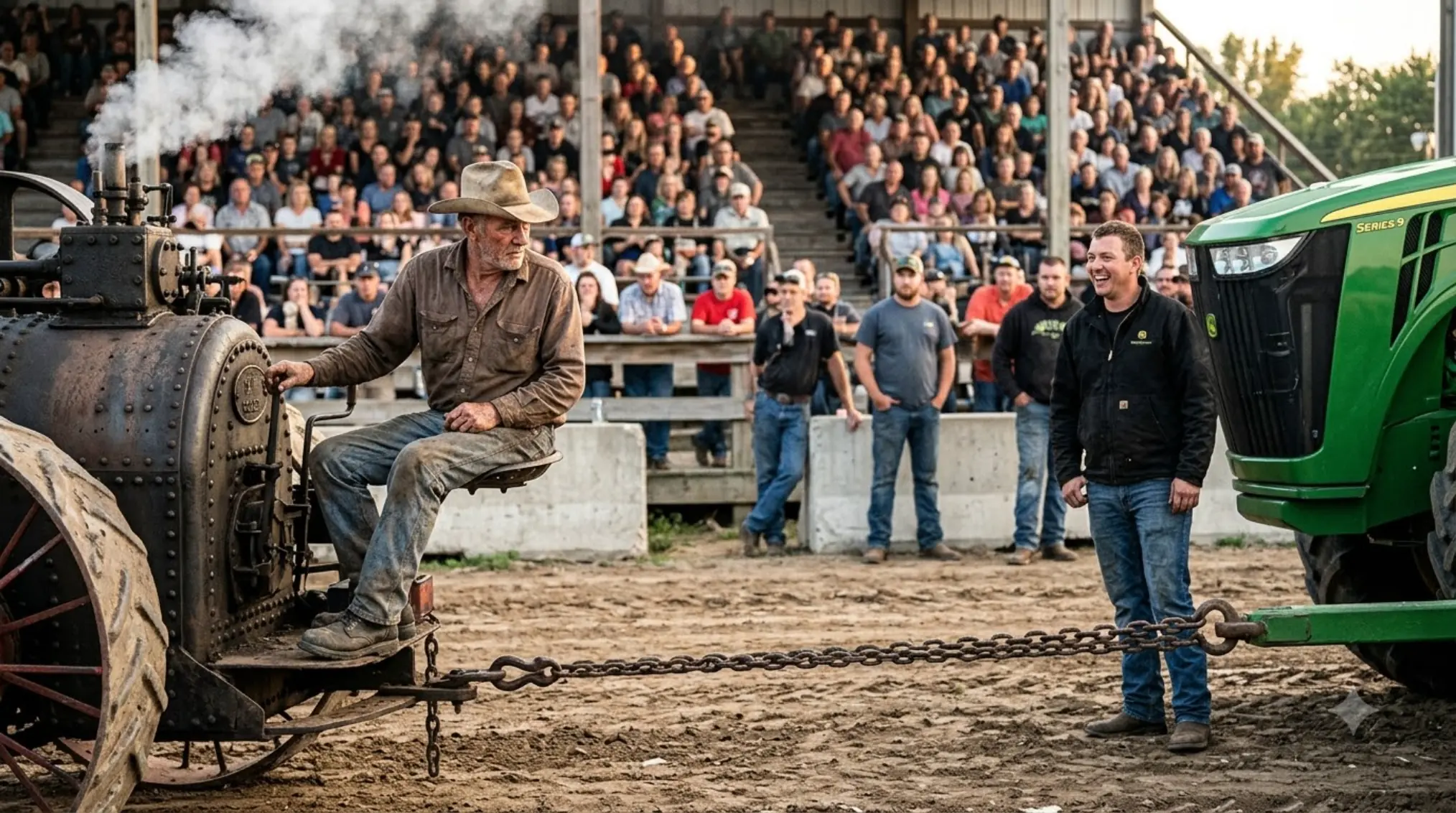
On one end sat a brand-new green John Deere Series 9, its paint still glossy beneath the July sun, its enormous rear tires clean enough to show every molded edge. Beneath the hood waited roughly 620 horsepower, dual turbochargers, electronic traction management, computer-controlled torque distribution, and enough technology to make the machine more intelligent than some entire farm shops had been twenty years earlier.
On the other end sat something that looked as if it had escaped from an old photograph.
A 1915 Case steam tractor.
Its iron wheels were scarred and dark with age. Brass fittings caught the sunlight around a boiler stained by more than a century of heat. White steam drifted lazily from the stack while exposed chains and rods clicked softly at idle.
And sitting on the hard iron seat was Earl Hutchfield, seventy-three years old, alone.
No mechanics.
No sponsor tent.
No matching shirts.
No laptop.
No tablet.
Just Earl, the Case, an old toolbox, and a thermos of black coffee.
People were already laughing.
Earl heard them.
He simply did not care.
The Millhaven County Fair had hosted tractor pulls for seventeen years, but nobody remembered a matchup like this one.
Most competitions paired machines of comparable weight and class.
This was different.
It had started as a joke during registration when somebody noticed Earl unloading his century-old Case near the pull lane.
A younger farmer had pointed toward the steam tractor and said, “Somebody ought to hook that thing against Tyler’s Deere.”
People laughed.
Then Tyler Brant heard about it.
Thirty-one years old, wealthy, confident, and never particularly good at resisting an audience, Tyler had looked across the fairgrounds at Earl’s machine and smiled.
“Fine with me.”
That was how the challenge began.
Tyler came from a family with money, but he had only recently begun calling himself a serious farmer.
Two years earlier, the Brant family had purchased six hundred acres of fertile bottomland near Millhaven. Tyler transformed the operation almost immediately.
Satellite-guided planting.
Automated irrigation monitoring.
Electronic soil sensors.
Fiber internet to the equipment barns.
Data-driven fertilizer management.
New trucks.
New tractors.
New everything.
There was nothing inherently wrong with any of it.
The equipment was excellent.
The technology worked.
The problem was Tyler had begun confusing ownership with mastery.
When he arrived at the fair that morning, he brought two assistants, a custom equipment trailer, a generator, tools, computers, and the Series 9.
Earl had arrived before sunrise.
Alone.
At 5:40 a.m., while vendors were still unfolding tables, Earl backed his old flatbed through the fairground gate.
He lowered the ramps himself.
Then he eased the Case down slowly.
He checked boiler water.
Drive chains.
Lubrication points.
Pressure fittings.
Wheel hardware.
Nothing hurried.
Afterward, Earl sat on the running board of his truck drinking coffee while the sun climbed above the trees.
By the time Tyler arrived, Earl had already been there three hours.
Tyler stepped from his pickup wearing sunglasses and clean boots.
He walked around the Case once.
His assistant followed with a phone recording.
Tyler laughed.
“I didn’t drive three hours to lose to a museum piece.”
Several spectators heard him.
Some laughed too.
Earl did not turn around.
He continued checking a brass fitting near the boiler.
Tyler walked closer.
“You hear me?”
Earl tightened the fitting.
Then looked up.
“I heard you.”
“That thing actually pull?”
Earl glanced at the Deere.
“Does yours?”
Tyler’s smile disappeared for half a second.
Then came back.
“We’ll find out.”
By nine o’clock, hundreds of people crowded the wooden barriers around the pull lane.
Children sat on shoulders.
Farmers leaned against rails.
Phones rose everywhere.
The fair organizer, Bill Carver, walked to the center carrying a flag and measuring tape.
He explained the challenge.
The machines would be connected by an eighty-foot chain.
A white marker identified the center.
Best of three pulls.
Move your opponent ten feet beyond the neutral line, and you take the round.
Nobody needed the rules explained twice.
The difference between the machines was obvious.
The Deere had more than ten times the rated horsepower of Earl’s Case.
Computer-managed traction.
Massive modern rubber tires.
Electronic drivetrain controls.
The Case had perhaps forty-five horsepower under ideal conditions.
But horsepower was only one number.
Earl knew that.
Most of the crowd did not.
The first chain link lifted from the dirt.
Then another.
Then another.
Both machines loaded against each other.
Tyler sat high inside his cab.
Air conditioning.
Digital displays.
Headset.
Earl sat exposed to the July heat with one hand resting beside an analog pressure gauge.
Bill raised the flag.
Dropped it.
Tyler hit the power immediately.
The Deere erupted.
Its enormous rear tires spun half a rotation before biting hard.
Black exhaust punched upward.
The chain snapped straight.
The Case jerked backward.
One foot.
Two.
Three.
The crowd on Tyler’s side exploded.
Someone screamed, “There it goes!”
The ancient iron wheels scraped through the dirt.
Four feet.
Tyler smiled inside the cab.
His assistants pumped their fists.
Earl did not panic.
That was the first thing nobody understood.
Instead of opening the steam regulator completely, he increased it gradually.
A little.
Then another little adjustment.
The flywheel accelerated.
The exposed drive chains tightened.
Steam pulsed from the machine.
Then the Case stopped moving backward.
Five feet from the center line.
The Deere continued roaring.
Its electronic system searched for traction.
The Case remained planted.
Iron cleats sank into the ground.
The chain vibrated under tension.
For nearly ten seconds neither machine moved.
Bill stepped forward after both operators backed off.
He measured.
No winner.
Round one was a stalemate.
For a moment the crowd was silent.
Then the fairground exploded with noise.
Tyler sat inside the cab staring forward.
That had not been part of the plan.
He climbed down and went directly to his assistants.
A tablet came out.
Settings changed.
Rear tire pressure was adjusted.
Traction parameters were recalibrated.
Tyler was not stupid.
He had underestimated Earl once.
He had no intention of doing it again.
Earl, meanwhile, poured more coffee.
Round two began twenty minutes later.
This time Tyler used technology instead of brute force.
The Deere loaded gradually.
The traction-management system adjusted torque continuously as the rear tires searched for the strongest contact points.
The effect was obvious.
The Series 9 pulled smoothly.
Power without unnecessary wheelspin.
The Case slid backward.
One foot.
Then two.
Earl increased boiler pressure.
The old tractor resisted.
But the ground near the center of the lane had become harder and drier after the first round.
That favored rubber.
Tyler kept pulling.
Three feet.
Four.
The white center marker moved toward Earl.
Bill raised the flag.
Round two belonged to Tyler Brant.
The crowd erupted again.
Someone near the barrier shouted, “Send that rust bucket back to the museum!”
Tyler climbed from the cab smiling.
He held one finger toward his crew.
One more.
Earl stepped down from the Case.
Nobody expected what he did next.
He walked to the lane.
Crouched.
Pressed one bare hand against the dirt.
Moved six inches.
Pressed again.
Then another spot.
The crowd began whispering.
Tyler watched from across the lane.
“What’s he doing?”
One assistant shrugged.
Earl remained crouched nearly thirty seconds.
Then he stood.
Walked to his toolbox.
Opened it.
Pulled out an old curved wrench.
It looked handmade.
The handle had been polished smooth by decades of use.
Earl knelt beside the rear differential housing and made a small mechanical adjustment.
A quarter turn.
Then another.
Nothing spectacular.
No sparks.
No engine noise.
He returned the wrench to the box.
Tyler laughed.
“You fixing it already?”
Earl stood.
“No.”
“Then what are you doing?”
“Getting ready.”
Tyler slapped a glove against the Deere’s hood.
“Hook that museum scrap up! I’ll drag it straight off this field!”
Earl kicked loose dirt from his boot.
“Six hundred horses won’t help if none of them can grip.”
Tyler smashed his fist against the cab door.
“When that antique breaks, don’t come crying to my crew!”
Earl climbed back onto the Case.
He reached beneath the seat and locked the mechanical rear differential.
Then his hand moved toward the steam regulator.
“Save your breath, boy.”
He looked straight at Tyler.
“You’re about to watch that green monster come backward.”
The reaction spread through the crowd.
People laughed.
Some shouted.
Others stopped talking entirely.
Because Earl did not sound like a man performing for spectators.
He sounded like someone describing something he had already seen.
Before the final round, Earl did something else unexpected.
He climbed down and walked across the lane toward Tyler.
Tyler remained inside the Deere.
Earl stopped beside the cab.
Tyler opened the door.
“What?”
Earl extended his hand.
“Good tractor you’ve got.”
Tyler stared at him.
No insult.
No sarcasm.
Nothing.
Finally Tyler shook his hand.
“Thanks.”
Earl nodded.
Then returned to the Case.
That small moment changed the atmosphere.
This was no longer an old man versus a young man.
It was two operators.
Two machines.
Two methods.
The crowd quieted.
Earl climbed onto the iron seat and checked the pressure gauge.
Beside the gauge was a faded strip of tape.
It had been there for decades.
Three words were written across it in old pencil.
Only when it matters.
Earl’s father had placed it there years earlier.
When Earl was young, his father had explained that every machine had limits and reserves.
Knowing how much remained was not enough.
You had to know when it was worth using.
Earl opened a valve he had not touched during the first two rounds.
Pressure increased.
Not beyond the machine’s safe range.
But higher than he normally ran it.
The Case changed sound.
Its rhythm deepened.
Steam rolled harder from the stack.
Earl rested one hand on the regulator.
Bill raised the flag.
Tyler leaned forward.
The flag fell.
The Deere hit full load.
Six hundred twenty horsepower surged through the drivetrain.
The chain slammed tight.
The Case shuddered.
Its entire frame trembled under the force.
For one second, Earl moved backward.
Then stopped.
Tyler pressed harder.
The Deere’s traction system responded instantly.
Torque shifted.
Tire grip adjusted.
Computers reacted to the ground hundreds of times per second.
But Earl had done something before the pull that the computer could not see.
He had read the soil.
During round two, Earl noticed the upper layer had dried and hardened.
Beneath it sat a slightly softer layer that still held moisture from rain several days earlier.
The Deere’s broad rubber tires were riding primarily across the dry top layer.
Earl’s narrow iron cleats could cut through it.
That was why he had locked the differential.
Both rear wheels now turned mechanically together.
No torque could escape through the easier wheel.
No electronic system needed time to detect slip and correct it.
Both wheels simply pulled.
The iron lugs bit through the dry crust.
Found moisture beneath.
Held.
Tyler’s smile disappeared.
The chain remained rigid.
Then the center marker moved.
An inch.
Two.
Toward Tyler.
His assistants stopped cheering.
“Come on!”
Tyler pushed the Deere harder.
The turbochargers screamed.
The rear tires began tearing at the dirt.
The computer shifted torque.
Reduced slip.
Reapplied power.
The Case continued.
Slowly.
Its steam engine did not roar like the Deere.
It pulsed.
Steady.
Heavy.
The iron wheels turned one deliberate section at a time.
The chain moved another foot.
People pressed against the rails.
Tyler stared at the dashboard.
Traction warning.
Wheel slip.
Torque redistribution.
Everything was functioning.
Nothing was broken.
Yet the Deere was moving backward.
Two feet.
Tyler shouted at the machine as if it could hear him.
“No!”
Earl did not look toward the crowd.
His eyes remained on the ground ahead.
Three feet.
Four.
The Deere’s tires spun faster.
That made the problem worse.
They loosened the topsoil and reduced traction further.
The Case’s cleats dug deeper.
Five feet.
The crowd had stopped screaming.
Everybody was watching.
Six.
Seven.
The Deere rolled backward beneath the force of a machine manufactured more than a century earlier.
Tyler pushed the controls as far as they would go.
The computer had nothing left to give.
Neither did the tires.
The center marker crossed the winning distance.
Bill Carver threw up the red flag.
The pull was over.
For two seconds, complete silence covered the fairgrounds.
Then the place erupted.
People shouted.
Farmers slapped the rail.
Children jumped.
Hats flew into the air.
Someone near Earl’s side screamed his name.
“EARL!”
The Case sat idling.
Earl eased the pressure valve back.
That was all.
No raised fists.
No victory lap.
No mocking gesture toward Tyler.
He simply reduced the boiler pressure and listened to the old machine settle.
Bill announced the result.
“Earl Hutchfield! Two rounds to one!”
The noise grew louder.
Tyler remained inside the Deere.
His hands rested on the steering wheel.
He stared through the windshield at Earl.
One of his assistants approached the cab.
Tyler waved him away.
He needed a moment.
Across the lane, people began gathering around the Case.
A little boy ducked beneath the barrier and ran toward the iron rear wheel.
He placed one hand against it.
His father hurried after him.
An older farmer crouched near the drive housing, studying the mechanical differential lock.
Another man pointed toward the iron cleats packed with darker soil.
He understood immediately.
“That old bastard found the wet layer.”
His friend nodded.
“He read the track.”
Earl stayed seated while the boiler pressure dropped.
Only when the gauge reached the level he wanted did he climb down.
By then Tyler had left the Deere.
He crossed the lane alone.
The crowd noticed.
People moved aside.
Tyler stopped beside Earl.
For several seconds, neither spoke.
Then Tyler asked one word.
“How?”
Earl took off his hat.
Wiped his forehead.
“She doesn’t fight the ground.”
Tyler looked at the Case.
Earl continued.
“She works with it.”
Tyler glanced toward the torn pull lane.
“That’s it?”
“No.”
Earl nodded toward the Deere.
“You’ve got a fine machine.”
Tyler almost laughed.
“It just lost to forty-five horsepower.”
“No.”
Earl shook his head.
“It lost to the ground.”
Tyler stared.
Earl pointed toward the ruts.
“You kept trying to make the dirt accept what your tractor wanted.”
He pointed toward the Case’s iron cleats.
“I gave the machine what the dirt would accept.”
Tyler looked again.
Then he noticed the old wrench in Earl’s toolbox.
“What did you change?”
“Locked the differential.”
“Manually?”
Earl nodded.
Tyler crouched beside the housing.
He understood immediately.
“No waiting for wheel slip.”
“No.”
“No computer correction.”
“No.”
“Both wheels locked together from the start.”
Earl nodded again.
Tyler looked embarrassed.
“I should’ve seen that.”
“Maybe.”
Earl picked up the wrench.
Then held it toward him.
Tyler took it.
It was heavier than expected.
Dark steel.
Oil stained.
Smooth handle.
“How old is this?”
“Older than you.”
Tyler smiled for the first time since losing.
Earl took the wrench back.
“You know what your problem is?”
Tyler expected an insult.
Instead Earl said, “You trust equipment before you trust yourself.”
Tyler’s smile faded.
Earl continued.
“That tractor can tell you a lot.”
He nodded toward the Deere.
“But it can’t tell you everything.”
Tyler looked toward the lane.
“What should I have done?”
Earl shrugged.
“Got out of the cab.”
Tyler laughed.
Earl did not.
“I mean it.”
He pointed toward the dirt.
“Touch it.”
Tyler looked down.
“Feel what changed after the second round.”
Tyler crouched.
He pressed his palm against the soil.
Dry surface.
Then dug his fingers down.
Cooler moisture beneath.
He looked up.
Earl nodded.
“That’s where I pulled from.”
Tyler remained there a moment.
For perhaps the first time since purchasing his farm, he was listening to soil without a sensor interpreting it for him.
The fair continued around them.
Music from the stage.
Livestock barns.
Food vendors.
Children.
Engines.
But Tyler seemed disconnected from all of it.
At four o’clock Earl received the trophy.
A small wooden base.
Bronze plate.
Nothing expensive.
He accepted it with his hat in one hand.
Tyler stood near the back of the crowd.
He applauded.
Later, Earl loaded the Case onto the flatbed.
He secured the chains himself.
Tyler approached one final time.
“You coming next year?”
Earl looked at him.
“Probably.”
Tyler smiled.
“I’ll be ready.”
Earl pulled the last binder tight.
“You better be.”
Tyler looked toward the Case.
“I’m not changing tractors.”
“Wouldn’t tell you to.”
“I’m keeping the Deere.”
“Good.”
Tyler hesitated.
“But I might start getting out of the cab more.”
Earl looked at him.
“That’ll help.”
Tyler returned to his crew.
His Deere left the fairground later that afternoon with nothing mechanically wrong.
The engine remained perfect.
Software remained current.
Tires held pressure.
Every system operated exactly as designed.
But the man driving it had changed.
He arrived believing horsepower could replace understanding.
He left knowing horsepower only mattered when the ground agreed to accept it.
Earl drove home with his old Case chained to the trailer.
When he reached his barn, he unloaded it slowly.
Checked the boiler.
Drained what needed draining.
Oiled the exposed metal.
Covered the machine.
Then he carried the trophy inside.
On a shelf in his kitchen stood an old photograph.
Earl’s father beside that very tractor decades earlier.
Earl placed the trophy next to it.
He looked at the picture for a long moment.
Then smiled.
The Case had never been magic.
It had never secretly possessed hundreds of horsepower.
It had simply spent more than a century being operated by people who learned that machines do not work separately from the land beneath them.
And that afternoon at Millhaven County Fair, hundreds of people watched a lesson that could not be purchased with a bigger engine, downloaded through an update, or displayed on a touchscreen.
The newest tractor had every advantage money could buy.
The oldest tractor had something different.
A man who knew exactly where to make it bite.