Mr. Gable brought the pollination contract exactly thirty-one days after Arthur Voss was buried.
His blue truck remained running in the driveway, sending a thin ribbon of exhaust across the porch as if he had already decided Helen was not worth turning off the engine for. He climbed out carrying a clipboard beneath one arm, wearing the dusty cap and self-assured expression every farmer in the valley recognized. Helen stood at the porch rail in a faded work jacket, trying not to look toward the empty chair where her father had once cleaned mud from his boots.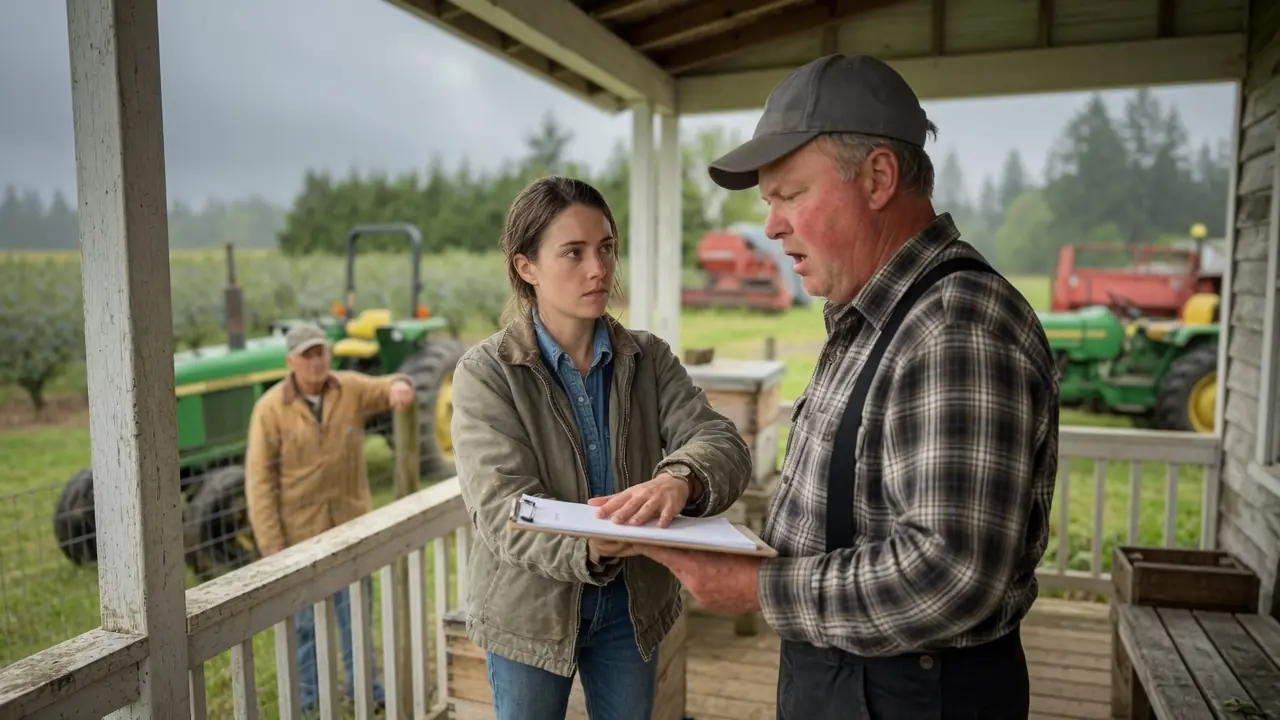
Mr. Gable did not mention Arthur.
He did not ask whether Helen was sleeping, whether she had learned to enter the barn without expecting to hear her father humming, or whether the silence inside the farmhouse still felt larger after sunset. He simply placed the contract against the porch rail and tapped the new price with one thick finger. The rental cost had increased five percent, the hives would arrive Friday, and payment would be due before the first crates left the field.
Helen looked past him toward thirty acres of blueberry bushes opening into pale spring blossoms.
Her father’s land sloped gently toward a belt of fir, cedar, and wild maple that bordered the eastern property line. Arthur had planted the oldest rows forty years earlier, back when Helen’s mother was alive and the farmhouse roof still leaked above the kitchen sink. For most of Helen’s childhood, the Voss farm had smelled of damp soil, diesel fuel, ripe berries, and the waxy sweetness of summer fruit.
In recent years, it had smelled mostly of worry.
The yields had declined slowly enough that each season could be blamed on something different. One year had been too wet, another too dry, another too cold during bloom. Pollination fees increased, fuel costs rose, and the bank manager began using careful phrases such as restructuring and liquidation whenever Arthur came in to renew the operating loan.
Her father had refused to quit.
Then his lungs failed before the farm did.
Helen had returned from agricultural college two years earlier when Arthur’s breathing became too weak for full days in the field. She handled payroll, pruning schedules, irrigation repairs, and the long nights when her father sat at the kitchen table pretending the oxygen tank beside his chair did not exist. When he died in March, he left her the farm, its debt, an aging combine, and thirty years of handwritten journals.
Mr. Gable cleared his throat.
“The price is up for everyone,” he said. “Fuel, feed, labor. You know how it is.”
Helen placed both hands in her jacket pockets so he would not see them shake. “I won’t be needing your hives this year.”
He looked at her as though grief had made her speak another language.
“You have thirty acres coming into bloom.”
“I’m aware.”
“And you’re refusing pollination?”
“I’m refusing your contract.”
His eyes narrowed. “You planning to walk flower to flower with a paintbrush?”
Helen kept her voice level. “I have another plan.”
His laughter struck the porch boards and seemed to remain there after he stopped.
Mr. Gable had supplied rented honeybee colonies to nearly every berry farmer in the valley for nineteen years. He arrived each spring with trucks loaded with white boxes, placed them at field edges, collected his payment, and removed them before summer. Farmers complained about rising prices, weak colonies, and inconsistent coverage, but few were willing to risk a crop without him.
Arthur had signed every contract.
Helen had spent the previous three weeks understanding why.
Her father’s journals were not ordinary farm ledgers. Between fuel receipts and harvest totals, Arthur had recorded weather, bloom density, rainfall, wind direction, soil temperature, insect sightings, and the precise week each section of the farm reached peak fruit set. He had written in small, disciplined handwriting that became shakier during his final years.
The pattern appeared only after Helen spread twelve journals across the dining-room table.
The rows beside the eastern woods consistently produced more fruit.
Not once or twice.
Every season.
Even in years when frost damaged the central field, the bushes near the forest developed heavier clusters. Arthur had circled those numbers several times, then written the same note in the margin.
More native activity near timber.
Helen had walked those rows at dawn and watched bumblebees, mason bees, mining bees, and small dark insects moving between blossoms before the rented honeybees became active. They nested in old fence posts, hollow reeds, deadwood, bare earth, and the wild margin her father had never cleared. The farm had been paying for temporary workers while neglecting the pollinators that already lived there.
She was not planning to abandon bees.
She planned to keep them.
Mr. Gable took the contract from the railing and tucked it back beneath his arm.
“Don’t call me in two weeks when your blossoms start dropping,” he said. “My schedule will be full.”
“I won’t call.”
“You’re young enough to think confidence replaces experience.”
“And you’re comfortable enough to think experience means nothing should change.”
His face reddened.
He climbed into his truck and leaned through the open window before reversing. “Your father knew better.”
Helen felt the words strike exactly where he intended.
She still did not answer.
By supper, everyone in the valley knew Arthur Voss’s daughter had refused Mr. Gable’s bees. By breakfast the next morning, the story had grown into something more dramatic: Helen had declared rented pollination a fraud, claimed she understood bees better than every farmer in the county, and planned to save the farm with insects she would train herself.
Then people learned she was selling the combine.
That became proof she had lost her judgment.
The old red machine was twenty-three years old, but it remained the farm’s most valuable movable asset. Arthur had used it for the small grain acreage he rented west of town, though the lease had produced almost no profit for five seasons. Helen calculated that selling the combine and releasing the rented grain fields would save fuel, labor, maintenance, and loan payments.
It would also give her enough money to buy twenty established honeybee colonies from an aging beekeeper named Samuel Reed.
The decision was practical.
The valley called it madness.
Mr. Miller stopped his tractor beside Helen’s fence while she placed shallow water pans near the new apiary.
“You’re selling a working combine for boxes of bugs?” he asked.
“For colonies.”
“Bugs in boxes.”
“The grain acres lose money.”
“Your father kept them.”
“My father also wrote that he should have dropped them eight years ago.”
Mr. Miller glanced toward the hives arranged behind the cedar windbreak. “Arthur wrote many things when he was sick.”
Helen turned toward him. “Do you have business here?”
He removed his cap, scratched his head, and looked almost embarrassed. “Just trying to keep you from making a mistake.”
“I already inherited several. I’m trying not to repeat them.”
He drove away without replying.
The established colonies arrived during the final week of April.
Samuel Reed transported them at night, when the bees were inside and calm. He was seventy-three, thin as a fence post, and spoke about bees with the seriousness of a man discussing weather or scripture. He helped Helen position the hives in four groups around the farm rather than placing every colony along one road as Mr. Gable did.
“Spread them,” Samuel advised. “Make the bees work shorter distances.”
Helen had already reached the same conclusion from her father’s maps.
She placed five colonies near the cedar windbreak, five beside the western irrigation pond, six along the central access lane, and four near the eastern woods where native pollinator activity was strongest. She added nesting blocks for mason bees, left patches of bare soil undisturbed, drilled holes into untreated wood, and planted strips of clover, phacelia, and early-blooming herbs to feed insects before and after the blueberry bloom.
Samuel watched her work.
“You’re not just buying honeybees,” he said.
“I’m buying time while I rebuild habitat.”
He nodded slowly. “Your father would have understood that.”
The words nearly stopped her.
Helen looked down at the smoker in her hand. “He understood more than he acted on.”
“That is true of most farmers.”
For ten days, the colonies settled.
Helen checked brood patterns, food stores, queen activity, and signs of disease. She moved carefully around the hives, learning not to confuse speed with confidence. Every evening, she returned to Arthur’s journals and wrote her own observations beneath his.
The house felt different when she did that.
Less like a museum of someone who had died.
More like a conversation interrupted but not entirely ended.
Bloom opened early in May.
Thousands of white and pink flowers covered the bushes until the fields looked dusted with snow. Helen walked the rows at sunrise and heard the first rising hum of bees moving through the blossoms. Some were from her colonies, others from the woods and soil margins she had begun protecting.
She marked pollinator counts on a clipboard.
The activity was strongest in the outer rows, just as Arthur had recorded. More importantly, the central sections showed increased visits because the permanent colonies had been distributed around the farm. Helen began believing the plan might work.
Then the storm warning appeared.
A cold front was moving inland, carrying heavy rain, violent wind, and possible hail. The forecast predicted gusts strong enough to damage trees and overturn unsecured equipment. Farmers throughout the valley rushed to cover machinery, clear drainage ditches, and protect vulnerable young plants.
Helen spent the afternoon fastening hive lids with straps and driving stakes into the ground.
She positioned temporary barriers on the windward side and checked every drainage channel twice. At sunset, dark clouds covered the western hills. By eight, rain struck the farmhouse windows hard enough to sound like handfuls of gravel.
Helen tried to sleep.
The wind shook the roof.
Branches scraped the siding, and thunder rolled across the valley with such force that the glass beside her bed trembled. Every person who had laughed at her seemed to return through the noise.
The combine is gone.
The hives are exposed.
The bank will take the land.
Arthur’s daughter killed the farm.
Near midnight, she pulled on jeans beneath her nightgown, shoved her feet into rubber boots, and took the strongest flashlight from the mudroom.
Rain hit her the moment she opened the door.
It soaked her hair and filled her boots before she crossed the yard. Lightning flashed above the trees, turning the fields silver for one terrifying second at a time. Helen pushed through the first blueberry row with one arm raised against the wind.
The colonies behind the cedar barrier were still standing.
One strap had loosened.
Water rushed beneath two pallets, and a branch had fallen close enough to strike the nearest hive if the wind shifted. Helen dragged the branch away, tightened the strap, and dug a shallow channel with a shovel to redirect the runoff.
A truck’s headlights appeared on the distant farm road.
Mr. Gable had come to check several rented colonies placed on the neighboring property. He stopped near Helen’s windbreak and stepped out wearing a raincoat over his plaid shirt. Even in the storm, contempt remained stronger than concern.
“Why are you risking your life for hives that’ll be dead by morning?” he shouted.
Helen placed one hand against the wet wood of the closest colony.
At first, she felt only rain and vibration from the wind.
Then came a low, steady humming from inside.
Alive.
The bees had clustered together, creating warmth and protecting their queen.
Helen closed her eyes for one second.
“They’re still alive,” she shouted back. “And they’re fighting harder than you expected.”
Mr. Gable laughed into the rain. “One storm doesn’t make you a farmer.”
Helen opened her eyes and looked at him across the flooded path.
“Then come back at sunrise—when every field hears what you were too arrogant to believe.”
He climbed back into his truck and drove away.
Helen remained with the hives until the worst of the wind passed.
At dawn, the valley looked bruised.
Branches covered roads, several roofs had lost shingles, and low fields held standing water. Two of Mr. Gable’s rented hive stacks on the Miller property had overturned because they had been placed in an exposed section without straps.
Helen’s colonies remained upright.
By nine, the clouds opened enough for sunlight to touch the fields.
The first bees emerged cautiously, circling near their entrances. Then more followed. As the temperature rose, they spread into the blueberry rows, joined by native bees shaken from the hedges and woods.
Helen stood between the bushes and listened.
The whole farm sounded awake.
The weeks after bloom were filled with waiting.
Flowers dropped, leaving tiny green fruit behind. Helen inspected branches every morning, measuring clusters and comparing them with Arthur’s past records. Fruit set appeared heavier than the previous year, but she refused to celebrate before the berries developed.
The bank refused to wait so patiently.
Mr. Peterson, the agricultural loan manager, visited in June with a folder and a sympathetic expression. He reminded Helen that a major payment was due after harvest and that the sale of the combine had reduced the bank’s recoverable collateral.
“I invested that money into permanent pollination assets,” she explained.
“Hives are not valued like machinery.”
“They produce every season.”
“If they survive.”
“They survived the storm.”
Mr. Peterson closed the folder. “The bank needs numbers, Helen.”
“So do I.”
“If the crop falls short, we may have to discuss selling part of the eastern acreage.”
Helen looked through the window toward the woods where native bees lived.
“That section is not for sale.”
“It may not remain your decision.”
After he left, Helen stood in the kitchen with both hands pressed against the counter.
Selling the eastern woods might satisfy the loan temporarily, but clearing the habitat would destroy the strongest pollination zone on the farm. It would solve one season by weakening every season after it. Arthur had nearly accepted the same proposal two years earlier before illness delayed the paperwork.
Helen refused to survive by dismantling the thing that made survival possible.
June became July.
The berries turned from green to pink, then deep blue.
Branches bent beneath their weight. Pickers entering the oldest rows called Helen over because clusters were thicker than anything they remembered from recent seasons. Even the center rows, historically weak, showed heavy fruit.
Tractors slowed along the county road.
Neighbors stared.
Mr. Miller stopped at the fence but did not offer advice.
Mr. Gable drove past twice without entering.
Harvest began during the first week of August.
Helen hired the same crew Arthur had used for years. The foreman, Luis Mendoza, had worked the Voss fields since Helen was twelve. He knew where the soil softened after rain, which rows ripened late, and how many crates a healthy acre should produce.
By midday, he found Helen beside the packing shed.
“You need to see the weigh tickets,” he said.
The first load had exceeded the previous year’s daily average by thirty-eight percent.
Helen checked the number twice.
“That cannot be right.”
Luis smiled. “Then the berries have learned to lie.”
The second load came in heavier.
By evening, the packing shed ran out of empty pallets.
Helen called the buyer and requested additional trucks. The buyer asked whether another farm had delivered fruit under her account by mistake. Helen invited him to come count the rows himself.
News spread through the valley before the next morning.
Farmers began appearing near the scale.
Some pretended they needed to speak with Luis. Others openly asked to see the tickets. Mr. Miller stood near the loading dock with both hands in his pockets, staring at crates overflowing with firm blue fruit.
Mr. Gable arrived last.
He parked his truck beside the packing shed and stepped out carrying no clipboard.
The final truck from the central field rolled onto the scale. Luis waited for the display to settle, then looked down at the ticket.
His pencil froze above the paper.
Helen stood beside him. “What is it?”
He handed her the slip.
The farm had produced the largest single-day blueberry weight in its recorded history.
By the end of harvest, the total yield was sixty-two percent higher than the previous season and twenty-seven percent above Arthur’s best recorded crop. Fruit quality improved, rejection rates dropped, and the buyer offered a premium for the late-season shipment.
The scale did not merely prove the colonies had worked.
It proved the farm had been operating below its natural capacity for years.
Mr. Gable stared at the stacked crates.
“You had favorable weather after bloom,” he said.
Helen looked toward the broken branches still visible near the windbreak.
“We had a storm strong enough to overturn your hives.”
“One season proves nothing.”
“No. Thirty years of my father’s records proved it. This season only made you look.”
Several farmers moved closer.
Mr. Miller removed his cap. “How much did the colonies cost?”
Helen told him.
“And you keep them?”
“As long as I keep them healthy.”
“What about honey?”
“Secondary income.”
“Can they pollinate other farms?”
“Some colonies may be divided once they are strong enough.”
The questions continued.
Helen answered without boasting. She explained that honeybees were only part of the result and that protecting native nesting habitat mattered just as much. She showed them maps of hive placement, bloom timing, forage strips, water sources, and wind protection.
Mr. Gable listened from the edge of the group.
His business would not disappear overnight. Large farms still needed rental colonies, and permanent apiaries required labor, knowledge, disease management, and winter preparation. Helen did not claim her solution would fit every field.
But the valley no longer believed his contract was the only possible answer.
That was what angered him most.
“You sold your father’s combine for this,” he said.
Helen met his eyes. “I sold a machine tied to losing grain fields and invested in something the blueberries needed.”
“He would never have done that.”
Helen opened Arthur’s final journal and turned to a page dated two months before his death.
She held it where Mr. Gable could read.
Sell grain lease. Keep woods. Invest in resident pollinators if Helen agrees.
Mr. Gable’s mouth tightened.
“My father was afraid to make the change,” Helen said. “That doesn’t mean he never saw it.”
The crowd fell quiet.
For months, people had described Helen’s decision as a rejection of Arthur’s legacy. The journal revealed the opposite. She had not discarded her father’s knowledge.
She had completed the choice he had been too sick to make.
The harvest revenue paid the bank installment in full.
Helen replaced the farmhouse roof, repaired the irrigation pump, and placed the remaining profit in a reserve account rather than buying equipment she did not need. She hired Samuel Reed one day a week to teach her advanced colony management and began training Luis’s daughter, Sofia, who wanted to study agricultural science.
The following spring, five neighboring farms reduced their rented hive contracts.
Two established small permanent apiaries. Three created native pollinator strips and protected forest margins they had previously planned to clear. Mr. Miller paid Helen to inspect his proposed hive locations, though he spent the first fifteen minutes insisting he could have figured it out himself.
Mr. Gable lowered his rental price.
For the first time in nineteen years, his contracts included colony-strength guarantees, storm placement standards, and partial refunds when delivered hives failed inspection. Competition had forced him to offer the accountability farmers should have demanded long before Helen challenged him.
He never apologized.
Helen stopped needing him to.
A year after Arthur’s burial, she stood beneath the cedar windbreak while bees crossed the spring air around her. The original twenty colonies had survived winter with only two losses. Several were strong enough to divide, giving the farm new colonies without another major purchase.
She opened her father’s oldest ledger.
On the final blank page, Helen wrote the season’s bloom date, temperature, colony count, and early native-bee activity. Beneath the numbers, she added a sentence she wished Arthur could read.
The farm answered because I finally listened.
A bee landed briefly on the edge of the page, then lifted toward the blueberry rows.
From the porch, the chair where her father once sat remained empty.
The emptiness still hurt.
It probably always would.
But the farm no longer felt like a grave she had inherited.
It felt alive.
Helen had been called foolish for refusing the familiar contract, reckless for selling the combine, and arrogant for believing the notes of a dead farmer mattered more than the advice of living men. She had nearly lost the land, walked through a midnight storm, and placed everything she owned behind wooden walls filled with thousands of fragile wings.
The valley believed the harvest proved she had been fearless.
Helen knew better.
She had been terrified from the beginning.
Courage had not been certainty that the hives would survive.
It had been walking into the rain while every doubt followed her.
The combine was gone.
The bank was paid.
The woods still stood.
And when bloom returned each spring, the thirty acres of Voss blueberries filled with a rising golden hum that no contract could own.