On a freezing, rainy night, Marcus Williams hurried toward his second job, his worn jacket pulled tight against the cold. He was already exhausted from a long shift at the auto repair shop, already worried about rent, tuition, and his sister’s medicine. Every minute mattered.
Then he saw her.
An elderly woman stood alone at a bus stop across the street, soaked through, shivering, and completely lost. Her cardigan hung heavy with rain.
One slipper twisted awkwardly beneath her foot. Her silver hair clung to her pale face, and her frail hands trembled as she tried to lower herself onto the metal bench.
Marcus slowed.
Across the street, Bernie’s Diner glowed through the rain. His second shift started in minutes. Bernie had already warned him that one more late arrival would cost him the job. Marcus could almost hear the man’s voice in his head.
But the woman tried to sit again, missed the bench, and caught herself with a small, helpless gasp.
Marcus stopped walking.
For one long breath, he stood between survival and conscience. Then he crossed the street.
Rain hammered against the bus shelter as Marcus approached her carefully.
“Ma’am,” he said softly. “Are you okay? Do you need help?”
The woman blinked at him, but her eyes were distant, pale blue and unfocused. She looked through him, then past him, as if searching for a place her mind could not find.
Marcus set down the grease-stained paper bag Ray from the garage had given him and shrugged off his jacket. It was his only real coat, the one his grandmother had bought him years ago, its lining torn and its zipper stubborn, but still warm enough to matter.
He draped it over the woman’s narrow shoulders.
The cold bit into him immediately through his thin work shirt, but he did not take the jacket back. The woman’s shaking fingers gripped the edge of it like it was something precious.
Marcus pulled out his phone. The battery was low, the cracked screen glowing red at the corner.
He dialed 911.
“Yes, ma’am,” he said when the dispatcher answered. “I’m at the bus stop on Madison Avenue and Harrison Street. There’s an elderly woman here. She seems confused and disoriented. She’s soaked through from the rain. I don’t think she knows where she is.”
The dispatcher asked if the woman was breathing, if she was conscious, if Marcus could stay with her until help arrived.
Marcus looked across the street at Bernie’s Diner. The orange sign flickered in the rain. His shift had already started.
“Yes, ma’am,” he said quietly. “I can stay.”
He sat beside the woman on the cold bench, close enough that she would not feel alone, but far enough not to frighten her. His shirt clung to his back, rainwater sliding down his neck. The wind cut through him, but he waited.
Nine minutes later, a patrol car pulled up without sirens, its blue and red lights flashing across the wet pavement.
Officer Brennan stepped out first, a young woman with blond hair pulled back tightly beneath her cap. Behind her came an older officer carrying a thermal blanket.
Marcus stood, stiff from the cold.
“I found her like this,” he explained. “She was trying to sit, but she kept losing her balance. She hasn’t really answered me.”
Officer Brennan crouched in front of the woman.
“Ma’am, my name is Officer Brennan. We’re going to help you, okay?”
The woman did not answer, but when they helped her toward the car, she turned once and looked at Marcus. For just a second, her eyes seemed to clear. She did not speak. She only held his gaze, as if some part of her understood that he had stopped when he did not have to.
Then the officers wrapped her in the blanket and helped her into the patrol car.
Officer Brennan returned to Marcus.
“You did good,” she said. “Most people wouldn’t have stopped in weather like this.”
Marcus only nodded.
She looked at his soaked shirt. “Where’s your coat?”
“I gave it to her.”
“That was your only jacket?”
“Yes, ma’am.”
Officer Brennan reached into the car and pulled out a folded gray sweatshirt.
“Take this.”
“I can’t.”
“You can, and you will,” she said firmly. “What’s your name?”
“Marcus Williams.”
“Well, Marcus Williams, her family is going to want to thank you. Do you have a number where they can reach you?”
Marcus hesitated, then gave it to her.
“Get yourself somewhere warm,” Officer Brennan said. “And thank you.”
Marcus pulled the dry sweatshirt over his head and ran toward the diner.
By the time he burst through the back door of Bernie’s Diner, he was twenty-three minutes late.
Bernie stood in the kitchen with his arms crossed over his chest. He was a heavyset white man in his mid-fifties, with thinning hair and a permanent scowl that deepened whenever he was angry.
“You’re twenty-three minutes late,” Bernie said.
“I know. I’m sorry. There was an old woman at the bus stop. She was confused and lost. I couldn’t just leave her in the rain.”
Bernie threw down the towel in his hand.
“You think I care? I told you, Marcus. One more late clock-in, and we’re done. No excuses.”
“She needed help.”
“And I need employees who show up on time.”
Marcus stood there, dripping onto the kitchen floor, his chest still heaving from the run.
“The police came,” he said. “They took her somewhere safe. I stayed until they got there.”
“That’s real noble,” Bernie snapped. “But this is a business. Teresa had to cover for you because you decided to play hero.”
“I wasn’t trying to play hero.”
“Then you should’ve tried harder to keep your job.”
Marcus swallowed hard.
“Bernie, please. I need this money. My sister’s medication—”
“You should’ve thought about that before you were late for the third time.”
Bernie pointed toward the back door.
“Out. Right now. And don’t come asking about your last paycheck.”
The words hit Marcus like a blow.
For a moment, he could not move.
The kitchen sounds seemed distant: sizzling oil, clattering dishes, the hum of the refrigerator. Teresa, the line cook, gave him a helpless look, but there was nothing she could do.
Marcus turned and walked back out into the rain.
He stood in the alley for several seconds, water running down his face. Then he began walking.
Not toward anywhere at first.
Just walking.
He had lost both jobs in one day. The auto shop had laid him off. The diner had fired him. Rent was due in six days. His sister Emma had only a few days of asthma medicine left. His little brother Caleb needed school supplies. His college account was already on hold because of unpaid tuition.
The careful math Marcus had been doing for months no longer worked.
By the time he reached the apartment, the rain had softened into a cold drizzle.
The building was old, poorly maintained, and dimly lit by a hallway bulb that flickered constantly. Marcus climbed to the third floor slowly, each step heavier than the last. He unlocked the door as quietly as possible.
Inside, the apartment was cold.
A single lamp glowed in the living room. Emma sat propped against the worn couch, wrapped in their grandmother’s faded quilt. She was seventeen, a high school senior with tired eyes and a strong face made fragile by sickness. Her breathing came hard and uneven, each inhale carrying a faint wheeze.
Marcus dropped his backpack and hurried to her side.
“Em,” he said softly. “Did you take your medicine?”
She shook her head weakly.
He grabbed the prescription bottle from the small table and shook it. Four pills rattled inside. Four days. After that, nothing.
He found a half-crushed water bottle in his backpack, gave her one pill, and helped her sit up enough to swallow it.
“It’s all we’ve got for tonight,” he whispered. “Try to rest.”
Emma’s glassy eyes stayed on him. She knew something had happened, but she was too sick to ask.
Marcus dampened a washcloth with the last bit of water in the kitchen and wiped her forehead. Then he went to the desk in the corner and opened his student portal.
A red message filled the screen.
Account Hold. Unpaid Balance: $4,700. If payment is not received within seven days, enrollment will be terminated.
He closed the app.
Soft footsteps creaked behind him.
His little brother Caleb stood in the bedroom doorway, rubbing one eye. Caleb was ten years old, small for his age, with curious eyes that seemed to understand too much.
“You don’t work at Bernie’s anymore?” Caleb asked quietly.
Marcus opened his mouth, but no words came.
Caleb waited, then nodded as if the silence itself was an answer. He turned and went back to bed.
That broke Marcus more than yelling would have.
No one blamed him.
No one cried.
No one shouted.
The silence was worse.
It was the silence of people who had grown used to disappointment. The silence of a family already bracing for the next loss.
Marcus sat at the desk, lowered his head onto his folded arms, and stayed there in the cold dark until exhaustion pulled him under.
His last thought was a question he could not answer.
Did I do the right thing?
Morning came gray and cold.
Marcus woke with his head still on the desk, his neck cramped, his clothes stiff from dried rain. Emma’s fever had broken during the night, and her breathing was easier. He adjusted the quilt around her shoulders, made stale toast for Caleb, and changed into the one clean button-down shirt he owned.
Today had to be about finding work.
He opened a job search app and began scrolling through listings. Dishwasher needed. Overnight warehouse. Retail associate. He had started his third application when his phone buzzed.
Unknown local number.
He almost ignored it.
Then he answered.
“Hello, is this Marcus Williams?”
“Yes, ma’am.”
“My name is Patricia Hendricks. Officer Brennan gave me your number. The woman you helped last night was my mother, Dorothy Hendricks.”
Marcus sat up straighter.
“Is she okay?”
“She is now, thanks to you,” Patricia said, her voice catching slightly. “Marcus, can you meet me this morning? There’s something I need to tell you in person.”
He hesitated, looking around the apartment.
“Yes, ma’am. Where?”
“Morning Grounds coffee shop on Riverside Avenue. Nine o’clock. I’ll buy you breakfast. Please.”
“I’ll be there.”
Across the city, Patricia Hendricks sat at her kitchen table with her laptop open. She had not slept.
A security camera from the corner store across from the bus stop had captured everything: Marcus stopping, crossing the street, giving Dorothy his jacket, calling for help, waiting in the rain.
Patricia had watched the footage over and over.
Her mother had dementia. She had slipped out of her memory care facility during a shift change and wandered for nearly three hours in the storm. By the time Marcus found her, she was soaked, hypothermic, and dangerously confused. The doctors said another hour in that weather might have killed her.
Patricia had posted the video online in the early hours of the morning, asking if anyone knew the young man who had saved her mother.
By sunrise, thousands of people had shared it.
Officer Brennan finally called with his name.
Marcus Williams.
Now Patricia was looking into everything she could find. Community college records. Volunteer mentions. A former high school teacher who described him as gifted, responsible, and kind. A young man raising two siblings while trying to stay in school.
Patricia opened the account for the Hendricks Foundation, the charitable organization her late husband had created to support education for young people with potential and character.
Then she wrote to the board.
Emergency scholarship recommendation. Immediate consideration requested.
At nine o’clock, Marcus stepped into Morning Grounds, a cafe he had passed many times but never entered. It smelled of coffee, warm bread, and things too expensive for his life.
Patricia stood from a table near the back window.
She was white, in her late fifties, with silver-streaked brown hair and tired eyes. She shook his hand with both of hers.
“Marcus, thank you for coming.”
“Yes, ma’am.”
“Please sit. Have you eaten?”
Before he could answer, she ordered him a full breakfast.
When the server left, Patricia turned to him, her eyes bright with emotion.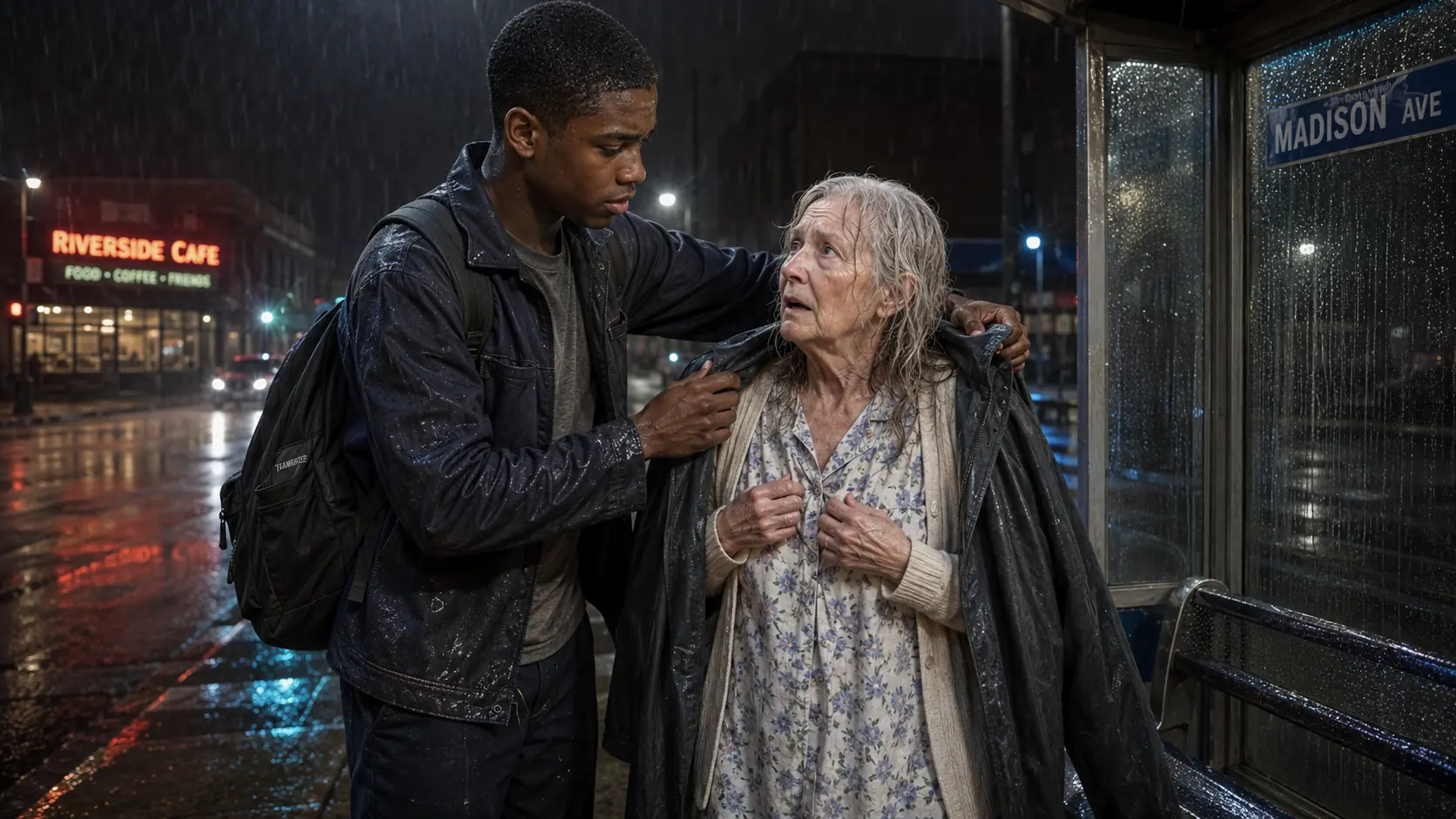
“My mother’s name is Dorothy,” she said. “She has dementia. Last night, she wandered away from her care facility. We didn’t realize she was gone until almost two hours later.”
Marcus listened quietly.
“She was outside in that rain for nearly three hours. The doctor said if she’d been out there much longer, she might not have survived.”
“I’m just glad she’s okay,” Marcus said.
“She kept talking about you,” Patricia said. “She couldn’t remember your face, but she kept saying, ‘Kind hands. Warm coat.’”
Marcus looked down.
“I just did what anyone would do.”
“No,” Patricia said firmly. “Most people would not have stopped. You did.”
She opened a manila envelope and pulled out papers.
“Marcus, I need you to be honest with me. Are you in school?”
“I was,” he said. “Community college. I got suspended yesterday for unpaid tuition.”
“Are you working?”
“I was. I lost both jobs yesterday.”
Patricia’s face tightened.
“You lost your job because you stayed to help my mother?”
Marcus shrugged slightly.
“It wasn’t the first time I’d been late. He warned me.”
“That does not make it right.”
She slid the papers across the table.
“My late husband started the Hendricks Foundation fifteen years ago. We provide educational grants and support for young people who show academic promise and strength of character. Marcus, we want to offer you a full educational grant. Tuition, books, fees, everything covered for however long it takes you to finish your degree.”
Marcus stared at her.
“I can’t accept that.”
“You can,” Patricia said. “And there’s more. We’re starting a community outreach program this spring. We need someone to coordinate it part-time while in school. Someone who understands struggle. Someone with compassion and integrity. We would like to offer you that position.”
Marcus could not speak.
It felt impossible, like something that happened in stories to people who were not him.
Patricia’s voice softened.
“You gave my mother your only coat. You stayed in the rain when you had somewhere else to be. You lost your job because you chose to help a stranger. That is exactly the kind of person we want to invest in.”
Marcus looked at the papers with shaking hands. Full tuition. Monthly stipend. Housing assistance.
“Why?” he whispered.
“Because kindness matters,” Patricia said. “Because people like you should be supported, not punished. Because my mother is alive today because you stopped.”
Marcus tried to hold himself together, but one tear escaped.
“I have a sister,” he said, voice rough. “She has asthma. We only had a few days of medicine left. My little brother is ten. Rent is due in six days. I don’t know what we’re going to do.”
“You are not alone anymore,” Patricia said. “Let us help you the way you helped my mother.”
Marcus looked at her for a long moment.
He thought about Emma on the couch, Caleb accepting bad news without complaint, and himself sitting at the desk in the dark wondering whether doing the right thing had ruined them.
“I don’t know what to say.”
“Say yes.”
Marcus took a trembling breath.
“Yes,” he whispered. “Yes, ma’am. Thank you.”
By noon, Marcus’s world had changed.
Patricia took him to the foundation’s office, helped him fill out paperwork, and introduced him to staff members whose names blurred together. She told him the official grant approval would take only a few days.
Then she wrote him a check for two thousand dollars.
“For your sister’s medicine and this month’s rent,” she said. “A bridge until the paperwork clears.”
“I’ll pay you back,” Marcus promised.
“If you insist on repaying it,” Patricia said, “then donate it to the foundation someday. Help someone else. That is how kindness multiplies.”
Marcus went straight to the pharmacy and bought Emma’s medication. A full thirty-day supply.
Then he went to the grocery store and filled a cart with real food: fresh vegetables, fruit, milk, eggs, bread, chicken, rice.
For the first time in months, he paid without fear.
When he came home that evening, Emma was awake on the couch and Caleb was doing homework at the kitchen table.
Both stared at the grocery bags.
“What’s all that?” Emma asked.
“Food,” Marcus said. “Real food.”
He held up the pharmacy bag.
“And your medicine. Thirty days.”
Emma’s eyes widened.
“How?”
Marcus smiled for the first time in what felt like weeks.
“The woman I helped last night, her daughter found me. They’re helping me get back into school. They offered me a job. A real one.”
Caleb looked up.
“Because you helped that lady?”
“Yeah,” Marcus said. “Because I helped her.”
“Even though you lost your job?”
Marcus knelt beside his little brother.
“Listen to me, Caleb. Doing the right thing doesn’t always feel good at first. Sometimes it feels like losing. But kindness still matters, especially when it costs something.”
“So we should always be kind?”
“Especially when it’s hard,” Marcus said. “That’s when it matters most.”
Emma wiped her eyes.
“You’re going to make me cry, and I just stopped coughing.”
Marcus laughed softly and started unpacking groceries.
That night, he cooked chicken, rice, and vegetables. Nothing fancy. But for the first time in a long time, the apartment felt less like a place they were barely surviving in and more like a home.
The story spread across the city.
The security footage went viral. People saw Marcus cross the street in the freezing rain, give Dorothy his coat, and wait beside her until help arrived. Strangers left comments. Some called him a hero. Others created a fundraiser for him.
Bernie saw the video on the evening news and recognized Marcus instantly.
For the first time, shame twisted in his stomach.
The owner of the auto shop saw it too and left Marcus a message, saying he might have made a mistake letting him go.
Marcus did not know what to do with the attention at first. He hated being stared at, hated being called a hero. But Patricia gave him advice that changed the way he saw it.
“Use the attention to help others,” she said. “Every time someone asks about what you did, tell them about students who need support. Turn your story into a bridge.”
So Marcus did.
By spring, he was back in classes, his tuition covered by the Hendricks grant. He worked twenty hours a week at the foundation, helping low-income students apply for college, scholarships, emergency funds, tutoring, and housing support.
He was good at it because he understood them.
He knew what it felt like to be tired before the day began. He knew what it felt like to choose between medicine and rent. He knew what it felt like to believe that one mistake could destroy everything.
When a student came in ashamed to ask for help, Marcus knew how to speak to them.
“You’re not a burden,” he would say. “You’re just carrying too much alone.”
Emma got accepted into a nursing program with a partial scholarship. Caleb joined an after-school robotics club and began talking about engineering. The family moved into a better apartment, not fancy, but warm, safe, and dry.
Marcus still worried. He still studied late. He still carried responsibility.
But he was no longer drowning.
One afternoon, Bernie came to the foundation office.
Marcus froze when he saw him.
The man looked smaller than he remembered, his gruff confidence softened by shame.
“Hey, Marcus,” Bernie said quietly. “Hope I’m not interrupting.”
Marcus invited him to sit.
“I saw the news back in November,” Bernie said. “The video. The story about what you did for that woman.”
He swallowed.
“And I felt awful. You were out there helping someone in the cold, and I fired you without listening. I treated you like you were disposable.”
Marcus said nothing.
Bernie pulled an envelope from his pocket.
“I talked to my accountant. This is what I owed you. Your last paycheck, unpaid hours, and interest. And an apology I should’ve given months ago.”
Inside was a check for $2,800 and a handwritten note.
Marcus stared at it.
“I’m sorry,” Bernie said, voice rough. “Truly.”
Marcus exhaled slowly.
Bernie cleared his throat.
“There’s a job for you at the diner if you want it. Part-time. Better pay. Flexible hours. You can say no. I wouldn’t blame you.”
Marcus looked at him for a long moment.
“I’ll think about it,” he said.
Bernie nodded, relief crossing his face.
“I’m proud of you, kid. What you’re doing here matters.”
By late spring, Marcus had found a rhythm. Classes in the morning. Foundation work in the afternoon. A few flexible shifts at the auto shop in the evenings. Enough work to help his family, but not so much that he had to sacrifice sleep, health, or school.
He was building something.
At a community celebration in April, Patricia asked him to speak. Marcus stood before students, parents, volunteers, and scholarship recipients, nervous but steady.
“I’m not a hero,” he told them. “I’m just someone who stopped.”
The room went quiet.
“That night, I thought helping someone had cost me everything. I lost my job. I thought I’d made a terrible mistake. But I understand now that compassion isn’t a transaction. It’s not about doing good so good will come back to you. It’s about choosing to be human when the world makes it hard.”
He looked at the young people in the crowd.
“You don’t have to wait until you have money or power to make a difference. You just have to care. You just have to choose compassion over convenience. And when someone helps you, pass it forward.”
The applause that followed was thunderous.
Afterward, a young woman named Sarah Mitchell approached him. She was a single mother, one of the foundation’s new scholarship recipients.
“I almost didn’t apply,” she said. “But then I read about you. I thought maybe there was hope for someone like me.”
“There is,” Marcus said firmly. “And you earned this.”
Months later, Marcus graduated from community college with a 3.9 GPA. Emma and Caleb cheered the loudest. Patricia sat beside them, wiping away tears. Dorothy, frail but smiling, clapped softly, her memory holding on to something deeper than details.
Kind hands.
Warm coat.
Someone stopped.
Marcus walked across the stage, accepted his degree, and saw in the crowd not just family, but community. Patricia. Emma. Caleb. Bernie. Officer Brennan. Students he had helped. People whose lives had touched his because one rainy night, he crossed the street.
He had been accepted to a four-year university on a full scholarship. The foundation offered him a permanent role as program director. Sarah Mitchell was close to graduating. Caleb was already planning for college. Emma was becoming the nurse she had dreamed of being.
The rain had fallen hard that November night.
Marcus had stopped.
That single choice had changed everything.
Years later, when Marcus told the story, he never described himself as brave. He never said he had known what would happen. He always told the truth.
He had been scared.
He had been late.
He had been one bad paycheck away from losing everything.
And still, he stopped.
Because sometimes the world changes not when someone powerful acts, but when someone ordinary refuses to walk past another person’s pain.
The rain may fall.
The night may grow cold.
But someone can still become shelter.
Someone can still become light.
And sometimes, by saving another person from the storm, we find the road that saves us too.