The storm reached Knoxville, Tennessee, just after sunset.
It came rolling over the city in a wall of clouds, dragging wind behind it hard enough to bend the trees along Briar Lane.
Rain struck the roofs, the sidewalks, the parked cars, and the thin gutters of Maya Coleman’s small white house like someone emptying buckets from the sky.
The windows shook in their frames, and every few minutes, lightning flashed bright enough to turn the kitchen silver.
Maya stood at the stove stirring chicken stew with one hand and holding the lid down with the other because the old pot rattled whenever it began to boil too hard.
She was thirty-four years old, a single mother, tired in the way a person becomes when exhaustion is no longer a visitor but part of the furniture. Her pharmacy uniform still smelled faintly of hand sanitizer and receipt paper, and her feet ached from standing through an eleven-hour shift.
Across the kitchen table, her eight-year-old son, Caleb, leaned over a math worksheet with his pencil gripped too tightly in his small hand. He was supposed to be finishing subtraction problems, but every time thunder cracked above the house, his eyes jumped toward the window.
“It’s only a storm,” Maya said gently, though she checked the ceiling near the laundry room for the third time that evening.
“I know,” Caleb said, trying to sound brave. “But it sounds mad.”
Maya smiled tiredly.
“Storms always sound mad. Then by morning, they act like nothing happened.”
Their house sat at the end of Briar Lane, a quiet street where the yards were small, the porches were narrow, and people knew one another mostly through waves, borrowed tools, and occasional complaints about trash pickup. Maya had lived there for six years, long enough for the neighbors to know she worked too much, raised Caleb alone, and kept her place clean even when the house itself seemed determined to fall apart one repair at a time.
Money was always tight.
The roof leaked over the laundry room whenever rain came from the east. The heater made a rattling sound every time it started, like loose coins trapped inside a metal box. One kitchen cabinet hung slightly crooked because Maya had repaired it herself with a screwdriver, prayer, and more confidence than skill.
Still, the little house was warm in the ways that mattered.
There were spelling tests pinned to the refrigerator with bright magnets. A jar of loose change sat beside the microwave, marked “Caleb’s Field Trip Fund” in permanent marker. Lemon candles burned on the counter because Maya liked the way they made the house smell clean and hopeful, especially on days when life felt too heavy.
That night, the house smelled of rice, chicken stew, and lemon wax.
Maya was about to tell Caleb to check problem number six again when she heard the knock.
Three taps.
Weak.
Almost swallowed by rain.
At first, she thought it might be a branch hitting the porch railing. Then it came again.
Tap.
Tap.
Tap.
Caleb lifted his head.
“Mom?”
Maya turned off the stove burner and dried her hands on a towel. Her first instinct was caution. A woman alone with a child did not open her door at night during a storm without thinking. She had learned that from life, from news reports, from her mother, from every woman who had ever whispered, “Be careful,” as if carefulness were armor.
She moved quietly to the front room and looked through the peephole.
At first, she saw only rain.
Then lightning flashed.
An elderly white man stood on her porch, soaked through his brown cardigan, gray hair plastered to his forehead, one hand gripping the porch railing as though it was the only thing holding him upright. His shoulders shook. His mouth moved, but she could not hear him through the door.
Maya opened it only a few inches, keeping the chain on.
“Sir?”
The man blinked at her.
Water ran down his face and dripped from his chin.
“I’m sorry,” he said. His voice trembled badly. “I’m sorry to bother you. My name is Arthur Bell. I got turned around. I don’t know where I am.”
Maya looked past him into the street.
No car.
No neighbor.
No one calling his name.
No headlights moving slowly through the rain.
Just Arthur Bell standing on her porch, terrified, embarrassed, and freezing.
Behind her, Caleb came into the hallway.
Maya raised one hand to keep him back.
“Sir, where do you live?”
Arthur’s face tightened with effort.
“I know it,” he whispered. “I know I know it.”
He looked toward the street, then back at Maya, and his eyes filled with panic.
“There was a blue door,” he said. “I think there was a blue door.”
Caleb peeked around his mother’s side.
“Mom,” he whispered, “he’s shaking.”
Maya knew every reason not to open the door wider.
She knew the world could be dangerous. She knew kindness did not cancel risk. She knew she had a child in the house, a child who depended on her to think beyond one moment of pity.
But she also knew what she was seeing.
This was not a man trying to force his way inside. This was not a man with a story too smooth to trust. This was an old man lost in a storm, too cold to hide his fear, too ashamed to ask for more than help remembering where he belonged.
Maya slid the chain free.
“Come inside, Mr. Bell,” she said. “Let’s get you warm first.”
Arthur stepped over the threshold slowly, almost apologetically, leaving wet footprints on the floor. He looked down at them at once.
“I’m sorry,” he said. “I’m making a mess.”
“It’s only water,” Maya said. “Caleb, bring me the towel from the bathroom.”
Caleb ran.
Arthur stood uncertainly in the hallway, still holding his hands close to his chest as if he had not been invited all the way in.
Maya guided him toward the kitchen.
“Sit down right there.”
“I don’t want to trouble you.”
“You already knocked,” she said softly. “So we’re past that.”
He looked at her as if the sentence had surprised him.
Then he sat.
Maya wrapped him in Caleb’s spare blanket while Caleb appeared with two towels. The boy kept watching Arthur with wide, worried eyes.
“Are you sick?” Caleb asked.
“Caleb,” Maya said.
“It’s all right,” Arthur answered. “I don’t think so. I think I’m just old.”
Caleb considered that seriously.
“My grandpa used to say old bones don’t like rain.”
Arthur smiled faintly.
“He was right.”
Maya noticed the medical bracelet on Arthur’s wrist while he dried his hands. The metal tag was scratched but readable.
Arthur Bell.
Memory impairment.
Emergency contact: Rachel Bell.
A phone number followed, though part of it was faded.
Maya pulled out her cell phone and tried the number.
It rang twice.
Then voicemail.
She tried again.
Voicemail.
She left a message.
“My name is Maya Coleman. I live on Briar Lane in Knoxville. Arthur Bell is at my house. He is safe, but he seems lost and cold. Please call me back as soon as possible.”
Arthur stared down at the table, shame settling heavily over his face.
“I forgot,” he said. “I forgot her number.”
“That’s all right.”
“It isn’t.” His voice cracked. “A man ought to know his daughter’s number.”
Maya placed a bowl of chicken stew in front of him.
“A man caught in a storm ought to eat something hot.”
He looked at the bowl.
His hands shook too badly to lift the spoon at first.
Maya pretended not to notice.
That was something her own father had taught her before he died. Some kinds of help had to be given without making a person feel watched.
She turned to Caleb.
“Finish your worksheet.”
“But Mom—”
“Kitchen table. Now.”
Caleb obeyed, though his eyes stayed on Arthur.
For a few minutes, the room settled into small sounds. Rain against the windows. Spoon against bowl. Caleb’s pencil scratching numbers onto paper. The old heater rattling in the hall, trying and failing to sound dependable.
Arthur ate slowly, as if every bite brought him back from somewhere far away.
His eyes moved to the refrigerator.
Maya’s refrigerator was crowded with life. Caleb holding a spelling bee certificate. Caleb missing two front teeth. Caleb in a Halloween dinosaur costume. Maya’s late father, Joseph Coleman, standing beside a barbecue grill with one hand raised mid-laugh. A faded picture of Maya and her mother, Denise, taken before illness made Denise thin and quiet.
Arthur’s gaze stopped on the spelling bee photo.
“That boy,” he said softly. “He looks proud.”
Caleb looked up.
“I came in second.”
“That is still proud.”
Caleb smiled.
Arthur’s face changed, softening into an ache.
“I had a daughter who smiled like that once,” he said. “Her name is Rachel. I think she still does.”
Maya sat across from him.
“Do you remember where Rachel lives?”
Arthur closed his eyes.
His fingers curled around the edge of the blanket.
“I know it,” he whispered. “It’s there. It’s like a book on a high shelf. I can see the shelf, but I can’t reach the book.”
Maya waited.
“A blue door,” he said finally. “There was a blue door.”
Outside, thunder rolled over the house so hard the windowpanes buzzed.
Maya called the local non-emergency line next. She explained the situation, gave Arthur’s name, described the medical bracelet, and repeated the faded phone number. The dispatcher listened carefully but sounded overwhelmed.
“Ma’am, the storm has knocked out traffic lights all over the city. We have flooded roads, stalled vehicles, and several welfare checks pending. If he is safe with you and not in medical distress, keep him warm and indoors. We’ll send someone when we can.”
Maya looked at Arthur’s trembling hands.
“All right,” she said. “But please make a note. Someone is probably looking for him.”
“We will, ma’am.”
When Maya hung up, she stood still for a moment with the phone in her hand.
Caleb watched her.
“Is someone coming?”
“Eventually.”
“When is eventually?”
Maya looked toward the rain.
“I don’t know.”
Arthur seemed to shrink into himself.
“I should not have come here,” he said. “You have a child.”
Maya heard the shame in his voice and recognized it. Not because she had ever been lost in the rain with a failing memory, but because hardship had its own language. She knew what it felt like to believe your need was an inconvenience to everyone around you.
She had felt it standing in grocery lines, putting items back.
She had felt it calling the landlord about the leak again.
She had felt it sitting in the pharmacy break room calculating whether she could pay the heating bill and still afford Caleb’s field trip.
Need made people apologize for taking up space.
Maya walked to the hallway closet and pulled out a stack of old clothes. They had belonged to her father, Joseph. She had kept them after he died because grief made even ordinary shirts feel sacred. A soft flannel. A pair of sweatpants. Thick socks.
“Mr. Bell,” she said, “these should be dry.”
Arthur looked at the clothes.
“I can’t take another man’s things.”
“My father would have wanted them used.”
His eyes lifted to her face.
“He’s gone?”
“Five years.”
“I’m sorry.”
“Me too.”
Maya showed him the bathroom and gave him privacy to change. When he came out wearing Joseph’s flannel, Caleb stared.
“You look like Grandpa Joe,” he said.
Arthur touched the sleeve.
“Was he a good man?”
Caleb nodded hard.
“He made pancakes shaped like bears.”
Arthur smiled.
“Then I am honored to wear his shirt.”
That was the first moment Maya stopped seeing Arthur only as a problem to solve.
He was gentle.
Confused, yes. Frightened, yes. But gentle.
She made up the couch with extra blankets and one of Caleb’s pillows. The rain showed no sign of stopping, and no officer or caseworker arrived. By ten o’clock, Caleb was yawning against the kitchen chair.
“Bed,” Maya said.
Caleb went to Arthur first.
He held out a blue blanket covered in faded dinosaurs.
“This one keeps bad dreams away,” Caleb said.
Arthur looked at the blanket, then at the boy.
For a moment, his face trembled.
“I wouldn’t want to take your best one.”
“It’s not my best,” Caleb lied. “It’s just my backup.”
Maya said nothing.
Arthur accepted the blanket with both hands.
“Thank you, Caleb.”
Caleb nodded with solemn pride.
When Maya tucked her son into bed, he whispered, “Is Mr. Arthur going to find his daughter?”
“Yes,” Maya said, brushing his curls back from his forehead. “We’re going to help him.”
“What if I got lost when I’m old?”
Maya’s heart tightened.
“Then I hope you knock on the right door.”
“Like ours?”
She kissed his forehead.
“Like ours.”
Maya slept lightly that night.
She kept her bedroom door open and her phone beside her pillow. Every creak of the house woke her. Every burst of rain made her listen for movement in the living room. Around two in the morning, she got up quietly and checked on Arthur.
He was asleep on the couch, one hand resting over the dinosaur blanket.
His face looked smaller in sleep.
Not dangerous.
Not strange.
Just old.
By morning, the storm had passed.
The world outside looked washed and battered. Branches lay in the yard. The curb was flooded. Water dripped steadily from the roof near the laundry room, falling into the bucket Maya had placed there with practiced irritation.
Arthur was awake before Caleb.
He sat on the couch folding the dinosaur blanket with slow, careful hands.
“I’m sorry,” he said as soon as Maya came into the room.
“You don’t need to start the day apologizing.”
“I do if I wake in a stranger’s house.”
“You were safe.”
He looked down.
“I don’t remember coming here.”
Maya kept her voice calm.
“You knocked on my door. You told me your name.”
“I did?”
“Yes.”
“That’s something, then.”
Maya called Rachel’s number again.
Voicemail.
She called the non-emergency line and learned no one had been able to come during the storm. She gave them an update, then started calling nearby clinics, hospitals, shelters, and senior care offices. No one had a missing Arthur Bell in their system yet, or if they did, the right department had not heard.
By eight, Caleb was eating toast with grape jelly beside Arthur on the porch. The air smelled of wet earth and broken branches. The porch steps glistened. Arthur held his toast with both hands, watching a squirrel leap from the fence to the oak tree.
“I used to build things,” he said suddenly.
Maya, standing by the door with her coffee, turned.
“What kind of things?”
“Houses,” Arthur said. “Cabinets. Porch swings. Once, a dollhouse with a red roof.” He frowned. “No. Blue roof? Maybe red.”
“For Rachel?”
He smiled.
“For Rachel.”
Caleb leaned closer.
“Could you build a treehouse?”
Arthur looked at him.
“I built one that leaned left for twelve years and never fell.”
Caleb grinned.
“That counts.”
Just then, Maya’s neighbor, Linda Price, came across the wet lawn in rain boots and a pink robe under her coat. Linda was in her sixties, kind on good days and suspicious on all days. She looked from Arthur to Caleb to Maya and lowered her voice.
“Maya, can I speak to you?”
Maya stepped into the yard.
Linda glanced at Arthur.
“Who is that man?”
“His name is Arthur Bell. He got lost in the storm. I called the authorities. I’m trying to find his daughter.”
Linda’s eyes widened.
“You let him sleep here?”
“He had nowhere to go.”
“Maya, you’ve got a child in this house.”
“I know what I have.”
“You can’t just take in strangers.”
Maya looked back at the porch.
Arthur and Caleb were comparing toast crusts like it mattered.
“Last night,” Maya said quietly, “he wasn’t a stranger. He was someone’s father in the rain.”
Linda pressed her lips together.
“I understand your heart, honey. I do. But hearts can get women hurt.”
Maya did not argue.
Linda was not entirely wrong.
“I’m being careful,” Maya said. “But I’m not putting him back outside.”
Linda studied her, then sighed.
“I’ll make some calls too.”
“Thank you.”
“And lock your bedroom door tonight if he’s still here.”
Maya almost smiled.
“Goodbye, Linda.”
For three days, Arthur stayed in Maya’s home.
The first day, Maya missed half a pharmacy shift and spent the rest of her lunch breaks making calls. The second day, her manager, Mr. Patel, warned her gently that she could not keep leaving the counter short-staffed. Maya nodded, apologized, and went home feeling guilty from every direction.
At home, Arthur tried to help.
He folded dish towels with careful hands. He dried plates after dinner. He insisted on wiping the kitchen table though he forgot twice where the dishcloth was. In small moments of clarity, he helped Caleb with math, explaining subtraction with coins from Maya’s jar.
“You don’t lose the numbers,” he told Caleb. “You move them where they belong.”
Caleb frowned.
“That sounds like cleaning.”
Arthur laughed softly.
“Math is tidying up a mess you cannot see.”
Maya watched from the stove, something warm rising behind her ribs.
Arthur remembered pieces of himself like sunlight breaking through clouds.
He remembered his wife, Helen, who loved gardenias and hated when he left sawdust in the laundry room. He remembered building a porch swing for Rachel when she was ten. He remembered Rachel falling asleep there with a library book on her chest. He remembered a dog named Jasper. He remembered his hands being stronger.
But whenever Maya asked how he had wandered so far from home, fear moved across his face.
The words disappeared.
“It gets foggy,” he said once. “I was looking for something.”
“What?”
He shook his head, distressed.
“I don’t know.”
Maya stopped asking.
At night, after Caleb went to bed and Arthur slept on the couch, Maya sat at the kitchen table with her bills spread in front of her.
The roof repair estimate.
The heating company’s warning that the system might not survive another winter.
Caleb’s school expense sheet.
The grocery list she kept rewriting to make it smaller.
She looked toward the living room, where Arthur slept beneath Caleb’s dinosaur blanket, and wondered whether she had been foolish. One more person in the house meant more food, more laundry, more risk, more worry.
But each time she imagined turning him away, she saw her father.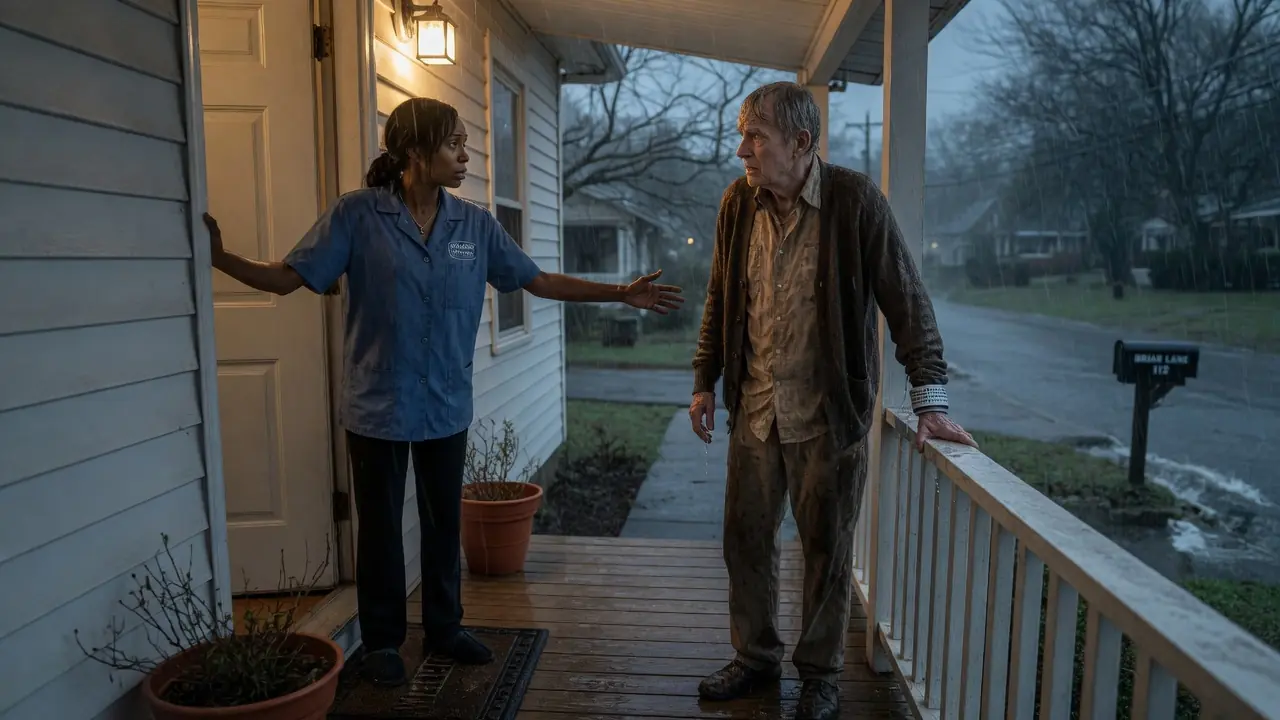
Joseph Coleman had been proud, stubborn, and kind enough to embarrass her when she was younger. He fixed neighbors’ gutters for free. He shoveled snow from porches before people woke up. He once brought home a man from church who had lost his job and let him sleep in their den for two weeks.
Maya had asked him why he trusted people so easily.
Joseph had answered, “I don’t trust everybody, baby. I just refuse to let fear make all my decisions.”
Maya did not trust blindly.
But she refused to let fear make this one.
On the fourth morning, she found Arthur standing by the front window.
He held a pencil in one hand and the back of a grocery receipt in the other. His shoulders were tense with concentration. Rainwater still dripped from the porch roof outside, but sunlight was beginning to break through the gray clouds.
“Mr. Bell?”
He did not answer at first.
Then he turned.
His eyes were bright.
“I drew it.”
Maya stepped closer.
On the receipt, Arthur had sketched a small house. The lines shook, but the details were clear. A porch. Two oak trees. A mailbox shaped like a barn. A fence with one leaning section. And a bright rectangle where the front door should be.
Under the drawing, he had written one word.
Fairview.
Maya’s breath caught.
“Is that your neighborhood?”
“I think so.” Arthur touched the paper. “Fairview. There was a sign. Or a school. Maybe a road. But this house. I know this house.”
Maya searched on her phone and found a Fairview area nearly seven miles away. Several streets. Older homes. Quiet residential blocks.
Seven miles.
Arthur had wandered seven miles in a storm.
The thought made her stomach twist.
She called the non-emergency line with the update, but road crews and emergency services were still backed up. They advised her not to drive if she felt unsafe, but if Arthur recognized the area and she was willing, she could take him while keeping them informed.
Maya looked at her shift schedule.
She was already late.
She looked at Caleb, who was eating cereal and listening to every word.
Then she looked at Arthur.
“I’ll take you,” she said.
Arthur’s hands trembled.
“You don’t have to.”
“I know.”
Caleb ran for his shoes.
Maya nearly told him to stay, then thought better of it. She did not want to leave him with Linda and spend the whole drive worrying. So Caleb climbed into the back seat with his backpack and a peanut butter sandwich Maya packed in case the search took too long.
Arthur sat in the passenger seat, holding the drawing in both hands.
They drove slowly through wet streets, past fallen branches, city workers, flashing traffic lights, and yards filled with storm debris. Arthur looked out the window with hope and dread fighting across his face.
“Do you recognize anything?” Maya asked.
“Maybe.”
They turned onto Fairview Road.
Arthur sat straighter.
Maya slowed.
They passed a brick church, a closed barber shop, and a row of small houses with porches.
Arthur shook his head.
“No. Not yet.”
Caleb leaned forward from the back seat.
“What about that blue door?”
“Caleb,” Maya warned gently.
“No,” Arthur whispered. “He’s right. Blue door.”
They turned again.
A gray house appeared at the end of a quiet street.
Two oak trees stood in the yard. The fence leaned near the mailbox. The mailbox was shaped like a small red barn.
The front door was bright blue.
Arthur’s breath caught.
“That fence,” he whispered. “I painted that fence.”
Maya pulled over.
Before she could turn off the engine, the blue door opened.
A woman in her forties ran out barefoot onto the wet porch.
Her hair was pulled back messily. Her face looked hollow with sleeplessness. She saw Arthur through the windshield and made a sound Maya felt more than heard.
“Daddy!”
Arthur opened the car door with shaking hands.
Rachel Bell reached him before he had fully stepped out.
She wrapped her arms around him and sobbed his name again and again.
Arthur held her like a child reaching for home.
“Rachel,” he whispered. “Rachel, I lost the road.”
“I know, Daddy. I know. I’ve got you.”
Maya stood beside the car with one hand on Caleb’s shoulder, giving them space.
For several minutes, Rachel could not stop crying.
When she finally looked at Maya, her eyes were swollen, red, and full of gratitude so raw it almost made Maya uncomfortable.
“You found him?”
“He found us,” Maya said. “He knocked on my door during the storm.”
Rachel covered her mouth.
“Oh my God.”
She explained in broken pieces.
Arthur had early memory loss. Some days were good. Some days were frightening. He had been living with Rachel for nearly a year after leaving his own house became unsafe. The night of the storm, Rachel had gone upstairs to change his bedsheets after he spilled tea. She thought he was watching television in the den.
When she came back down, the front door was unlocked.
Arthur was gone.
“I searched the block first,” Rachel said, wiping her face. “Then I called neighbors. Hospitals. Police. I filed reports. I drove until the roads flooded. I thought…” She stopped, unable to finish.
Arthur looked ashamed.
“I didn’t mean to scare you.”
Rachel turned to him at once.
“No. No, Daddy. This is not your fault.”
Maya heard the firmness in her voice and respected it.
Rachel invited them inside, but Maya looked at the clock and shook her head.
“I need to get to work.”
Rachel’s face crumpled again.
“You cared for him for three days?”
“Yes.”
“You fed him?”
Maya nodded.
“And he slept safely?”
“On our couch.”
Caleb spoke up.
“With my dinosaur blanket.”
Arthur smiled at him.
“That blanket is powerful medicine.”
Rachel knelt in front of Caleb.
“Thank you,” she said. “You helped save my dad.”
Caleb looked startled by the seriousness of her voice.
“He was cold,” he said simply.
Arthur reached into his cardigan pocket and pulled out the folded grocery receipt drawing.
He pressed it into Caleb’s hand.
“So you remember,” Arthur said softly, “that lost people can still find kind doors.”
Caleb held the drawing carefully.
Maya felt tears rise and blinked them back.
Rachel took Maya’s hand.
“I don’t know how to thank you.”
“You don’t have to.”
“Yes,” Rachel said. “I do.”
Maya gave her phone number in case anyone needed to confirm details with emergency services. Then she helped Arthur up the porch steps. Rachel kept one arm around him as if she feared he might vanish again if she let go.
At the blue door, Arthur looked back at Maya.
For a moment, confusion clouded his face.
Then it cleared just enough.
“Your kitchen smelled like lemons,” he said.
Maya smiled.
“It usually does.”
“I liked that.”
Rachel began crying again.
Maya returned to her car with Caleb.
As they drove away, Caleb looked down at the drawing.
“Mom?”
“Yes?”
“Can we frame it?”
Maya glanced at him in the rearview mirror.
“Sure.”
“It’s important.”
“Yes,” Maya said. “It is.”
Life returned to its ordinary shape after that, but not quite.
Maya went back to long shifts at the pharmacy. Caleb went back to school. The bucket still sat beneath the laundry room leak. The heater still rattled. Bills still came. Groceries still cost too much. The world did not become easy because one good thing had happened.
But something had changed in the feeling of the house.
Caleb taped Arthur’s drawing to the refrigerator between his spelling certificate and a pizza coupon. Every morning before school, he glanced at it as if checking that the blue door was still there.
Maya thought about Rachel often.
She imagined the terror of losing a parent in a storm.
She imagined blaming herself.
She imagined Arthur sitting in the gray house with the blue door, sometimes remembering her kitchen and sometimes not.
Two weeks later, Maya came home from work after another exhausting shift. Her back hurt, her head ached, and she was carrying a bag of discounted groceries in one hand and Caleb’s school folder in the other. The sun was low over Briar Lane, turning the wet patches in the driveway gold.
She saw the envelope before she reached the porch.
It was taped to the front door.
Her name was written across it in careful handwriting.
Maya Coleman.
Caleb came up behind her, still wearing his backpack.
“What is it?”
“I don’t know.”
She unlocked the door, set the groceries inside, and sat on the porch steps before opening it.
Inside were two letters.
The first was from Rachel.
Dear Maya,
I have started this letter at least twelve times and still do not know how to say thank you properly.
My father has not stopped talking about your kitchen. Some days he remembers your name. Some days he calls you “the woman with lemon light.” He remembers Caleb’s blanket more clearly than things that happened yesterday. He remembers that no one in your house made him feel ashamed.
I need you to understand what you did. You did not only keep him dry. You protected his dignity during what could have been one of the most terrifying nights of his life.
I also need you to forgive me for what I am about to do, because I know you did not ask for anything.
Maya paused.
Her pulse changed.
She continued reading.
I spoke with my attorney and with a contractor I trust. Your neighbor Linda helped me understand some of what your house needs, though she made me promise to say she did not gossip, only “provided community context.”
Maya laughed through sudden tears.
Rachel’s letter went on.
I have arranged to pay for your roof repairs, a new heating system before winter, and Caleb’s school expenses for this year. There is no debt attached to this. No expectation. No performance of gratitude required.
Please do not think of it as payment. There is no payment equal to my father’s life.
Think of it as one daughter taking care of the house that took care of her father.
Maya lowered the letter.
Her hands shook.
Caleb leaned against her shoulder.
“What does it say?”
Maya tried to answer, but no sound came out.
She handed him the page.
Caleb read slowly, his lips moving over some words.
Then his eyes widened.
“Mom. The roof?”
Maya covered her mouth with one hand.
For months, she had gone to bed worrying about the roof. She had imagined the heater failing during the first cold week. She had delayed dental work for herself because Caleb needed new shoes. She had prayed for more hours at work, then cried in the shower because she was too tired to take them.
Now a letter on her porch had shifted the weight.
Not erased every problem.
But lifted enough that she could breathe.
“There’s another one,” Caleb said softly.
Maya unfolded the second letter.
The handwriting was shaky and uneven.
Dear Maya,
Rachel is helping me write this because my hand does not always do what I ask anymore.
I spent my life building houses. I built walls, floors, cabinets, porches, and once a treehouse that leaned left but never fell. I used to think a home was something a man made with wood, nails, paint, and a roof that did not leak.
You reminded me what a home is.
A home is the place where someone sees you lost and does not turn away.
I was ashamed when I came to your door. I was wet, confused, and frightened. I did not know my road. I did not know my daughter’s number. I barely knew myself.
But you called me by my name. You gave me dry clothes. You fed me soup. Your boy gave me a blanket for bad dreams.
I do not remember everything, Maya. I lose many things now. But I remember kindness.
Thank you for opening the door.
Arthur Bell
Maya read the final line twice.
Then she lowered the letter and looked out at Briar Lane.
The evening was quiet.
A neighbor’s dog barked somewhere down the street. A car passed slowly, tires whispering against the road. The little white house behind her still needed work, but now help was coming. The lemon candle inside burned softly on the kitchen counter.
Caleb rested his head against her shoulder.
“Are we allowed to say yes?” he asked.
Maya wiped her face.
“I think sometimes accepting help is part of being kind too.”
“Grandpa Joe would say that?”
Maya smiled.
“He would pretend he thought of it first.”
The repairs began the following week.
Rachel did not send strangers without warning. She called first, explained everything, and came with the contractor herself. She stepped onto Maya’s porch holding a folder and a nervous smile, as if she feared Maya might still refuse.
Linda Price stood at her window pretending not to watch.
Maya noticed and shook her head.
Rachel saw too.
“That must be the community context.”
Maya laughed.
It was the beginning of something.
The roof was repaired before the next heavy rain. The laundry room ceiling was patched and painted. The old heater was removed, and a new system was installed before the first cold spell of the season. Caleb’s school account was paid, including the field trip Maya had been dreading.
Maya still worked hard.
She still clipped coupons.
She still counted money.
But the panic in her chest loosened.
One Sunday afternoon, a car pulled up in front of the house.
Rachel stepped out first, carrying a basket of muffins. Arthur followed slowly, holding a cane in one hand and a folded blue blanket in the other. It was new, soft, and covered in small white stars.
Caleb opened the door before Maya reached it.
“Mr. Arthur!”
Arthur smiled.
Some days, Rachel had warned, he might not remember everything.
But that day, he looked at Caleb and said, “Blanket doctor.”
Caleb grinned.
“That’s me.”
Arthur handed him the new blanket.
“For your backup,” he said.
Caleb hugged it to his chest.
Maya invited them in.
Rachel placed muffins on the counter. Arthur stood in the kitchen, looking around. His eyes moved to the refrigerator, where his drawing of the blue-door house had been placed in a simple wooden frame.
He touched the frame with one finger.
“I drew that.”
“You did,” Maya said.
“It found me.”
Rachel’s eyes filled again, but she smiled through it.
From then on, Arthur and Rachel came most Sunday afternoons.
Sometimes Arthur remembered the first stormy night clearly. Sometimes he asked Maya whether she had met his wife, Helen. Sometimes he called Caleb “young carpenter” and tried to explain how to measure twice before cutting once. Sometimes he sat quietly on the porch, watching the street as if listening for a memory passing by.
But he always smiled when he reached Maya’s door.
Even on days when his mind misplaced names, his heart seemed to recognize the house.
Caleb began saving little projects for him. A school diorama. A crooked birdhouse kit. A math problem he wanted Arthur to explain because “he makes numbers sound less mean.” Rachel and Maya often sat in the kitchen drinking coffee while the two of them worked.
Rachel spoke honestly about caregiving.
The guilt. The fear. The exhaustion. The way people praised devotion but disappeared when daily help was needed. Maya spoke honestly too, about single motherhood, about bills, about the constant calculation of survival, about how hard it was to be strong when strength became something everyone expected and no one supported.
The friendship grew slowly, the way real things do.
Not from grand gestures.
From showing up.
One afternoon, months after the storm, Arthur sat on Maya’s porch while Caleb read aloud from a school book. The repaired roof held firm above them. Warm air hummed through the new heater inside. Lemon candles burned in the kitchen.
Arthur looked toward the end of Briar Lane.
“Did I come from there?” he asked.
Maya followed his gaze.
“Yes.”
“Was it raining?”
“Very hard.”
He nodded.
“I was scared.”
Caleb lowered the book.
“You’re not scared now, are you?”
Arthur looked at him, then at Maya.
“No,” he said. “Not here.”
Maya turned her face slightly so he would not see her tears.
That evening, after Rachel and Arthur left, Caleb stood by the refrigerator looking at the framed drawing.
“Mom,” he said, “do you think lost people always find kind doors?”
Maya thought about the question.
She thought about risk. Fear. Weather. Race. Age. Need. The strange distance that can exist between houses on the same street and between people in the same city. She thought about how easy it would have been to pretend she had not heard those three weak knocks.
“No,” she said honestly. “Not always.”
Caleb looked sad.
Maya came to stand beside him.
“That’s why we have to be one when we can.”
He leaned against her.
Outside, evening settled over Briar Lane in soft blue layers. The porch light glowed. The repaired roof did not leak. The house stood small and white at the end of the street, not perfect, not rich, not free from trouble.
But it was warm.
It was watchful.
It had opened once when someone was lost.
And because it had, a frightened old man found his daughter again, a tired young mother found unexpected help, and a little boy learned that kindness was not weakness.
It was a door.
One that could change everything when opened at the right time.