A weary Hells Angels biker entered a small-town diner hoping to eat quickly before returning to the highway.
His seven-year-old daughter was undergoing emergency surgery, and he had already spent ten days riding across the country to help an injured brother.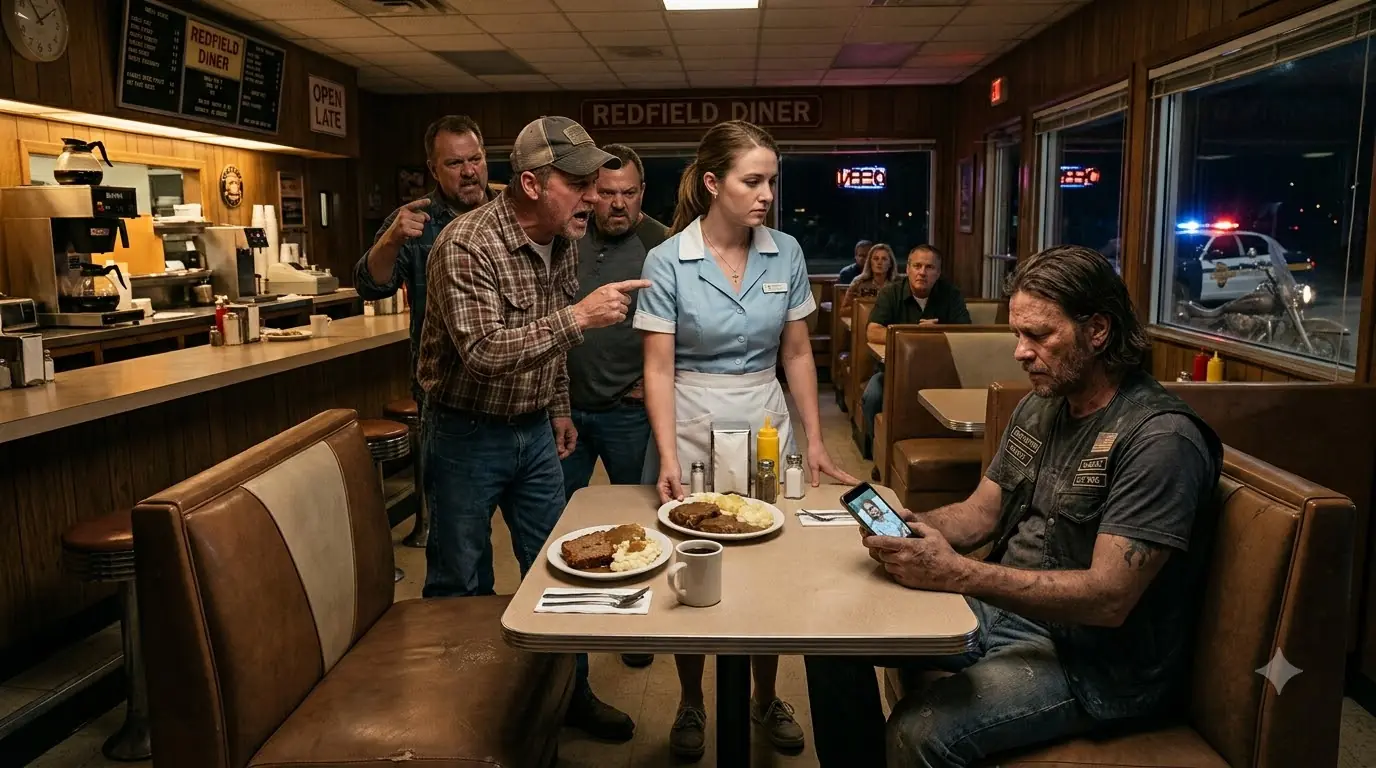
Inside the diner, local residents mocked him, insulted him, and accused him of stealing a wallet that had never been stolen.
Someone later sabotaged his motorcycle so he could not leave.
Only Chenise, the young woman who owned the diner, treated him with dignity.
Her kindness made the town turn against her, costing her customers and leaving hateful words across the front of the business her mother had built.
The same town also punished Caleb Foster, a fourteen-year-old boy who repaired the stranger’s motorcycle when every adult mechanic refused.
What Chenise and Caleb did not know was that the biker belonged to a family that never forgot an act of kindness.
Nearly eight hundred riders were already preparing to answer his call.
The rumble of motorcycles faded as Dylan Carter pulled into the gravel driveway outside Marcus Reed’s home.
He had spent ten long days on the road helping Marcus recover from a factory accident that had nearly cost him a leg.
The club had organized transportation, medical support, repairs around the house, and enough money to keep Marcus’s family stable until he could work again. That was what the brotherhood did.
Dylan switched off his engine. His leather vest clung to his back, damp with sweat and covered in dust from almost two thousand miles of highway.
He swung one leg over the motorcycle and stepped onto the gravel.
“Daddy’s home!”
Marcus’s son Tommy came running from the house. The seven-year-old crashed into his father’s legs and wrapped both arms around them.
“Easy, champ,” Marcus said with a laugh.
He ran one hand through the boy’s hair while trying not to place too much weight on his injured leg.
Marcus’s wife, Sarah, stood in the doorway. One hand rested against her hip while the other wiped tears from her face.
Dylan watched the family reunite.
He saw the way Tommy looked at his father as though Marcus had hung the moon. He saw Sarah’s expression change the moment her husband limped toward her.
Marcus’s smile was crooked and tired, but it was real.
Something tightened inside Dylan’s chest.
“You all right, brother?” Marcus called.
“Just tired,” Dylan answered.
He forced a smile.
“I should get moving.”
“Stay for dinner,” Sarah said. “I have a pot roast in the oven.”
“I cannot.”
Dylan started to explain, but his phone vibrated inside his pocket.
The vibration felt wrong. It was too persistent and too urgent.
He pulled out the phone.
His mother was calling.
Dylan’s stomach dropped.
“I need to take this.”
He stepped away from the family and walked toward the row of motorcycles parked beside the fence.
“Hey, Mom. What is it?”
“Dylan?”
Her voice cracked.
That one word carried fear, panic, and desperation.
Dylan tightened his grip on the phone.
“What happened?”
“It is Emma.”
A sob came through the line.
“She collapsed at school. They rushed her to Memorial Hospital.”
Dylan stopped breathing.
“What happened to her?”
“They think it is her appendix. It ruptured, Dylan.”
His mother struggled to continue.
“They have to operate immediately. They are taking her into surgery.”
The world tilted beneath him.
Dylan grabbed the fence post to keep himself upright.
“Dylan, are you still there?”
“I am coming.”
His voice sounded distant even to him.
“Tell her I am coming. Tell her Daddy is on his way.”
“Just get here, please. She keeps asking for you.”
The call ended.
Dylan stared at the dark phone screen.
Emma was his daughter, his little girl, and the only person left after his wife Rachel died three years earlier in a collision on Highway 9.
Emma was the reason Dylan woke up every morning. She was the reason he had fought through grief, remained sober, and kept his life moving forward when he had wanted to disappear.
Now she was in a hospital, frightened and critically ill.
He was two hundred miles away.
“Dylan?”
Marcus limped toward him.
“What happened?”
“It is Emma.”
Dylan’s words came out in broken pieces.
“She is in the hospital. Emergency surgery.”
“How far?”
“Two hundred miles.”
Marcus looked toward the highway.
“That is several hours, even without stopping. You have been riding for ten days, brother. You need rest.”
“I need to see my daughter.”
Dylan’s voice broke.
He swallowed and looked away.
“Sorry. I just have to go.”
Marcus gripped his shoulder.
“Then ride carefully.”
He met Dylan’s eyes.
“Call me when you get there.”
Dylan nodded because he could not speak.
He climbed onto his motorcycle with shaking hands. The engine roared to life, a sound that normally comforted him but now registered as little more than noise.
He pulled away from the house and headed for the highway.
The road stretched gray and seemingly endless beneath the late-afternoon sun.
Dylan rode as quickly as he could without surrendering completely to panic. His mind refused to remain quiet.
“Daddy, you are my superhero.”
Emma had said those words two weeks earlier before he left on the trip with the club.
She had drawn another picture for him. It showed two stick figures beside an enormous motorcycle, her tiny drawn hand resting inside his much larger one.
Dylan had attached the picture to the refrigerator with a star-shaped magnet.
“When are you coming home?” Emma had asked.
“Soon, baby. Very soon.”
But he had not returned soon.
He remained on the road because Marcus needed him and because the club never abandoned a brother in trouble.
Now Emma needed him, and he was hours away.
Dylan reached into his jacket and removed the photograph he carried everywhere.
Emma had been six when it was taken. She had a wide, gap-toothed smile and held up a crayon drawing of a motorcycle.
The photograph was creased from being folded and unfolded hundreds of times. Its edges had become soft from wear.
Dylan could not safely hold the picture while riding. He used a small piece of tape from the emergency roll he kept inside his jacket and secured it near the center of the instrument panel.
Emma’s face remained visible every time he glanced down.
“Hold on, baby girl,” he whispered. “Daddy is coming.”
The sun lowered toward the horizon. Orange light spread across the sky and reflected from the pavement.
Dylan continued riding.
His phone vibrated again.
The screen mounted near the handlebars showed a message from his mother.
“They are preparing her for surgery. Where are you?”
Dylan used the voice-response feature.
“Tell her I am on my way. A few hours.”
Another message appeared almost immediately.
“She is frightened, Dylan. She wants her daddy.”
The words struck him like a fist.
His vision blurred. He blinked rapidly and wiped his eyes with the back of his glove.
Another memory surfaced.
Emma had been four years old when she scraped her knee outside their apartment. Dylan picked her up, blew gently across the small cut, and assured her that everything was all right.
“You fixed it, Daddy,” she said. “You can fix anything.”
But he had not been able to save Rachel.
He could not bring Emma’s mother home or fill the space her death left inside their lives.
No matter how hard Dylan tried, he could not stop Emma from waking at night and calling for someone who would never answer.
He tightened his hands around the handlebars.
The road disappeared beneath him. Small towns came and went as the evening light faded.
His back hurt from ten days of riding. His fingers ached, and his eyes burned from wind and exhaustion.
None of it mattered.
He looked at Emma’s photograph.
Even in the weak light from the instrument panel, he could see her trusting smile.
She believed he could save anyone.
She believed he would never abandon her.
“I am trying, baby,” Dylan whispered into the wind. “I am trying.”
The sky changed from orange to purple and finally to .
Cold stars appeared overhead.
Dylan followed the white line through the darkness, racing against time and the terrifying possibility that he might arrive too late.
His phone vibrated again.
He did not look.
He kept riding.
Several hours later, Dylan’s body forced him to acknowledge what fear had allowed him to ignore.
His stomach twisted from hunger. The last thing he had eaten was a packaged sandwich at a gas station almost twelve hours earlier.
His hands had begun trembling against the handlebars.
That was dangerous.
If he did not eat, exhaustion could take him off the road before he reached Emma.
A neon sign appeared ahead.
MAMA’S KITCHEN.
Dylan slowed and turned into the gravel parking lot.
A roadside sign identified the town as having a population of slightly more than three thousand people.
Six cars and an old pickup truck were parked outside the diner. Every license plate appeared local.
Dylan switched off the motorcycle.
Silence settled over him so suddenly that his ears rang after hours of engine and wind noise.
Through the diner’s wide front windows, he saw families eating dinner, couples talking, and teenagers crowded together inside a corner booth.
They were ordinary people living ordinary lives.
Dylan looked down at himself.
His leather vest carried the Hells Angels patch. His boots were covered in road dust, and several days of stubble darkened his jaw.
He smelled like sweat, gasoline, and the highway.
Dylan checked his phone.
Another message waited from his mother.
“They are taking her in now. Surgery begins in twenty minutes.”
His chest tightened.
He remained approximately ninety miles away.
Even under ideal conditions, he had a long ride ahead.
But if he did not put food inside his body, he might never reach the hospital.
Dylan pocketed the phone and pushed open the diner door.
The small bell above it chimed.
Every conversation stopped.
Dylan remained in the doorway as more than twenty pairs of eyes turned toward him.
A woman pulled her young daughter closer. The teenagers in the corner booth became silent.
An elderly man sitting at the counter rotated his entire body to study the stranger.
The only remaining sound was food sizzling on the griddle behind the counter.
“Hello,” Dylan said.
His voice sounded rougher than he intended.
“I need something to take with me. A sandwich would be fine.”
Nobody answered.
A young woman emerged from the kitchen while wiping her hands against her apron. She appeared to be in her mid-twenties and wore her hair in a neat bun.
The name tag on her uniform read CHENISE.
Her eyes met Dylan’s.
Surprise and caution briefly crossed her face. Then she offered a professional smile.
“Welcome to Mama’s Kitchen.”
Her voice carried a warmth that felt impossible inside the frozen room.
“You may sit anywhere you like.”
“I do not need a table,” Dylan said. “I only need something quick.”
“I insist.”
Chenise pointed toward an empty booth near the corner.
“You look like you have been traveling for a long time. Sit down and let me take care of you.”
Dylan glanced around.
The stares had not softened.
“Maybe I should leave.”
“Sit,” Chenise said.
Her tone remained polite, but it made clear that she did not consider the instruction negotiable.
Dylan nodded and walked toward the booth.
His boots struck heavily against the linoleum. Each step seemed to echo.
He slid onto the vinyl seat and attempted to make himself smaller.
It did not work.
“Chenise.”
A woman’s voice cut sharply through the room.
“What are you doing?”
Chenise turned toward a middle-aged woman in a floral dress seated three booths away.
“I am serving a customer, Mrs. Patterson.”
“That is not a customer.”
Mrs. Patterson looked directly at Dylan.
“Look at him. He is one of those bikers.”
“So?”
Chenise’s smile remained, but Dylan heard steel beneath it.
“We do not want people like him in here.”
Mrs. Patterson stood. Her husband reached for her arm, but she pulled away.
“Tom, do not stop me. Someone needs to say it.”
One of the teenagers laughed.
“He looks like he crawled out of a dumpster.”
His friends snickered.
A father near the counter abruptly stood and pulled his two children toward the entrance.
“We are leaving.”
“But Dad, I have not finished—”
“Now.”
The bell chimed as the family walked out.
It chimed again when another couple followed.
Dylan clenched his hands beneath the table.
He should leave.
He should get onto his motorcycle and find food somewhere else.
Then Emma’s face appeared inside his mind.
He needed enough strength to reach her.
Chenise stopped beside his table with a notepad.
She clicked her pen.
“What can I bring you?”
“I do not want trouble.”
“You will not have trouble here.”
She examined him.
“A hungry man who has traveled that far needs an actual meal. The meatloaf special comes with mashed potatoes, green beans, and cornbread.”
Dylan’s stomach answered loudly enough for several people to hear.
“That sounds good, but I need it quickly. I am trying to get to—”
“I will ask Miguel to rush it.”
Chenise wrote the order.
“Coffee while you wait?”
“Please.”
She started to leave, then turned back.
“My mother used to say that every person who enters this place deserves respect until they prove otherwise.”
Chenise raised one eyebrow.
“Have you proved otherwise?”
Dylan shook his head.
“Then you are good with me.”
She walked toward the kitchen.
“Chenise!”
Mrs. Patterson’s voice struck like a whip.
“If you serve him, we are filing a complaint with the owner.”
Chenise stopped.
She turned slowly.
“I am the owner, Mrs. Patterson.”
The room became quiet again.
“This was my mother’s place, and now it belongs to me.”
Chenise’s smile disappeared.
“I will serve anyone I choose.”
Mrs. Patterson’s face reddened.
“Well, I never—”
“Your meal is on the house,” Chenise said. “Have a blessed evening.”
Then she disappeared into the kitchen.
Whispers spread across the diner.
Dylan heard fragments.
“Dangerous.”
“He probably has weapons.”
“Our tax money supports this place.”
The old man near the window struck his cane against the floor.
The sharp crack startled everyone.
“This is what is wrong with the world,” he declared.
His voice shook with age and anger.
“We used to have standards.”
He pointed the cane toward Dylan.
“We knew who belonged and who did not.”
His expression twisted with disgust.
“We certainly did not allow people like that to sit where decent families eat.”
Dylan’s jaw tightened.
His hands became fists beneath the table.
Do not react.
Do not give them what they want.
Think about Emma.
Chenise returned with a mug and a coffee pot. She placed the mug in front of Dylan and filled it with steady hands.
“Cream or sugar?”
“ is fine.”
“Your meal will be ready in ten minutes.”
“Thank you.”
Dylan wrapped both hands around the warm mug.
“You did not have to defend me.”
“Yes, I did.”
Chenise met his eyes.
“My mother taught me to recognize right from wrong.”
She gestured around the diner.
“This is wrong.”
“You are sitting quietly and asking for a meal. That is not wrong.”
One of the teenagers pushed back his chair.
“This is ridiculous,” he announced. “I am not eating beside some biker.”
His friends followed him toward the door, laughing loudly.
The bell chimed repeatedly.
Within five minutes, half the diner had emptied.
Families left. The teenagers left.
Mrs. Patterson and her husband also departed, although she slammed the door hard enough to shake the front windows.
Dylan stared into his coffee.
“I am sorry.”
“For what?”
“I am costing you customers.”
Chenise refilled the mug even though he had barely touched the coffee.
“Anyone who leaves because I treated you like a human being may stay gone.”
The elderly man with the cane remained, glaring from across the room. A young couple sat in a corner whispering while casting nervous looks toward Dylan.
One man at the counter continued eating pie as though nothing unusual had happened.
The kitchen door opened.
A middle-aged Hispanic man leaned through it.
“Chenise, are you all right?”
“I am fine, Miguel.”
She looked toward him.
“How is the meatloaf?”
“Five minutes.”
Dylan checked his phone.
There were no new messages.
That could mean the surgery was proceeding normally.
It could mean something had gone terribly wrong.
He forced himself not to imagine either possibility.
The front door chimed.
Dylan looked up, expecting another customer to leave.
Instead, Mrs. Patterson stormed back inside with her husband following several steps behind.
“There he is!”
She marched directly toward Dylan’s booth.
Her finger pointed at him like a weapon.
“I knew something was wrong.”
Dylan placed his fork on the table.
“Ma’am, I do not know what—”
“My wallet is gone.”
Her voice filled the diner.
“I reached my car and realized it was missing.”
She jabbed her finger toward him.
“You are the only person who could have taken it.”
“I have not moved from this booth.”
Dylan kept his voice controlled.
“I did not touch your wallet.”
“Liar.”
Mrs. Patterson’s face became red.
“Thief.”
She turned toward her husband.
“Tom, call the police right now.”
Her husband reluctantly removed his phone.
“Honey, perhaps you misplaced it.”
“Call them.”
Chenise hurried from behind the counter.
“Mrs. Patterson, he has been sitting here in plain sight. I watched him the entire time.”
She stepped between the woman and Dylan.
“He did not take anything.”
“Of course you would defend him.”
Mrs. Patterson spun toward her.
“You allowed this criminal into the diner.”
“He is not a criminal.”
“He is a biker,” Mrs. Patterson shouted. “They are all criminals.”
She pointed toward Dylan again.
“Look at him. Of course he took my wallet.”
Dylan forced himself to remain seated.
Think about Emma.
Only Emma.
“The police are coming,” Tom Patterson said quietly.
Mrs. Patterson began pacing.
“My wallet contained three hundred dollars, my credit cards, and my driver’s license.”
She glared toward Dylan.
“He probably gave it to one of his friends outside.”
“There is nobody outside,” Miguel said from behind the counter. “Only his motorcycle.”
“Then he hid it.”
Mrs. Patterson turned toward the room.
“Search him.”
Dylan slowly stood with both hands visible.
“You want the police to search me? Fine.”
“Do not come near me,” Mrs. Patterson said, stumbling backward.
Dylan stopped.
The wait felt endless.
Mrs. Patterson paced and muttered about criminals, motorcycle clubs, and how unsafe the town had become.
Her husband sat near the door with his head in his hands.
Chenise stood beside Dylan’s booth with her arms folded.
“This is absurd,” she said.
“It is fine,” Dylan replied.
“I am accustomed to it.”
“You should not have to be.”
Dylan checked the time.
Every minute inside the diner was another minute Emma remained inside surgery without him.
His leg moved restlessly beneath the table.
Come on.
Several minutes later, the bell rang.
Two police officers entered.
The older one appeared to be about fifty and had a thick mustache. The younger officer was lean, with sharp features and pale blue eyes.
His attention immediately settled on Dylan’s vest.
“Someone reported a theft,” the older officer said.
“Yes.”
Mrs. Patterson rushed forward.
“He stole my wallet.”
She pointed toward Dylan.
“I left here fifteen minutes ago and noticed it was missing when I reached my car.”
The younger officer rested one hand near his belt.
His eyes remained fixed on Dylan and the Hells Angels patch.
“Sir, step away from the booth, please.”
“I did not take anything.”
Dylan moved slowly.
“I have been sitting here the entire time.”
“Step away from the booth.”
Dylan complied.
The older officer glanced over his leather vest, dusty boots, and tired face.
“Ma’am, when did you last see the wallet?”
“I had it when I paid for dinner.”
Mrs. Patterson clutched her purse.
“I remember putting it back inside.”
“You checked the purse thoroughly?”
“Of course I did.”
The officer looked toward Dylan.
“Sir, empty your pockets and place everything on the table.”
Dylan slowly removed his wallet, keys, phone, roll of tape, coins, and a crumpled receipt.
Emma’s smiling face appeared on the phone’s lock screen.
The younger officer examined each object.
He opened Dylan’s wallet and checked the identification and cards.
Everything carried Dylan’s name.
The wallet contained twenty-three dollars.
There was nothing belonging to Mrs. Patterson.
“Check his jacket,” she demanded. “He probably hid it there.”
The older officer gestured.
“Sir, the vest.”
Dylan removed it and handed it over.
The officer checked every pocket.
Nothing.
“Search his motorcycle,” Mrs. Patterson said.
The younger officer frowned.
“We cannot search his vehicle without consent or sufficient cause.”
“He is a Hells Angel. Is that not sufficient?”
“No, ma’am.”
His voice hardened.
“That is not how the law works.”
Mrs. Patterson’s face darkened.
“This is unbelievable. He stole my wallet, and you are allowing him to leave.”
“We have found no evidence that a theft occurred,” the older officer said.
He held up one hand.
“Are you absolutely certain that you had the wallet when you left?”
“Yes.”
“And you checked every section of your purse?”
“I know where I keep my wallet.”
“Check again.”
The instruction was no longer a suggestion.
Mrs. Patterson opened the purse and began moving its contents.
Lipstick, receipts, tissues, and keys appeared.
“See? Nothing.”
She shoved everything back inside.
“He took it.”
“Check beneath your booth,” Miguel suggested.
“Sometimes objects fall and slide beneath the seat.”
“That is ridiculous.”
“Please check,” the older officer said.
His patience was disappearing.
Mrs. Patterson marched toward the booth where she had eaten. Her husband knelt beside her.
“There is nothing here,” she said.
“This entire situation is a complete waste of—”
She stopped.
Mrs. Patterson reached beneath the seat.
When she stood, a brown leather wallet rested inside her hand.
The diner became silent.
She stared at it.
Her mouth opened and closed.
The older officer’s mustache moved slightly.
“Is that your wallet?”
“Yes, but I do not understand.”
Mrs. Patterson held it against her chest.
“It must have fallen when I stood.”
“So it was not stolen?”
“No, but given the circumstances—”
The younger officer interrupted.
“Do you understand that you reported a crime that did not occur?”
Her face paled.
“I made an honest mistake.”
“You accused this man of theft and required officers to respond.”
The older officer’s voice had become stern.
“You could face consequences for knowingly making a false accusation.”
“I genuinely believed he took it.”
Mrs. Patterson looked toward Dylan.
“Anyone would have thought the same. Just look at him.”
“That is enough,” the officer said.
He pointed toward the door.
“Leave before I reconsider how this should be handled.”
Mrs. Patterson grabbed her husband’s arm and hurried toward the exit.
As she passed Dylan, she muttered, “He still looks suspicious.”
The door slammed behind her.
The older officer turned toward Dylan.
“You are free to leave.”
He exhaled.
“I am sorry for the inconvenience.”
Dylan nodded.
His hands shook while he collected his property from the table.
The younger officer was already leaving.
The older one paused at the door.
“Whatever you are rushing toward, get there safely.”
Then both officers were gone.
The diner remained silent except for the hum of a refrigerator.
Dylan sat down heavily.
His entire body trembled from adrenaline, relief, exhaustion, and anger.
Chenise slid into the booth across from him.
“Are you all right?”
“No.”
His voice came out hoarse.
“I need to leave. I need to reach my daughter.”
“I understand.”
Chenise looked toward his untouched plate.
“But the food is cold.”
She stood.
“Miguel is preparing a fresh meal.”
“I do not have time.”
“You will take five minutes.”
Her voice was gentle but firm.
“You cannot help your daughter if you lose consciousness on the highway.”
Dylan wanted to argue.
She was right.
His vision had begun to soften around the edges.
He nodded.
Chenise placed one hand against his shoulder.
“You are almost there. Hold on a little longer.”
Miguel brought out another plate five minutes later.
Steam rose from the meatloaf and mashed potatoes. Butter glistened against the vegetables.
The smell should have made Dylan hungry, but fear had tied his stomach into a knot.
He forced himself to eat.
The diner was now empty except for Dylan, Chenise, and Miguel.
The remaining customers had slipped away during the police confrontation, leaving money beside their plates.
Chenise cleared tables with practiced movements, but Dylan saw tension across her shoulders.
“I am sorry,” he said.
Chenise looked up.
“For what?”
“For all of this.”
Dylan gestured toward the empty booths.
“I cost you your customers.”
“You did nothing.”
She carried a stack of dishes toward the kitchen.
“They made their own choices.”
Miguel appeared while removing his apron.
“I am taking the trash out, and then I should go home. My daughter has a school event tomorrow.”
“Go ahead,” Chenise said. “Thank you for staying.”
Miguel nodded toward Dylan.
“Take care of yourself. I hope your child is all right.”
Dylan could not speak past the pressure inside his throat.
He nodded.
The back door closed.
Only Dylan and Chenise remained.
She poured herself coffee and sat across from him.
“You do not need to eat quickly,” she said. “Finish properly.”
“I should go.”
Still, Dylan took another bite.
His body needed fuel even while his mind demanded movement.
“How old is your daughter?” Chenise asked.
“Seven. She turns eight next month.”
“What is her name?”
“Emma.”
Speaking the name tightened his chest.
“Emma Grace Carter.”
“That is beautiful.”
Dylan unlocked his phone and turned it toward Chenise.
Emma smiled from her school photograph, showing the missing front teeth.
Chenise’s expression softened.
“She is precious.”
“She is everything.”
Dylan’s voice broke.
“She is all I have left.”
Chenise waited without pressing him.
“My wife died three years ago.”
The words escaped before Dylan decided to share them.
“A driver crossed the highway median and struck her car.”
He stared at Emma’s photograph.
“Rachel was returning from her sister’s house.”
Dylan swallowed.
“Emma was with me that day. She was four and did not understand why her mother was never coming home.”
“I am sorry.”
“It has been the two of us ever since.”
Dylan set down the phone.
“Emma and me against the world.”
He lowered his eyes.
“I try to be a good father. I try to be there.”
“Sometimes the club needs me, and I leave.”
“She says she understands, but she is seven. She should not have to understand.”
Chenise reached across the table and rested her hand over his.
“You received the call, and you started riding immediately.”
“You have been traveling through the night to reach her.”
“That matters.”
“I am still two hours away.”
Dylan pulled back his hand and covered his face.
“She is in surgery, and I am sitting inside a diner eating meatloaf.”
His voice cracked.
“What kind of father does that make me?”
“A human one.”
Chenise’s voice remained calm.
“You needed food.”
“You cannot protect her if you collapse before reaching the hospital.”
Dylan lowered his hands.
“Everyone sees the patch and decides I am a criminal.”
He touched the edge of his vest.
“They think all of us are violent or dangerous.”
He looked at Emma’s picture.
“I am only a father trying to raise his daughter.”
“The club is my family. They help when money is tight or when one of us is injured.”
“They are good people, but strangers rarely see any of that.”
“They see the patch and decide who I am before I speak.”
“I see you,” Chenise said.
She leaned closer.
“I see a father frightened for his child.”
“I see someone who has ridden for ten days and still refuses to stop until he reaches the hospital.”
“That is not a criminal.”
“That is a good man.”
Dylan’s eyes burned.
“You do not know me.”
“I know enough.”
Chenise stood and walked behind the counter.
She returned carrying a small paper bag.
“Here.”
“What is it?”
“Dessert.”
She placed it beside him.
“Two slices of my mother’s pecan pie.”
“One for you and one for Emma when she feels better.”
Dylan stared at the bag.
“I cannot accept this. You have done too much already.”
“I have done nothing extraordinary.”
Chenise smiled sadly.
“I treated you like a human being.”
“That should not be extraordinary.”
She looked around the diner.
“My mother ran this place for thirty years.”
“She always said every person who enters has a story, people they love, and a life nobody else understands.”
“She told me never to forget that.”
“She sounds wise.”
“She was.”
Chenise’s eyes became distant.
“I lost her to cancer two years ago.”
She gave a soft laugh.
“Some days I still hear her in the kitchen telling me I am using too much salt.”
Chenise gestured around the empty room.
“This diner is what I have left of her.”
“The recipes, the tables, and the people who come through the door.”
“It is her legacy.”
“She would be proud of you,” Dylan said.
“What you did tonight required courage.”
Chenise shrugged.
“I did what was right.”
“My mother taught me that too.”
Dylan finished the meal and checked his phone.
There were still no updates.
The surgery had lasted more than an hour.
He stood and removed his wallet.
“Do not even think about it,” Chenise said.
She waved his money away.
“The meal is free.”
“I need to pay something.”
“You need to get to your daughter.”
Chenise pointed toward the door.
“Be there when she wakes. That will be payment enough.”
Dylan’s throat tightened.
“Thank you for the food, for defending me, and for treating me like a person.”
“You are a person.”
She walked him toward the entrance.
“And Dylan, when Emma recovers, bring her here.”
“I want to meet the girl with such a devoted father.”
Dylan could not speak.
He nodded.
Chenise opened the door.
“Ride carefully.”
She pointed toward the paper bag.
“My number is written on the receipt inside.”
“Send a message when you arrive so I know you made it.”
Dylan walked across the parking lot.
Cool night air touched his face.
He removed the motorcycle keys.
Then he saw the rear tire.
It was completely flat.
“What happened?”
Dylan crouched beside it.
Even under the weak parking-lot light, he could see that the valve had been deliberately loosened.
A long scratch marked the engine casing.
He opened the side cover.
Several ignition wires had been pulled loose. The oil cap was missing, and dirt had been poured into the reservoir.
Someone had deliberately disabled the motorcycle while he was inside.
It might have happened during the confrontation with Mrs. Patterson or while the police questioned him.
Dylan’s hands shook with rage.
Anger would not repair the motorcycle.
It would not take him to Emma.
He checked the time.
The surgery had already been underway for more than an hour, and he remained ninety miles away.
Dylan inhaled slowly.
Think.
Do not panic.
He needed a mechanic.
He returned to the diner.
Chenise was wiping the final table.
She looked up.
“Did you forget something?”
“Someone sabotaged my motorcycle.”
Dylan’s voice was flat.
“The tire is disabled, and the engine has been tampered with.”
“I need a mechanic. Is anyone still open?”
Chenise’s face fell.
“Are you serious?”
“Yes.”
She immediately removed her phone and searched through her contacts.
“Try Benson’s Auto Repair. It is three blocks down Main Street.”
She showed him the address.
“Bill Benson owns it. He sometimes works late.”
“Tell him I sent you.”
“Thank you.”
The motorcycle could not be ridden.
Dylan took the handlebars and began pushing.
More than six hundred pounds of dead weight resisted every step.
His shoulders immediately began hurting, but he continued.
Main Street was nearly empty.
A few passing vehicles slowed to observe him. None stopped.
A Hells Angels biker pushing a broken motorcycle through town at night gave them an image they could interpret however they wished.
Benson’s Auto Repair appeared ahead.
A large red sign stood over two garage bays. Light spilled from one of them.
Dylan pushed the motorcycle up the driveway.
A man wearing coveralls was working beneath the hood of a pickup truck.
He appeared to be in his fifties, with gray hair and thick forearms.
“Excuse me,” Dylan called. “Are you Bill Benson?”
The man straightened.
His eyes immediately moved toward Dylan’s vest.
His expression hardened.
“We are closed.”
“Someone sabotaged my motorcycle.”
Dylan struggled for breath.
“My daughter is in emergency surgery. I need to reach the hospital.”
“I said we are closed.”
Bill wiped his hands against a rag and stopped looking at him.
“Chenise sent me from Mama’s Kitchen.”
“I do not care who sent you.”
Bill’s voice became colder.
“I do not work on motorcycles for Hells Angels members.”
“Not during business hours and certainly not after closing.”
“I will pay whatever you ask.”
“It is not about money.”
Bill walked toward a workbench and increased the distance between them.
“It is about principle.”
“I do not do business with criminals.”
“I am not a criminal.”
Dylan’s voice tightened.
“I am a father trying to reach his child.”
“You wear the patch. That tells me enough.”
Bill picked up a wrench.
It was not quite a threat, but the intention was clear.
“Remove the motorcycle from my property before I call the police.”
Dylan wanted to argue.
He wanted to make the man understand.
The expression on Bill’s face told him the decision would not change.
Dylan took the handlebars and returned to the street.
His phone vibrated.
A message from his mother appeared.
“The surgery is taking longer than expected. She is fighting. Where are you?”
Dylan typed with one thumb.
“Motorcycle problems. Coming as fast as possible.”
The map showed another business several blocks away.
Jackson’s Garage.
Dylan continued pushing.
His arms burned. His back ached, and sweat moved into his eyes despite the cool air.
Jackson’s Garage was smaller, with one bay inside an older building.
A thin man in his sixties was lowering the garage door when Dylan arrived.
“Please wait,” Dylan called. “I need help.”
The man turned.
His eyes settled on the patch, and he took one step backward.
“We do not serve bikers.”
“Please listen.”
“I said no.”
The man’s voice shook with fear or anger.
“My son joined a motorcycle gang ten years ago.”
Pain crossed his face.
“He ended up dead beside a road.”
“So no, I will not help any of you.”
“I am sorry about your son, but I did not—”
“Get away from my business.”
The man’s voice broke.
“Leave before I call the police.”
He pulled the garage door down.
The metal crashed into place.
The lock clicked, and the interior lights went out.
Dylan stood alone inside the darkness.
His legs felt weak.
He wanted to collapse against the pavement.
Emma was waiting.
He checked the time.
Another repair business appeared on the map near the edge of town.
Morgan’s Repair.
Dylan pushed onward.
The streets became darker as the buildings spread farther apart.
His phone vibrated.
“Complications. Doctors say it is serious. Please hurry.”
Dylan’s vision blurred.
He continued.
Morgan’s Repair finally came into view.
It was completely dark.
A sign on the chain-link fence listed business hours from eight in the morning until five in the afternoon.
Dylan shook the gate.
“Hello?”
Nothing moved.
“Is anyone here?”
No answer came.
Dylan searched his phone for another mechanic.
The map displayed nothing else nearby.
He lowered himself against the fence with the motorcycle beside him.
His body shook from exhaustion, fear, and despair.
He had failed.
He would not reach Emma.
He had not been there when Rachel died, and now he would be too late for his daughter.
A distant engine interrupted his thoughts.
Dylan looked toward the end of the road.
A small building stood beyond the darkness with a single light glowing inside.
A hand-painted sign read FOSTER’S GARAGE.
The business did not appear on the map.
It was too small, too old, or too informal.
But the light was on.
Dylan forced himself upright.
One last attempt.
He pushed the motorcycle toward the building.
The garage was little more than a large shed. Tools were scattered across the walls, an old car rested on blocks, and years of oil stains marked the concrete floor.
A boy of approximately fourteen stood over a lawnmower engine. He wore coveralls several sizes too large and hummed while turning a wrench.
Dylan pushed the motorcycle into the pool of light.
The boy looked up.
They studied each other.
Dylan was exhausted, desperate, and dressed in leather carrying a motorcycle-club patch.
The boy held a wrench and looked surprised.
Then he smiled.
“Your motorcycle looks rough.”
He stepped closer.
“What happened?”
“Someone sabotaged it.”
Dylan’s voice broke.
“I need help. My daughter is in the hospital.”
The boy stood and wiped his hands against his coveralls.
“Let me examine it.”
No hesitation.
No judgment.
No fear.
Relief moved through Dylan so sharply that his knees weakened.
“You are not afraid of me?”
The boy looked at him carefully and shrugged.
“My mother says anyone can need help.”
“It does not matter where they come from or what they look like.”
He approached the motorcycle.
“My name is Caleb Foster.”
“Dylan Carter.”
Caleb inspected the engine and tire with experienced eyes.
“This is definitely sabotage, but I can repair most of it.”
He crouched.
“It may take thirty or forty minutes.”
Dylan stared at him.
“You can fix it?”
“Sure.”
Caleb grinned.
“Motorcycles are easier than cars.”
He pointed toward the doorway.
“Let us bring it inside while I still have enough light.”
In the darkest moment of the night, with his daughter ninety miles away and his motorcycle destroyed, Dylan found someone willing to help.
It was not a trained adult mechanic with a large business.
It was a fourteen-year-old boy named Caleb Foster.
Caleb pushed the motorcycle into the garage with surprising strength.
He positioned a rolling stool beside it and immediately began examining the damage.
“Someone did a serious job on this.”
He whistled softly.
“They loosened the tire valve, disconnected ignition wiring, and put dirt inside the oil system.”
Caleb looked up.
“That seems personal.”
“What did you do to make them so angry?”
“I entered a diner.”
Dylan’s voice carried bitterness.
“That was all.”
Caleb studied Dylan again.
His eyes moved from the patch to the man’s face.
“I understand.”
He returned to the engine.
“People see what they expect to see. The truth does not always matter to them.”
Dylan watched the boy’s hands move confidently across the machine.
“How old are you?”
“Fourteen. Fifteen next month.”
Caleb cleaned the contaminated parts.
“I have worked on engines since I was eight.”
“My father taught me before he died.”
“I am sorry.”
“It was six years ago.”
Caleb continued working.
“My mother has two jobs. I run the garage after school and on weekends.”
“It helps with the bills.”
Dylan felt pressure inside his chest.
The boy was fourteen, helping support his mother, maintaining a business, and still willing to assist a stranger every adult had rejected.
“You genuinely are not frightened by the patch?” Dylan asked.
Caleb paused.
“Should I be?”
“Most people think so.”
“Most people are foolish.”
Caleb turned back to the motorcycle.
“My mother says to judge people by their behavior.”
“So far, you asked for help reaching your daughter.”
“That does not sound threatening.”
Dylan looked away before Caleb could see his eyes.
“What happened to your daughter?” Caleb asked.
“Her appendix ruptured.”
Dylan swallowed.
“She is seven.”
Caleb’s hands stopped briefly.
“That is serious.”
“My cousin had the same operation last year. It frightened everyone, but he recovered.”
Caleb looked toward him.
“The doctors know what they are doing.”
“I hope so.”
“How far is the hospital?”
“Ninety miles.”
Caleb whistled.
“How far did you push the motorcycle?”
“A mile or two. I stopped counting.”
Caleb shook his head.
“You must love your daughter very much.”
“She is everything.”
Dylan showed him the photograph on his phone.
Caleb’s face softened.
“She looks like a fighter.”
“She is.”
“Then she will make it.”
Caleb said it with such certainty that Dylan almost believed him.
“Let me finish this so you can reach her.”
Caleb worked quickly but carefully.
He talked while repairing the engine, providing a steady stream of commentary that helped Dylan remain calm.
“I need to remove the dirt from the oil system first.”
He pointed toward the open casing.
“The good news is that they did not cause permanent damage. They contaminated it, but the engine itself looks intact.”
Caleb smiled.
“They did not know enough to do worse.”
“How did you learn all of this?”
“My father taught me the basics.”
Caleb reached for another tool.
“After that, videos, manuals, and trial and error.”
He laughed.
“Mostly error at first.”
“I destroyed a lawnmower engine when I was ten.”
“My mother was furious, but I learned.”
“Your mother raised an intelligent boy.”
“The decision about whether I am good is still being reviewed.”
Caleb smiled.
Dylan’s phone vibrated.
He grabbed it.
“Out of surgery. Doctor wants to speak with you. Call me.”
Dylan’s hands shook so badly that the phone nearly fell.
He called immediately.
His mother answered after the first ring.
“What did the doctor say?”
“She survived the operation.”
Dylan closed his eyes.
“But it was close.”
His mother’s voice trembled.
“The infection spread farther than they expected. They had to remove part of her intestine.”
“She is inside intensive care now.”
“Still critical.”
Dylan lowered himself onto the concrete floor.
“But she is alive.”
His voice barely worked.
“She is alive?”
“She is fighting, but you need to come.”
His mother began crying.
“Even while sedated, she keeps saying ‘Daddy.’”
“The nurses think hearing your voice may help when she wakes.”
“I am coming.”
Dylan looked toward Caleb.
“My motorcycle broke down, but someone is repairing it.”
“I will be there.”
“Tell her Daddy is coming.”
“Hurry.”
The call ended.
Dylan remained seated with the phone between his hands.
Emma was alive.
She was also still in danger.
“Are you all right?” Caleb asked.
“She survived surgery.”
Dylan looked up.
“She is inside intensive care.”
“Then we need to move faster.”
Caleb returned to the motorcycle with renewed concentration.
“I have almost finished cleaning the system.”
“I need to reconnect the ignition, repair the tire, and test everything.”
His hands moved rapidly.
“The tire is the difficult part.”
Caleb examined it.
“I do not have a replacement in the correct size, but I can make a temporary repair strong enough for the trip.”
“That is all I need.”
Caleb retrieved a repair kit.
“You have any other children?”
“Only Emma.”
Dylan watched him work.
“Her mother died three years ago.”
“I am sorry.”
“It is difficult raising a child alone,” Dylan said. “But she is worth every hard day.”
“She is fortunate to have you.”
“Any father would make this trip.”
Caleb’s voice became quiet.
“Not every father would.”
There was pain behind the words.
Before Dylan could ask, Caleb stood and pulled over an air compressor.
“Moment of truth.”
The tire slowly inflated.
Caleb examined every section.
“It is holding.”
He smiled.
“Now we test the engine.”
Caleb climbed carefully onto the motorcycle. His feet barely reached the ground.
He turned the key.
The engine coughed twice.
Then it roared to life.
The sound was the most beautiful thing Dylan had heard all night.
Caleb listened while the engine ran, then switched it off.
“It sounds good.”
He climbed down.
“You should reach the hospital without a problem, but ride carefully and stop if the tire begins losing pressure.”
Dylan stood.
Relief made his body weak.
“How much do I owe you?”
“Nothing.”
“What?”
“You owe nothing.”
Caleb wiped his hands.
“Reach your daughter. That is payment.”
“You spent almost an hour repairing my motorcycle.”
Dylan opened his wallet.
“You need to accept something.”
“You can repay me by reaching the hospital before she wakes.”
Caleb’s voice remained firm.
“Give her a hug from me.”
Dylan could not speak.
Caleb smiled.
“You have suffered enough tonight. I will not make it worse by charging you.”
Dylan removed all the cash he had.
Twenty-three dollars.
He held it out.
“It is not much, but please take it.”
Caleb gently pushed his hand away.
“Use it to buy your daughter flowers or candy when she leaves the hospital.”
“I do not know how to thank you.”
“Do not thank me.”
Caleb looked toward the motorcycle.
“Ride carefully.”
Then he grinned.
“When your daughter asks what happened, tell her Caleb Foster repaired the bike.”
“I want her to know that decent people still exist.”
Tears moved down Dylan’s face.
He wiped them away, but more followed.
“Are you all right, Mr. Dylan?”
“Yes.”
His voice shook.
“You are a remarkable kid.”
“Your mother raised you correctly.”
“I know.”
Caleb laughed.
“She reminds me every day.”
Dylan climbed onto the motorcycle and started the engine.
“Mr. Dylan,” Caleb called.
Dylan looked back.
“Stop for fuel before the tank becomes too low.”
“I will.”
“And your daughter is going to recover.”
Caleb stood inside the doorway.
“I can feel it.”
Dylan nodded.
He raised one hand before pulling into the street.
Caleb waved from beneath the single garage light, a thin fourteen-year-old wearing oversized coveralls and smiling as though he had accomplished something extraordinary.
He had.
Dylan returned to the highway.
Emma’s photograph remained taped near the instrument panel.
“Daddy is coming, baby girl.”
He rode through the night, resisting the urge to allow panic to make the journey even more dangerous.
The miles slowly disappeared.
His mother sent messages asking for his location, but Dylan responded only when he could do so safely.
The highway passed through farmland beneath a full moon. Dark fields stretched on both sides.
Under different circumstances, the view might have been beautiful.
Dylan saw only Emma’s face.
He remembered her calling him Daddy with the faint lisp she still had. He remembered how she climbed into his lap when frightened and trusted him to make the world safe.
He had not been present when she collapsed.
He had not been inside the ambulance.
He had not held her hand before surgery.
He would be there when she woke.
The city lights finally appeared.
Signs directed him toward Memorial Hospital.
The motorcycle’s engine continued running smoothly. Caleb’s temporary tire repair held.
Dylan followed the hospital signs and entered the parking area.
He stopped inside a motorcycle space near the entrance and switched off the engine.
His legs nearly failed when he stepped down.
After days on the road, every muscle in his body hurt.
He ignored it.
Dylan ran through the automatic doors.
The lobby was painfully bright after hours of darkness.
A reception desk stood ahead, elevators to the right, and rows of uncomfortable chairs to the left.
Dylan reached the desk.
“Emma Carter.”
He struggled for breath.
“My daughter. Emma Grace Carter.”
“She had emergency surgery. Where is she?”
The young woman wearing scrubs looked startled by his appearance.
Her eyes moved across his leather vest, exhausted face, and unshaven jaw.
“Sir, I need you to calm down.”
“I am calm.”
He was not calm.
“My daughter is seven years old. Her appendix ruptured.”
“Please tell me where she is.”
The receptionist typed.
“What was the last name?”
“Carter.”
Dylan spelled it.
“Emma Grace Carter.”
The woman’s expression changed from caution to sympathy.
“She is inside intensive care on the fourth floor.”
Dylan moved toward the elevators.
“Sir, you need to sign—”
He pressed the elevator button repeatedly.
The doors opened.
Dylan stepped inside and selected the fourth floor.
His reflection appeared in the polished metal walls.
He looked exactly like the type of person security might stop.
His eyes were bloodshot, his face pale, and his clothing covered in road dirt.
None of it mattered.
The elevator opened onto the intensive-care unit.
The corridor was quiet and dim. Machines beeped behind closed doors.
An older nurse at the central station looked up.
“You cannot enter without authorization. This is intensive care.”
“I am family.”
Dylan approached.
“Dylan Carter. Emma Carter is my daughter.”
Recognition crossed the nurse’s face.
“Mr. Carter.”
She stood.
“Your mother said you were coming.”
The nurse moved from behind the desk.
“Follow me.”
Dylan walked beside her down the corridor.
She stopped outside room 412.
“Your daughter survived surgery, but the procedure was complicated.”
The nurse spoke carefully.
“The infection spread farther than expected.”
“They removed a damaged portion of her lower intestine.”
Dylan’s hands shook.
“But she is alive.”
“She is alive.”
The nurse’s expression softened.
“She remains critical, but her condition is stable.”
“She is sedated so her body can rest.”
“Your mother is inside.”
Dylan nodded.
The nurse opened the door.
Emma lay inside a small bed surrounded by monitors and intravenous lines.
She looked tiny beneath the white sheets.
Her face was pale, and dark circles showed beneath her eyes.
Wires and tubes connected her to the machines around her.
Her chest rose and fell.
She was breathing.
Dylan’s mother sat beside the bed holding Emma’s hand.
She looked up.
Her face collapsed with relief.
“Dylan.”
He crossed the room in three steps.
Dylan dropped to his knees beside the bed and took Emma’s other hand.
It felt impossibly small inside his.
He pressed it against his face.
“I am here, baby girl.”
Tears moved freely down his cheeks.
“Daddy is here.”
“I am sorry it took so long.”
His mother placed one hand against his shoulder.
“She kept asking for you.”
“Even under the sedation, she said ‘Daddy’ again and again.”
“The nurses believed she knew you were coming.”
“I came as fast as I could.”
Dylan struggled to speak.
“The motorcycle broke down.”
“People would not help, but I found someone.”
His voice failed.
“I tried.”
“You made it.”
His mother squeezed his shoulder.
“That is what matters.”
Dylan rested his forehead against Emma’s hand.
The door opened quietly.
A young doctor entered wearing scrubs beneath a white coat.
“Mr. Carter?”
Dylan stood.
“I am Dr. Patel. I performed Emma’s surgery.”
“Is she going to live?”
“The next twenty-four hours are important.”
Dr. Patel chose his words carefully.
“The infection was extensive.”
“We removed the appendix and part of the damaged intestine.”
“She is receiving strong antibiotic treatment.”
Dylan waited.
“Her vital signs are stable, which is encouraging.”
“Will she recover?”
“She has a good chance.”
Dr. Patel’s voice softened.
“She is young, and her body responded well.”
“I will not mislead you. The operation was extremely difficult.”
“Another delay of an hour or two could have changed the outcome.”
Dylan’s legs weakened.
His mother caught his arm.
“But you did not lose her,” Dylan said.
“No.”
Dr. Patel gave a small smile.
“We did not lose her, and we do not intend to.”
He looked toward Emma.
“You have a brave daughter.”
“She fought very hard.”
“She is a fighter,” Dylan whispered. “Like her mother.”
“Try to rest.”
Dr. Patel made a note on the chart.
“There is a family room down the hall.”
“I am not leaving.”
The doctor nodded as though he expected the answer.
“Then become comfortable. It may be a long night.”
After he left, Dylan sank into the chair beside the bed.
His mother moved to the opposite side.
“You look terrible,” she said gently.
“I feel terrible.”
Dylan never looked away from Emma.
“I almost did not make it.”
He touched his vest.
“Everyone saw the patch and treated me as a criminal.”
“They did not see a father trying to reach his daughter.”
His mother studied him.
“But somebody helped.”
“A fourteen-year-old boy.”
Dylan exhaled.
“Caleb Foster repaired my motorcycle at midnight and refused payment.”
“A child showed more kindness in one hour than most adults showed me all night.”
His mother reached across the bed and took his hand.
“Good people still exist.”
“I found two tonight.”
Dylan looked toward Emma.
“Caleb and a woman named Chenise.”
“She owns a diner and defended me when everyone wanted me gone.”
“Those are people you should remember.”
“I will.”
Dylan stroked Emma’s knuckles with his thumb.
“I will never forget them.”
The room remained quiet except for the soft beeping of the monitors.
“I am here now,” Dylan whispered.
“I am not leaving.”
“Not again.”
Emma did not move.
Dylan imagined her fingers tightening faintly around his.
Perhaps it was wishful thinking.
He leaned forward and kissed her forehead.
“I love you, Emma Grace.”
“You are my whole life.”
“Keep fighting, and when you wake, Daddy will be here.”
His mother wiped her eyes.
“She will recover.”
“Yes.”
Dylan’s voice was barely audible.
“She has to.”
Outside the window, morning light began appearing across the horizon.
Dylan held his daughter’s hand and watched her breathe.
For the first time in twelve hours, he allowed himself to hope.
Three days later, Emma opened her eyes.
Dylan had barely left her side.
He slept inside the chair, ate tasteless hospital food, and watched every rise and fall of her chest.
That morning, her eyelids moved while he held her hand.
“Daddy.”
Her voice was faint and rough after the breathing support had been removed.
It was the most beautiful sound Dylan had ever heard.
“I am here, baby girl.”
He leaned closer without disturbing the remaining tubes.
“Daddy is right here.”
“You came.”
A weak smile crossed Emma’s face.
“I knew you would.”
“Nothing could stop me.”
Dylan’s voice broke.
“How do you feel?”
“Tired.”
She frowned slightly.
“My stomach hurts.”
“I know.”
Dylan brushed hair away from her forehead.
“The doctors say you are improving.”
Emma’s eyes began closing.
“Do not leave.”
“I will not.”
He held her hand.
“I promise.”
She fell asleep again.
Dr. Patel examined her an hour later.
He checked the incision and reviewed the monitor readings.
Then he smiled.
“She has turned the corner.”
Dylan stood.
“The infection is responding to treatment, and her vital signs are strong.”
“Unless another complication appears, she should recover completely.”
Dylan’s knees weakened with relief.
His mother began crying from the corner.
“Thank you,” Dylan said.
“Thank your daughter.”
Dr. Patel smiled toward the bed.
“She is stronger than many adults.”
“We should transfer her from intensive care tomorrow.”
“She will remain inside the hospital for approximately another week, but the worst is behind her.”
After the doctor left, Dylan sat beside Emma and allowed himself to breathe.
His little girl was going to survive.
Later that afternoon, while Emma slept and his mother remained beside her, Dylan walked outside for fresh air.
His motorcycle had not moved from the parking space.
He found dozens of missed calls and messages from club members asking about Emma.
He would update them soon.
First, he had promises to keep.
Dylan found Chenise’s number on the receipt inside the pie bag and called.
“Mama’s Kitchen. This is Chenise.”
“Chenise, it is Dylan Carter.”
A pause followed.
Then her voice brightened.
“Dylan. How is your daughter? Did you reach the hospital?”
“I made it.”
He leaned against the motorcycle.
“She survived surgery and is recovering.”
“Thank God.”
Chenise exhaled.
“I have been praying for both of you.”
“Thank you.”
Dylan looked across the parking lot.
“And thank you for everything you did.”
“The meal, defending me, and sending me toward a repair shop.”
“Although the first recommendations did not work.”
“What happened?”
Dylan explained the sabotage, the mechanics who refused him, and the garage where Caleb finally repaired the motorcycle.
Chenise made an angry sound.
“I am sorry.”
She paused.
“I should have known Bill Benson might refuse.”
“It does not matter now.”
“I found Caleb.”
Dylan smiled faintly.
“I want to thank you properly.”
“When Emma is well, I want to bring her to the diner for that pecan pie.”
Chenise became quiet.
“That is kind, but perhaps you should not return for a while.”
Dylan straightened.
“Why?”
“It is complicated.”
“Tell me what happened.”
“People heard that I served you and defended you.”
Chenise’s voice sounded tired.
“They are angry.”
“What do you mean?”
“Business has fallen.”
She hesitated.
“People have been saying things and doing things.”
Dylan tightened his hand around the phone.
“What did they do?”
“It is not important. I will handle it.”
“Chenise.”
He spoke firmly.
“Tell me.”
She remained silent for several seconds.
“Someone painted words across the front of the diner.”
Her voice became smaller.
“They called me a traitor and said I support criminals.”
Dylan closed his eyes.
“I am sorry.”
“This is not your fault.”
“It happened because of me.”
“It happened because people chose cruelty.”
“Did you call the police?”
“They took a report.”
Chenise sighed.
“They said it was probably vandalism by young people and that there was little they could do without witnesses.”
“I will return and help clean it.”
“No.”
Her voice became firm.
“Stay with your daughter.”
“I can handle paint.”
“Emma needs you.”
Dylan wanted to argue.
Emma was upstairs recovering from critical surgery.
“All right,” he said.
“But I will make this right.”
“You already did what mattered.”
Chenise’s tone softened.
“You reached Emma.”
“When she is home, send me a picture of her eating the pie.”
“That will be enough.”
“You are too kind.”
“My mother raised me properly.”
He heard a smile inside her voice.
“Go back to your daughter.”
Dylan ended the call, but guilt followed him into the hospital.
Chenise had shown him kindness, and the town had punished her.
He purchased a notepad from the gift shop and wrote down the diner’s address.
He did not know how to repair the damage yet.
He would find a way.
The following day, Emma moved into a brighter private room.
Dylan helped her eat soup and crackers while his mother went home to rest.
“Daddy?”
“Yes, baby?”
“Why are you sad?”
“I am not sad.”
Dylan smiled.
“You are getting better. I am happy.”
“You have your sad face.”
Emma studied him.
“The face you make when you miss Mommy.”
Dylan’s throat tightened.
“I am tired.”
“Is it because I became sick?”
“No.”
He sat on the edge of the bed.
“You did nothing wrong.”
“I am thinking about people who helped me.”
“What people?”
Dylan told her about Chenise and Caleb.
Emma listened with complete seriousness.
“They sound kind.”
“They are.”
“Can we thank them when I am better?”
“I hope so.”
Dylan looked toward the window.
“Some people became angry with them because they helped me.”
Emma frowned.
“That is not fair.”
“No, it is not.”
“We should help them back.”
Dylan smiled despite the heaviness inside him.
“You are right.”
“What can we do?”
“I do not know yet.”
Emma reached for his hand.
“You always figure things out.”
Her eyes remained trusting.
“You are my superhero.”
Dylan looked away before she saw his tears.
Two days later, Emma was stable enough for Dylan to leave for several hours.
His mother remained with her.
Dylan rode the ninety miles back to the small town.
Mama’s Kitchen came into view.
His heart sank.
spray paint covered the front wall. Words such as TRAITOR and BIKER LOVER stretched across the building, accompanied by insults he did not want to read.
The windows were intact but dirty.
A CLOSED sign hung inside the door.
Dylan saw movement through the glass.
Chenise was wiping a table with her shoulders slumped.
He knocked.
She looked up and hurried toward the door.
“What are you doing here?”
“Emma is stable. My mother is with her.”
Dylan pointed toward the wall.
“I had to see this.”
“I told you not to return.”
There was no anger in her voice, only exhaustion.
“Is the diner closed?”
“Temporarily.”
Chenise looked at the graffiti.
“Until I can clean it.”
She paused.
“And until people forgive or forget.”
A weak smile appeared.
“Defending a biker is apparently bad for business here.”
“How bad?”
“I served three customers yesterday.”
She lowered her eyes.
“Two left when they saw the words outside.”
“They said they would not support someone who welcomed criminals.”
“You welcomed a hungry customer.”
“In their minds, that is the same thing.”
“Let me help.”
“Dylan—”
“I cannot allow you to suffer alone because you helped me.”
Chenise studied him.
Then she nodded.
“Only the cleaning.”
“After that, return to Emma.”
They worked for two hours.
Dylan purchased paint remover and supplies from a hardware store. The owner watched him suspiciously but completed the sale.
Some words came away.
Others only smeared across the surface.
The wall would require professional repainting.
When they finished, they sat on the curb and drank bottled water.
“I will repair this,” Dylan said.
“I do not know how yet, but I will.”
“You cannot repair a town’s prejudice.”
“Perhaps not.”
He looked at the stained wall.
“But I can try.”
After leaving the diner, Dylan rode to Foster’s Garage.
In daylight, the small business looked worse than he remembered.
The front window had been broken. Glass covered the concrete.
Tools had been thrown across the yard. An oil drum was overturned, leaving a dark stain.
The hand-painted sign had been defaced with the same type of hateful language found on the diner.
The garage door was closed and padlocked.
“Caleb?”
Dylan approached.
“It is Dylan Carter.”
A door opened on the small house beside the garage.
A woman in her forties stepped outside. She wore medical scrubs and had tired, guarded eyes.
“He is not here.”
“Are you Caleb’s mother?”
“Who is asking?”
“My name is Dylan.”
He pointed toward the motorcycle.
“Your son repaired this a few nights ago so I could reach my daughter.”
Her expression softened slightly.
“Caleb told me.”
“What happened here?”
She looked toward the broken window.
“Some boys came two nights ago.”
Her voice shook with contained anger.
“They said we had no business helping criminals.”
“They damaged the window, ruined equipment we cannot replace, and painted over the sign.”
“Did you call the police?”
She laughed without humor.
“They made a report.”
“They said there was little they could do without witnesses.”
“They suggested it was young people behaving foolishly.”
“Where is Caleb?”
“At school.”
She folded her arms.
“I am grateful you checked on us, but it may be better if you do not return.”
“This town does not forgive easily.”
“Every time someone sees your motorcycle here, it creates more trouble.”
“I am going to fix this.”
“You cannot fix how the town has always been.”
She turned toward the house.
“I need to leave for work, and you should be with your daughter.”
“She is recovering.”
“Then stay beside her.”
The woman paused at the door.
“Mr. Carter, do not feel guilty.”
“Caleb does not regret helping you, and neither do I.”
She looked toward the garage.
“My son has the largest heart of anyone I know.”
“I am proud that he helped a stranger.”
“I only wish the world treated kind people better.”
The door closed.
Dylan remained beside the broken window.
Two people had helped him.
Both were suffering because of it.
He removed his phone and called Marcus.
“How is Emma?” Marcus asked immediately.
“She is recovering.”
Dylan stared at the damaged garage.
“But I need to speak with the club.”
“All of them.”
“Can you organize a meeting?”
“Of course.”
Marcus’s voice became serious.
“What happened?”
“I need help.”
Dylan looked toward the hateful paint.
“A great deal of help.”
“You have it. Say when.”
“Soon.”
Dylan’s voice hardened.
“I need to make something right.”
“Consider it done.”
As Dylan returned to the hospital, a plan began forming.
He would repay Chenise and Caleb.
He would show the town that it had punished the wrong people.
The Hells Angels cared for their own.
After what they had done, Chenise and Caleb were now part of that circle.
Two weeks later, Emma returned home.
Dylan carried her up the apartment steps even though the doctor said she could walk.
She wrapped both arms around his neck and rested her face against his shoulder.
“Home,” she whispered.
“Home,” Dylan agreed.
His mother had cleaned the apartment, filled the refrigerator, and placed fresh flowers on the kitchen table.
She embraced both of them with tears in her eyes.
“My babies are home.”
Emma spent the first day resting beneath blankets and watching cartoons.
Dylan sat beside her and watched her breathe, still struggling to believe she was safe.
That night, after Emma fell asleep and his mother left, Dylan called Marcus.
“It is time.”
“Tell me when and where.”
“This Saturday.”
Dylan gave him the town’s location.
“It is the place where those people helped me.”
“We will be there.”
“How many riders can come?”
Dylan thought about the damaged diner and the broken garage.
“All of them.”
He looked toward Emma’s bedroom.
“Everyone who can ride.”
“I want the town to understand what it did.”
“You have it.”
The message traveled quickly through the club.
Dylan Carter needed his brothers and sisters.
When one of them called, the others answered.
By Friday night, riders were arriving from three states.
They gathered at a clubhouse approximately fifty miles from the town.
Motorcycles filled the parking area. Exhaust and leather scented the air.
Dylan stood on the clubhouse steps and looked across approximately two hundred people wearing club vests.
Some had known him for years.
Others had never met him.
They came anyway.
Marcus joined him.
“This is less than half.”
“More are arriving in the morning.”
“How many?”
“Last count was close to eight hundred.”
Dylan stared at him.
He had expected two hundred.
Perhaps three hundred.
Almost eight hundred people were preparing to help.
“Brothers and sisters,” Dylan called.
The crowd quieted.
“Thank you for answering.”
He took a breath.
“Most of you know what happened.”
“My daughter became critically ill while I was on the road.”
“I tried to reach the hospital, but my motorcycle was sabotaged inside a small town.”
Dylan’s voice strengthened.
“Nearly everyone there rejected me.”
“Two people did not.”
“A woman named Chenise fed me when I was exhausted.”
“She defended me when the diner accused me of theft.”
“A fourteen-year-old boy named Caleb repaired my motorcycle at midnight and refused payment.”
Murmurs moved through the gathering.
“They helped me reach Emma.”
“They may have saved her life.”
Dylan paused.
“Now the town is punishing them.”
Angry voices rose.
“Someone damaged the diner, destroyed Caleb’s garage, and drove away their customers.”
“All because they helped me.”
Dylan looked over the crowd.
“Tomorrow, we return.”
The gathering became still.
“We are not going to threaten anyone.”
“We are not going to destroy anything.”
“We will repair what they broke.”
“We will clean what they dirtied.”
“We will show the town that kindness should never be punished.”
A woman near the front raised her fist.
The crowd erupted into cheers and the roar of motorcycle engines.
Marcus smiled.
“You have an army.”
“I hope we do not frighten everyone beyond repair.”
“We will frighten them at first,” Marcus said.
“Then we show them who we really are.”
The club worked through the evening organizing supplies and assigning teams.
Some riders had construction experience. Others painted, repaired windows, worked on engines, or managed landscaping.
Marcus contacted suppliers for tools, glass, lumber, cleaning materials, and paint.
The plan went far beyond a temporary repair.
They would transform both businesses.
Because Halloween was approaching, they also decided to decorate the town center.
Everyone would see what happened.
Dylan woke before sunrise on Saturday.
He entered Emma’s room and kissed her forehead.
“I love you, baby girl.”
She remained asleep.
“Daddy has something important to do.”
His mother would remain with her.
Dylan rode toward the meeting point outside the town.
Motorcycles stretched along both sides of the road as far as he could see.
Hundreds of riders waited beneath the cold morning sky.
The sound of idling engines resembled distant thunder.
Marcus pulled beside him.
“Ready?”
“Let us do this.”
Marcus raised one hand.
When he lowered it, hundreds of engines came alive together.
The ground seemed to shake.
The riders entered town in a river of chrome, leather, and exhaust.
Residents stepped onto porches and sidewalks.
Some looked frightened. Others appeared angry or confused.
The motorcycles filled Main Street and surrounded Mama’s Kitchen and Foster’s Garage.
Then the riders switched off their engines.
Silence fell.
Dylan stepped from his motorcycle with hundreds of bikers behind him.
The old man with the cane stood on a porch.
“What do you want?” he shouted.
“Are you here to destroy our town?”
Dylan walked into the center of the street.
“We are here to repair it.”
Confusion spread through the watching residents.
Dylan gestured toward the riders.
“These people came to fix the damage your town created.”
“They will clean the walls, repair the broken windows, and replace what was destroyed.”
He looked around at the gathered faces.
“We came to show what kindness looks like.”
Dylan nodded toward Marcus.
“All right,” Marcus shouted. “You know your assignments.”
He smiled.
“Let us make this place beautiful.”
The bikers went to work.
Several teams approached Mama’s Kitchen carrying ladders, rollers, brushes, and paint.
Others moved toward Foster’s Garage with replacement glass, tools, and cleaning equipment.
Within minutes, they began covering the hateful words across the diner.
A separate group removed the shattered window from Caleb’s garage, cleaned the oil stain, and examined the damaged tools.
Other riders hung Halloween decorations from storefronts and telephone poles.
Orange streamers, carved pumpkins, lights, skeletons, and artificial spiderwebs appeared across Main Street.
The town watched in silence.
Mrs. Patterson stood on her porch with her mouth open.
Dylan approached the diner.
Chenise stood inside the doorway with tears moving down her face.
“Dylan.”
She stared at the hundreds of riders.
“What did you do?”
“I brought some friends.”
“Some friends?”
She gestured toward Main Street.
“This is unbelievable.”
“You helped me when everyone else turned away.”
Dylan looked at the workers.
“This is how I return the favor.”
A biker carried a bucket of yellow paint past them.
Another followed with orange.
Instead of merely painting over the graffiti, several artists were creating a sunrise mural across the wall.
Hate disappeared beneath something bright and hopeful.
Chenise covered her mouth and began crying.
Dylan walked toward Foster’s Garage.
Caleb stood outside with enormous eyes while bikers replaced the broken window.
“Mr. Dylan?”
His voice cracked.
“Is this real?”
“It is real.”
Dylan placed one hand against Caleb’s shoulder.
“You helped me.”
“Now we help you.”
“But there are so many people.”
“That is what family does.”
Dylan smiled.
“They appear when you need them.”
He pointed toward the patch on his vest.
“You helped one of us. That makes you part of the family.”
Caleb’s mother emerged from the house in her medical scrubs.
She looked around at the work and then toward Dylan.
“I do not understand.”
“Your son showed me kindness.”
Dylan gestured toward the riders.
“The club remembers people who help us.”
“We care for our own, and that includes those who care for us.”
She began crying.
Caleb embraced her.
All around them, the transformation continued.
A tattooed biker carefully painted a jack-o’-lantern on the diner window while concentrating like a professional artist.
Children gathered to watch.
A woman with bright purple hair climbed a ladder and hung strings of lights.
She looked down at the children.
“Would you like to help?”
The children glanced toward their parents.
The adults hesitated, then nodded.
Soon the children ran along the sidewalk carrying decorations and laughing beside the bikers.
An elderly woman approached Dylan carefully.
“I do not understand why you are doing this.”
“We are repairing what was damaged.”
“But why after the way people treated you?”
Dylan studied her.
“Because decent people help.”
“Even when helping is difficult.”
“Even when others may not deserve it.”
Tears appeared inside the woman’s eyes.
She nodded and walked away.
By noon, Mama’s Kitchen looked completely different.
The walls had been painted in welcoming yellows and oranges.
The hateful messages were gone, replaced by a mural showing sunrise above fields of wheat.
Halloween decorations hung from the roof and windows.
Foster’s Garage had a new window, a freshly painted sign, clean pavement, and replacement tools.
Pumpkins lined the front of the building. Artificial bats hung beneath the roof.
The bikers did not stop with those businesses.
They decorated the town center.
Every telephone pole carried orange streamers. Storefronts displayed pumpkins, skeletons, or lights.
Main Street began resembling a festival.
Residents slowly joined.
At first, they brought coffee for the workers.
A hardware-store owner donated additional decorations.
Families carried out pumpkins.
Soon, townspeople were painting, cleaning, and hanging lights beside the riders they had feared that morning.
Fear gave way to curiosity, gratitude, and shame.
By three in the afternoon, the work was finished.
Dylan stood in the center of Main Street and looked around.
The town was beautiful.
Chenise emerged from the diner carrying a tray filled with slices of pecan pie.
“I do not have enough to feed eight hundred people,” she called.
“But I wanted to give everyone something.”
The riders cheered and formed an orderly line.
Each person accepted a small piece, thanked Chenise, and found a place to sit.
Dylan watched club members eating pie on sidewalks while speaking with residents.
The town was beginning to understand that the dangerous strangers were people with families, jobs, grief, loyalty, and kindness.
Caleb approached with his mother.
“Mr. Dylan, may I ask something?”
“Anything.”
“Why did you do all of this?”
Dylan crouched so they were closer to eye level.
“You repaired my motorcycle when I needed help most.”
“You did not hesitate or judge me.”
“You saw a person in trouble and helped.”
He looked toward Caleb’s mother.
“She raised you to be kind.”
“The club wanted you to understand that kindness is not weakness.”
“It may be the strongest thing a person can choose.”
Caleb’s mother squeezed her son’s shoulder.
“Thank you for showing him that doing the right thing is worth the cost.”
“Thank you for raising a boy who already understood.”
As sunset approached, many riders began preparing to leave.
They planned to return the following evening for Halloween, but the repair work was complete.
Dylan stood beside Marcus.
“We did something good,” Marcus said.
“Yes.”
“Do you believe the town learned?”
Dylan watched children playing with plastic skeletons while their parents spoke with club members.
Mrs. Patterson was crying while apologizing to Chenise.
The old man with the cane shook hands with a heavily tattooed biker.
“Perhaps they did.”
Marcus placed one hand against Dylan’s shoulder.
“Emma will be proud.”
“I hope so.”
“You showed her something important.”
Marcus smiled.
“When people answer hate with more hate, nothing changes.”
“You gave them something better.”
Dylan checked his phone and asked his mother about Emma.
The reply arrived immediately.
“She is perfect and asking when you will return.”
Dylan typed, “Soon. Tell her Daddy loves her and did something good today.”
The riders started their engines.
The rumble filled the town again.
This time, residents did not retreat.
They waved and cheered.
Hundreds of motorcycles left Main Street.
They returned to their families, jobs, and separate lives.
They left behind a reminder that kindness mattered and that the people a community feared could be the same people who came to repair what others had broken.
Dylan departed last.
He looked once more at Mama’s Kitchen glowing beneath the evening light and at Foster’s Garage standing restored.
Then he rode home to tell Emma how hundreds of bikers reminded a small town what it meant to treat people like human beings.
On Halloween evening, Dylan helped Emma put on her costume.
She wore a red superhero cape with a gold star across the back.
He had purchased it from the hospital gift shop.
“You are my superhero,” Emma had told him. “I want to be one too.”
She stood before the mirror with the cape behind her.
Her incision was healing. She still became tired easily, but color had returned to her face and light to her eyes.
“How do I look?”
“Like the strongest superhero I have ever seen.”
Dylan’s throat tightened.
His mother entered carrying a glitter-covered plastic pumpkin for candy.
“Are you sure you feel strong enough?”
“We can stay home and give out candy.”
“I have been inside forever.”
Emma grabbed the bucket.
“I want to go.”
Dylan knelt to adjust the cape.
“We move slowly.”
“If you become tired, tell me immediately.”
“I promise.”
Dylan’s phone vibrated.
Marcus had sent a message.
“The town is packed. You need to see this. Bring Emma.”
Dylan looked toward his mother.
She smiled.
“Go.”
“I will stay and give candy to the neighborhood children.”
“You two should have an adventure.”
Twenty minutes later, Dylan rode into the small town with Emma secured safely behind him, her arms around his waist.
The town had changed again.
Main Street was crowded with families.
Children wearing costumes ran between homes and businesses. Music played through outdoor speakers.
The decorations from the previous day glowed against the evening darkness.
Nearly a hundred bikers had returned.
Some handed out candy beside their motorcycles. Others helped children repair costumes or spoke with residents.
Dylan parked near Mama’s Kitchen.
The diner glowed from inside.
Every booth appeared full.
Chenise stood near the entrance greeting customers.
Her face lit up when she saw Dylan.
“You came.”
She hurried toward him and stopped when she saw Emma.
“Is this your daughter?”
Emma nodded shyly while partially hiding behind Dylan.
“Emma, this is Chenise.”
Dylan placed one hand against his daughter’s shoulder.
“She helped Daddy.”
Emma looked up.
“Thank you for helping my daddy.”
Chenise crouched.
“You do not need to thank me.”
“Your father needed to reach you.”
“I was happy to help.”
She touched the edge of Emma’s cape.
“I love your costume.”
“Are you a superhero?”
“Like my daddy.”
Chenise looked toward Dylan with tears inside her eyes.
“She is beautiful.”
“She is my world.”
“I can see that.”
Chenise stood.
“Come inside. I saved a table.”
She smiled at Emma.
“And I have something special for you.”
Mama’s Kitchen was loud, warm, and full of life.
Every booth was occupied, and every counter stool held a customer.
Nobody stared at Dylan’s vest.
Nobody whispered.
Several people nodded or smiled.
Bill Benson stood from a nearby table.
“Dylan Carter.”
Dylan became tense.
“Yes?”
“I owe you an apology.”
Bill looked down.
“What I said and how I treated you were wrong.”
“There is no excuse.”
“You needed help reaching your sick child, and I judged you before listening.”
He extended his hand.
“I am sorry.”
Dylan studied his face.
The shame appeared genuine.
He accepted the handshake.
“Apology accepted.”
“If you ever need work on the motorcycle, come to my garage.”
Bill held his gaze.
“No charge.”
After Bill returned to his table, Chenise led Dylan and Emma to a corner booth.
She placed two slices of pecan pie in front of them.
“One for Emma and one for Dylan.”
She smiled.
“As promised.”
Emma took one bite.
Her eyes widened.
“This is wonderful.”
“My mother’s recipe,” Chenise said.
“She made it better than anyone.”
Dylan watched his daughter eat.
Her face brightened with every bite.
He looked around at the families, decorations, and bikers speaking comfortably with residents.
This was what he had fought to reach.
His daughter was alive, safe, and eating pie inside a welcoming diner.
Afterward, Dylan took Emma outside.
The street had become even more crowded.
“Can I go trick-or-treating?”
“That is why we came.”
They moved slowly along Main Street.
At every home and business, people welcomed Emma and placed candy inside her bucket.
An older woman stopped beside Dylan.
She was the resident who had asked why the bikers helped after being mistreated.
“I wanted to thank you,” she said.
“For yesterday.”
Her voice caught.
“You showed us what we should have been.”
Dylan nodded, unable to find an answer.
They reached Foster’s Garage.
Caleb and his mother stood outside distributing candy.
Caleb raised both hands when he saw them.
“Mr. Dylan, you came back.”
“I told you I would.”
Dylan gestured toward his daughter.
“Caleb, this is Emma.”
“Emma, Caleb repaired my motorcycle.”
Emma looked up with enormous eyes.
“You helped my daddy reach me.”
“I did.”
Caleb smiled.
“The motorcycle was in terrible shape, but we repaired it.”
“Thank you.”
Emma’s voice was small but sincere.
“I was frightened, and then Daddy came.”
Caleb’s mother placed one hand over her heart.
Tears appeared inside her eyes.
“You are welcome,” Caleb said.
He grinned.
“Would you like to see something interesting?”
Caleb led them inside the restored garage.
The new window shone beneath the overhead light. Tools stood organized across new shelves.
A motorcycle sat in one corner.
“It is mine,” Caleb said proudly.
“At least it will be when I am old enough to ride legally.”
“I have rebuilt it for two years.”
He pointed toward the engine.
“Members of your father’s club helped finish it yesterday.”
“They brought parts and showed me techniques I had never seen.”
Dylan examined the motorcycle.
The work was clean and careful.
“You built most of this?”
“My father taught me the beginning.”
Caleb touched the seat.
“I learned the rest gradually.”
“When I get my license, this will be my motorcycle.”
“You are going to become an excellent mechanic.”
“I already am.”
Caleb smiled.
“But I intend to become better.”
They remained while Caleb explained parts of the motorcycle to Emma.
She listened carefully and asked questions.
Caleb answered every one with patience.
Dylan stood beside Caleb’s mother.
“Thank you,” she said quietly.
“For what the club did.”
She watched Caleb.
“Before yesterday, we considered leaving town.”
“We did not want to remain where helping someone resulted in punishment.”
She looked around the restored garage.
“Now I believe we may stay.”
“Perhaps the town changed.”
“Or perhaps you reminded people who they used to be.”
Dylan looked toward Caleb.
“You raised a good boy.”
“I raised a kind boy.”
She smiled.
“That matters more.”
She glanced at Emma.
“You raised a strong daughter.”
“I am fortunate to have her.”
Marcus found them outside the garage.
A five-year-old girl wearing a princess costume stood beside him.
“Dylan, this is my daughter Sophia.”
He smiled at the girls.
“Sophia, this is Uncle Dylan’s daughter, Emma.”
The girls examined each other shyly.
“I like your cape,” Sophia said.
“I like your crown,” Emma replied.
“Would you like to collect candy together?”
Emma looked toward Dylan.
He nodded.
The girls walked ahead comparing their candy buckets.
Marcus and Dylan followed.
“Emma looks well,” Marcus said.
“She is recovering.”
“The doctor expects a full recovery within another month.”
“That is wonderful.”
Marcus watched the children.
“What we did yesterday mattered.”
“Not only to the town.”
“It reminded the club what we are supposed to represent.”
“What is that?”
“Family.”
Marcus smiled.
“Loyalty.”
“Taking care of people who take care of us.”
He looked toward the Halloween decorations.
“Apparently, we also represent seasonal decorating now.”
Dylan laughed.
The sound felt good.
As they continued along the street, Mrs. Patterson appeared on her porch.
“Mr. Carter?”
She looked nervous.
“May I speak with you?”
Dylan asked Marcus to watch Emma and approached.
Mrs. Patterson twisted her hands together.
“I need to apologize properly.”
“What I did inside the diner was cruel.”
She struggled to continue.
“I convinced myself that I knew who you were simply by looking at you.”
“I was certain you had to be guilty.”
Her eyes filled.
“I did not see a father trying to reach his sick child.”
“I could have delayed you until it was too late.”
“But I reached her,” Dylan said.
“Because good people helped you despite people like me.”
Mrs. Patterson wiped her face.
“I am ashamed.”
“What you and the club did yesterday changed something in this town.”
“It changed me.”
Dylan studied her.
He saw genuine remorse.
“Everyone makes mistakes.”
“What matters is what happens afterward.”
“I will do better.”
Her voice became steadier.
“I will judge people by what they do rather than how they appear.”
“That is all anyone can ask.”
More residents approached Dylan during the evening.
The old man with the cane shuffled toward him.
“I was wrong about you,” he said simply.
“I am old enough that I dislike admitting when that happens.”
He looked around at the celebration.
“This is the best Halloween this town has experienced in fifty years.”
“It happened because of you and your people.”
He held out his hand.
“Thank you.”
By eight o’clock, Emma was yawning.
Her bucket was full, and her steps had slowed.
“Ready to go home?” Dylan asked.
“Can we return next year?”
Dylan looked toward Chenise standing outside the crowded diner.
He saw Caleb teaching children about engines and bikers speaking comfortably with residents.
“Yes.”
He smiled.
“We can return.”
They said goodbye.
Chenise hugged Emma and made her promise to visit again.
Caleb gave her a small wrench.
“Every superhero needs tools,” he said.
Marcus walked them toward Dylan’s motorcycle while carrying a sleeping Sophia.
“You did something good, brother.”
“We all did.”
“Next year, we make it larger.”
Marcus smiled.
“We could turn this into a club tradition.”
“Find people who need help, arrive near Halloween, and create something good.”
“I would like that.”
Dylan helped Emma onto the motorcycle and secured her safely.
She wrapped her arms around him.
As they rode out of town, Dylan looked into the mirror.
Main Street continued glowing.
The town had been transformed by more than decorations.
It had been changed by understanding and the realization that kindness was stronger than fear.
“Daddy?”
Emma’s sleepy voice reached him.
“Yes, baby?”
“This was the best Halloween.”
“It was a good one.”
“You really are a superhero.”
“You made everyone happy.”
Dylan’s eyes burned.
“No.”
He placed one hand briefly over hers when they stopped safely.
“I reminded them to be kind.”
“They did the rest.”
“Will you always be my superhero?”
“Always.”
“Forever?”
“No matter what.”
“You promise?”
“I promise.”
They returned home beneath the full moon.
The air was cold, but Emma’s weight against Dylan’s back was the best feeling in the world.
His mother met them at the door.
Dylan carried Emma to her room.
She refused to remove the superhero cape, so he placed her inside bed with it still beneath her shoulders.
“Love you, Daddy,” she murmured.
“I love you too, baby girl.”
She fell asleep before he reached the door.
Dylan remained in the hallway and watched his daughter breathe.
His mother stood beside him.
“You did well today.”
“I did what any father would do.”
“No.”
She squeezed his shoulder.
“You showed that child and an entire town that answering hate with kindness may be the bravest choice a person can make.”
Her voice softened.
“Your father would have been proud.”
Then emotion caught inside her throat.
“Rachel would be proud of the man and father you became.”
Dylan’s vision blurred.
“I hope so.”
They stood together inside the quiet hallway.
Outside, Halloween celebrations were ending.
Children returned home with candy. Music stopped, and porch lights went out.
Something important had changed.
A town had learned to look beyond appearances.
Bikers and residents from different worlds had found common ground.
A little girl had her father home, safe and determined to become the hero she already believed him to be.
Dylan’s phone vibrated.
Chenise had sent a message.
“Thank you for bringing Emma. She is wonderful. You are both always welcome at Mama’s Kitchen.”
Another message came from Caleb.
“Emma is great. When she is older, I will teach her about motorcycles. Every superhero should know how to repair things.”
Marcus sent a third.
“Same time next year. Let us make Hells Angels Halloween a tradition.”
Dylan smiled and replied to all three.
“Count on it.”
He looked toward Emma again.
Her small hand held the edge of the blanket. The red superhero cape spread beneath her.
She was his entire world.
“Good night, baby girl.”
Dylan lowered his voice.
“Daddy is here.”
He would be there for every nightmare, scraped knee, broken heart, victory, and ordinary day.
That was what fathers did.
They appeared.
They stayed.
They loved without conditions.
Dylan quietly closed the door.
The following morning, he would thank every rider who answered his call. He would take Emma to her medical appointment and begin planning the next Halloween visit.
For that night, he allowed himself to feel grateful.
Grateful for second chances, kind strangers, a daughter who survived, and brothers and sisters who came when he called.
Grateful for a town that learned to see beyond fear.
Dylan lay down without changing his clothes.
For the first time in weeks, perhaps months or even years, he fell asleep smiling.
Sometimes everything became darkest immediately before kindness appeared.
Sometimes the people everyone feared became the people willing to help.
Sometimes a diner owner and a fourteen-year-old mechanic changed the course of a stranger’s life.
Sometimes hundreds of motorcycles carried more healing than anger.
And sometimes a story ended exactly as it should.
With a little girl sleeping safely inside her bed and a father nearby who would move mountains to remain beside her.
One act of kindness had crossed a diner counter.
Another had happened inside a small garage near midnight.
Neither person expected repayment.
Yet their choices awakened hundreds of others and reminded an entire town that humanity could be rebuilt one generous action at a time.