The moment Margaret Hollister walked into the Silver Dollar Saloon that autumn afternoon, the entire room seemed to lose its breath.
The piano player missed a note.
A card game stopped mid-hand.
The men at the bar turned one by one, their glasses paused near their mouths, their laughter dying before it could finish.
In Redemption Valley, respectable women did not walk into saloons unless they were looking for a husband, a scandal, or a fight.
Margaret Hollister looked like she had no strength left for any of those.
She stood in the doorway with rain-dark dust clinging to the hem of her faded brown dress.
Her bonnet was bent on one side, her gloves worn thin at the fingertips, and her face carried the pale exhaustion of someone who had gone too long without sleep, too long without a hot meal, too long pretending that pride could hold a life together.
At her side stood her daughter.
The girl was small, maybe eight years old, with a serious little face and eyes too old for a child.
She clutched her mother’s hand with both of hers, holding on as if Margaret were the last solid thing left in the world.
James Connor watched them from his corner table.
He had chosen that table because it kept his back to the wall and his face half-hidden in shadow.
That was how he preferred life these days. Quiet. Unnoticed. Unclaimed.
At fifty-three years old, James had the kind of face men earned only by surviving things they did not talk about.
His beard was dark with silver threading through it. His hands were scarred and broad, the knuckles thick from years of ranch work, horse breaking, and fistfights he no longer took pride in.
His shoulders remained strong, but life had bowed them slightly, not from weakness, but from grief.
He had come to Redemption Valley five years earlier with a saddle, two shirts, a pocket watch that no longer worked, and a heart he had decided was no longer useful.
Before that, he had been a husband.
Before that, a ranch owner.
Before that, a man who believed effort could save anything.
Then his wife, Clara, died of fever after three terrible weeks. The medical bills and the debts swallowed the ranch. The bank took the land. Neighbors who once shook his hand began crossing the street because grief made them uncomfortable. James buried his wife, watched strangers inventory his life, and left without looking back.
He came to Redemption Valley to disappear.
For five years, he had done it well.
He worked when he needed money. He broke horses for ranchers who cared more about muscle than conversation. He slept in a room above a feed store and spent evenings at the Silver Dollar with a whiskey he rarely finished.
Nobody expected anything from him.
Nobody asked him to care.
Then Margaret Hollister stepped into the saloon with desperation in her eyes, and all of James Connor’s careful emptiness shifted.
She walked straight to the bar.
Jake Williams, the owner, had been wiping glasses with a towel so old it had lost its color. When he saw Margaret, his hands stopped moving.
“Mrs. Hollister,” he said carefully.
The room listened.
Margaret lifted her chin. Her voice, when it came, was steady enough to fool anyone who was not watching her hands.
“I need work, Mr. Williams.”
Jake glanced at the girl, then back at Margaret.
“What kind of work?”
“Any kind. I can cook. Wash. Clean. Mend. I can scrub floors, haul water, take laundry. I’ll work for food if that’s all you can offer.”
A quiet murmur moved through the saloon.
Margaret heard it. Everyone knew she heard it.
Still, she did not lower her head.
Jake shifted his weight, uncomfortable. “Margaret, I’d help if I could, but I barely keep Martha paid in the kitchen. Business has been slow since the cattle drives moved farther west.”
“I understand,” Margaret said.
But her daughter’s fingers tightened around hers.
That small movement cut through James more sharply than any plea could have.
He knew hunger when he saw it.
Not the loud kind. Not the kind that begged.
The quiet kind.
The kind that made a mother count every biscuit on a plate.
Jake cleared his throat. “Maybe the church ladies—”
“No,” Margaret said quickly.
A flush rose beneath her tired eyes. “I’m asking for work, not charity.”
James looked down at the whiskey in front of him.
He had spent years training himself not to step into other people’s pain.
Pain had a way of recognizing pain. It could pull a man under if he let it.
But he also knew what it meant when a proud person came asking in public.
It meant every private door had already closed.
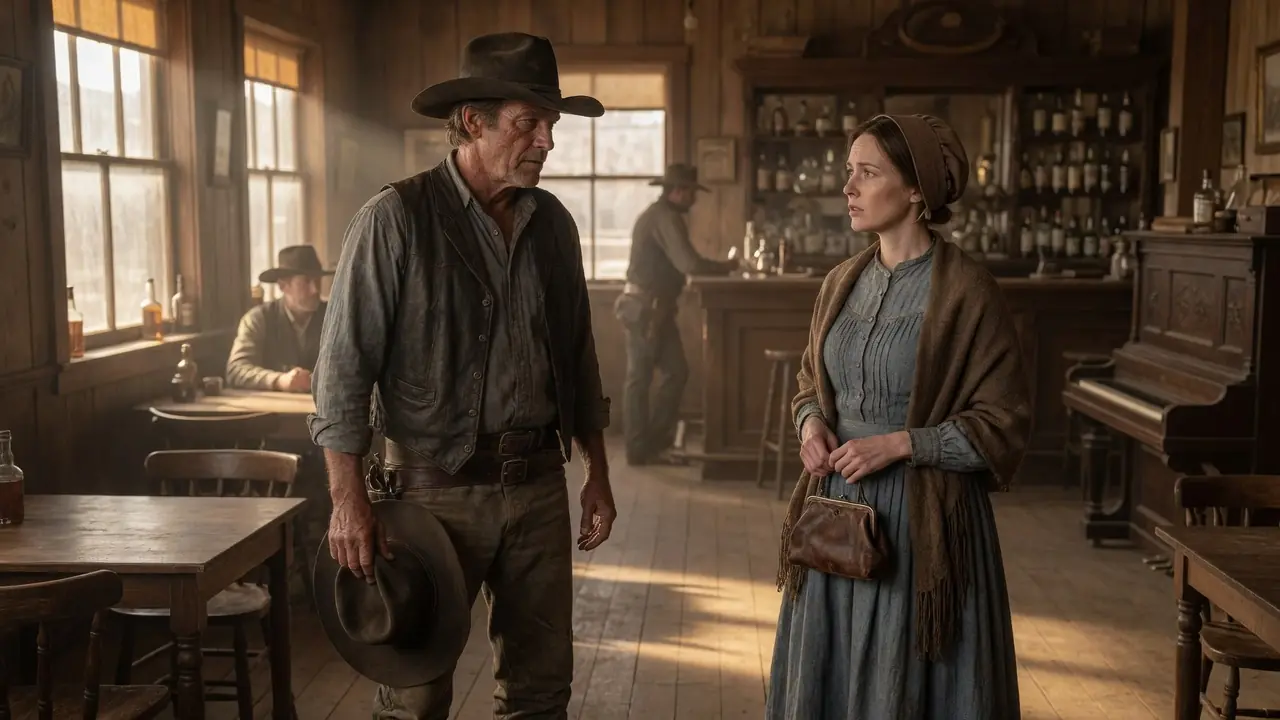
Before he could think better of it, James stood.
“I’ll hire her.”
Every face in the saloon turned toward him.
Jake stared. “You?”
James ignored him and walked toward the bar.
Margaret turned slowly, her eyes narrowing with suspicion. She had seen enough of the world to distrust easy rescue.
“I don’t need charity, Mr. Connor.”
Her voice was soft, but the warning in it was clear.
James stopped a respectful distance away.
“Didn’t offer charity.”
“You don’t even know what work you need done.”
“I know exactly what work I need done.”
That was not entirely true, but James had spent enough years around men with money to know that confidence could cover a lie if the lie was kind.
He held up his hands.
The palms were rough, scarred, and cracked from rope burns and winter cold.
“I’ve been breaking horses for the Mercer outfit. Two months of hard work. Paid me eighty dollars cash.”
That part was true.
“My clothes are torn to hell. My shirts need mending, my bedding needs washing, and my coat looks like it lost an argument with a mountain lion. No woman in this town will take the work because I’ve got a reputation for being difficult.”
Jake snorted behind the bar.
James shot him a look. “Quiet.”
For the first time since entering the saloon, Margaret’s mouth almost moved toward a smile.
Almost.
“How much work?” she asked.
“A month’s worth.”
“How much pay?”
James heard the stillness return to the room.
He saw the calculation in Margaret’s eyes, the pride ready to reject anything that sounded like pity.
“Seventy dollars,” he said.
Someone coughed.
Jake’s eyebrows rose nearly to his hairline.
Margaret’s face tightened. “That is not fair pay.”
“It is if I say I’m difficult.”
“It’s too much.”
“Then make me more difficult and earn it.”
Her daughter looked at James then, directly and without blinking.
“What does difficult mean?” the girl asked.
James crouched slightly, bringing himself closer to her level without towering.
“It means I complain about crooked stitches and pretend I know more about laundry than I do.”
The girl studied him seriously.
Then she said, “Mama can stitch straight.”
“I believe it.”
“And she can cook better than anyone.”
Margaret touched her daughter’s shoulder. “Emma.”
James looked at the child. Emma. The name suited her. Small, clear, stubborn.
“I’ll pay for supper too,” James said, straightening. “For all three of us. Jake, whatever Martha has hot.”
Margaret immediately shook her head. “No.”
“Yes,” James said.
“No, Mr. Connor.”
“James.”
“No, James.”
He was surprised by the sound of his name in her mouth. It landed somewhere inside him he thought had gone numb.
He lowered his voice. “A working agreement is best discussed over food.”
“I haven’t agreed.”
“No. But your daughter is hungry, and whatever you think of me, I know you’re not cruel enough to make her wait while you argue.”
Margaret’s eyes flashed.
For one moment, James thought she might slap him.
Instead, she looked at Emma.
The child was trying very hard not to stare at the smell coming from the kitchen.
Margaret’s pride bent.
It did not break.
“Only because this is business,” she said.
“Only because this is business,” James agreed.
Martha emerged with three plates piled with stew, biscuits, and fried potatoes. She set them down without comment, but the look she gave Margaret was not pity. It was understanding.
Margaret sat stiffly at a table near the wall.
Emma climbed into the chair beside her and folded her hands in her lap, waiting for permission.
James pretended not to notice the way Margaret divided the food in her mind before touching her fork.
He also pretended not to notice when Emma ate too quickly, then forced herself to slow down after a glance from her mother.
People began talking again around them, but quietly now. The saloon had resumed its noise, yet something had changed. The room knew it had witnessed the beginning of something, even if no one could yet name it.
James waited until Margaret had eaten several bites before speaking.
“The Broken Wheel,” he said. “How bad is it?”
Margaret looked up sharply.
“That’s not part of the work.”
“No,” James said. “But it may be part of the business.”
She held his gaze for a long moment.
Then something in her gave, not surrender, but exhaustion.
“It’s bad.”
Emma leaned closer to her mother.
Margaret set down her fork.
“The Broken Wheel was David’s dream. One hundred and sixty acres. Good grazing land, if the weather is kind. Strong well. Small house, barn, enough room to build.”
James listened without interrupting.
“Before the winter of ’85, we had nearly two hundred head. David knew cattle. He was careful. Not rich, but steady.”
“The big die-up,” James said quietly.
Margaret nodded.
Everyone who had lived through that winter remembered it.
The old men still spoke of it in low voices, as if winter itself might hear them and return.
“They call it a natural disaster,” Margaret said. “But it wasn’t only nature.”
Her voice hardened.
“It was wire. Barbed wire and greed.”
James watched her closely.
“Before the fencing, when storms came, cattle could drift south. They followed instinct. They found grass, shelter, warmth. But after the big ranchers fenced the open range, the herds had nowhere to go. They pressed against the wire until they froze where they stood.”
She swallowed.
“David rode out after the worst of it. He found them stacked against the fences like firewood.”
Emma had stopped eating.
Margaret placed a gentle hand on the child’s back.
“We lost eighty head. Maybe more. Enough to ruin us.”
“David borrowed to rebuild,” James guessed.
“Two thousand dollars from Carl Brennan.”
James’s jaw tightened.
Carl Brennan owned the bank in Redemption Valley, though calling it a bank made it sound more respectable than it was. Brennan loaned money to desperate people, then took pleasure in collecting what desperation could not repay.
“David thought he’d have time,” Margaret continued. “He thought the herd would recover, that two good seasons would set things right.”
“But he died.”
Her lips pressed together.
“Thrown from a horse. Broke ribs. Pneumonia set in. He lasted three days.”
She looked down at her hands.
“Carl Brennan came to the ranch before David was even cold in the ground.”
James felt an old anger move in his chest.
“What did he say?”
“He said he was sorry for my loss.”
Her voice carried no softness.
“Then he reminded me about the note. Two thousand dollars. Two years to pay, unless the property showed signs of distress. If Brennan decides the ranch is distressed, he can call the debt due immediately.”
“Did David know that clause was there?”
“David trusted men too easily.”
“And you?”
“I learned not to.”
Their eyes met.
There was no flirtation in that look, no softness yet. Only recognition.
Both of them had been taught by loss.
“How long?” James asked.
“Maybe six months. Maybe less. I sold most of the herd to keep up with taxes, feed, and repairs. There are only thirty head left now. The fences need work. The barn roof is failing.”
She glanced at Emma.
“We are not doing well.”
The honesty cost her. James could see it.
He wanted to tell her then that she did not have to fight alone, but he knew she would reject him. Margaret Hollister had not come to the saloon to be saved. She had come to earn another day.
So James only nodded.
“Bring the mending to my room tomorrow,” he said.
“I’ll bring it back finished,” she replied.
“No. I’ll bring it to you.”
Her eyes narrowed. “Why?”
“Because I want to see the ranch.”
“I didn’t invite you.”
“I’m inviting myself.”
“That is rude.”
“I told you I was difficult.”
Emma looked between them and, for the first time, smiled.
Three days later, James rode out to the Broken Wheel Ranch with a packhorse carrying more than torn shirts.
He brought cloth, thread, rope, nails, two sacks of flour, coffee, dried beans, salt pork, a bundle of shingles, and tools.
He told himself it was practical.
If Margaret was going to work for him, she needed supplies to keep herself and Emma alive long enough to do it.
But the truth was harder.
He had not stopped thinking about her.
Not in the foolish way of a young man dazzled by beauty, though Margaret was beautiful in a worn, haunted fashion. Her beauty was not in softness. It was in endurance. In the way she stood when life had every right to knock her down.
He found the Broken Wheel at the end of a long track carved between low hills and scrub grass.
The ranch looked tired.
The house leaned slightly toward the east, as if bracing against years of wind. The porch boards sagged. The barn roof had holes where light fell through in pale shafts. Several fence lines had collapsed completely, and the cattle in the near pasture were thin enough that James could count ribs from the saddle.
Margaret was in the corral, trying to work an old mare through a broken gate.
The mare was stubborn, not mean. She had the dull-eyed look of an animal asked for too much by people who had too little.
Margaret turned when James rode up.
Her expression closed immediately.
“What is all that?”
“The mending,” James said.
“That is not mending.”
“Some of it is.”
She walked to the fence, wiping her hands on her apron.
“I told you I would not accept charity.”
“And I told you I need work done.”
“You need flour and shingles mended?”
“I need my investment protected.”
“Investment?”
He swung down from the saddle.
“You are working for me for a month. If you starve before the month is done, I lose money. If your roof leaks on my shirts, I lose money. If your fence fails and cattle wander through while you’re sewing, I lose time.”
Margaret stared at him.
“That is the worst excuse I’ve ever heard.”
“I’m out of practice.”
Emma appeared in the doorway of the house, watching with bright interest.
“Did you bring coffee?” she asked.
“Emma,” Margaret scolded.
James reached into a sack and lifted a small packet.
“Coffee. And peppermint candy.”
Emma’s eyes widened.
Margaret closed her eyes briefly, as if praying for patience.
“You cannot give my child candy after insulting my intelligence.”
“I can if she takes it as wages for helping unload.”
Emma was already moving.
Margaret caught her gently. “Ask properly.”
Emma turned to James. “May I help unload, Mr. Connor?”
“You may. And call me James if your mother allows it.”
Margaret gave him a warning look.
Emma whispered, “Mama?”
Margaret sighed. “Mr. James, then.”
For two hours, the three of them unloaded supplies, stacked wood, patched a leaking barrel, and sorted the mending. James noticed how Margaret worked. Efficient, disciplined, never wasting motion. She had the competence of someone who had learned because there was no one else to do it.
He also noticed how often she glanced at Emma.
Not controlling.
Counting.
Counting how far the child walked. How long since she ate. How close she stood to the mare. How much warmth remained in the kitchen stove.
A mother’s love, James realized, was often a thousand silent calculations.
When the supplies were stored, Margaret crossed her arms.
“Now tell me the truth.”
“About what?”
“Why you are here.”
James looked toward the pasture.
A cow limped near the far fence, favoring a swollen leg.
“That one needs treating.”
“I asked you a question.”
“I know.”
“James.”
Again, his name in her voice. Firmer this time.
He turned back.
“I think Brennan is counting on you being alone.”
She said nothing.
“I think he believes he can take this place because you are tired and proud and too honorable to ask for help.”
Her jaw tightened.
“I am not asking.”
“No. But I am offering.”
“Why?”
He almost answered honestly.
Because when you walked into that saloon, I felt something in me wake up.
Because your daughter smiled at me, and I remembered what it meant to care whether a child ate.
Because I have spent five years dead while still breathing, and somehow you made me ashamed of it.
But those truths were too exposed for a dusty corral and a woman who had already lost too much.
So he said, “Because the ranch is worth saving.”
Margaret’s eyes softened despite herself.
“It may not be.”
“It is.”
“You don’t know that.”
“I know land. I know cattle. I know when something has good bones.”
He looked at the house, the barn, the pasture.
“And I know when someone has been fighting alone too long.”
Margaret looked away.
For a while, only the wind spoke.
Then Emma came from the house carrying three tin cups of coffee so weak it was more hope than beverage.
James accepted his cup like it was fine whiskey.
From that day forward, he came to the Broken Wheel nearly every morning.
At first, Margaret pretended it was strictly business.
He brought shirts. She mended them.
He brought laundry. She washed it.
He brought work. She did it.
But between the stitches and the washing, fences began to rise again. The barn roof stopped leaking. The cattle were wormed, treated, and moved to better grass. James taught Emma to check water troughs, to read hoof prints, to stay away from a nervous steer’s hind legs.
Margaret resisted help at every turn.
Then she began to argue less.
Then she began to ask questions.
By late October, she could look over a cow and tell whether the animal needed salt, shade, or medicine. She learned how to judge breeding stock, how to count feed costs against winter risk, how to decide which cattle to keep and which to sell.
James, in turn, learned from her.
Margaret understood the land in a way he had forgotten. She knew where the grass came back earliest after frost. She knew which draw held water longest in dry months. She knew how to stretch flour, how to make a meal from almost nothing, how to warm a house without wasting a single log.
Their partnership grew in the quiet spaces between tasks.
At first, they spoke only of fences and cattle.
Then of weather.
Then of David.
Then, one evening as the sun burned red behind the hills, Margaret asked about Clara.
James had been repairing a harness at the table while Margaret kneaded bread.
Emma slept in a chair by the stove, a book open on her lap.
“You never speak of your wife,” Margaret said softly.
James’s hands stilled.
“No.”
“Was she kind?”
The question surprised him.
Most people asked how Clara died. Margaret asked who she had been.
“Yes,” he said after a moment. “Kind. Stubborn. Terrible singer. Best laugh I ever heard.”
Margaret continued kneading, giving him space to stop if he needed to.
“She wanted children,” James said.
The words came slowly, rough from disuse.
“We never had any. She lost two before they drew breath. After the second, something in her quieted. Then the fever came the next winter.”
“I’m sorry,” Margaret whispered.
James nodded.
“I thought I could save the ranch if I just worked harder. Thought I could outrun debt, grief, everything. I was wrong.”
“You lost everything.”
“I lost her. The rest was just wood, cattle, dirt.”
Margaret’s hands stopped moving.
“Land is not just dirt.”
“No,” he said, looking around the small kitchen, at Emma sleeping, at Margaret’s flour-dusted hands. “I suppose it isn’t.”
From that night on, something between them changed.
It did not become romance suddenly. They were too old for sudden illusions and too wounded for easy surrender.
It became trust.
Margaret began leaving coffee ready for him in the morning.
James began bringing small things Emma needed without making a show of it: a slate pencil, a warmer scarf, a little tin whistle he claimed had been lying around his room for years.
Margaret scolded him for the whistle because Emma played it badly for three days straight.
James only smiled.
It was the first time Margaret saw him smile fully.
It changed his face.
Made him younger.
Made her heart do something she did not have time to examine.
Then Carl Brennan arrived.
He came in late October on a bright cold morning, dressed in a tailored suit and polished boots, riding a horse too clean to have done an honest day’s work.
James and Margaret were near the barn, measuring boards for a repair, when Brennan rode into the yard without calling out.
Margaret saw him and went still.
James saw the color leave her face.
“Mrs. Hollister,” Brennan said, dismounting with the smooth ease of a man who enjoyed being watched. “I came to discuss the note.”
Margaret set down the board.
“The note is on schedule.”
“Unfortunately, I disagree.”
Brennan pulled a folded paper from his jacket but did not hand it to her.
“There is a clause in your husband’s loan agreement. If the property shows signs of distress or inability to maintain debt obligations, the bank may call the full amount due.”
James stepped forward. “The ranch is being improved.”
Brennan’s gaze moved over him with open contempt.
“And you are?”
“James Connor. Partner.”
“A legal partner?”
James said nothing.
Brennan smiled.
“Then no partner at all.”
Margaret lifted her chin.
“The Broken Wheel is not distressed.”
Brennan turned slowly, gesturing toward the barn, the patched fences, the thin cattle.
“Mrs. Hollister, sentiment does not change fact. The house roof is worn. The barn is failing. Your herd is nearly gone. I would say distress is obvious.”
“You waited until we started improving it,” James said.
Brennan’s smile thinned.
“I waited until the bank’s interests required protection.”
“No,” Margaret said quietly. “You waited until you thought I was weak enough.”
For the first time, irritation flickered across Brennan’s face.
“Two thousand dollars,” he said. “Thirty days. If payment is not made in full, the bank takes possession. Land, improvements, livestock, and all attached property.”
Emma had appeared in the house doorway.
James hated that she was hearing this.
Margaret did not look at her daughter. If she did, she might break.
“Thirty days,” Brennan repeated. “Not one more.”
After he rode away, the ranch felt emptier than before.
Margaret sat on the porch steps.
She did not cry.
That frightened James more than tears would have.
He sat beside her.
“We can raise some.”
“Not two thousand.”
“We sell cattle.”
“That gets maybe eight hundred.”
“I have savings.”
She looked at him quickly. “No.”
“You don’t know what I was going to say.”
“I know enough.”
James leaned forward, elbows on knees.
“I had a sister. Ruth. She died three years ago. Left me some money. Not much to a rich man. Enough to a man like me.”
Margaret stared at him.
“I’ve kept it hidden because using it meant admitting I had a future.”
His voice lowered.
“I didn’t think I did.”
Margaret’s expression changed.
Not pity.
Something more dangerous.
Understanding.
“I won’t take your future from you,” she said.
James turned to her.
“You’re not taking it.”
“Then what am I doing?”
“Giving me one.”
Her eyes filled then, but she blinked the tears back.
“James.”
“I love you,” he said quietly.
The words surprised even him, not because they were untrue, but because they had been true for longer than he had admitted.
Margaret looked at him as if the world had tilted beneath her.
“No,” she whispered.
“No?”
“You cannot say that because you feel sorry for me.”
“I don’t.”
“Because you miss your wife.”
“I do miss her. I will always miss her.”
The honesty steadied them both.
“But loving Clara does not stop me from loving you. Grief is not a locked room, Margaret. I thought it was. I lived in it for years. Then you opened the door without even knowing.”
She pressed one trembling hand to her mouth.
“I have nothing to offer you.”
James gave a soft, broken laugh.
“You have Emma. You have this ranch. You have courage enough for ten men. You have a way of looking at me like I am still worth something.”
“You are.”
“So are you.”
The tears came then.
Margaret leaned forward, and James took her into his arms carefully, as if she were something both strong and fragile.
She cried for the ranch, for David, for hunger, for fear, for two years of waking up every morning and choosing not to collapse.
James held her through all of it.
When she finally pulled back, she looked embarrassed.
He wiped one tear from her cheek with his thumb.
“I’m not asking for an answer tonight,” he said.
“I cannot think beyond thirty days.”
“Then we fight for thirty days.”
“And after?”
“After, if you’ll have me, we talk about the rest of our lives.”
The next month nearly broke them.
They sold every head of cattle except five breeding stock. James used Ruth’s inheritance as collateral for a loan. Jake from the saloon organized buyers. Martha sent food when Margaret was too busy to cook. Mrs. Whitcomb from the church, who had never said more than three words to Margaret before, arrived with quilts and left without asking questions.
Word spread.
Not as gossip this time, but as resistance.
People in Redemption Valley had all owed Brennan something at one time or another. They had all watched him smile while families lost land. Margaret’s fight became their quiet revenge.
On day twenty-nine, Margaret walked into Carl Brennan’s office wearing her cleanest dress and carrying a banker’s draft for exactly two thousand dollars.
James waited outside.
He watched through the window as Brennan took the paper.
For the first time since James had known of him, Carl Brennan looked truly surprised.
Then angry.
Then afraid.
Not because he had lost money.
Because he had lost control.
Margaret came out five minutes later with the canceled note in her hand.
She stood on the boardwalk, staring at it.
James stepped toward her.
“Well?”
Her lips trembled.
“It’s ours.”
He exhaled hard.
Margaret looked up at him.
“The Broken Wheel is ours.”
James wanted to kiss her then, right there in the street, in front of Brennan’s bank and everyone passing by.
But he waited.
Margaret had spent too long having choices taken from her.
So he only held out his hand.
She looked at it.
Then she took it.
They were married two weeks later in the small white church at the edge of Redemption Valley.
It was not a grand wedding.
Margaret wore a simple blue dress that Martha altered for her. Emma carried wildflowers and cried openly through the vows. Jake stood beside James, looking uncomfortable in a clean shirt. Martha sat in the front row with a handkerchief already damp before the ceremony began.
When the preacher asked if anyone objected, half the town turned to see if Brennan had dared show his face.
He had not.
James spoke his vows slowly, his voice rough with feeling.
“I promise to stand beside you in work and in rest. In hunger and in plenty. In fear and in peace. I promise never to treat your strength as something I own, but as something I am honored to stand beside.”
Margaret’s eyes shone.
Her vows were quieter.
“I promise to trust you even when trust frightens me. I promise to build with you, not behind you or beneath you, but beside you. I promise that this life, whatever it becomes, will be ours together.”
After the ceremony, Emma threw herself into James’s arms.
“Does this mean you are my father now?”
James froze.
Margaret’s breath caught.
The entire church seemed to pause.
James crouched in front of Emma.
“It means I will be whatever you allow me to be.”
Emma studied him with her mother’s sharp eyes.
Then she wrapped her arms around his neck.
“I allow father.”
James closed his eyes.
For the second time in his life, he felt a future settle into his hands.
The first winter was brutal.
They had nearly no herd, little money, and a debt in James’s name that would take years to repay. The house remained drafty. The barn needed more work than they could afford. Some nights, supper was beans, bread, and stubborn optimism.
But they were not alone anymore.
That made all the difference.
Margaret woke before dawn, and James rose with her. They worked until their bodies ached. Emma helped with chores, then sat by the stove at night learning her letters from old newspapers James brought home.
There was laughter now.
Not every day.
Some days were too hard for laughter.
But enough.
When the blizzard came in February, it nearly took their last breeding mare. James and Margaret worked twenty hours straight in the barn, warming blankets by the stove, rubbing the mare’s legs, coaxing life into an animal too valuable to lose and too beloved to abandon.
Near dawn, the mare stood.
In spring, she delivered a healthy foal.
Emma danced around the barn until Margaret laughed so hard she had to sit down.
James watched them and felt something inside him heal in a place he had not known was still wounded.
The years that followed were not easy, but they were theirs.
By the third year, the herd was back over one hundred head.
By the fifth, the Broken Wheel turned a profit.
By the seventh, the barn had a new roof, the house had a proper stove, and Emma had a horse of her own.
By the tenth, the debt was gone.
The day James made the final payment on his loan, Margaret baked a cake with sugar frosting, and Emma hung a sign on the barn door that read:
FREE AND CLEAR.
James stood before that sign for a long time.
Margaret came beside him and slipped her hand into his.
“You did it,” she said.
He looked at her.
“We did.”
Their life became known in Redemption Valley not because it was grand, but because it endured.
People came to the Broken Wheel when they needed fair work. James and Margaret paid honestly, fed their hands well, and never turned away someone willing to learn.
Margaret became known for her sharp mind and sharper tongue at cattle auctions. More than one dealer learned not to mistake her quiet voice for weakness.
James still broke horses, but fewer now. His back had begun to stiffen in the mornings, and Margaret scolded him when he pretended otherwise.
Emma grew tall and strong, with her mother’s eyes and James’s steady way with animals. She ran sections of the ranch before she turned twenty, and no man on the property questioned her twice.
Years later, when people asked James why he had helped Margaret Hollister that day in the saloon, he never gave them the answer they expected.
He did not say he was noble.
He did not say he was generous.
He did not even say he was brave.
He always said, “I was tired of being dead.”
Because that was the truth.
Life had broken James Connor once, and he had mistaken hiding for survival. He had thought grief was something a man honored by living small. By asking nothing. By offering nothing. By becoming a ghost in the corner of a saloon.
Then Margaret Hollister walked in with her daughter’s hand in hers and hunger in her pride.
She needed work.
She needed food.
She needed someone willing to stand beside her without trying to own her.
And somehow, in giving her that, James found his own life again.
The Broken Wheel Ranch still stood.
Its fences ran strong across the hills. Its cattle grazed on land Brennan had once been certain he would take. Cottonwoods whispered near the creek. The barn roof held firm through winter storms.
And in the evenings, when the work was done, James and Margaret sat together on the porch.
Sometimes they spoke.
Sometimes they simply watched the sky turn purple over the pastures.
On one such evening, many years after the day she walked into the saloon, Margaret leaned her head against James’s shoulder.
“Do you ever wonder what would have happened if you had not spoken up that day?” she asked.
James looked toward the darkening fields.
“No.”
She lifted her head. “No?”
“If I think about it, I get angry at the man I almost was.”
Margaret took his hand, tracing the old scars on his palm.
“You saved us.”
James turned his hand and held hers.
“No, Margaret. I helped. There is a difference.”
She smiled softly.
“You are still difficult.”
“You married me knowing that.”
“I did.”
“And?”
Her smile deepened.
“And I would do it again.”
James looked at the woman beside him, the woman who had carried grief, hunger, debt, motherhood, fear, and hope with the same two hands.
He thought of the saloon.
The silence.
The little girl with watchful eyes.
The seventy dollars that had become a life.
Then he leaned over and kissed his wife gently, not like a young man stealing passion, but like an old man honoring a miracle.
The wind moved through the cottonwoods.
Somewhere in the barn, a horse shifted.
Inside the house, Emma’s children laughed near the stove.
The Broken Wheel was no longer a place waiting for foreclosure.
It was a home.
A family.
A promise kept.
And James Connor, who had once come to Redemption Valley to disappear, had finally become visible again because Margaret Hollister had needed help, and he had remembered how to give it.
In the end, she did not only save the ranch.
She saved him.
And together, they built something stronger than either of them could have built alone.