“Don’t buy the horse,” the young woman said, stepping into the open space between the rancher and the black stallion. “Buy me. I work harder than every horse here.”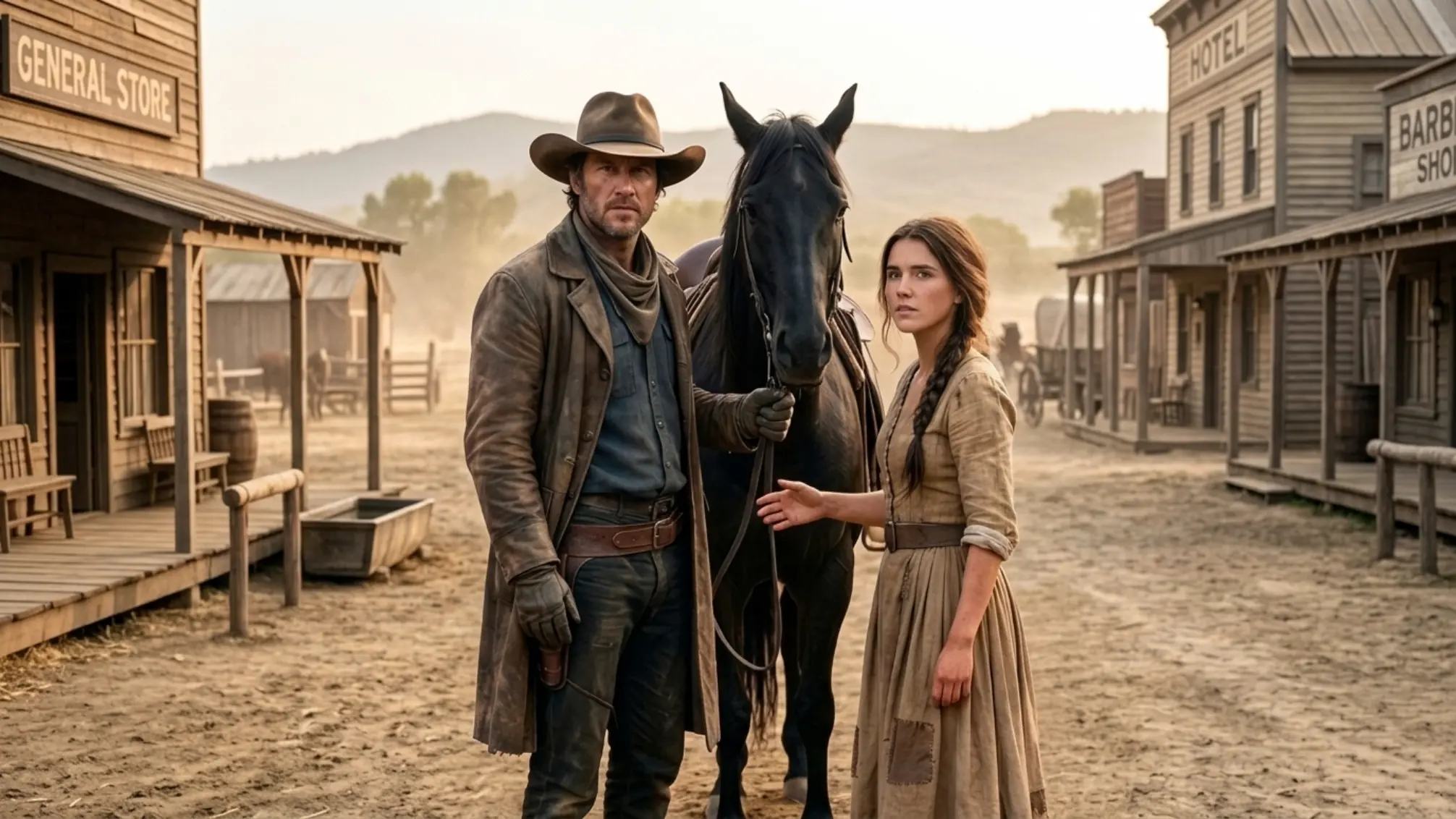
The horse market fell silent so quickly that Elias Mercer could hear the stallion breathing beside him. Men who had spent the afternoon shouting over cattle prices now stared as though a gun had been fired. Dust drifted across the crowded yard, settling on the young woman’s patched tan dress and the dark braid hanging over her shoulder.
Elias tightened his hand around the reins. He was thirty-eight, broad through the shoulders, and weathered by years beneath the Kansas sun. Grief had carved patience into him, but it had also taught him to distrust anything that arrived too suddenly. “A woman isn’t livestock,” he said. “I don’t purchase human lives.”
A few traders laughed nervously, but the woman did not lower her eyes. She could not have been older than twenty, though exhaustion made her look older around the mouth. Her brown eyes held fear, yet behind it was something harder—a will that had not broken despite every reason it should have. “Then give me work,” she said. “Give me shelter, and one reason not to disappear tonight.”
Elias looked past her toward the men gathered near the livestock pens. Most appeared merely curious, but three were not watching her with surprise. They were watching her with recognition. The oldest wore a black coat despite the heat, while the two beside him kept their hands close to their gun belts.
“Who are they?” Elias asked quietly.
The woman’s outstretched hand trembled. “Men who believe I belong to them.”
That answer changed the air between them. Elias released the stallion’s reins and handed them to the horse trader without discussing the price. Then he extended his rough, gloved hand toward the young woman.
“Take my hand,” he said. “But tell me who’s hunting you before they reach my ranch.”
She placed her fingers in his without hesitation. The three men near the pens began moving through the crowd, but Elias had already turned her toward the hitching rail. He lifted her onto his chestnut mare, climbed into the saddle behind her, and guided the horse through the western gate before anyone could block their path.
They rode hard until the noise of Dodge City disappeared behind the low hills. The woman sat stiffly in front of him, one hand gripping the saddle horn and the other holding the edge of her skirt away from the brush. Elias kept looking over his shoulder, but the road remained empty.
“What’s your name?” he asked.
“Clara Vale.”
“Are they lawmen?”
“No.”
“Family?”
Her shoulders tightened. “Not anymore.”
Elias waited for more, but Clara fell silent. He understood silence better than most people. His own had lasted almost six years.
His ranch lay twenty miles north of town, beyond a dry creek and a stretch of open grassland where the wind moved without obstruction. Once, the property had belonged to his father. Later, it had belonged to Elias and his wife, Rebecca, at least in every way that mattered.
Rebecca had died during a winter fever that swept through the county. Their unborn child died with her. After that, Elias stopped attending church suppers, stopped visiting neighbors unless work demanded it, and spoke only when silence became impossible.
The ranch survived because he worked from before sunrise until darkness. He raised cattle, repaired his own fences, and grew enough corn to feed the animals through winter. The house remained as Rebecca had left it, except for the dust that gathered on the piano she used to play.
Clara saw the cabin as they crossed the final rise. It stood beneath a line of cottonwoods, small but solid, with a barn and corrals behind it. The evening sky burned red across the western plains.
“That is your home?” she asked.
“It is.”
“And no one else lives there?”
“No.”
She glanced at him over her shoulder. “You truly are alone.”
Elias did not answer. She had said it without mockery, which somehow made the truth feel heavier.
At the cabin, Clara slipped from the saddle before he could help her. Her knees nearly buckled when her boots touched the ground, but she steadied herself against the mare. Elias noticed then how thin she was beneath the loose dress and how carefully she avoided putting weight on her left foot.
“You’re hurt.”
“It’s only a blister.”
“That isn’t how people stand when they have a blister.”
She looked toward the distant road. “We should get inside.”
Elias led her through the cabin door. The main room held a stone fireplace, a plain wooden table, two chairs, and Rebecca’s piano against the far wall. Clara stopped when she saw a framed photograph on the mantel.
Rebecca had been smiling in that picture, wearing a white dress and holding a bundle of prairie flowers. Elias watched Clara study it.
“Your wife?”
“She died.”
“I’m sorry.”
“So am I.”
Clara turned away, understanding that he wanted no more questions. Elias lit a lamp and brought water from the kitchen. When she finally removed her boot, he found a deep cut along the side of her foot, swollen and crusted with dirt.
“That didn’t come from walking through town,” he said.
“No.”
“What happened?”
“I jumped from a wagon three nights ago.”
Elias cleaned the wound while she gripped the edge of the chair. She did not cry out, though her breathing became shallow when he poured whiskey over the cut. He wrapped her foot with clean cloth and placed a plate of bread, beans, and cold beef before her.
Clara stared at the food. “What do you expect in return?”
“Nothing tonight.”
“And tomorrow?”
“Tomorrow, you tell me the truth.”
She ate slowly at first, then with the hunger of someone who had gone days without a proper meal. Elias sat across from her and watched the window. He had not seen riders on the road, but he could feel trouble approaching as surely as he could feel a storm in his bones.
After finishing, Clara folded her hands in her lap. “The man in the black coat is Silas Rourke,” she said. “He owns a freight company outside Dodge City.”
“I’ve heard the name.”
“Most people have. They say he transports cattle, lumber, and machinery.”
“And what does he really transport?”
“People who cannot defend themselves.”
Elias’s expression hardened.
Clara explained that her father, Thomas Vale, had worked as a surveyor. He mapped rail routes, water claims, and property lines across western Kansas. One year earlier, he discovered that Rourke was using freight wagons to move young women from isolated settlements to mining camps farther west.
Some had been promised employment. Others had been told they were entering legal domestic-service contracts. Once transported, their papers were taken, their debts were inflated, and armed men prevented them from leaving.
“My father found names,” Clara said. “Payments, routes, buyers, and the officials Rourke bribed.”
“What did he do with the evidence?”
“He tried to bring it to a federal marshal.”
“And Rourke found out.”
Clara looked down at her hands. “My father died before he reached Fort Larned. They said his horse threw him into a ravine, but he had two bullet wounds in his back.”
The lamp flame moved in the draft. Elias felt something old and violent stir beneath his calm.
“What happened to you?” he asked.
“Rourke came to our house after the funeral. He said my father owed him money and that the debt now belonged to me. He produced a contract with my father’s signature.”
“Was it real?”
“The signature was copied from an old surveying agreement. I told him so. He laughed and said paper becomes truth when enough powerful men agree to it.”
Rourke moved Clara into a guarded boarding house with six other women. He claimed they were employees repaying debts through domestic labor. In reality, he planned to send them west in a freight convoy before the end of the week.
Clara escaped by hiding beneath sacks in a supply wagon. When the wagon slowed near Dodge City, she jumped, cut her foot on a broken wheel brace, and ran into the market. She had seen Elias there before during previous cattle seasons.
“You said you watched me ride through town,” Elias said.
“I did.”
“Why?”
“Because you were always alone, but no one was afraid of you. Children approached your horse. Old men trusted you with money while they counted change. Once, I saw a drunk insult you outside the feed store, and you walked away instead of shooting him.”
“That may have been poor judgment.”
“It told me you were not cruel.”
Elias leaned back in his chair. “You offered yourself to a stranger based on that?”
“I offered work. The words were the only ones shocking enough to stop the market and force you to notice me before Rourke reached me.”
Despite himself, Elias almost smiled. “It worked.”
“I had no better plan.”
“You could have asked for help.”
“Men hear a woman asking for help every day. Most keep walking.”
The honesty of it struck him harder than accusation would have. Elias rose and crossed to the window. Moonlight silvered the open yard, and the cottonwoods bent under the night wind.
“Where is the evidence your father collected?”
Clara hesitated.
“If Rourke is chasing you this far, he believes you have it.”
“My father hid a ledger before he died. He told me that if anything happened, I should find the place where water runs uphill beneath the hanging tree.”
Elias turned. “What does that mean?”
“I don’t know. I searched our property until Rourke took me away. I found nothing.”
“Did your father ever survey land north of Dodge?”
“Hundreds of acres.”
“Did he survey mine?”
Clara frowned. “What is this ranch called?”
“Mercer’s Crossing.”
Her face changed. “Yes. He came here seven years ago.”
Elias remembered the surveyor then—a quiet man with a gray beard who had spent two days examining the creek, the ridge, and an abandoned stone well near the northern boundary. Thomas Vale had been hired during a disagreement over grazing lines.
“He marked something near the old cottonwood,” Elias said.
“Is there water there?”
“A spring flows beneath the roots, but the ground rises before it reaches the creek. People call it the uphill run.”
Clara pushed back from the table. “The hanging tree.”
“There’s an old cottonwood with a broken branch that bends like a gallows.”
“My father hid the ledger on your land.”
A horse whinnied sharply outside.
Elias extinguished the lamp.
Clara froze. “They found us.”
He took his rifle from the pegs above the fireplace and moved quietly toward the door. Through a gap in the shutter, he saw three riders near the barn. Moonlight caught the black coat of the man in front.
Silas Rourke had arrived before dawn.
“Stay inside,” Elias whispered.
“I can help.”
“You can help by staying alive.”
He stepped onto the porch with the rifle held low. Rourke and his men dismounted near the corral, confident enough to make no effort at concealment. The older man removed his hat and smiled.
“Mercer,” he called. “I believe you accidentally carried away something that belongs to me.”
Elias rested the rifle against his shoulder. “I didn’t buy the horse.”
Rourke’s smile thinned. “I’m not talking about the horse.”
“Then you came a long way for nothing.”
The two gunmen spread apart. One moved toward the barn, while the other approached the side of the cabin. Elias could have shot either man, but he kept his finger outside the trigger guard.
Rourke stopped twenty feet from the porch. “The girl is under a legal labor contract. She owes money, and she fled before completing her obligation.”
“Bring the contract to a judge.”
“I do not need a judge to recover stolen property.”
“She is not property.”
“To men like you and me, everyone is property. The only difference is price.”
The cabin door opened behind Elias.
Clara stepped onto the porch holding Rebecca’s old shotgun. It was unloaded—Elias had kept it only because it had belonged to his wife—but Rourke could not know that.
“You murdered my father,” Clara said.
Rourke looked almost amused. “Your father died because he confused knowledge with power.”
“And you came because you think I know where he hid the ledger.”
The amusement vanished.
Elias glanced at Clara. Her hands were steady now.
“The ledger is here,” she continued. “That’s why you followed me instead of waiting for your wagon to leave town. You’re afraid of what my father wrote.”
Rourke’s right hand moved toward his coat.
Elias raised the rifle. “Finish that motion, and you die before your fingers touch the grip.”
For several seconds, no one moved. Then the gunman near the barn kicked open the side door and slipped inside. Elias heard wood splintering as the man began searching.
“You are surrounded,” Rourke said. “Give me the girl, and I leave your ranch standing.”
Clara’s voice sharpened. “You burned the Miller farm after their daughter escaped you.”
Rourke looked at her.
“You buried two women beside the western trail,” she continued. “My father wrote their names down.”
The second gunman lunged toward the porch.
Clara swung the empty shotgun with both hands and struck him across the jaw. He staggered sideways, and Elias drove the rifle stock into the man’s stomach before shoving him off the steps.
Rourke drew his revolver.
A shot cracked from the darkness near the corral.
Rourke’s weapon flew from his hand, and he screamed as blood appeared across his fingers. More riders emerged beyond the barn, their rifles trained on the yard.
Henry Boone, Elias’s nearest neighbor, rode forward beside a deputy marshal. Behind them came four ranchers from properties along the southern trail.
Rourke stared in disbelief. “How?”
Elias kept the rifle pointed at him. “I sent Henry’s boy from the market before Clara and I left town. Told him to bring the marshal if three men followed us north.”
“You knew?”
“I knew men who believe they own people rarely accept the word no.”
The deputy marshal dismounted. “Silas Rourke, step away from your weapon.”
The gunman inside the barn tried to escape through the rear window, but two ranchers dragged him into the yard. Within minutes, all three men were disarmed and bound.
Yet Rourke began laughing.
“You have a frightened girl and a dead surveyor’s accusations,” he said. “No ledger, no witnesses, no case. By next week, I’ll own every man standing here.”
Clara lowered the shotgun. “The ledger is beneath the hanging tree.”
Elias led the marshal, Clara, and two ranchers to the northern boundary. The eastern sky had begun to pale when they reached the old cottonwood. Its broken limb curved above the ground, while the hidden spring emerged from stone and flowed toward the higher bank before turning downhill.
Thomas Vale had carved a small symbol into the trunk—an arrow inside a circle. Beneath the roots, protected by a flat stone, they found an oilskin package sealed with wax.
Inside lay a leather ledger filled with names, dates, payments, wagon routes, and the signatures of men across three territories. There were sheriffs, freight agents, mine owners, hotel keepers, and officials who had accepted money to ignore missing women. Thomas had also included copies of false contracts and a list of burial sites.
The marshal turned the pages slowly. “This will reach Washington.”
Rourke, standing under guard nearby, stopped laughing.
One month later, federal officers raided Rourke’s freight yard. They freed eleven women from a guarded warehouse and intercepted another wagon before it crossed into Colorado. Several local officials were arrested, and search teams recovered evidence from the burial sites recorded in Thomas Vale’s ledger.
Rourke stood trial in a packed federal courtroom. Clara testified for two days, refusing to lower her voice even when his attorneys called her dishonest, unstable, and immoral. The ledger confirmed every important part of her account.
Silas Rourke was sentenced to spend the rest of his life in prison. His property was sold, with part of the money used to help the surviving women return home or begin new lives. The false debts and contracts were declared fraudulent.
Clara returned to Mercer’s Crossing after the trial. Elias had expected her to choose a town, perhaps work with the marshal’s office or travel east where no one knew what had happened to her. Instead, she arrived in a small wagon carrying two trunks, several books, and a new pair of work boots.
“You came back,” Elias said.
“You offered me work.”
“I offered shelter for one night.”
“You also said we would discuss tomorrow.”
“It has been four months.”
Clara smiled. “Then you have had enough time to prepare.”
She proved nearly every claim she had made in the market. She repaired fences, kept accounts, handled cattle, planted a kitchen garden, and transformed the neglected house without disturbing Rebecca’s memory. She cleaned the piano but never moved the photograph from the mantel.
At first, Elias gave her wages and a room. Then he gave her trust. The two grew close not through grand declarations but through ordinary days—shared meals, long rides, winter repairs, and quiet evenings when Clara read beside the fire while Elias worked leather at the table.
One night, nearly a year after the market, Clara sat at Rebecca’s piano and pressed a single key. “Would it hurt you if I played?”
Elias looked at the photograph on the mantel. For years, he had believed loving what remained meant refusing anything new. But memory had not asked him to become a grave.
“No,” he said. “I think the house has been quiet long enough.”
Clara played softly, and the music moved through the cabin like warmth returning after winter. Elias stood behind her, listening until she finished.
“You saved me that day,” she said.
He shook his head. “You saved yourself. You stopped an entire market with one sentence.”
“You still took my hand.”
“And I would take it again.”
Clara turned on the piano bench. “Then do it.”
Elias reached for her hand, not as a bargain, not as a rescue, and not because either of them owed the other a future. He held it because she had chosen to remain, and because he had finally chosen to stop living as though hope were another thing the frontier could steal.
They married beneath the old cottonwood beside the uphill spring. Several women rescued from Rourke’s warehouse attended, along with the ranchers who had ridden to the cabin before dawn. The deputy marshal stood beside Henry Boone, both men pretending not to cry.
The black stallion from the market was there too. Elias had returned months later and purchased him after all, though Clara claimed the animal worked only half as hard as she did.
She never again offered to belong to anyone.
Instead, she built a life beside a man who understood that love was not ownership, shelter was not debt, and a hand freely given was worth more than any contract ever signed.
Elias had ridden into the frontier market searching for a horse strong enough to help him survive another season.
He rode away with a woman strong enough to teach him how to live again.