In the forgotten southern town of Bellweather Creek, evenings always arrived slowly.
The sun did not set all at once there. It lowered itself over rusted tin roofs, sagging porches, cotton fields gone half-wild, and streets where red dust settled into every crack like old sorrow.
The heat lingered long after daylight faded, clinging to fences, window screens, and the backs of tired necks.
Cicadas screamed from the trees as if trying to keep the town awake.
Bellweather Creek had once been a lively place.
There had been a cotton mill near the river, a railroad spur that brought travelers through twice a day, a hardware store that sold more than nails and rope, and a church choir strong enough to make even proud men lower their heads.
But the mill closed.
The railroad stopped.
The young people left.
And those who remained learned to live on less.
Less work.
Less money.
Less hope.
On the edge of Maple Road, where the pavement gave up and became packed dirt, stood a small white house with peeling paint and a porch that leaned slightly to the left. That was where Clara Johnson lived with her mother and two younger brothers.
At twenty years old, Clara had already become the person everyone in the house leaned on.
Her father had died when she was fourteen, leaving behind a jar of rusted screws, three unpaid bills, and a silence her mother never fully recovered from. Her mother, Ruth, had weak lungs from years spent cleaning rich people’s houses with chemicals that burned her throat. On bad mornings, Ruth’s cough shook the walls before sunrise.
Clara’s brothers, Samuel and Ben, were twelve and nine. They still argued over marbles, chased frogs after rainstorms, and believed Clara could fix anything if they brought it to her.
A torn shirt.
A scraped knee.
A broken kite.
A bad dream.
Clara worked mornings at the bakery on Main Street, washing trays, sweeping flour, and packing day-old bread for customers who could not afford fresh loaves. In the afternoons, she cleaned rooms at the Magnolia Rest Inn, a faded roadside motel where traveling salesmen and truck drivers stayed when they were too tired to keep driving.
She earned just enough to keep the lights on most months.
Almost enough for groceries.
Never enough to stop worrying.
Still, Clara had a way of moving through life gently.
She spoke softly to children.
She saved crumbs for birds.
She watered the half-dead rosebush beside the porch even when her mother said it was a waste.
And every Sunday, if she had a spare coin, she placed it in the cracked donation box at the church vestibule, not because she believed God needed money, but because someone poorer than her might need soup.
People in Bellweather Creek called Clara sweet.
Some meant it kindly.
Others meant foolish.
“She’s got too soft a heart,” Mrs. Whitcomb at the bakery often said. “World will chew a girl like that up.”
Clara never argued.
She only smiled and kept working.
But there was one person in Bellweather Creek who knew that Clara’s kindness was not weakness.
His name was William Turner.
He lived across the dirt road from Clara in a narrow gray house with a rusted gate, a sagging roof, and a porch where the boards complained beneath every step. Once, William’s place had been the best-kept home on Maple Road. He had planted marigolds by the steps. He had painted the shutters blue every spring. He had kept his tools polished and his woodpile stacked clean as a church pew.
When Clara was little, William Turner had been the strongest man she knew.
He was tall then, broad-shouldered, with thick dark hair and hands that could fix anything. A broken wagon wheel. A leaking roof. A cracked chair. A child’s toy. People called for William when something fell apart, and he always came.
He had a laugh that carried.
A voice that calmed frightened horses.
A back strong enough to haul lumber all day and still lift a child onto his shoulders at dusk.
But now William was old.
His body had thinned until his clothes hung from him. His shoulders bent forward as if life had placed a heavy hand between them and never lifted it. His hair had gone white and wispy. His hands trembled, especially when he was hungry.
Most painful of all was the tin bowl.
William carried it when he went door to door.
A small dented bowl with scratches along the rim, pressed close to his chest the way another man might carry a Bible.
No one said much about it in daylight.
But everyone knew.
William Turner was begging for food.
And everyone knew why that made the shame heavier.
Because once, William Turner had raised a boy who now had more money than the whole town combined.
Michael Carter.
Even the name sounded polished now, like something printed on glass doors in tall buildings.
But before the private jets, magazines, stock market interviews, and expensive suits, Michael Carter had been a barefoot orphan with no home and no one willing to take him.
His mother died when he was six. His father had been gone before Michael could remember him. For a short while, neighbors passed him around out of duty, feeding him at one table one night and another the next. But poverty made even kindness cautious in Bellweather Creek. Everyone had mouths to feed.
Then William Turner stepped forward.
He was not related to Michael by blood.
He did not have extra money.
He did not have a wife to help him.
But he looked at the boy standing outside the church after the funeral, clutching a paper sack of clothes, and said, “Come on, son. You can stay with me.”
That was how it began.
William gave Michael his spare room.
Then his food.
Then his future.
He packed lunches before dawn.
He mended school shirts by lamplight, stabbing his big fingers with the needle and laughing at himself when he bled onto the thread.
He worked at the sawmill six days a week and took extra jobs fixing porches, roofs, and fences on Sundays after church.
He sat beside Michael at night, sounding out spelling words he barely understood himself.
When Michael wanted books, William found books.
When Michael needed shoes, William went without tobacco for six months.
When Michael won a scholarship but still needed money for travel, fees, and school clothes, William sold his only cow.
People remembered that.
They remembered him leading the cow down the road to market, one hand on the rope, face straight ahead. That cow had given milk every morning. It had been William’s small safety net. Selling it meant no butter, no milk money, no backup when things turned bad.
But Michael went to college in a clean shirt and polished shoes.
William stood at the bus station that morning and placed both hands on the boy’s shoulders.
“You go learn everything I never got to learn,” he told him. “And don’t you look back until you’ve become what you’re meant to be.”
Michael cried then.
He promised he would come back.
He promised he would buy William a big house one day.
He promised no one who had helped him would ever be forgotten.
For a while, letters came.
Then fewer.
Then only holiday cards printed by assistants.
Then nothing.
Eight years passed.
The town heard about Michael anyway.
His face appeared on magazine covers at the general store.
Local newspapers ran stories when his software company sold for millions, then when his investment firm became a billion-dollar empire, then when he built a tower in New York with his name in silver letters across the top.
Bellweather Creek took pride in him at first.
“Our Michael made it,” people said.
Then pride soured into gossip.
Especially when William’s roof started leaking.
Especially when the old man’s garden died.
Especially when he began walking with that tin bowl.
On the evening Clara first saw him at her gate, the sky was turning purple behind the pecan trees.
She had just finished stirring a thin pot of beans on the stove. Cornbread sat in a cast-iron pan by the window, cooling under a clean cloth. There was not much food, but Clara had learned the mathematics of hunger.
Add water.
Add patience.
Cut smaller pieces.
Pretend you already ate.
Her mother sat in a chair near the stove, coughing into a handkerchief. Samuel and Ben were washing up outside at the pump, arguing over who had spilled flour on the porch.
Clara wiped her hands on her apron and stepped outside for a breath of air.
That was when she saw William.
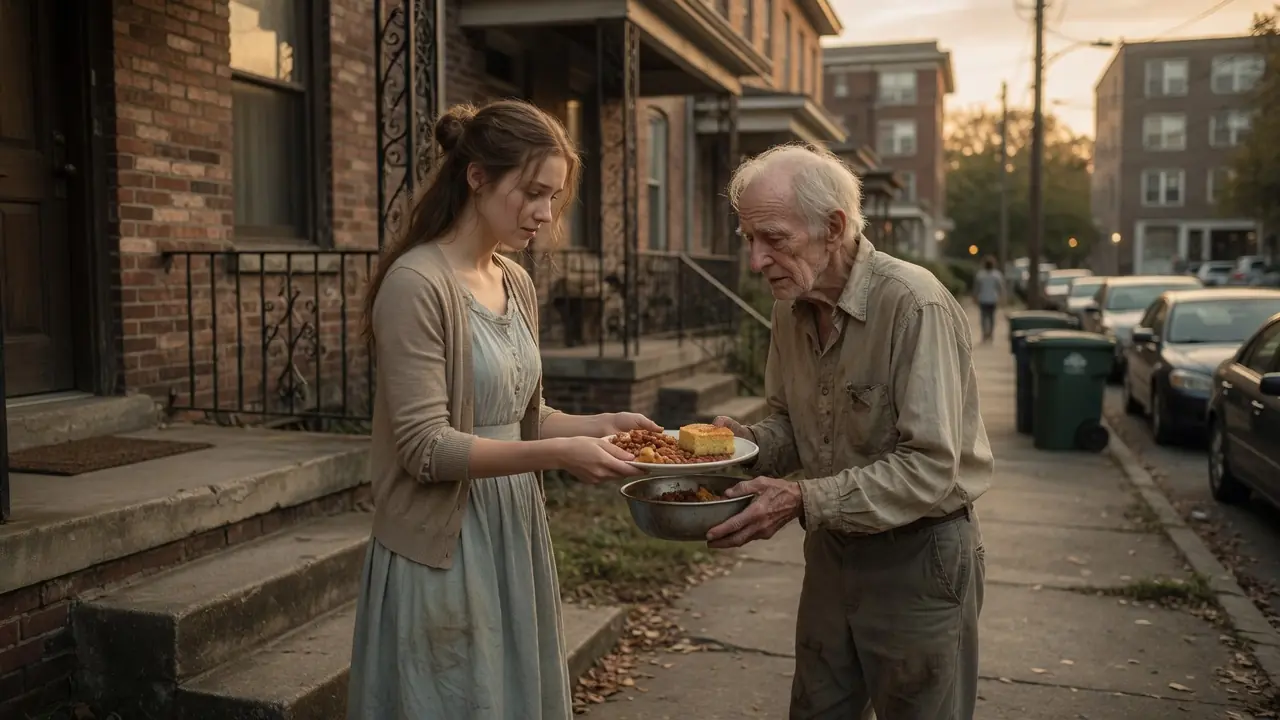
He stood at the gate across the yard, one hand resting on the post, the other holding the tin bowl. His head was lowered. His hat sat crooked. He looked smaller than he had the day before, as if shame could shrink a man overnight.
For a moment, he did not speak.
Neither did Clara.
The cicadas filled the silence.
Then William lifted his face.
“Evening, Clara.”
His voice was thin.
“If there’s a little to spare…”
The words faded before finishing.
Clara felt something twist sharply in her chest.
She could have pretended not to understand.
Many people did.
She could have said they had barely enough for themselves.
That would have been true.
She could have told him to try another house.
That would have been what most people did.
Instead, she opened the gate.
“Wait right there, Mr. Turner.”
Inside, Ruth looked up from her chair.
“Who is it?”
“Mr. Turner.”
Her mother’s face tightened, not with cruelty but with worry.
“Clara…”
“I know.”
“We don’t have enough to feed the whole road.”
“I know.”
But Clara took William’s bowl anyway.
She ladled beans carefully, making sure to scoop from the bottom where the thickest pieces settled. She tore a square of cornbread and placed it on top, then hesitated and added another half piece.
Her brothers watched from the doorway.
Ben whispered, “Is Mr. Turner hungry?”
Clara nodded.
“Then give him mine,” Ben said.
Clara swallowed hard.
“You eat yours. I’ll manage.”
She carried the bowl back outside.
William had not moved.
He seemed almost surprised that she had returned.
“Here,” Clara said softly. “It’s hot. The cornbread’s fresh.”
William accepted the bowl with both hands.
His fingers trembled so badly that Clara reached out instinctively to steady it.
He looked ashamed of that.
“Thank you, child.”
His voice cracked on the last word.
Across the road, two men leaned against a fence beside an old wagon wheel. Earl Bixby and Tom Raines. They spent most evenings pretending to repair things they never finished while talking about everyone else’s failures.
“Well, look there,” Earl muttered loudly enough to be heard. “Old Turner begging again.”
Tom shook his head.
“Ain’t that something? Raised that rich Carter boy like his own, and now look.”
“Boy’s worth billions, they say.”
“Billions don’t buy shame back once you spend it.”
Clara’s spine stiffened.
William heard them too.
She saw the flinch, small but unmistakable. His shoulders folded in, then lifted again in a fragile attempt at dignity.
He gave Clara a faint smile.
“Don’t mind folks.”
“I do mind,” Clara said.
William’s eyes flickered.
She stepped closer.
“You don’t have to thank me, Mr. Turner. You’ve done more for others than most men ever do. Don’t forget that just because some people have short memories.”
For one moment, the old man looked at her as if she had handed him something warmer than food.
Then he nodded.
Slowly, carefully, he turned and shuffled back toward his house, carrying the bowl like treasure.
Clara stood at the gate long after he disappeared inside.
That night, she could not sleep.
She lay on her narrow bed beneath a patched quilt, listening to the house settle around her. Samuel snored softly in the next room. Her mother coughed twice, then quieted. Outside, a dog barked far away.
But Clara kept seeing William’s hands.
The tremor.
The bowl.
The shame.
By morning, she had made a decision.
No more waiting for him to ask.
No more watching him walk from door to door while people whispered behind curtains.
If William Turner needed supper, he would get it from Clara’s porch.
Every evening.
Even if the portions grew smaller.
Even if the town talked.
Especially then.
The next day, Clara worked harder than usual. At the bakery, she asked Mrs. Whitcomb if she could take the broken loaves usually thrown to chickens.
Mrs. Whitcomb frowned.
“What for?”
“Bread pudding,” Clara lied.
The older woman studied her, then slid three hard loaves into a flour sack.
At the motel, Clara pocketed two unopened packets of crackers left behind in a room. She knew it was not stealing if the housekeeper would throw them away. Still, she said a quick prayer under her breath.
That evening, before William reached the gate, Clara was already waiting with a plate.
Beans.
Cornbread.
A slice of fried onion.
A small piece of day-old bread warmed near the stove until it softened.
William stopped in the road when he saw her.
“Child…”
“Good evening, Mr. Turner.”
“You don’t need to do this.”
“I know.”
“Your family needs food too.”
“They have it.”
“Clara.”
His voice carried a warning, but there was no strength behind it.
She held out the plate.
“Don’t go to other doors anymore. Come here.”
His pride rose then.
She could see it.
The last strong thing in him, battered but alive.
“I am not your burden.”
“No,” Clara said. “You are my neighbor.”
He looked at her for a long time.
Then down at the food.
Need won, but not easily.
He took the plate.
“God bless you,” he whispered.
From that evening forward, William came to Clara’s porch.
At first, he came near dark, when fewer people could see. He would pause by the gate, clear his throat, and wait as if she might change her mind. Clara never did.
Some nights she gave him beans.
Some nights rice with gravy.
Some nights collard greens and cornbread.
Once, when the bakery had leftover chicken scraps from a church order, she made soup thick enough that William closed his eyes after the first spoonful.
“You cooked this?” he asked.
“Yes, sir.”
“Tastes like my mother’s kitchen.”
That was the first time Clara saw him smile fully.
It transformed his face.
Not young again.
But remembered.
As the days passed, Clara began sitting with him while he ate. At first, William spoke little. Shame kept his words tied down. But Clara was patient. She asked gentle questions.
About the old mill.
About the river.
About the time lightning struck the church steeple.
About Michael as a boy.
William resisted that last subject at first.
Then one evening, after a supper of black-eyed peas and rice, he began.
“Michael hated shoes,” he said.
Clara looked over, surprised.
William was staring toward the road, eyes distant.
“Couldn’t keep a pair on him. Boy would run barefoot even in winter if I didn’t catch him. Said shoes made him think too slow.”
Clara smiled.
“What did you say?”
“I said thinking slow might keep his toes attached.”
William chuckled softly.
“He was smart. Too smart for me sometimes. I’d come in from the mill tired enough to sleep standing, and he’d be sitting at the table with some book open, asking me questions I didn’t understand.”
“Did that bother you?”
“No.”
William’s expression softened.
“Made me proud. I figured if he could ask questions I couldn’t answer, then maybe I was doing something right.”
He told more stories after that.
Michael catching frogs near the creek.
Michael winning a spelling contest with shoes two sizes too small.
Michael crying the night before he left for college because he was afraid the city would laugh at him.
William always smiled at the beginning of those stories.
He always went quiet at the end.
Clara never pressed.
But each story added weight to the truth.
William had not simply raised Michael.
He had poured himself into that boy until little remained.
The town noticed Clara’s routine within a week.
Of course it did.
Bellweather Creek could miss a church roof leaking for ten years, but it never missed a woman doing something it could judge.
At the bakery, whispers followed Clara like flour dust.
“She’s feeding him every night.”
“Taking from her own brothers’ mouths, I hear.”
“Soft-hearted girls end up poor wives.”
“That old man’s son could buy this whole town, and she’s the one feeding him.”
Mrs. Whitcomb finally confronted her while Clara was stacking loaves.
“You’re making yourself a spectacle.”
Clara did not look up.
“No, ma’am. I’m making supper.”
“You think kindness will protect you? People will take until you’re empty.”
Clara tied the bread sack.
“Maybe. But if everybody waits until they have extra before helping, nobody hungry ever eats.”
Mrs. Whitcomb had no answer for that.
At home, Ruth worried too.
One night, after William had gone, Clara’s mother sat by the stove, rubbing her thin hands together.
“You have your father’s heart,” she said.
Clara smiled faintly.
“Is that bad?”
“It killed him faster.”
Clara looked up.
Ruth’s eyes were tired, not angry.
“He gave too much. Took extra shifts. Helped cousins who never repaid him. Fixed roofs for people who forgot to say thank you. Then when sickness came, he had nothing left.”
“I remember.”
“I don’t want to watch the world empty you too.”
Clara crossed the kitchen and knelt beside her mother’s chair.
“I’m not empty, Mama.”
“You will be if you keep giving.”
Clara took her mother’s hand.
“Maybe giving is the only thing that keeps me from feeling empty.”
Ruth looked at her daughter for a long time.
Then she sighed.
“Your father said something like that once.”
After that, she stopped objecting.
Sometimes she even set aside an extra spoonful before Clara asked.
Weeks passed.
William changed in small ways.
Not enough for the whole town to notice.
But Clara noticed everything.
His steps became a little steadier.
His voice grew clearer.
He began coming before dark.
Then, one evening, he arrived with something tucked under his arm.
A small wooden box, cracked at one corner.
“What’s this?” Clara asked.
William sat slowly on the porch chair.
“Something I made years ago. Thought your brothers might use it.”
Inside were carved wooden animals.
A horse.
A dog.
A little bird with one wing spread.
Ben gasped.
“You made these?”
William nodded.
“Hands worked better then.”
Samuel picked up the horse.
“It looks real.”
William watched the boys examine the toys, and his face softened in a way Clara had never seen.
That night, after the boys went inside, Clara sat beside him.
“You miss having someone to care for,” she said.
William looked at her sharply.
Then away.
“A man gets used to feeding another plate.”
“You did that for Michael.”
“Yes.”
“And now?”
His throat moved.
“Now I suppose I’m learning what it means when the chair stays empty.”
Clara’s eyes burned.
“You shouldn’t have to.”
William smiled sadly.
“Should and shouldn’t don’t change much, child.”
But Clara believed they could.
If enough people had courage.
If enough truth found its way into daylight.
Far away from Bellweather Creek, Michael Carter stood on the rooftop of a Manhattan hotel and looked down at a city that glittered like a kingdom he had conquered.
The party around him was built for cameras.
A live jazz band played near the glass railing. Waiters carried trays of champagne. Investors laughed too loudly at jokes they did not understand. Models, politicians, technology founders, and journalists moved through the crowd in circles of influence and ambition.
Michael wore a midnight-blue tuxedo cut perfectly to his frame. His shoes shone. His watch cost more than most homes on Maple Road. His smile was easy, practiced, camera-ready.
At thirty-two, he was one of the youngest billionaires in America.
He had built a software platform that changed logistics tracking across the country, then used the profits to launch an investment firm. He bought companies, funded startups, appeared on magazine covers, and gave speeches about discipline, vision, and the hunger to succeed.
People loved his story.
Or at least the version he told.
Orphan boy from a poor southern town rises to build an empire.
Self-made.
Fearless.
Unstoppable.
He had told the story so many times that parts of it had hardened into performance.
He spoke of dirt roads.
Of studying by lamplight.
Of wearing secondhand shoes.
Of promising himself he would never be poor again.
He spoke less often of William.
At first, he had mentioned him in interviews.
“My adoptive father taught me work ethic,” he once said.
Then publicists shortened it.
“My upbringing taught me work ethic.”
Then investors preferred a cleaner myth.
“I built myself from nothing.”
Nothing.
The word was easy.
Convenient.
A lie that made applause louder.
That night, his assistant, Dana Lewis, approached with a phone in her hand.
“Michael, Channel 8 is on the line. The producer for the prime-time profile.”
Michael stepped away from the music to a quieter corner of the rooftop.
The producer’s voice came through bright and persuasive.
“Mr. Carter, America knows the billionaire. They know the company, the tower, the investments. But they don’t know the boy. We want to tell the full journey. Dirt road to digital empire. A true American rise.”
Michael looked at his reflection in the glass wall.
Behind him, Manhattan burned with light.
“What do you need from me?”
“We’ll film here, of course. Your office, your team, your home. But we also want to return to your hometown. Bellweather Creek. The house where you grew up. The school. The street. The people who knew you when you had nothing.”
For a moment, Michael’s throat tightened.
Bellweather Creek.
The name opened something he had kept locked.
A porch with blue shutters.
A man’s hands tying his shoes.
Cornbread cooling in a kitchen.
A voice saying, Don’t look back until you’ve become what you’re meant to be.
William.
Michael pushed the image away.
“How long would we need to be there?”
“Two days. Maybe three. We want authenticity. You walking the old roads. Talking about hardship. Returning as proof of possibility.”
Authenticity.
Michael almost laughed.
Instead, he said, “Yes. Let’s do it.”
After the call, he stood alone for a moment.
He had not spoken to William in almost three years.
Not properly.
There had been assistants.
Holiday baskets.
A check once, returned uncashed because it had gone to an address William no longer checked regularly. Or perhaps because Michael had not bothered to confirm where he lived.
He told himself William was fine.
William had always been strong.
Always stubborn.
Always proud.
He was probably sitting on the porch, whittling wood, telling neighbors his boy had made something of himself.
Michael let that picture soothe him.
Then he returned to the party.
Two weeks later, a black limousine rolled slowly into Bellweather Creek.
Behind it came two production vans, a camera crew, a sound technician, a director, a field producer, and a makeup artist who stared out the window as if the town were a museum exhibit about poverty.
The road into town was lined with kudzu, leaning fences, and mailboxes bent by weather. Heat rose from the cracked pavement. Cicadas screamed from the trees.
The director, a sharp man named Paul, tapped the window excitedly.
“This is perfect. Look at this texture. The contrast is incredible.”
Michael said nothing.
He sat in the back seat, wearing a light gray suit, rehearsing lines in his head.
I learned resilience here.
I learned hunger here.
I learned that if you want something, no one is coming to give it to you.
The limousine turned onto Maple Road.
Michael’s chest tightened.
The houses looked smaller than memory.
Older.
More tired.
They passed the church.
The old store.
The road where he had raced barefoot as a boy.
Then the limousine slowed near William’s house.
Michael leaned slightly forward.
The gray house was worse than he expected.
The porch sagged.
One shutter hung crooked.
The roof had patches where metal sheets had been nailed over leaks.
The marigold beds were gone, overtaken by weeds.
The gate leaned open.
Something cold moved through Michael’s stomach.
The limousine stopped.
The crew began unloading.
Paul clapped his hands.
“All right, Michael. We’ll get the shot of you stepping out. Then maybe walking toward the old house. Talk about where you began. Very emotional. Very powerful.”
Michael barely heard him.
Because across the street, on Clara Johnson’s porch, an old man sat in a wooden chair, holding a tin bowl.
Clara stood beside him, ladling stew from a pot.
She moved carefully, making sure each spoonful landed cleanly. Then she placed cornbread on top.
William Turner accepted the bowl with trembling hands.
Michael stopped breathing.
For one second, his mind refused to understand what his eyes saw.
That could not be William.
Not the man who had once lifted him onto his shoulders.
Not the man who had carried sacks of feed like they weighed nothing.
Not the man who had sold his cow, his comfort, his future.
But it was.
White hair.
Bent back.
Thin wrists.
The tin bowl.
Michael heard the sound of metal against metal as William’s spoon touched the side.
A tiny sound.
A devastating sound.
The director whispered, “Keep rolling.”
The cameras shifted.
They captured the billionaire standing beside the limousine.
The old man on the porch.
The young woman holding a ladle.
The neighbors emerging from doorways and fences.
Earl Bixby was there, older now but still leaning on fences like work might catch him if he moved too fast.
“Well, I’ll be,” Earl said loudly. “Michael Carter came home after all.”
Tom Raines spat into the dust.
“Came home with cameras. Not food.”
The words landed hard.
Clara looked up.
She saw the limousine first.
Then the cameras.
Then the man in the suit.
Recognition came slowly, then all at once.
Her grip tightened on the ladle.
William followed her gaze.
He raised his head.
For a moment, pride lifted his shoulders.
“My boy,” he whispered.
The words nearly broke Michael.
Then William looked down at the bowl in his hands, and shame crossed his face.
He pulled it closer to his chest as if hiding it.
Michael stepped forward.
Then stopped.
The street had gone silent.
The cameras kept rolling.
The version of his life he had polished for the world collapsed in the space between him and the porch.
Clara stepped down from the porch.
Her face was wet, though whether from tears or heat Michael could not tell.
“You came back,” she said.
Michael tried to speak.
Nothing came.
Clara’s voice rose.
“He waited for you.”
The neighbors shifted.
“He defended you,” she continued. “Every time folks said you forgot him, he said no. He said his boy was busy. His boy had burdens. His boy would find his way back.”
Her voice cracked.
“And while he defended you, he came to my gate with an empty bowl.”
Michael flinched.
William tried to stand.
“Clara, don’t.”
But she could not stop now.
Not after weeks of watching him tremble over soup.
Not after hearing people whisper.
Not after seeing the son return in a limousine with cameras behind him.
“He starved himself to raise you,” Clara cried. “He gave you every meal he never ate. Every coin he never spent. Every night he never rested. He sold his cow so you could go to school. He worked until his hands bled so you could study. And where were you when his roof leaked? Where were you when his cupboard emptied? Where were you when he had to choose between shame and hunger?”
The street became a courtroom.
The neighbors its jury.
The cameras its scribes.
Michael stood in the dust, unable to breathe.
Clara pointed the ladle toward him, not like a weapon, but like truth made visible.
“All your money. All your speeches. All your towers. None of it changes the fact that the man who made you is sitting here with food from a poor girl’s stove.”
A murmur rose.
“Shame.”
“Lord help him.”
“Forgot the man who raised him.”
Michael heard all of it.
But the worst sound came next.
William’s voice.
“Don’t blame him.”
It was weak, but the town fell silent.
William had managed to stand now, one hand on the porch post, the bowl still held carefully in the other.
“Don’t blame my boy.”
Clara turned, stunned.
“Mr. Turner…”
William’s eyes were fixed on Michael.
“He has burdens we don’t know. The city changes a man. Work pulls him. Time gets away.”
His lips trembled.
“He hasn’t forgotten me. He just lost the road home.”
The mercy was unbearable.
Michael could have endured anger.
He could have fought accusation.
He could have defended himself against cruelty.
But forgiveness stripped him bare.
The man he had abandoned was protecting him from shame.
The father who had every right to curse him was still making excuses for him.
Michael’s knees weakened.
He looked at William and saw a dozen memories at once.
William teaching him to tie a tie before his scholarship interview.
William pretending not to be hungry when there was only one biscuit left.
William standing in the rain at the bus station, smiling too hard so Michael would not feel guilty leaving.
William saying, Don’t look back.
And Michael, fool that he was, had obeyed too well.
He crossed the road slowly.
The cameras followed.
No one stopped them.
Michael reached the porch and stood before William.
For a moment, neither spoke.
Then Michael lowered himself to his knees in the dust.
Gasps moved through the crowd.
His suit creased.
Dust clung to the polished fabric.
He reached for William’s hand.
The old man’s fingers were thin, rough, trembling.
Michael pressed them against his forehead.
“I’m sorry,” he whispered.
William’s breath shook.
“I’m so sorry, Dad.”
The word Dad broke the street open.
Clara covered her mouth.
William’s face crumpled.
Michael looked up, tears running freely now.
“I let the world call me self-made. I let them erase you because it made the story cleaner. I let money make me busy. I let pride make me distant. I told myself you were fine because I was afraid of seeing what my absence had done.”
His voice strengthened, though it still shook.
“But I see it now. I see you. I see what you gave. I see what I forgot.”
He turned toward the cameras.
“Film this,” he said.
The crew froze.
Michael looked directly into the nearest lens.
“My name is Michael Carter, and I am not a self-made man. William Turner made me. He fed me when he had nothing. He clothed me when his own coat was torn. He sold the only cow he owned so I could go to college. And I left him behind.”
The street was silent.
“If my story is told, it begins with him. If my name is honored, his name comes first. And if my wealth means anything, it will start by restoring the man who gave me everything.”
He turned back to William.
“Come home with me.”
William blinked through tears.
“My home is here.”
“Then I’ll rebuild it.”
Michael looked at the sagging porch, the roof, the road, Clara, the neighbors.
“I’ll rebuild this house. I’ll repair every roof on this street that needs it. I’ll fund the clinic this town lost. I’ll reopen the library. I’ll put money into the school. Not as charity. As debt.”
His voice broke again.
“A debt I should have paid long ago.”
William touched Michael’s cheek with his trembling hand.
“My boy,” he whispered.
That was all.
No grand absolution.
No speech.
Just two words.
But they were enough.
Michael wept then, not like a billionaire, not like a public figure, but like the orphan boy William had once carried home from a churchyard.
Clara stood nearby, tears still on her face, her anger softening into something more complicated.
Relief.
Hope.
A cautious belief that maybe truth, once spoken, could still change something.
The documentary never became the polished success story Channel 8 planned.
Instead, it became something bigger.
The footage aired six weeks later under a new title.
The Man Behind Michael Carter.
America watched a billionaire step from a limousine into the truth.
They watched Clara Johnson accuse him with a ladle in her hand and tears in her eyes.
They watched William Turner defend the son who had abandoned him.
They watched Michael kneel in the dust and confess that the world had been praising the wrong person.
The clip spread everywhere.
People argued about it.
Some called it staged.
Most knew it was too raw to be performance.
Donations poured into Bellweather Creek before Michael could even announce his plans. But he did not rely on strangers to pay his debts.
Within a month, workers arrived.
Not flashy contractors from New York, but local crews hired at fair wages.
William’s house was repaired first.
The roof replaced.
The porch rebuilt.
The shutters painted blue again, just as they had been when Clara was little.
A ramp was added so William could move safely.
A garden bed was planted with marigolds.
Michael stayed through the work.
At first, people watched him with suspicion.
They expected him to leave once the cameras did.
He did not.
He stayed in William’s spare room, where the bed was too short and the ceiling fan clicked all night. He woke early. He sat with William on the porch. He took him to doctor appointments. He learned which medicines he took and which foods were easiest on his stomach.
He helped Clara carry groceries once and spilled flour across her kitchen floor.
Ben laughed so hard he had to sit down.
Michael apologized, embarrassed.
Clara handed him a broom.
“Start sweeping, billionaire.”
For the first time in years, Michael laughed without performing it.
Clara did not forgive him quickly.
She was polite.
Sometimes.
She accepted his help for William because William needed it.
She accepted a job managing the new community food kitchen Michael funded because she trusted herself to make sure the money reached the right people.
But she did not soften just because Michael looked sorry.
One evening, after the food kitchen opened in the renovated church hall, Michael found her washing pots alone.
“You still hate me,” he said.
Clara kept scrubbing.
“I don’t hate you.”
“You look at me like you want to.”
“I look at you like a man who needed cameras to remember his father.”
Michael absorbed that.
He deserved it.
“I did.”
That made her pause.
He stepped closer, not too close.
“I’m not asking you to tell me I’m good.”
“Good.”
“I’m asking if you’ll keep telling me the truth when everyone else starts praising me for doing what I should have done years ago.”
Clara looked at him then.
Really looked.
The shame in him had not disappeared.
But neither had he run from it.
That mattered.
“You want truth?”
“Yes.”
“Then here it is. You don’t fix abandonment with money. You fix it with presence. Day after day. When it’s boring. When nobody films it. When he repeats the same story three times. When he spills soup. When he wakes scared because he thinks you’ve left again.”
Michael’s throat tightened.
“I know.”
“No,” Clara said. “You don’t. But you can learn.”
He nodded.
“I will.”
That was the beginning of something quieter.
Not forgiveness yet.
Not friendship exactly.
But the first plank in a bridge.
Over the next year, Bellweather Creek changed.
The clinic reopened in a brick building near the church, staffed three days a week at first, then five.
The library, closed for nearly a decade, opened with new shelves, repaired windows, and a children’s reading room named after William Turner.
The school received computers, roof repairs, and a scholarship fund for students who wanted college but had no money to reach it.
The old cotton mill, long abandoned, became a job training center.
And the church hall kitchen, managed by Clara, served hot meals every evening.
No one had to bring a tin bowl to a neighbor’s gate anymore.
That was Clara’s rule.
“If people need food,” she told Michael, “they come through the front door and sit at a table.”
So they did.
Widows.
Children.
Workers between jobs.
Old men too proud to ask until they saw William sitting there too, laughing softly over cornbread.
William changed most of all.
Good food filled him out a little.
Doctors stabilized his health.
The repaired porch gave him back his favorite place in the world.
But what restored him was not wood, medicine, or money.
It was Michael.
Michael sitting beside him each morning.
Michael listening to old stories.
Michael taking notes when William spoke about the town’s needs.
Michael learning how to make beans the way William liked them.
Michael staying.
The first time William fell asleep in his chair with his hand resting on Michael’s sleeve, Clara saw Michael look down and silently cry.
She turned away to give him privacy.
But after that, something in her anger loosened.
Not because Michael deserved easy forgiveness.
Because he was finally doing the work.
One spring afternoon, Clara found Michael in the garden beside William’s house, kneeling in the dirt with a packet of marigold seeds.
“You’re planting them too deep,” she said.
Michael looked up.
“You always begin conversations kindly.”
“You always give me reasons not to.”
He smiled faintly.
She knelt beside him and took the packet.
“Like this.”
She showed him how to press the seeds gently, how much soil to cover them with, how to water without drowning them.
Michael watched carefully.
“You know,” Clara said, “your father planted these every year.”
“He told me.”
“He said your mother liked them.”
Michael went still.
“I don’t remember her much.”
“No. But he did.”
Clara handed him the watering can.
“He kept every memory he could for you. Even when you weren’t here to ask.”
Michael looked at the seeds.
“I don’t know how to forgive myself.”
Clara’s voice softened.
“Maybe start by becoming someone he doesn’t have to defend anymore.”
He looked at her then.
That sentence stayed with him.
Years later, he would say it changed him more than any business lesson.
The seasons turned.
Bellweather Creek no longer looked forgotten.
Not rich.
Not polished.
But alive.
Paint returned to porches.
Children filled the library after school.
Men who had once leaned on fences whispering now worked paid jobs repairing homes.
Women gathered at the food kitchen not only for meals, but for conversation, planning, and help.
Clara’s own family changed too.
Her mother received proper treatment for her lungs.
Samuel joined the training program and discovered a gift for electrical repair.
Ben spent every afternoon at the library, reading books about animals and announcing he would become a veterinarian.
Clara, once known only as the poor Johnson girl with the soft heart, became the person people came to when something needed doing right.
Michael offered her scholarships, money, a house.
She refused the house.
Accepted the scholarship only after making him agree to fund ten more for others.
“You are difficult,” he told her.
“You needed difficult.”
“Yes,” he said. “I did.”
Their bond grew carefully.
Not romantic at first, though people whispered about that too.
It grew from arguments over budgets, shared concern for William, long evenings organizing meal programs, and quiet mornings when Clara found Michael already on the porch with coffee, listening to William describe the same story for the fifth time as if it were the first.
Clara began to see the boy inside the billionaire.
The orphan still trying to prove he had earned the space he occupied.
The man ashamed of his absence but determined not to waste his return.
Michael began to see Clara not as the woman who exposed his shame, but as the woman who had preserved what mattered most before he arrived.
She had not saved William with money.
She had saved him with dignity.
One evening, two years after Michael’s return, William sat at the head of a long table in the renovated church hall.
The room was full.
Children laughed over plates of stew. Elderly neighbors drank coffee. The walls were bright with new paint. A sign near the entrance read:
Turner Community Kitchen
No Empty Bowls.
William looked at the sign for a long time.
Then he looked at Clara.
“You did this.”
Clara shook her head.
“We did.”
William looked at Michael.
“My boy came home.”
Michael bowed his head.
“I should have come sooner.”
“Yes,” William said.
The honesty made the table quiet.
Then William reached over and placed one hand on Michael’s.
“But you came.”
Michael’s eyes filled.
Clara watched them and felt the old ache in her chest finally ease.
Not vanish.
Some wounds remained as reminders.
But ease.
Later that night, after the kitchen closed and the last dishes were washed, Clara stepped outside into the warm southern dark.
Cicadas hummed in the trees.
The same sound that had filled the evening when William first stood at her gate with an empty bowl.
Michael came out behind her.
For a while, neither spoke.
Across the road, William’s house glowed softly. Blue shutters. Rebuilt porch. Marigolds by the steps.
Michael leaned against the railing.
“I used to think success meant getting far enough away that nothing could pull me back.”
Clara looked at him.
“And now?”
“Now I think it means knowing what is worth coming back for.”
She smiled faintly.
“That almost sounds wise.”
“I’ve been listening to difficult people.”
“Good.”
He turned toward her.
“Clara.”
Something in his voice made her still.
“I can never repay what you did for him.”
“No,” she said. “You can’t.”
He nodded.
“I know.”
“But you can honor it.”
“I’m trying.”
“I know.”
That was the first time she said it without accusation.
Michael heard the difference.
Months later, when he asked Clara to marry him, he did not do it in New York, or in a restaurant, or in front of cameras.
He asked on William’s porch, at sunset, with cicadas singing and marigolds blooming near the steps.
William sat inside by the window, pretending not to watch.
Michael held no diamond large enough to impress magazines.
Only a simple ring, warm from his hand.
“I don’t want to take you away from this town,” he said. “I don’t want to turn your kindness into my redemption story. I don’t want to be praised for loving you. I just want to build a life beside you, if you’ll let me. Here. In the place where I learned who I was and forgot, and where you reminded me.”
Clara looked at him for a long time.
She saw the man who had failed.
The man who had returned.
The man still learning.
The man who stayed.
“Yes,” she said.
Inside the house, William shouted, “About time.”
Clara laughed so hard she cried.
Their wedding was held beneath the pecan trees behind the church.
No cameras.
No celebrity guests.
No rooftop champagne.
Just the town, the church choir, Clara’s family, Michael’s staff who had become friends, and William Turner sitting in the front row wearing a navy suit Michael had chosen with more care than his own.
When the preacher asked who gave Clara away, Ruth stood with trembling pride.
When he asked who stood for Michael, William rose slowly.
Michael reached to help him, but William waved him off.
He stood on his own.
“My boy stands for himself now,” William said. “But I’ll stand beside him.”
There was not a dry eye beneath the trees.
At the reception, held in the Turner Community Kitchen, people ate beans, cornbread, fried chicken, greens, peach cobbler, and cake baked by Mrs. Whitcomb, who had long ago stopped warning Clara about softness.
William gave the only speech that mattered.
He stood with one hand on the table and one hand on Michael’s shoulder.
“I once thought kindness was something you gave away and never saw again,” he said. “But I was wrong. Kindness goes on ahead of you. It waits in places you didn’t know you’d need it. I fed a boy, and years later, when I was hungry, a girl fed me. Then that kindness brought my boy home.”
He looked at Clara.
“You did not just fill my bowl, child. You kept my heart from giving up.”
Clara covered her mouth.
William looked at Michael.
“And you, son. You lost the road. But you came back walking.”
Michael bowed his head.
William smiled.
“That’s enough for this old man.”
Years passed.
William lived long enough to see the town become almost unrecognizable in the best way.
He saw the first class of Turner Scholars leave for college.
He saw Ben Johnson accepted into veterinary school.
He saw Samuel open an electrical repair shop on Main Street.
He saw Clara and Michael welcome a daughter, Ruthie, named for Clara’s mother, with Michael’s dark eyes and Clara’s stubborn chin.
He sat on the porch with the baby in his lap and whispered stories about cows, buses, cornbread, and the importance of never believing anyone is self-made.
When William died, it was not in hunger.
Not in shame.
Not alone.
He passed in his own bed, in the blue-shuttered house, with Michael holding one hand and Clara holding the other.
The whole town came to the funeral.
Not out of obligation.
Out of love.
The tin bowl was placed in the Turner Community Kitchen behind glass, beneath a small plaque Clara wrote herself.
It read:
This bowl once held shame. Then kindness filled it. Now let no one in this town go hungry.
Years later, people still told the story of the day Michael Carter came home with cameras and found the truth waiting on a porch.
Some told it as a warning.
Some told it as a love story.
Some told it as proof that money without memory is poverty of another kind.
But Clara told it differently.
When young volunteers at the kitchen asked her how everything began, she would point across the road toward the old blue-shuttered house and say, “It began with supper.”
Just supper.
A bowl of beans.
A piece of cornbread.
A young woman too poor to give much, but too human to give nothing.
And that was enough.
Enough to keep an old man alive.
Enough to bring a lost son home.
Enough to wake a sleeping town.
Enough to prove that kindness, even when mocked, even when costly, even when given quietly from a poor girl’s kitchen, can travel farther than wealth ever will.
Bellweather Creek still had hot summers.
The cicadas still screamed at dusk.
Dust still lifted on Maple Road when trucks passed too fast.
But no one on that road carried an empty bowl anymore.
And every evening, when the lights came on inside the Turner Community Kitchen, Clara remembered William’s trembling hands and the first meal she gave him.
She remembered the whispers.
She remembered Michael kneeling in the dust.
She remembered William saying, My boy came home.
Then she would tie on her apron, lift the ladle, and serve the next person in line.
Because kindness was never meant to end with one story.
It was meant to be passed from hand to hand.
Bowl to bowl.
Heart to heart.
Until no one had to stand alone at a gate, ashamed to ask for food.