Late at night, behind a run-down diner on the east side of Cleveland, Monique Jackson, a poor but warm-hearted Black American waitress, came across an old man digging through the trash in the freezing snow.
He was trembling, confused, and unable to remember who he was.
Feeling sorry for him, she gave him her only meal and brought him back to her cramped apartment.
In the days that followed, they cooked together, talked, and slowly began to treat him like family.
But everything shifted on a rainy afternoon when Monique spotted a soaked flyer on the alley wall with the old man’s face printed on it and a single line of text that revealed a secret no one could have imagined.
The back door of Maple Street Diner slammed shut behind Monique, and the cold hit her like a slap.
Snow drifted down through the broken street light, turning the narrow alley into a blur of white, gray, and rusted metal.
Her feet ached so badly she could feel each heartbeat in her heels.
God, they always ached after the late shift.
Monique hefted the heavy garbage bag over her shoulder, her breath coming out in white puffs that vanished almost as soon as they appeared.
The alley smelled like old grease, wet cardboard, cigarette smoke, and the sour stench of trash left too long in the cold.
Somewhere in the distance, a car alarm wailed weakly, then stopped.
Just another Tuesday night in this part of town.
Monique had been on her feet since six that morning.
She had worked the breakfast shift, stayed through lunch because another waitress had called in sick, then picked up half of the dinner rush after the manager promised her an extra twenty dollars cash.
Twenty dollars was twenty dollars.
In Monique’s life, every dollar already had a job before it touched her hand.
Rent.
Heat.
Bus fare.
Groceries.
Sophie’s school lunch account.
Her mother’s blood pressure medicine.
The electric bill notice folded in her coat pocket.
That one was the loudest in her mind tonight.
$347 past due.
Final warning.
Monique had read those words three times that morning while standing in the narrow kitchen of apartment 2B, trying to make coffee with the last spoonful of grounds.
Her mother, Emma Jackson, had pretended not to notice the paper trembling in Monique’s hand.
Sophie had sat at the table in her pajamas, swinging her little legs and asking if they could buy oranges soon because oranges made winter feel less sad.
Monique had smiled at her daughter and said,
“Maybe Friday, baby.”
Friday was always the magic word.
Friday meant payday.
Friday meant maybe the lights stayed on.
Friday meant maybe Sophie could have oranges.
Friday meant maybe Emma could stop cutting pills in half and pretending she forgot the right dose.
Now it was late Tuesday night, and Friday felt like a country on the other side of the ocean.
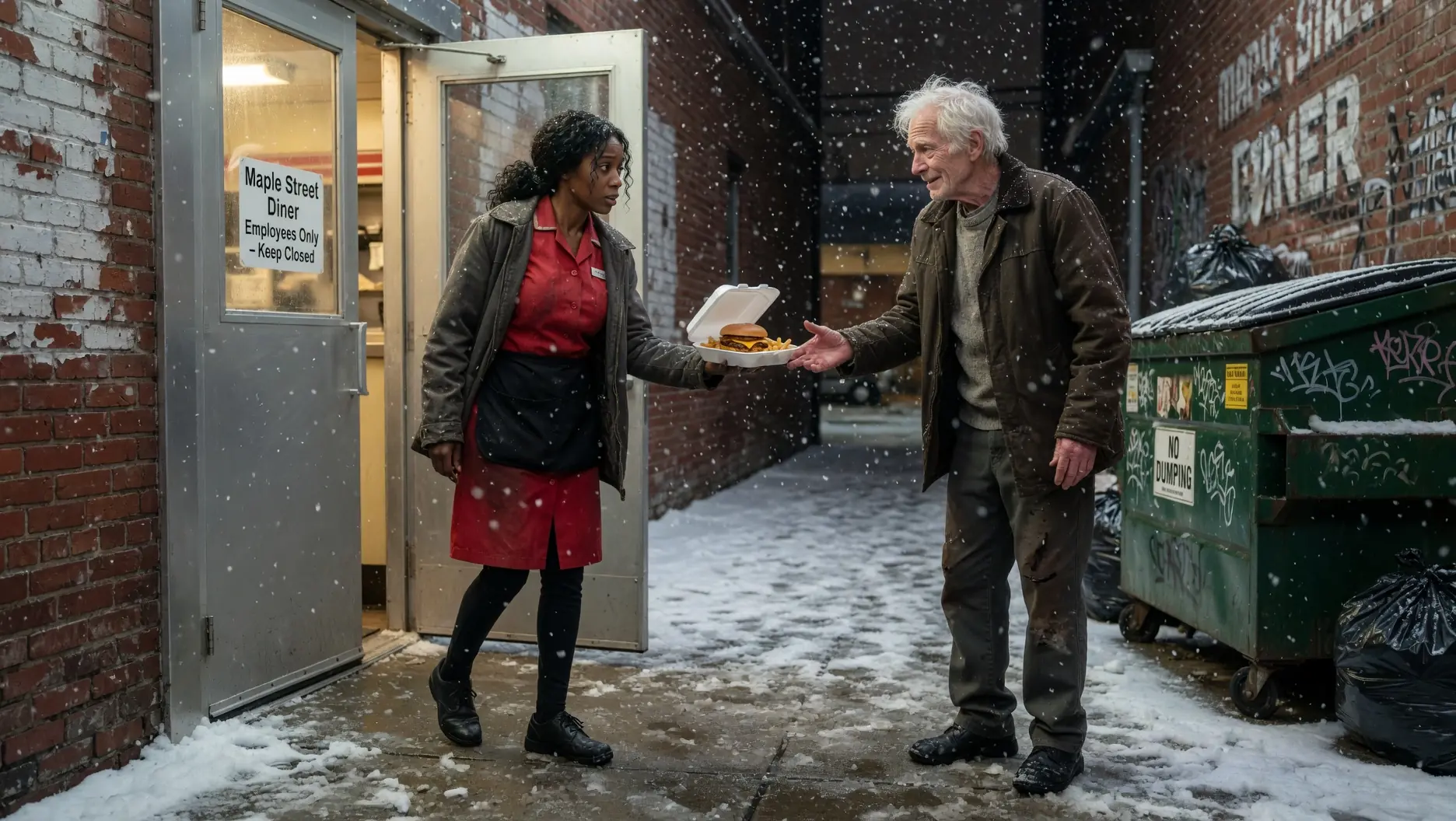
Monique was halfway to the dumpster when she heard it.
A sound, quiet but distinct.
The scrape of something against metal.
She froze.
For one breath, she thought it might be a rat.
Then she heard a muffled cough.
Not an animal.
A person.
Monique tightened her grip on the garbage bag and looked toward the dumpster.
There, behind the rusted green container, a figure hunched over in the snow.
The man’s hands moved through the garbage with desperate, trembling motions.
His coat was more holes than fabric, and his white hair caught what little light there was, making him look almost ghostly.
He was digging through the trash like he had already made peace with being invisible.
Monique’s first instinct was to look away.
Pretend she had not seen anything.
Dump the trash, go inside, clock out, and hurry home.
Her hand moved automatically to her coat pocket, feeling the folded electric bill notice.
She had problems of her own.
Big ones.
Hungry ones.
Cold ones.
She should just walk past, dump the trash, and go home to Sophie, to her mother, to the cracked ceiling of their cramped apartment and the space heater that barely worked.
She should go home to the stack of bills that never seemed to get smaller no matter how many double shifts she pulled.
The man’s shoulders shook.
Maybe from cold.
Maybe from shame.
Maybe from both.
Monique closed her eyes.
“Damn it,” she whispered to herself.
Her father’s voice echoed in her head the way it sometimes did when she was tired.
“Baby girl, we ain’t got much, but we got enough to share.”
He had said that the last winter before he died, when he gave his only warm coat to a stranger at a bus stop.
Monique had been furious with him then.
She had told him he was being stupid.
She had told him they needed that coat.
A week later, pneumonia took him.
For years, Monique had carried guilt and love for him in the same place in her chest.
The old man shifted, and Monique saw his face.
Gaunt.
Hollowed out.
But his eyes, when they caught the light, were clear blue.
Lost.
Not drunk.
Not dangerous.
Lost.
Monique made a decision she would probably regret.
“Hey!”
Her voice came out rougher than she intended.
The man’s head snapped up.
For a second, fear flashed across his face, raw and animal.
He stumbled backward, nearly falling into the snow-packed brick wall.
“Wait, wait,” Monique said, holding up her free hand.
“I’m not going to hurt you. I just… hold on a second.”
The man stared at her like he did not understand the language of kindness anymore.
Monique dropped the garbage bag near the dumpster and reached into her other coat pocket.
The foam container was still warm.
Frank, the night cook, had given it to her before she left.
A burger and fries.
Her dinner.
The only meal she would have until tomorrow’s lunch break.
Monique looked at the container.
Then she looked at the old man.
Then back at the container.
“Jesus Christ, Monique, you’re such an idiot,” she muttered.
But she was already walking toward him, holding it out.
The man stared at the container like it might explode.
His hands shook worse up close.
They were raw and red from cold.
His fingernails were cracked and dirty.
There was a cut across one knuckle, dry blood dark against pale skin.
“It’s just a burger,” Monique said softly.
“Take it, please.”
He reached out slowly.
When his fingers closed around the foam, his whole body sagged with relief.
He opened it right there.
The way he looked at that burger made Monique’s throat tighten.
Like it was not food.
Like it was proof he still existed.
“Thank you,” he whispered.
His voice was barely there, rough with disuse.
“Thank you.”
Monique nodded, wrapping her arms around herself against the cold.
She should go.
She had done her good deed.
Sophie was probably still awake, waiting up even though she was not supposed to.
Emma would be worried too, sitting in the old recliner with her sewing basket in her lap, pretending she was not listening for footsteps in the hallway.
But the man was eating so carefully.
So slowly.
Like he was trying to make it last.
Like he could not quite believe it was real.
“What’s your name?” Monique heard herself ask.
He stopped mid-bite.
He looked up at her with those confused blue eyes.
For a long moment, he only stared, his forehead creasing with effort.
“I… I don’t…”
His voice cracked.
“I’m not sure.”
Monique frowned.
“You’re not sure?”
“I know I had one,” he said.
His hands tightened around the foam container.
“I remember there were people. Voices. Bright lights. A room with glass walls, maybe. Numbers. Someone shouting. Then nothing.”
He pressed one palm to his temple.
“Just cold. And I can’t remember where I’m supposed to be.”
Oh God.
Monique glanced around the alley.
The snow was starting to fall harder, and the wind was picking up.
The temperature was supposed to drop below freezing tonight.
She had heard it on the radio at work while wiping down booth seven.
“Listen,” she said, making another decision she definitely could not afford.
“You can’t stay out here. You’ll freeze to death.”
The old man looked at her, and she saw something in his expression that made her heart hurt.
Hope.
Tiny and fragile.
Like he did not quite dare believe it.
“I don’t have anywhere to go,” he said simply.
Monique thought about her apartment.
She thought about her mother’s face when she brought home a stranger.
She thought about Sophie sleeping down the hall.
She thought about all the very logical reasons why this was a terrible idea.
Then she thought about her father again.
The coat.
The bus stop.
The way he had smiled even while shivering.
The way he had told her that the measure of a person was not what they had, but what they did when they had almost nothing left to give.
“Yeah, well,” Monique said, clearing her throat.
“Neither did I once upon a time. Come on. My place is small, but at least the wind won’t cut right through you.”
The man stared at her like she had offered him the moon.
“I’m Monique,” she said, holding out her hand.
He took it.
His grip was weak, but something about the gesture felt formal.
Old-fashioned.
Careful.
“I wish I could tell you my name,” he said quietly.
“That’s okay,” Monique replied.
“We’ll figure it out.”
She pulled her hand back and gestured toward the street.
“But first, let’s get you somewhere warm before we both turn into popsicles. My mother’s going to have questions. I’m warning you now. She’s protective.”
The man looked ashamed.
“I don’t want to frighten anyone.”
“You already look like a ghost digging through trash behind a diner,” Monique said.
“That part’s done.”
For the first time, his mouth twitched.
Not quite a smile.
But close.
They walked out of the alley together.
Monique tried not to think about what she was getting herself into.
The snow fell faster, covering their footprints almost as soon as they made them.
The bus ride home was silent.
Monique paid for both of them using the last emergency dollars tucked into her sock, because the old man had no wallet, no ID, and no idea where he had come from.
He sat beside her near the back of the bus, clutching the foam container in both hands.
Every few minutes, he looked at Monique like he expected her to vanish.
“You okay?” she asked once.
He nodded.
Then shook his head.
“I don’t know.”
“That’s fair.”
The bus windows were fogged with cold and breath.
Outside, Cleveland slid by in broken pieces.
Closed corner stores.
Snow-covered cars.
Graffiti on brick walls.
A church sign with missing letters that read: GOD SEES W AT YOU CARRY.
Monique stared at that sign until the bus turned the corner.
When they reached the entrance to her building, with its cracked concrete steps and flickering hallway light, Monique paused.
“This is it,” she said.
“It’s not much.”
The old man looked up at the building.
The peeling paint.
The buzzer panel with three missing buttons.
The metal door patched with two different locks.
“It’s shelter,” he said.
“That’s everything.”
Monique’s building was one of those low-income housing complexes the city pretended did not exist.
Peeling paint.
Broken elevator.
Walls so thin you could hear your neighbors’ entire lives playing out.
A baby crying upstairs.
A couple arguing on the first floor.
Someone’s television too loud through the pipes.
But it was home.
Or as close to home as she could afford.
She unlocked the door to apartment 2B and pushed it open.
“Mama,” she called out, trying to sound normal.
“I’m home and… um, I brought someone.”
The apartment went quiet.
Then came the sound of movement from inside.
Emma Jackson appeared in the narrow hallway, still dressed despite the late hour, a needle and thread in her hand.
She was sixty-two, with silver-streaked hair pulled back in a neat bun and eyes that missed nothing.
Those eyes went straight to the old man behind Monique.
“Baby, what?”
Emma’s voice trailed off.
Her whole body went rigid.
She shifted slightly, positioning herself between the hallway and Sophie’s bedroom door.
“Mama, please,” Monique said, stepping inside.
The old man hesitated at the threshold like he needed permission.
“He was in the alley behind the diner in the snow,” Monique lowered her voice.
“He doesn’t remember who he is. He can’t stay out there, Mama. He’ll die.”
Emma’s jaw tightened.
Monique could see the war happening behind her mother’s eyes.
Fear.
Caution.
Anger at the risk.
And something else too.
Recognition, maybe, of what it meant to have nothing and need one person not to close the door.
Emma’s gaze moved slowly over the old man.
His shaking hands.
His worn-out shoes held together with what looked like duct tape.
The way he stood there swaying slightly with exhaustion.
Emma’s expression softened just a fraction.
“Come in,” she said finally.
“But you leave that door to Sophie’s room closed. Understand?”
The old man nodded quickly.
“Yes, ma’am.”
His voice carried a strange formality that seemed at odds with his appearance.
Emma stepped aside.
“Shoes on the mat. Don’t track snow through my kitchen.”
“Yes, ma’am.”
Monique almost laughed from sheer nerves.
Emma moved into the kitchenette and ladled bean soup from a pot on the stove, stretching the ingredients as far as they could go.
She set the bowl on the small table and nodded toward it.
“Sit. Eat.”
The old man sat slowly, like his body was not sure it could manage the movement.
When he picked up the spoon, Monique noticed something.
The way he held it.
Careful.
Measured.
Elegant.
Like muscle memory from another life.
He ate slowly.
Not like someone who was starving, even though he clearly was.
Like someone who had once been taught manners and still held onto them when everything else had disappeared.
Emma and Monique exchanged glances.
“What’s your name, sir?” Emma asked.
The old man stopped eating.
His face tightened with effort.
“I don’t know,” he said after a moment.
“I can’t remember. There are pieces, but nothing fits together. I see buildings, glass, numbers, a fountain maybe. A woman crying. A boy yelling.”
He set the spoon down carefully.
“I’m sorry to intrude. I know this is your home and I’m a stranger.”
“You’re a person who needs help,” Emma corrected.
“That’s what you are.”
A sound came from the hallway.
All three of them turned.
Sophie stood in her doorway, rubbing her eyes.
She wore her favorite pajamas, the ones with cartoon cats, and clutched her stuffed bear to her chest.
Her curls stuck up in every direction.
“Mama?” she said sleepily.
“Who’s that?”
“Sophie, baby, go back to bed,” Monique said quickly.
But Sophie, being Sophie, did exactly the opposite.
She walked straight over to the old man and looked up at him with wide, curious six-year-old eyes that did not yet know all the reasons the world told people to be afraid.
“You look cold,” Sophie announced.
Then, without hesitation, she held out her bear.
“Here. Mr. Fuzzy keeps me warm. You can borrow him.”
The old man’s hands froze halfway to the bear.
Monique saw his eyes fill with tears.
Watched his throat work as he tried to swallow them down.
“Sophie, honey, he doesn’t need your…”
“Thank you,” the old man whispered.
He took the bear with both hands, holding it like it was made of glass.
“Thank you so much.”
A tear rolled down his cheek.
Sophie beamed at him, completely oblivious to the weight of the moment.
“You’re welcome. What’s your name?”
“I don’t remember, sweetheart.”
Sophie considered this seriously.
“That’s okay. We can call you something else until you remember.”
The old man blinked.
“What would you call me?”
Sophie tilted her head.
“How about Mr. Gray? Because of your hair.”
The old man smiled.
It transformed his whole face.
Made him look younger somehow.
“Mr. Gray is perfect.”
Monique felt something crack open in her chest.
This was crazy.
Absolutely insane.
She had brought a stranger into her home, into her daughter’s life, when she could barely afford to feed the three of them.
But looking at Sophie’s happy face, Emma’s softening expression, and the old man clutching a stuffed bear like it was a lifeline, Monique thought maybe crazy was okay sometimes.
“All right, Mr. Gray,” she said.
“You can sleep on the couch tonight. Tomorrow we’ll figure out the rest.”
“I can’t thank you enough,” he said softly.
“Don’t thank me yet,” Monique replied.
“The couch is lumpy, and the heater sounds like it’s going to explode any minute.”
Emma gave her a look.
“But it works,” Monique added quickly.
“Mostly.”
When she brought out the spare blanket, the thin one with the holes in it, Mr. Gray took it like she had handed him a treasure.
That night, Monique lay awake in the bed she shared with Sophie, listening to the sounds of the apartment.
The radiator clanking.
Her mother’s soft cough.
The low hum of the fridge.
And from the living room, almost nothing.
Just the occasional shift of an old man trying to rest on a couch too small for him.
She wondered what she had just done.
What complications she had invited into their already complicated life.
But mostly she thought about those blue eyes.
Lost.
Grateful.
And somehow still hopeful.
“Please don’t let this be a mistake,” she whispered into the darkness.
Sophie stirred beside her.
“Is Mr. Gray gonna be okay?” she mumbled.
“I hope so, baby.”
“He can keep Mr. Fuzzy tomorrow too.”
Monique closed her eyes.
For tonight, they had kept someone alive.
That had to count for something.
Morning came too fast.
Monique woke to the smell of coffee and the sound of Emma moving quietly in the kitchen.
Sophie was already gone from the bed.
That made Monique sit up fast.
She stepped into the hallway and saw her daughter sitting cross-legged on the living room floor beside the couch.
Mr. Gray was awake, sitting upright with Mr. Fuzzy in his lap.
Sophie had arranged three crayons in front of him.
“You can use the blue one,” Sophie said.
“It’s my best one.”
Mr. Gray held the crayon carefully between his fingers.
“What are we drawing?”
“A house,” Sophie said.
“Everybody knows that.”
Mr. Gray looked down at the paper.
His hand hovered.
Then he began to draw.
Monique stopped in the doorway.
The lines were shaky at first.
Then they grew steady.
Sharp.
Precise.
He drew a house, but not like Sophie would have drawn one.
Not a square with a triangle roof.
He drew tall windows, columns, stone steps, a gate with curved ironwork, and a long fountain in front.
It was beautiful.
Too beautiful.
Emma came up behind Monique and saw it too.
Neither woman spoke.
Sophie leaned over the paper.
“That’s a fancy house.”
Mr. Gray stared at the drawing as if he had surprised himself.
“I think… I think I know this place.”
Monique stepped closer.
“Is it yours?”
His face twisted.
“I don’t know.”
The frustration in his voice was painful.
“I can see it, but I don’t know if I lived there or visited or dreamed it.”
Emma set a cup of coffee on the table.
“Memory comes how it comes.”
Mr. Gray looked up at her.
“Did I cause trouble last night?”
Emma folded her arms.
“You ate soup, slept on my couch, and made my granddaughter give up her bear. That’s not trouble yet.”
He lowered his eyes.
“I am sorry.”
Sophie patted his knee.
“It’s okay. Mr. Fuzzy likes helping.”
Monique smiled despite herself.
That morning, she called the non-emergency police line.
She explained that she had found an elderly man confused in the alley, with no ID and no memory.
The woman on the phone sounded tired before Monique finished the first sentence.
“Is he injured?”
“No, but he was outside in the snow. He doesn’t remember who he is.”
“Any signs of violence?”
“Not that I can see.”
“Can you bring him to a precinct?”
Monique looked at Mr. Gray, who was now carefully helping Sophie draw smoke coming out of the chimney.
“I work a double today,” she said.
“And I don’t have a car.”
The woman sighed.
“We can send someone when available, but it may take a while.”
“How long is a while?”
“Could be today. Could be tomorrow. Weather’s got us backed up.”
Monique almost laughed.
Tomorrow.
The city had a whole file cabinet full of people it would get to tomorrow.
“Fine,” she said.
“I’ll keep him here until someone comes.”
Emma stared at her when she hung up.
“You’ll keep him here?”
“What was I supposed to say?”
Emma rubbed her forehead.
“Monique.”
“I know.”
“No, I don’t think you do.”
Monique leaned against the counter.
“Mama, I couldn’t just throw him back outside.”
“I’m not saying throw him outside. I’m saying we don’t know who he is.”
“He doesn’t know who he is either.”
“That does not make me feel better.”
“I know.”
Emma glanced toward the living room, where Sophie was giggling because Mr. Gray had drawn a lopsided dog in front of the fancy house.
Then Emma sighed.
“You go to work. I’ll watch him today.”
Monique blinked.
“Mama, you sure?”
“No.”
Emma picked up her coffee.
“But I’m doing it anyway.”
Monique hugged her quickly.
Emma pretended not to soften.
“Don’t squeeze me like you’re trying to pay rent with affection.”
“I love you too.”
“Go get dressed.”
When Monique left for work, Mr. Gray stood by the door like a guest in a hotel lobby.
“Thank you for trusting me,” he said.
Monique looked at his torn coat, his tired eyes, and the stuffed bear tucked under one arm because Sophie had insisted he needed it.
“I’m not sure I do yet,” she admitted.
“But I trust you enough to come back.”
He nodded solemnly.
“I will do my best to deserve that.”
At the diner, Monique moved through the morning rush like a body on autopilot.
Coffee.
Eggs.
Toast.
Refills.
Receipts.
Fake smiles.
A man in booth five complained that his hash browns were too crisp.
A woman at the counter left thirty-two cents as a tip on a twenty-dollar order.
Brenda, the manager, snapped at Monique for being three minutes late even though Monique had covered three shifts that week without complaint.
“You look like hell,” Frank said when Monique passed the kitchen window.
“Good morning to you too.”
“You eat?”
“Not yet.”
He slid a biscuit wrapped in a napkin onto the counter.
“Don’t argue.”
Monique took it.
“Bless you.”
“I know.”
By noon, her phone buzzed.
A text from Emma.
He fixed the kitchen chair.
Monique stared at the screen.
Then another text came in.
And the loose cabinet handle.
Then another.
Sophie says he draws better than you.
Monique smiled for the first time all day.
When she got home that night, the apartment smelled different.
Not rich.
Not fancy.
But fuller.
Bean soup had been stretched with potatoes.
The kitchen chair no longer wobbled.
The cabinet handle no longer threatened to fall off every time someone opened it.
Sophie ran to the door.
“Mama! Mr. Gray knows how to fix stuff!”
Mr. Gray stood from the couch.
“I hope I did not overstep.”
Monique looked at the repaired chair.
Then at the cabinet.
Then at the old man.
“You can overstep like that anytime.”
Emma sat at the table, pretending not to be impressed.
“He also folded towels wrong.”
Mr. Gray looked genuinely concerned.
“I apologize. There is a correct way?”
“In my house, yes.”
Sophie whispered loudly,
“Grandma has rules for towels.”
Mr. Gray nodded.
“Then I must learn the towel law.”
Monique laughed.
It startled her.
A real laugh.
Not the tired little customer-service laugh she used at work.
Something warm moved through the room.
Over the next few days, Mr. Gray stayed.
The police never came.
Or if they did, they came while everyone was out and left no message.
Monique called again.
Then again.
Each time, she was told someone would follow up.
No one did.
So Mr. Gray became part of their strange little routine.
In the mornings, Emma made coffee and watched him suspiciously over the rim of her mug.
By the end of the first week, she was giving him chores.
Not hard ones.
Small ones.
Peeling potatoes.
Sorting screws in an old coffee can.
Reading labels on medicine bottles for her when her glasses disappeared.
He accepted every task with quiet dignity.
Sophie adored him completely.
She made him paper name tags that said MR. GRAY in purple crayon.
She taught him the rules of her stuffed animal hospital.
She demanded bedtime stories, and when he said he did not know any, she told him to make one up.
To everyone’s surprise, he did.
His stories were strange and beautiful.
About lost kings in glass towers.
About trains that carried people to places they forgot they loved.
About a girl who kept a lantern burning in the window so her father could find his way home.
Sophie would fall asleep listening.
Sometimes Monique found Mr. Gray sitting silently afterward, staring at the wall with tears in his eyes.
“You okay?” she asked one night.
He wiped his face quickly.
“I think I had a daughter.”
Monique sat down across from him.
“You remember her?”
“Not her face. Just… the feeling.”
He pressed a hand to his chest.
“When Sophie laughs, something here hurts.”
Monique swallowed.
“Maybe that means it’s waking up.”
“Or maybe it means something is gone forever.”
She did not know how to answer that.
So she said nothing.
Sometimes silence was kinder.
By the second week, Monique found herself hurrying home after work.
Not because life had gotten easier.
It had not.
The electric bill still hung over her.
The landlord still called.
The diner still drained every ounce of strength from her body.
But the apartment felt less like a survival bunker now.
It felt alive.
Mr. Gray helped Emma cook.
Emma taught him how to season beans properly because, as she put it,
“Your hands know silver spoons, but they don’t know garlic.”
He smiled and listened.
Monique noticed his manners more each day.
The way he stood when Emma entered the room.
The way he pulled out a chair for her without thinking.
The way he spoke to Sophie like she was a full person, not a child to be dismissed.
The way he read newspapers from the free stand outside the diner, moving his eyes over business articles with a focus that did not match his lost memory.
One evening, Monique brought home an old newspaper someone had left in booth three.
Mr. Gray opened it while Sophie colored beside him.
His hand stopped on the financial section.
For a moment, his whole body went still.
“Mr. Gray?” Monique asked.
He tapped a headline with one finger.
It was about a merger between two large investment firms.
“Sterling,” he murmured.
Emma looked up.
“What?”
“Sterling,” he repeated.
“I know that word.”
Monique leaned over.
“Like silver?”
He frowned.
“No. Like a name. Or a building.”
“Is it your name?”
His face tightened with effort.
“I don’t know.”
The moment passed.
The fog returned to his eyes.
He folded the paper carefully and set it aside.
“I’m sorry.”
Monique wanted to scream at the unfairness of it.
A whole life trapped behind a locked door, and every now and then, one word slipped through.
But not enough.
Never enough.
On the tenth day, the landlord came.
Monique was at work.
Emma told her later.
Mr. Peterson pounded on the door at two in the afternoon, his voice booming through the hallway.
“Emma, open up. I know you’re in there.”
Emma opened the door with the chain still on.
Mr. Peterson was a thick-necked man with a permanent scowl and a cheap leather jacket.
He looked past Emma into the apartment.
“You got extra people living here now?”
Emma’s face hardened.
“You got business here?”
“My business is rent.”
“You’ll get it Friday.”
“That’s what your daughter said last Friday.”
“She paid half.”
“Half don’t keep a roof over your head.”
Sophie hid behind Mr. Gray’s leg.
Mr. Gray stood quietly near the kitchen table, one hand resting gently on Sophie’s shoulder.
Mr. Peterson noticed him.
“Who the hell is that?”
“A guest,” Emma said.
“This ain’t a shelter.”
“No,” Mr. Gray said calmly.
“But it appears to be a residence governed by tenant law.”
Mr. Peterson blinked.
“What?”
Mr. Gray stepped forward, still thin, still dressed in donated clothes, still looking like a man who had slept too many nights in the cold.
But something in his posture changed.
His spine straightened.
His voice became smooth and precise.
“Under Ohio law, a landlord cannot remove tenants without proper notice and court proceedings. Harassment, intimidation, or threats may constitute grounds for complaint.”
Emma stared at him.
Sophie stared too.
Mr. Peterson’s face darkened.
“You a lawyer?”
Mr. Gray looked confused for half a second.
Then said,
“I don’t believe so.”
Mr. Peterson scoffed.
“You don’t believe so?”
Mr. Gray looked him directly in the eye.
“But I believe I know enough to recognize unlawful pressure.”
There was a silence.
Then Mr. Peterson stepped back.
“Friday,” he snapped.
“If I don’t have the money Friday, I file.”
He stomped down the hall.
Emma closed the door slowly.
She turned to Mr. Gray.
“What was that?”
He looked troubled.
“I don’t know.”
Sophie looked up at him with awe.
“Are you a secret judge?”
Mr. Gray smiled faintly.
“I hope not.”
When Monique got home and heard the story, she stared at him for a long time.
“Tenant law?”
Mr. Gray rubbed his temple.
“It just came out.”
“Things like that don’t just come out of people who don’t know things.”
“I know.”
“Sterling. Legal stuff. Fancy house drawings. Expensive manners.”
Emma leaned back in her chair.
“That man was somebody.”
Mr. Gray looked down.
“Was.”
Monique regretted it immediately.
“You still are somebody.”
He looked at her.
She meant it.
“You hear me? Memory or not, money or not, name or not. You are somebody.”
Mr. Gray’s eyes grew wet.
“Your father taught you that?”
Monique nodded.
“Yeah. Sometimes I wish he had taught me how to pay bills too, but yes.”
He laughed softly.
So did Emma.
The next day, Monique found the flyer.
Rain had replaced the snow by then.
Cold rain.
Mean rain.
The kind that turned old snow into gray slush and made the whole city feel tired.
Monique had just finished another late shift at the diner.
She stepped into the alley to toss trash, and the first thing she noticed was the flyer slapped crookedly against the brick wall near the back door.
It was soaked.
The corners curled.
Black ink ran in streaks from the letters.
But the face was still clear.
Monique froze.
It was Mr. Gray.
Not exactly as he looked now.
In the photo, he was clean-shaven, dressed in a dark suit, standing in front of a glass building.
His white hair was neatly combed.
His blue eyes were sharp.
Powerful.
The kind of eyes that made people stand straighter.
Under the photo, in bold letters, were the words:
MISSING: ELLIOT GRANT STERLING
Monique’s breath stopped.
Below that was another line.
BILLIONAIRE PHILANTHROPIST AND FOUNDER OF STERLING FOUNDATION DISAPPEARED AFTER HOSPITAL RELEASE.
There was a phone number.
A reward notice.
$500,000 for information leading to his safe return.
Monique’s hand shook as she reached for the flyer.
The paper tore slightly under her fingers.
Elliot Grant Sterling.
Sterling.
That word from the newspaper.
Mr. Gray had not been imagining it.
He was a billionaire.
Not just rich.
Not just someone with a nice watch.
A billionaire.
Monique stood in the rain behind the diner, staring at the flyer while her heart pounded so hard it hurt.
A half-million dollars.
The number seemed unreal.
It was bigger than her debts, bigger than her rent, bigger than every worry stacked on the kitchen table at home.
It could change everything.
Her electric bill.
Emma’s medicine.
Sophie’s future.
A better apartment.
A working heater.
Dental visits.
New shoes.
Oranges every winter.
Monique folded the flyer carefully and tucked it inside her coat.
Then she stood there, soaked and shaking, and felt ashamed of the first thought that had entered her mind.
Money.
Not Mr. Gray.
Not Elliot.
Money.
She leaned against the brick wall and closed her eyes.
“Daddy,” she whispered.
“What do I do?”
The rain gave no answer.
When Monique got home, Mr. Gray was sitting at the kitchen table helping Sophie with spelling words.
Emma was darning a sock under the yellow light.
The radiator hissed angrily in the corner.
Everything looked the same.
But nothing was the same.
Sophie looked up.
“Mama, Mr. Gray says Wednesday is a weird word because it has letters hiding in it.”
Monique tried to smile.
“It sure does, baby.”
Emma noticed immediately.
“What happened?”
Monique pulled the flyer from her coat.
She unfolded it on the table.
Emma’s needle stopped.
Mr. Gray stared at the paper.
The room went silent.
Sophie leaned forward.
“Mr. Gray, that’s you.”
He did not answer.
His hands trembled.
Monique watched his eyes move over the page.
The photo.
The name.
The words.
Elliot Grant Sterling.
He whispered the name once.
“Elliot.”
Then again.
“Elliot Sterling.”
His face twisted as if the name hurt.
“I think… I think that is me.”
Emma crossed herself silently.
Sophie looked confused.
“You’re not Mr. Gray?”
He looked at her, and his face softened.
“I think I am both, sweetheart.”
Monique sat down slowly.
“There’s a number. Your family must be looking for you.”
He stared at the flyer.
“My family.”
His voice was hollow.
“I don’t remember them.”
“You remembered Sterling,” Emma said gently.
“And the house maybe,” Monique added.
He closed his eyes.
“A hospital. I remember white walls. Someone arguing. A man’s voice. I wanted to leave. Or maybe I was afraid.”
Monique’s stomach tightened.
“Afraid of what?”
He opened his eyes.
“I don’t know.”
Emma’s expression sharpened.
“Something about this don’t feel simple.”
Monique looked at the reward notice.
$500,000.
Emma saw where her gaze went.
For a moment, neither woman spoke.
Then Emma said quietly,
“Call the number.”
Monique looked at her.
“Mama.”
“Call the number.”
“What if they think we kidnapped him?”
“What if someone bad is looking for him?”
“What if he needs medical care?”
“What if we call and everything changes?”
Emma looked at her daughter with tired, loving eyes.
“Baby, everything already changed when you brought him through that door.”
Monique swallowed.
Mr. Gray reached across the table and placed his hand over the flyer.
“If I have people looking for me, I should not keep them in pain.”
His voice trembled.
“But I am afraid.”
Sophie climbed into the chair beside him and hugged his arm.
“You can be afraid here.”
That broke him.
He bowed his head, and for a moment, Elliot Grant Sterling, billionaire philanthropist, founder of some foundation, missing man on a flyer, was just Mr. Gray.
An old man crying at a cheap kitchen table.
Monique called the number.
A woman answered on the second ring.
“Sterling Recovery Line.”
Monique’s mouth went dry.
“Hi. My name is Monique Jackson. I think… I think I found the man on your flyer.”
There was a sharp silence.
“Ma’am, please repeat that.”
“I think I found Elliot Sterling.”
“Where are you?”
Monique hesitated.
Emma shook her head and pointed to the wall, silently telling her not to give the address yet.
Monique said,
“I need to know who I’m speaking to first.”
The woman’s tone changed.
“Ma’am, this is a secure recovery line operated by the Sterling Foundation. Mr. Sterling is a vulnerable missing person. If you have information, you need to provide your location immediately.”
“I found him almost two weeks ago,” Monique said.
“He was freezing behind a diner. He didn’t remember his name. I took him in.”
Another silence.
Then the woman said,
“Is he alive?”
Monique looked at Mr. Gray.
He nodded.
“Yes.”
“Is he injured?”
“No. Confused. Weak, but better than he was.”
The woman exhaled shakily.
“Please hold.”
The line clicked.
Monique’s pulse roared in her ears.
A new voice came on.
Male.
Deep.
Controlled, but barely.
“This is Adrian Sterling. Who am I speaking with?”
Monique sat straighter.
“Monique Jackson.”
“Miss Jackson, are you telling me my father is with you?”
Mr. Gray flinched at the word father.
Monique noticed.
“Yes.”
“Where?”
“I’m not giving you my address until I know he’s safe with you.”
Adrian inhaled sharply.
“Safe with me? He’s my father.”
“He was found digging through garbage in the snow with no memory,” Monique said, her voice hardening.
“So forgive me if I ask questions.”
Emma’s eyebrows lifted.
Proud.
Adrian was quiet for a moment.
Then his voice softened.
“You’re right. I’m sorry.”
That apology surprised her.
“My father disappeared after being discharged from a private neurological clinic. He has early-stage dementia complicated by head trauma from a fall. He left the facility confused. We have been searching everywhere.”
“Why wasn’t this all over the news?”
“We tried to keep it quiet at first,” Adrian said.
“For his privacy. Then we realized someone may have seen him and not known who he was. That’s why the flyers went out.”
Mr. Gray closed his eyes.
“A clinic,” he whispered.
Monique repeated,
“He remembers a hospital.”
“Can I speak to him?” Adrian asked.
Monique looked at Mr. Gray.
He looked terrified.
Then nodded.
She handed him the phone.
His fingers trembled so badly she had to help him hold it.
“Hello?” he said.
The voice on the other end broke.
“Dad?”
Mr. Gray’s face tightened.
“I’m sorry,” he whispered.
“I don’t remember you.”
Monique looked away.
Emma wiped her eyes with the corner of her sleeve.
The room was silent except for Adrian Sterling crying quietly through the phone.
“That’s okay,” Adrian said.
His voice shook.
“That’s okay, Dad. I remember you. That’s enough for now.”
Mr. Gray closed his eyes.
“I have been safe.”
“I know. Miss Jackson told me.”
“They gave me soup.”
Adrian let out a broken laugh.
“They gave you soup?”
“And a bear,” Mr. Gray said.
Sophie smiled proudly.
“His name is Mr. Fuzzy,” she whispered.
Adrian’s voice softened further.
“Can I come get you?”
Mr. Gray looked at Monique.
There was trust in his eyes.
Trust she did not feel ready to carry.
Monique nodded slowly.
He said,
“Yes. But please do not frighten the child.”
Adrian promised.
He arrived forty-five minutes later in a black SUV that looked completely out of place in their parking lot.
Two other cars came with him.
Security, probably.
Monique watched from the window, her stomach twisting.
Emma stood beside her.
“Rich people even arrive loud when they trying to be quiet,” Emma muttered.
Monique almost smiled.
Adrian Sterling stepped out first.
He was in his early forties, tall, clean-cut, with dark hair streaked slightly at the temples and a face drawn with exhaustion.
He wore a wool coat that probably cost more than Monique made in a month.
But when he looked up at apartment 2B, there was no arrogance on his face.
Only fear.
Only hope.
Monique opened the door before he knocked.
Adrian stood there with his hands visible, as if trying to show he was not a threat.
“Miss Jackson?”
“Monique.”
“Monique.”
His voice caught.
“Thank you for calling.”
She stepped aside.
“Come in. But slowly. He’s nervous.”
Adrian nodded.
The moment he saw his father sitting at the kitchen table with Sophie beside him, his face crumpled.
“Dad.”
Mr. Gray looked up.
For a second, nothing happened.
Then his eyes narrowed with effort.
“A boy,” he said.
Adrian froze.
“What?”
“I remember a boy in a red sweater,” Mr. Gray whispered.
“You fell from a tree. Broke your arm. You cried because your mother cut the sweater off.”
Adrian’s hand flew to his mouth.
He made a sound like someone had punched him in the chest.
“That was me.”
Mr. Gray’s eyes filled with tears.
“I don’t remember your name.”
“Adrian,” he said quickly.
“My name is Adrian.”
“Adrian.”
Mr. Gray repeated it carefully.
Like a man holding a match in the wind.
“Adrian.”
Then Adrian crossed the room and knelt before his father.
He did not grab him.
Did not force a hug.
He only bowed his head and pressed his forehead against the old man’s hand.
“I thought I lost you,” Adrian whispered.
Mr. Gray looked at Monique helplessly.
She nodded.
“It’s okay.”
Only then did he rest his hand on Adrian’s head.
The apartment seemed to hold its breath.
Sophie whispered,
“Is Mr. Gray going home now?”
Adrian looked up at her.
His eyes were red.
“I hope so.”
Sophie looked at Mr. Gray.
“Will you visit?”
Mr. Gray’s face crumpled.
“If I can remember where to come.”
Monique laughed and cried at the same time.
“We’ll write it down.”
Adrian turned to Monique.
“I owe you more than I can say.”
Monique immediately shook her head.
“You don’t owe me.”
“Yes,” he said quietly.
“I do.”
He reached into his coat and pulled out an envelope.
Monique stiffened.
Adrian noticed.
“This is the reward.”
Emma’s eyes went to Monique.
Sophie looked confused.
Mr. Gray watched silently.
Monique stared at the envelope.
Half a million dollars.
Maybe not all in cash, but enough.
More than enough.
Her whole life changed in one envelope.
She thought about every bill.
Every night Sophie went to sleep in socks because the heat barely worked.
Every time Emma skipped medicine.
Every time Monique counted coins at the grocery store.
Her hands stayed at her sides.
“I didn’t help him for money,” she said.
“I know,” Adrian replied.
“That is why you deserve it.”
Monique looked away.
“I don’t know how to take something like that.”
Emma spoke softly from behind her.
“Baby.”
Monique looked at her mother.
Emma’s eyes were wet.
“Pride don’t pay electric bills.”
The truth of it landed hard.
Adrian held the envelope out.
“You saved my father’s life. You protected him when the world walked past. This reward was offered because we prayed someone like you would exist.”
Monique slowly took the envelope.
It felt heavier than paper.
Mr. Gray reached for her hand.
“You gave me a name before I had my own.”
Monique shook her head.
“Sophie gave you that name.”
Sophie nodded.
“Mr. Gray is a good name.”
Adrian smiled through tears.
“It is.”
Before they left, Mr. Gray insisted on taking Mr. Fuzzy with him only if Sophie allowed it.
Sophie thought seriously.
Then said,
“You can keep him until you’re not scared anymore.”
Mr. Gray hugged the bear.
“I will bring him back.”
Adrian promised to call.
Monique did not know whether to believe promises from people who lived in houses behind gates.
But he did call.
The next morning.
Then the next.
Then every day that week.
Mr. Gray was back at his estate, under medical care, surrounded by family and nurses.
His memory came and went.
Some days he remembered Adrian.
Some days he did not.
But every evening, he asked for Monique.
And Sophie.
And Emma.
On the fourth day, Adrian sent a car.
Monique almost refused.
Emma made her wear her good coat.
Sophie wore her purple boots and carried a drawing of Mr. Gray, Mr. Fuzzy, and a very large bowl of soup.
The Sterling estate stood outside the city, beyond gates and trees and a driveway so long Sophie asked if they were still in Ohio.
The house was enormous.
Stone walls.
Tall windows.
A fountain in front.
The house from Mr. Gray’s drawing.
Sophie gasped.
“He remembered!”
Monique felt chills.
Adrian met them at the door.
“My father’s been waiting all morning.”
Mr. Gray sat in a sunroom filled with plants and light.
He looked cleaner now.
Healthier.
But smaller somehow without the couch and the old blanket and the cramped apartment around him.
When he saw Sophie, he smiled.
“My little doctor.”
Sophie ran to him and placed the drawing in his lap.
“I made this.”
He studied it with great seriousness.
“This is excellent work.”
Then he looked at Monique.
For a moment, his eyes were clear.
“Monique.”
She froze.
“You remember?”
“I remember your name today,” he said.
“I may lose it tomorrow. But today, I have it.”
Monique sat beside him.
“That’s enough.”
Adrian watched from the doorway.
Emma sat in a chair near the window, looking uncomfortable among so much expensive furniture.
A nurse brought tea in cups so delicate Monique was afraid to touch them.
Sophie asked if rich people always drank from cups that looked nervous.
Mr. Gray laughed so hard the nurse smiled.
Over the next month, their lives changed in ways Monique could hardly understand.
The reward paid off the electric bill.
Then the rent.
Then Emma’s medical debt.
Then Monique placed money into a savings account for Sophie.
Real savings.
Not coins in a jar.
Not emergency dollars hidden in socks.
Money that could sit there and grow.
Adrian insisted on more.
At first, Monique resisted.
Then he showed up at Maple Street Diner in a suit and sat in her section.
She nearly dropped a coffee pot.
“What are you doing here?”
“Ordering lunch.”
“This diner is not your kind of place.”
“My father says the burgers here saved his life.”
“Technically, one burger did.”
“Then I’ll have that one.”
Frank nearly passed out when he learned who Adrian was.
Brenda suddenly remembered Monique was her “most valued employee.”
Monique did not miss the timing.
Adrian ate the burger without complaint.
Then he left a tip large enough to make Monique chase him into the parking lot.
“I can’t take this.”
“Yes, you can.”
“No, I can’t.”
“Monique, do you ever accept help?”
She opened her mouth.
Closed it.
Adrian smiled gently.
“My father asked me the same thing once.”
“What did you say?”
“I said no. Then he told me stubborn pride is just fear wearing church clothes.”
Monique stared at him.
“That sounds like something Emma would say.”
“Then your mother and my father would get along.”
They did.
Mr. Gray and Emma became unlikely friends.
He came to apartment 2B once after insisting he needed to return Mr. Fuzzy properly.
Adrian protested.
The doctor protested.
Emma said,
“If the man wants to visit, let him visit. He survived my couch once.”
So he came.
This time in a warm coat, with a nurse nearby and Adrian watching him like he might dissolve.
Mr. Gray stood in the doorway of apartment 2B and smiled.
“I remember this place.”
Monique held her breath.
“You do?”
“Not all of it. But I remember being warm.”
Emma looked away.
Sophie hugged his waist.
“You can still be warm.”
He returned Mr. Fuzzy with great ceremony.
Then Sophie immediately gave him a new stuffed rabbit named Officer Carrot, because, she said, rich houses probably needed more security.
Mr. Gray accepted with dignity.
That night, before leaving, he stood by the kitchen table.
“I built foundations,” he said slowly.
“Buildings. Programs. Scholarships. Hospitals.”
His eyes moved over the cracked walls.
“But I forgot the simplest thing.”
“What’s that?” Monique asked.
“A door that opens.”
No one spoke for a moment.
Then Emma said,
“Well, don’t stand there making speeches. Take some cornbread with you.”
He did.
A few weeks later, Adrian asked Monique to meet him at the Sterling Foundation office.
She arrived nervous, wearing her best blouse and the shoes that pinched her toes.
The building was all glass and sunlight.
People moved quickly through the lobby, carrying laptops and coffee cups and the kind of confidence that came from knowing exactly where they belonged.
Monique did not feel like she belonged.
Adrian met her at the elevator.
“You look terrified.”
“I’m not terrified.”
“You look like you want to fight the receptionist.”
“She looked at me funny.”
“She looks at everyone funny.”
He led her upstairs to a conference room overlooking the city.
A folder waited on the table.
Monique looked at it suspiciously.
“What is this?”
“A proposal.”
“I don’t like rich people proposals. They usually come with fine print.”
“This one does.”
“At least you’re honest.”
Adrian smiled.
“My father wants to create a new program through the foundation. Emergency shelter grants. No red tape, no months of waiting, no committees that meet while people freeze.”
Monique slowly sat down.
“Okay.”
“He wants it named after your father.”
Monique’s breath caught.
“What?”
Adrian opened the folder.
“The Jackson Open Door Fund.”
Monique stared at the words.
Her father’s last name.
Her name.
Their name.
“The fund would support small emergency shelters, meal programs, heating assistance, and crisis housing. The kind of help that reaches people before it’s too late.”
Monique’s eyes burned.
“Why my father?”
“Because you told my father what your father used to say.”
Adrian’s voice softened.
“We ain’t got much, but we got enough to share.”
Monique covered her mouth.
Adrian slid another paper toward her.
“My father also wants you involved. Paid position. Community outreach director.”
Monique almost laughed.
“Me?”
“You know what people need because you’ve needed it.”
“I’m a waitress.”
“You’re also the person who saved my father when a whole city walked past him.”
“I don’t have a degree.”
“You have experience no university can give.”
Monique looked out over the city.
Somewhere down there was Maple Street Diner.
Apartment 2B.
The bus stops.
The alleys.
The people everybody got around to tomorrow.
“What would I do?”
“Help us find the people who fall through cracks. Tell us where money actually needs to go. Keep us from becoming another foundation that looks good in brochures and does nothing fast enough.”
Monique swallowed hard.
“My daddy would have liked that.”
“I think so too.”
She touched the folder.
For once, something good did not feel like charity.
It felt like work.
Purpose.
Responsibility.
Something she could stand inside without shame.
“I’ll do it,” she said.
“But I’m not wearing heels every day.”
Adrian laughed.
“I wouldn’t dare ask.”
Monique gave notice at the diner two weeks later.
Frank hugged her so hard her ribs hurt.
Brenda acted offended.
“You leaving us after all these years?”
“You paid me minimum wage and yelled at me for taking bathroom breaks.”
Brenda sniffed.
“I yelled with affection.”
“No, you didn’t.”
Frank slipped a fresh burger into a bag for her.
“For Mr. Gray,” he said.
“He’s got chefs now.”
“Bet they don’t make it right.”
Monique took it.
“You’re probably right.”
The Jackson Open Door Fund launched in early spring.
The first grant went to a shelter that had been turning people away during storms because their boiler had failed.
The second paid overdue heating bills for thirty elderly tenants in a crumbling apartment complex.
The third created a late-night meal program behind Maple Street Diner.
Frank volunteered twice a week.
Emma helped organize donated coats.
Sophie drew the logo.
It was a crooked door with light coming through.
Mr. Gray said it was perfect.
Some days Elliot Sterling knew exactly who he was.
Some days he was Mr. Gray again.
Some days he called Monique by name.
Some days he called her Grace, or Alice, or simply “dear child.”
Monique learned not to mind.
Memory was not the only way to love someone.
One afternoon, almost a year after she found him in the snow, Elliot asked to visit the alley.
Adrian did not like the idea.
Monique did not either.
But Elliot insisted.
“I need to see where I was lost,” he said.
So they went.
Monique, Adrian, Elliot, Emma, and Sophie.
The alley looked the same.
The dumpster.
The brick wall.
The diner door.
The broken street light had finally been replaced, though the new one flickered too.
Elliot stood near the place where Monique had found him.
For a long time, he said nothing.
Then he turned to her.
“I was dying here.”
Monique’s throat tightened.
“Yes.”
“And you stopped.”
“Yes.”
“Why?”
She looked at him.
At the man who had been a stranger, a ghost, a billionaire, a patient, a friend.
At Mr. Gray.
“My daddy would’ve haunted me if I didn’t.”
Elliot smiled.
“Then I owe your father as well.”
Sophie tugged his sleeve.
“Grandpa Gray, are you sad?”
Everyone went still.
Grandpa Gray.
No one had said that before.
Elliot looked down at her.
His eyes filled with tears.
“A little.”
Sophie took his hand.
“It’s okay. You can be sad here.”
Those were the words she had said months ago at the kitchen table.
Elliot remembered.
Maybe not with his mind.
But somewhere deeper.
He squeezed her hand.
“Thank you, sweetheart.”
Later that evening, the first official Jackson Open Door winter shelter opened two blocks from Maple Street Diner.
There were clean beds.
Hot soup.
A nurse on call.
Phone chargers.
Coats.
A wall of missing-person resources.
And a small corner with children’s books and stuffed animals.
Above the entrance, a sign read:
THE JACKSON OPEN DOOR HOUSE
Weather First. Questions Later.
Emma cried when she saw it.
Monique cried too.
Sophie announced that everybody was crying too much and asked if there would be cookies.
There were.
At the opening, Adrian gave a speech.
Then Elliot stood beside him.
He had written notes, but his hands shook.
Monique stood near the front with Emma and Sophie.
Elliot looked out at the crowd.
Reporters.
Donors.
Shelter workers.
Former diner regulars.
People from the neighborhood.
People in suits.
People in worn coats.
For once, they were all standing in the same room.
“I have spent my life building things,” Elliot said.
His voice was slow but clear.
“Buildings. Companies. Foundations. Systems.”
He paused.
“I forgot that sometimes the most important thing a person can build is trust.”
Monique wiped her eyes.
“A year ago, I was lost. I had no name, no memory, no money I could use, no power that mattered. I was cold and hungry behind a diner, digging through trash.”
The room was silent.
“Many people walked past. One woman stopped.”
He looked at Monique.
“She had almost nothing. But she gave me her dinner. Then she gave me shelter. Then her family gave me a name when I could not remember mine.”
Sophie whispered loudly,
“Mr. Gray.”
People laughed softly.
Elliot smiled.
“Yes. Mr. Gray.”
Then his voice thickened.
“I thought I was the wealthy man. But Monique Jackson had what I had lost. Mercy. Courage. A door that opened.”
Monique pressed a hand to her chest.
“This house exists because of her. Because of her father’s words. Because of her mother’s strength. Because of a little girl who gave an old man her bear.”
Sophie looked proud.
Elliot folded his notes.
“May no one who comes to this door ever feel invisible again.”
The applause rose like thunder.
Monique did not know what to do with all those eyes on her.
She had spent most of her life being unseen unless someone wanted coffee, rent, payment, or apology.
Now people were clapping for the part of her she had always been told was foolish.
The part that stopped.
The part that shared.
The part that brought home a stranger in the snow.
After the ceremony, Elliot sat in the children’s corner with Sophie while she showed him how to arrange stuffed animals by emergency importance.
Adrian stood beside Monique near the soup counter.
“You okay?” he asked.
“No.”
He smiled.
“Good no or bad no?”
“Big no.”
“That makes sense.”
She looked around the shelter.
At the volunteers.
The steaming bowls.
The clean blankets.
The people coming in from the cold.
“My daddy would’ve loved this.”
“I wish I could’ve met him.”
Monique looked at Adrian.
“You kind of did. This is him.”
Adrian nodded.
For a moment, they stood quietly.
Then he said,
“My father wants to change his will.”
Monique stiffened.
“No.”
“You didn’t let me finish.”
“If it involves giving me something huge, no.”
“It involves funding the Open Door House permanently.”
“Oh.”
“And setting up an education trust for Sophie.”
“Adrian.”
“She already told my father she wants to be a doctor, a chef, and a bus driver.”
“She’s six.”
“She’s ambitious.”
Monique laughed, but tears filled her eyes again.
“I don’t know how to live in a world where good things keep happening.”
Adrian’s expression softened.
“Maybe you don’t have to know yet. Maybe you just learn.”
Monique looked toward Elliot.
He was wearing a paper crown Sophie had made for him.
It said GRANDPA GRAY in purple marker.
He looked ridiculous.
He looked happy.
“I can try,” she said.
Years later, people would tell the story many different ways.
Some would say a waitress saved a billionaire in an alley.
Some would say a rich man’s disappearance changed a neighborhood.
Some would say the Jackson Open Door Fund was one of the most effective emergency shelter programs in the state.
But Monique always told it simpler.
She told Sophie,
“One night, I had a burger. Someone else needed it more.”
Sophie, older by then, would roll her eyes and say,
“Mama, you always leave out the part where he was secretly rich.”
Monique would smile.
“That wasn’t the important part.”
“What was?”
“The important part is that he was cold.”
And that was the truth.
Before Elliot Sterling was a billionaire, before he was a philanthropist, before he was a missing man on a flyer, before he became Grandpa Gray to a little girl with a stuffed bear, he was simply an old man in the snow.
Hungry.
Confused.
Forgotten.
And Monique Jackson, tired, broke, and carrying her own impossible burdens, chose not to look away.
She opened a door.
Then another opened.
Then another.
Until the warmth that began in a cramped apartment with a lumpy couch and a thin blanket spread across a whole city.
The world is full of people waiting for someone else to help.
Someone with more money.
More time.
More power.
More certainty.
But kindness does not always begin with abundance.
Sometimes it begins with a tired waitress holding a foam container behind a diner.
Sometimes it begins with a mother making room at a crowded table.
Sometimes it begins with a child offering her favorite bear to a stranger with no name.
And sometimes, the smallest mercy becomes a shelter big enough for thousands.
Monique never forgot that night.
Neither did Elliot.
Even when his memory faded further, even when names slipped away again, even when the past and present tangled in ways no doctor could untie, he remembered one thing in his bones.
A door had opened.
A woman had said,
“Come on. My place is small, but at least the wind won’t cut right through you.”
And for the rest of his life, whenever snow began to fall, Elliot would turn toward the window, hold Mr. Fuzzy in his lap, and whisper the only name that never seemed to leave him completely.
“Monique.”
Not because she had saved a billionaire.
But because she had saved a man.