“I missed the last bus,” the woman whispered, staring at the empty road. “And I don’t think anyone’s coming for me.”
Rain streamed from the edge of the shelter and gathered around her black heels. A long cream coat covered most of her fitted black dress, but the fabric near the hem was already dark with water. Her structured black handbag rested beside her on the metal bench while she held a silent phone between trembling fingers.
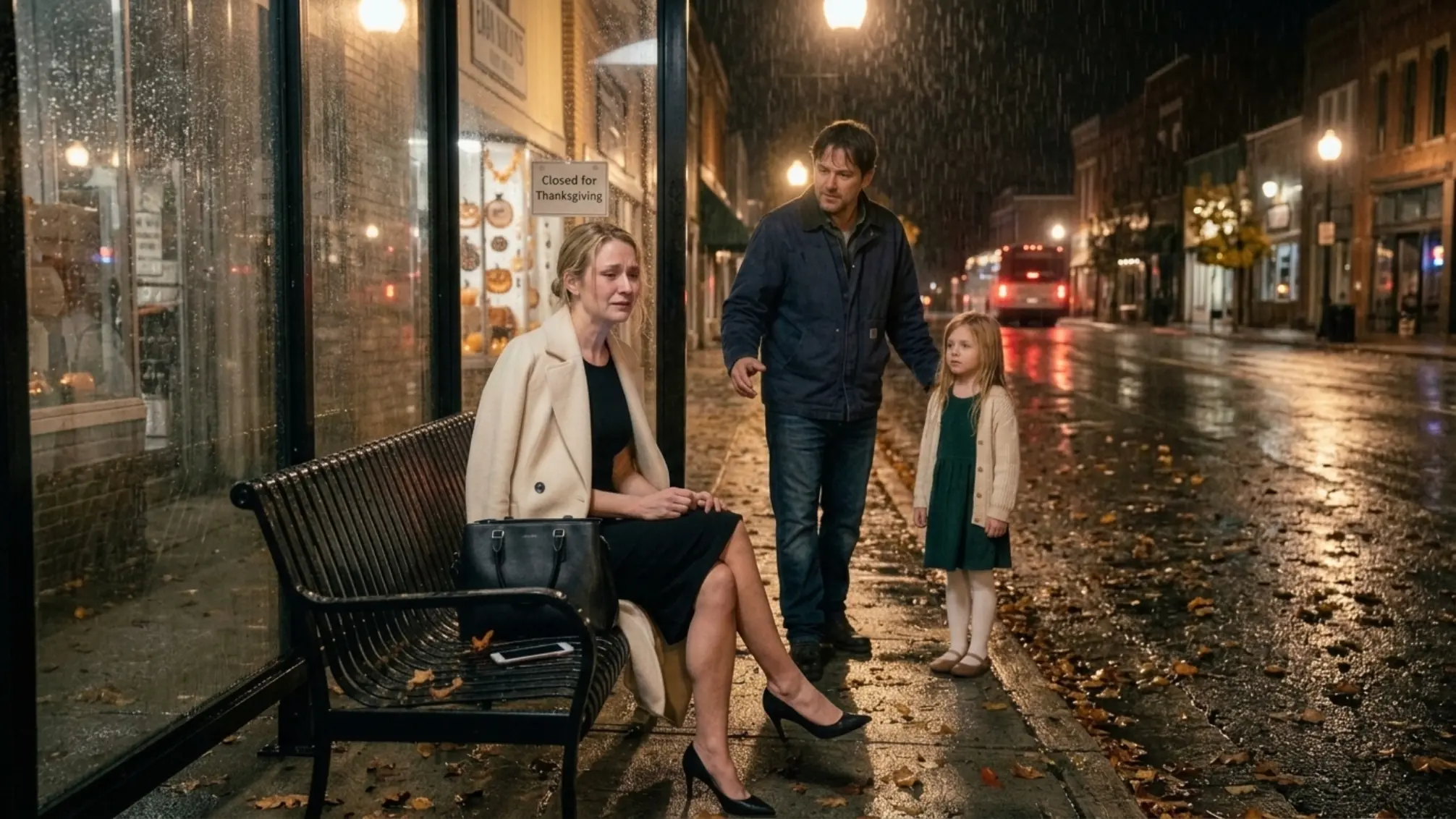
The taillights of the final bus had disappeared less than three minutes earlier.
She had run after it, waving one arm and calling for the driver to stop. Her heel slipped on the wet pavement, forcing her to catch herself against the shelter. By the time she regained her balance, the bus had turned at the next intersection and vanished into the storm.
The station schedule confirmed what she already knew.
There would be no other bus until six the following morning.
The woman’s name was Claire Bennett. She was thirty years old, successful enough to own an apartment overlooking downtown Chicago, and usually surrounded by assistants, drivers, and people paid to solve unexpected problems. Yet on Thanksgiving night, in a small Wisconsin town nearly two hours from home, she sat alone beneath a flickering bus-stop light with no one willing to answer her calls.
Her mother had ignored the first two.
Claire’s older brother had declined the third.
The fourth went directly to voicemail.
Only six hours earlier, she had been seated at her family’s dining table beneath a crystal chandelier, listening to her mother explain why Claire’s life was incomplete. She needed to stop focusing on work, marry someone respectable, attend more family events, and apologize for embarrassing her brother during a recent business dispute.
The dispute had not been personal.
Claire’s brother had asked her investment firm to fund a real-estate project built on manipulated financial projections. When she refused, he accused her of caring more about numbers than family. Their mother agreed with him because agreement was easier than admitting her son had nearly risked everything they owned.
Thanksgiving dinner became an interrogation.
When Claire finally stood and announced that she was leaving, her brother smiled across the table.
“Go ahead,” he said. “You always leave when people stop admiring you.”
She had walked nearly a mile to the bus station rather than ask anyone for a ride.
Now rain struck the metal roof above her, and the town had become so quiet that every passing vehicle sounded like hope before continuing without slowing.
Claire looked down at her phone again.
Five percent battery.
No available rideshare drivers.
The nearest motel was almost four miles away.
She was considering walking when headlights appeared through the rain. An old dark pickup moved slowly along the curb, passed the shelter, and stopped twenty yards ahead.
Claire straightened.
The truck reversed carefully until its passenger door aligned with the bench. A tall man stepped onto the wet sidewalk, raising both hands slightly so she could see he carried nothing.
He appeared to be in his late thirties, with short brown hair dampened by the rain, light beard stubble, and concerned blue-gray eyes. A dark jacket covered a black shirt and faded jeans. He left enough distance between them to avoid frightening her.
“Ma’am, are you waiting for someone?”
Claire glanced toward the open passenger door.
A little blonde girl sat inside wearing a dark green dress beneath a cream cardigan. She pressed one hand against the rain-speckled window and waved.
“I missed the bus,” Claire said.
The man looked toward the empty road. “The next one isn’t until morning.”
“I know.”
“Do you have somewhere nearby to stay?”
“I’m trying to find a ride.”
He studied her face, not her clothes or handbag. “Any luck?”
“No.”
The little girl lowered the window several inches.
“Daddy,” she called, “she’s getting soaked.”
The man glanced back. “I noticed, sweetheart.”
He returned his attention to Claire. “My name is Daniel Mercer. That’s my daughter, Lily. We live about fifteen minutes from here.”
Claire did not respond immediately.
Daniel understood her hesitation. A strange man offering transportation to a woman alone at night could sound more dangerous than the storm.
He removed his wallet and placed his driver’s license on the dry edge of the bench rather than handing it directly to her.
“Take a picture and send it to anyone you trust,” he said. “You can also photograph the license plate.”
Claire looked at the identification.
The address was local.
The photograph matched.
“You do this often?” she asked.
“Offer stranded women documentation?”
“Yes.”
“No. Usually I’m trying to convince my daughter not to adopt every wet animal we pass.”
Lily leaned closer to the window. “People aren’t animals.”
“You tried to bring home a mailman last month because he looked cold.”
“He needed soup.”
Claire almost smiled.
Daniel extended his hand, keeping his palm open. “Don’t sit here alone in the rain. I can take you to the motel, the police station, or anywhere else that feels safe.”
Claire looked at his grease-marked fingers.
He noticed and wiped them against his jeans. “Sorry. The truck needed a belt replacement this afternoon.”
“You repaired it yourself?”
“I own a small garage.”
Lily opened the passenger door wider. “Daddy makes good hot chocolate. You can sit with us.”
Daniel sighed. “We are not pressuring the stranger into our house, Lily.”
“I’m inviting her.”
“She understands.”
Claire’s phone screen went black.
The battery had died.
She stared at it for a moment, then at the rain beyond the shelter. Daniel removed his jacket and draped it over her shoulders without touching anything else.
It was still warm.
“If I take your hand tonight,” Claire said quietly, “I may not want to let it go.”
The sentence escaped before she could stop it.
Daniel’s expression softened. He seemed to understand she was not flirting so much as admitting how tired she was of facing every difficult thing alone.
“Then hold on until you feel steady,” he said.
Claire placed her hand in his.
Daniel helped her rise from the wet bench. When one heel slipped against the pavement, he caught her gently around the waist, keeping her upright without pulling her unnecessarily close.
Lily clapped from the truck. “I knew we were rescuing her.”
“We’re offering transportation,” Daniel corrected.
Claire picked up her handbag. “It feels a little like rescue.”
Daniel opened the rear door and moved a booster seat aside so she could sit comfortably. Lily twisted around from the front passenger seat and offered Claire a folded blanket covered in cartoon stars.
“It’s clean,” the girl promised. “Mostly.”
“Thank you.”
Claire wrapped it across her knees.
The pickup smelled faintly of motor oil, peppermint gum, and cinnamon. A paper turkey made from Lily’s handprint was taped to the dashboard. Beneath the radio sat several crayons, a small wrench, and a photograph of Daniel holding Lily when she was much younger.
“Where were you heading?” Daniel asked as he returned to the road.
“Chicago.”
“In this weather?”
“I planned to arrive before midnight.”
“Family dinner?”
Claire looked through the window. “Something like that.”
He did not ask why her family had allowed her to walk to a bus station during a storm.
That restraint made her trust him more.
Daniel explained that he and Lily had spent Thanksgiving with his sister’s family. They had left early because Lily grew tired and Daniel needed to check a leaking window at home. His wife, Rebecca, had died four years earlier after a sudden illness.
Claire watched him carefully.
“I’m sorry.”
“Thank you.”
“Does Thanksgiving make it harder?”
“Some years.”
Lily turned around. “Mommy made apple pie better than Aunt Rachel.”
Daniel smiled faintly. “Your aunt believes opinions like that should remain private.”
“But it’s true.”
Claire leaned forward. “What made your mother’s pie better?”
“She used more sugar.”
“That is a strong argument.”
Lily nodded approvingly.
Daniel’s house stood at the edge of town on a quiet street lined with bare maple trees. It was small but carefully maintained, with a narrow porch, yellow kitchen light, and a child’s red bicycle resting beside the garage.
Claire hesitated when he stopped.
“The motel is in the opposite direction,” Daniel said. “I can still take you there.”
She looked at Lily, who had already unfastened her seat belt.
“Do you really have hot chocolate?”
Lily gasped. “The best.”
Daniel opened Claire’s door. “Apparently, the decision has been made.”
Inside, the house felt warmer than any luxury hotel Claire had ever entered. Children’s drawings covered the refrigerator, photographs lined the mantel, and a pair of small rain boots sat crookedly beside Daniel’s larger ones.
Lily disappeared into the hallway and returned carrying dry socks, flannel pajama pants, and a sweatshirt decorated with a cartoon snowman.
“These are mine,” she explained. “Except the pants. They’re Daddy’s.”
Claire held up the enormous gray pants.
Daniel looked embarrassed. “You don’t have to wear those.”
“They may improve the outfit.”
“You currently look like you’re attending a diplomatic dinner.”
Claire glanced down at the black dress beneath her cream coat. “I was attending a trial disguised as Thanksgiving.”
Daniel said nothing, but his eyes showed that he understood more than she had explained.
Claire changed inside the small bathroom. She removed her wet heels, folded the expensive dress carefully, and pulled on Daniel’s flannel pants and sweatshirt. When she looked into the mirror, she barely recognized herself.
Without the tailored clothes, makeup, and controlled expression, she looked younger.
And exhausted.
Lily had prepared three mugs of hot chocolate by the time Claire entered the kitchen. Marshmallows covered the surface so completely that almost no liquid remained visible.
Daniel lifted one eyebrow. “Did you add the entire bag?”
“No.”
The empty package rested beside her elbow.
Claire sat at the table.
Daniel warmed leftover turkey, mashed potatoes, stuffing, and green beans. He apologized for the meal’s appearance while arranging everything onto mismatched plates.
“It’s perfect,” Claire said.
“You haven’t tasted it.”
“Nobody at my family’s dinner asked whether I had eaten.”
Daniel stopped.
He placed the plate gently before her. “Then eat as much as you need.”
Claire lowered her eyes.
For several minutes, the only sounds came from forks, rain, and Lily explaining why the family dog next door preferred her over its actual owners. The ordinary conversation calmed something inside Claire that had remained tense for years.
After dinner, Lily brought a box of board games from the living room.
Daniel reminded her that it was nearly ten.
“She can’t sleep yet,” Lily argued. “She’s sad.”
Claire looked at the child. “How do you know?”
“Your eyes.”
Daniel crouched beside his daughter. “We don’t tell guests what their faces are doing.”
“She should know.”
Claire reached for Lily’s hand. “You’re right. I am a little sad.”
Lily climbed into the chair beside her and wrapped both arms around Claire’s waist.
The embrace was immediate, uncomplicated, and completely unexpected.
Claire froze.
Then she slowly placed one arm around the girl’s shoulders.
“My mommy used to get sad on holidays,” Lily whispered. “Daddy hugged her until she remembered she wasn’t alone.”
Across the table, Daniel looked down.
Claire felt tears pressing behind her eyes. “Your daddy seems very good at that.”
“He forgets to hug himself.”
Daniel cleared his throat. “Bedtime.”
Lily protested until Claire promised she would still be there in the morning. The child accepted the promise and allowed Daniel to carry her down the hall.
Claire remained in the kitchen, staring at the family photographs on the wall. Most showed Daniel and Lily alone: school plays, birthdays, fishing trips, Christmas mornings, and afternoons inside his garage.
Rebecca appeared in the older pictures.
She had kind eyes.
Daniel returned carrying a folded blanket and pillow.
“I can take the couch,” he said. “You can use my room.”
“I’m not putting you out of your bed.”
“You already missed a bus. Let me protect one part of your evening.”
Claire looked toward the hallway. “Lily is extraordinary.”
“She’s dangerous. Give her twelve hours and she’ll choose your retirement plan.”
“She hugged me.”
“She does that when words are too slow.”
Daniel sat across from her.
Claire turned the empty mug between her hands. “My family thinks I’m cold.”
“Are you?”
“I believed I had to be.”
“For work?”
“For everything.”
She explained that her father had died when she was twenty-three, leaving her mother and brother dependent on a business neither knew how to manage. Claire sold part of her inheritance, built an investment company, and spent years repairing financial damage her brother repeatedly created.
They thanked her by calling her controlling.
“They want my help,” she said, “but they resent every boundary that comes with it.”
Daniel listened without interrupting.
“Tonight my brother asked me to invest in a project built on numbers he knew were false. When I refused, my mother told me I had chosen money over family.”
“You refused because the deal was dishonest.”
“Yes.”
“Then you chose integrity over pressure.”
Claire looked at him. “Nobody has described it that way.”
“Maybe nobody benefited from describing it honestly.”
She smiled through the tears gathering in her eyes.
Daniel reached across the table, giving her enough time to pull away. When she did not, he brushed one tear from her cheek with his thumb.
“You don’t have to solve anything tonight,” he said.
Claire covered his hand with hers.
His skin was rough from work, but his touch was careful.
“What happens tomorrow?” she asked.
“The roads clear. I drive you to the station.”
“And after that?”
Daniel’s eyes searched hers. “That depends on whether you meant what you said about not letting go.”
Claire leaned forward until her forehead rested against his.
“I meant it more than I should.”
“There isn’t a correct amount.”
His other hand settled gently at her waist.
Claire closed the distance between them.
Their first kiss was soft, brief, and uncertain. Daniel pulled back immediately, giving her the choice to end it. Instead, Claire reached behind his neck and brought him closer.
The second kiss held everything the first had been too careful to express.
Rain continued against the windows.
When they separated, Daniel kept his forehead against hers.
“You’ve had a difficult night,” he whispered. “I don’t want you waking up tomorrow thinking I took advantage of that.”
Claire traced the edge of his jaw with one finger. “You offered me safety before you knew my name.”
“I knew your name.”
“Before you knew anything that mattered.”
Daniel smiled gently. “I knew you were cold.”
That answer nearly made her cry again.
She slept in his room while he used the couch. Before closing the bedroom door, Claire found a framed photograph of Rebecca on the dresser.
She looked toward Daniel in the hallway.
“You don’t have to hide her because I’m here.”
“I wasn’t going to.”
“Good.”
Something changed in his expression.
Grief did not make space easily for another person. Claire understood that loving him would never require erasing the woman who had helped create the life she was entering.
Morning sunlight replaced the storm.
Claire woke to the smell of pancakes and Lily singing loudly in the kitchen. She dressed in her black gown and cream coat again, though the outfit felt less like armor than it had the previous night.
Lily frowned when she entered.
“You’re leaving.”
“I have to go home.”
“Do you want to?”
Claire looked at Daniel.
“Yes,” she said. “But I also want to come back.”
Lily considered that carefully. “Next Friday?”
Daniel laughed. “Perhaps we let her check her schedule.”
Claire knelt in front of the girl. “Next Friday.”
“Promise?”
“Promise.”
Claire kept it.
She returned the following Friday in a black sedan, carrying a store-bought apple pie that Lily immediately criticized for lacking sufficient sugar. They ate dinner, decorated the porch for Christmas, and watched a film that Lily fell asleep before finishing.
Claire came back the week after that.
Then Daniel and Lily visited Chicago.
Their lives did not merge dramatically. They joined slowly through ordinary acts: Daniel repairing a broken drawer in Claire’s apartment, Claire attending Lily’s school concert, shared grocery trips, cold mornings at the garage, and calls that lasted until one of them fell asleep.
Claire’s family reacted badly.
Her mother described Daniel as unsuitable. Her brother suggested that a mechanic saw Claire’s wealth as an opportunity. Daniel offered to leave the relationship rather than become another conflict she had to manage.
Claire refused.
“You stopped in the rain when everyone with my last name left me there,” she told him. “Do not ask me to pretend that means less than your bank account.”
Daniel never asked again.
Months later, Claire discovered that his garage was close to closing. The owner planned to sell the building, and Daniel lacked enough savings to purchase it.
Claire could have solved the problem with one check.
She knew Daniel would reject it.
Instead, she helped him prepare a real business plan, locate a community loan, and negotiate a fair price. Daniel invested his savings and accepted only the same terms any other qualified buyer would receive.
The garage became Mercer Automotive.
He added a small waiting area with a hot-chocolate station that Lily named after herself. Claire’s investment firm later sent several company vehicles there, but Daniel charged every repair at the normal rate.
Their first anniversary arrived on another rainy Thanksgiving night.
Daniel drove Claire to the same bus stop where they had met. Lily sat in the truck, pretending not to know what was happening while watching through the rear window.
The metal bench remained beneath the shelter.
Daniel took Claire’s hand and led her toward it.
“You looked terrified sitting here,” he said.
“I was.”
“Of the storm?”
“Of needing someone who might not come.”
Daniel removed a small box from his jacket.
Claire stared at it.
He lowered himself onto one knee beside the wet bench.
“A year ago, I offered you a ride because I couldn’t leave you alone in the rain,” he said. “Then you entered our house, held my daughter, respected the wife I lost, and somehow made our home feel larger without replacing anything that was already there.”
Claire covered her mouth.
Daniel opened the box.
Inside was a simple diamond ring.
“You said that if you took my hand, you might not want to let go. I’m asking you not to.”
Claire dropped to her knees in front of him and wrapped both arms around his neck before he could finish the question.
“Yes.”
Behind them, the pickup horn sounded repeatedly.
Lily lowered the window. “Put the ring on her!”
Daniel laughed against Claire’s shoulder.
He slid the ring onto her finger, then kissed her beneath the bus shelter while rain began falling lightly around them.
Claire’s family did not attend the wedding.
That hurt, but it did not ruin the day.
Lily walked beside Claire carrying flowers and wearing the same dark green color she had worn on the night they met. A photograph of Rebecca rested near the front row, placed there by Claire herself.
Daniel cried when he saw it.
Their wedding dinner included apple pie with an unreasonable amount of sugar.
Years later, Claire still kept the cream coat she had worn that Thanksgiving night. The hem carried a faint stain that dry cleaning never fully removed. She could have replaced it a thousand times, but she never did.
The mark reminded her of the moment she believed nobody was coming.
She had been wrong.
A single father in an old pickup saw her sitting alone and stopped without knowing her job, wealth, or family name. His little girl offered a blanket, hot chocolate, and the kind of affection Claire had spent years pretending she did not need.
They had not merely rescued her from rain.
They gave her a place where love did not depend on usefulness, obedience, or financial sacrifice. Daniel gave her his hand, Lily gave her trust, and together they showed her that family could be built from the people who chose to stay.
Claire missed the last bus on Thanksgiving night.
But the ride she accepted carried her somewhere far more important than home.
It carried her toward the people who would become it.