On a cold, rainy October night, a young woman working the night shift at a small gas station encountered a desperate single mother trying to get home with her child, but without enough money for gas.
Quietly, she paid the difference out of her own pocket. That simple act of kindness got her fired on the spot.
But just an hour later, a sleek Bentley pulled up outside her door, carrying a shocking truth and a life-changing opportunity no one could have seen coming.
The night air wrapped around Oakridge like a damp wool blanket, thick with October fog and the kind of slow, steady drizzle that crept into your bones without asking.
The gas station lights hummed low beneath the weight of the dark sky, their flickering glow reflecting off the wet pavement like faded memories.
Inside, the only sound was the quiet clack of Maya Thompson’s boots as she moved between the aisles, restocking the gum rack with practiced ease. It was nearly midnight, and Oakridge Gas Station had slipped into its usual rhythm. Quiet, almost forgotten.
Maya didn’t mind. She liked the stillness, the way night stripped the world of pretense. The tired nurses grabbing coffee, the truckers who nodded instead of speaking, the same faces, the same routines. It made her feel rooted in a world that otherwise moved too fast.
At twenty-five, Maya carried herself with the kind of calm forged in long nights and short paychecks. Her skin was deep brown, her eyes alert, steady, always watching. She wore her curly hair pulled back into a loose bun under her company cap. Her dark green work jacket, one size too big, bore a fading Oakridge logo over the left chest.
She’d been at this job three years now. More than just a paycheck, it was her path through business school, her late-night classroom, her lifeline.
Her fingers lingered on the edge of the counter as she paused, glancing through the wide front windows into the rain-slick night. Somewhere out there, people were asleep in warm beds, families tucked in together. She swallowed a breath. Not everyone got that kind of peace.
She thought of her mother, Angela, who used to whisper the same thing every time they passed a stranger asking for change.
“Help when you can, baby girl. One day, it’ll be you on the other end.”
That lesson had stayed with Maya long after the world had taken her mother away. And even now, years later, the echo of those words still lived in her chest, soft and strong.
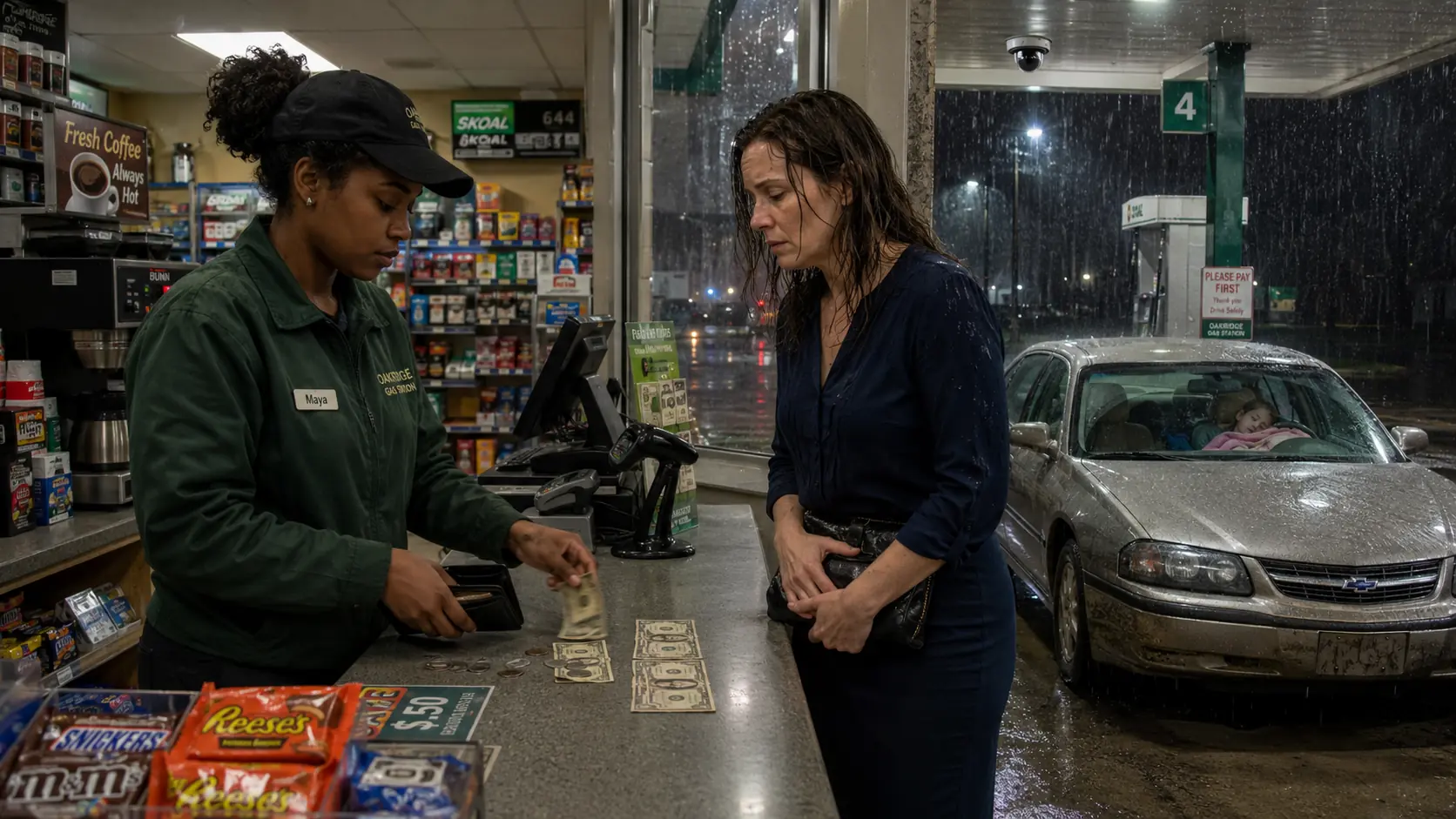
The low rumble of an approaching engine broke the quiet. Maya turned, wiping her hands on her jeans, and stepped toward the window. Headlights cut through the fog like tired eyes. A beat-up, mud-streaked Chevy pulled slowly into the lot. The car jerked forward once, sputtered, then rolled to a reluctant stop beside pump four.
Maya tilted her head. Something about the way it moved. It wasn’t just an old car. It was struggling.
The driver’s door opened with effort, creaking on rusted hinges. A young woman stepped out, shielding herself from the drizzle with one arm. She was dressed in a navy blouse and pencil skirt, formal but wrinkled, like she had slept in it. Her dark hair clung to her face in damp strands, and her heels clicked unevenly across the wet concrete.
There was exhaustion in every inch of her body, in the way her shoulders drooped and her fingers clenched her purse too tightly.
Maya’s eyes narrowed as she caught a glimpse of the back seat. A car seat. A tiny foot poking out from beneath a faded pink blanket.
Her throat tightened.
The woman pushed the glass door open with a trembling hand, the bell above giving a half-hearted chime. She stood just inside, dripping slightly onto the floor, her breath coming fast like she had been holding it too long.
“Evening,” Maya offered gently, giving a small smile. “Rough night?”
The woman hesitated, glancing back at her car. Her voice came out thin, almost hoarse.
“Yeah, you could say that.”
Maya stepped around the counter, not too close, just enough to let the woman know she was paying attention.
“What can I help you with?”
The woman looked down, fumbling with the clasp on her purse.
Maya blinked. Savannah was a solid four-hour drive south, nearly two hundred miles. She didn’t need a map to know twelve bucks in gas wouldn’t come close. She felt the familiar twist of worry rise in her gut.
“What’s your name?” Maya asked, soft but direct.
“Alyssa,” she replied, eyes glassy but not yet broken. “Alyssa Carter.”
Maya nodded. “Maya. Let me check something real quick.”
She moved behind the counter and tapped on the calculator app on the station’s dusty old tablet. She didn’t need the numbers to tell her, but showing the math sometimes helped people feel less helpless. She did the mental calculation anyway. Twelve dollars wouldn’t get Alyssa more than a hundred miles, maybe less with a car like that.
She looked back up.
“You’d need about twenty-seven, maybe thirty, to make it there. Do you have anyone who can send you the rest?”
Alyssa’s eyes flinched. She shook her head, jaw stiffening.
“I’ve tried three other stations already. They just turned me away.”
She took a breath, trying to steady her voice, but it trembled all the same.
“I have my baby in the car. She’s sleeping. I just… I just need to get home.”
Maya didn’t respond right away. She looked through the window again at the little car under the rain. The faint rise and fall of the blanket in the back seat, the kind of quiet only babies had when they were too tired to cry.
For a moment, she was ten years old again, sitting in the front seat of her mother’s car, watching Angela count coins into her palm. Just enough gas to get to work. Just enough hope to keep going. Her mother never asked for help. But Maya had never forgotten the weight in her voice when she whispered, “This too shall pass.”
She blinked the memory away.
Without another word, Maya reached into her own jacket pocket, pulled out her wallet, and slid a twenty-dollar bill across the counter. She paused, then added a five.
Alyssa stared at it, stunned.
“I can’t take that,” she whispered, shaking her head. “You don’t even know me.”
“It’s not a loan,” Maya said, her tone clear, almost firm. “It’s just a hand when you’re slipping. Pay it forward someday.”
Alyssa’s face crumpled then, just slightly. Not enough to break, but enough to reveal the crack beneath the mask.
“Thank you,” she whispered, voice thick with disbelief. “I don’t even know what to say.”
Maya offered a soft nod.
“Just get home safe.”
Together, they stepped back outside. The rain had thinned to a mist, but the air was still cold. Maya held the nozzle steady, watching the numbers tick up on the screen as she filled the tank. Alyssa opened the back door, tucking the blanket more tightly around her sleeping daughter, then closed it gently.
No child should ever feel their mother’s fear, Maya thought.
As the nozzle clicked, she looked up at Alyssa and gave a small smile.
“You’re good to go.”
Alyssa’s lips trembled.
“I won’t forget this.”
Maya said nothing, just watched as the Chevy sputtered back to life and rolled into the fog, taillights glowing like faint embers in the dark.
She stood in silence for a long moment before turning back toward the station, unaware that from a far corner of the lot, behind the veil of rain and the angle of a high-mounted camera, someone had been watching.
And that act, simple, quiet, and uncelebrated, was about to change everything.
The fluorescent lights in the back hallway buzzed faintly overhead as Maya made her way toward the office. Her boots echoed softly on the linoleum, each step feeling heavier than the last. She had just finished wiping down the register and was about to log the shift count when the phone rang. Short, clipped, sharp.
Brian Kesler’s voice on the other end had been like a slap of cold water.
“I need to see you in my office now.”
No pleasantries, no explanation.
She stood outside the door for a beat longer than necessary, her knuckles grazing the handle before she pushed it open. The small room smelled of stale coffee and printer ink, dimly lit by a desk lamp that cast long shapes over piles of unopened mail and corporate memos.
Behind the desk sat Brian Kesler, Oakridge’s new district manager, a man whose presence could freeze a room without saying a word. His suit was too pressed for a gas station, his hair too neat, his expression too clean. The kind of man who saw the world in spreadsheets and policy handbooks, not faces.
He didn’t look up right away. He clicked through something on his laptop, his lips drawn into a flat line. Maya stood straight, hands folded in front of her, trying not to shift on her feet.
Finally, Brian looked at her, eyes cold and unreadable.
“You helped a customer tonight,” he said, his tone so neutral it came off as accusatory.
Maya blinked. “Yes, I…”
He cut her off with a wave of his hand and turned the laptop toward her.
“This is from camera three, pump four. Timestamped 11:47 p.m.”
He hit play.
The grainy footage showed exactly what she expected. Alyssa stepping out of her car, Maya sliding her the bills, the brief exchange, and Maya walking out to pump the gas herself. It was all there, plain as daylight.
Brian tapped the screen.
“You just cost this company money.”
She stared at him, feeling her jaw tense.
“That was my own money. Twenty-five dollars out of my wallet. Not the register.”
“It doesn’t matter whose pocket it came from,” he snapped, standing from his chair so abruptly the metal leg screeched across the tile. “You created an expectation that customers can show up here with a sob story and get a handout.”
Maya’s eyebrows lifted in disbelief.
“A handout?” she echoed. “She had a baby in the car. She was trying to get to her sick mother. It was pouring rain and she had no help left. That was a human being in need.”
Brian leaned across the desk, his knuckles pressing into the wood like he could mold it to his will.
“This isn’t a shelter, Maya. This is Silverline Energy now. New ownership, new rules, zero leniency, zero exceptions. I don’t care if she had six kids and a note from the Pope. You don’t get to rewrite company policy based on your feelings.”
Maya kept her voice steady, though her hands had started to tremble.
“So kindness is now a fireable offense?”
Brian’s mouth twisted into something like a smirk.
“Call it what you want. I call it a liability. You’re done here.”
The words hit harder than she thought they would. Not because she hadn’t seen them coming, but because of how quickly and cleanly they had been delivered. Three years of service, of cleaning spills no one else wanted to touch, of covering last-minute shifts, of smiling through exhaustion and stomachaches and finals week, and it was over in six syllables.
She reached up slowly, unpinned her name tag from her chest, and set it on the desk. Her fingers lingered on it for half a second before she let go.
“I understand,” she said quietly.
Brian said nothing.
She turned to leave, the chill from the hallway rushing into the room as she opened the door. Behind her, the laptop screen continued to loop the footage like evidence in a courtroom no one had asked for.
The rain had turned heavy by the time she stepped outside. It came down in steady sheets, soaking through her jacket in seconds. She pulled her hood up, but it was no use. The wind whipped sideways across the empty parking lot.
The glow from the gas pumps flickered behind her as she crossed the street and began the long walk home. Every step squelched against the waterlogged sidewalk. The town was silent except for the hiss of passing tires in the distance, the occasional flicker of porch lights blinking through the storm.
Her apartment was nearly two miles away. She didn’t care. She couldn’t have stood to sit still anyway.
She tried not to think of the bills on her kitchen table, or the tuition payment due in three weeks, or the two weeks left in the month and how far one last paycheck could stretch. She pushed it all down because if she thought too hard about it, it would crush her.
She kept her head low as she passed the pharmacy, the laundromat, the shuttered diner with the neon sign still buzzing faintly in the window. She knew this route better than her own heartbeat.
When she finally reached her building, her jeans were soaked through, her shoes squishing with every step on the worn wooden stairs. She fumbled with her keys, hands stiff from cold, then pushed the door open.
Her apartment was small, just two rooms and a kitchenette. The walls were lined with books she’d collected from secondhand shops, a coffee table covered in class notes and grocery receipts, and on the shelf above her desk, a single framed photograph of her mother.
She dropped her bag by the door, pulled off her wet jacket, and crossed the room, water dripping onto the scuffed floorboards. She stood in front of the photo, staring at Angela Thompson’s warm eyes, her proud smile frozen in time.
“I did the right thing,” Maya whispered, her voice almost a question.
The hum of the radiator answered in silence.
“I did,” she repeated, stronger this time.
She reached up and touched the edge of the frame with two fingers, grounding herself in the memory of that woman, that strength, that lesson.
Help when you can.
Maya closed her eyes and let the sound of the rain fill the room. She didn’t know what came next. But she knew this much. Tonight, she had stood on the side of decency, and no title, no paycheck, no policy manual could take that away.
The clock on Maya’s wall ticked past 12:47 a.m., its quiet rhythm the only sound in the stillness of her apartment. She sat curled on the edge of her worn couch, wrapped in a fleece throw that didn’t quite keep out the chill.
The rain had slowed outside, turning into a soft patter against the windowpane, but the cold had settled deep in her bones. The scent of old books and faint lavender from the plug-in near the door hung in the air like comfort she didn’t quite feel.
She hadn’t turned on the TV. The silence felt more honest tonight. Her textbook sat open on the coffee table, but she hadn’t read a word. Her eyes had wandered hours ago, her thoughts spinning in quiet circles that led nowhere.
Fired just like that. For helping someone. For living by the words her mother had taught her.
She had replayed the moment in her head a hundred times since she got home. The look on Brian’s face, the way her own voice hadn’t cracked when she handed over her name tag. Still, part of her felt like she’d been thrown into the ocean with bricks tied to her ankles, drifting between pride and panic.
Then, just as she leaned forward to finally close her books and surrender to sleep, the sound came.
A knock at the door.
Firm, steady.
One knock, then two more.
She froze.
It was nearly one in the morning. No one ever knocked on her door this late. Her neighbors kept to themselves. Friends, she didn’t have many these days.
Her fingers tightened around the edge of the blanket.
Another knock echoed, this time slower, more deliberate.
Her heart kicked in her chest as she stood up and moved carefully toward the door. She didn’t turn on the porch light at first. Instead, she looked through the peephole, and what she saw made her pull back in disbelief.
A sleek Bentley was parked just outside the building, its polished chrome gleaming under the yellow glow of the street lamp. And standing in front of her door was a tall, older, white man with silver-streaked hair, a navy trench coat tailored to perfection, and the unmistakable posture of a man who hadn’t waited for anything in decades.
Beside him, just off to his right, stood Alyssa Carter, no longer in wrinkled workwear, but in a soft wool coat the color of pearl, her hair pinned neatly back. Her eyes were the same, though, earnest and searching. There was no hesitation in them now, only something deeper: gratitude.
Maya took a breath, braced herself, and opened the door slowly, keeping her body slightly behind it as the cold night air swept into her apartment.
Her voice was cautious but firm.
“Can I help you?”
The man stepped forward slightly, stopping at the edge of the mat. He extended a gloved hand with practiced confidence.
“Maya Thompson, I presume. My name is Charles Carter.”
Maya didn’t move to take his hand. She looked past him at Alyssa, who gave a faint smile, almost apologetic.
“I’m Alyssa’s father,” Charles continued. “And the CEO of Carter Holdings.”
Maya’s brow furrowed. She didn’t answer immediately. Her eyes scanned both of their faces for some clue, some logical reason why two strangers in high fashion and a luxury vehicle had shown up on her doorstep in the middle of the night.
Charles seemed to catch the question before she could ask it.
“I know it’s late,” he said, his tone softening just slightly. “But we couldn’t wait.”
Maya folded her arms across her chest, her posture still guarded.
“Why are you here?”
Charles glanced at Alyssa, who stepped forward, her voice warmer, familiar, almost pleading.
“I told him what happened at the gas station. About what you did for me tonight. You didn’t know who I was, Maya. You had no reason to help me. No way to gain anything. But you did it anyway.”
Maya held her gaze, still wary.
“I didn’t do it to get thanked.”
“I know that,” Alyssa said quietly. “That’s why it mattered.”
Charles spoke again, stepping in just a little, but not crossing the threshold.
“What my daughter didn’t tell you earlier is that she was trying to prove something. She’s been living on her own these last few months, trying to build her independence, but tonight she left her wallet behind. She didn’t want to call anyone, didn’t want to admit she couldn’t handle it. I can’t say I agree with that choice, but I respect that she tried. And you, you didn’t hesitate to help her. That means something to me.”
Maya’s grip on the door tightened.
“With all due respect, Mr. Carter, I lost my job tonight because of that decision, and I’m not exactly in the mood for late-night appreciation tours.”
He nodded slowly.
“I saw the footage.”
Maya blinked. “What?”
“I have contacts within Silverline,” he said. “I already had people monitoring the acquisition. When I heard what happened, I requested the security footage personally. I watched you hand her the money. I watched Kesler fire you. Cold, heartless, unacceptable.”
Maya stared at him, unsure whether to believe this was real or some elaborate dream conjured from stress and cold air.
Charles didn’t flinch.
“Silverline’s acquisition closes in forty-eight hours. As of then, I will have full controlling interest. And when I do, I want people in place who understand that leadership is about more than spreadsheets. I want someone like you managing that station.”
Maya blinked, stunned into silence.
“I’m offering you the full manager position,” he continued. “Salary, benefits, tuition support, full authority to run that site how you see fit, within reason, of course.”
Maya let out a dry, almost disbelieving laugh.
“You’re offering me a promotion at one in the morning after watching me get fired on a grainy security tape?”
Charles didn’t smile.
“Yes, because most people would have turned Alyssa away. You didn’t, and that’s exactly the kind of judgment I want overseeing my operations.”
Maya looked at Alyssa again.
“Why didn’t you just tell me who you were?”
Alyssa lowered her eyes, her voice soft.
“Pride, I guess. I didn’t want to be that girl who only mattered because of her name. I thought I could handle everything alone. But when I couldn’t, you were there.”
Maya’s defenses faltered then, just slightly. The wind shifted around them, carrying the scent of rain and damp pavement into the hallway.
Alyssa’s voice caught as she added, “You saved me and my daughter tonight, not just with gas, but with dignity. I’ll never forget that.”
Silence stretched between them. Maya looked back into her apartment, at the dim glow of her desk lamp, the textbooks she might not be able to afford next semester, the photo of her mother watching it all like a silent witness.
She turned back to the man and woman before her. Her voice was steady but low.
“Why should I believe this isn’t just a PR stunt, some corporate feel-good story to put in a quarterly report?”
Charles met her eyes with a firmness that surprised her.
“Because I don’t care if the world knows about it. I care that you do.”
And that was what made her stop. Not the car, not the offer, not the tailored coat or the CEO title, but the honesty in those words.
Maya looked at Alyssa one last time.
“You really meant what you said.”
Alyssa’s eyes didn’t waver.
“Every word.”
The tension in Maya’s shoulders eased just enough for her to open the door wider.
“Then I’ll do it,” she said simply. “But not because I want your charity. I’ll do it because I believe in doing things the right way.”
Charles Carter nodded, a small glimmer of approval crossing his face.
“That’s all I ask.”
And just like that, the night that had taken everything from her handed something back. Not pity, not a favor, but a chance. A chance wrapped in the echo of her mother’s voice and the quiet promise that maybe, just maybe, doing the right thing really was worth it.
The morning air was brisk, still carrying the weight of last night’s rain. Small puddles reflected the gray sky as Maya stepped out of the sedan and stood quietly in front of Oakridge Gas Station. Her hands were tucked into the pockets of her new charcoal coat, not for warmth, but to still the nervous twitch in her fingers.
The parking lot looked the same. Cracks in the asphalt, the familiar curve of the curb, the faint oil stains near the pumps. But above the front entrance, everything had changed.
The old Silverline sign was gone. In its place gleamed a new brushed-steel logo mounted on a fresh panel of dark blue.
Carter Fuel.
Powered by kindness.
The words were simple, clean, elegant, but for Maya, they hit deeper than any mission statement.
She pulled the door open and walked inside. The familiar chime above the frame rang out, and for a moment, it felt like nothing had changed. The scent of strong coffee, burnt rubber, and warm asphalt still hung in the air. The humming refrigerator still buzzed behind racks of soda and snacks. The flicker from one misaligned light above the counter still blinked with stubborn rhythm.
Then heads turned.
Devon, the senior cashier, stood behind the register mid-scan, a granola bar in his hand. He froze, his eyes widening slightly. Jasmine, who usually worked stocking, peeked around the corner from the back cooler. Her eyebrows shot up in disbelief. And Miguel, the night cleaner, straightened from where he’d been wiping down the tile near the coffee station.
No one said anything for a beat.
The last time they’d seen Maya, she had walked out of that door with rain on her jacket and dignity in her spine, but no job. Now she had returned, not in a uniform, not with a badge clipped to her shirt, but as their new manager.
Devon was the first to break the silence.
“No way,” he muttered, blinking. “Maya?”
She smiled, slow and sure, stepping up to the center of the floor.
“Morning,” she said calmly, voice carrying just enough to be heard without shouting. “I know this is a surprise. It was for me, too. But as of today, I’m officially back. I’ve been offered the manager role, and I accepted, not just because I needed a job, but because I believe this place can be better.”
The staff stared at her, still stunned. She took a breath and gestured toward the new sign above the door.
“Carter Fuel wants change. So do I. And we’re going to lead with something simple: business with heart. We’re still a gas station, still a place for people on the go. But we’re also a place where someone can breathe, where someone feels seen. That’s the kind of place I want to run.”
Jasmine stepped forward slowly, wiping her hands on her apron.
“Wait, so you’re in charge now?”
Maya gave a small nod.
“Yes, and we’ve got work to do.”
Later that afternoon, Maya sat down in the breakroom with a cup of coffee and a legal pad. The staff gathered around her, some sitting, some standing, each holding on to curiosity and cautious hope.
She cleared her throat, tapping the pen once on the edge of the pad.
“I want to start something here,” she said. “Something we’ll call the Oakridge Care Fund.”
She explained the idea. A small donation box by the counter, voluntary, anonymous. Anyone, staff or customer, could toss in whatever they wanted whenever they could. The funds would go toward helping people in real need. Folks running out of gas on their way to work, single moms like Alyssa who just needed a boost, tired nurses with empty wallets who still needed to make it to their next shift.
“We’ll keep it accountable,” she said. “We’ll track it. We’ll make sure it’s never abused, but we’ll help when we can. Just like someone helped me once.”
There was a long pause. Then Devon leaned back in his chair and let out a low whistle.
“That might actually work.”
Jasmine nodded slowly.
“I’d put five in right now.”
Miguel reached into his pocket and pulled out two crumpled dollar bills.
“Make it seven.”
By the end of the first day, the little glass jar beside the register had eighteen dollars inside, with a small sign taped above it that read in careful handwriting, “A little today could mean a lot tomorrow.”
The first act of giving came the very next evening. A trucker pulled in, his rig groaning from a long haul. Maya recognized him. Larry, one of the regulars who always joked about his cholesterol and asked for extra cream in his coffee. He saw the sign, read it, then pulled a fifty-dollar bill from his wallet and dropped it in the jar without saying a word.
When Maya asked him why, he shrugged.
“I had nights where I didn’t know if I’d make it to the next town. Somebody once helped me. Feels right to pass it on.”
A few days later, an elderly woman came in, raincoat soaked and shoes worn thin. She bought a single gallon of gas and stood at the counter, fumbling for change. Devon covered the difference from the fund without blinking. The woman’s eyes welled with tears, and she walked out whispering blessings under her breath.
One morning, a nurse with tired eyes and trembling hands rushed in during shift change, only to find she had forgotten her wallet. She looked so exhausted, Maya didn’t even need to ask questions. The coffee and fuel were on the house, covered by strangers she would never meet.
Word began to spread, not in headlines or social media posts, but in the quiet language of community. People told their neighbors. Truckers mentioned it at other stops. Customers started swinging by not just to fill their tanks, but to see what was happening.
And slowly, business began to grow. Not by accident, not by some corporate algorithm, but because people knew something rare was happening at Oakridge.
By the end of the second week, the fund had helped twelve people and collected over two hundred dollars. Every act logged carefully in a small notebook Maya kept in the office drawer. Not for recognition, but for accountability, for history.
Maya would stay late most nights, reviewing receipts, checking inventory, and updating the logs. But she did it with a kind of energy she hadn’t felt in years. Her mother’s photo now sat quietly on the edge of her desk, just beneath the jar of pens, watching her build something that wasn’t just a job, but a legacy.
And though she didn’t say it out loud, Maya could feel it in the hum of the store, in the glances between strangers, in the way people began holding the door for one another or slipping quarters into the fund like it was second nature.
Kindness had taken root, and Maya Thompson, once a night shift worker barely scraping by, was now the one lighting the way.
The skyline of Atlanta stretched wide beyond the tall windows of Maya Thompson’s office. Afternoon light spilled across the polished floors, casting long golden lines that shimmered against the glass walls. From her chair on the thirty-second floor of Carter Fuel’s southeastern regional headquarters, Maya watched the city move, tiny cars crawling below, rooftops baking under the southern sun, lives unfolding one red light at a time.
She sat quietly, one leg crossed over the other, her blazer folded neatly behind her on the chair. Her desk was modern but modest, not cluttered, though one corner bore her most treasured items: a framed degree from Georgia State, a silver plaque etched with her title, Regional Director, Southeast Division, and beside them both, tucked into a small glass frame, an old gas receipt.
Fifteen dollars.
Pump four.
October 17th, 2025.
The ink had faded, but Maya never needed to read it to remember.
In the five years since that cold October night, the pay-it-forward program she’d launched had become companywide policy. Every Carter Fuel station from Alabama to the Carolinas now had a version of the Oakridge Care Fund. Thousands of people, single parents, students, and stranded truckers had been quietly helped. There were no press releases, no headlines, no viral videos, just gas in the tank, coffee in the cup, hope in the passenger seat.
Maya ran operations for seventy-three locations. She worked harder now than she ever had, but the weight was different. She bore it with purpose.
A gentle knock at the glass door made her turn. Alyssa Carter stepped inside, dressed in soft blue and looking every bit the polished professional Maya had come to know. A young boy followed beside her, six years old now, tall for his age, with big, curious eyes and a head full of soft curls.
“He asked if he could see the top of the world,” Alyssa said with a grin.
Maya smiled, standing to greet them.
“Then he came to the right place.”
The boy wandered to the window, placing his small hand against the glass.
“It’s so high,” he whispered.
Alyssa looked around the office, her eyes landing on the framed receipt. She pointed gently.
“You never replaced that.”
Maya walked over, gazing at it for a long second.
“No, that one stays.”
“Why?” Alyssa asked softly.
“Because it reminds me,” Maya said, her voice quiet but sure. “You don’t have to change the whole world to make a difference. Sometimes all it takes is helping the person right in front of you.”
Alyssa nodded, her hand resting on her son’s shoulder.
“You didn’t just help us. You gave us something we didn’t know we’d lost.”
Maya looked at the boy, who was now watching planes pass through the clouds.
“He’s grown.”
“He’s starting first grade,” Alyssa said, smiling. “He told his teacher his hero runs gas stations.”
Maya laughed gently, grabbing her blazer from the back of her chair.
“That might be the best thing anyone said about me all year.”
“You have time for coffee?” Alyssa asked.
“Always,” Maya replied, stepping toward the door and holding it open for them.
As they walked down the hallway together, Maya glanced once more toward the skyline, then said, more to herself than anyone else, “We don’t change the world all at once. But one person at a time, one night at a time, it adds up.”
The elevator opened with a soft chime, and they stepped inside, leaving behind an office, a story, and a quiet revolution that had begun not with money, not with power, but with the simple choice to care.