At twenty-four, Grace Miller had learned that people did not always know when they were carrying the most important thing they owned.
Sometimes it looked like an ordinary box.
A cardboard box with tape across the top.
A brown paper label.
A handwritten address.
A little dent on the corner.
To a stranger, it might look like nothing more than mail.
To the person who lost it, it could feel like a piece of life had been sent away by mistake.
Grace worked at a small shipping counter inside Hartley’s Market in the town of Briar Falls, Pennsylvania.
The counter sat near the front of the grocery store, between the flower cooler and the customer service desk.
It handled packages, returns, certified envelopes, printed labels, stamps, and all the small mailing problems people brought in with anxious faces.
Grace was a young white American woman with fair skin, long chestnut-brown hair tied into a low ponytail, soft green eyes, and a calm voice that made nervous customers feel less embarrassed when they did not understand labels, tracking numbers, or forms.
Her job was simple on paper.
She weighed packages.
Printed receipts.
Scanned barcodes.
Answered questions.
Helped people tape boxes properly.
Explained shipping speeds.
Fixed labels when customers wrote apartment numbers in the wrong place.
But the job was rarely only about packages.
People shipped pieces of their lives.
A college student mailed winter clothes home because he could not afford another suitcase.
A grandmother sent birthday gifts to grandchildren who lived three states away.
A widower shipped his wife’s favorite books to their daughter.
A woman returned baby clothes she had bought before a pregnancy ended.
A man overnighted court papers with shaking hands.
Grace had learned to treat every box carefully, because she never knew what kind of heart was inside it.
Her dream was to start a program called Careful Hands.
It would help elderly residents organize important mail, label boxes, protect keepsakes, track packages, prepare documents, and avoid shipping mistakes.
Not a big agency.
Not anything complicated.
Just patient help.
A table once a week.
Large-print labels.
Photo checklists.
Tracking cards.
Document sleeves.
A way for older people to say, “I’m afraid I’ll do this wrong,” without feeling foolish.
Grace had written the idea in a blue notebook she kept in her tote bag.
But dreams needed approval, volunteers, funding, space, and someone willing to believe that shipping a box could be a serious emotional task.
So the notebook stayed hidden.
And Grace kept helping one person at a time.
The day everything changed began on a cold Thursday afternoon in November.
Rain had fallen all morning, not hard enough to close schools, but steady enough to soak coats, blur windshields, and make everyone in Briar Falls move a little faster than usual.
Hartley’s Market was crowded because Thanksgiving was only a week away.
People pushed carts full of potatoes, pie crusts, canned pumpkin, cranberry sauce, rolls, and flowers.
The shipping counter had a line of customers mailing early holiday packages.
Grace had already handled three returns, four birthday boxes, two certified letters, and one customer who became deeply offended that overnight shipping cost more than the item inside the box.
By four o’clock, the line had finally thinned.
Grace was sorting receipts when an elderly woman stepped up to the counter.
She was in her late seventies, a white American woman, short and thin, with silver hair tucked beneath a pale blue rain hood, pale skin, and tired blue eyes behind round glasses.
She wore a beige coat, black gloves, and brown shoes damp from the rain.
In her arms, she carried two cardboard boxes.
One was large and taped carefully.
The other was smaller, wrapped in plain brown paper and tied with white string.
The smaller box looked old-fashioned, almost too carefully prepared to be ordinary.
Grace smiled.
“Good afternoon. How can I help you?”
The old woman placed the boxes on the counter with effort.
“I need to send the large one to my daughter in Ohio.”
“Of course.”
“And the smaller one…” She paused, touching the string with her gloved fingers. “The smaller one is not to be mailed. I only brought it because I needed both hands.”
Grace nodded.
“No problem. We’ll keep them separate.”
The woman looked relieved.
“My name is Margaret Ellis.”
“I’m Grace Miller.”
Margaret smiled faintly.
“That is a lovely name.”
“Thank you.”
Grace weighed the large box.
It contained quilts, according to Margaret, and homemade ornaments for her daughter Claire’s family.
Margaret had written the address in neat but shaky handwriting.
Grace checked it carefully and noticed the zip code was missing one digit.
“Do you know the full zip code?”
Margaret searched in her purse.
“I wrote it somewhere.”
She found a folded paper and handed it over.
Grace corrected the label and printed a new one.
Margaret watched anxiously.
“I’m sorry. I used to be better at this.”
“You’re doing fine.”
“I keep forgetting small things.”
“Small things are easy to miss.”
Margaret touched the smaller brown-paper box again.
“Not that one. I cannot miss that one.”
Grace glanced at it.
“Is it fragile?”
Margaret’s face changed.
“Yes.”
Grace waited.
Margaret looked down and said softly, “It has my husband’s letters inside.”
The market noise seemed to fade around them.
“Your husband?”
“Arthur. He passed last year.” Margaret’s fingers rested on the string. “My daughter wants to make a memory table for Thanksgiving. She asked if I could bring some letters and photographs when I visit next week. I was afraid to keep them loose in my purse, so I put them in this little box.”
Grace softened.
“That makes sense.”
“I didn’t intend to bring it to the counter, but I had the quilt box too, and the rain, and my hands…” Margaret gave a small embarrassed laugh. “My hands don’t always follow orders anymore.”
Grace smiled gently.
“Then we’ll make sure this one stays right here.”
She moved the smaller box to the far side of the counter, away from the scale.
“Memory box stays separate.”
Margaret repeated the words quietly.
“Memory box stays separate.”
Grace processed the large package.
She printed the receipt and tracking number, then handed it to Margaret.
“This is for the quilt box going to Ohio.”
Margaret placed the receipt carefully into her purse.
Then the store phone rang.
At the same moment, a customer behind Margaret stepped forward holding three prepaid return boxes.
One of his boxes slipped and knocked against the counter.
The smaller brown-paper box shifted closer to the scanner.
Grace reached to steady it, but the customer apologized and began stacking his boxes quickly.
Margaret turned to make room.
The line grew again.
A cashier called from customer service asking for change.
The grocery manager asked Grace if a delivery driver had picked up the outgoing bin.
The next few minutes became noisy and crowded.
Grace scanned the customer’s return boxes.
The driver arrived early.
Grace loaded outgoing packages into the rolling bin.
A grocery clerk asked whether the large quilt box was ready.
Grace said yes.
The driver scanned the bin quickly.
Then he rolled it toward the front doors.
Only after the crowd cleared did Margaret turn back to the counter.
“My small box, please.”
Grace looked to the far side of the counter.
It was empty.
For one second, she did not understand what she was seeing.
Then her stomach dropped.
The brown-paper box was gone.
Margaret saw her face.
“What is it?”
Grace checked behind the counter.
Nothing.
She checked beside the scale.
Nothing.
She looked under the counter.
Nothing.
Margaret’s voice became small.
“Where is it?”
Grace’s pulse began to pound.
“It may have been moved.”
“Moved where?”
“I’m checking.”
Margaret’s hands began to tremble.
“No. No, please. That box cannot be mailed.”
Grace looked toward the front doors.
The outgoing driver had just left.
The rolling bin was gone.
The memory box had been near the outgoing packages.
The customer’s return boxes had been stacked beside it.
The store had been loud.
The scanner had beeped several times.
Grace’s mind raced.
Had the box been accidentally scanned?
Had the driver taken it?
Was it in the outgoing bin without a label?
Would it disappear into the shipping warehouse with no address?
Margaret gripped the counter.
“Grace.”
The old woman’s voice broke on her name.
Grace turned to her immediately.
“We are going to find it.”
Margaret’s eyes filled.
“My husband’s letters are in there.”
“I know.”
“Forty-eight years of letters. His first letter from college. The note he wrote when Claire was born. The last birthday card before he got sick.” Her voice shook harder. “I can’t lose them.”
Grace came around the counter.
“Margaret, sit down for me.”
“I can’t sit. I need the box.”
“I know. Sitting will keep you safe while I search.”
Margaret looked like she wanted to argue, but her knees seemed weak.
Grace helped her into the chair beside customer service.
Then she ran back to the shipping counter.
She checked the outgoing log.
The large quilt box had been scanned.
Three return boxes had been scanned.
One small unlabeled item had also registered an exception scan.
Grace froze.
Exception scan meant the scanner had detected a barcode or old label fragment, but the system did not have a complete shipment attached.
She looked at the timestamp.
4:17 p.m.
The exact moment the driver took the bin.
Grace grabbed the phone and called the local pickup dispatcher.
“Hi, this is Grace at Hartley’s Market shipping counter. A small brown-paper box may have been accidentally placed in outgoing pickup without a label. It contains personal keepsakes. The driver just left.”
The dispatcher put her on hold.
Grace looked at Margaret.
The old woman sat very still, both hands clasped tightly in her lap.
Her face was pale.
Grace wanted to run outside, but the truck could already be several streets away.
The dispatcher returned.
“The driver is still on Route 12. He hasn’t reached the depot yet. Can you describe the package?”
“Small cardboard box, brown paper, white string, no shipping label, possibly an old barcode fragment. It may have been scanned as an exception at 4:17.”
“One moment.”
Hold music.
Grace hated every second of it.
Margaret stood.
Grace shook her head gently.
“Not yet.”
Margaret whispered, “Arthur kept every letter I ever wrote him too. He said paper remembers better than people.”
Grace’s throat tightened.
“We’re going to make sure the paper gets back.”
The dispatcher returned.
“The driver says he has a small brown box in the bin. He can’t stop on the road to search fully, but he can return to Hartley’s after his next pickup. About twenty minutes.”
Grace exhaled.
“Please tell him it is urgent and not to send it to the depot.”
“I’ll flag it.”
“Thank you.”
Grace hung up and went to Margaret.
“He may have it. He’s coming back.”
Margaret closed her eyes.
A tear slipped down her cheek.
“He may have it?”
“Yes.”
“But not sure?”
“Not yet.”
Margaret nodded slowly.
“Then I will breathe carefully until sure.”
Grace sat beside her.
“I’ll breathe carefully too.”
For twenty minutes, Margaret told Grace about Arthur.
Not all at once.
In small pieces.
Arthur had been a high school history teacher.
He wrote letters on yellow legal paper even after email existed.
He believed grocery lists should include jokes.
He once mailed Margaret a postcard from a town only thirty minutes away because he said romance did not require distance.
He wrote a note to their daughter Claire every year on her birthday.
He kept stamps in an old coffee tin.
He hated throwing away envelopes.
Margaret laughed once through tears.
“I used to tease him about keeping everything.”
Grace smiled.
“Now you’re grateful?”
“More than grateful. I am ashamed I teased him.”
“I think he would forgive you.”
“He always did.”
The front doors opened.
The driver returned.
He was a young man in a rain jacket, holding a small brown-paper box tied with white string.
Margaret made a sound that was almost a sob.
Grace stood so quickly her chair moved back.
“That’s it.”
The driver looked apologetic.
“I’m sorry. It got mixed in with the returns. No label, so I figured something was off.”
Grace took the box carefully.
The paper was slightly damp from the bin, but the string held.
The box was intact.
She brought it to Margaret.
The old woman took it with both hands and pressed it against her chest.
For a moment, she did not speak.
Then she whispered, “Arthur came back.”
Grace looked away, giving her privacy.
Margaret opened the box just enough to check inside.
Letters tied with ribbon.
Photographs in envelopes.
A small black notebook.
Dry.
Safe.
Margaret began to cry fully then.
Grace sat beside her and let her cry.
The driver apologized again.
Margaret looked up and shook her head.
“You brought it back. That matters.”
Grace thanked him and made a note in the incident log.
Then she did something else.
She printed a large red tag that said:
DO NOT SHIP — PERSONAL MEMORY BOX.
She placed the box inside a clear protective bag and added Margaret’s name and phone number.
Margaret watched.
“You are making it safer.”
“Yes.”
“I should have labeled it.”
“You were carrying too much.”
“I should have known better.”
“No,” Grace said gently. “The counter got crowded. The driver came early. The boxes got mixed. This was a system mistake, not a Margaret mistake.”
The old woman looked at her.
“A Margaret mistake?”
“They exist, I’m sure. This was not one.”
Margaret laughed through tears.
“You are kind.”
“I am accurate.”
That made Margaret laugh again.
Grace then took Margaret to the café corner inside the grocery store and bought her a cup of tea.
Margaret protested.
Grace ignored her politely.
They sat at a small table near the window while rain streaked the glass.
The memory box sat between them.
Margaret kept one hand on it.
“My daughter told me to bring the letters next week,” she said. “I almost told her no.”
“Why?”
“Because opening the drawer felt like opening grief again.”
Grace nodded.
“I understand.”
“But Thanksgiving is coming. Claire said the children should know Arthur’s words, not just his photographs.”
“That sounds right.”
“It is right. But right does not mean easy.”
“No,” Grace said. “It doesn’t.”
Margaret looked at the box.
“When the box disappeared, I thought I had lost him a second time.”
Grace’s eyes stung.
“I’m sorry.”
“You found him.”
“The driver brought the box back.”
“You noticed fast enough to stop it.”
Grace looked down at her hands.
“I’m glad.”
Margaret studied her.
“You are very good at caring for important things.”
Grace smiled softly.
“I try.”
“No,” Margaret said. “You do.”
The next week, Margaret returned to Hartley’s Market.
This time, she came with her daughter Claire.
Claire was in her late forties, with dark blonde hair, tired blue eyes, and the emotional face of someone who had heard the story several times and still felt shaken by it.
She walked straight to Grace’s counter and took both of her hands.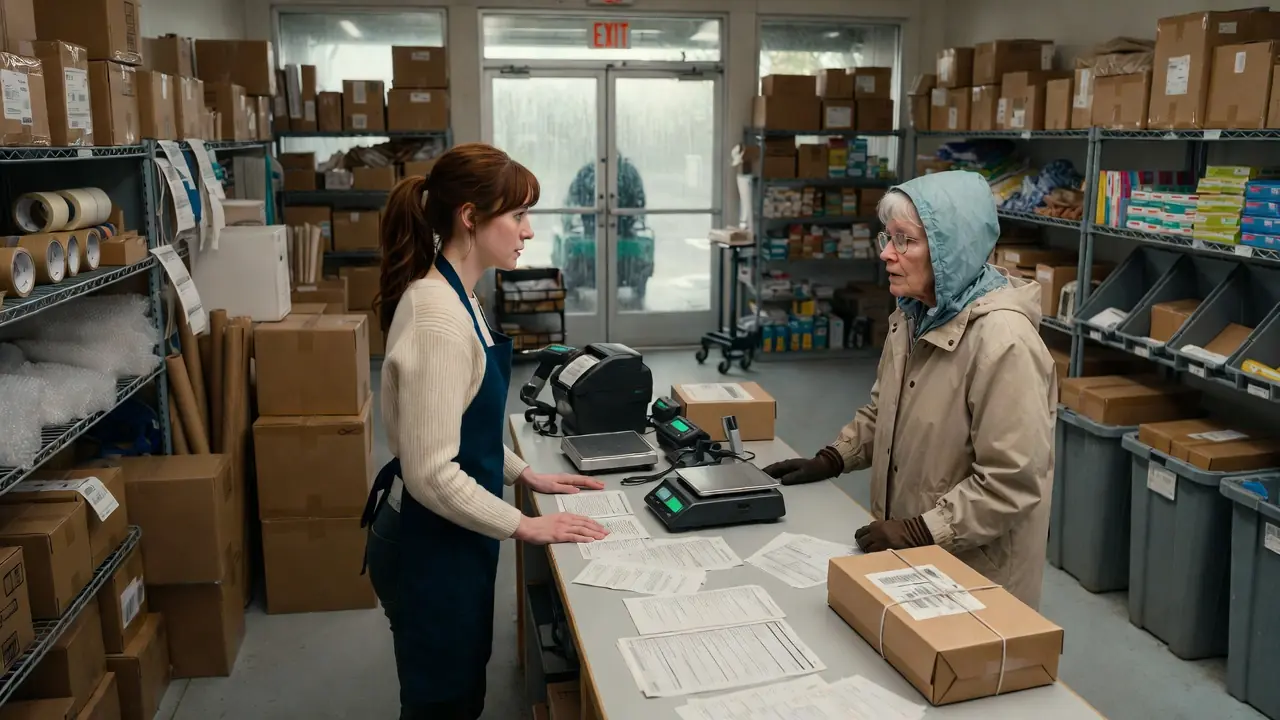
“Thank you for saving my father’s letters.”
Grace smiled.
“I’m glad we got them back.”
“You have no idea what those letters meant to my mother.”
Margaret stood beside her, holding the memory box safely in both hands.
“She knows,” Margaret said.
Claire looked at Grace.
“She does?”
Margaret nodded.
“She listened.”
That simple sentence meant more to Grace than she expected.
Claire opened the memory box and showed Grace one letter.
It was written on yellow legal paper in careful blue ink.
At the top, Arthur had written:
For Margaret, because ordinary days deserve records too.
Grace read only that line before Claire tucked it back away.
She did not need to read more.
The letters were not for her.
The meaning was enough.
Margaret placed a small envelope on the counter.
“For you.”
Grace shook her head.
“You don’t have to.”
“I know. That is why it is a gift.”
Inside was a handwritten note.
Dear Grace,
The day my memory box disappeared, I thought I had lost my husband’s voice.
You did not treat my panic as foolish.
You treated the box as if it mattered before you knew everything inside it.
That is rare.
Thank you for helping Arthur’s letters reach home again.
With gratitude,
Margaret Ellis
Grace read it twice.
Her throat tightened.
“Thank you.”
Margaret smiled.
“No, dear. Thank you.”
After that, Margaret became one of Grace’s favorite customers.
Sometimes she shipped packages.
Sometimes she bought stamps.
Sometimes she came only to ask Grace whether a label looked right.
Each time, Grace helped her patiently.
Margaret began bringing other seniors from her apartment building to the shipping counter.
“This is Grace,” she would say. “She makes sure boxes behave.”
Grace laughed every time.
But the need became obvious.
An elderly man tried to mail a tax form without a return address.
A widow wanted to send jewelry to her granddaughter but did not know how to insure the package.
A retired teacher had three packages with three addresses and almost swapped the labels.
A man brought medical forms in a grocery bag, nearly leaving half of them at the counter.
A grandmother mailed a birthday gift but forgot to keep the tracking number.
Grace started making little cards.
Tracking number.
Date shipped.
Recipient.
Contents.
Phone number to call.
She also made bright tags.
Do not ship.
Hold for pickup.
Fragile keepsake.
Documents inside.
Open with care.
She did not call it a program yet.
But Careful Hands was already happening.
One afternoon, Margaret saw Grace writing in her blue notebook.
“What is that?”
Grace closed it quickly.
“Just ideas.”
Margaret raised one eyebrow.
“At my age, just ideas usually means something important waiting for courage.”
Grace laughed.
“You sound very sure.”
“I am old enough to be sure when young people are hiding useful things.”
Grace hesitated.
Then she opened the notebook and turned it toward Margaret.
Careful Hands.
Senior mailing help.
Keepsake protection.
Document sleeves.
Tracking cards.
Large-print labels.
Memory box checklists.
Appointment mail prep.
No shame.
No rushing.
Margaret read slowly.
Then she looked up.
“This should exist.”
“I think so.”
“No. It should.”
“I don’t know if Hartley’s will approve it.”
“Ask.”
“It needs space.”
“You have that little table near the flower cooler.”
“It needs supplies.”
“People will donate.”
“It needs people to understand why it matters.”
Margaret placed her hand on the notebook.
“Then tell them about the day my husband’s letters almost left without me.”
Grace looked at her carefully.
“Only if you want me to.”
“I do. Use my name if it helps. Use the truth. Not pity.”
Grace nodded.
“Not pity.”
Margaret’s letter became the beginning.
Grace brought her notebook, Margaret’s note, and several examples of shipping mistakes to Mr. Hartley, the grocery store owner.
Mr. Hartley was a practical man in his sixties with gray hair, heavy glasses, and a habit of tapping a pen whenever he was thinking.
He listened.
He read the notebook.
He read Margaret’s letter.
Then he looked through the front window at the shipping counter.
“People really need this?”
“Yes.”
“We already help customers.”
“We help them when they ask. Many don’t know what to ask.”
He tapped his pen.
“That sounds like my mother.”
Grace waited.
He sighed.
“One morning a week. Small table. No interfering with regular counter traffic.”
Grace smiled.
“That’s enough.”
Careful Hands began the next Tuesday.
Grace set up a small folding table near the flower cooler with labels, pens, document sleeves, tape, tracking cards, plastic bags, and a sign.
Need help preparing important mail, packages, documents, or keepsakes?
Ask at Careful Hands.
No rush. No shame.
The first hour, no one came.
Then Margaret arrived with three seniors from her building.
“I brought customers,” she announced.
Grace smiled.
“So I see.”
One woman needed help mailing old photographs to her son.
One man needed to send insurance forms.
One woman wanted to mail a ceramic angel to her granddaughter but was afraid it would break.
Grace helped each person slowly.
She labeled packages in large print.
She wrote tracking numbers on cards.
She photographed labels with their phones.
She taped boxes properly.
She placed documents in sleeves before envelopes.
She never made anyone feel foolish.
By the end of the day, eight people had used the table.
By the third week, there was a waiting list.
The program grew quickly.
The library asked Grace to host a mailing workshop before the holidays.
The senior center requested tracking cards.
The apartment building asked for a Careful Hands pickup day before Christmas.
Hartley’s Market donated a shelf for supplies.
Customers began donating bubble wrap, sturdy boxes, packing paper, and unused greeting cards.
Margaret became the program’s unofficial ambassador.
Her name tag read:
Margaret Ellis.
Memory Box Survivor.
Grace laughed when she saw it.
Margaret lifted her chin.
“It is accurate.”
“Yes, it is.”
Careful Hands helped with more than shipping.
It helped people protect meaning.
A widow mailed her husband’s watch to their grandson with insurance and a handwritten note inside.
An elderly man shipped baby blankets to a daughter expecting twins.
A retired librarian sent rare books to a niece.
A grandmother mailed a box of Christmas ornaments and cried when Grace labeled it Keepsakes: Handle With Care.
A man sent his late wife’s recipe cards to his sister, keeping copies in a document sleeve Grace made for him.
Grace saw that people were not afraid of shipping.
They were afraid of losing what the shipping represented.
Careful Hands gave them a process.
A checklist.
A receipt.
A tracking card.
A little more courage.
Six months later, Mr. Hartley helped Grace apply for a community service grant.
Margaret wrote the main support letter.
At the end, she wrote:
Grace Miller understands that packages are not always objects. Sometimes they are memory, grief, love, apology, proof, and family history. She helps people send what matters without losing themselves to fear.
The grant was approved.
Not a fortune.
Not a separate office.
But enough to buy storage shelves, protective sleeves, large-print labels, a tablet for tracking, portable scanners, packing materials, volunteer badges, and a small stipend for Grace to coordinate Careful Hands officially.
Grace cried when she read the approval letter.
Margaret brought lemon cookies and said, “Good. Now stop crying and label something.”
The program became part of Briar Falls.
During holidays, it was busy every day.
Before tax season, it helped people mail documents.
Before graduations, it helped grandparents ship gifts.
Before estate moves, it helped families send keepsakes.
Grace trained volunteers.
Ask before touching items.
Do not rush decisions.
Do not call anything junk.
Do not say, “It’s just a box.”
Write tracking numbers clearly.
Photograph labels if the customer wants.
Protect paper from rain.
Separate do-not-ship items from outgoing mail.
Treat memory like it is fragile, because it is.
Margaret loved that last rule.
She said Arthur would have written it on yellow paper.
Years passed.
Careful Hands expanded beyond Hartley’s Market.
The library hosted a monthly table.
The senior center kept supplies.
The post office partnered for document mailing days.
Other towns called Grace to ask how to start their own version.
Grace became known as the young woman who could turn panic into a checklist and a box into a safe journey.
But the biggest gift came one autumn afternoon, three years after the memory box almost disappeared.
Margaret came to Hartley’s Market with Claire and two grandchildren.
She carried a folder.
Claire carried flowers.
The grandchildren carried a bakery box.
Grace immediately grew suspicious.
“What is happening?”
Margaret smiled.
“A delivery.”
Inside the folder was a letter from the Briar Falls Community Foundation.
Margaret, Claire, Mr. Hartley, and the library director had nominated Grace for a community care fellowship.
The fellowship would pay for Grace to study nonprofit program coordination, fund a part-time assistant for Careful Hands, and support expansion into three nearby towns.
Grace stared at the letter.
Her hands shook.
“I don’t understand.”
Margaret smiled gently.
“You helped my husband’s letters come home. Now we are helping your work go farther.”
“This is too much.”
“No,” Margaret said. “Losing Arthur’s letters would have been too much. Watching people lose important things because no one helped them slow down is too much. This is the correct size of gratitude.”
Claire laughed softly.
“She practiced that line.”
“I did,” Margaret said.
Grace cried.
The fellowship changed everything.
She completed training in community program management.
She learned grant writing, volunteer coordination, privacy practices, outreach planning, and senior support systems.
Careful Hands expanded into nearby towns.
It created memory box kits.
Document mailing kits.
Holiday shipping clinics.
Family history protection days.
Grace helped people record what was inside keepsake boxes before sending them.
She taught families to photograph important items, copy letters, label boxes clearly, and keep tracking information safe.
She never forgot the brown-paper box tied with white string.
Margaret lived long enough to see Careful Hands serve its thousandth customer.
The program celebrated quietly with tea, cookies, and a table full of labeled boxes.
Margaret sat near the front, wearing her Memory Box Survivor name tag.
Grace gave a short speech.
“This began because one box mattered more than anyone could see from the outside.”
Margaret squeezed her hand.
“That was enough,” she whispered.
Two years later, Margaret passed away peacefully.
At her memorial gathering, Claire placed Arthur’s letters on a memory table, along with the black notebook, old photographs, and the small brown-paper box tied again with white string.
This time, it was not being shipped anywhere.
It was home.
After the gathering, Claire handed Grace one final envelope.
“Mom wrote this for you.”
Inside was a note in Margaret’s careful handwriting.
Dear Grace,
The day my memory box disappeared, I thought I had lost Arthur’s voice.
You moved quickly, but you did not rush me.
You understood that grief can live in cardboard, string, paper, and ink.
You made sure my memories came home.
Then you built Careful Hands so other people could trust their precious things to the world without so much fear.
The fellowship was not repayment.
It was my way of helping your careful hands reach more people.
Keep treating every box like it might hold a life.
With love,
Margaret Ellis
Grace framed the note at the Careful Hands table.
Beside it, she placed one of the first red tags she had printed:
DO NOT SHIP — PERSONAL MEMORY BOX.
Years later, whenever people asked how Careful Hands began, Grace told them the truth.
“It began with an old woman at a grocery store shipping counter, a brown-paper box tied with string, and a set of letters that almost disappeared.”
Then she would show them Margaret’s note.
The gift Grace received was not a house.
Not a car.
Not a fortune.
It was a chance.
A fellowship.
A way to turn one frightening mistake into a program that helped thousands of people protect what mattered.
And every time an elderly customer approached the table holding a box too carefully, whispering, “I’m afraid I’ll do this wrong,” Grace smiled gently.
She never rushed them.
She never made them feel silly.
She simply pulled out a tracking card and said, “Let’s make sure it gets there safely.”
Because sometimes love traveled in a box.
Sometimes grief was tied with string.
Sometimes memory needed a label, a receipt, and someone patient enough to understand that ordinary packages were not ordinary at all.
And sometimes, saving one misdelivered box was enough to open a future neither person saw coming.