It was fourteen degrees outside, sleet was falling almost sideways, and fifteen-year-old Liam Dobson was beginning to understand that freezing to death did not feel the way he had imagined.
He had always thought it would hurt.
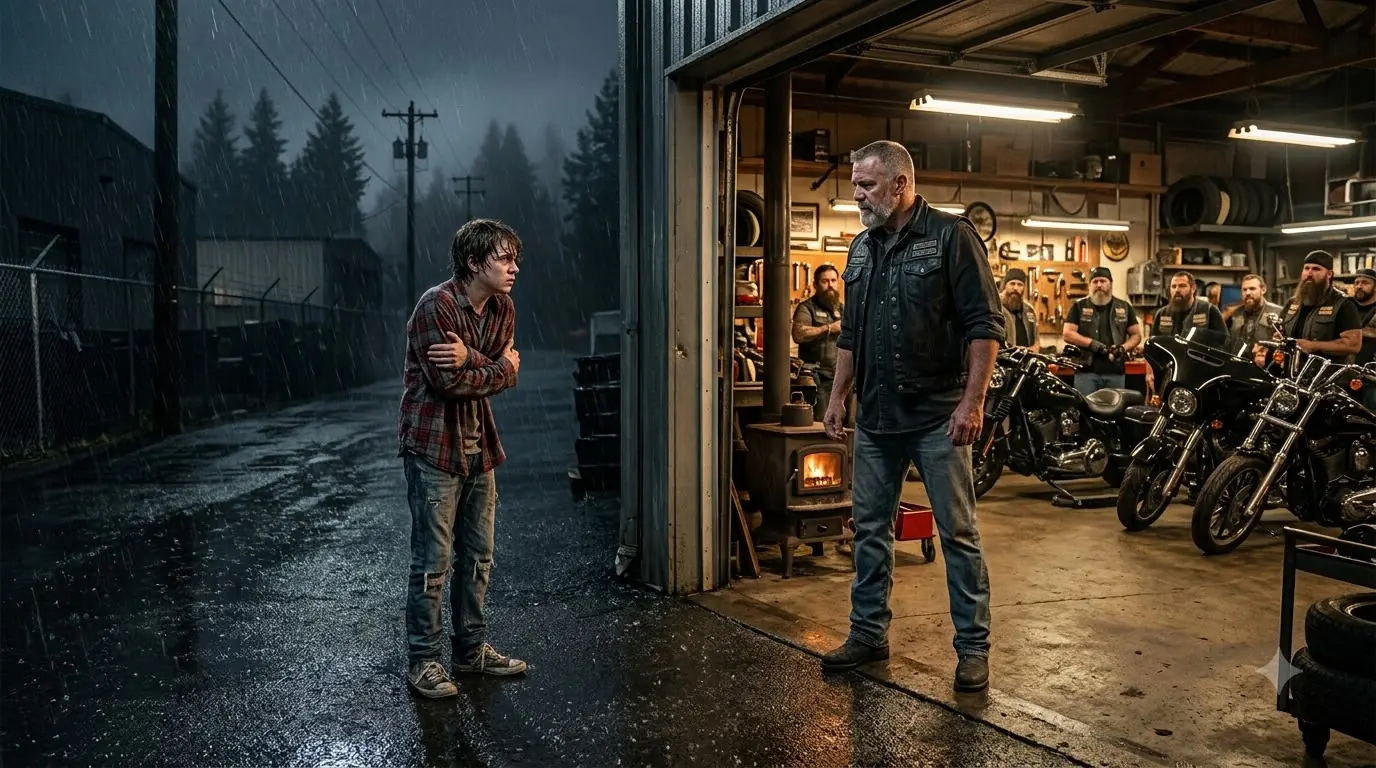
He had pictured unbearable cold, violent shaking, teeth clattering so hard they cracked.
At first, that had been true.
For almost an hour, Liam had shivered beneath the metal overhang behind an abandoned packaging warehouse on Ironwood Avenue, his knees pulled against his chest, his wet flannel shirt plastered against his back.
Then the shaking had begun to slow.
That frightened him more.
He remembered a teacher once saying that when somebody became dangerously cold, they could stop shivering because the body was running out of energy.
Liam did not know whether that was completely accurate.
He did know he was suddenly tired.
Not normal tired.
The kind of tired that made lying down in freezing rain seem reasonable.
His left eye was swollen nearly shut.
His lower lip had split sometime during the run.
One Converse sneaker had collected enough water that every step made a soft squishing noise.
The sole of the other shoe was held together by silver duct tape that had started peeling loose.
He had no coat.
No phone.
No money.
No idea where he was going.
Behind him stood a dumpster that smelled like wet cardboard and machine oil.
Ahead stretched the abandoned industrial end of Oak Haven, Washington, a Pacific Northwest lumber town that seemed permanently trapped between fog and pine forest.
Oak Haven had once been built around three sawmills, a rail spur, and the idea that timber would keep families employed forever.
The largest mill closed in 1999.
The second lasted another seven years.
The third still operated, but with one-third the workforce it once had.
By the time Liam was born, Oak Haven had become the kind of town where people still talked about the good years as though they were an address everyone had somehow misplaced.
Empty storefronts.
Old warehouses.
Pawn shops.
Cheap motels.
Churches that ran food drives every winter.
Bars with pickup trucks parked outside at noon.
The forests surrounding town were beautiful from a distance.
Up close, at two in the morning, they felt endless.
Liam had lived there his entire life.
His mother, Denise Dobson, had raised him in a second-floor apartment above a laundromat on Ash Street.
Raised might have been a generous word.
She loved him.
Liam believed that.
But love and stability had never been the same thing in their house.
Some months Denise worked.
Some months she disappeared into depression so deep Liam learned not to ask when she was getting out of bed.
There were good periods.
Pancakes on Sundays.
Old movies.
Trips to the lake.
Birthdays where she somehow found enough money for a real cake.
Then bad periods.
Bills stacked behind the toaster.
Electricity shutoff notices.
Empty refrigerator shelves.
Men Liam was told to call “friends” who stayed too long.
Denise crying in the bathroom with the water running.
Liam became good at making himself small.
Good at cereal for dinner.
Good at telling teachers everything was fine.
Then, three weeks earlier, on a Tuesday afternoon, he came home from school and found the apartment silent.
His mother's rust-colored 1998 Pontiac was gone.
Her clothes were mostly gone too.
On the kitchen table sat a fast-food napkin.
Five words in blue pen.
I can't do this anymore.
Underneath:
I'm sorry.
Liam had sat at that table until dark.
He did not cry.
Not then.
At eight-thirty, the landlord knocked because Denise owed rent.
By the next afternoon, school officials knew.
Then county services.
Then emergency placement.
Liam had been told he would be safe.
That word came up repeatedly.
Safe.
Temporary safe placement.
Safe adult supervision.
Safe emergency foster environment.
The farmhouse belonged to Brenda Walsh.
She was fifty-six, broad-faced, heavyset, with bleached blonde hair and a voice that became sweet whenever county workers were present.
Her property sat six miles outside town near an abandoned mill road.
From the front, the place almost looked respectable.
White farmhouse.
Red barn.
A row of bare apple trees.
Two dogs.
Inside was different.
Liam was placed there with four other foster children.
Twelve-year-old Evan.
Thirteen-year-old Madison.
A nine-year-old boy named Cole.
And a sixteen-year-old girl named Tasha who barely spoke to anyone.
The first night, Brenda showed Liam the rules.
Breakfast at six.
School bus at seven-ten.
Work assignments after school.
Lights out at nine.
No food outside meals.
No locked bedroom doors.
No complaints to social workers unless Brenda was present.
Liam noticed the padlock on the pantry before he understood why it mattered.
The refrigerator had a chain through the handles at night.
Brenda claimed it was because kids stole food.
The thermostat stayed at fifty degrees.
“You want heat,” Brenda said, “wear another shirt.”
The children performed chores that went far beyond normal household responsibility.
Splitting firewood.
Cleaning animal pens.
Scrubbing floors.
Hauling broken fencing.
Brenda received state money for each foster placement.
The children saw very little of it.
Breakfast was often instant oatmeal.
Lunch came from school.
Dinner was whatever Brenda chose to make, usually cheap pasta or canned soup.
If someone asked for seconds, Brenda said there was no money.
Yet packages arrived constantly.
Electronics.
New clothes for Brenda.
Liquor.
And envelopes from online betting companies.
Carl Brenner was worse.
He was forty-eight and lived in a small trailer behind the barn.
Brenda called him her property manager.
The children called him nothing when he was near.
Carl had previously worked private security until losing his license after repeated complaints.
He still carried himself like a man expecting obedience.
Broad shoulders.
Shaved head.
Heavy boots.
A permanent expression of annoyance.
He liked rules because rules gave him reasons.
Reasons to shout.
Reasons to drag someone by the arm.
Reasons to make children stand outside.
Reasons to remind them that nobody believed foster kids anyway.
Liam tried to stay invisible.
For three weeks, it worked.
Then, Thursday night, he found Cole sitting on the kitchen floor after everyone else had gone upstairs.
The nine-year-old was crying.
Quietly.
The refrigerator was locked.
“What happened?” Liam whispered.
Cole wiped his face.
“I'm hungry.”
Liam was hungry too.
Everyone was.
On the counter sat half a loaf of bread.
Not locked away yet.
Liam looked toward the hallway.
Then took two slices.
He gave one to Cole.
The second never reached his own mouth.
Carl walked in.
“What are you doing?”
Liam froze.
Cole bolted upstairs.
Carl looked at the bread.
Then Liam.
“You steal?”
“It’s bread.”
“Answer.”
“No.”
“You took food without permission.”
“I was hungry.”
Carl stepped closer.
“So rules don't apply when you're hungry?”
Liam said nothing.
Carl shoved him backward.
Liam hit the table.
Then came a hard strike across the side of his face.
The room flashed white for an instant.
Liam staggered.
His lip split against his teeth.
Carl grabbed the front of his shirt.
“You think because county people feel sorry for you, you can do whatever you want?”
Liam smelled stale coffee on his breath.
Then Brenda appeared at the doorway.
She did not stop Carl.
That was what Liam remembered most.
She watched.
“Put him downstairs,” she said.
Carl released him.
Liam stumbled toward the mudroom.
He knew what downstairs meant.
A cold unfinished basement room Brenda used when someone was “acting out.”
No proper bed.
No heat vent.
A thin camping mat.
Liam went down because resistance would make things worse.
Carl shut the door.
Liam sat in darkness for twenty minutes.
His face hurt.
His left eye was swelling.
Something inside him changed.
Not courage.
Desperation.
He had spent three weeks telling himself to wait.
Social worker visit next week.
School counselor eventually.
Maybe his mother would return.
Maybe somebody would notice.
That night, he understood something.
Waiting was becoming dangerous.
At 12:40 a.m., the farmhouse was quiet.
Liam climbed the basement shelving.
There was a narrow window above the utility sink.
Painted shut.
He worked at the latch until one fingernail tore.
Finally the frame moved.