The Training Commander’s hand closed around the front of the Woman’s olive-green jacket in front of nearly six hundred public-safety cadets.
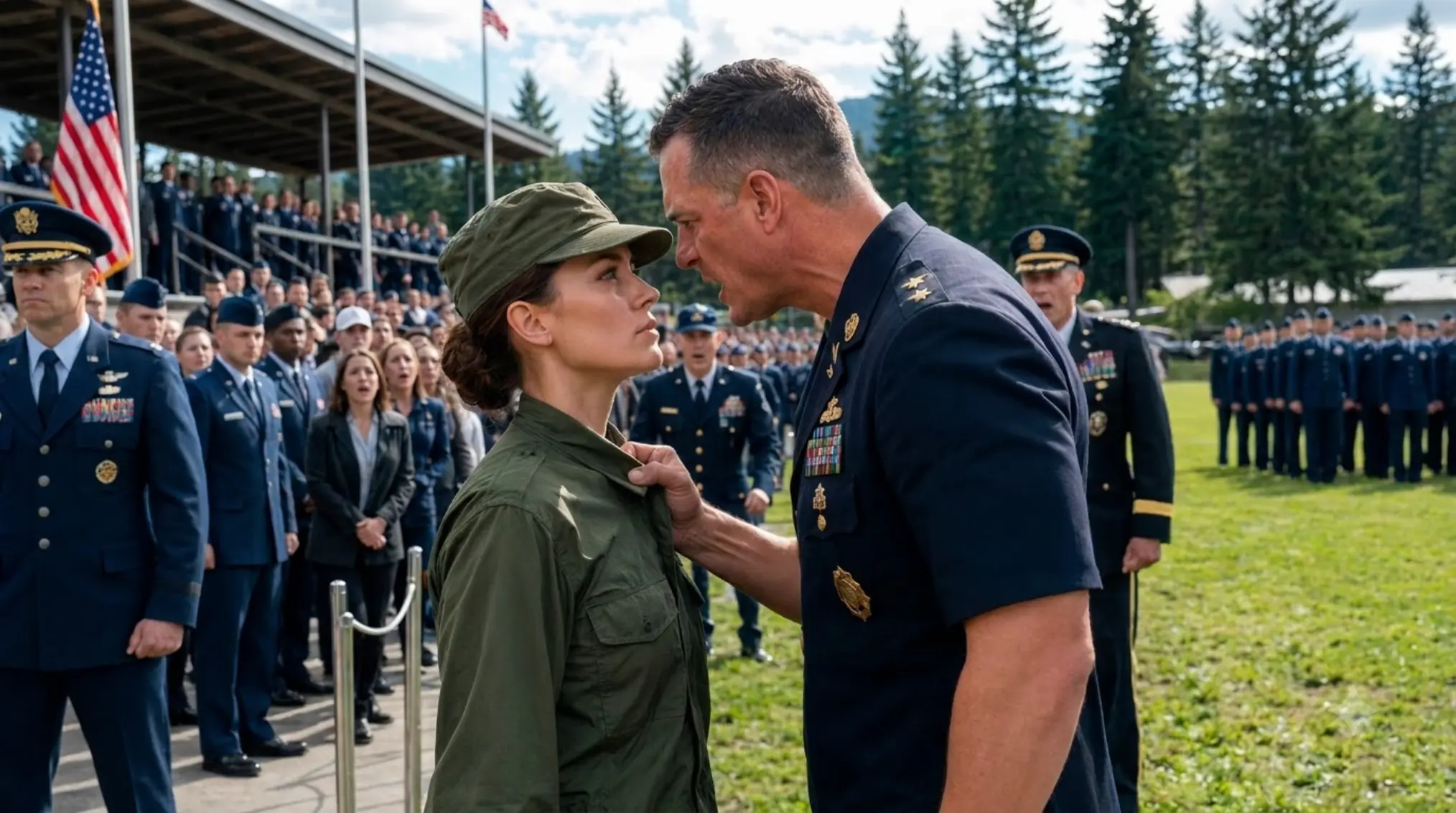
“Remember your place.”
His voice carried across the entire academy field.
The Woman did not flinch.
She stood beneath the bright Washington morning with her hands open at her sides, dark hair tucked beneath a plain field cap, hazel eyes locked calmly on the broad man leaning into her face.
No badge was visible.
No title.
No unit marking.
Nothing suggested she was anyone important.
That was intentional.
She had come to the Northern Washington State Public Safety Academy for only one reason.
Her younger brother was graduating.
She wanted to see him cross the field.
That was all.
No speeches.
No introductions.
No recognition.
She had even asked the State Public Safety Commissioner to keep her visit private.
He had agreed.
Then the Training Commander noticed her standing near the visitor barrier.
And everything changed.
The Woman was twenty-eight years old, although stress had taught her how to look both younger and older depending on what a situation required.
For eight years, she had worked inside a classified state investigative unit that officially appeared on almost no organizational charts.
The unit handled threats against judges, witnesses, public officials, and critical state infrastructure.
Most of its work never became news.
That was the point.
Her job was not to be seen.
It was to notice what everyone else missed.
She had spent years studying human behavior, threat patterns, surveillance, defensive movement, and crisis extraction.
People often misunderstood what that meant.
They imagined someone aggressive.
She was the opposite.
Real skill had taught her how much could be prevented by remaining calm.
That morning, she had driven to the academy in an ordinary gray sedan.
She wore plain olive field clothing because the Commissioner had told her civilian visitors would be allowed near the academy’s demonstration area if they dressed appropriately.
Her younger brother had been training there for six months.
He knew his sister worked for the state.
He did not know exactly what she did.
Their mother knew even less.
That arrangement had kept everyone safer.
The Woman intended to keep it that way.
Then the Training Commander stepped into her path.
He was forty-eight years old and had been at the academy for more than a decade.
Physically, he was intimidating.
Tall.
Broad.
Powerful.
He wore a dark navy ceremonial public-safety uniform decorated with service pins and senior command insignia. His reputation among cadets was complicated.
Some admired him.
Others feared him.
He believed fear and discipline were almost the same thing.
That belief had been tolerated because his graduating classes consistently performed well on evaluations.
Nobody talked much about what happened between evaluations.
That morning, he had already screamed at three cadets for standing half an inch out of formation.
Then he saw the Woman.
She stood behind a rope near the reviewing area, hands folded calmly.
The Training Commander walked directly toward her.
“You.”
She looked over.
“Yes?”
“Visitors stand behind the second barrier.”
“The Commissioner’s office placed me here.”
He laughed.
Several nearby cadets heard it.
“The Commissioner’s office?”
“Yes.”
“Name?”
She did not answer.
The Commissioner had specifically asked her not to identify herself publicly.
The Training Commander interpreted silence differently.
“Who cleared you?”
“I’m authorized to be here.”
“That wasn't my question.”
The Woman looked toward the ceremony.
Her brother stood in the third row.
She could see him watching.
“Sir, I’m not interfering with your event.”
The Training Commander stepped closer.
“You don't decide that.”
“No.”
She nodded toward the officials’ platform.
“Your administration does.”
That answer bothered him.
He was used to nervous people.
People who apologized before understanding what they had supposedly done.
The Woman did neither.
“You think you're clever?”
“No.”
“What department?”
“I’m not discussing that.”
He smiled.
There was no humor in it.
“So you walk onto my field wearing academy-style clothing, refuse identification, and expect me to let you stand beside restricted personnel?”
“If you believe there is a security issue, call the Commissioner’s office.”
Several cadets turned their heads.
The Training Commander noticed.
Now his authority had an audience.
That made compromise impossible for him.
He stepped across the barrier.
“Stand there quietly.”
The Woman’s expression did not change.
“Excuse me?”
“And remember your place.”
Her brother’s face tightened in the formation.
He knew that look on his sister.
Not anger.
Calculation.
The Woman lowered her voice.
“Do not touch me.”
The Training Commander laughed.
Then shoved her shoulder.
She moved half a step.
Nothing more.
“Last warning,” she said.
The Training Commander’s jaw tightened.
“You don't warn me on my field.”
He grabbed the front of her jacket.
That was the moment the crowd became completely silent.
The Woman saw everything at once.
His right hand gripping fabric.
Weight forward.
Left foot planted too heavily.
Shoulders tense.
Balance compromised.
No weapon in his hands.
No immediate threat from anyone else.
She could have hurt him badly.
She chose not to.
Her left hand trapped his wrist.
She stepped outside his planted leg.
Turned.
The movement was almost too fast for the first rows to understand.
The Training Commander suddenly lost balance.
His arm folded harmlessly behind him.
One knee touched the grass.
Then both.
The Woman guided him down and stopped.
No strike.
No kick.
No unnecessary force.
Just control.
The Training Commander shouted.
“Get off me!”
She released him immediately and stepped backward with open hands.
“I warned you not to touch me.”
Six hundred cadets stared.
Her younger brother looked as though he had forgotten how to breathe.
Several academy officers rushed forward.
The Training Commander climbed to his feet.
His face was red.
“She assaulted me!”
The Woman remained still.
“You grabbed me.”
“You attacked a senior academy officer!”
“You placed your hands on me after I told you not to.”
“Detain her!”
Two academy security officers approached.
The Woman did not resist.
She actually extended her hands slightly.
“If you believe detention is appropriate, proceed.”
That answer confused them.
One officer reached toward his restraints.
Then a voice came from behind the formation.
“Stop.”
Everybody turned.
The State Public Safety Commissioner was walking across the field.
He was in his sixties, silver-haired, controlled, and rarely known to move quickly.
Now he moved quickly.
Several senior officials followed him.
The Training Commander pointed toward the Woman.
“Commissioner, this individual entered a restricted area, refused identification, and attacked me.”
The Commissioner did not look at him.
He walked directly toward the Woman.
Stopped.
Then extended his hand.
“Good morning.”
She shook it.
“Commissioner.”
The Training Commander’s expression shifted.
The Commissioner finally turned.
“What happened?”
“She assaulted me.”
The Commissioner looked toward the nearest camera tower.
“This entire field is recorded.”
The Training Commander went silent.
The Commissioner looked back at the Woman.
“You warned him?”
“Twice.”
“Did you strike him?”
“No.”
“Did you continue force after he was controlled?”
“No.”
The Commissioner nodded.
Then looked toward academy security.
“Preserve every recording.”
“Yes, sir.”
The Training Commander stepped forward.
“Commissioner, who is she?”
The Commissioner studied him.
For several seconds he said nothing.
Then he asked a different question.
“Why did you put your hands on a visitor?”
“She refused my order.”
“Was she threatening anyone?”
“No.”
“Attempting to enter a restricted building?”
“No.”
“Carrying prohibited equipment?”
“No.”
“Then why?”
The Training Commander glanced toward the cadets.
The Commissioner noticed.
That was answer enough.
The Woman wanted to leave.
Her brother’s ceremony had effectively collapsed into confusion.
She had spent years avoiding attention.
Now hundreds of people were staring.
The Commissioner leaned closer.
“I’m sorry.”
“Not your fault.”
“I approved your location personally.”
“I know.”
The Training Commander heard that.
His face changed again.
The Commissioner turned toward the assembled academy.
“Continue holding formation.”
Nobody moved.
Then he faced the Training Commander.
“You asked who she is.”
“Yes.”
The Woman quietly said, “Commissioner.”
He looked at her.
She shook her head slightly.
Do not say everything.
He understood.
So he revealed only what was necessary.
“This visitor is a senior protective investigator assigned to the State Public Safety Directorate.”
Whispers spread instantly.
The Training Commander stared.
The Commissioner continued.
“She has direct clearance from my office and was invited here as a family member of one of today’s graduates.”
The Training Commander swallowed.
“I wasn't informed.”
“You did not need to be.”
“She refused to identify herself.”
“She was not required to disclose protected assignment information to you in front of six hundred cadets.”
Silence.
The Commissioner’s voice hardened.
“And her identity does not excuse your conduct anyway.”
That sentence mattered more than the reveal.
The Training Commander looked confused.
The Commissioner continued.
“If she had been an accountant, teacher, mechanic, or unemployed visitor, you still would not have been entitled to grab her because she questioned you.”
The Woman looked toward him.
That was exactly what she had hoped he would say.
The ceremony resumed forty minutes later.
The Training Commander did not return to formation.
He had been temporarily removed pending review.
The Woman considered leaving.
Her younger brother found her behind the administration building.
He was twenty-two and still wearing his academy ceremony uniform.
He stared at her.
“You.”
She smiled.
“Hello.”
“What was that?”
“Complicated.”
“You dropped him like he weighed nothing.”
“I redirected him.”
“You redirected him into the ground.”
“He chose most of the momentum.”
Her brother stared.
She almost laughed.
Then his expression became serious.
“What do you actually do?”
The Woman looked toward the field.
“You know I work investigations.”
“That was not investigator stuff.”
“It occasionally overlaps.”
He folded his arms.
“How long?”
“Eight years.”
“And you never told me?”
“I told you what you needed to know.”
“That is the most irritating sentence you've ever said.”
“I know.”
He looked at her for a long moment.
Then asked quietly, “Did you come here for me?”
“Of course.”
His anger softened.
“You almost missed the ceremony.”
“You almost let one loud man ruin it.”
He laughed.
Then hugged her.
The Woman closed her eyes.
For all the secrecy, training, investigations, and years of learning how to disappear, this was the reason she had come.
Her brother.
Nothing more.
The internal review began the following Monday.
Investigators pulled footage from nine cameras.
The sequence was clear.
The Woman stood in her authorized location.
The Training Commander approached.
She did not enter any restricted area.
She did not threaten him.
She told him to contact the Commissioner’s office.
He shoved her.
She warned him.
He grabbed her collar.
She restrained him.
The entire physical exchange lasted less than four seconds.
But the review expanded when investigators interviewed cadets.
One question produced uncomfortable answers.
Had the Training Commander behaved this way before?
At first, nobody wanted to speak.
Then one cadet did.
Then another.
Then eleven.
Then thirty-seven.
Stories accumulated.
Public humiliation.
Unnecessary physical intimidation.
Threats of dismissal over minor errors.
Aggressive grabbing during instruction.
Retaliatory assignments against cadets who questioned methods.
None individually resembled a major scandal.
Together they formed a pattern.
The Commissioner read every interview.
His frustration grew with each page.
A training institution designed to teach judgment had allowed intimidation to masquerade as leadership.
The Woman was invited to provide a statement.
She sat across from the review panel.
One investigator asked:
“Did you know his reputation beforehand?”
“No.”
“Would you have behaved differently if you had?”
“No.”
“Did you intentionally provoke him?”
“No.”
“Why didn't you identify yourself?”
“My assignment status is restricted.”
“Could you have shown credentials privately?”
“Yes.”
“Why didn't you?”
She paused.
“Because he never asked privately.”
The investigator looked up.
She continued.
“He wanted obedience in front of an audience.”
That sentence went into the report.
The Training Commander defended himself aggressively.
He argued the academy required immediate compliance.
He said uncertainty created security risks.
He insisted the Woman’s refusal forced escalation.
Then investigators played the footage.
He watched himself step across the barrier.
He watched himself shove her.
He heard her say:
“Do not touch me.”
Then watched himself grab her anyway.
The chair of the review panel paused the video.
“What security threat existed at that exact moment?”
The Training Commander remained silent.
The chair repeated the question.
“She was refusing lawful direction.”
“That is not what I asked.”
Silence.
“Was she reaching for a weapon?”
“No.”
“Moving toward cadets?”
“No.”
“Attempting to flee?”
“No.”
“Threatening you?”
“No.”
“Then identify the danger.”
The Training Commander looked toward his attorney.
There was no useful answer.
Because the real danger had existed only in his mind.
She had challenged his authority publicly.
To him, that felt like threat enough.
The review lasted five weeks.
The findings reached far beyond one confrontation.
The academy changed its instructor-conduct policy.
Physical contact during corrective instruction became tightly limited and documented.
Cadets received clearer procedures for reporting misconduct without routing complaints through the same chain responsible for evaluating them.
Training officers were reminded that authority did not eliminate the need for explanation.
Most importantly, the academy rewrote a sentence that had appeared informally in instructor culture for years:
Immediate obedience proves discipline.
The replacement said:
Professional discipline includes lawful judgment, communication, and proportional response.
The Woman liked that better.
The Training Commander was removed from leadership duties.
After additional findings involving previous cadet complaints, he chose to resign rather than accept reassignment and extended corrective supervision.
The Commissioner did not celebrate.
Neither did the Woman.
A career had ended.
That was serious.
But so was the pattern that produced the outcome.
Three months later, the Woman returned to the academy.
This time almost everyone knew her face.
She hated that.
Her brother was completing advanced public-safety field training and had invited her to a family lunch.
A group of cadets noticed her near the cafeteria.
One whispered something.
Another smiled.
She pretended not to see them.
Then a young woman approached.
“Ma’am?”
The Woman turned.
“Yes?”
“I was in the second row that day.”
“I’m sorry.”
The cadet laughed.
“For what?”
“Ruining the ceremony.”
“You didn't.”
The cadet became serious.
“I filed a report afterward.”
The Woman waited.
“About him.”
She nodded slowly.
“Good.”
“I almost didn't.”
“Why did you?”
The cadet looked toward the field.
“Because when he grabbed you, you didn't look scared.”
The Woman shook her head.
“I was concerned.”
“You didn't look like it.”
“Looking calm and feeling calm are different skills.”
The cadet smiled.
Then asked, “Were you ever afraid people would think you were weak because you stayed quiet?”
The Woman considered.
“Yes.”
“What did you do?”
“Stopped needing them to understand.”
The cadet nodded.
That answer seemed to matter.
Later that afternoon, the Commissioner joined her near the visitor area.
“Different atmosphere.”
“Yes.”
“No one grabbed you.”
“Excellent improvement.”
He laughed.
Then became serious.
“You know what bothered me most?”
“What?”
“The way everyone reacted after learning who you were.”
The Woman looked at him.
“Same.”
“Suddenly they believed you.”
“Yes.”
The Commissioner nodded.
“That can't be the standard.”
“No.”
He looked toward the cadets.
“They should have looked at the behavior first.”
The Woman smiled faintly.
“Now you're sounding like an investigator.”
“Terrible career choice.”
They both laughed.
Her brother graduated later that year.
The Woman attended again.
No plain field clothes this time.
She wore dark slacks, a simple blouse, and a gray coat.
Nothing tactical.
Nothing mysterious.
Just a sister standing among families.
When her brother crossed the stage, he found her immediately.
She applauded harder than anyone.
Afterward, he handed her his certificate.
“Hold this.”
“Why?”
“I need a picture.”
He pulled out his phone.
They stood together.
No secrets in the photograph.
No confrontation.
No commander.
No officials.
Just two siblings smiling.
Before leaving, her brother looked toward the section of field where the earlier incident occurred.
“You think about that day much?”
“No.”
“You're lying.”
“Occasionally.”
“What part?”
The Woman thought.
Not the takedown.
Not the Commissioner’s reveal.
Not six hundred stunned faces.
She remembered the Training Commander saying:
Remember your place.
She answered quietly.
“The part where he thought he got to decide where I belonged.”
Her brother nodded.
“And now?”
She looked around the academy.
“Now I think he taught everyone else something useful.”
“What?”
“That authority is easiest to abuse when everyone mistakes confidence for correctness.”
Her brother smiled.
“That sounds like something they should put on a wall.”
“No.”
“Why?”
“People stop reading walls.”
Years later, academy instructors still discussed the incident during ethics training.
The Woman’s identity was rarely mentioned.
That was intentional.
New cadets saw only the footage.
A visitor standing still.
A senior official confronting her.
A warning.
An unnecessary grab.
A controlled defensive response.
Then instructors stopped the recording before the Commissioner arrived.
They asked one question:
Based only on what you have seen so far, who exceeded their authority?
That was the lesson.
Not that the Woman had powerful connections.
Not that she worked in a sensitive state role.
Not that the Commissioner knew her.
Those facts created the dramatic reversal.
But they were never what made the Training Commander wrong.
He was wrong before anyone knew who she was.
He was wrong when she was only a quiet woman standing behind a rope.
He was wrong before the officials approached.
Before the cameras were reviewed.
Before the investigation.
Before the resignation.
Her hidden identity changed the consequences.
It did not change the principle.
And that became the story the academy eventually chose to keep.
A powerful Training Commander tried to teach a quiet visitor to “remember her place.”
Instead, in front of six hundred cadets, he gave the entire institution a lesson about his own.