After I was robbed, I couldn't sleep in my own home. My heart was pounding with fear and resentment, so I asked to stay with my son for a few days, but he coldly replied, "I don't need an extra mouth to feed in my house." Expecting support from my own flesh and blood, I was met with cruelty, and when I came to visit him uninvited, I saw something that would destroy our family forever. The picture frame lay shattered on the hardwood floor, Ella's smiling face staring up at me through a spiderweb of broken glass. My keys fell from trembling fingers, clattering against the doorframe as I stepped into what had once been my living room.
The coffee table sprawled on its side like a wounded animal. Magazines scattered across the floor like fallen leaves. Papers from my desk drawer created a white carpet leading toward the kitchen, and the silence felt wrong. It was too deep, too empty, missing the familiar hum of appliances that should have greeted me home. "What in the world?" the words escaped me in a whisper as my suitcase dropped with a thud behind me.
Glass crunched beneath my shoes as I moved deeper into the chaos, each step revealing fresh violations. The entertainment center gaped open, its shelves picked clean. My television was gone, and the stereo system Ella had saved three months to buy me for our anniversary vanished completely. The smell hit me then—stale air mixed with something else, something that made my stomach turn. It was not the warm scent of home I'd expected after two weeks visiting my sister in California.
This was the smell of strangers, of hands that didn't belong here touching everything we'd built together. I picked up a torn photograph from the debris near my feet showing Melvin's high school graduation, his cap tilted at that cocky angle and my arm around his shoulders. The corner was ripped, separating us in the image. I had lived 23 years in this house and never locked the back door during the day, while barely remembering to lock it at night. Ella used to say, "Silas, you trust people too much."
She'd been right about that, just like she'd been right about most things. The kitchen drawers hung open like screaming mouths, with silverware scattered across the linoleum and cabinet doors askew. My coffee canister was overturned, with grounds creating dark stains on the white counters. They'd been thorough and methodical, as this wasn't random destruction but a strategic search. My legs felt unsteady as I climbed the stairs, gripping the banister with white knuckles.
Each step brought new dread and a new understanding of how completely my sanctuary had been violated. The bedroom made my breath catch. Our mattress hung half off the frame, and the dresser drawers were emptied onto the carpet. Ella's jewelry box, the music box that played "The Way You Look Tonight," lay on its side, silent and empty. Her wedding ring and the pearl earrings her mother had given her, all the little treasures I'd kept because they still carried her perfume, were gone.
But it was the study that broke something inside me. The safe door hung open like a wound, its interior stripped bare. My father's gold pocket watch, passed down through three generations, was gone. The emergency cash Ella had insisted we keep just in case, and the savings bonds we'd bought instead of fancy vacations thinking they'd help Melvin someday, vanished completely. "Who would do this?" I spoke aloud to the empty house, wondering, "Who even knows where I keep it?"
The terrible thought crept in like cold water rising. It had to be someone who'd been here before, someone who knew about the safe behind my desk. They knew where we kept the spare house key and knew I'd be away for exactly two weeks. I sank into my desk chair, the only piece of furniture still upright in the room. My hands shook as I reached for the phone, muscle memory guiding my fingers to the numbers.
"911, what's your emergency?" the dispatcher's calm voice anchored me. "My house was broken into; I just got home from California and everything's destroyed," I reported. "Are you in immediate danger, sir, and are the perpetrators still on the premises?" the dispatcher asked. "No, they're gone, but they took everything because they knew exactly where to look." "We're dispatching officers to your location now, so can you give me your address?"
As sirens wailed in the distance, growing louder with each passing second, I remained surrounded by the wreckage of my peaceful life. The late afternoon sun streamed through the windows, illuminating the destruction with a golden light that seemed to mock the violation of everything I'd held sacred. The sound of approaching help mixed with the echo of my own words: "They knew exactly where to look." The sirens cut through the evening air as two patrol cars pulled into my driveway. I still held the phone in my hand, the dispatcher's voice serving as a lifeline in the chaos surrounding me.
Officer Johnson emerged first, a stocky man with graying temples who moved with the deliberate pace of someone who'd seen too many crime scenes. His younger partner, Officer Martinez, carried a camera and an evidence kit, already scanning the visible damage through my front windows. "Mr. Mills, I'm Officer Johnson, and this is Officer Martinez; are you injured?" he asked. "No, just overwhelmed," I replied, my voice sounding strange and disconnected. Johnson's experienced eyes swept the living room, taking in details I hadn't even noticed yet.
"Martinez, start with photos of the entry points and main areas," Johnson instructed. "Sir, I need to ask you to step outside while we do a quick security sweep." From my front porch, I watched them move through my house with professional efficiency. Johnson checked closets and corners while Martinez documented everything with systematic clicks of his camera. The flash illuminated rooms I'd lived in for decades, which were now foreign landscapes of destruction.
"All clear," Johnson called out, "Mr. Mills, you can come back in, so let's start at the point of entry." He led me to the back door, where splintered wood around the lock told its clear story. "Forced entry, but quietly," Johnson observed. "See how they worked the wood? It took time, and they used the right tools, so this wasn't some kid looking for quick cash." Martinez knelt beside the doorframe, dusting for fingerprints with careful precision.
"The damage pattern suggests they knew what they were doing; they are professional, or at least experienced," Martinez noted. We moved room by room, with Johnson asking questions while Martinez collected evidence. Each violation felt completely fresh as we cataloged it officially. "How long were you away, Mr. Mills, and who knew about your trip?" Johnson asked. "Two weeks; I visited my sister in California, and I told my son and my neighbor, Roy, while mentioning it to a few people at the grocery store," I answered.
I paused and thought, "But the most valuable things—they went straight to them." "How could they know where I kept my father's watch and the safe combination?" Johnson made notes in a small pad and remarked, "These thieves knew exactly where to look, which suggests familiarity with your home." "Do you have any ongoing disputes, or anyone who might hold a grudge?" he inquired. "I'm retired, officer; I keep to myself and help my neighbors when I can, so I can't imagine who would do this," I replied.
Martinez looked up from photographing my emptied safe. "There is no random destruction here," he said. "They were looking for specific items like jewelry, cash, and electronics, but they left family photos scattered rather than destroyed." "It is almost like they were angry, but still had some restraint." The kitchen table became our command post, serving as the only space untouched by the chaos.
Johnson spread out forms while Martinez entered information into his tablet. "We'll need a complete inventory of missing items," Johnson explained, his pen ready, "so start with the most valuable pieces." The list grew longer as we talked: the television, the stereo system, my father's watch, Ella's jewelry, the emergency cash, and even my good tools from the garage. Each item felt like another piece of my life torn away from me. "Mr. Mills," Johnson's tone grew gentler, "I need to ask about family members."
"Are there any financial troubles, or anyone who might need money quickly?" he asked. The question hit me like a physical blow. "My son, Melvin, works as a mechanic, and though he's had some rough patches, he'd never..." I couldn't finish the sentence. Martinez looked up from his tablet and said, "Sometimes the people closest to us surprise us." "We are not saying it's family, but we have to consider all possibilities."
They completed their work as darkness settled over the neighborhood. Johnson handed me a case number written on official letterhead, explaining the investigation process, the follow-up procedures, and the slim chances of recovery. "One more thing," Johnson said as they prepared to leave, "you might want to consider staying somewhere else tonight." "Sometimes perpetrators return, especially if they think they missed something." Martinez nodded and added, "Change your locks tomorrow, definitely, and maybe install a security system."
I stood in my doorway, watching their taillights disappear into the night. The house felt completely different now—not just violated, but officially categorized, processed, and reduced to case numbers and evidence tags. The silence returned deeper than before. Fingerprint powder coated my furniture like ash, and yellow evidence tape marked areas I couldn't disturb. My home had become a crime scene, and I was now officially a victim.
But Johnson's words echoed continuously in my mind: "Familiarity with your home." It had to be someone who knew my habits, my hiding places, and my schedule. The terrible possibility I'd been avoiding suddenly seemed less terrible and more inevitable. The police cars disappeared around the corner, leaving me alone with the wreckage and the growing weight of exhaustion. Exactly two weeks of travel, hours of emotional trauma, and now this hollow silence seemed to press against my eardrums.
I attempted to restore some order, uprighting a lamp here and stacking scattered books there, but every small effort revealed ten more violations. Broken picture frames cut my fingers, and overturned furniture proved far too heavy for my aging back. The absolute futility of it overwhelmed me. My body ached from the flight, from hunching over evidence forms, and from the tension that had seized my shoulders the moment I'd seen Ella's shattered photograph. The house felt unsafe now, completely contaminated by strange hands and suspicious motives.
I needed help, for it was the first time in five years since Ella's funeral that I needed to lean on someone else. My phone lay buried under scattered papers from my desk, but I eventually found it beneath a pile of old tax documents. Its screen was cracked but still functional. The contact list felt foreign under my shaking finger. When had I become so isolated that calling my own son required real courage?
The phone rang three times before Melvin answered. "Dad?" his voice sounded strange, tight with something I couldn't quite identify. "Why are you calling so late?" he asked. "Melvin, son, something terrible happened; my house was robbed while I was in California," I said. Silence stretched between us as I heard television noise in the background, along with Wendy's voice asking something I couldn't make out.
"Robbed?" he finally said, "Are you okay?" "I'm fine physically, but the house is destroyed and they took everything." "Your grandmother's jewelry, Grandpa's watch, even the television are gone, so I can't stay here tonight." "Could I possibly come over, just for a few days until I can get things sorted?" The pause felt endless.
When he spoke again, his voice carried an edge I'd never heard before: "Dad, look, I can't help you right now, as I've got my own problems." The words hit me like a slap. In 35 years, through every childhood crisis, every scraped knee, broken heart, and financial struggle of his early adulthood, I'd never heard him speak to me like this. "But I'm your father," I pleaded, "I just need a couch for a few nights until I can—" "I said no," his tone grew harder, almost frantic, "I don't need another mouth to feed right now, so find a hotel or something."
"Melvin, please; this is your childhood home," I said. "Someone violated everything your mother and I built together, so I need family right now." "Well, family isn't always there when you need them, is it?" the bitterness in his voice shocked me. "You'll figure something out, as you always do," he concluded, and the line went dead. I stared at the phone, replaying the conversation in utter disbelief.
His mother would have been deeply ashamed because we'd raised him better than this. We taught him about loyalty, about taking care of family, and about standing together when times got tough. But something in his voice haunted me—not just cruelty, but fear and guilt, sounding like a child caught in a lie who lashes out to avoid consequences. No, his own son said no. The house felt even colder now, and the violations deeper.
Material loss was one thing, since televisions could be replaced and jewelry was just metal and stones. But this cut into something far more fundamental: 35 years of birthday parties and baseball games, of scraped knees kissed better, and college tuition paid without complaint. And this was exactly how family responded when crisis struck. I gathered a few clean clothes from my bedroom floor and stuffed them into an overnight bag that had somehow escaped the chaos. My back protested as I bent to collect scattered socks and underwear, but physical pain seemed minor compared to the hollow ache in my chest.
The front door felt heavier than usual as I pulled it closed behind me. Each step across my yard toward Roy's house carried the full weight of defeat. The porch light next door glowed like a beacon, promising the kindness my own blood had denied me. As I walked through the cool evening air, one thought kept circling back. Melvin's voice had sounded wrong—not just cruel, but desperate, like someone trying to convince himself as much as me, and like someone carrying a terrible secret.
Roy's front door opened before my knuckles could even touch the wood. His weathered face, lined with concern, appeared in the yellow porch light like a lighthouse keeper welcoming a storm-tossed sailor to shore. "Silas, come in, come in," he said, stepping aside and gesturing me into his modest living room. "I saw you walking over, and the police already asked me everything about what happened." The warmth of his home enveloped me like a physical embrace.
Unlike my violated sanctuary, Roy's place felt entirely safe. It featured worn furniture arranged with military precision, photographs of his service years lined up on shelves, and everything in its proper place. "What a terrible thing to happen in this neighborhood," he continued, taking my overnight bag. "In the 23 years we've been neighbors, I never thought I'd see the day when something like this would touch our street." Relief flooded through me because here was someone who understood and cared without conditions or cruel rejections.
"Of course you'll stay here," Roy said, already pulling blankets from a hall closet. "I should have thought to offer earlier, but I figured family would... well, never mind that now." He set up the couch with military efficiency, each pillow positioned just so. Within minutes, he had a proper sleeping arrangement prepared and was guiding me toward his kitchen. "Coffee, tea, or something stronger?" Roy asked, pulling out chairs around his small table, "you look like you've been through a war zone."
"Coffee would be perfect," I replied, sinking into the offered chair, suddenly aware of how much my body ached. Roy's waves of hospitality deeply soothed something raw inside me. He moved with purpose, starting the coffee maker and retrieving mugs from perfectly organized cabinets. "I told Officer Johnson everything I could remember," he said, settling across from me as the coffee brewed. "I told him about seeing Melvin's Honda at your place a few times this week."
My head snapped up in surprise. "I saw Melvin Tuesday morning, I think, and maybe Thursday afternoon," Roy nodded, pouring steaming coffee into our mugs. "Good boy, checking on his dad while you were away." "I waved, but he seemed in a hurry, probably worried about you traveling alone at your age." The coffee warmed my hands, but Roy's words sent a completely different kind of heat through my chest.
Pride mixed instantly with intense confusion. "He's always been protective," I said slowly, "his mother taught him to look after family." "Smart woman, your Ella, rest her soul," Roy raised his mug in a small salute. "She'd be proud to see how he watches out for you." But even as I nodded agreement, something nagged at the edges of my thoughts.
If Melvin had been checking on the house, why hadn't he mentioned it during our phone call? Why had he seemed so strange and so defensive? "I'm glad he was keeping an eye on the place," I said finally, "which makes this whole thing even more puzzling." Roy leaned forward, lowering his voice conspiratorially. "Between you and me, I think this was professionals, given the way they knew exactly what to take and how quiet they were about it."
"This wasn't some desperate kids looking for quick cash." "You think so?" I asked. "My 26 years in the service teaches you to read situations, so I think someone planned this carefully." "They knew your routines and knew when you'd be gone." He paused, sipping his coffee, and asked, "The question is, who could have known all that?"
The question hung heavily in the air between us like smoke. I found myself thinking about everyone who knew about my California trip. There was the grocery store clerk who'd wished me safe travels, and the mailman I'd asked to hold my deliveries. My sister knew, of course, but she lived 2,000 miles away. And Melvin knew.
"This feels so calculated," I admitted, "like whoever did this had been watching and learning my habits." Roy nodded grimly and said, "That's exactly what I told the police." "I said it reminded me of intelligence gathering: methodical, thorough, and patient." We sat in comfortable silence—two old men trying to make sense of a sensory violation. Outside, the neighborhood settled into its evening quiet, porch lights creating small pools of security in the darkness.
"I'll help you clean up tomorrow," Roy offered, "for there's no sense facing that mess alone." "I appreciate that more than you know," I said, the words coming out rougher than intended. "What else are neighbors for?" Roy's smile was genuine and uncomplicated. "Besides, I want to get a closer look at how they got in, since I might need to upgrade my own security after this." As I prepared for bed on Roy's comfortable couch, his words echoed continuously in my mind: "Someone planned this carefully."
The thought should have been frightening, but instead I found it strangely focusing. My thirty years as an engineer had taught me that every problem had a solution and every mystery had clues waiting to be discovered. Someone had violated my home and stolen my memories, and somehow I would find out who. The last thing I remembered before sleep claimed me was Roy's innocent observation: "Good boy checking on his dad." Morning brought a clarity I hadn't expected.
Roy's coffee, his genuine concern, and a decent night's sleep had fully restored some of my analytical thinking. After breakfast, I'd spent time organizing my thoughts, making lists of what needed to be done and who needed to be contacted. But one item remained firmly at the top of my mental agenda: talking properly with Melvin. His townhouse sat in a development that had seen better days—modest homes built for young families starting out. I'd helped him with the down payment three years ago, proud that my son was building his own life and his own future.
Now parking in his narrow driveway, I noticed details I'd previously overlooked: paint peeling around the window frames and a small crack in the front step. The lawn needed attention, meaning times must be harder than he'd let on. I pressed the doorbell and waited. Sounds came from inside, indicating movement and maybe voices, but no one answered immediately. Finally, footsteps approached and the door opened to reveal Melvin's face, pale and startled.
"Dad? What... what are you doing here?" he stammered. His reaction caught me completely off guard. This wasn't the greeting of a son concerned about his father's crisis; this was the response of someone who'd been caught unprepared and possibly unwelcome. "Hello, son. Sorry to drop by unannounced, but we need to talk," I said. "After last night's call, I thought we should clear the air."
"I... yeah, okay. Come in, I guess." The living room felt cramped and cluttered, with magazines scattered across a coffee table and dishes on every surface. Melvin moved with nervous energy, clearing space on the couch while actively avoiding my eyes. "Where's Wendy?" I asked, settling into the offered seat. "Work—she's pulling double shifts this week," he replied, perching on the edge of an armchair, his leg bouncing with anxiety.
"Look, Dad, about last night—I was tired, stressed, and didn't mean to sound so harsh," he apologized. "I understand pressure, son, as we all face difficult times." I kept my voice gentle and non-threatening, adding, "But family should stick together during a crisis, don't you think?" Melvin's laugh came out brittle and forced. "Right, family... of course."
Something in his tone made me lean forward. "Roy mentioned he saw your car at my place a few times this week," I noted. The effect was immediate: Melvin's bouncing leg stilled completely, and his face went rigid. "Did he? I... I don't remember driving by there." "You were checking on the house while I was away, weren't you, looking after things like your mother taught you?"
"Maybe once or twice," his voice came out tight and defensive, "why does it matter?" The contradiction struck me like a physical blow. First he didn't remember, and now it was maybe once or twice. My engineering mind, trained to spot inaccuracies in complex systems, began cataloging the discrepancies. "You seem nervous, Melvin; this whole thing has you more shaken than I expected."
He shot to his feet, pacing to the window. "Of course I'm shaken—my father's house was robbed." "Someone violated your privacy and stole your things, so how am I supposed to feel?" But his body language told a completely different story: the rigid shoulders, the total avoidance of eye contact, and the way he wrung his hands. This wasn't grief or concern; this was the behavior of someone carrying a tremendous burden.
"Sit down, son, you're making me nervous," I instructed. Melvin returned to his chair but couldn't stay still, his fingers drumming against the armrest. His eyes darted around the room like a trapped animal seeking escape routes. "Tell me about these visits to check on the house," I said carefully, "what exactly were you checking?" "Just, you know, making sure everything looked normal and that nobody was bothering the place."
"And did everything look normal?" The pause stretched out far too long. "Yeah, everything was fine." But absolutely nothing about this conversation was fine. Every answer felt rehearsed, and every gesture was calculated to deflect rather than inform.
This wasn't the son I'd raised—the boy who used to confess his smallest infractions with tears in his eyes. "Melvin, what's wrong? And don't tell me it's just the burglary, for something else is eating at you." He stood up again, this time heading toward the kitchen. "I need some water. You want anything?" he asked. As he disappeared around the corner, I found myself analyzing our exchange like a failed engineering project.
Every question had produced evasion, and every attempt at connection had been rebuffed. My son was lying to me, but about what? The sound of running water gave me a moment to study his living room more carefully. There were bills stacked on the end table, some with red overdue stamps. There was a gaming magazine opened to an article about poker strategies, and empty beer bottles lined up behind the couch.
When Melvin returned, a glass trembling slightly in his hand, I made one more attempt at direct communication. "Son, if you're in some kind of trouble, you can tell me." "Whatever it is, we'll figure it out together." His laugh came out harsh, almost bitter. "Trouble? What kind of trouble could I be in, Dad?"
The question felt like a challenge, but I couldn't understand the rules of whatever game we were playing. "I don't know, and that's why I'm asking," I said. Melvin sat back down, but his entire body remained coiled like a spring under tension. Every few seconds, his eyes would flick toward the mantelpiece, then quickly away, as if checking on something he didn't want me to notice. Melvin excused himself to the kitchen again, muttering something about needing to check on dinner preparations.
The house felt far too quiet with his nervous energy removed, like the moment between lightning and thunder when the air itself holds its breath. I sat back in the uncomfortable chair, letting my eyes wander around the cluttered living room. Bills, magazines, and empty bottles served as the debris of a life that wasn't going according to plan. The poor kid was clearly struggling more than I'd realized. My gaze drifted to the mantelpiece where a few framed photographs sat beside some decorative items.
There was Melvin as a child grinning gap-toothed at a baseball game, and his wedding day arm around Wendy in her simple white dress. There were a few knickknacks that looked like flea market finds, and a watch. At first glance it seemed unremarkable—just another piece of decoration among the accumulated possessions of a young couple trying to make their house feel like home. But something about its profile, specifically the curve of its case, made me look twice. The brass face caught the afternoon light streaming through Melvin's windows.
The leather band was worn soft with age and handling. I noticed the distinctive shape of the winding crown that had been slightly bent since 1987, when a ten-year-old me had dropped it while trying to wind it in secret. My heart stopped. I rose from the chair slowly, my legs feeling entirely disconnected from my body. Each step toward the mantelpiece required conscious effort, as if I were walking through deep water.
I prayed internally, "Please be wrong; please let this be some terrible mistake." But as I drew closer, more details emerged with sickening clarity. There was the small scratch on the crystal face where I'd carelessly bumped it against a doorframe in my childhood. There was the patina on the brass case that came from decades of handling by loving hands. The inscription on the back was hidden, but I knew it by heart: To William Mills, faithful service, 1943–1978.
This was my father's watch, my grandfather's legacy—the timepiece meant to rest in Melvin's hands through proper ceremony, not theft. The room seemed to tilt around me. Blood rushed in my ears like ocean waves, and I gripped the edge of the mantelpiece to keep from falling. Exactly 35 years of fatherhood collapsed into a single devastating moment of absolute clarity. My own son—the boy I'd taught to ride a bicycle, to throw a curveball, and to treat people with dignity—had robbed me.
"The scratch from when I dropped it at age 10... there's no doubt," I whispered to the empty room. Footsteps approached from the kitchen as Melvin's voice called out, "Dad, everything okay out there?" I forced myself to move away from the mantelpiece and return to my chair with what I hoped looked like casual movement. But my hand shook as I gripped the armrests, and my breathing came in short, sharp bursts. "That's a handsome watch on your mantle," I said when he reappeared, my voice sounding strange and distant even to my own ears.
Melvin glanced over far too casually. "Oh, that old thing? Picked it up at a pawn shop downtown," he said. The lie hit me like a physical blow, not just the theft, but the ease with which deception rolled off his tongue. "Looks like an antique, good quality," I noted. "Yeah, got it cheap, as the guy probably didn't know its value."
Each word twisted the knife deeper into my chest. This was my own flesh and blood, looking me in the eye and lying about stealing his great-grandfather's watch. It was the watch that should have been his inheritance, his connection to family history and honor. "Well," I managed, standing on unsteady legs, "I should probably head back." "Roy's helping me clean up this afternoon."
Melvin seemed almost relieved at my departure. "Sure, Dad, and again, sorry about last night." "I'll call you later and see how you're doing." It was another lie, for we both knew he wouldn't call. The walk to my car felt like a journey through quicksand.
Each step required tremendous effort, and the world around me seemed muffled and distant. I fumbled with the keys, dropping them twice before managing to start the engine. As I pulled out of his driveway, I caught a glimpse of Melvin in his front window. He wasn't waving goodbye or showing concern for his robbed father; he was just watching, making sure I actually left. My own son, my own flesh and blood—how could he look me in the eye?
The drive back to Roy's house passed in a blur of automatic reflexes. I navigated turn signals, stop signs, and traffic lights without any conscious thought. My mind churned with terrible mathematics: the timing of my trip, the knowledge of my hiding places, and the surgical precision of what had been taken. Everything I'd taught him about honor, family, and standing up for what was right was entirely meaningless. By the time I parked in Roy's driveway, one thing had crystallized in my mind with absolute clarity.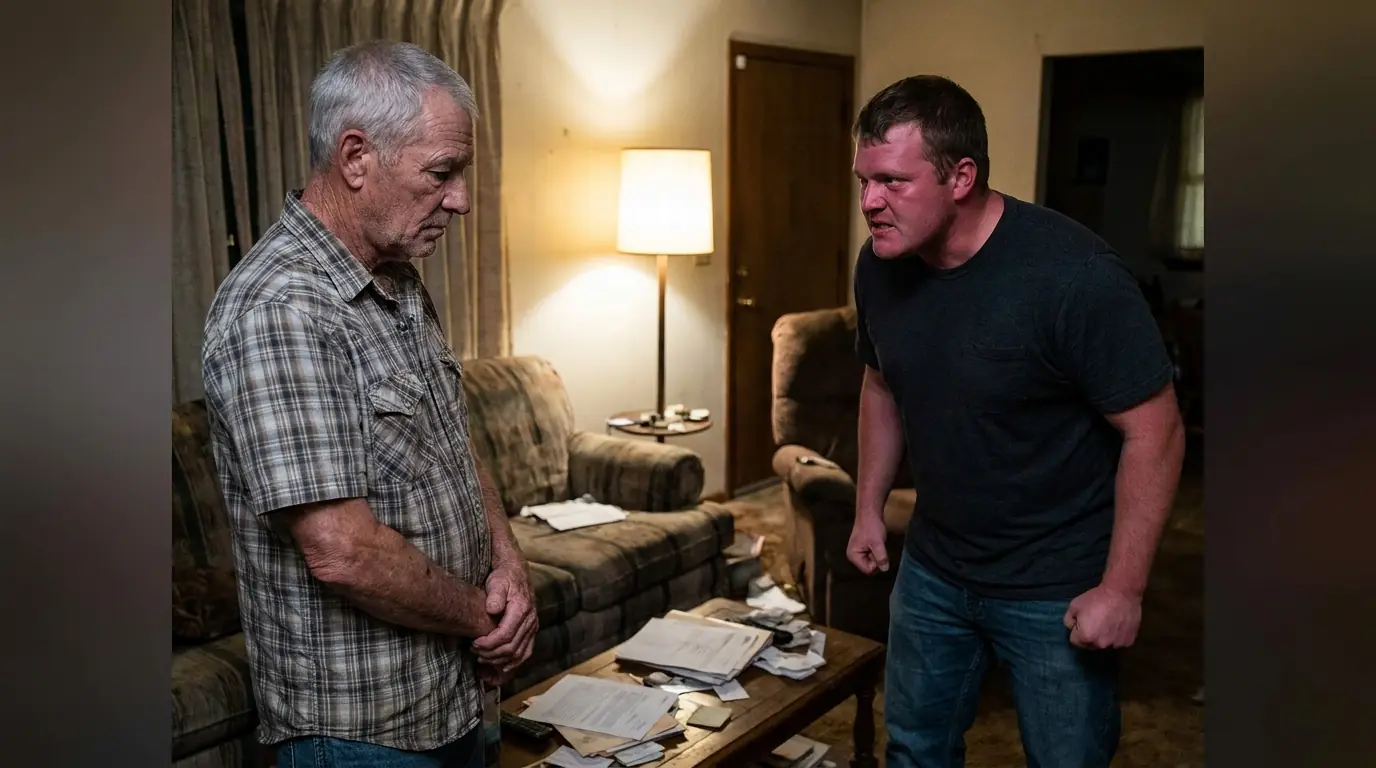
If Melvin thought he could destroy everything his mother and I had built together, steal from his own family, and walk away untouched, he had seriously underestimated what his old man was capable of. The boy had made the worst mistake of his life. Roy's borrowed Camry felt foreign beneath my hands as I gripped the steering wheel outside Melvin's townhouse. The key turned in the ignition with a mechanical click that seemed unnaturally loud in the afternoon silence. "The scratch from when I dropped it at 12 years old... there's no mistaking it," I muttered.
Traffic moved around me in a blur of color and motion while my mind replayed the devastating moment of recognition. I recalled the distinctive bend in the winding crown and the patina that came from decades of loving handling. My father's inscription was hidden on the back but burned into my memory. I pulled over at a gas station, my hands trembling too violently to maintain safe driving. Customers walked past my windshield, living their normal lives, while mine crumbled into fragments.
Exactly 35 years of fatherhood were reduced to a single undeniable truth sitting on my son's glass mantelpiece. The engine idled as I sat there, breathing deeply, trying to process what felt impossible to accept. Maybe there was an explanation, and maybe someone had sold it to him legitimately. But the timing, his nervousness, and those visits Roy had mentioned all pointed toward one horrifying conclusion. Twenty minutes passed before I trusted myself to continue driving.
The streets of Omaha blurred past like watercolors in rain, familiar neighborhoods becoming foreign landscapes through my shock-clouded vision. Roy was working in his garden when I pulled into his driveway. He looked up with a smile that faded immediately when he saw my face. "Silas, you look like you've been seeing a ghost; the talk with Melvin didn't go well?" he asked. "Something's not right, Roy," the words came out hoarse and scratchy.
"I can't explain it yet, but something's very wrong." He geographic set down his pruning shears, brushing soil from his hands. "Family troubles can be the hardest kind, so you need to talk about it." "Not yet, as I need to be certain first and need to check some things." Roy studied my face with the sharp eyes of someone who'd learned to read people under pressure.
"Well, you know where to find me when you're ready, for the coffee is always on." Inside his guest room, I lay on the narrow bed, staring at water stains on the ceiling. The watch image replayed endlessly: the brass face catching afternoon light, and the leather band worn soft with age, sitting there like an accusation among the scattered possessions of my son's modest life. But doubt gnawed relentlessly at the edges of my certainty. I questioned 35 years of raising him and teaching him right from wrong.
Was it all entirely meaningless? Had I failed so completely that the boy who once cried over stepping on an ant could rob his own father? The engineer in me demanded proof beyond emotion—evidence that would stand up to scrutiny and couldn't be explained away or dismissed as coincidence. If I was going to destroy our relationship forever, I owed it to both of us to be absolutely certain. I pulled out a notepad and began making lists, taking a methodical approach to an impossible situation.
I noted times, dates, opportunities, what had been stolen, where it might have gone, and who might remember seeing what. The gaming magazine I'd noticed made sudden, terrible sense alongside the bills with overdue stamps. Melvin's strange behavior and his desperate rejection when I'd asked for help all fit. The pieces formed a clear pattern I'd been too trusting to see. But I needed more than patterns; I needed proof that would satisfy a court of law, because that's exactly where this was heading if my suspicions proved correct.
After 3 hours of planning, I had a strategy. It would take time, patience, and the kind of methodical investigation that had served me well in thirty years of engineering problem-solving. If I was wrong, I would beg his forgiveness and spend the rest of my life making amends. If I was right, the boy who stole from his father would learn that his old man was capable of more than he'd ever imagined. The yellow pages felt brittle under my fingers as I searched for pawn shops across Omaha.
Roy had lent me his car again, no questions asked, which was the kind of trust I'd once extended to my own son. Seven days of systematic investigation began at Pete's Pawn Palace on Dodge Street. The owner, a heavyset man with suspicious eyes, examined the photographs I'd prepared carefully. "Yeah, I remember that watch—vintage piece, real quality workmanship," he said, tapping the photo with a thick finger. "A young guy, maybe mid-30s, seemed nervous as a cat."
My heart hammered hard against my ribs. "Can you describe him more specifically?" I asked. "Dark hair, about 6 feet tall, wearing work clothes; said it was his grandfather's watch but needed cash quick for some emergency," Pete recalled. Pete's eyes narrowed as he asked, "Why you asking this—is it about insurance or something?" "Something like that," I said, keeping my voice steady.
"Do you still have any paperwork?" The receipt copy showed a date of May 13th, exactly two days into my California trip. The signature was illegible, but the physical description matched Melvin perfectly. He had accepted $300 for a watch worth ten times that amount. Two more pawn shops yielded similar results.
I found my television at Second Chance Electronics. I tracked Ella's jewelry to Golden Memories Consignment. Each transaction was desperate and hurried, with items sold far below their value by a young man who fit my son's description perfectly. Mrs. Peterson, my neighbor three houses down, welcomed me into her kitchen with the enthusiasm of someone who rarely had visitors. "Oh yes, I definitely saw that Honda Civic on the 13th around 2:00 in the afternoon," she recalled.
"I thought it was strange since you weren't home, but figured maybe Melvin was checking on things." "Did you see the driver clearly?" I inquired. "Not his face, but the build looked familiar; the young man moved like he was in a hurry and parked right in your driveway, bold as anything," she said. The timeline aligned perfectly. While I'd been having lunch with my sister in San Francisco, my son had been robbing my house three time zones away.
Security camera footage from the Hendersons showed a Honda Civic matching Melvin's license plate number. The timestamp read 2:17 p.m. on May 13th, right in the window Mrs. Peterson had specified. Each piece of evidence felt like another nail in the coffin of my hopes. The methodical part of my mind cataloged every detail while the father in me died a little more with each confirmation. Friday evening, I followed him from the auto shop to Riverbend Casino.
I watched through the parking lot as he walked inside with the purposeful stride of someone feeding an addiction. Two hours later he emerged looking defeated, his shoulders slumped, probably lighter by whatever money he'd started with. The final piece of the puzzle clicked into place. Desperation had driven him to rob his own father, and here he was, throwing away more money he didn't have. Back at Roy's kitchen table, I spread out everything I'd collected.
I laid out photographs, receipts, witness statements, and timeline documentation. The evidence painted a picture so clear that even Melvin wouldn't be able to deny it. "The boy I raised is gone, and this stranger who stole from me has taken his place," I whispered to the empty room. "But I need him to know that I knew, and I need to look into his eyes when confronted with proof of his betrayal." Tomorrow I would drive to his house with this folder of evidence and watch him try to explain away the inexplicable.
The watch was still sitting on his mantelpiece, waiting to serve as the final, undeniable accusation. Justice demanded truth, and truth demanded real courage. Both waited for tomorrow's confrontation. The manila folder sat on my passenger seat like a loaded weapon as I drove toward Melvin's townhouse. One week of methodical investigation had produced evidence that would satisfy any court.
There were photographs, receipts, witness statements, and timeline documentation that left absolutely no room for doubt or denial. Melvin answered the door with the same confused expression he'd worn during my previous visit. But this time, I felt nothing but cold determination. "Dad, what brings you by again?" he asked. "We need to talk, son; may I come in?"
The living room looked exactly as I'd left it—cluttered, showing signs of financial stress, and dominated by that brass pocket watch glinting on the mantelpiece like an accusation waiting to be voiced. I set the folder on his coffee table with deliberate precision. "Melvin, I know you robbed my house, and I have proof." His face went completely white. "What? Dad, you're scaring me; what are you talking about?" he stammered.
"Stop lying," I said, opening the folder to reveal the first photograph. "I have witnesses, receipts, and documented evidence, and I have this." I pointed toward the mantelpiece where my father's watch caught the afternoon light. "I bought that at a pawn shop, I told you," he countered. "Pete's Pawn Palace, May 13th, for $300," I replied, sliding the receipt copy across his coffee table.
"The physical description matches you perfectly." "Want to explain how your grandfather's watch ended up in a pawn shop two days after my house was robbed?" bridge/My son's hand shook violently as he picked up the receipt. His mouth opened and closed without making a sound, like a fish pulled from water. "Here's Mrs. Peterson's statement about seeing your car in my driveway that afternoon," I continued.
Another document joined the first: "This is security camera footage from the Hendersons showing your license plate at 2:17 p.m." "Dad, please..." he begged. "This is a receipt from Second Chance Electronics for my television, and another from Golden Memories Consignment for your mother's jewelry." Each piece of evidence hit the table with the finality of a judge's gavel. "Should I continue?" I asked.
The breakdown came suddenly. Melvin collapsed into his armchair, his face buried in his hands, his shoulders shaking with sobs that sounded more like animal whimpers. "You don't understand—they were going to hurt Wendy," he wept. "I owed $15,000 to people who don't accept payment plans." "So, you stole from your father instead of asking for help?"
His head snapped up, his eyes red but blazing with desperate justification. "You would have lectured me and given me one of your speeches about responsibility and poor choices," he argued. "You're right, I would have, but I also would have helped you." "I was going to pay it back; once I got ahead at the tables, I was going to buy everything back, and you'd never know," he said. It was the gambling delusion laid bare—always one win away from solving everything, never accepting that the system was designed to take everything he had.
"Instead, you violated my home, stole your mother's wedding ring, and pawned your great-grandfather's watch for a fraction of its value." My voice stayed level, engineer steady. "You looked me in the eye and lied about it." Melvin shot to his feet, desperation making him dangerous. "You can't call the police on your own son!" he yelled.
"Watch me," I said, reaching for my phone. "You made this choice when you broke into my home." "Mom would never forgive you for this!" his voice cracked with absolute hysteria. The words hit like a physical blow, but I stood firm. "Your mother would be deeply ashamed of what you've become," I said, my finger already dialing 911.
He lunged toward me then, trying to grab the phone, but thirty-five years of disappointment had crystallized into something harder than his desperation. I stepped back, the voice from the phone cutting through Melvin's pleas like a knife through silence. And in that moment, I crossed a line that could never be uncrossed. "911, what's your emergency?" the dispatcher's calm voice cut through the room. My finger remained steady on the phone despite the trembling in my hands.
"I need to report a residential burglary; I have the perpetrator here with me and I have evidence," I stated. "Sir, is the perpetrator still on scene, and are you in immediate danger?" the dispatcher inquired. Melvin lunged toward me again, trying to grab the phone, but desperation made him clumsy. I stepped back, maintaining distance while keeping my voice completely level. "The perpetrator is my son; he's not dangerous, but he's trying to prevent me from reporting the crime."
The next 15 minutes felt like hours. Melvin alternated between frantic pacing and collapsed sobbing, occasionally making desperate attempts at negotiation. "Dad, please think about Wendy; think about your granddaughter," he pleaded. But the time for family considerations had fully passed. The brass watch on his mantelpiece caught the late afternoon light—a silent witness to a betrayal that cut deeper than any wound.
Two patrol cars arrived with familiar efficiency. Officers Johnson and Pierce stepped out, their faces showing recognition as they approached the house. "Mr. Mills, we responded to your burglary report three weeks ago," Johnson noted. "That's right, Officer Johnson, and I've discovered who committed the crime." Martinez glanced between me and Melvin, professional assessment evident in his expression.
"This is the son you mentioned during the original investigation?" he asked. "Yes, and I have comprehensive evidence of his guilt." Melvin's voice cracked as he appealed directly to the officers: "This is a family dispute; you can't arrest someone based on their father's accusations." Johnson's expression remained entirely neutral. "Sir, we'll need to examine any evidence and make our own determination," he said.
The manila folder felt heavier than it should as I spread its contents across Melvin's coffee table. Each document, photograph, and receipt told its part of the story with methodical precision. "Pawn shop receipts showing my father's watch sold on May 13th," I began pointing to the evidence systematically. "The physical description matches my son exactly." Martinez photographed each item with his department camera.
"These look legitimate, and we can verify them with the establishments," Martinez said. "This is security camera footage from the Hendersons showing his vehicle at my residence during the burglary timeframe." Another document joined the display as I noted, "These are witness statements placing him at the scene." Melvin's face had gone completely ashen. The reality of professional police scrutiny was clearly different from his father's emotional accusations.
"And here," I said, pointing toward the mantelpiece, "is my great-grandfather's pocket watch sitting in plain view." Johnson examined the watch without touching it. "This matches the description in your original police report," he observed. "Exactly, down to the distinctive scratch from when I dropped it as a child." The sound of a car door slamming outside interrupted our proceedings.
Wendy burst through the front door, still wearing her work uniform, her eyes wide with panic at the sight of patrol cars. "What's happening, Melvin? Why are the police here?" she demanded. Her husband couldn't meet her eyes. "Wendy, I... there's been a misunderstanding," he stammered. "There is no misunderstanding," I said quietly, "your husband robbed my house, and I have proof."
The scream that tore from her throat was pure anguish. She collapsed to her knees beside Melvin's chair, grabbing his hands. "Tell them it's not true! Tell them you didn't do this!" she cried. But Melvin's total silence spoke louder than any denial could have. Officer Martinez finished documenting the evidence and conferred quietly with his partner.
Their decision took less than five minutes. "Melvin Mills, you're under arrest for residential burglary and theft of property valued over $1,000," Johnson announced. The Miranda rights sounded completely surreal spoken in my son's living room, but the handcuffs clicking around his wrists were brutally real. "Dad, please," Melvin's voice cracked as they escorted him toward the door, "I'm still your son." "That's exactly why this is necessary," I replied.
Wendy's sobs echoed loudly through the empty house as the patrol cars pulled away. I stood alone in the living room, staring at the empty space on the mantelpiece where my father's watch had been. The evidence was gone, confiscated for the legal process that would now unfold with inevitable precision. But the hollow feeling in my chest suggested that victory could be the most devastating defeat of all. Three weeks had passed since the arrest, and sleep remained as elusive as the peace I'd expected to feel.
Roy found me at his kitchen table again at dawn, nursing cold coffee and staring at court documents that had arrived in yesterday's mail. "You keep this up and you'll waste away to nothing," he said, starting fresh coffee without being asked. The preliminary hearing notice felt heavy in my hands. It set a date of July 15th—the date when my testimony would formally begin the process of sending my own son to prison. "Sometimes I wonder if Ella would understand," I admitted, sharing the first doubt I'd spoken aloud.
Roy sat across from me, bringing the warmth of human companionship to my isolated struggle. "Your wife was a wise woman, so she'd see the principle behind the pain," he reassured me. But principles felt abstract at 3:00 in the morning when the weight of destroying my family pressed down like a physical burden. The house felt too quiet without normal life continuing around me. The district attorney's office occupied the eighth floor of a downtown building that smelled of old carpet and institutional coffee.
Ms. Rebecca Chen, the prosecutor assigned to our case, greeted me with professional sympathy. "Mr. Mills, in thirty years of practice, I've never seen a father prosecute his own son with this level of documentation," she noted. "Does that make it wrong?" I asked. "No, sir; it makes it extraordinary, and since the evidence is comprehensive, he'll likely accept a plea agreement to avoid trial." She spread photocopies of my investigation across her desk: pawn shop receipts, neighbor testimonies, and security camera stills.
Each piece of paper represented hours of methodical work, but also another nail in the coffin of my family relationship. "Residential burglary with theft over $1,000 typically carries two to four years. With his clean record and family circumstances, he'll probably get probation with mandatory counseling," she explained. The Douglas County Corrections Center felt like stepping into another world entirely. It was filled with metal detectors, visitor badges, and guards who'd seen too much human weakness to be surprised by family betrayal.
Melvin appeared behind reinforced glass, wearing orange that made his complexion look sickly. Weight loss had sharpened his features, and his eyes held a bitterness I'd never seen before. "Are you satisfied now?" his voice came through the speaker with electronic distortion. "Seeing me locked up like an animal?" "I wanted you to face consequences, not become bitter," I answered.
"What did you expect—that I'd thank you for destroying my life?" The conversation lasted twenty minutes and accomplished absolutely nothing except to deepen my growing doubt. Prison was supposed to teach lessons, but the man across from me seemed to be learning all the wrong ones. Back in Roy's kitchen, I pushed food around my plate while he watched with growing concern. "You're questioning yourself; I can see it eating at you," he observed.
"What if I've destroyed any chance of redemption for him?" I asked. Roy's military background had taught him about tough decisions under pressure. "Silas, sometimes love means letting people face the consequences of their choices." "But what if those consequences break him instead of fixing him?" "Then that's his choice, too, for you can't save someone who doesn't want to be saved."
The mail brought more legal documents, more court dates, and more reminders that the wheels of justice ground forward regardless of a father's doubts. July turned into August with a series of sleepless nights and conversations with lawyers who spoke about my son like he was a case number rather than the boy I'd taught to ride a bicycle. Public opinion in the neighborhood remained mixed. Some admired my principles, while others questioned my family loyalty. Mrs. Peterson stopped speaking to me entirely after learning the full story.
"People think they understand until it's their own child," Roy observed during one of our evening walks. "Maybe they're right, and maybe blood should be thicker than justice. Or maybe justice is how we show love to people who can't see they need saving." The preliminary hearing came and went as Melvin accepted the plea agreement. He received two years of probation, mandatory gambling addiction counseling, community service, and full restitution for the stolen items.
There would be no prison time and no permanent criminal record if he completed the term successfully. Standing outside the courthouse afterward, I felt neither victory nor defeat—just the exhausted emptiness of someone who'd fought a war with no winners. The court clerk handed me an envelope. "From the defendant, sir," she said. Inside was a single sheet of paper with Melvin's handwriting. It read: Dad, the counselor says I need to understand why you did this. I'm trying. Maybe we can talk when I'm ready. Still your son, Mel.
For the first time in months, I managed to sleep all the way through the night. Six months later, I stood in my empty living room, surrounded by boxes marked "Arizona" in Roy's careful handwriting. The decision to leave Omaha hadn't been easy, but staying in the house where everything had started felt completely impossible. "You sure about this?" Roy asked, taping another box closed, "running away never solved anything." "I'm not running; I'm choosing to heal somewhere new," I explained.
The letter from Melvin sat on the kitchen counter, its edges worn from repeated reading. There were three pages of careful handwriting, serving as the first real communication we'd had since the sentencing hearing. Dad, the gambling counselor says I have to accept responsibility before I can make amends, he wrote. You were right about the addiction controlling me; I see that now. The theft wasn't about the money; it was about feeding something that had already destroyed my judgment.
I'm sorry it took legal consequences to make me understand what you tried to teach me my whole life. I know you didn't do this to hurt me; you did it because you love me enough to let me face the truth. I'm not ready to see you yet, but I wanted you to know that the counseling is helping. Maybe someday we can rebuild what I broke. Still learning how to be your son again, Melvin. Roy found me holding the letter, tears I hadn't allowed myself to shed finally falling freely.
"He gets it now," I said simply. "Took him long enough," Roy noted. The moving truck arrived on a Tuesday morning that felt entirely like a rebirth. Arizona offered a healthy distance from painful memories and proximity to my sister, who'd been calling weekly since learning about the family crisis. "Any regrets about how you handled it?" Roy asked as we loaded the last boxes.
"The methods were painful, but the principle was right. Sometimes the hardest thing and the right thing are the exact same thing. Ella would understand, as she always said love isn't always comfortable." Roy's embrace at the airport felt like closure and a new beginning simultaneously. Exactly 23 years of neighborly friendship were distilled into a handshake and a firm promise to stay in touch.
"Take care of yourself, Silas, and don't wait too long to answer when that boy calls," he said. The flight to Phoenix gave me time to think deeply about justice, family, principles, and true forgiveness. Somewhere over Kansas, I realized that the hardest part hadn't been calling the police on my son. The hardest part had been learning that love sometimes requires causing pain in service of a larger healing process. Arizona welcomed me with completely clear skies and the kind of desert heat that bakes doubt right out of a man's bones.
My new apartment overlooked mountains that made human problems seem appropriately small. The watch, returned to me after the court proceedings, sat on my nightstand right next to Ella's photograph. Three generations of Mills men had carried it, and someday, when Melvin was ready, it would continue its journey. But first, he had to finish learning the lesson I'd been too afraid to teach him until crisis forced my hand. The phone rang on a Thursday evening, exactly six months after I'd settled in Arizona.
The caller ID showed a number I recognized but hadn't heard from in over a year. "Dad, it's me," Melvin's voice carried an entirely new weight. It was the sound of someone who'd traveled through consequence and emerged fundamentally changed. "Hello, son." "I... I wanted to call on Mom's birthday, as I thought she'd want us to talk today," he said.
"She would have," I agreed. "I've been sober from gambling for eight months, and the counselor says I'm ready to start making real amends. How do you want to begin?" he asked. The conversation lasted for two hours as we talked openly about addiction and accountability, about justice and forgiveness, and about the difference between enabling someone and loving them enough to let them fall.
"I understand why you did it now," he said finally, "I hated you for it, but I understand." "I never stopped loving you, Melvin, not for one single second." "I know, Dad, and that's exactly what made it so hard to accept." When I hung up the phone, the desert sunset was painting the mountains purple and gold. Tomorrow would bring another conversation, and the day after that, another small step toward rebuilding what had been broken.
Justice had been served, and now the real work of healing could begin. The watch ticked steadily on my nightstand, keeping time for a future where love and accountability could coexist. It timed a future where tough choices led to stronger relationships, and where sometimes the greatest gift a father can give his son is the chance to face the consequences of his own choices. Ella's photograph smiled at me across the years, and I could almost hear her voice inside my head: "Well done, Silas. Well done."