After my wife gone, my son did not comfort me.
He changed the locks and left my life in cardboard boxes on the curb.
Days later, the hospital called, demanding payment for my surgery. My son had signed the papers, then refused to pay.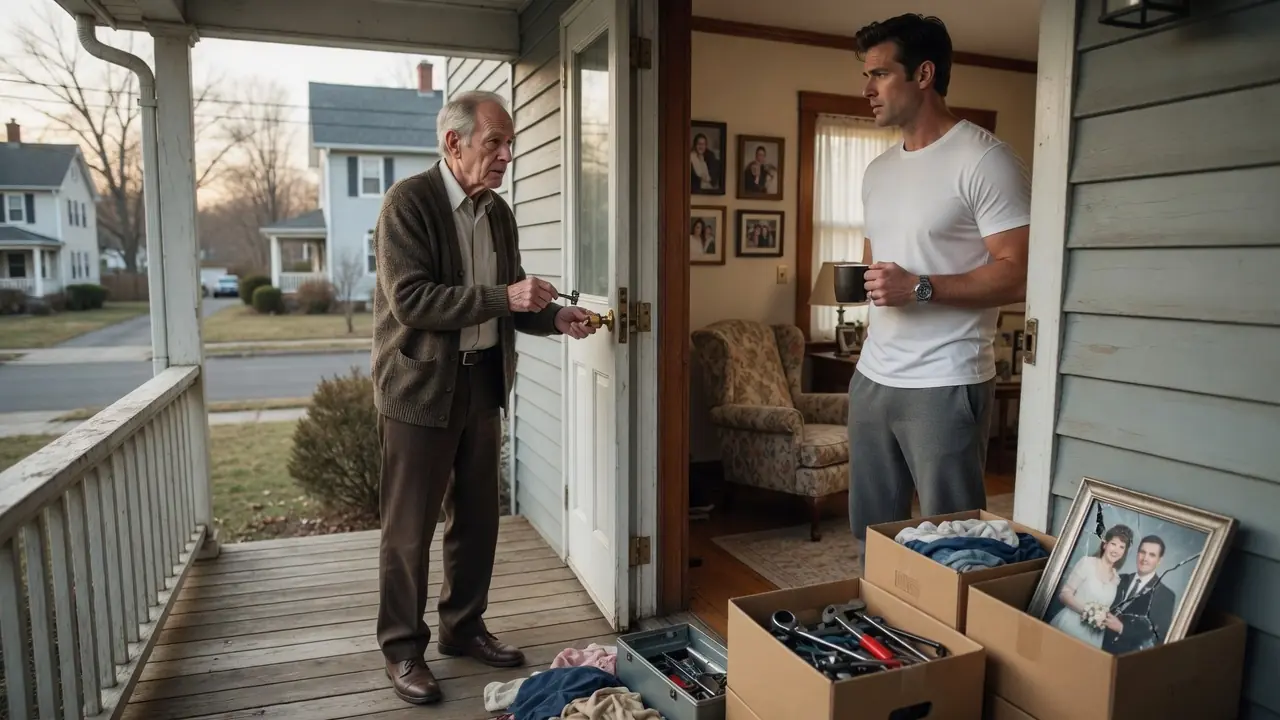
“Not my responsibility anymore,” he said.
At the will reading, he leaned close and mocked me.
“Enjoy being homeless. I made sure you get nothing.”
Then the lawyer calmly said, “There is one final section of the will.”
That was when my son fainted.
The phone rang at 11:47 p.m. while I was on my knees in the hallway, sanding the third step from the bottom, the one that had creaked for six months, the one Virginia kept reminding me to fix.
My hands were covered in sawdust, and I had been working by the light of a single lamp because I did not want to wake her.
She had gone to bed early. She said she was tired.
She was always tired lately.
I almost did not answer.
At that hour, it is never good news. But something, instinct maybe, or 44 years of marriage teaching me to listen when the universe whispers, made me wipe my hands on my jeans and pick up.
“Mr. Morgan?”
A woman’s voice. Professional. Careful.
The kind of careful that means someone has been trained to deliver bad news.
“This is Hartford General Hospital. I’m calling about your wife, Virginia Morgan.”
The sandpaper slipped from my hand.
“Is she…”
I could not finish. I could not make my mouth form the question.
“Mr. Morgan, I’m so sorry. Your wife was brought in by ambulance at 11:15 tonight. She went into cardiac arrest. We did everything we could, but…”
A pause.
The kind that stretches forever.
“She didn’t make it. I’m so sorry.”
Sudden heart failure, they said. Nothing anyone could have done.
The lamp in the hallway flickered. The third step still creaked.
And Virginia, my Virginia, was gone.
I do not remember the drive to Hartford General.
I remember grabbing my keys. I remember the cold steering wheel under my hands, the way my fingers would not stop shaking.
The Parkinson’s makes my hands tremble sometimes, but this was different. This was my whole body trying to reject what I had just heard.
The hospital parking lot was almost empty. I found a spot near the emergency entrance and sat there for a moment, engine still running, staring at the bright lights of the ER.
Inside those doors, Virginia was waiting.
And I was not ready.
Forty-four years, and I still was not ready to say goodbye.
But you never are, are you?
Nurse Angela Turner met me at the front desk. She was young, maybe 30, with kind eyes and a name tag that caught the fluorescent light.
She did not ask me to fill out paperwork.
She just said, “Mr. Morgan, follow me,” and led me down a hallway that smelled like disinfectant and grief.
Room seven.
That was where they had put her.
Room seven, like it was just another appointment, just another checkup.
Angela opened the door.
“Take all the time you need,” she said softly, then stepped back.
I walked in alone.
Virginia looked like she was sleeping.
That is what everyone says, isn’t it? They looked peaceful. They looked like they were sleeping.
But it was true.
Her face was smooth, relaxed in a way I had not seen in months. No pain. No worry. Just stillness.
They had left her wedding ring on.
I noticed that first.
Forty-four years, that ring.
I had bought it at a little jewelry shop in West Hartford in 1979 with two months’ pay from the construction site. It was not fancy, just a simple gold band. But she had never taken it off.
Not once.
I reached for her hand.
Still warm.
Not cold yet.
That surprised me. I do not know why. Maybe because in movies, they are always cold.
But Virginia’s hand was warm, and for a second, just a second, I let myself believe this was all a mistake.
That she would wake up.
That we would go home together.
But she did not wake up.
I held her hand and cried. Not loudly. Not the kind of crying you see in movies. Just quiet tears that fell onto the white hospital sheet and disappeared.
I told her I was sorry.
Sorry I had not fixed that third step sooner.
Sorry I had not noticed she was tired. Really tired, not just end-of-the-day tired.
Sorry I had not said I loved her that morning when she left for her book club.
I told her I did not know how to do this without her.
And she did not answer.
Because she was gone.
I do not know how long I sat there. It could have been ten minutes. It could have been an hour. Time does strange things when your world ends.
The door opened behind me.
I did not turn around.
I knew who it was.
I could hear the expensive shoes on the tile floor, the faint buzz of a phone on vibrate.
“Dad.”
Mike’s voice. Flat. No tears.
I turned.
He was standing in the doorway, still in his work clothes, tailored shirt, no tie, phone in his hand. He had probably been at some dinner. Some client meeting.
His BMW was parked outside next to my old truck, sleek and black and worth more than I had ever spent on a car in my life.
He glanced at Virginia. Just a glance, like he was checking the time.
Then he looked at me.
“We need to talk about arrangements,” he said.
Not, “How are you holding up?”
Not, “I’m sorry, Dad.”
Not, “I can’t believe she’s gone.”
Arrangements.
I stared at him.
My son. My only son.
And I did not recognize him.
“Mike,” I started.
“The funeral home, the service, all of that. We should get it scheduled fast, before Christmas probably.”
He was scrolling through his phone now, not even looking at me.
“I’ll handle it. You don’t need to worry about the details.”
“I’m not worried about the details,” I said quietly. “I’m worried about your mother.”
He looked up then.
Something flashed across his face. Annoyance maybe. Then it was gone.
“She’s gone, Dad. The details are all that’s left.”
He pocketed his phone and turned to leave.
At the door, he paused.
“I’ll call you tomorrow. We’ll figure out next steps.”
He glanced at Virginia one more time, clinical and detached, like she was a problem to be solved, then walked out.
I heard his shoes echoing down the hall. I heard the ding of the elevator. I heard him leave.
And I sat there holding Virginia’s hand, wondering when my son had become a stranger.
As I watched my son walk away from the hospital room, Virginia’s hand still warm in mine, I did not know that this was only the beginning.
I did not know that in four days, I would not even be allowed into my own home.
But I should have.
Because Virginia had known.
She had known for years.
And she had been planning.
Four days later, I stood at the back of St. Paul’s Episcopal Church, watching my wife’s funeral from a distance.
I had arrived early, an hour before anyone else, because I wanted to see Virginia one more time before they closed the casket.
But when I got there, it was already sealed.
White roses were arranged on top. A framed photo from our wedding day was propped on an easel beside it.
Virginia at 22, smiling in a dress she had sewn herself, holding a bouquet of daisies because roses were too expensive.
Forty-four years ago.
A lifetime ago.
I stood there alone in the empty church, my hand on the smooth wood of the casket, and said the things I did not get to say in the hospital.
The things I had thought of at three in the morning when sleep would not come.
The things that mattered.
Then people started arriving, and I moved to the back.
By ten o’clock, the church was full. Virginia had touched a lot of lives: her book club, her garden club, the women from her quilting group, neighbors we had known for decades.
They filed in quietly, found their seats, and whispered condolences that I nodded at but could not really hear.
Mike and Tiffany sat in the front row.
Center seats.
Like they had reserved them.
Mike wore a black suit that probably cost more than my truck. Tiffany wore pearls. They looked like they had stepped out of a magazine, polished and appropriate, the picture of grieving family.
Mike had his arm around Tiffany’s shoulders. Every few minutes, she dabbed at her eyes with a tissue, though I never saw any tears.
Amanda sat three rows back with Joshua. I caught her eye once when she first came in, and she looked away.
Not coldly. Just quickly, like she could not decide where to land.
Joshua squeezed her hand. She stared straight ahead.
Dylan was not there.
When I asked Mike about it on the phone, he said, “He’s too young to handle this, Dad. Better he remembers Grandma the way she was.”
Dylan was 16. Old enough to handle a funeral. Old enough to say goodbye.
But Mike had decided for him.
Pastor Williams kept the service short. He opened with a prayer, read from Psalms, and talked about Virginia’s kindness and her love for her family.
It was nice. Generic, but nice.
The kind of service you give someone when you know them a little, but not enough to capture who they really were.
Then Mike stood to give the eulogy.
He walked to the podium with a folded piece of paper in his hand. Printed, I noticed. Not handwritten.
He smoothed it out, cleared his throat, and looked at the congregation with an expression I had seen him practice in the mirror when he was in high school.
Somber. Composed. In control.
“My mother,” he began, “was a devoted wife and a devoted mother.”
I felt something tighten in my chest.
“She gave everything to her family. She made our house a home. She taught us the value of hard work and the importance of…”
He paused, glanced down at his paper.
“The importance of being practical.”
Practical.
Virginia hated that word.
“Be practical, Virginia,” people used to tell her when she wanted to plant a garden on a construction worker’s salary.
“Be practical,” they said when she insisted on driving 40 miles to visit her mother every Sunday, even though gas was expensive.
She would smile and do it anyway.
Because Virginia was not practical.
She was loving. She was stubborn. She was willing to sacrifice comfort for the people she cared about.
But Mike did not mention any of that.
“Mom would want us to honor her memory,” he continued, “by being realistic about what comes next. By taking care of business. By making smart decisions for the family’s future.”
He looked directly at me for the first time.
I understood what he was really saying.
Sell the house.
Move on.
Do not be sentimental.
The rest of the eulogy blurred. Something about cherishing memories. Something about moving forward.
The words did not matter.
What mattered was the performance.
Mike had rehearsed this. Every pause. Every inflection.
This was not grief.
This was a presentation.
When he finished, people applauded softly. He returned to his seat. Tiffany took his hand.
And I stood in the back, invisible, wondering when my son had learned to lie so well.
The service ended. People filed out to the parking lot, murmuring about the reception at the church hall, about how lovely the flowers were, about how strong Mike was to give such a beautiful eulogy.
I walked slowly, letting the crowd thin.
Leonard Foster fell into step beside me, my old friend from the construction crew. The one who had lent me tools when I could not afford my own. The one who had been at our wedding 44 years ago.
“That was a hell of a speech,” Leonard said quietly.
I did not answer.
“Sounded like he was selling something,” Leonard added.
“He was.”
We reached the parking lot. I was headed toward my truck when I heard footsteps behind me.
“Dad.”
I turned.
Mike was walking toward me, Tiffany a few steps behind, scrolling through her phone.
“We need to talk about the house,” Mike said.
No preamble. No, “How are you holding up?”
Just business.
I looked at him. At my son. At this stranger in an expensive suit.
“What about it?” I said.
“It’s time to sell. You can’t maintain it alone, Dad. The stairs, the yard, the repairs.”
He gestured vaguely, like the house was already falling apart.
“Mom would want you to be practical.”
There was that word again.
“That’s my home,” I said quietly. “Virginia and I bought it in—”
“Virginia’s gone.”
His voice was flat. Not cruel, exactly. Just matter-of-fact.
“Be realistic.”
Something in me cracked. Not broke, not yet, but cracked.
“I am being realistic,” I said. “That house is where we raised you. Where we—”
“Dad.”
Mike’s tone sharpened.
“I’m trying to help you. The house is too big. You’re getting older. You have Parkinson’s. You need to downsize. I can help you find a place.”
“I don’t need your help.”
Mike’s jaw tightened. For a second, I saw something flicker in his eyes. Anger maybe. Frustration.
Then it was gone.
“Fine,” he said. “We’ll talk about this later, when you’re thinking clearly.”
He turned and walked back to his BMW. Tiffany followed without looking up from her phone.
Leonard stepped closer.
“You okay?”
I watched Mike’s car pull out of the parking lot, tires crunching on gravel, and disappear down the street.
“No,” I said. “I’m not.”
Leonard put a hand on my shoulder.
“Come stay with me tonight. You shouldn’t be alone.”
I almost said no. Almost said I would be fine.
But the truth was, I did not want to go back to that empty house.
Not yet.
“Okay,” I said.
We walked to our trucks together, and I tried not to think about Mike’s words.
Tried not to think about the way he had said “be realistic,” like Virginia’s life, our life together, was something that could be reduced to square footage and market value.
But I could not stop thinking about it.
As I watched Mike’s BMW pull out of the church parking lot, I thought that was the worst conversation we would ever have.
I was wrong.
The next morning, I discovered I no longer had a key to my own front door.
The morning after Virginia’s funeral, I woke up at 6:30 a.m. on Leonard’s couch.
The same time I had woken up for 40 years. Body clock refusing to adjust, even when everything else had changed.
Leonard was still asleep. I could hear him snoring softly from his bedroom down the hall.
I made coffee in his kitchen, moving quietly, trying not to wake him.
The house smelled like old wood and Murphy’s Oil Soap, the way Virginia’s house used to smell before she switched to that lavender stuff from the farmers’ market.
I stood at the window with my mug, watching the sun come up over West Hartford, and made a decision.
I needed to go home.
Not to stay. Leonard had offered his spare room, and I would probably take him up on it.
But I needed my things.
Clothes. Tools. The photo albums Virginia kept in the hall closet. My grandfather’s watch.
The things that mattered.
I left a note for Leonard on the counter.
Gone to the house. Back by lunch. E.
Then I got in my truck and drove to 523 Maple Drive.
The neighborhood looked the same.
Mrs. Helen Armstrong was out watering her roses, even though it was December and the roses were dormant. She waved. I waved back.
Two houses down, the Kowalskis’ dog barked from behind their fence, the same as he had done every morning for eight years.
Everything looked normal.
I pulled into the driveway behind Mike’s truck, surprised to see it there this early, but not alarmed.
Maybe he had stayed overnight to start sorting through Virginia’s things. Maybe he wanted to talk. Really talk, without Tiffany scrolling through her phone in the background.
Maybe I was still hoping my son would show up.
I walked up the front steps, the ones I had built in 1987, the ones I had repaired a dozen times since, and pulled out my key.
I slid it into the lock.
It did not turn.
I tried again. Jiggled it. Pulled it out and checked to make sure I had the right key.
I did.
The same key I had used for 38 years, worn smooth on one edge from my pocket.
I tried a third time.
Nothing.
That was when I noticed the deadbolt.
New. Brass. Shinier than the rest of the hardware.
He had changed the locks.
I stood there for a moment, key in hand, staring at that new deadbolt like it was something from another planet.
My brain could not process it.
This was my house. My door. My lock.
Except it was not anymore.
I knocked.
Footsteps inside. Heavy. Slow.
Then the door opened, and Mike stood there in sweatpants and a T-shirt, coffee mug in hand, looking at me like I was a door-to-door salesman.
“What are you doing here?” he said.
I blinked.
“What am I… This is my house, Mike.”
“No,” he said flatly. “It’s not.”
I looked past him into the hallway. I could see the living room beyond him, Virginia’s reading chair by the window, the bookshelf I had built her for Christmas ten years ago, the painting we had bought at a yard sale in 1992 because Virginia said it looked like the house she grew up in.
All of it still there.
All of it mine.
“Mike, what’s going on?” I said.
He took a sip of his coffee. He did not invite me in.
“You don’t live here anymore, Dad. I’m selling the house.”
The words did not make sense. They could not make sense.
“This is my house,” I said again, slower this time, like maybe he had not heard me. “Virginia and I bought it in 1985. We—”
“Check the deed.”
Mike’s voice was calm. Too calm.
“Mom’s name only. She transferred it three years ago.”
I stared at him.
“What?”
“2021. She put the house in her name. Sole ownership.”
He shrugged.
“Which means it’s part of her estate. Which means I inherit it. Which means…”
He gestured vaguely at me.
“You don’t live here anymore.”
My mouth opened, then closed.
No words came out.
Virginia had transferred the deed without telling me.
“That’s not… She wouldn’t…”
“She did.”
Mike reached into his back pocket and pulled out an envelope.
He held it out to me.
“Here. Five hundred bucks. Should cover a motel for a couple weeks while you figure things out.”
I looked at the envelope. At the cash inside. At my son offering me money to leave my own home.
“I’m not taking your money,” I said quietly.
Mike shrugged again.
“Suit yourself.”
He started to close the door.
“Mike, wait.”
“Dad.”
He stopped, door half closed, and looked at me with something close to pity.
“You’re trespassing. Legally, I could call the police. But I’m trying to be nice here. So take the money, get a room, and we’ll figure out next steps later.”
Next steps.
My voice cracked.
“This is my home.”
“Was your home.”
He pushed the door shut.
I heard the deadbolt slide into place.
New. Brass. Locked.
I stood there on my own front porch.
The porch I had rebuilt twice. The porch where Virginia and I used to sit on summer evenings with lemonade and the newspaper.
And I did not know what to do.
Then I saw the boxes.
Three of them.
Cardboard. Taped shut. Sitting at the end of the driveway near the curb like trash waiting for pickup.
I walked over and opened the first one.
My clothes. Jeans, flannel shirts, work boots. Thrown in without folding, like someone had just grabbed armfuls from the closet and dumped them.
Second box.
Tools. My hammer, my level, the electric sander Virginia bought me for my 60th birthday. The box was heavy, carelessly packed. I could hear things shifting inside.
Third box.
Photos. Albums, loose pictures, frames.
And on top, the wedding photo. The one that used to hang in the hallway. Virginia in that dress she had sewn, me in my only suit, both of us grinning like we had won the lottery.
It was in a black trash bag. The frame was cracked. The glass was broken.
He had thrown it away.
I pulled it out carefully and shook off the broken glass.
Virginia’s face smiled up at me, young and hopeful and so happy.
“Mr. Morgan?”
I turned.
Mrs. Helen Armstrong was standing at the edge of her yard, garden hose still in hand, staring at me and the boxes.
“What’s going on?” she said.
I did not know how to answer. I did not know how to explain that my son had just locked me out of my own house the morning after I buried my wife.
“I’m just getting some things,” I said.
Mrs. Helen’s eyes moved from me to the boxes to Mike’s truck in the driveway. Her mouth tightened into a thin line.
“This isn’t right,” she said.
“No,” I agreed. “It’s not.”
She pulled out her phone.
“I’m taking a picture. For the record.”
I did not stop her.
I loaded the three boxes into the bed of my truck. I did not look at the house. I did not look at the windows to see if Mike was watching.
I just loaded the boxes, climbed into the cab, and started the engine.
As I drove away from 523 Maple Drive for what I thought might be the last time, I did not look in the rearview mirror.
I could not.
But I kept that wedding photo on the passenger seat. The one Mike had thrown away like garbage.
And I made a promise to Virginia.
I would not let him win.
I had been sleeping on Leonard Foster’s couch for three nights now.
Three nights of staring at his ceiling, listening to the clock on the mantel tick, wondering how I had gotten here.
Every morning, I woke up and forgot where I was. Forgot Virginia was gone. Forgot Mike had locked me out.
For about five seconds, everything was normal.
Then reality came back heavy as concrete.
Leonard never asked how long I would stay. He just made coffee in the mornings, extra strong the way I liked it, and left the newspaper folded on the table.
“You’re staying as long as you need to,” he had said that first night when I showed up with three cardboard boxes. “I’ve got a spare room upstairs.”
But I could not take his spare room.
The couch was temporary.
The couch meant I was still figuring things out.
Leonard and I went back 40 years. We had met in 1984 on a construction site in downtown Hartford. Both of us young. Both of us trying to make something of ourselves.
He had worked nights as a firefighter and days doing carpentry. I had lent him my truck when his broke down. He had lent me tools I could not afford.
His wife Ellen died five years ago. Cancer. I had driven him to the hospital every day for two months during her treatment.
You do not forget friendships like that.
So when I showed up at his door with everything I owned in three boxes, Leonard did not ask questions.
He just opened the door wider and said, “Come on in.”
That Saturday morning, I finally opened the boxes.
I had been avoiding them. I did not want to see my life reduced to cardboard.
But Leonard had gone to the hardware store. The house was too quiet. And I needed something to do with my hands.
First box, tools.
My hammer, 40 years old, handle worn smooth. My tape measure, my level, the electric sander Virginia had given me for my 60th birthday.
I set it aside, throat tight.
Second box, clothes.
Jeans, flannel shirts, work boots. Everything smelled like cedar. Like our bedroom. Like home.
Third box, photos.
I pulled out the wedding album. Virginia in that dress she had sewn herself because a real wedding dress cost too much. Me in my cousin’s borrowed suit, two sizes too big.
Both of us grinning like we had won the lottery.
We had gotten married at City Hall on a Tuesday. Just us, two witnesses, and a judge who had said, “You kids look happy.”
We were.
I turned the page.
Our first apartment. Virginia pregnant with Mike. Pictures I had not looked at in years.
I closed the album.
I could not look anymore.
At the bottom of the box, I found Virginia’s gardening journal.
Notes about planting schedules, watering times, where the sun hit best.
The last entry was from October.
Lavender doing well this year. Edward says the smell reminds him of his grandmother.
I sat on Leonard’s floor holding that journal, and something in me cracked.
Leonard came home around noon. He took one look at me surrounded by boxes and albums and did not say anything.
He just sat down on the floor next to me.
“You need a lawyer,” he finally said.
I shook my head.
“I don’t even know where to start.”
“Did Virginia have a lawyer?”
I thought about it.
Maybe she handled all the paperwork.
Leonard nodded toward my wallet on the coffee table.
“Check.”
I did not know what I was looking for, but I opened it anyway.
Driver’s license. Credit card. Twenty-three dollars. Insurance card.
And a business card.
Small. White. Bent from being in my wallet for who knew how long.
Christine Lawson. Estate Attorney. Harrison and Cole Law Offices.
I turned it over.
On the back, in Virginia’s handwriting, the looped L’s I would know anywhere, was a note.
If something happens, CL.
I stared at it. Read it again. Turned it back over.
“What’s that?” Leonard asked.
“A business card,” I said slowly. “For a lawyer.”
“Virginia must have put it in my wallet.”
Leonard leaned over and looked at the note.
“If something happens.”
“Something happens to what?”
“I don’t know.”
But even as I said it, something shifted in my chest.
Virginia had put this card in my wallet. She had written that note. She had wanted me to find it.
If something happens.
Something had happened.
“Call her,” Leonard said. “Monday morning.”
I looked at the card again. At Virginia’s handwriting. At the phone number I had never noticed before.
“Okay,” I said. “Monday.”
That Sunday night, I sat at Leonard’s kitchen table long after he had gone to bed, turning Christine Lawson’s business card over and over in my hands.
Virginia’s handwriting on the back.
If something happens, CL.
What had she been trying to tell me?
The clock on the wall ticked past midnight. The house was silent except for Leonard’s soft snoring from upstairs.
I set the card down. Picked it up again. Traced Virginia’s handwriting with my thumb.
She had planned something.
I did not know what.
I did not know why she had not told me.
But on Monday morning, I would find out.
I owed her that much.
On January 15th, 2024, five weeks after Virginia’s death, I walked into Christine Lawson’s office on the 12th floor of a glass building downtown, carrying nothing but that business card and a faint hope that someone could help me.
The office was clean and modern, with floor-to-ceiling windows overlooking Hartford, a mahogany desk with neat stacks of files, and diplomas on the wall.
Yale Law. Connecticut Bar Association.
Everything about it said expensive, and I almost turned around.
I could not afford expensive.
But the receptionist had already seen me.
“Mr. Morgan?”
I nodded.
“Ms. Lawson is expecting you. Go right in.”
Expecting me?
I had not called ahead. I had not made an appointment. I had just shown up at nine in the morning because Leonard had pushed me out the door with coffee and a pep talk.
The door to the inner office opened, and a woman in her mid-fifties stepped out.
Sharp gray suit. Reading glasses on a chain. The kind of calm authority that comes from 30 years of practice.
“Mr. Morgan,” she said, extending her hand. “I’m Christine Lawson. I’ve been expecting you.”
I shook her hand, confused.
“You have?”
“Please sit.”
She gestured to the chairs across from her desk.
“Virginia and I have been working together for ten years.”
The words did not register at first.
Could not register.
“Ten years,” I said slowly.
Christine sat down, folded her hands on the desk, and looked at me with something close to sympathy.
“Yes. Since 2014. Your wife came to me after a cancer scare. It was benign, but it changed her perspective. She wanted to make sure you were protected.”
I stared at her.
“Protected from what?”
“From Mike.”
Christine opened a file on her desk. Thick. Organized. Tab dividers with dates going back a decade.
“Your wife knew Mike had problems,” she said carefully. “Financial problems. Gambling problems. She discovered them in 2015 and started documenting everything.”
She slid a stack of papers across the desk.
Receipts. Bank statements. Handwritten notes in Virginia’s looping script.
-
Thirty thousand dollars. Investment opportunity.
-
Five thousand dollars. Emergency car repair.
-
Twelve thousand dollars. Business licenses.
-
Eight thousand dollars. Medical bills.
I read through them twice.
Loans Virginia had given Mike over 12 years.
Loans he had never paid back.
“That’s over $55,000,” Christine said quietly. “None of it repaid. None of it even acknowledged.”
My throat was dry.
“I didn’t know.”
“She didn’t tell you. She said if you knew, you would try to help him, and she couldn’t let that happen.”
I looked up from the papers.
“Why not?”
“Because helping Mike meant enabling Mike. Virginia knew that if she didn’t protect the estate, Mike would take everything, which is exactly what he tried to do.”
Christine pulled out another document. Crisp, legal, stamped.
“Power of attorney,” she said. “Filed December 2023. Mike claimed you were incompetent due to Parkinson’s disease and grief. He forged your signature.”
I felt like I had been punched.
“He forged it?”
“We have proof. The signature analysis came back last week. It’s not yours, which means Mike committed fraud.”
Christine leaned forward.
“Your wife was playing chess while he was playing checkers. Let me show you what Virginia built.”
She pulled up a spreadsheet on her computer and turned the screen toward me.
Virginia Eleanor Morgan, estate summary.
Real property: 523 Maple Drive, Hartford, Connecticut. Five hundred twenty thousand dollars. Deed transferred to Virginia E. Morgan, sole ownership, March 2021.
Life insurance: Northwestern Mutual policy, four hundred thousand dollars. Beneficiary: Edward Morgan.
Financial accounts: Hartford Federal Credit Union, one hundred seventy-eight thousand dollars.
Stocks and bonds: Fidelity, seventy-eight thousand dollars.
401k retirement account: ninety-five thousand dollars.
Total estate value: one million, two hundred seventy-one thousand dollars.
I could not speak.
I could not process the numbers.
A million dollars.
Virginia had saved a million dollars.
“She worked part-time as a bookkeeper for ten years,” Christine said. “Quiet work, careful work. Every paycheck went into accounts in her name only. She never told Mike. She never told you, because she knew Mike would find a way to take it.”
I thought about Virginia coming home from work tired. Always tired lately.
I thought she was just getting older. I thought the bookkeeping job was just something to keep her busy.
She had been building a fortress.
“The house deed,” Christine continued, “was transferred in 2021. You signed the papers, but I doubt you noticed. Virginia told you it was for tax purposes.”
I remembered vaguely.
Sitting at the kitchen table. Virginia sliding papers in front of me.
“Just a formality, honey. Saves us on property taxes.”
I had signed without reading.
“It saved more than taxes,” Christine said. “It saved your home. Mike can’t touch it. It’s not his. It’s yours.”
“What do I do now?” I asked.
Christine closed the file.
“We wait.”
“Wait?”
“For the will reading. June 20th. Virginia’s will is ironclad. Witnessed, notarized, and video recorded with a forensic psychiatrist confirming her mental competency. Mike can contest it, but he’ll lose.”
She paused.
“He’ll try anyway.”
“Of course he will.”
Christine smiled grimly.
“That’s why Virginia set aside a $50,000 defense fund for legal fees. For your protection.”
She had thought of everything.
I sat back in the chair, overwhelmed.
Virginia had known.
For ten years, she had known Mike would do this.
And she had spent a decade quietly, carefully, methodically building a wall between him and me.
“Why didn’t she tell me?” I said.
Christine’s expression softened.
“Because you would have tried to fix it. You would have tried to save Mike. And Virginia knew some people can’t be saved. They can only be contained.”
I left Christine’s office at noon, walking out into the January cold with a folder full of documents I did not fully understand and a head spinning with numbers and plans and revelations.
Virginia had saved over a million dollars.
She had transferred the house deed.
She had documented Mike’s loans.
She had hired a lawyer.
She had recorded a video.
She had set aside money for my defense.
For ten years, she had been three steps ahead, and I had no idea.
As I walked to my truck, my hands were shaking.
Not from Parkinson’s.
Not this time.
From something else.
Gratitude. Grief. Awe.
Virginia had known.
She had always known.
And she had protected me.
But as I sat in the truck, key in the ignition, staring at the folder on the passenger seat, one question burned in my mind.
What else had she planned that I did not know about?
Three days after meeting Christine, I could not sleep.
It was two in the morning, and I kept thinking that if Virginia had planned this for ten years, there had to be more. There had to be something she left for me.
Leonard found me in the kitchen, staring out the window.
“You’re not sleeping,” he said.
“Can’t. I keep thinking there has to be more. Something Virginia left.”
Leonard was quiet for a moment.
“Then there’s a box in my attic. Virginia dropped it off two years ago. Said to give it to you when the time comes.”
I looked up.
“Show me.”
The attic stairs creaked. Leonard pulled the cord for the overhead bulb.
In the corner, on top of old boxes, sat a brown cardboard box taped shut.
On the side, in Virginia’s handwriting, were the words:
For Edward. When the time comes.
My hands shook as I carried it downstairs. We set it on the kitchen table. I cut the tape with my pocketknife.
Inside, everything was organized.
That was Virginia. Meticulous. Nothing left to chance.
Bank statements from Hartford Federal Credit Union. An account in Virginia’s name only. Opened March 2014. Ten years of deposits. Final balance: $178,412.
House deed. Transfer documents from March 2021. From Edward and Virginia Morgan to Virginia E. Morgan, sole ownership. My signature at the bottom. I had signed it thinking it was for taxes.
Insurance policies. Northwestern Mutual life insurance. Four hundred thousand dollars. Beneficiary: Edward Morgan.
And then a thick envelope, rubber banded and bulging.
I opened it.
Sixty-seven receipts.
Each one paper clipped with a handwritten note.
October 2009. Check 1847. Thirty thousand dollars. Investment opportunity. Mike. Never repaid.
June 2015. Cash. Five thousand dollars. Emergency car repair. Mike. Car repossessed three months later.
November 2018. Check 3392. Twelve thousand dollars. Business licenses. Mike. Business never opened.
March 2021. Bank transfer. Eight thousand dollars. Medical bills. Mike. Gambling debts.
Twelve years of loans.
Every one documented.
Every one with Virginia’s notes.
At the bottom was a piece of notebook paper.
He never paid back a cent.
There was one more thing.
A sealed envelope. White. My name on the front.
Underneath, in Virginia’s handwriting, it said:
Read this alone.
Leonard quietly left the room.
I opened it.
My dearest Edward,
If you’re reading this, I’m gone. And I’m so sorry I’m not there with you.
But I want you to know I’ve been preparing for this day for a very long time.
I’ve known about Mike’s problems since 2009. The gambling, the debts, the lies. At first, I thought I could help him. I gave him money. I believed his stories.
But the money disappeared, and the stories kept changing, and I realized he wasn’t going to stop.
I couldn’t tell you. I know how that sounds. I know you’re probably angry with me right now.
But Edward, if I had told you, you would have tried to fix it. You would have given him more money. More chances. You would have believed him, because that’s who you are. You see the best in people even when they don’t deserve it.
I couldn’t let that happen. I couldn’t let him destroy you the way he was destroying himself.
So I kept secrets. I opened accounts you didn’t know about. I transferred the house deed. I documented everything.
And I hated it.
I hated lying to you. I hated carrying this alone. But I had to protect you, even if it meant you would be angry with me later. Even if it meant you would never understand why.
I hope you can forgive me.
Please trust Christine. I’ve been working with her for ten years. She knows the plan. She will guide you through it.
And Edward, I know this is hard. I know you’re hurting. But you’re stronger than you think. You always have been.
I love you. I’ve always loved you.
From the day we got married in that courthouse with your cousin’s borrowed suit, to the day I wrote this letter knowing I might not see you again, you were my home.
You still are.
Forever yours,
Virginia.
I sat at Leonard’s kitchen table as dawn broke, Virginia’s letter in my hands, surrounded by a decade of evidence she had quietly collected.
She had known.
She had always known.
And she had protected me, even when it meant carrying the weight alone.
I cried then.
Not the quiet tears from the hospital.
This time, I sobbed for Virginia, for the secrets she had kept, for the burden she had carried, for the love that drove every decision.
When I finally stopped, I folded Virginia’s letter carefully, put it back in the envelope, and set it on top of the box with the receipts, bank statements, and proof of everything she had done.
She had documented everything.
She had built a fortress.
But one question remained.
What else had she set in motion?
The answer came the next morning.
My phone lit up with a Facebook message from someone I never expected.
Dylan Morgan.
At 7:34 p.m. on January 18th, my phone buzzed with a Facebook message.
I almost did not check it. I barely used Facebook, only kept the account because Virginia used to tag me in photos.
But something made me look.
The name at the top was Dylan Morgan.
I stared at it. Read it again.
Dylan.
My grandson.
The kid I had not seen in five years.
For a second, I thought it was spam. Some scam using his name.
But then I opened it.
Grandpa, I need to talk to you. I have something you need to hear. Please don’t tell Dad.
My heart stopped.
I had not seen Dylan since 2019. He had been eleven then. Still a kid. Still excited about comic books and building things with his hands.
We had spent every Sunday together for nine years. I taught him basic carpentry, how to use a level, how to measure twice and cut once.
He loved it.
Then one day in March 2019, Mike stopped bringing him.
“He’s busy with school,” Mike had said when I asked. “Got a lot of homework. You know how it is.”
I nodded and believed him.
Kids get busy.
But weeks turned into months. I would call Mike’s house and ask to talk to Dylan.
Mike always had an excuse.
He was at a friend’s house. He was studying. He was asleep.
Virginia tried too. She called Mike’s cell. Mike blocked her number.
By 2020, I had stopped trying.
I figured Dylan had outgrown me. Teenagers do that, right? They grow up, get embarrassed by their grandparents, and move on.
But this message said something else.
Please don’t tell Dad.
I showed Leonard the phone.
“What do you think?” I said. “Is it real, or is Mike messing with me?”
Leonard read the message twice.
“Could be a trap.”
“That’s what I’m thinking. But what if it’s not?”
Leonard looked at me.
“What if the kid actually needs you?”
I stared at the screen. At Dylan’s name. At the words I need to talk to you.
“Only one way to find out,” Leonard said.
I typed slowly, my thumb shaking.
Dylan, is this really you?
The reply came immediately.
Yes, Grandpa. It’s me. I’m 16 now. I remember you used to teach me carpentry on Sundays. You made me that wooden box for my Legos. The one with the sliding lid.
I sat down hard.
The Lego box.
I had made it in 2018 for Dylan’s eleventh birthday. He had been obsessed with Legos, had them scattered all over Mike’s living room. Virginia joked that someone was going to step on one and hurt their foot.
So I built him a box.
Pine wood, sanded smooth, with a sliding lid that locked with a small wooden peg. Dylan’s name burned into the top with Virginia’s wood-burning kit.
He loved it. Carried it everywhere for months.
Mike could not have known about that box. He had never paid attention to the things Dylan and I made together.
This was real.
Why now? I typed. Why after five years?
The three dots appeared. Disappeared. Appeared again.
Because Grandma Virginia told me to. She gave me this phone two years ago. She said when the time came, I’d know what to do.
I read it three times.
Virginia had given Dylan a phone two years ago.
She gave you a phone?
Yes. In 2022. Right after Dad said I couldn’t visit you anymore. She met me at school one day and handed me this old smartphone. Said to keep it hidden. Said someday I’d need it to reach you.
I looked at Leonard. He had been reading over my shoulder.
“She knew,” Leonard said quietly. “Two years before she died, she knew Mike would cut you off. And she made sure Dylan had a way to reach you.”
My hands were shaking again.
Not from Parkinson’s.
From the realization that Virginia’s plan went deeper than bank accounts and receipts and legal documents.
She had protected my connection to Dylan.
Can we meet? Dylan’s next message read. Day after tomorrow. There’s something you need to hear. Something I recorded.
Recorded?
I can’t explain over text, but it’s important. Please, Grandpa. I need your help.
I hesitated and looked at Leonard.
“Public place,” Leonard said. “Somewhere safe, just in case.”
I nodded.
Where? I typed.
Anywhere you want. I can get there.
I thought for a moment.
Pete’s Diner. Main Street, downtown Hartford. Day after tomorrow, 2:00 p.m. Do you know it?
I’ll find it.
Come alone, I typed. And Dylan, I know. Don’t tell Dad.
I won’t. He can’t know about this.
The way he said it, he can’t know, made my chest tighten.
Dylan was not just keeping a secret.
He was scared.
After Dylan stopped replying, I sat at Leonard’s kitchen table with my phone in my hands, staring at the conversation.
Dylan had been eleven when I last saw him.
Now he was sixteen.
Five years I had missed.
Five years Mike had stolen.
And Virginia had known. She had known Mike would cut Dylan off, so she had given my grandson a secret phone and told him to wait.
When the time comes, you’ll know what to do.
“What do you think he recorded?” Leonard asked.
“I don’t know.”
But even as I said it, I had a feeling. A suspicion that made my stomach turn.
If Virginia had given Dylan a phone to keep hidden from Mike, and if Dylan had something recorded that he could not explain over text, it had to be Mike.
That night, I barely slept.
I lay on Leonard’s couch, staring at the ceiling, thinking about Dylan.
About the Lego box I had made him years ago. About the kid who used to spend every Sunday with me learning to measure and sand and build.
About the phone Virginia had given him in secret.
About whatever he had recorded that he needed me to hear.
On January 20th at 2:00 p.m., I would meet my grandson for the first time in five years.
And something told me that whatever Dylan had to show me would change everything.
At 1:55 p.m. on January 20th, I sat in a booth at Pete’s Diner, hands wrapped around a cup of coffee I could not drink, watching the door.
The diner smelled like grease and bacon the way it had for 40 years. The old red vinyl booths were still there. The jukebox still played oldies.
Virginia and I had eaten breakfast there the morning after our wedding in 1979.
Forty-five years later, I was still sitting there, waiting for something that would change my life.
At exactly 2:00 p.m., a teenage boy walked in.
Tall, skinny in that awkward way 16-year-olds are. Dark hair. Mike’s jawline. But something softer in his eyes.
For a moment, I saw Mike at 17, before the gambling, before the lies, when he still looked at me like I was someone worth knowing.
Then Dylan saw me and waved nervously, and the moment broke.
“Hi, Grandpa,” Dylan said, sliding into the booth across from me.
“Hi, Dylan.”
Silence.
We stared at each other like strangers, because that was what we were now.
Five years changes a kid.
Eleven to sixteen. Middle school to high school. Boy to young man.
“I wasn’t sure you’d come,” Dylan said finally.
“I wasn’t sure this was real.”
Dylan’s mouth twitched, almost a smile.
“Yeah. I get that.”
A waitress came by. Dylan ordered water. I ordered more coffee I would not drink.
She left.
Dylan reached into his jacket and pulled out a phone.
Old Android. Cracked screen.
Not the kind of phone teenagers carried lately.
“Grandma gave me this in 2019,” Dylan said. “Right after Dad stopped letting me visit you. She met me outside school one day and handed it to me. Told me to hide it. Said someday I’d need it.”
I looked at the phone. At Virginia’s foresight reaching back five years.
“Why?”
Dylan’s eyes met mine.
“She said when the time came, I’d know what to do.”
He paused.
“She was right.”
Dylan tapped the phone screen, opened a folder, and selected a file.
“Thanksgiving 2022,” he said. “Fourteen months ago. I was in my room. They were in the kitchen. They thought I couldn’t hear them.”
He pressed play.
The audio was muffled at first. Background noise. Dishes clinking.
Then voices.
Clear. Unmistakable.
Mike’s voice.
“Once the old man is gone, we’ll have everything. The house, the insurance, everything.”
Tiffany’s voice.
“What if he doesn’t cooperate?”
Mike.
“We’ll have him declared incompetent if we have to. He’s already showing signs with that Parkinson’s thing.”
Tiffany.
“What about your mom?”
Mike.
“She won’t be around forever. And when she goes, I’ll make sure everything’s in my name. Dad won’t even know what hit him.”
Laughter.
Then the recording ended.
I could not speak.
Could not move.
The words echoed in my head.
Once the old man is gone.
Declared incompetent.
Won’t even know what hit him.
My son.
My son had said those things. Had laughed about them.
“Grandpa,” Dylan said, his voice small and scared.
I looked up.
Dylan was watching me, waiting.
“She knew,” Dylan said quietly. “Grandma knew. She recorded their conversations for two years. Different holidays, different nights. She gave me this phone so I’d have proof.”
“Why didn’t she tell me?” My voice cracked.
“She said you’d try to fix it. Try to save Dad. She said Dad would hurt you if you got in his way.”
Dylan’s hands were shaking.
“She was protecting you.”
I closed my eyes.
Virginia.
Always protecting me.
Even when it meant lying. Even when it meant carrying the weight alone.
“Why are you telling me now?” I asked.
“Because she’s gone,” Dylan said, his voice breaking. “And you need this. For the will reading. To prove what Dad’s really like.”
I opened my eyes and looked at my grandson, this brave, scared 16-year-old kid who had kept Virginia’s secret for five years.
“Would you testify?” I asked. “In court, against your father?”
“Yes.”
No hesitation.
“I’m done lying for him.”
“Dylan…”
“He’s not a father, Grandpa,” Dylan said, his eyes wet now. “Fathers don’t plot against their parents. Fathers don’t cut their kids off from people who love them. He’s a bully. And I’m done.”
I reached across the table and took Dylan’s hand.
His fingers were cold.
“You’re the only grandfather I have left,” Dylan whispered.
“And you’re the bravest person I know,” I said.
Dylan started to cry then. Quiet tears, the kind you try to hide.
I squeezed his hand tighter.
“I miss her so much,” he said.
“Me too, son,” I said. “Me too.”
We sat there for a while.
Two people who had lost Virginia. Two people who had been manipulated, lied to, and kept apart, finally finding each other again.
Eventually, Dylan wiped his eyes, drank his water, and looked at me.
“What happens now?” he asked.
“Now,” I said, “we make sure Virginia’s plan works.”
Dylan nodded.
“The will reading. June 20th. Five months from now. Can you keep this secret until then?”
“I’ve kept it for five years,” Dylan said. “I can keep it five more months.”
“If your father finds out—”
“He won’t. I’ll be careful.”
I looked at this young man who had just given me the ammunition to expose his own father.
And I felt something I had not felt in weeks.
Hope.
Not just for justice.
For family.
As Dylan and I left Pete’s Diner that afternoon, the recording safely in my pocket, I felt lighter than I had in months.
Dylan was brave. Braver than I had ever been.
Together, we were going to make sure Virginia’s plan succeeded.
But first, we had to survive what came next.
On February 10th, three weeks after meeting Dylan, I received a phone call that proved Mike was not done.
Not even close.
I was at Leonard’s kitchen table sorting through paperwork Christine had sent, estate documents, court filings, things I barely understood, when my phone rang.
Unknown number. Hartford area code.
I almost did not answer, but Leonard looked up from his newspaper and said, “Might be important.”
I picked up.
“Hello?”
“Mr. Morgan? This is Russell Adams, administrator at Hartford General Hospital. Do you have a moment?”
My stomach dropped.
Hospital calls were never good news.
“Yes,” I said. “What’s wrong?”
“We have an issue with your account, sir. Your hip surgery bill, $45,000, hasn’t been paid. According to our records, your son, Michael Morgan, signed as guarantor, but he’s refused payment.”
The words did not register at first.
“He what?”
Russell’s voice was careful and professional.
“He called yesterday afternoon and said, and I’m quoting here, ‘He’s not my responsibility anymore.’ Then he hung up.”
Not my responsibility.
I set the phone down on speaker. Leonard was already standing, moving closer.
“Mr. Adams,” I said slowly, “my wife passed away two months ago. My son locked me out of my house the day after her funeral. I haven’t spoken to him since.”
Silence on the other end.
Then Russell said, “I’m very sorry for your loss, Mr. Morgan, and for this situation. But the hospital still needs payment. If we don’t receive it within 30 days, we’ll have to turn the account over to collections.”
Collections.
My credit ruined. Bills I could not pay.
All because Mike had signed a piece of paper and then walked away.
“I don’t have $45,000,” I said quietly.
“I understand. We can set up a payment plan.”
“Give me 24 hours,” I said. “Let me call my attorney.”
Russell agreed. We hung up.
I stared at the phone.
Leonard sat down across from me.
“What do you need?”
“Christine,” I said. “I need Christine.”
Christine Lawson answered on the second ring.
“Edward? Everything okay?”
“No.”
I explained the hospital call, Mike’s refusal, the $45,000 bill, Russell Adams’s deadline.
When I finished, Christine was quiet for a moment.
Then she said, “Use the defense fund.”
“The what?”
“The $50,000 defense fund Virginia set aside. That’s exactly what it’s for.”
“But that’s for legal fees. Court costs.”
“It’s for protecting you,” Christine said firmly. “From Mike. From situations exactly like this. Virginia knew he’d try something. This is something.”
“But—”
“Edward, stop. Virginia planned for this. Let her protect you.”
I closed my eyes.
Virginia.
Always three steps ahead.
Even from the grave.
“Okay,” I said.
“I’ll wire the money to Hartford General today. Give me Russell Adams’s direct line.”
I gave her the number.
“What about Mike?” I asked. “He signed as guarantor. Doesn’t that mean—”
“It means he committed fraud,” Christine said. “He agreed to pay, then refused. We’ll add it to the complaint.”
Complaint.
Elder financial abuse. Abandonment of medical responsibility. Fraud.
“This isn’t just civil court anymore, Edward. Mike has committed real crimes. When we go to the will reading on June 20th, we’re bringing all of this with us.”
June 20th.
Four months away.
It felt like forever.
“He thinks he’s won,” I said.
Christine’s voice went cold.
“Good. Let him think that. The longer he believes it, the harder he’ll fall.”
I thought about Mike in that hospital room the night Virginia died, scrolling through his phone while her body was still warm.
I thought about him changing the locks, throwing my wedding photo in the trash, and refusing to pay my medical bills.
“Is it wrong,” I said slowly, “that I want to see that? That I want to watch him fall?”
Christine was quiet for a second.
Then she said, “No, Edward. It’s human.”
After I hung up, I sat at Leonard’s table for a long time, staring at nothing.
Leonard poured me fresh coffee, sat down, and did not say anything.
Finally, I looked up.
“Four months.”
“Four months,” Leonard agreed.
“Four months until Mike finds out.”
Leonard’s mouth twitched into something that was not quite a smile.
“Four months until justice.”
I picked up my coffee. It was still hot. Leonard had remembered I liked it black, no sugar, the way I had been drinking it for 50 years.
“And Virginia set aside $50,000,” I said. “Just in case Mike did this.”
“She knew,” Leonard said simply. “She always knew.”
We sat there in the quiet kitchen, winter sun coming through the window, and for the first time in weeks, I felt something close to peace.
Mike had tried to destroy me. Tried to take my home, my money, my dignity.
But Virginia had built a fortress.
And brick by brick, that fortress was holding.
Four months until June 20th.
Four months until the will reading.
Four months until Mike’s world collapsed.
But neither Leonard nor I knew how much worse things would get before then.
Because the next week, Mike stopped playing private games.
He went public.
I should have known something was wrong when Mike called Monday morning and invited me to church.
My son had not invited me anywhere in five years, but his voice was different.
Soft. Pleading.
“Dad, maybe we should talk. With professional help. Pastor Richards offered to mediate.”
Leonard watched me hang up.
“You’re not going.”
“It’s a church. What’s he going to do?”
Leonard’s expression told me exactly what Mike was going to do.
St. Andrew’s Church sat on Farmington Avenue, a brick building with a white steeple.
I arrived at two.
The parking lot was half full.
Inside, the fellowship hall was arranged like an intervention.
Chairs in a circle. Tissues on the table. A woman in a navy suit with a clipboard.
Mike and Tiffany sat on one side. Pastor Richards sat next to them, looking uncomfortable.
Three church members I vaguely recognized occupied other chairs, and in the center was the woman with the clipboard.
“Dad.”
Mike stood and smiled.
“Thank you for coming. This is Dr. Nancy Hoffman. She’s a specialist in addiction and cognitive impairment.”
The room tilted.
Dr. Hoffman extended her hand.
“Mr. Morgan? Your son has expressed concerns about your ability to manage your affairs.”
I did not shake her hand.
“What is this?”
“An intervention,” Mike said.
He pulled papers from a folder.
“I’ve prepared guardianship documents. Dr. Hoffman will conduct a preliminary assessment. If she determines you’re unable to make sound decisions—”
“I’m not incompetent.”
“Dad.”
Mike’s voice was patient.
“You’re living on a friend’s couch. You can’t pay your hospital bills. You’ve made irrational accusations.”
“Because you stole from me.”
Tiffany spoke.
“Edward, we’re worried. The Parkinson’s. The pain medications.”
“I don’t take pain medications.”
“But the pharmacy records suggest otherwise,” Dr. Hoffman said.
She opened her clipboard.
“Mr. Morgan, could you tell me what day it is?”
“No. I’m not answering your questions.”
Mike’s smile never wavered.
“See? Defensive. Paranoid. Classic cognitive decline.”
The door opened behind me.
Christine Lawson walked into the fellowship hall carrying a briefcase and an expression that could freeze lava.
She wore a charcoal suit. Her heels clicked like a countdown.
“I’m Christine Lawson, Mr. Morgan’s attorney. This meeting is over.”
Mike stood.
“This is a private family matter.”
“This is elder abuse,” Christine said.
She set her briefcase on the table, opened it, and pulled out three folders.
“And I have documentation.”
Dr. Hoffman looked uncertain.
“I’m just here to conduct an assessment.”
“On a man you’ve never met, based on information from his estranged son, who stands to benefit if guardianship is granted?”
Christine’s voice was ice.
“Have you reviewed Mr. Morgan’s medical records?”
“Well, no.”
“Then let me help.”
Christine opened the first folder.
“Medical records from Dr. Lisa Crawford, Mr. Morgan’s primary physician of 15 years. Last exam, February 28th, 2024. Diagnosis: early-stage Parkinson’s, well managed. Cognitive function normal. Dr. Crawford’s notes state, ‘Patient demonstrates clear decision-making capacity.’”
She opened the second folder.
“Cognitive evaluation by Dr. Patricia Chen, neuropsychologist, last month. Mr. Morgan scored normal for his age. No dementia or impaired judgment.”
Mike’s face was red.
“Those are undocumented medical facts.”
Christine opened the third folder.
“Bank statements for six months. He has managed finances independently, paid bills on time, and made no erratic decisions. The only financial abuse here is the hospital bill your son refused to pay after signing as guarantor, leaving his father to cover $45,000 out of pocket.”
The room went silent.
Christine turned to Dr. Hoffman.
“Did Michael Morgan disclose that he forged a power of attorney three months ago? That he changed his father’s locks the day after his mother’s funeral? That his mother specifically excluded him from inheriting because she knew he would do this?”
Dr. Hoffman closed her clipboard.
“I think there’s been a misunderstanding.”
“I think you’ve been used in an estate dispute,” Christine said. “If you proceed, I’ll file a complaint with the Connecticut Medical Board for conducting an evaluation under false pretenses.”
Dr. Hoffman stood.
“I’m not comfortable continuing.”
She looked at Mike.
“This isn’t what you described.”
She walked out.
Mrs. Helen Armstrong spoke from the back row. I had not noticed her.
My neighbor, who had witnessed Mike throwing my belongings into boxes, who had photographed my wedding portrait in the trash, stood and walked to the center.
“I’ve known the Morgans 32 years,” she said. Her voice shook, but it carried. “I watched Edward raise his children. I watched Virginia battle fear and grief with dignity. And I’m telling you, Mike Morgan is lying.”
She showed her phone to Pastor Richards.
“This photo is from December 13th. Edward’s belongings on the lawn. His son changing the locks. This is not dementia. This is robbery.”
Three other church members stood. Mr. and Mrs. Patterson from Maple Drive. Sarah Chen, whose father Virginia had helped.
“We’ve seen this,” Mr. Patterson said.
Pastor Richards closed his eyes.
When he opened them, he looked at Mike.
“I agreed to mediate a family conversation, not participate in elder abuse. This meeting is over.”
Mike’s chair scraped back.
“You’ll regret this.”
Christine smiled.
“I already do. But not for the reasons you think.”
Mike grabbed Tiffany’s arm, and they left.
Mrs. Armstrong hugged me after they were gone. The Pattersons shook my hand. Sarah Chen promised to testify if needed. Pastor Richards apologized and said he had been deceived.
Christine packed her briefcase.
“He’s desperate,” she said. “That means he’s dangerous.”
“What do I do?”
“You wait. The will reading is June 20th. That’s when this ends. Until then, you document everything. You stay safe. And you trust Virginia’s plan.”
She paused at the door.
“This was rehearsal, Edward. June 20th is the real performance.”
I walked out into the March afternoon.
For the first time since Virginia died, I felt something other than grief.
I felt hope.
Three days later, there was a knock on Leonard’s door.
I opened it.
Amanda stood on the porch, her eyes red from crying.
“Dad,” she whispered. “We need to talk about Mike.”
I opened the door.
My daughter stood there in her nursing scrubs, hair pulled back, mascara smudged. She looked like she had driven there straight from her shift at Hartford Hospital without stopping to breathe.
“Come in,” I said.
She stepped inside. She had not visited since the funeral. Three months.
Leonard nodded from the kitchen and disappeared upstairs, giving us space.
Amanda sat on the couch where I had been sleeping. She folded her hands, then unfolded them.
“Mike called me yesterday. He said you were at church. That there was an intervention.”
“There was.”
“He said you refused help. That you got angry and stormed out. That your lawyer showed up and made threats.”
She looked up.
“Is that true?”
“That’s Mike’s version.”
“What’s yours?”
I sat in Leonard’s recliner.
“What exactly did Mike tell you?”
Amanda’s voice cracked.
“That you’re addicted to pain medication. That you can’t take care of yourself. That Mom left the house to him because she knew you couldn’t manage it.”
She wiped her eyes.
“That you’re sick, Dad. That you need help and you won’t accept it.”
“And you believed him.”
“I don’t know what to believe anymore,” she said. “You’re my father, and he’s my brother, and Mom is gone, and I don’t know who’s telling the truth.”
I leaned forward.
“Sit down. There’s something you need to hear.”
I pulled out the phone Dylan had given me, the old phone Virginia had given him years ago.
I found the recording and pressed play.
Amanda listened.
At first, her expression was confused. Then it changed. Her hand came up to cover her mouth.
Mike’s voice filled the room.
“Once the old man is gone, we’ll have everything. The house is worth half a million. Life insurance is four hundred thousand. Savings, stocks, the 401k. We’re talking over a million dollars.”
Tiffany’s voice.
“What if he doesn’t cooperate?”
Mike.
“We’ll have him declared incompetent. The Parkinson’s thing makes it easy. Get a doctor to say he can’t manage his affairs. Then we file for guardianship.”
Amanda’s face went white.
“Oh my God.”
Tiffany.
“What about Amanda?”
Mike.
“Amanda will side with me. She always does.”
I stopped the recording.
Amanda was crying.
“Dylan recorded this?”
“Your mother gave him the phone before she died. She knew, Amanda. She knew everything.”
“Knew what? Since when?”
“Ten years,” I said carefully. “Your mother started planning in 2014. She knew about Mike’s gambling debts. She knew about the money he borrowed and never paid back. She knew he’d come after me when she was gone. So she protected me. Changed the house deed to her name in 2021. Updated her will. Set up a defense fund. Left evidence. Left instructions.”
I paused.
“She even left a video message explaining everything. We’ll see it at the will reading on June 20th.”
Amanda’s shoulders shook.
“I didn’t know. I swear I didn’t know.”
“I know, sweetheart.”
She looked up, devastated.
“He told me he needed $25,000 for funeral expenses. I gave it to him. I withdrew it from my retirement account. I thought it was for Mom.”
The room went silent.
“He told your mother something similar in 2018,” I said quietly. “Said he needed $12,000 for business licenses. She gave it to him. He never paid it back. There are 67 receipts in a box your mother left me. Loans going back to 2009. Over $55,000. He never repaid a cent.”
Amanda buried her face in her hands.
“He lied to all of us.”
“Yes.”
“For years.”
“Yes.”
She looked up.
“What do I do, Dad?”
I reached across and took her hand.
“You get to choose. I won’t force you. I won’t guilt you. Mike is your brother. That’s real. But you get to decide who you stand with.”
Amanda squeezed my hand.
“I choose you. I’m standing with you, Dad.”
Her phone rang. Joshua.
She answered on speaker.
“Hey,” Joshua’s voice said. “Everything okay? You left the hospital in a hurry.”
Amanda’s voice shook.
“Josh, I need to tell you something.”
She explained everything. The recording, the loans, the lies, Virginia’s ten-year plan.
When she finished, there was silence on the line.
Then Joshua said, “We’re going to the will reading. All of us.”
Amanda wiped her eyes.
“You sure?”
“I’m sure. Your dad’s family. That’s all I need to know.”
Amanda smiled through tears.
“Thank you.”
“We’ll bring Isabella and Noah too,” Joshua said. “They should see their grandfather. It’s been too long.”
After she hung up, Amanda stood and hugged me.
“We’ll be there June 20th. All four of us.”
Then she looked at me.
“And Dad?”
“Yeah?”
“I’m sorry. For not calling. For not visiting. For believing Mike without asking questions.”
“You didn’t know.”
“I should have.”
She headed for the door, then stopped.
“Will you be okay?”
“I will now.”
She left promising to bring the grandkids next weekend.
After Amanda drove away that night, I felt something shift.
I was not alone anymore.
Virginia’s plan was working.
Christine had the evidence. Dylan had the recording. Amanda was standing with me.
Even Leonard, who had given me his couch for three months without complaint, was proof that family was not always blood.
But Mike was not done fighting.
A week later, Leonard’s house was vandalized.
Spray paint on the garage door. Broken windows. A message that left no doubt who was responsible.
I stood in the driveway at dawn, staring at the word someone had painted in red.
Liar.
Mike was getting desperate.
And desperate people can become dangerous.
Leonard stood in his driveway in his bathrobe and slippers, holding a coffee mug. Steam rose into the cold morning air. His face was pale.
“Jesus Christ,” he said.
I walked past him to get a better look.
The word was six feet tall, dripping red paint.
Three windows on the first floor were smashed. Glass glittered on the lawn. The mailbox had been knocked over. The flower beds Virginia had helped Leonard plant five years ago were trampled flat.
“Leonard, I’m so sorry,” I said. “This is because of me.”
He turned. His jaw was set.
“Don’t apologize. This proves we’re right.”
“Right about what?”
“That your son is out of control.”
He pulled out his phone.
“I’m calling the police.”
I looked at the garage door again, at the word, at what Mike had reduced himself to.
“Do it,” I said.
Officer Mark Sullivan arrived 20 minutes later. He was a young cop with a crew cut and kind eyes. Leonard said he had been on the force for ten years.
“Good guy,” Leonard said. “Fair.”
Sullivan walked the perimeter of the house, taking notes. He photographed the spray paint, the broken windows, and the mailbox.
He asked Leonard if anything was stolen.
“No,” Leonard said. “This wasn’t about theft. This was about intimidation.”
Sullivan looked at me.
“Mr. Morgan, your friend says you know who did this.”
“I do.”
“You have proof?”
Leonard stepped forward.
“Security cameras. I installed them after a break-in two years ago.”
Sullivan’s expression changed.
“You have footage?”
“Everything.”
We went inside. Leonard pulled up the security system on his laptop, found the timestamp, and pressed play.
The screen showed Leonard’s driveway in night vision. Empty. Quiet.
Then, at 2:34 a.m., a black BMW pulled up with no headlights.
The driver’s side door opened. A man got out. Tall, heavy build, wearing a hoodie.
He walked straight to the garage with a spray paint can and started painting.
The red letters showed up dark on the camera.
Liar.
Then he moved to the windows, picked up a rock from the flowerbed, and smashed three windows in quick succession.
He kicked over the mailbox, trampled the flowers, got back in the BMW, and drove away.
The whole thing took four minutes.
Officer Sullivan rewound the footage and paused on the license plate.
The plate was crystal clear.
“That’s your son’s car,” Sullivan said.
It was not a question.
“Yes.”
Sullivan wrote in his notebook.
“This is clear. I’m filing charges. Vandalism, destruction of property, criminal mischief.”
“Will that stop him?” I asked.
Sullivan closed his notebook.
“It’ll slow him down. He’ll have to appear in court, pay fines, maybe community service, and it goes on his record.”
He looked at me.
“Is there anything else I should know? Other incidents?”
I thought about the intervention, the hospital bill, the forged power of attorney, the locks changed on my own house.
“A lot,” I said. “But my lawyer has the documentation.”
Sullivan handed me his card.
“Have her call me. We’ll coordinate.”
After Sullivan left, Leonard and I stood in the driveway staring at the garage door.
“He’s losing control,” Leonard said.
“I know.”
“What happens when he loses it completely?”
I did not have an answer.
I called Christine from Leonard’s kitchen. She answered on the second ring.
“Edward, what happened?”
I told her about the vandalism, the security footage, the BMW, and the police report.
Christine was silent for a moment.
Then she said, “I’m adding this to the complaint. This is witness intimidation now. He’s trying to scare you into dropping the case.”
“Is it working?”
“Is it?”
I looked out the window at Leonard boarding up the broken windows, at the garage door with its bleeding red letters, at my friend who had given me his couch for three months without complaint and was now paying the price.
“No,” I said. “It’s not working.”
“Good. Because we’re almost there. June 20th. The will reading. That’s when this ends.”
“What if he does something worse before then?”
Christine’s voice was steady.
“Then we document it. Every threat, every act of vandalism, every violation. We build the case, and when the time comes, we show exactly who Mike Morgan is.”
After I hung up, I went outside to help Leonard.
We spent the afternoon boarding up windows, cleaning glass off the lawn, and covering the spray paint with plywood.
Neighbors stopped by to ask what happened. Mrs. Armstrong brought sandwiches. Mr. Patterson offered to help with repairs.
By sunset, the house looked like it was under siege.
Leonard stood back, surveying our work.
“You know what the funny thing is?”
“What?”
“I’ve lived in this house for 32 years. Raised my kids here. Lost my wife here. Never had a single problem.”
He turned to me.
“You move in for three months, and suddenly I’m a crime scene.”
“I’m sorry.”
“Don’t be.”
He clapped me on the shoulder.
“This is what family does. And you’re family now.”
That night, I lay on Leonard’s couch, staring at the ceiling, thinking about Mike.
About how far he had fallen. How desperate he had become.
The intervention had failed.
The vandalism had failed.
What would he try next?
I did not know then that the worst was still ahead.
Three months later, on June 17th, Mike would show up at Leonard’s door at midnight, drunk and furious.
Officer Sullivan would be called back.
And this time, the police would not just file a report.
They would make an arrest.
At 11:30 on the night of June 17th, three days before the will reading, Leonard and I were watching the late news when someone started pounding on the front door.
Not knocking.
Pounding.
Like they were trying to break through with their fists.
I knew before Leonard checked the window.
I knew from the rhythm of the blows, from the rage behind them.
It was Mike.
Leonard pulled back the curtain. His face went pale.
“His BMW’s in the driveway. Engine still running.”
The pounding got louder.
“Open up!” Mike shouted, his voice slurred and furious. “Open this door!”
Leonard let the curtain fall.
“He’s drunk. Don’t open it.”
“Wasn’t planning to.”
Mike kicked the door. The whole frame shook.
“I know the old man’s in there! You think you’ve won? You think that will reading is going to change anything?”
My hands started trembling. The Parkinson’s always got worse when I was afraid. I shoved them in my pockets.
“Mom left everything to me!” Mike shouted. “You hear me? Everything! You’re going to die alone and broke, and no one’s going to remember you!”
Leonard moved to the phone.
I caught his arm.
“Wait.”
“For what?”
“I want to hear what he says. All of it.”
Leonard hesitated, then nodded. But he kept his hand on the phone.
Mike was still shouting.
“That house is mine! The insurance money is mine! Amanda was supposed to side with me. She always sided with me. But you turned her against me. You poisoned my own sister against me.”
I closed my eyes.
Amanda, my daughter, who had cried in this living room a month ago. Who had chosen to stand with me.
Mike could not forgive that.
“And Dylan,” Mike shouted, his voice cracking. “My own son recording me like some kind of spy. He’s a traitor, just like you!”
Something in his voice made my chest tighten.
Not anger.
Grief.
Mike had lost his family, and he knew it.
The intervention had failed. The vandalism had failed. Amanda had chosen me. Dylan had chosen truth.
And in three days, at the will reading, Mike would lose everything else.
He kicked the door again, harder this time.
I heard wood splinter.
Leonard picked up the phone.
“I’m calling 911.”
“Do it.”
Leonard dialed and spoke quietly to the dispatcher.
“There’s a drunk man threatening the homeowner. Yes, he’s outside now. 847 Hillside Avenue, West Hartford. Please hurry.”
Mike must have heard Leonard’s voice through the door because he kicked it again.
“You hiding behind that old man, Dad? Can’t face your own son?”
“You’re not my son,” I said quietly.
Too quietly for him to hear through the door.
But Leonard heard.
He squeezed my shoulder.
“The police are coming,” Leonard called through the door. “You need to leave, Mike.”
Mike laughed. It was an ugly sound.
“Police for what? Visiting my father? That’s not a crime.”
“Drunk and disorderly is.”
“I’m not drunk.”
“You can barely stand up.”
There was a long silence.
Then Mike spoke again, and this time his voice was different. Softer. Almost pleading.
“I just want to talk to him. That’s all. Just let me talk to my dad.”
My chest hurt.
Leonard looked at me.
I shook my head.
“Not tonight, Mike,” Leonard said.
“Please.”
Mike’s voice broke.
“Please, I need to talk to him. I need to explain.”
I moved to the door. I did not open it. I just stood there with three inches of wood between us.
“Explain what?” I asked. “Explain how you forged my signature? Explain how you changed the locks on my house the day after your mother died? Explain how you tried to have me declared incompetent so you could steal everything?”
Silence.
Then Mike’s voice came back cold.
“That will reading won’t change anything. You’re still going to lose.”
“We’ll see.”
“You’re going to regret this.”
“I already do,” I said. “But not for the reasons you think.”
Sirens cut through the night.
Getting closer.
Mike swore. I heard his footsteps on the porch. Running.
The BMW door slammed.
But before he could drive away, blue and red lights flooded the driveway.
Officer Mark Sullivan’s voice carried through the cruiser speaker.
“Michael Morgan, step out of the vehicle.”
Leonard and I watched through the window.
Mike got out slowly. Stumbled. Caught himself on the car door.
Officer Sullivan approached.
“You’ve been drinking tonight, Michael?”
“Just a couple beers.”
“How many is a couple?”
“I don’t know. Four? Five?”
“And you drove here?”
“It’s not far.”
Sullivan pulled out his handcuffs.
“All right. Turn around. Hands on the vehicle.”
“What? Why?”
“You’re intoxicated in public. You’re threatening a resident. And according to my records, this is the third time we’ve been called to this address because of you.”
Sullivan’s voice was flat. Professional.
“Turn around.”
Mike turned.
Sullivan cuffed him, read him his rights, and walked him to the patrol car.
As Sullivan opened the back door, Mike looked at Leonard’s house. At the boarded-up windows from the vandalism. At the window where I was standing.
Our eyes met through the glass.
For a moment, I saw my son.
Not the man who had forged documents and changed locks and tried to steal his mother’s estate.
Just my son.
Forty-two years old. Drunk. Desperate. Broken.
Then Sullivan guided him into the cruiser.
After the patrol car left, Sullivan came to the door. Leonard let him in.
“Mr. Morgan,” Sullivan said. “This is the third incident. Vandalism in March. Now this. I’m going to recommend a restraining order.”
“Will it help?”
Sullivan’s expression was grim.
“It means if he comes near you again, he goes to jail. No warnings.”
He paused.
“The will reading is in three days?”
“June 20th. Two o’clock.”
“I’ll make sure there’s an officer present. Just in case.”
After Sullivan left, Leonard and I sat in the living room. The late news was still playing, but neither of us watched.
“Three days,” Leonard said.
“Three days.”
I looked at the wedding photo on Leonard’s mantel. The one I had saved from the trash.
Virginia and me, 45 years ago, standing outside St. Paul’s Episcopal Church. We were so young. So sure the world would be fair if we just worked hard and loved each other and raised our kids right.
We had been wrong about the world.
But not about each other.
“She knew this would happen,” I said. “Virginia knew.”
“She was a smart woman,” Leonard said. “Playing chess while he was playing checkers.”
I smiled.
“That’s what Christine said.”
Leonard stood.
“You should try to sleep. Big day Thursday.”
“I don’t think I can sleep.”
“Try anyway.”
But I could not.
I lay on Leonard’s couch, staring at the ceiling.
Thinking about Mike in a holding cell. About Amanda and Dylan choosing truth over blood. About Virginia’s video message waiting to be played.
About the ten years she had spent protecting me from this moment.
In three days, at 2:00 p.m., everything would change.
Virginia’s plan, a decade in the making, would finally be revealed.
Mike, drunk and desperate and convinced he had already won, would learn the truth.
I almost felt sorry for him.
Almost.
At exactly two o’clock on the afternoon of June 20th, 2024, I walked into Christine Lawson’s conference room for the reading of Virginia’s will.
I had been waiting for this moment for 194 days.
One hundred ninety-four days since the phone call that changed everything.
Today, it would end.
The conference room was on the third floor of Harrison and Cole Law Offices, a downtown Hartford building with marble floors and mahogany trim.
The room itself was elegant. A long table that could seat ten. Leather chairs. A video screen mounted on the wall. Large windows overlooking Asylum Avenue.
The afternoon sun slanted through, making everything look staged.
I walked in with Leonard.
Christine met us at the door.
“Edward. Leonard. Thank you for coming.”
She shook our hands. Her grip was steady.
“We’re just waiting for a few more people.”
Amanda was already there. She stood when she saw me. Her husband Joshua stood beside her with Isabella and Noah.
My grandchildren.
Eight and ten years old.
I had not seen them in five years.
Isabella had Virginia’s eyes. Noah had her smile.
“Grandpa,” Isabella whispered.
I knelt down and hugged them both.
They smelled like sunscreen and summer.
“Thank you for coming,” I said.
Amanda touched my shoulder.
“We wouldn’t miss it.”
Dylan arrived next, 17 now. He wore a button-down shirt and khakis that his mother had probably picked out.
When he saw me, he walked straight over and sat in the chair next to mine.
“Grandpa,” he said.
He pulled out his phone, the old phone Virginia had given him, and set it on the table between us.
“The recording,” he said. “Thanksgiving 2022. Just in case.”
Christine took her seat at the head of the table. Her legal assistant sat beside her with a laptop and documents.
I sat on Christine’s right with Dylan next to me, then Amanda, Joshua, and the kids. Leonard sat at the far end.
The chairs on the other side of the table sat empty.
At 2:05, Mike walked in.
He looked terrible.
Three days after the arrest had left him unshaven and rumpled. His lawyer, James Cooper, walked beside him in an expensive suit that made Mike look even worse by comparison.
Tiffany trailed behind them, eyes down.
Mike surveyed the room, saw Dylan sitting next to me, saw Amanda with her family.
His expression darkened.
“Well,” he said. “Isn’t this cozy?”
He sat directly across from me. James Cooper sat beside him, already pulling out documents. Tiffany took the chair at the end.
Mike leaned back and smiled at me.
“Enjoy your last day in the spotlight, Dad.”
I did not respond.
Christine cleared her throat.
“Thank you all for being here. We’re gathered for the reading of the last will and testament of Virginia Eleanor Morgan, executed on March 15th, 2022.”
She opened a leather folder.
The will.
I had seen it before in her office back in January, but now it felt different.
Real. Final.
“Before we begin,” Christine continued, “I want to clarify that Mrs. Morgan was of sound mind and full testamentary capacity when this will was executed. We have documentation from Dr. Emily Williams, a forensic psychiatrist, confirming this. Mrs. Morgan was evaluated three times between 2021 and 2022. All evaluations confirmed her mental competence.”
Mike waved his hand dismissively.
“Of course she was competent.”
“She knew exactly what she was doing,” Christine said.
Mike’s smile faltered, just for a second.
Then it came back, harder now. More forced.
James Cooper leaned forward.
“Ms. Lawson, my client is simply eager to proceed. If we could move forward with the distributions.”
“We will,” Christine said. “But Mrs. Morgan left very specific instructions about how this reading should proceed, and I’m bound by the terms of the will to follow them exactly.”
She nodded to her assistant, who stood and moved to the video screen.
“Mrs. Morgan recorded a video message, and she wanted it played before any distributions are read.”
The room went still.
Mike’s leg started bouncing under the table.
“A video? That’s ridiculous. Just read the will.”
“The video is part of the will,” Christine said calmly. “If we don’t play it, the entire will becomes invalid and the estate goes to probate. Connecticut law allows testators to include video testimony as part of their last wishes, provided certain conditions are met. Mrs. Morgan met all those conditions.”
James Cooper frowned.
“How long is this video?”
“Thirty-two minutes.”
“Thirty-two?”
“It was recorded on March 12th, 2022,” Christine continued, “in this conference room, nine months before Mrs. Morgan’s death. She was evaluated by Dr. Williams immediately before and after the recording. I was present. So was a notary. Everything was done properly.”
She looked around the table at all of us.
“Mrs. Morgan knew some of you might object to watching this. She anticipated that. So she included a clause in the will stating that anyone who refuses to watch the video in full forfeits their inheritance. The entire inheritance would then go to charity.”
Mike’s face went red.
“You can’t do that.”
“I didn’t do it,” Christine said. “Your mother did.”
Her voice was ice.
“So I’ll ask once. Does anyone object to watching this video?”
Silence.
James Cooper whispered something to Mike. Mike shook his head, jaw clenched.
“No objections,” Cooper said.
“Good.”
Christine nodded to her assistant.
The lights dimmed. The video screen flickered on. For a moment, there was nothing but static.
Then the image cleared.
Virginia appeared.
She was sitting at the same table, in the same leather chair, with the same windows behind her. She wore a blue cardigan I recognized. Her hair was shorter than I remembered. She had lost weight.
But her eyes were clear and bright and alive.
Amanda made a small sound. Isabella buried her face in her mother’s shoulder. Noah stared at the screen, mouth open.
Dylan’s hand clenched into a fist on the table.
Mike had gone pale.
Virginia looked directly at the camera.
Directly at us.
She folded her hands on the table and took a breath.
Then she spoke.
“Hello, everyone,” she said.
Her voice filled the room.
Warm. Real.
Like she was sitting right there.
“If you’re watching this, I’m gone. And I have a few things I need to say.”
The room went silent.
Even Mike stopped moving. Even James Cooper stopped shuffling papers.
We all just stared at the screen.
At Virginia.
At my wife speaking to us from the past, telling us she had things to say.
And I realized, sitting in that conference room with the sun slanting through the windows and my wife’s face filling the screen, that this was the moment everything had been building toward.
This was what Virginia had planned for ten years.
This was her final move.
And Mike, sitting across from me with his lawyer, his forged documents, and his absolute certainty that he had won, had no idea what was coming.
None of us did.
Virginia’s voice filled the conference room, and for a moment, it felt like she had never left.
“Edward, my love,” she said, looking directly into the camera. “If you’re watching this, I’m so sorry I’m not there with you. But I want you to know I’ve been preparing for this day for a very long time.”
My throat tightened.
Beside me, Dylan sat perfectly still.
Virginia folded her hands on the table.
“I need to start at the beginning. In 2014, I had a cancer scare. For three weeks, I thought I was dying. And in those three weeks, I realized that if I died, Edward would be alone. Vulnerable. And our son would destroy him.”
Mike shifted in his chair.
James Cooper put a hand on his arm.
“So I made a plan,” Virginia continued. “A ten-year plan. I got a part-time job as a bookkeeper. I saved every penny. I opened a separate bank account. I transferred the house deed into my name in March 2021. I updated my life insurance. I documented everything Mike borrowed. And I worked with Christine Lawson to make sure that when I died, Edward would be protected.”
She held up receipts.
“These are loans my son asked me for between 2009 and 2021. Fifty-five thousand dollars. He promised each time to pay it back. He never did.”
She set them down.
“The first loan was thirty thousand dollars in 2009. Mike said he had a business opportunity. What he had was a gambling problem.”
Mike’s face went red.
“This is—”
“Quiet,” Christine said.
Virginia’s expression was sad now.
“I found out about the gambling in 2015. Mike came to me crying, said he owed money to dangerous people. I gave him five thousand dollars and made him promise never to gamble again.”
She paused.
“He was back six months later.”
I looked at Mike.
He was staring at the table.
“I kept giving him money,” Virginia said. “Not because I believed his lies, but because he was my son. I loved him. I still love him. But I could not let him destroy Edward.”
She took a breath.
“So here is how my estate will be distributed.”
Everyone leaned forward.
“The house at 523 Maple Drive belongs to Edward. The deed is in my name, and my will transfers it directly to him. It is worth approximately $520,000. Edward also receives my life insurance, $400,000, and my savings, $178,000. He receives my stocks, my 401k, and all personal property.”
Amanda covered her mouth.
“Amanda,” Virginia said, and my daughter started crying. “You receive $100,000. You also receive all my jewelry, my photo albums, and my 2019 Honda Accord.”
Amanda nodded, tears streaming. Joshua pulled her close.
“Dylan,” Virginia continued, “you receive a trust fund of $75,000. It becomes available when you turn 18. The money is for college. For your future.”
Dylan’s jaw clenched. His eyes were wet.
Virginia’s expression hardened.
“And Mike, you receive $10,000 and a letter explaining why you’re receiving only that amount.”
The room went silent.
Virginia leaned forward.
“Mike, I know you’re angry right now. You thought you’d inherit everything. You thought the house was yours. But here’s the truth, son. You lost your inheritance long before I died. You lost it when you chose gambling over family. You lost it when you forged documents. You lost it when you tried to have your father declared incompetent.”
Mike’s face drained of color.
“This house was never yours to inherit,” Virginia said firmly. “Your father and I bought it in 1985. We paid every mortgage payment. We raised you in it. And when I transferred the deed into my name in 2021, it was to protect it from you. To protect Edward from you.”
Tiffany stood suddenly and walked out.
The door closed behind her.
James Cooper whispered something to Mike. Mike shook his head violently.
“I don’t hate you, Mike,” Virginia said. “You’re my son. I will always love you. But I also know who you are. If I left you the house, you would sell it within a year. You would gamble the money away, and Edward would have nothing.”
She paused.
“The $10,000 I’m leaving you is enough to get help. Real help. There is a treatment program in Massachusetts for gambling addiction. The money will cover six months. What you do with it is your choice. But I am not enabling you anymore.”
Virginia turned slightly, then looked back.
“Dylan, I need you to know something. You are so much braver than you know. You are sixteen years old, and you are standing up to a man who should have been protecting you. That takes courage. Your grandfather needs you. Amanda needs you. And I need you to keep being brave.”
Dylan’s hand shook on the table.
I reached over and took it.
Virginia smiled, the smile I remembered, the one she had given me for 44 years.
“Edward,” she said softly, “my love, my rock, you have spent our entire marriage trying to fix things, trying to help everyone, and I love you for it. But this time, I fixed it for you.”
Tears ran down my face.
“You deserve peace,” Virginia said. “You deserve to keep the home we built. You deserve to know that Amanda and Dylan love you. That Leonard is there for you. That you are not alone.”
She leaned forward.
“I have left you everything I could. The house, the money, the proof you need, and most importantly, I have left you free. Free from Mike’s manipulation. Free from fear.”
Her eyes were wet now too.
“I love you, Edward Morgan. I have loved you since I was 22 years old, and I will love you forever.”
The screen went dark.
For a long moment, no one moved.
Amanda was sobbing. Joshua held her. Isabella and Noah looked confused. Leonard was wiping his eyes. Dylan stared at the blank screen.
I could not breathe.
Then Mike stood.
His chair scraped back, his whole body shaking.
“This isn’t over,” he said hoarsely. “I’ll contest this will. I’ll sue. I’ll—”
Dylan stood up.
He was holding his phone, the old phone Virginia had given him.
“Actually, Dad,” Dylan said quietly, “there’s one more thing you need to hear.”
Dylan stood there with the phone in his hand, the phone that had been sitting on the table between us this entire time, waiting.
“There’s one more thing you need to hear,” Dylan said again.
Mike’s face was still red from Virginia’s video, from hearing his mother tell him he had lost everything.
“Sit down, Dylan. This doesn’t concern you.”
“Actually, Dad, it does.”
Dylan set the phone on the table and pressed play.
James Cooper stood.
“Ms. Lawson, I object to—”
“Your client can leave if he wants,” Christine said. “But Dylan Morgan is a named beneficiary in the will. He has the right to speak.”
Cooper sat back down.
Mike looked at him, then at Dylan, then at the phone.
The recording started.
At first, there was just background noise. Dishes clinking. Voices talking.
Then Mike’s voice came through clearly.
“Once the old man is gone, we’ll have everything. The house is worth half a million. Life insurance is four hundred thousand. Savings, stocks, the 401k. We’re talking over a million dollars.”
The room went silent.
Tiffany’s voice on the recording said, “What if he doesn’t cooperate?”
Mike’s voice answered, “We’ll have him declared incompetent. The Parkinson’s thing makes it easy. Get a doctor to say he can’t manage his affairs. Then we file for guardianship.”
Amanda covered her mouth and started crying again. Joshua put his arm around her.
Tiffany’s voice continued, “What about Amanda?”
Mike’s voice laughed.
“Amanda will side with me. She always does.”
I looked at my daughter. She was shaking her head, tears streaming down her face.
The recording continued.
Mike’s voice said, “And if that doesn’t work, we forge a power of attorney. He’s old. He’s got Parkinson’s. No one’s going to question it.”
The room felt like all the air had been sucked out.
Dylan stopped the recording.
The silence that followed was absolute.
Mike stood slowly. His hands were shaking.
“That was taken out of context. We were just talking. Joking around.”
“You weren’t joking,” Dylan said.
His voice was steady. Calm.
“I was in the next room, Dad. I heard everything. Grandma asked me to record it because she knew. She knew what you were planning.”
“You recorded me? Your own father?”
“You were planning to steal from Grandpa. Your own father.”
Mike’s face darkened.
“You little—”
“Mr. Morgan.”
James Cooper stood. His expression was grim. He picked up his briefcase.
“I’m withdrawing as your counsel, effective immediately.”
Mike spun to face him.
“What?”
“That recording is evidence of intent to commit elder financial abuse, possibly fraud. I can’t represent you.”
Cooper looked at Christine.
“The will is valid. My client has no grounds to contest.”
He walked to the door, stopped, and looked back at Mike.
“Get help. Real help.”
Then he left.
Mike stood there in the middle of the conference room, his lawyer gone, his inheritance gone, his family staring at him like he was a stranger.
“This is wrong,” he said, his voice shaking. “All of this. Mom turned you all against me. She poisoned you.”
“Mom protected us,” Amanda said.
Her voice was quiet but firm.
“She protected Dad from you.”
Mike turned to her.
“You’re choosing him over me? Your own brother?”
“You’re not my brother anymore,” Amanda said. “My brother died a long time ago. You’re just someone who looks like him.”
Mike’s face crumpled.
For a second, I thought he might cry.
Then his expression changed, hardening into something ugly and desperate.
He lunged toward Dylan.
I started to stand, but Joshua was faster. He stepped between Mike and Dylan, one hand up.
“Don’t,” Joshua said quietly.
Mike stopped.
He looked at Joshua. At Dylan. At me. At Amanda. At the empty chairs where Tiffany and his lawyer had been sitting.
Then something in him seemed to break.
His legs gave out.
He collapsed into the chair, put his head in his hands, and his whole body shook.
“I need…”
He stopped.
“I need…”
Then he slumped forward.
Unconscious.
Christine was already at the door.
“We need medical assistance. Conference Room B.”
Officer Sullivan had arranged for paramedics to be on standby, just in case.
Two EMTs came in within seconds. They checked Mike’s pulse and his breathing. One of them said something about syncope. Psychological shock.
They helped him sit up and got him conscious again.
Mike’s eyes were unfocused. Glassy. He let them help him stand. Let them guide him toward the door.
As he passed Dylan, he stopped.
He looked at his son.
Dylan looked back and did not flinch.
Mike opened his mouth like he was going to say something.
Then closed it.
There was nothing left to say.
The paramedics led him out.
The door closed.
The silence that followed felt different.
Lighter.
Like something heavy had been lifted.
I looked at Dylan. My grandson. Sixteen years old. Braver than any man I had ever known.
“Thank you,” I whispered.
Dylan took my hand and squeezed it.
“Grandma told me to wait for the right moment. She said I’d know when it was.”
He looked at me.
“This was it.”
Christine Lawson stood, picked up the official will documents, and looked around the table at all of us.
At Amanda and Joshua and the kids.
At Dylan.
At Leonard.
At me.
Then she said five words that changed everything.
“Now. Let’s finish this.”
After the paramedics led Mike out, Christine stood at the head of the table with the will documents spread before her.
“Now,” she said quietly. “Let’s finish this.”
She opened to the distribution page. Her voice was steady and professional.
“To Amanda Morgan Davis, $100,000 in cash. Virginia’s complete jewelry collection, including her wedding band and her mother’s engagement ring. The 2019 Honda Accord. And a personal letter.”
Amanda covered her mouth with both hands. Joshua held her shoulders.
“To Dylan Morgan, a trust fund of $75,000 to be held until his 18th birthday on July 15th, 2025. The funds are designated for college. Also, all family photo albums dating back to 1979 and Virginia’s handwritten recipe box.”
Dylan’s hand squeezed mine under the table.
“To Michael Thomas Morgan, $10,000 in cash and a sealed letter to be delivered separately.”
Ten thousand dollars.
Enough to prevent a legal contest for total disinheritance.
Nothing more.
Christine turned to the final page.
“To Edward James Morgan, the house at 523 Maple Drive, valued at $520,000. Life insurance policy of $400,000. Savings account of $178,000. All stock portfolios, retirement accounts, and remaining personal property. Total estate value transferred: approximately $1,098,000.”
I could not speak.
Virginia had saved everything.
She had protected me completely.
She had given me back not just the house, but my entire future.
“There’s one more thing,” Christine said.
She handed Dylan a sealed envelope.
“Mrs. Morgan specifically asked that Dylan read this letter aloud. She wanted everyone here to hear it.”
Dylan took the envelope with shaking hands and opened it carefully.
Inside was a single sheet of paper in Virginia’s handwriting.
He cleared his throat and began to read.
“Dylan, my brave boy.
If you’re reading this, you did what I asked. You waited for the right moment. You told the truth even when it was hard. Even when it meant standing against your father.
I want you to know how proud I am of you.
You are sixteen years old, and you have more courage than most men twice your age.
Your grandfather needs you. Amanda needs you. Be there for them. Love them. And don’t let your father’s choices define who you are.
You are not his mistakes.
You are your own person.
Strong, honest, and good.
I love you. I’ve always loved you.
Grandma Virginia.”
Dylan’s voice broke on the last words. He pressed the letter against his chest. Tears ran down his face.
Amanda stood, walked around the table, and pulled Dylan into a fierce hug.
Then she reached for me.
Suddenly, we were all holding each other. Amanda, Dylan, me, Joshua, and the kids.
Even Leonard stood nearby, wiping his eyes.
When we separated, Christine handed me one final envelope.
Small, sealed with red wax.
My name was written on the front in Virginia’s careful script.
“She marked this one private,” Christine said softly.
I opened it with trembling hands.
Inside was a single sentence in Virginia’s handwriting.
Plant lavender in the backyard. I will always be there with you.
I closed my eyes.
Virginia’s garden journal. Her love of lavender. The way she had tended those purple flowers every summer for 40 years.
She was giving me a way to remember her.
A way to keep her close.
When we left the conference room that afternoon, six months after Virginia’s death, I held Dylan’s hand on one side and Amanda’s on the other.
We walked past Mike’s empty chair. Past the video screen where Virginia had said goodbye.
Then we stepped out into the warm June sunshine.
This was not the end.
It was a new beginning.
In December of 2024, six months after the will reading, I sold 523 Maple Drive for $530,000 and bought a two-bedroom condo in Portland, Maine, for $280,000.
Smaller. Easier to manage. And twenty minutes from Amanda’s family.
Dylan moved in with me in August to finish his senior year. Mike had lost his house to foreclosure, and Tiffany had filed for divorce.
Dylan chose to stay with me.
“I want to finish school here,” he said. “With you.”
Mike’s company went bankrupt by September. His gambling debts caught up with him. By fall, he was working nights at a hardware store and attending Gamblers Anonymous three times a week.
In November, Mike sent Dylan a letter apologizing and saying he was getting help.
Dylan read it, folded it carefully, and put it in his desk.
“I’m not ready yet,” he told me.
“Maybe someday,” I said. “That’s okay.”
In October, I donated $50,000 to open the Virginia Morgan Memorial Workshop in Hartford, a woodworking program for teenagers who needed guidance and support.
Leonard volunteered to teach there.
By the end of the year, they had helped more than 40 kids.
My Parkinson’s stayed manageable.
On weekends, Dylan and I worked in the garage. I taught him how to use tools, join corners, and sand with the grain.
He had good hands.
On July 15th, 2025, Dylan turned 18. The $75,000 trust became active, and he enrolled at Portland Community College for architecture.
“I want to build houses like you, Grandpa,” he said.
Amanda visited every Sunday with Joshua and the kids. Isabella and Noah called me Grandpa now. They ran through the condo, filling the space with laughter.
In December of 2025, exactly two years after Virginia died, Dylan and I sat on the balcony.
Snow was falling.
I had planted lavender in pots that summer, and a few purple blooms had survived into winter.
“You miss her,” Dylan said.
“Every day.”
“Me too.”
He paused.
“Do you think she knew how everything would turn out?”
I thought about Virginia’s ten-year plan.
The business card.
The evidence box.
The phone she had given Dylan.
The video message.
“Yeah,” I said. “I think she knew.”
“She saved us.”
“She did.”
We sat watching the snowfall.
Two years ago, I had been on Leonard’s couch, wondering if I had lost everything.
Now, I had a home. Family. Peace.
Dylan stood.
“I’m going to make hot chocolate. Want some?”
“Yeah. Thanks.”
He went inside, and I stayed on the balcony.
I thought about Virginia. About meeting her 46 years ago at a church dance. About buying 523 Maple Drive in 1985. About the ten years she had spent protecting me.
The secrets she had carried.
The evidence she had collected.
The plan she had executed perfectly, even after death.
She was gone, but she was still here.
In Dylan’s hands, building bookshelves.
In Amanda’s laughter.
In the lavender on my balcony.
In the workshop, teaching kids to build.
In the family she had fought to save.
Dylan came back with two mugs of hot chocolate. We sat together in the cold, watching the city lights through the falling snow.
“Grandpa,” Dylan said.
“Yeah?”
“I’m glad I stayed.”
“Me too, buddy. Me too.”
And then I realized, as the snow fell and the lavender bloomed, and my grandson sat beside me, that this was more than enough.
Looking back at my family story now, I see love in every hidden detail.
In the business card Virginia left in my wallet.
In Dylan’s courage to record the truth.
In Amanda’s choice to stand with me.
Even in Leonard’s couch, where I slept for three months.
Virginia understood something I did not.
Protecting your family does not always mean shouting the truth from the beginning.
Sometimes it means planning quietly.
Sometimes it means collecting evidence.
Sometimes it means giving your grandson a phone and trusting him to be brave when the moment comes.
This was never really about revenge.
It was about a woman who loved her husband enough to carry the weight of truth by herself.
It was about sacrifice, protection, and grace.
Virginia taught me that love can be strategic, that faith requires action, and that justice rooted in love is stronger than anger ever could be.
And if I could say one thing to anyone listening, it would be this.
Do not assume the people you love will always be there tomorrow.
Do not let pride or silence build walls in your family.
And if you see someone you love heading down a destructive path, speak up early. Get help early. Intervene before it is too late.
Because by the time I realized what was happening, Virginia had already been fighting alone for ten years.
She was gone.
But she left behind a plan, a family, and a garden full of lavender.
And in the end, she still brought us home.