“Are you deaf? Get out of my line.”
The words cut through the priority-service area at Hartsfield-Jackson Atlanta International Airport so sharply that three people standing behind Naomi Carter looked up from their phones at the same time.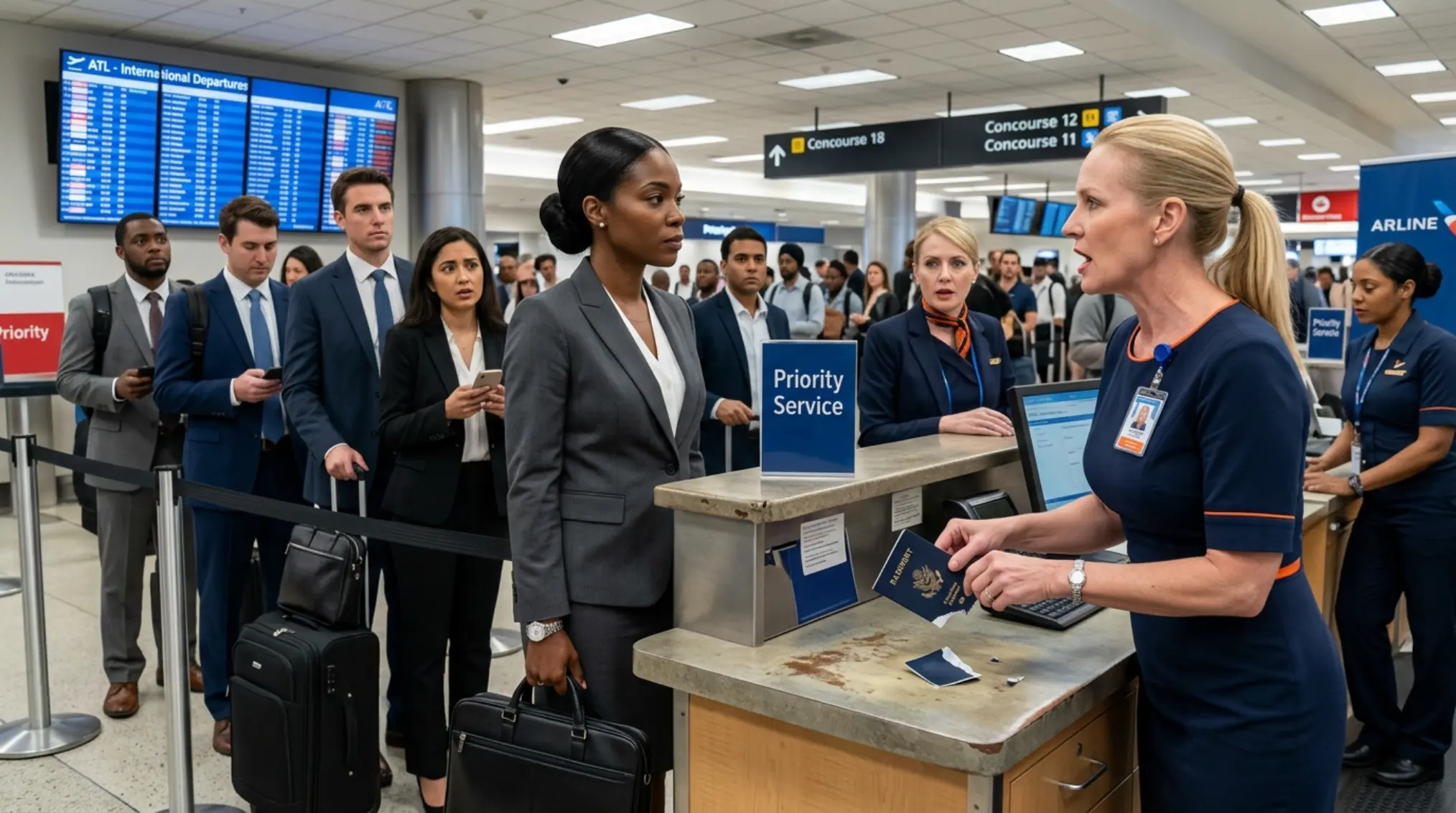
Naomi did not move.
She stood on the passenger side of the polished counter with a structured black leather briefcase hanging from one hand. Her charcoal-gray suit had been tailored in New York, but nothing about it was flashy. A crisp white blouse. Black heels. A silver watch. Small earrings. No visible logo. No assistant. No entourage.
She looked exactly like what she wanted to look like.
A business traveler.
Nothing more.
Across from her, SkyVale Airways agent Diane Mercer leaned forward with one hand planted on the metal counter.
Diane was fifty-two, blonde, neatly groomed, and dressed in the navy uniform of a senior premium-service representative. Orange piping ran along her collar and cuffs. Her badge identified her as a fifteen-year employee.
Her expression identified something else.
She had already decided who Naomi was before looking at a single document.
Naomi glanced toward the small sign above the counter.
PRIORITY SERVICE.
Then back at Diane.
“This is the priority line.”
“I know what line this is.”
“My boarding pass says priority.”
Diane made a short sound through her nose.
“Then whoever issued it made a mistake.”
Naomi’s expression remained neutral.
“Would you like to scan it?”
“I don’t need to.”
“Then how did you determine there’s a mistake?”
A man in a navy suit standing two positions behind Naomi lowered his phone.
Diane noticed.
Her tone sharpened.
“You people always want to turn a simple instruction into an argument.”
Naomi’s eyes changed slightly.
Not anger.
Attention.
“What people?”
Diane paused.
Only for half a second.
Then she reached toward Naomi’s documents.
“Passport.”
Naomi placed it on the counter.
Diane opened it.
Her eyes flicked across the identification page.
Then toward Naomi.
Then back again.
“Where are you traveling?”
“London.”
“Purpose?”
“Business.”
“What business?”
Naomi looked at her.
“That is not required for check-in.”
Diane closed the passport.
“You’re being difficult.”
“I’m answering every relevant question.”
“You’re standing in a premium line with an attitude.”
“I’m standing in a premium line with a premium ticket.”
Diane’s face reddened.
Behind Naomi, the queue had stopped moving completely.
Several passengers were watching now.
One woman quietly raised her phone.
Naomi noticed the movement reflected in the counter’s metal trim.
She noticed everything.
That was why she was there.
Three months earlier, Naomi Carter had become chief executive officer of SkyVale Airways after leading an investment group that acquired controlling ownership during one of the most turbulent periods in the company’s thirty-four-year history.
SkyVale was not failing financially.
That was part of the problem.
Its planes were full.
Its premium routes were profitable.
On-time performance had improved.
Corporate partnerships were expanding.
Yet passenger complaints had risen twenty-eight percent in eighteen months.
Employee turnover at several major hubs was worse.
Internal surveys repeatedly mentioned humiliation, favoritism, retaliatory management, and an obsession with appearance.
The previous executive team called those issues “service inconsistency.”
Naomi called them warning signs.
She had spent twenty years building transportation and hospitality companies.
She knew spreadsheets could hide behavior.
A customer-service score of 86 did not tell you whether one traveler had been treated beautifully while another was dismissed because somebody decided they did not look important enough.
So before announcing her appointment publicly, Naomi made an unusual decision.
She would travel through SkyVale’s busiest airports without executive credentials.
No corporate car.
No staff greeting.
No special notification to airport managers.
The board hated the idea.
Naomi insisted.
“If I arrive as CEO,” she told them, “I’ll meet the airline everyone prepares for me to see.”
“What are you hoping to find?” Chairman Robert Ellison asked.
“The airline passengers actually experience.”
Atlanta was her third airport.
Chicago had been imperfect but encouraging.
Denver revealed scheduling problems but mostly professional staff.
Atlanta was different almost immediately.
Naomi watched a counter employee ignore an elderly passenger for nearly four minutes while finishing a personal conversation.
She watched another passenger redirected twice because nobody wanted to handle a damaged reservation.
Then she entered priority service.
And met Diane Mercer.
Diane opened Naomi’s passport again.
“Where did you get this?”
Naomi almost smiled.
“From the Department of State.”
“Don’t get smart.”
“You asked where I got my passport.”
Diane looked toward the boarding pass.
First class.
Seat 2A.
Paid fare.
SkyVale Platinum status.
Her eyes narrowed.
“This account probably isn’t yours.”
A murmur moved through the line.
Naomi’s voice became quieter.
“Scan the passport.”
Diane stared at her.
“Excuse me?”
“Scan it. Verify the reservation. Then either process my bag or tell me specifically what policy prevents you from doing so.”
For the first time, Diane looked uncertain.
The uncertainty became anger.
She picked up Naomi’s passport by one corner.
“You think because you bought an expensive ticket you can talk down to me?”
“No.”
Naomi held her gaze.
“I think because I bought a ticket you should process it without inventing reasons not to.”
Diane pulled the passport closer.
The cover bent.
Naomi watched her fingers.
“Please be careful with that.”
“Don’t tell me how to do my job.”
“I’m asking you not to damage federal identification.”
Diane gave the passport a sharp tug as though emphasizing her point.
The identification page caught against the corner of a document tray.
There was a tearing sound.
Everyone nearby heard it.
Diane froze.
Naomi looked down.
A section of the laminated page had separated near the upper corner.
Not completely destroyed.
But visibly damaged.
The passenger behind Naomi whispered:
“Oh my God.”
Diane looked at the passport.
Then at Naomi.
She could have apologized.
That moment remained available for perhaps two seconds.
Instead, she dropped the passport onto the counter.
“You shouldn’t have pulled against me.”
Naomi stared.
“I never touched it.”
“You were reaching.”
“My hands were at my sides.”
“You were aggressive.”
Naomi slowly set her briefcase down.
“I want your supervisor.”
Diane laughed.
“No.”
“Then security.”
That surprised her.
“You want security?”
“Yes.”
Naomi picked up the damaged passport.
“Please call them.”
Diane smiled as though she had finally regained control.
“With pleasure.”
She pressed a button beneath the counter.
Then pointed toward Naomi.
“And when they get here, you’re leaving this line.”
Naomi examined the damaged page.
“Before they arrive, I want one thing clarified.”
Diane folded her arms.
“What?”
“Did you intentionally refuse to scan my ticket before questioning whether I belonged here?”
Diane stared.
“I don’t have to answer an interrogation.”
“Did you?”
“You came into my line with an attitude.”
Naomi nodded slightly.
“Good.”
“Good?”
“Thank you.”
Diane looked confused.
Naomi glanced toward the woman holding a phone behind her.
Then toward two ceiling cameras positioned above the counter.
Diane followed her eyes.
Her confidence weakened.
“You’re recording me?”
Naomi replied:
“I’m standing in an airport.”
Security arrived three minutes later.
Two airport officers approached first, followed by a SkyVale floor supervisor named Kevin Barnes.
Kevin was forty-five, tall, nervous, and immediately wore the expression of a manager who had encountered Diane in trouble before.
“What happened?”
Diane spoke first.
“This passenger refused instructions, became argumentative, and interfered with document verification.”
Naomi said nothing.
Kevin looked at her.
“Ma’am?”
Naomi held up the passport.
“I presented a valid first-class reservation and passport. She refused to scan either, questioned whether the reservation belonged to me, told me to leave priority service, and damaged my passport.”
Diane interrupted.
“She yanked it while I was holding it.”
Naomi looked toward the witnesses.
“So did anyone here see me touch the passport?”
The man in the navy suit immediately said:
“No.”
The woman recording added:
“Her hands were down.”
A third passenger nodded.
“I saw the whole thing.”
Diane pointed at them.
“They don’t know what happened behind the counter.”
The airport officer asked:
“Is there camera coverage?”
Kevin hesitated.
“Yes.”
“Then we’ll preserve it.”
Diane’s face changed.
She turned toward Kevin.
“You know how these situations go.”
Naomi noticed the phrase.
Not this situation.
These situations.
Kevin looked uncomfortable.
“Diane, stop talking.”
That told Naomi even more.
The officer examined the passport.
“Ma’am, it may still scan, but the damage could create travel complications. You may need additional documentation.”
“I understand.”
Diane muttered:
“Good. Maybe she’ll learn how to behave.”
Kevin closed his eyes.
Naomi slowly turned toward her.
“What did you say?”
Diane raised her chin.
“I said maybe next time you’ll follow directions.”
Naomi picked up her briefcase.
“Kevin, is it?”
“Yes.”
“Please provide me with Diane’s employee identification number, your employee identification number, the station manager’s name, and written confirmation that the surveillance footage from this counter will be preserved.”
Kevin blinked.
“That’s a lot of information.”
“It’s a straightforward request.”
“What exactly are you planning to do?”
“Review the incident.”
Diane laughed.
“Review it with who? Customer relations?”
Naomi looked at her.
“No.”
That single word landed differently.
Kevin studied Naomi more carefully.
There was something about the woman’s stillness that bothered him.
Not because she appeared threatening.
Because she seemed completely unafraid of the machinery around her.
Most passengers became emotional when security arrived.
Some became apologetic.
Others became angry.