“Can I check in here?” Adrian Cole asked, placing his identification and printed reservation on the white counter beneath the glowing PREMIER ACCESS sign. He was forty-three, tall and athletic, with deep brown skin, closely trimmed black hair, and the controlled expression of a man accustomed to observing before speaking. His black blazer, gray crew-neck shirt, dark trousers, and inexpensive rolling suitcase made him look like thousands of ordinary business travelers passing through Northbridge International Airport that morning. Nothing visible suggested that somewhere inside the federal aviation system, his name carried access authority few airport employees would ever encounter.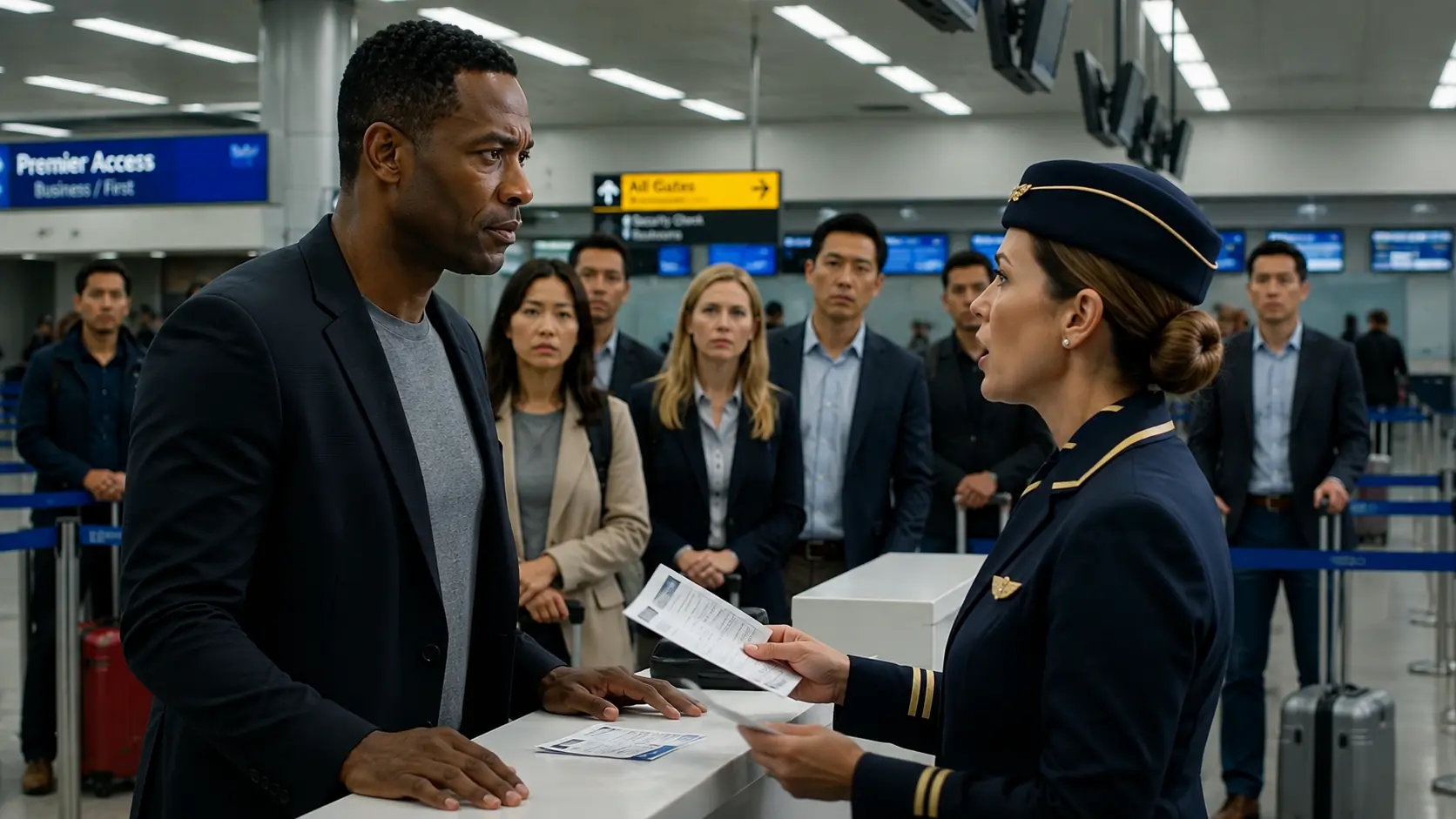
The airline agent barely looked at him. Evelyn Mercer, thirty-eight, wore a perfectly pressed navy uniform with gold trim, pearl earrings, and a matching cap pinned over a tight brown bun. She glanced at Adrian’s plain suitcase, then toward the line of expensive luggage behind him before returning her eyes to the computer. “No. Flight oversold.”
Adrian looked toward the empty premium counter beside her. “I have a confirmed reservation.” He pushed the printed confirmation slightly closer without raising his voice, certain the booking had been reconfirmed twice before he left Washington. Evelyn finally picked up the paper, scanned it for several seconds, and let out a dismissive breath. The passengers waiting behind Adrian began paying attention.
“Confirmed didn’t make you look luxury, filthy man.” Evelyn tore the paper straight down the middle. Before Adrian could react, she tore both halves again and dropped the pieces onto the counter as though disposing of junk mail. A woman standing two positions back gasped, while a businessman beside her slowly lowered his phone from his ear. Adrian stared at the four pieces of his reservation lying between them.
For nearly five seconds he said nothing. Anger moved through him, but twenty years of investigative work had taught him that the first emotional response was rarely the useful one. He placed both hands flat on the counter and looked directly at Evelyn. “Did you just destroy a confirmed passenger document because you didn’t think I looked expensive enough?”
Evelyn smiled. “I told you the flight is oversold.” She reached toward the next passenger and called, “Next,” pretending Adrian had already ceased to exist. Adrian did not move. “Then enter my reservation number and document the denial.”
Her hand stopped.
“I don’t need to explain airline inventory to you.”
“You do if you’re denying confirmed carriage.”
Evelyn looked up sharply. “Are you threatening me?”
“No.”
Adrian’s voice remained even. “I’m asking you to record what you just did.”
A supervisor several counters away glanced toward the growing confrontation but did not approach. Evelyn noticed the attention and seemed to interpret it as support rather than warning. “You people always think waving a confirmation around means you can demand whatever you want.” Adrian’s expression hardened at the phrase, but he still refused to give her the argument she appeared to be seeking.
Behind him, phones began appearing. One traveler quietly recorded from waist level while another moved closer to hear. Evelyn noticed and raised her voice, perhaps believing public confidence could turn her decision into fact. “This gentleman has been informed the cabin is full, and he is refusing to leave the premium area.”
Adrian turned slightly toward the witnesses. “I asked her to process my confirmed reservation.” Then he looked back at Evelyn. “Nothing more.”
“Security can remove you.”
“Call them.”
For the first time, her confidence flickered. She had expected anger, perhaps embarrassment, maybe a passenger who would collect the torn paper and retreat to another counter. Adrian instead remained exactly where he was, calm enough that her own aggression became increasingly visible. Evelyn reached for the keyboard.
“Fine,” she muttered. “Let’s see what little miracle you think is hiding in here.”
She typed the confirmation number from the reservation record. The first screen displayed Adrian’s confirmed first-class seat, originally assigned weeks earlier. Evelyn stared at it, then quickly clicked another tab. Adrian noticed her eyes narrow.
“Seat 3A,” he said.
Evelyn did not answer.
“Still oversold?”
She clicked again.
The system hesitated.
Then the screen changed.
A dark red banner appeared across the reservation window.
RESTRICTED FEDERAL AVIATION CLEARANCE — IDENTITY VERIFICATION REQUIRED — CONTACT AIRPORT SECURITY OPERATIONS.
Evelyn stopped breathing.
Another notification appeared beneath it.
AUTHORIZED OVERSIGHT ACCESS — DO NOT ALTER PASSENGER RECORD WITHOUT SECURITY AUTHORIZATION.
The color drained from her face. Adrian watched her read both messages twice. Somewhere beneath the counter, an automated security alert had already been generated.
“What is that?” she whispered.
Adrian’s voice became colder. “The screen you should have checked before tearing my ticket.”
Evelyn immediately minimized the window. “There’s obviously some system mistake.” Her fingers moved rapidly across the keyboard as if she could erase what had appeared. Adrian leaned slightly forward. “Do not modify that reservation.”
She looked at him.
“Who are you?”
Before Adrian answered, two airport security supervisors emerged from a secure corridor behind the counters. They were followed by Marcus Lane, Northbridge International’s deputy security director, who looked at Adrian, then at Evelyn, then at the torn pieces lying on the counter. Marcus’s expression changed instantly.
“Inspector Cole.”
The entire premium line went silent.
Evelyn stared at Adrian.
Marcus stepped closer. “Sir, we weren’t notified you were arriving today.”
“You weren’t supposed to be.”
Adrian reached inside his blazer and removed a slim credential wallet. He opened it briefly, revealing identification for the federal aviation oversight division conducting the airport’s unannounced compliance review. The title beneath his photograph identified him as the Chief Federal Aviation Security Inspector assigned to a multi-airport investigation into access control, passenger handling, and internal security failures.
Evelyn looked toward her supervisor. “I didn’t know.”
Adrian closed the credential case. “That should not matter.”
“I thought—”
“Yes,” he interrupted quietly. “That is exactly the problem.”
The words landed harder than shouting would have. Evelyn glanced at the passengers recording the confrontation and seemed to understand that the damage had already escaped the counter. Marcus instructed another employee to preserve the reservation screen and called airline station management. Adrian immediately stopped him from touching anything else.
“No one deletes, changes, reissues, upgrades, downgrades, or cancels this record until it is preserved.” Marcus nodded. Adrian pointed toward the ceiling. “And secure every camera covering this counter from thirty minutes before I arrived.”
Evelyn suddenly became defensive. “You’re making this into something it wasn’t.” Adrian looked at the torn ticket. “You told a confirmed passenger he did not look luxurious enough to fly in the cabin he paid for.” Evelyn’s supervisor finally stepped forward.
“She may have meant the flight was oversold.”
Adrian turned toward him. “Then why was seat 3A still active?”
The supervisor said nothing.
Adrian continued. “And why did she destroy a passenger document before checking the reservation?”
Again, silence.
The first clue appeared fifteen minutes later. Airline operations confirmed the flight had indeed been oversold, but not in the way Evelyn had described. Economy inventory was oversold by eleven passengers, while first class still showed two available seats because of a late aircraft swap.
Adrian’s seat had never been at risk.
The second clue was worse. A digital audit of the reservation showed that Evelyn had opened Adrian’s record several minutes before telling him the flight was oversold. She had already seen his confirmed first-class assignment.
Adrian stood inside a small airline office while an IT specialist projected the transaction history onto a wall monitor. The log showed Evelyn viewing his reservation, then accessing a manual reallocation screen often used when volunteers accepted compensation to move to later flights. But Adrian had never volunteered. Someone had attempted to mark his seat as eligible for reassignment.
“Who benefits if 3A becomes available?” Adrian asked.
The airline station manager, Thomas Bell, rubbed his forehead. “Could be sold as a last-minute upgrade.”
“For how much?”
“Depending on demand? Two thousand dollars. Maybe more.”
Adrian looked at him. “And does your staff receive commission?”
Thomas hesitated.
“Not officially.”
That answer immediately interested everyone in the room.
“What does unofficially mean?”
Thomas explained that some employees received performance bonuses based partly on premium-cabin revenue and customer-upgrade conversion. The metric was not intended to encourage agents to remove confirmed passengers, but the possibility existed that an employee could artificially create upgrade inventory. Adrian requested records for Evelyn’s counter transactions during the previous year.
Thomas became pale.
“That’s a lot of data.”
“Then start downloading.”
Evelyn sat in another room with a union representative while airport investigators preserved her workstation. She continued insisting the confrontation had been a misunderstanding created by pressure from an oversold flight. She claimed the insult was spoken in frustration and denied deliberately targeting Adrian because he was Black.
Then investigators examined previous complaints.
There were seventeen associated with Evelyn’s employee number.
Six involved passengers who claimed confirmed premium seats mysteriously disappeared at check-in. Four passengers alleged rude comments concerning clothing or appearance. Three specifically stated Evelyn told them they did not “look like premium travelers.”
Two of those passengers were Black.
Another was Latino.
One was an elderly white construction contractor who had flown first class using points and arrived wearing work boots.
Each complaint had been closed individually.
Together, they looked different.
Adrian requested the audit trail from those reservations.
The pattern emerged before lunch.
In nine cases, confirmed premium passengers had been moved or pressured into later flights shortly before their original seats were sold to walk-up passengers at substantially higher fares. Evelyn had handled seven of those transactions personally.
The other two involved agents working under the same supervisor.
Adrian looked toward Thomas. “This stopped being about one employee.”
Thomas nodded reluctantly.
“What happens to the additional revenue?”
“It goes to the airline.”
“And bonuses?”
“Quarterly.”
“Who approves them?”
Thomas answered quietly. “Station management.”
The investigation expanded.
By late afternoon, federal compliance investigators had secured employee access logs, reservation changes, premium-seat conversion records, customer complaints, and internal messages. One chat conversation between Evelyn and her supervisor contained a line that immediately changed the case.
Easy swap on 4:20. Guy looks like he’ll fold if pushed.
Another message followed.
Need two premium seats. Find volunteers or make them.
Adrian read the exchange without expression.
Marcus stood beside him. “That sounds bad.”
“It is bad.”
Another thread included staff joking about “discount-looking passengers” occupying expensive seats. One employee had written that passengers arriving in hoodies, work clothes, or inexpensive shoes were easier to pressure because staff assumed they lacked corporate travel departments or elite status capable of generating complaints.
The insults were not always racial.
But the targeting often overlapped with race, age, accent, and perceived wealth.
Adrian understood what he was seeing.
A revenue shortcut had become a culture.
Employees had learned which passengers appeared easiest to intimidate.
Management had learned not to ask why premium-seat conversions were unusually high.
Complaints had been processed individually so nobody had to confront the pattern.
Adrian’s torn ticket had simply brought the entire structure into one visible moment.
By evening, the airline’s regional vice president arrived from Chicago. She introduced herself as Rebecca Sloan and immediately asked to speak privately with Adrian. He agreed, but brought another investigator into the room.
Rebecca apologized for Evelyn’s behavior.
Adrian stopped her.
“Don’t apologize to me because you learned my title.”
Rebecca looked uncomfortable.
“I’m apologizing because what happened was unacceptable.”
“Good.”
He placed a folder on the table.
“Then explain why seventeen complaints produced no pattern review.”
Rebecca opened it.
Her face tightened.
She had not seen the combined records before.
At least, that was what she claimed.
Adrian asked another question. “What would have happened if I were not a federal inspector?”
Rebecca said nothing.
“That is the question everyone in this building needs to answer.”
The flight Adrian was supposed to take departed without him. Seat 3A remained empty because the reservation was frozen as evidence. Ironically, the airline that claimed there was no room had flown the aircraft with his confirmed seat untouched.
Passengers from the premium line posted their videos online.
Within hours, the confrontation spread across social media.
The most shared clip showed Evelyn tearing the ticket after insulting Adrian’s appearance.
A second video captured the exact moment her expression changed after the federal clearance notification appeared.
Headlines initially focused on Adrian’s identity.
He disliked that framing.
During a short statement the next morning, he deliberately redirected attention.
“The important issue is not that an airline employee mistreated a federal official,” he said. “The important issue is that she believed she was mistreating an ordinary passenger.”
Reporters became silent.
Adrian continued. “If respectful treatment appears only after someone discovers power, that is not respect. It is fear of consequences.”
The investigation lasted six weeks.
Data analysts reviewed nearly eleven thousand premium-seat transactions at Northbridge International. Most were perfectly legitimate. But forty-seven reservations were flagged for suspicious manual changes concentrated among a small cluster of employees.
Twenty-eight passengers agreed to interviews.
Their stories sounded painfully familiar.
A school principal traveling to his daughter’s wedding had been told his first-class upgrade “never existed,” although records showed it had been confirmed. A Black entrepreneur wearing jeans and a sweatshirt had been pressured to accept a connection after an agent told him business-class passengers were “already accommodated.”
An elderly mechanic using decades of saved airline miles was told there had been a computer error.
His seat was sold twenty-three minutes later for nearly four thousand dollars.
A Latina physician traveling after an overnight shift was asked three times whether she had “accidentally booked the wrong cabin.”
She produced her confirmation.
The agent moved her anyway.
The airline had refunded some passengers after complaints, but few cases had been connected.
Adrian refused to let the investigation become a search for one villain.
Evelyn’s conduct had been vicious, but the records showed employees operated within incentives management understood poorly and monitored even worse. Supervisors celebrated unusually high premium conversion numbers while ignoring the methods producing them.
One manager had written in an internal email:
Whatever you’re doing at Northbridge, keep doing it. Premium capture is leading the region.
That message became central to the review.
Rebecca Sloan testified during an internal hearing that senior regional managers never instructed employees to displace confirmed passengers. Adrian believed her. But lack of direct instruction did not erase a system that rewarded outcomes while ignoring how those outcomes were achieved.
Evelyn faced disciplinary proceedings.
She attempted to portray the confrontation as a single moment of stress.
The preserved footage defeated that argument.
Video showed Adrian behaving calmly from the moment he approached the counter.
It showed Evelyn opening his reservation before falsely claiming the cabin was unavailable.
It showed her examining his ordinary clothing.
Then it showed her tearing the ticket.
The airline terminated her employment.
Her supervisor was also dismissed after investigators linked him to repeated manual seat reallocations and internal messages encouraging agents to “make room” for profitable walk-up sales.
Two managers were demoted.
The regional premium-sales incentive program was suspended.
Every passenger complaint involving involuntary premium-seat removal from the previous eighteen months was reopened.
Several travelers received refunds and additional compensation.
The airline introduced a rule requiring supervisory authorization and written passenger acknowledgment before confirmed premium reservations could be voluntarily surrendered at check-in.
Federal regulators issued compliance findings regarding record preservation and passenger-processing controls.
None of those reforms satisfied Adrian completely.
Systems could change rules faster than cultures.
Three months later, he returned to Northbridge International.
This time there were no hidden credentials.
No investigation.
He was traveling to Denver for a conference.
Adrian approached the same premium counter carrying the same plain black suitcase.
A young airline employee greeted him.
“Good morning, sir. May I see your identification?”
Adrian handed it over.
The employee checked the screen.
“Mr. Cole, you’re confirmed in 2C. Would you like me to print a boarding pass, or are you using your phone?”
“Paper is fine.”
The agent printed it.
No hesitation.
No judgment.
No inspection of his clothing.
Just ordinary service.
That simplicity affected Adrian more than he expected.
He thanked her and turned away.
Near the security entrance, a man called his name.
Adrian recognized him as Thomas Bell, the former station manager.
Thomas had kept his job after investigators concluded he had not personally manipulated reservations, but his failure to identify the pattern earned him formal discipline.
“I wanted to thank you,” Thomas said.
Adrian raised an eyebrow.
“For nearly shutting down my station?”
Thomas smiled awkwardly.
“For showing me something I should have seen.”
Adrian waited.
Thomas explained that complaint reports were now reviewed collectively rather than one at a time. Patterns involving the same employee, seat category, or passenger complaint automatically triggered a secondary audit.
“We should have done that years ago.”
“Yes.”
Thomas nodded.
“I know.”
Adrian looked toward the check-in counters.
“What happened to the passengers whose cases were reopened?”
“Twenty-one received compensation. Seven had travel records corrected. Four declined anything except written apologies.”
“And the rest?”
“Still reviewing.”
Adrian nodded.
“Keep reviewing.”
Thomas hesitated before asking the question he had apparently been carrying for months.
“Why didn’t you show Evelyn your credentials immediately?”
Adrian looked toward the boarding pass in his hand.
“Because I wanted to know what happened before she believed consequences were standing in front of her.”
Thomas absorbed that.
“And you found out.”
“Yes.”
The boarding announcement for Adrian’s flight echoed through the terminal.
He started toward security.
Thomas called after him.
“Inspector.”
Adrian turned.
“I’m sorry.”
Adrian nodded once.
This apology felt different from the first one because Thomas now understood exactly what required apology.
Not that a federal official had been mistreated.
That an ordinary passenger had been considered disposable.
Adrian continued toward his gate.
He thought about the moment Evelyn tore the ticket.
Four pieces of paper had landed on a white counter.
To her, they represented nothing more than a reservation belonging to someone she believed she could push aside.
To Adrian, those pieces eventually became evidence.
One fragment still remained sealed in the investigative file.
He had considered keeping it.
Instead, he left it there.
Evidence belonged with the record.
Months later, federal auditors closed the formal Northbridge review after the airline completed required corrective actions. The final report did not describe the incident as an embarrassing customer-service failure.
It described a breakdown in control systems.
Passenger records had been manipulated.
Complaints had been siloed.
Financial incentives had rewarded aggressive seat conversions.
Employees had learned to judge who might resist.
That last finding mattered most to Adrian.
The investigation never proved every questionable reassignment had been motivated by race.
It did prove that appearance, clothing, perceived wealth, accent, age, and social confidence affected how certain employees selected passengers to pressure.
That was enough to expose something dangerous.
Rules were being applied differently depending on who employees believed was standing in front of them.
Adrian had spent his career studying airport vulnerabilities.
People usually imagined threats as weapons, unauthorized doors, stolen identification, or failures in screening technology.
But institutions could suffer another kind of vulnerability.
A culture in which authority depended on appearance.
That morning, Evelyn had looked across the counter and made a calculation.
Plain blazer.
Cheap suitcase.
No luxury watch.
Black man traveling alone.
Someone unlikely to fight back.
She was wrong about Adrian.
But his identity was never the real twist.
The real twist was how many times the same calculation had worked before him.
Passengers had gone home angry.
Some complained.
Some stayed silent.
Some convinced themselves arguing was not worth the trouble.
And because each person stood alone, the pattern survived.
Until Evelyn tore the wrong ticket in front of the right cameras.
Adrian boarded his Denver flight and took seat 2C.
A businessman sat beside him and glanced at his ordinary suitcase.
“Work trip?”
Adrian smiled faintly.
“Yes.”
“What do you do?”
Adrian looked through the window at Northbridge International stretching beyond the aircraft.
“I inspect systems.”
The businessman laughed.
“Sounds exciting.”
“Sometimes.”
The aircraft began pushing away from the gate.
Adrian rested his boarding pass on his knee.
This one remained perfectly intact.
And somewhere inside the airport behind him, every premium-counter employee now worked beneath a simple new rule displayed in their training materials:
A confirmed passenger is a confirmed passenger. Appearance changes nothing.
Adrian did not need his name on that rule.
He did not need the airport to remember his title.
He only needed them to remember what should have been obvious before he ever arrived.
The man standing at the counter deserved respect before the computer displayed federal clearance.
The ticket mattered before anyone knew who was holding it.
And the moment an institution required power before offering dignity, the institution itself was the thing that needed inspection.