Inside the polished VIP lounge of a private charter terminal outside Seattle, an exceptionally beautiful airport operations manager stood inches from Dr. Samuel Carter and pointed toward the glass exit doors. Vanessa Whitmore was thirty-four, with flawless fair skin, piercing blue eyes, sculpted features, and honey-blonde hair pulled into a sleek low ponytail. Her sleeveless white satin wrap dress, gold earrings, luxury watch, and immaculate heels made her look perfectly suited to the wealthy world she guarded. Samuel, meanwhile, wore a faded utility jacket, heavy jeans, dusty boots, and the exhausted expression of a single father who had been awake since three that morning.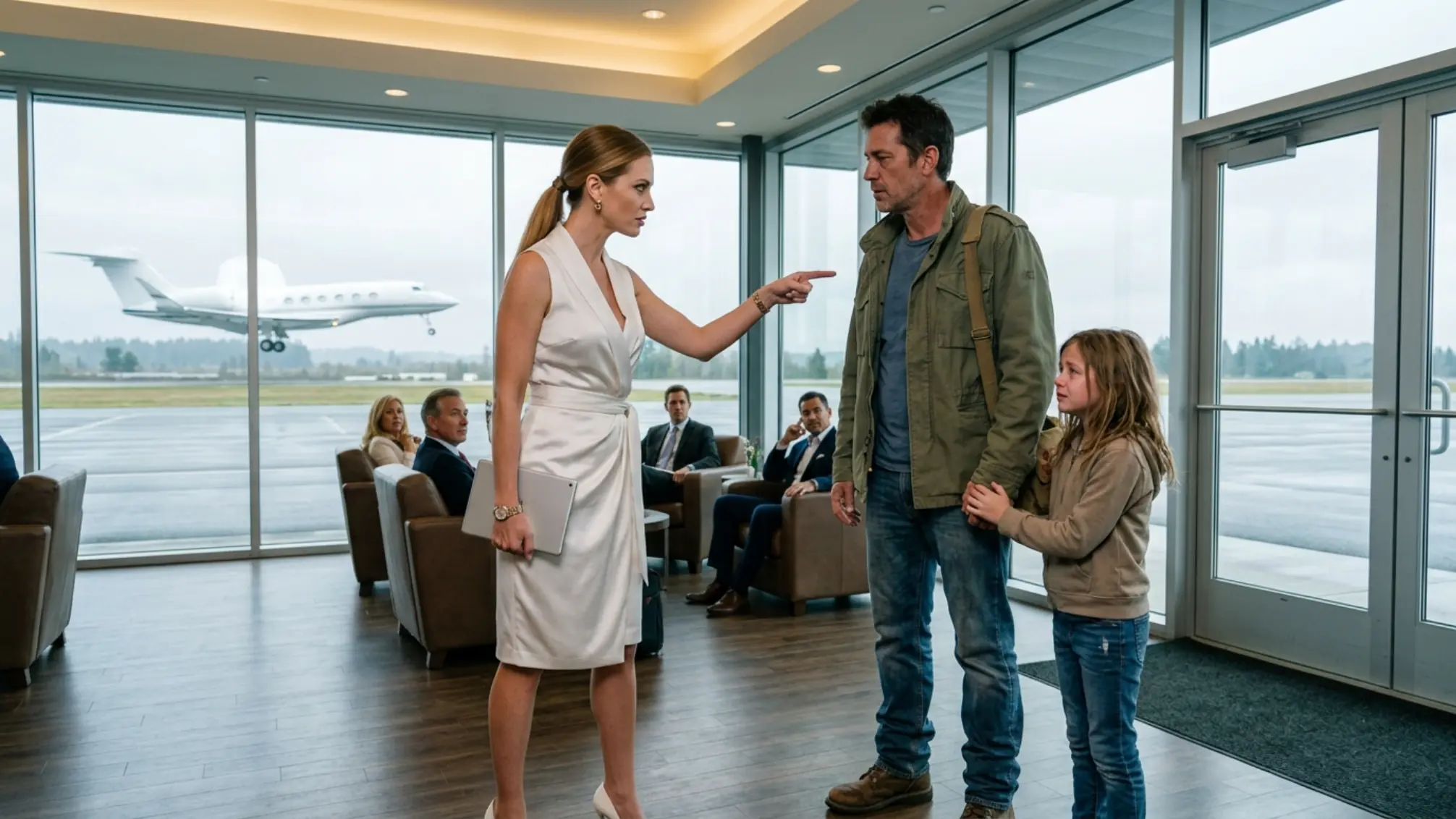
Ten-year-old Olivia tightened both hands around her father’s arm.
She wore a red winter coat over her school clothes and carried a small backpack decorated with faded violin pins. Her dark-brown hair was gathered into two loose braids, and her frightened hazel eyes moved from Vanessa’s accusing finger to the security guard standing several feet behind them.
“Dad,” she whispered, “did we come to the wrong airport?”
Samuel lowered himself until they were eye to eye.
“No, sweetheart. We are exactly where we were told to be.”
“Then why does she want us to leave?”
Samuel paused.
He could explain infection rates, laboratory failures, quarantine procedures, and emergency-response protocols to rooms filled with physicians. Explaining casual cruelty to his daughter was more difficult.
“Sometimes people make decisions before they collect the facts,” he said quietly. “That does not mean the facts disappear.”
Vanessa heard him and folded her arms.
She had managed Evergreen Executive Air for nearly four years. Every week, she greeted investors, celebrities, political donors, professional athletes, and business owners who treated private aircraft as casually as ordinary people treated taxis. She had learned to identify powerful clients by their luggage, watches, assistants, and confidence before they ever presented identification.
Samuel Carter matched none of those signs.
His old leather medical bag had scratches across its sides. Dust covered the soles of his boots, and one sleeve of his jacket had been repaired with dark thread. His daughter looked tired enough to sleep on the lounge carpet.
To Vanessa, they did not resemble charter passengers.
They resembled people hoping to slip into a restricted area.
“The confirmation on your phone is not appearing in our local manifest,” she said. “We cannot admit anyone based on an email that may have been altered.”
“Then contact Global Health Reach.”
“I have already told you the procedure.”
“You glanced at the screen for two seconds.”
“And I saw enough.”
Samuel’s voice hardened. “No, you saw my clothes.”
Several passengers turned toward them.
A gray-haired businessman sitting beneath a sculptural light fixture lowered his financial newspaper. Two women wearing designer coats exchanged irritated glances, while a younger man lifted his phone as though the humiliation might become entertaining enough to record.
Vanessa noticed their attention and became even more determined to remove the disruption.
“Security,” she said, without looking away from Samuel.
A broad-shouldered guard named Martin Cole approached from the reception desk. He was forty-five, with a shaved head, a navy uniform, and the weary caution of a man accustomed to handling wealthy people who believed rules existed only for others.
“What is happening?” he asked.
“This man claims he has an emergency charter,” Vanessa replied. “His name is not on the local list, and he is refusing to leave.”
Samuel held out his phone. “Dr. Samuel Carter. Priority transportation arranged through Global Health Reach and the federal emergency medical network. Flight number Seven Alpha Sierra.”
Martin studied the screen longer than Vanessa had.
The email looked official. It contained government authorization codes, a flight-service contact, and instructions to report to Evergreen Executive Air before two in the afternoon.
“Have we called the number?” Martin asked.
Vanessa’s expression tightened. “The local manifest is empty.”
“That wasn’t my question.”
The rebuke embarrassed her.
She straightened her shoulders. “Our clients should not have to wait while we verify every suspicious document presented by someone who wanders in from the public terminal.”
Samuel stared at her. “Suspicious because of what?”
Vanessa did not answer directly.
Her eyes moved to his jacket, the worn bag, and Olivia’s backpack.
Samuel nodded slowly. “That is what I thought.”
His calmness frustrated her more than anger would have. She expected embarrassed people to retreat or become loud enough to justify removal. Samuel did neither. He stood beside his daughter with the controlled authority of a man who had confronted emergencies far more dangerous than an arrogant manager.
He had spent twenty years studying infectious diseases.
He had entered hospitals during outbreaks when other specialists communicated only through screens. He had helped establish field laboratories after floods, traced waterborne illnesses through refugee camps, and stayed awake for thirty-six hours beside exhausted local doctors because leaving early would have meant abandoning hundreds of patients.
That afternoon, a remote mountain community called Pine Ridge Hollow was waiting for him.
Twenty-seven residents had developed high fevers, severe dehydration, and neurological symptoms within four days. Eleven were children. The small clinic had no functioning laboratory, and a landslide had damaged the main road through the northern pass.
Global Health Reach had chartered a private jet because driving would take almost eight hours.
Flying would take ninety minutes.
Inside Samuel’s battered leather bag were portable testing cartridges capable of identifying the contamination source before nightfall. Every minute wasted in the terminal allowed the illness to spread.
“I am asking you one last time,” Samuel said. “Call the flight coordinator.”
Vanessa picked up her silver tablet, tapped the screen, and pretended to conduct a more thorough search. In reality, she entered his name into the same local passenger system she had already checked.
“No Carter,” she announced.
“The booking may be protected under emergency authorization.”
“That is convenient.”
“It is standard for medical missions involving patient information.”
Vanessa gave a short, humorless laugh. “Sir, private aviation is expensive. People who belong here do not arrive wearing a jacket from a hardware store and carrying their equipment in an old school bag.”
Olivia looked down at her father’s leather case.
“My grandpa gave him that,” she said.
Vanessa barely acknowledged her.
Samuel’s face changed.
Insulting him was one thing. Dismissing something his late father had given him—and doing it in front of Olivia—reached a place beneath his professional restraint.
“My clothes do not determine the validity of a government authorization,” he said. “And my daughter should not be standing here frightened because you refuse to make one phone call.”
The gray-haired businessman spoke from his chair.
“Can someone remove them already? Some of us paid for privacy.”
Samuel looked toward him. “And people in Pine Ridge Hollow are paying for this delay with their health.”
The man lifted his newspaper again.
Vanessa pointed toward the doors.
“You have been asked politely. Now take your child and get the hell out.”
The terminal fell silent.
Even Martin appeared startled by the words.
Olivia’s eyes filled immediately. She pressed her face against Samuel’s arm, trying to hide the tears.
Samuel placed one hand protectively on her shoulder.
Then the first vibration passed through the windows.
A low mechanical rumble rolled across the runway, growing stronger with every second. Champagne glasses trembled on a nearby table. The businessmen and socialites in the lounge looked toward the airfield as a white Gulfstream descended through gray clouds.
Vanessa glanced outside but did not lower her arm.
“That aircraft has nothing to do with you.”
Samuel looked through the glass.
“No?”
The jet’s landing gear touched the runway. Tires released a brief trail of smoke before the aircraft slowed and turned toward the private terminal.
A telephone rang behind the reception desk.
The sound was sharp enough to make Vanessa flinch.
The receptionist answered it, listened for several seconds, and went pale.
“Ms. Whitmore,” he called. “The control tower needs you immediately.”
Vanessa walked to the desk with visible irritation and took the receiver.
“This is the operations manager.”
Her expression changed before the person on the other end completed the first sentence.
“Yes, we have a man here using that name.”
She listened.
Her blue eyes moved slowly toward Samuel.
“A priority-one medical authorization?”
Another pause.
“No, it did not appear in our local system.”
Her confidence drained further.
“Yes, I understand the national emergency network bypasses the standard manifest. I was not informed.”
Martin stared at her.
Vanessa gripped the receiver tightly.
“Yes, Captain. He is still in the terminal.”
The jet rolled directly toward the windows.
Its engines produced a deep roar that swallowed every whisper in the room. Ground personnel rushed into position as the aircraft stopped outside the main boarding doors.
The cabin door opened.
A metal staircase unfolded beneath it, and a silver-haired pilot stepped onto the upper platform wearing a dark uniform and a headset around his neck. He scanned the lounge through the glass until he found Samuel.
“Dr. Carter!” he called when the doors opened. “We’re already twelve minutes behind. The clinic just reported four more children with symptoms.”
Samuel lifted his medical bag.
“I was delayed at the desk.”
The pilot’s gaze shifted toward Vanessa.
“Why?”
No one answered.
A woman in medical scrubs descended behind him carrying two insulated containers. She hurried into the terminal and approached Samuel with urgent relief.
“Doctor, the testing cartridges need to be transferred into the thermal units,” she said. “The village physician believes the secondary well may be involved, but they cannot confirm it without you.”
Samuel opened his bag.
“Olivia, stay beside me.”
“I will, Dad.”
The child wiped her eyes and stood taller.
The same passengers who had regarded them as trespassers now watched Samuel remove carefully protected testing equipment from the worn leather case. There were no luxury items inside. No expensive watches, designer clothing, or bundles of money.
Only tools intended to save lives.
Vanessa placed the telephone down.
“Dr. Carter,” she said, “I sincerely apologize. Our system failed to display your authorization.”
Samuel looked at her.
“The system did not order me to get the hell out.”
Color rose across her face.
“I made a mistake.”
“You made several.”
“I was protecting the terminal.”
“From a doctor and his ten-year-old daughter?”
Vanessa glanced at Olivia, who immediately moved closer to her father.
“I did not understand the situation.”
“You refused to understand it.” Samuel’s voice remained controlled, which made every word more severe. “I handed you the flight number, the organization’s name, a government authorization, and a telephone contact. You chose my jacket as your most trusted source of information.”
Martin lowered his eyes.
Vanessa struggled to maintain her professional composure. “I recognize how that appears.”
“This is not about appearance. It is about time.”
The medical coordinator checked her watch.
“We need to move,” she warned.
Samuel turned back to Vanessa.
“Eleven sick children were waiting when I arrived here. Now there are fifteen. I cannot tell you whether these twelve lost minutes will matter, but in my profession, small delays become large tragedies.”
Vanessa’s lips parted, but no defense emerged.
Samuel took Olivia’s hand.
Martin stepped forward. “Please allow me to carry your bag.”
“No.”
“At least let us escort you across the tarmac.”
Samuel looked toward his daughter. “We managed to enter without assistance. We can manage to leave.”
They walked toward the open doors.
As they passed the gray-haired businessman, he lowered his newspaper and avoided Samuel’s eyes. One of the women with the designer handbags quietly moved it away from the empty seat where Olivia had been sitting, ashamed of how visibly she had guarded it before.
Olivia stopped near the doorway.
She looked back at Vanessa.
“My dad helps people who don’t have private planes,” she said. “The plane came because they needed him. It didn’t make him important.”
Vanessa’s expression collapsed.
Olivia continued, “He was important when you were yelling at him too.”
Samuel gently guided her outside.
“That was well said.”
“I was scared.”
“So was I.”
“You didn’t look scared.”
“Being brave does not mean you feel nothing. It means fear does not decide what you do next.”
They crossed the tarmac beneath the force of the idling engines. The medical team secured Samuel’s equipment, and Olivia climbed the staircase holding her father’s hand.
Before entering the cabin, Samuel looked back once.
Vanessa stood behind the terminal glass in her elegant white dress, surrounded by the luxury she had used to measure everyone entering her world. For the first time, she looked uncertain whether she belonged there herself.
The jet accelerated down the runway minutes later.
Inside, the wide leather seats remained mostly unused. Medical containers occupied the center aisle, satellite equipment covered one table, and maps of Pine Ridge Hollow glowed across several screens.
Samuel joined a conference call with the village clinic.
“Tell me when the first symptoms appeared.”
“Four days ago,” a physician answered through heavy static. “Three children from the northern settlement developed fever after attending the same school event. The illness spread quickly from there.”
“Any shared food?”
“Nothing consistent.”
“Water source?”
“The main well tested clear. A secondary pump serves the school and twelve homes.”
“Shut it down immediately.”
“We need confirmation before cutting access.”
“You have fifteen symptomatic children. Shut it down and distribute bottled reserves until I arrive.”
Olivia watched her father change.
In the garage at home, he was the man who burned pancakes, forgot where he placed his glasses, and sang badly during long drives. Inside the aircraft, his exhaustion disappeared beneath disciplined focus.
He was no longer defending his right to enter a lounge.
He was fighting an outbreak.
Ninety minutes later, the jet landed on a narrow mountain airstrip. An ambulance carried Samuel, Olivia, and the medical team to the clinic, where frightened families filled every available hallway.
Samuel established a temporary laboratory inside an unused storage room.
He tested water samples from the main well, the secondary pump, nearby streams, and household containers. Within three hours, the portable cartridges detected bacterial contamination in the school’s secondary water line.
A damaged underground pipe had allowed runoff from an old livestock enclosure to enter the system after several days of heavy rain.
Samuel ordered immediate isolation of the line, antibiotic treatment for severe cases, and clean-water distribution throughout the settlement. By midnight, no new households were reporting symptoms.
Olivia sat beside a recovering eight-year-old girl named May, showing her how to fold paper animals.
“Your father came in the airplane?” May asked.
“Yes.”
“Is he rich?”
Olivia smiled. “No. He just knows what to do.”
Three days later, health officials declared the outbreak contained.
Every sick child survived.
When Samuel and Olivia returned to Evergreen Executive Air, they looked even less like elite passengers than before. Mud stained Samuel’s jacket, fatigue shadowed his face, and Olivia wore a woven red scarf given to her by May’s grandmother.
The terminal doors opened before they reached them.
Vanessa waited inside.
She wore a conservative navy business suit rather than the white dress. Beside her stood Martin, the receptionist, the airport director, and two members of the company’s governing board.
“Dr. Carter,” the director began, “on behalf of Evergreen Executive Air, we offer our complete and unreserved apology.”
Samuel held Olivia’s hand.
The director continued. “Ms. Whitmore’s conduct was unacceptable. We reviewed the security footage, staff statements, and communication records. Your documentation could have been verified immediately through the emergency operations line.”
Vanessa stepped forward.
Her beauty and elegance remained, but the cold certainty had disappeared from her eyes.
“I judged you before I examined the facts,” she said. “I humiliated you in front of your daughter, delayed your mission, and used language no employee should ever direct at a guest.”
Samuel studied her.
She did not blame software, stress, or confusing procedures.
That mattered.
“I am sorry,” she continued. “Not because the jet proved you belonged here, but because you should never have needed a jet to prove you deserved respect.”
Olivia looked up at her father.
Samuel nodded slightly.
Vanessa faced the child. “I frightened you. What I did was wrong.”
Olivia held the ends of her red scarf.
“Are you going to do it to somebody else?”
“No.”
“How do you know?”
Vanessa glanced toward the board members. “Because I asked the company to change the system, and because I’m going to help train every employee—including myself.”
The airport director explained that Evergreen would connect its local manifest directly to the humanitarian emergency network. Staff would be required to verify presented documents before requesting removal, and appearance-based assumptions would become part of mandatory anti-bias training.
Samuel listened but did not appear impressed by corporate language.
“Policies matter only when people follow them under pressure,” he said.
“We understand.”
“No, you understand now because the person you mistreated was connected to an important mission. What happens when the next person is simply lost, poorly dressed, frightened, or unable to explain himself perfectly?”
No one answered.
“That person still deserves patience.”
Vanessa lowered her eyes. “You’re right.”
Samuel looked at her for several seconds.
“I don’t want you fired.”
She appeared surprised.
“Consequences are necessary,” he continued, “but removal alone teaches organizations to hide embarrassing employees instead of repairing the culture that created them. You believed wealthy clients needed protection from people who looked like me. That belief did not begin at the moment I entered.”
The airport director nodded slowly.
Samuel agreed to participate in one staff seminar. He did not speak about the private jet. Instead, he displayed a photograph of the mountain clinic, where families carried clean water past rows of recovering children.
“These are the people your terminal delayed,” he told the employees. “None of them cared what I wore. They cared whether I arrived.”
Vanessa sat in the front row.
After the seminar, she approached him without the tablet, expensive watch, or commanding posture that had once served as shields.
“I spent years learning how to recognize status,” she said. “I never learned how to recognize purpose.”
Samuel closed his medical case.
“Purpose rarely dresses for attention.”
She looked toward Olivia, who was drawing beside the window.
“Your daughter’s words stayed with me.”
“They should.”
Vanessa nodded. “She said the plane did not make you important.”
“It didn’t.”
“It only revealed how wrong I had been.”
Samuel picked up his bag. “Then make sure you do not require another dramatic reveal before believing the next person.”
Months later, every new Evergreen employee heard about the day an operations manager ordered a worn-out single father from the terminal seconds before a private jet landed for him.
Many people told the story as though it were about hidden wealth.
They imagined Samuel was secretly powerful because an aircraft had arrived with his name on the manifest. They focused on the roaring engines, the stunned passengers, and the beautiful manager standing speechless beneath the terminal lights.
Olivia always corrected them.
“My dad wasn’t important because the jet came,” she would say. “The jet came because his work was important.”
Samuel returned to his ordinary life.
He drove an aging SUV, packed Olivia’s lunches every morning, and continued carrying his father’s scratched leather medical bag. The airport offered him lifetime VIP access, but he declined.
He did accept one thing.
A small plaque was installed beside the reception desk—not bearing his name, but a sentence written by Olivia:
Respect should arrive before proof of status.
Vanessa passed it every morning.
She never forgot the man in the faded utility jacket, the frightened child holding his hand, or the four words she had thrown at them before the engines began to roar.
The private jet exposed her mistake in front of an entire terminal.
But the real lesson came later, when the aircraft was gone and no wealthy audience remained.
Every person entering those doors deserved to be seen before being judged.
And no uniform, dress, account balance, or passenger list could determine the value of the life standing in front of her.