Grant Keller’s hand remained inside the open suitcase as every company pager on the tarmac vibrated at once. Baggage handlers, gate supervisors, security officers, and the station manager all reached toward their belts while the same emergency message appeared across their screens. The notification carried the silver crest of SkyAtlas Airways and an authorization level most of them had never seen outside a training manual. Three words glowed beneath the code: EXECUTIVE TRANSITION ACTIVE.
Kiana James stood across from Grant without raising her voice. Her long structured tweed coat moved lightly in the wind, revealing black leather trousers fastened with polished gold buttons and tall heeled boots that looked entirely out of place on an active airport ramp. Dark gemstone earrings framed her composed face, and her oversized sunglasses now rested in one hand. At her feet lay the clothes Grant had thrown from her suitcase while his crew watched.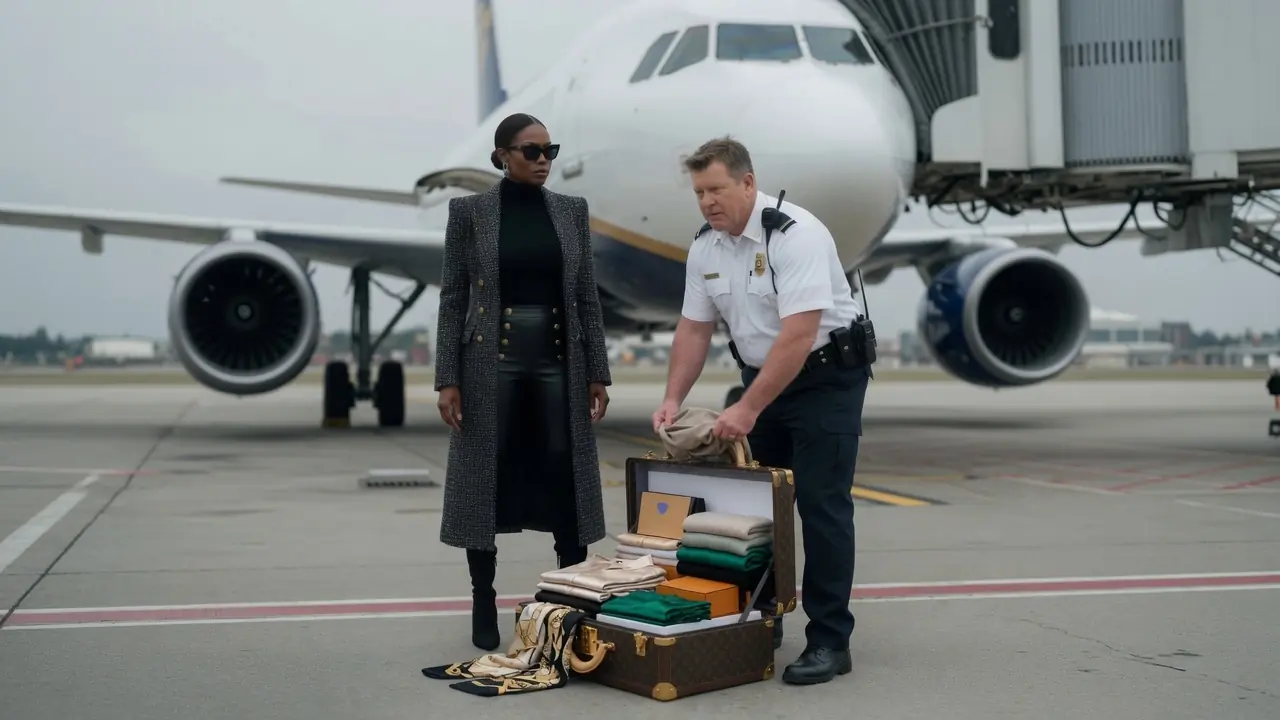
Grant stared at the alert, then at Kiana. “Anybody can send a fake message.”
“Not through the airline’s encrypted operations network.”
“You expect me to believe you run SkyAtlas?”
“No. I expect you to keep talking while the cameras record you.”
Grant looked toward the terminal windows. Passengers stood behind the glass, several holding phones toward the confrontation. Two ramp cameras covered the aircraft tail and luggage-loading area, while Kiana’s own phone had transmitted everything since the moment her suitcase struck the concrete.
A line of black vehicles approached from the far end of the service road.
Grant closed the suitcase roughly. “Get this passenger back inside.”
Nobody moved.
The youngest baggage handler, a twenty-two-year-old named Luis Herrera, had watched Grant remove Kiana’s bag from the cart despite its bright priority tag. Luis had also heard the supervisor order another worker to throw it from the loading platform. Grant called it a random security inspection, but he had selected the only Black first-class passenger’s luggage without opening a single bag belonging to anyone else.
“Didn’t you hear me?” Grant shouted.
Luis stepped backward. “Her name is on the alert.”
Grant pointed at him. “You work for me.”
A woman’s voice came from behind him. “Not anymore.”
Margaret Sloan, chairwoman of the SkyAtlas board, stepped from the first vehicle. Beside her walked the airline’s general counsel, two independent directors, and the head of corporate compliance. The board members had landed twenty minutes earlier on a separate flight and had watched the final minutes of the incident from inside their vehicles.
Margaret crossed the concrete toward Kiana and extended her hand. “Ms. James, I apologize that your first morning began this way.”
Kiana did not take it immediately. She looked down at the scattered clothes.
“My morning began inside your terminal,” she said. “This is only where your employees stopped pretending.”
Margaret followed her gaze.
A cream silk blouse lay near an aircraft tire. A leather document case had been opened and emptied onto the pavement. Near it rested a silver executive badge Grant had ignored when he found it because he assumed it had been stolen or manufactured.
The badge read:
KIANA JAMES
CHIEF EXECUTIVE OFFICER
SKYATLAS AIRWAYS
Grant’s mouth tightened. “She never identified herself.”
“I presented my passport, boarding pass, and employee authorization at the gate,” Kiana said. “Your staff scanned all three.”
“You should have said you were management.”
“I wanted to see how you treated someone who wasn’t.”
That answer silenced him.
Six weeks earlier, the SkyAtlas board had hired Kiana to replace a chief executive who resigned during a growing customer-service and safety crisis. The announcement had been kept confidential until the completion of a final operational review. Only a small group of directors, attorneys, and senior officers knew her identity.
Kiana had requested one condition before accepting the role.
She wanted to travel through SkyAtlas as an ordinary passenger.
The board expected her to assess delays, cleanliness, and customer communication. Nobody anticipated that one first-class journey would expose a culture deeper than poor service.
Kiana arrived at Hudson International Airport at seven that morning. She wore the elegant tweed coat she had purchased after her final promotion at a logistics company, not because it was necessary, but because it reminded her of how far she had come. Twelve years earlier, she had left the Air Force after serving in aviation operations and cargo security across three continents.
She understood airports from the ramp upward.
At the SkyAtlas check-in counter, agent Maddie Cullen greeted the white businessman ahead of Kiana with a smile and addressed him by name. When Kiana stepped forward, the smile disappeared.
Maddie inspected her first-class boarding pass twice.
“Did someone else book this for you?” she asked.
“I booked it myself.”
“Using miles?”
“No.”
Maddie turned toward another employee and asked him to verify the ticket. The second agent held it beneath the light and glanced repeatedly between Kiana’s face and the seat assignment.
Kiana said nothing.
The ticket was valid. The agents returned it without apologizing, and Maddie told her the economy security line was “probably easier” despite the priority access printed clearly on the pass.
Kiana documented the time and continued walking.
At baggage drop, a handler placed a red priority tag on the suitcase. Another employee removed it seconds later, claiming the tag had been attached incorrectly. When Kiana asked for it to be replaced, the man tossed the bag onto the conveyor hard enough to break one wheel.
“It’s luggage,” he said. “It’ll survive.”
Kiana photographed the damage.
At Gate B14, the same pattern continued. Gate agent Philip Ward asked to inspect her boarding pass after the scanner had already turned green. He questioned how she obtained seat 2A and joked to a colleague that SkyAtlas must be offering first-class prizes in sweepstakes.
His colleague laughed and suggested a wealthy boyfriend had paid.
Kiana heard every word.
She remained calm because anger would have given them an excuse to describe her as difficult. She also remained calm because every boarding scanner, gate camera, and employee login generated a record that could be preserved.
Inside the aircraft, a flight attendant asked to see her ticket a fourth time.
When Kiana sat in 2A, the attendant offered predeparture drinks to every passenger around her but skipped her row. Kiana pressed the service button and asked why her suitcase remained beside the baggage cart while other priority luggage had already been loaded.
The attendant sighed. “Ramp operations are not your concern.”
“It becomes my concern when my property is left unsecured.”
“Ma’am, we are preparing for departure. Please stop creating a disruption.”
A white passenger across the aisle spoke up. “She asked a reasonable question.”
The attendant turned away.
Through the window, Kiana watched Grant Keller approach the cart. He spoke to two handlers, pointed at her bag, and ordered them to remove it from the loading line. One handler lifted it onto the platform.
Grant pushed it off.
The suitcase hit the concrete and opened along the damaged zipper.
Kiana stood immediately.
The lead flight attendant attempted to block the aisle, claiming passengers were not permitted to leave after boarding. Kiana displayed her temporary operations credential and requested the station manager.
The attendant accused her of using a fake badge.
Kiana walked off the aircraft anyway.
By the time she reached the tarmac with an escort, Grant had already begun searching the suitcase. He removed clothes, documents, and a locked electronics pouch without gloves or an inspection witness. He smiled while employees gathered nearby.
“You’re really claiming this first-class luggage?” he asked. “Want me to dump the rest on the runway?”
That was where the board found them.
Margaret ordered the aircraft held at the gate. General counsel Evelyn Price collected Kiana’s damaged property and directed compliance officers to preserve every video, radio transmission, scan record, and message connected to Flight 271.
Grant laughed nervously. “You cannot shut down an international departure over one bag.”
Kiana looked at the open suitcase. “The bag is not why the flight is being held.”
“What else is there?”
“You opened a security-sealed case without authorization.”
Grant’s confidence flickered.
The leather document case contained no dangerous material. It did contain the confidential operational review authorizing Kiana to inspect SkyAtlas security procedures. A tamper-evident seal had been placed across the lock before she entered the terminal.
Grant had broken it without logging an inspection.
Airport regulations required two authorized employees to witness the opening of secured corporate cargo. Every item had to be recorded, photographed, and returned before the passenger was approached.
Grant had done none of those things.
He had treated the bag as something he could destroy because he believed its owner lacked the power to challenge him.
“I believed the luggage was suspicious,” he said.
“What made it suspicious?” Kiana asked.
“The passenger’s behavior.”
“What behavior?”
“You became confrontational at the gate.”
“I asked why my valid boarding pass was being examined again.”
“You refused staff instructions.”
“I followed every lawful instruction.”
“You walked off an aircraft.”
“After watching you throw my property onto concrete.”
Grant turned toward Margaret. “This is being twisted because she’s your new executive.”
Kiana stepped closer. “Your decisions happened before you knew who I was.”
He had no answer.
SkyAtlas security placed Grant on immediate administrative leave. His airport badge, radio, and company phone were collected while independent airport police—not his own team—escorted him away from the aircraft.
He looked over his shoulder at Kiana. “You’ll regret humiliating me in front of my people.”
Kiana’s expression stayed level. “They stopped being your people when you taught them cruelty was part of the job.”
Flight 271 departed three hours late after every checked bag underwent a second integrity review. Kiana did not board it. She remained at Hudson International and moved the executive transition meeting from corporate headquarters to an unused conference room inside the terminal.
She began with one question.
“How many complaints have been filed against this station?”
The regional vice president answered that Hudson’s complaint rate was slightly above average but remained within acceptable limits. Kiana asked for the raw numbers rather than the summary.
There were 1,842 customer complaints from the previous eighteen months.
More than six hundred involved baggage damage or missing property. Four hundred described discriminatory treatment, repeated ticket verification, denied upgrades, or selective security inspections. Nearly two hundred named Grant Keller directly.
The executive summary reduced those cases to twenty-seven “substantiated incidents.”
Kiana looked across the table. “Who decided the others were unsubstantiated?”
The regional vice president hesitated. “Local management reviewed them.”
“Grant reviewed complaints against himself?”
“He delegated them.”
“To supervisors he controlled.”
Nobody answered.
Kiana ordered every case reopened by an outside team.
By Wednesday, the investigation showed that Grant’s behavior extended far beyond one public humiliation. He had developed a coded system for targeting travelers he considered unlikely to complain successfully.
Employees referred to it as soft screening.
Passengers wearing expensive clothing but traveling with minority families were flagged for extra ticket verification. Black passengers seated in premium cabins were more likely to have boarding passes checked multiple times. Travelers with foreign accents were pressured to open luggage publicly, even when no security alert existed.
Grant described the practice as fraud prevention.
The numbers told another story.
Complaints involving white premium passengers were resolved within an average of four days. Complaints from Black passengers took twenty-three days, and most were closed without an interview.
The baggage records were worse.
Expensive items disappeared from bags selected for Grant’s unofficial inspections. Jewelry, electronics, designer clothing, and cash were marked as “not present when received.” Because the inspections happened outside the normal logging system, passengers could not prove when the items vanished.
Luis Herrera asked to speak privately with Kiana.
He entered the conference room frightened enough to keep glancing toward the door. Luis had worked on the ramp for eleven months and needed the job to support his mother and younger sisters.
“Mr. Keller keeps a storage room near Bay Six,” he said. “Only his supervisors have keys.”
“What is inside?”
“Things from damaged bags.”
“Have you seen them?”
Luis nodded. “Phones. Watches. Jackets. Sometimes sealed boxes.”
“Why didn’t you report it?”
“I did.”
He showed Kiana an email sent to the station manager four months earlier. The manager forwarded it directly to Grant, who cut Luis’s weekly hours and assigned him to overnight cleaning work.
Grant later warned him that immigrants were easy to replace.
Kiana placed the email inside the evidence file.
“You will not lose your job for telling the truth.”
Luis looked at her. “Everyone says that before the person in charge comes back.”
“He isn’t coming back.”
Airport police searched the Bay Six storage room under a warrant. They found hundreds of items tagged with flight numbers but never entered into the lost-property system. Some belonged to passengers whose claims SkyAtlas had denied months earlier.
Grant claimed the room held unprocessed damaged baggage.
Investigators found his handwriting on a ledger listing estimated resale values.
The scheme included three supervisors, two baggage contractors, and an outside seller who moved stolen property through online auctions. Grant selected luggage, created a false damage report, and allowed workers to remove valuable items before the bag reached the claim area.
Passengers who protested were labeled aggressive.
Those who appeared influential were compensated quickly.
Everyone else was ignored.
The discrimination had not merely been personal prejudice. It had become a tool for identifying victims Grant believed the company would not defend.
Kiana called an emergency meeting of the full SkyAtlas board on Friday morning.
She wore the same tweed coat from the tarmac.
The damaged suitcase stood beside her chair, its broken wheel and torn zipper left unrepaired. Around the table sat directors who had expected a difficult transition but had not understood how thoroughly the airline’s culture had failed.
Kiana began by playing the tarmac video.
Grant’s mocking voice filled the boardroom. Employees watched him throw clothing onto the concrete while passengers recorded through the terminal windows. The final frame showed Kiana holding up her phone as every pager activated.
She paused the recording.
“This is what the public saw,” she said. “The records show what the company trained itself not to see.”
She presented the complaint data, selective inspection patterns, missing-property ledger, and retaliatory schedules. She showed emails in which local leaders warned that Grant’s methods created legal and ethical risk.
Senior executives had chosen not to intervene because Hudson remained one of the airline’s most profitable stations.
Grant kept flights moving.
He reduced compensation payouts.
He silenced difficult passengers.
His misconduct had become useful enough to protect.
One director asked whether SkyAtlas could limit the investigation to Hudson and avoid damaging the larger brand.
Kiana stared at him. “The larger brand is the reason Hudson believed it could do this.”
She proposed immediate reforms.
Every complaint would be reviewed outside the station involved. Passenger demographics would be audited for disparities in seat challenges, security referrals, baggage claims, and denied service. Employees who retaliated against whistleblowers would face termination.
Baggage inspections would require automatic video recording and two-person authorization.
No local security supervisor could close a complaint naming themselves.
The board approved the measures unanimously.
Grant was terminated for theft, discrimination, evidence manipulation, retaliation, and multiple security violations. Airport authorities revoked his access credentials while prosecutors prepared criminal charges related to stolen property.
The regional vice president and station manager were also dismissed.
Several employees who participated in the scheme were charged. Others kept their jobs after cooperating, returning items, and accepting discipline.
Kiana refused to punish people solely for having laughed on the tarmac.
She did require each person to explain why they laughed.
Most admitted they feared Grant or wanted his approval. A few said the scene seemed funny until they learned who Kiana was.
That answer angered her most.
“It should not have required learning my title,” she told them. “The suitcase was mine before you knew my name.”
SkyAtlas contacted every passenger whose belongings were discovered in the storage room. Items were returned when possible, and customers received compensation when they were not.
The company publicly acknowledged the discrimination rather than calling it a misunderstanding.
Luis became assistant director of ramp integrity. He initially refused the promotion because he lacked management experience, but Kiana told him technical knowledge could be taught more easily than courage.
Maddie, Bryce, Philip, and the cabin crew members involved in Kiana’s journey underwent formal review. Two were dismissed after older complaints showed repeated discriminatory behavior. Others remained under final warning and were required to complete supervised customer-service work before returning to premium assignments.
Kiana did not purchase a new suitcase.
The damaged one sat inside her office throughout her first year as CEO.
Reporters often asked whether she kept it as a symbol of victory. She corrected them.
“It is evidence of how quickly people mistake authority for permission,” she said.
SkyAtlas initially suffered financially. Legal settlements rose, flights were disrupted by retraining, and public criticism intensified after the theft scheme became national news.
Some directors questioned whether transparency had been a mistake.
Kiana refused to retreat.
Within a year, baggage claims declined sharply. Employee turnover fell, customer trust improved, and whistleblower reports helped identify safety problems before they became emergencies.
Revenue recovered because passengers stopped treating SkyAtlas as an airline likely to punish them for complaining.
One morning, Kiana returned to Hudson International without announcing the visit.
She wore a simple black suit and carried the damaged suitcase herself. At the first-class counter, a new agent greeted her warmly, verified her identification once, and attached a priority tag without questioning how she had purchased the ticket.
At Gate B14, Philip’s replacement scanned the pass and wished her a pleasant flight.
On the aircraft, every passenger received the same welcome.
Through the window, Kiana watched Luis supervise the loading process. He stopped one handler who lifted a suitcase carelessly and showed him how to place it safely on the cart.
He did not know Kiana was watching.
That mattered more than any performance arranged for a chief executive.
When the aircraft landed, her suitcase appeared intact at baggage claim. A handwritten inspection card had been placed inside.
Handled by Luis Herrera’s ramp team. Seal verified. No damage observed.
Kiana carried the card back to headquarters and placed it beside the broken wheel displayed on her shelf.
Grant Keller had thrown her luggage onto the tarmac because he believed she was merely a passenger whose anger could be dismissed.
He was wrong about her title.
More importantly, he was wrong about the word merely.
A passenger was never just a seat number, ticket class, accent, skin color, or suitcase moving through a system. Every person entering an airport placed their safety, property, time, and dignity into the airline’s hands.
Kiana’s first order as CEO was not to demand special treatment for executives.
It was to build an airline where nobody needed to reveal power before employees remembered how respect was supposed to work.