“Get out.”
The harsh words of the cafe manager cut through the air as an elderly man stepped forward, trembling, and asked for a simple sandwich inside a warm cafe on a freezing winter day.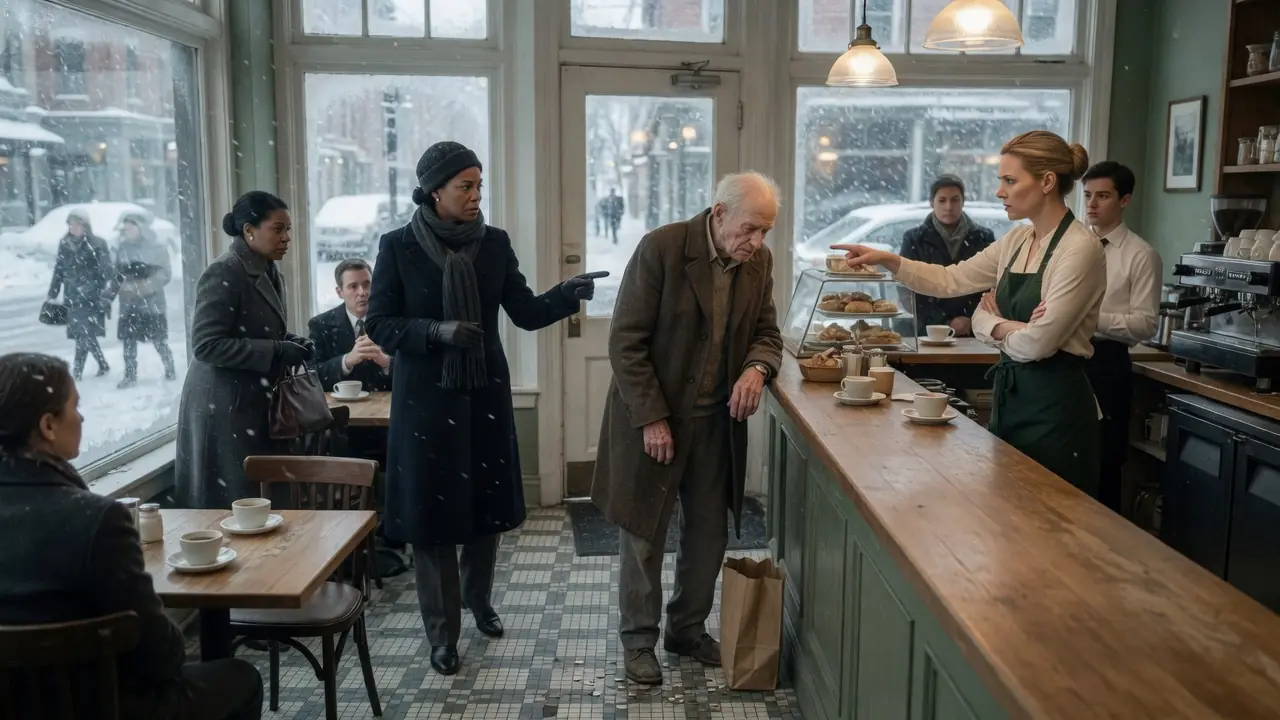
Everyone in the cafe stayed silent.
Not a single person tried to help.
The manager’s words grew more and more cruel.
Just as the old man seemed completely defeated, a Black woman stood up. She walked over and defended him.
But what happened next left everyone in the cafe speechless.
On a bitterly cold Tuesday morning in late January, the kind of morning where the wind finds its way through the thickest coats and bites at the bones, the bell above the door of the Cedar Room rang out with a faint chime that did not quite match the quiet, curated elegance of the place.
The Cedar Room was not just any cafe.
Tucked into a corner of downtown Newport, it had become a regular spot for professionals, retirees with time to spare, and the occasional family visiting from out of town.
The decor was minimalist, all white oak and muted greens, with warm lighting that tried, and often succeeded, to make people forget how harsh the world outside could be.
That morning, it was already half full.
Small tables were occupied by laptop screens, clinking cups, and the soft murmur of polite conversation.
The smell of freshly ground coffee and warm pastries lingered in the air, a kind of comfort that people had come to expect there.
Everything about the Cedar Room was polished, predictable, and very deliberately designed to keep things just the way they were.
Then Goldwin Scott stepped inside.
He did not fit.
Not into the decor.
Not into the clientele.
Not even into the pace of the place.
He moved slowly, almost cautiously, one hand trembling slightly as it hovered near the inside of his faded coat, searching for warmth that was not there.
At eighty-nine years old, Goldwin was a man worn down by years and weather.
His shoes, once sturdy leather, now revealed worn soles and fraying seams. His fingers, cracked and reddened from the cold, clutched a wrinkled paper bag that looked nearly as old as he was.
His eyes, pale blue and clouded at the edges, scanned the room, not with hope, but with the quiet dread of someone who knew what he was walking into.
Several patrons glanced up.
One man pulled his coat closer to his chair without even thinking about it.
A woman near the window shifted her purse into her lap.
Nobody said anything.
They did not have to.
Their silence was thick with suggestion.
Goldwin noticed it.
Of course he did.
He always did.
It had become part of the air around him, part of the routine of surviving each day.
Keep your head down.
Do not cause a scene.
Pretend the cold is not eating at your gut.
Pretend you do not hear the whispers, even when they are not whispers at all.
He made his way to the counter with deliberate steps, each one slow but steady, the kind of movement that betrays a body on the edge.
Behind the counter stood a woman in her early forties, Angela Meyers, the cafe’s general manager.
Angela was precise in every way, from the perfect bun in her blonde hair to the spotless apron tied around her waist.
She ran the Cedar Room like a fine watch, and she did not like anything that disrupted the rhythm.
As Goldwin approached, her eyes narrowed slightly, though her smile remained.
It was the kind of smile learned in customer service.
Thin, mechanical, and just tight enough to hold back what she was really thinking.
“Good morning,” she said, her voice polite but cool. “How can I help you today?”
Goldwin placed a small collection of coins onto the counter.
They made a dull clinking sound, barely enough to register.
His voice came out hoarse, more whisper than speech.
“I was hoping maybe a sandwich. Just the cheapest one you’ve got. Please.”
Angela did not respond right away.
Her eyes dropped to the coins, then back up to his face, scanning him like a barcode she could not quite read.
She did not touch the money.
Instead, she crossed her arms and leaned back slightly, as if his presence alone were pushing into her personal space.
“This is not a soup kitchen, sir,” she said, her tone tightening. “We serve paying customers here.”
Goldwin glanced down at the coins, ashamed.
His hand moved instinctively to gather them back, but it trembled too much.
A few coins clattered to the floor, spinning briefly before settling in the silence that had crept over the nearby tables.
No one got up to help.
A man at the corner table smirked and shook his head.
“I can pay,” Goldwin said quickly, his voice cracking. “It’s not much, but I just need something warm.”
Angela sighed, her patience clearly worn.
She did not raise her voice, but she made sure it carried.
“If you do not have enough for a proper meal, maybe you should try somewhere else. We have a reputation to keep.”
He flinched at the words like they had landed physically on his chest.
He knew this dance.
He had heard this song before.
Same tune, different lyrics.
There was always a line drawn between him and everyone else.
Sometimes it was money.
Sometimes it was status.
Sometimes, like today, it was just the unspoken rule that people like him did not belong in places like this.
He looked around the cafe, but no one met his eyes.
Not even the barista, who had paused mid-froth to listen in.
The room was full of people, but Goldwin had never felt more alone.
His hunger was not just in his stomach anymore.
It had spread into his chest, into his throat, thick and choking.
He was hungry for kindness.
For dignity.
For the smallest proof that he still mattered.
Angela leaned in slightly, her smile now gone.
“We do not do handouts here, sir. Please do not make this uncomfortable for everyone.”
Goldwin did not move.
For a moment, he could not.
His legs had gone stiff. His breath had caught in his throat.
He was not sure whether to leave or try again.
His pride told him to walk away.
His stomach, empty since yesterday morning, begged him to stay.
That was when the door opened again.
The sound of it, just the soft chime of a bell, should have been unremarkable.
But it changed everything.
Heads turned.
Even Angela paused just long enough for Goldwin to take a shaky breath.
He did not see her at first, the woman who stepped in from the cold.
But the others did.
And their reaction was not just surprise.
It was hesitation.
The door to the Cedar Room closed behind her with a quiet click, sealing out the winter wind and bringing with it a shift in the room’s atmosphere, so subtle yet so undeniable that even those buried in their phones or morning emails looked up.
Jazzy Russell stepped inside with a presence that did not demand attention, but still unmistakably received it.
She was not loud, nor did she move with the exaggerated confidence of someone seeking to prove a point.
Her presence was quiet, calm, and deliberate.
She carried herself like a woman who had earned the right to take up space because she had, in every sense.
She wore a tailored navy coat that hugged her shoulders neatly and stopped just below the knees, paired with a soft charcoal scarf and leather gloves she now began removing with care.
Her heels made soft contact with the tiled floor, measured and even.
Her skin was smooth, rich brown, and her hair, neatly pulled back into a low twist beneath a knit hat, framed her face with poised elegance.
In the seconds that followed, the tone in the cafe changed.
Patrons who had moments earlier chuckled at the old man near the counter now grew suddenly quiet, their eyes darting from her face to her coat to her shoes, silently calculating who she might be and why she was there.
The tension was not overt, but it was real.
There was no outright hostility in the air, just the kind of sharp, quiet discomfort that so often meets those who disrupt what others have come to think of as normal.
Jazzy took notice of the silence, but did not react.
She was used to it.
After years of walking into rooms where no one looked like her, she had developed a skill for reading these unspoken shifts, and she had also learned to stop letting them shape her response.
She moved toward the back of the line at first, scanning the room as she did.
That was when her gaze settled on him.
Goldwin Scott was still standing at the counter, his body slightly hunched, his hands trembling, his eyes fixed on the coins he had tried to offer as payment.
Angela Meyers remained behind the counter, arms crossed, her jaw tight with the kind of smile that had lost its shine.
One could tell she was waiting for him to move along, to leave quietly and take his shame with him.
What she was not expecting was a witness.
Jazzy’s breath caught, but not from surprise.
She had seen moments like this too many times to be shocked.
The specifics changed.
A classroom.
A boardroom.
A sidewalk.
But the dynamic stayed the same.
A person deemed inconvenient.
Another person in power pushing them aside.
And the rest watching, doing nothing.
She did not speak yet.
Instead, she watched closely.
She saw the way Goldwin’s shoulders were slightly curled inward, not just from age, but from habit, from humiliation, from too many days exactly like this.
She noticed the coins still lying on the counter untouched.
Not refused outright.
Just ignored.
That was a tactic.
Refusal would be a headline.
Ignoring made it deniable.
She knew this game.
Behind the counter, a younger barista whispered something to Angela, but it was low enough that Jazzy could not hear.
Angela nodded slightly, but did not take her eyes off Goldwin.
That was when Jazzy stepped forward.
Not quickly.
Not dramatically.
Just enough to close the space between herself and the register.
She reached into her coat pocket, not for her wallet, but to retrieve her gloves, giving herself one more moment to observe without appearing confrontational.
She watched as Angela finally broke eye contact with Goldwin and looked toward her.
“Can I help you?” Angela asked, the same default tone still in place, though now edged with something else.
Unease.
Jazzy offered a polite, tight smile.
“Not yet,” she replied evenly. “But I’m watching.”
Angela blinked, her posture stiffening.
Goldwin, hearing the voice, turned slightly toward her.
Their eyes met.
Jazzy gave him a nod.
Not of recognition, because they were strangers.
But of something deeper.
Solidarity.
She did not need to know his name to understand what he was feeling.
He blinked slowly, unsure what to do with the gesture.
Jazzy looked back at Angela.
“Does he owe you something more than what he put down?” she asked, gesturing slightly toward the scattered coins.
Angela hesitated.
“He doesn’t have enough for anything on the menu.”
“Then he is not asking for charity. He is offering what he has. There is a difference.”
Angela’s mouth tightened.
One of the patrons behind Jazzy stood up quietly and walked toward the exit, coffee in hand, eyes downcast.
Another leaned forward to whisper to a friend.
Jazzy noticed all of it.
She had lived enough years in this country to know when a room was choosing sides.
“Would you like to order something?” Angela asked her, clearly trying to redirect the interaction.
Jazzy shook her head.
“Not yet.”
Another pause.
The room remained tense, unsure.
Goldwin looked at the floor again.
Jazzy could see how badly he wanted to disappear.
How much of his life had been spent trying to be smaller, quieter, invisible in the spaces that did not want him.
That was the cruelest part of these moments.
They did not just deny people dignity.
They made people complicit in their own erasure.
Angela started to speak again, but Jazzy gently lifted one hand, signaling her to stop.
She did not raise her voice.
She did not point.
She simply stepped closer to the counter and placed a single ungloved hand gently over the coins that still sat untouched.
“This man deserves a seat, a warm meal, and your respect.”
Angela opened her mouth, but Jazzy did not give her the chance.
“I am not asking,” she said calmly. “I am watching, and so is everyone else.”
Angela looked past her, now scanning the room, perhaps realizing for the first time that silence did not mean agreement.
Jazzy did not need to turn around to know that more people were watching now, curious about what would happen next, possibly uncomfortable with what they were seeing.
That was good.
Discomfort often preceded change.
Jazzy finally took a step back and turned to Goldwin.
“Would you like to sit down?” she asked him gently.
He looked at her with something between disbelief and gratitude.
He nodded slowly, and Jazzy offered him her arm, which he hesitated before taking.
His fingers were cold and thin, but they held her wrist with surprising steadiness.
As they walked together to a table near the front window, the cafe went nearly silent, the kind of silence that only comes when something real has cut through the noise of routine.
Jazzy did not need to look back at Angela to know the message had been received.
She did not need to explain herself to anyone in that room.
Not yet.
What mattered was that Goldwin was sitting down now.
What mattered was that, for the first time that morning, he was not alone.
Jazzy remained by Goldwin’s side as he lowered himself carefully into the chair near the front window.
His knees bent with a soft groan, and she noticed the way his hands gripped the edge of the table, steadying himself, trying not to look as shaken as he was.
The room had not resumed its usual rhythm.
Conversations had not picked up.
The sound of the espresso machine hissed in the background, but even that seemed quieter than before.
Jazzy took the seat opposite him, resting her gloves gently on the table and watching as Goldwin tried to compose himself.
He kept his gaze lowered, hands folded loosely in his lap, fingers still twitching slightly from the cold, or perhaps the embarrassment.
She gave him space, letting a few breaths pass before speaking.
“Would you like something warm? Coffee? Tea?”
Her voice was soft but firm.
Goldwin nodded once, not looking up.
“If it’s not too much trouble.”
Jazzy stood, turned toward the counter, and locked eyes with Angela, who remained behind the register, arms still crossed, expression carefully neutral, but with that edge of quiet indignation still clinging to her face.
Jazzy walked over slowly, deliberately.
The people watching could not decide whether to look directly or avert their eyes.
So most of them shifted in their seats, pretending to scroll through their phones while stealing glances over their screens.
“I’d like a coffee,” Jazzy said, placing a twenty-dollar bill on the counter. “And a sandwich for the gentleman.”
She paused.
“Something hot, please.”
Angela looked at the money, but made no move to take it.
Instead, she said without changing her tone, “We have policies here.”
Jazzy tilted her head slightly.
“Policies against serving hungry people?”
Angela’s jaw stiffened.
“Policies against causing disruption.”
Jazzy smiled, but there was no warmth in it.
“You think he caused the disruption? Because from where I’m standing, it looked like he quietly asked for a meal and was humiliated in front of a room full of people. That policy?”
Angela glanced at the barista behind her, then back at Jazzy.
“We just expect a certain standard from our customers.”
“A standard,” Jazzy repeated slowly.
She took a breath, pressing her fingertips against the counter.
“Let’s talk about that, because it sounds a lot like code, and I have spent a lifetime reading between the lines.”
Angela did not respond, but her silence said plenty.
Jazzy leaned in just a little, lowering her voice, not to whisper, but to make sure only Angela could hear her.
“Is the problem that he is poor, or that I am not the kind of woman you are used to seeing defend him in here?”
Angela’s nostrils flared slightly, a flush creeping into her cheeks.
Jazzy did not give her time to answer.
She straightened and turned back to the barista.
“He’ll take the roast turkey sandwich, toasted, and a black coffee. For here.”
The barista nodded quickly and began preparing the order.
Angela still had not moved.
Jazzy looked back at her one last time.
“You do not have to like it. You just have to do your job.”
Returning to the table, Jazzy found Goldwin watching her.
His expression was caught somewhere between awe and disbelief.
His pale, tired eyes blinked slowly.
“You didn’t have to do all that,” he said quietly. “They would have made me leave.”
“I know,” she replied, taking her seat again. “That is why I did.”
He gave a faint, apologetic smile, eyes lowering again.
“You do not even know me.”
Jazzy folded her hands in front of her.
“I do not need to. I saw how they looked at you. How they talked to you. I have seen it before, more times than I can count. And not always aimed at someone else.”
Goldwin looked up, then really looked at her for the first time.
“You, too?”
She nodded.
“Different reasons. Same story.”
A long silence followed, but it was not uncomfortable.
It was the kind of silence that let the truth settle, that allowed both people at the table to breathe again without the weight of performance.
Around them, the cafe still had not returned to its normal pace.
The energy had shifted.
The customers were quieter, more deliberate in their movements.
Some avoided looking at them altogether.
A few glanced over and then looked away, ashamed or uncertain.
When the sandwich and coffee arrived, Jazzy thanked the barista, who barely met her eyes.
She pushed the plate gently toward Goldwin.
“Eat while it’s hot.”
He reached for it with hands that still trembled slightly, but this time from warmth, from the release of tension.
He took a bite, slow and almost reverent, chewing as if each piece restored something that had been chipped away over time.
Jazzy did not speak.
She just watched, letting him reclaim a little bit of dignity, a little bit of self.
Angela remained behind the counter, arms folded again, pretending to read something on the register screen.
But the tight line of her mouth and the stiffness of her shoulders betrayed her unease.
She was not used to being challenged, especially not by someone who looked like Jazzy, someone who did not raise her voice but left no room for retreat.
That kind of defiance was more dangerous than anger.
It exposed the cracks in the polite facade that places like the Cedar Room worked so hard to maintain.
Goldwin finished half the sandwich before speaking again.
“You’re not from around here, are you?”
Jazzy smiled this time, with a bit of humor.
“Depends who you ask. I was born two blocks from here, but no, most people wouldn’t say I belong.”
He nodded, taking another sip of coffee.
“You carry yourself different.”
“I had to,” she said. “When you grow up being told you don’t belong, you learn to walk like you do. Otherwise, they never let you forget.”
He looked down at the table.
“I forgot what it felt like to be seen. Not pitied. Just seen.”
Jazzy met his gaze.
“Well, I saw you. That’s a start.”
And in that moment, it was a beginning.
One neither of them expected.
But one neither could walk away from now.
Goldwin took another sip of the coffee, both hands wrapped around the cup as if it was the only warmth he trusted in that moment.
He had stopped trembling, at least on the outside, but his eyes held the kind of heaviness that came from years, not hours.
The sandwich was mostly gone, just a corner left on the plate, forgotten as his focus shifted inward.
Jazzy waited.
She did not push.
She did not prod.
Instead, she sat quietly, her hands resting in her lap, letting the silence speak until he was ready to break it.
“I wasn’t always like this,” Goldwin said at last, his voice low, rough from disuse, but clearer now. “I had a life. A family. Not a big one, but it was mine.”
Jazzy nodded slightly, offering no interruption.
“My wife’s name was Odette. She was strong, the kind of strong that could hold a room just by walking into it. She was never cruel, not to me, but she believed in rules. In order. In doing things the right way, always. And I respected that. Sometimes I feared it, but mostly I respected it.”
He paused, looking out the window, though he was not really seeing the street beyond.
He was looking backward into memories that had not surfaced in years.
“We had a son. Roger. He was everything. Smart, gentle, the kind of kid who held the door for strangers and never missed a birthday. He loved music, hated math, played piano by ear from the time he was seven. I used to come home from work and just listen to him play for a few minutes before I even said hello. That was enough to wipe the day off my shoulders.”
Jazzy watched him carefully, her expression unreadable, but her eyes did not leave his face.
“Roger was our whole world, especially for Odette. She wanted the best for him. And by that, she meant a very specific kind of life. One with structure, with rules, with a future she could understand. Private school. The right friends. The right manners. Everything just so.”
Goldwin let out a quiet breath.
“I went along with it because I wanted him to have opportunities, but I could see it wear on him. He was never meant to live inside a mold.”
He swallowed as if trying to make room in his throat for what came next.
“When Roger got older, he started pulling away. Not from us exactly, but from that path she laid out for him. He wanted to work with people, help others. He volunteered at a community center, taught kids music. He met someone there. Someone Odette didn’t approve of.”
He stopped, glanced at Jazzy, then looked down at his hands.
“She said it wasn’t about race. She said it was about class, ambition, upbringing. But I knew. I could see it in her face when he brought the girl around. She’d smile, but it never reached her eyes. She’d be polite, but her voice got tight. I tried to talk to her about it once, and she said, ‘I’m just protecting our son from making a mistake he can’t undo.’ That was the moment I knew we were losing him.”
Jazzy’s hands tensed slightly in her lap, but she said nothing.
Her breathing remained even, though her mind was racing.
“Roger loved her,” Goldwin said. “I could see it in the way he looked at her, in the way he talked about the future. He had plans, big ones. He wanted to move out, get a small place of their own, maybe go back to school, or maybe just keep doing what he was doing. He was happy, and that should have been enough. But it wasn’t. Not for Odette.”
He leaned back in the chair, the cushion groaning under the shift in weight.
His eyes were glassy now, though he had not yet shed a tear.
“They argued more and more. Not Roger and the girl. Roger and Odette. Sometimes me. She said he was throwing his life away, that he didn’t understand what he was giving up. She started blaming the girl for pulling him away. Said she was manipulating him, using him to escape her own life. I never believed that. Not once. But I didn’t say enough. I didn’t stand up for him the way I should have.”
The regret in his voice was unmistakable now, thick and unfiltered.
“One night, he didn’t come home. He called and said he needed some space. I tried to tell Odette it was temporary, that he’d be back. But she was furious. Said if he walked out, he shouldn’t bother walking back in. And he didn’t. Not that night. Not ever.”
Jazzy’s heart pounded.
She stayed still, her expression steady, but inside, every word was drawing lines between her past and the story unfolding in front of her.
“The accident happened a few days later,” Goldwin said. “We got the call from the hospital. They said it was a crash. Wet road. Lost control. He died before they even got him out of the car.”
He closed his eyes.
“She didn’t cry. Not at first. Just sat there staring. Then she stood up, went to his room, and didn’t come out for hours. When she did, she blamed the girl. Said she led him down the wrong path. Said if he hadn’t been with her, he’d still be alive.”
He wiped at his face, not realizing the tears had started to fall.
“I didn’t know what to say. What do you say to that? She was grieving, but so was I. And we never grieved the same way. That tore us apart. She pulled away from the world, and I let her. I didn’t fight. I just folded.”
Jazzy reached across the table slowly, placing her hand near his.
Not touching.
Just there.
Goldwin looked at it for a long moment before placing his own hand beside hers.
“After a while, everything fell apart. The house. Our savings. Our marriage. We lost it all. And now we drift from bench to bench, shelter to shelter.”
He lifted his sleeve slightly, revealing a worn silver watch on his wrist.
“This old watch is all I have left of him.”
It was scratched and dulled with age, but still ticking.
“Roger loved this thing,” he said with a sad smile. “Used to say it made him feel like a grown man. I gave it to him when he turned eighteen. After the crash, the hospital returned it with his things. I wear it every day. I guess I think if I keep it close, maybe a part of him stays with me.”
Jazzy stared at the watch.
Her breath caught, but she forced herself to stay calm.
She knew that watch.
Or one exactly like it.
Her eyes darted to the engraving, barely visible on the side.
She could not read it from across the table, but she did not need to.
Her memory filled in the gap.
Goldwin looked at her, suddenly aware of her stillness.
“You okay?” he asked gently.
She blinked, pulled herself together, and nodded.
“Yeah. Just… I know what it’s like to lose someone and carry them with you every day.”
He nodded slowly.
“Ever lose someone that made the rest of your life feel less alive?”
Her answer came only as a look.
A deep, heavy one.
The kind that said yes without needing a word.
They sat in silence again.
Not empty.
Full of everything unsaid.
Everything remembered.
Outside, the wind continued to press against the windows, but inside, for the first time all morning, there was warmth between them.
Not just from the coffee, but from the shared space of grief and recognition.
Jazzy held her gaze on the watch a moment longer before slowly pulling back her hand and resting it on her lap.
She looked down briefly, gathering her thoughts, her breath steadying in her chest.
Goldwin had just laid bare a lifetime of lost pain and the kind of quiet regret that only those who have loved and failed to protect that love could understand.
The moment hung in the air between them, not awkward, but sacred, as if any rush to speak would cheapen what had just been shared.
Jazzy finally looked up, and her voice, when it came, was calm and measured, though carrying a weight that had long lived inside her.
“I knew Roger,” she said softly.
Not past tense.
Not distant.
Like someone admitting a truth she had carried alone for too long.
Goldwin’s expression did not change immediately, but she saw something shift behind his eyes.
A ripple of recognition.
Or maybe confusion, trying to find clarity.
She continued slowly, carefully choosing her words.
“We met years ago, probably around the time you said he started volunteering. I was working retail back then, barely scraping by, taking night classes when I could, trying to make something out of a situation that did not offer much.”
Goldwin did not speak.
Did not blink.
He just listened.
“He walked in one evening with a group that brought winter coats to the children. Most of the volunteers came and went, but Roger stayed. He always came back. He made the kids laugh. He remembered names. He listened. That was the first thing I noticed about him. He listened.”
Her voice grew steadier as she spoke, though her eyes betrayed the years of memory pressing against each word.
“It started with short conversations, then coffee after his drop-offs. He was easy to talk to. There was no judgment in him. No performative charity. He did not pity me, and he did not treat me like some project he could fix. He saw me, and he made me feel like that was enough.”
Goldwin’s hands clenched slightly around his cup.
His breathing had deepened, but he said nothing.
“We did not rush things. It was not dramatic. It was quiet, steady, like something we both needed but did not know we were allowed to want. He told me about his mother, about how difficult she could be. How much pressure he felt to live a certain life.”
She paused.
“But he also told me about you. How you listened. How you noticed the little things. How you did not always speak up, but when you did, it mattered.”
Goldwin looked away for the first time, jaw tightening.
“I wish I had spoken up more.”
Jazzy gave him a small, sad smile.
“We all wish that, don’t we?”
She paused, her gaze drifting for a moment before returning.
“I met Odette twice. She was composed, impeccably dressed, perfect posture. But the way she looked at me…”
Jazzy swallowed.
“Not a word out of place. Not an insult said aloud. But I knew. I knew from the moment I shook her hand that I did not belong in the world she imagined for Roger.”
Goldwin nodded slowly, still not meeting her eyes.
“She never said anything directly,” Jazzy continued, “but every glance, every clipped sentence, every excuse not to invite me to family dinners, it built a wall. And Roger tried. God, he tried. He bent over backward to be the bridge. But eventually, bridges get tired, too.”
The memory caught in her throat for a moment, and she had to take a breath before continuing.
“We had one last night together. He told me he was done fighting two wars, one with his family and one with himself. He wanted to move forward with me. He was ready. We talked about what that life might look like. It was not big or fancy, but it was ours. And for the first time, I believed it might happen.”
Her voice dropped just slightly, words thick with grief.
“The next day, he was gone.”
The silence that followed was heavy.
Goldwin stared at the table as if the wood grain held the answer to a question he had not dared ask in years.
Jazzy leaned back in her chair, exhaling slowly.
“I broke after that. Not publicly. I did not have the luxury. But something inside me cracked. I did not have the time or the space to grieve properly. I had bills. A job I could not afford to lose. I went numb.”
She looked up at him again, eyes firm.
“But I promised myself something. I promised that if I ever got the chance to build something, anything, it would be because of him. Not in spite of losing him, but because he gave me a glimpse of what love could look like, of what dignity and hope felt like. I was not going to let that die in the wreckage.”
Goldwin finally looked at her.
There was no anger.
No suspicion.
Just sorrow and something close to gratitude.
“You became someone,” he said, voice cracked. “You built a life.”
She nodded once, eyes glistening.
“I had to. Not just for me.”
“He would be proud of you,” Goldwin said.
“I did not know what happened. We never got the chance to talk to anyone. After the funeral, Odette refused to speak his name for a long time. She erased everything. I did not know he had someone. That he was loved.”
Jazzy’s lips pressed together, a flicker of pain in her eyes.
“He was deeply loved.”
Outside the window, snow had begun to fall.
Not heavy.
Soft.
Steady.
People in coats hurried past, clutching coffee cups and shielding their faces.
Inside, time moved slower.
“Thank you,” Goldwin said finally. “For telling me. For not letting him just be a memory nobody talks about.”
She looked at him, her voice quieter now.
“It matters that you know someone who loved him still remembers him for who he really was, not who the world wanted him to be.”
Goldwin nodded, his eyes full.
“And now I do.”
They sat for a moment longer, not speaking, just breathing.
Two people bound by grief and love and the quiet power of truth, finally spoken aloud.
The next morning was overcast, the sky a dull shade of gray that seemed to mute the sounds of the city.
Jazzy stood by the kitchen counter in her apartment, placing a container of hot soup and a foil-wrapped sandwich carefully into a paper bag.
She moved with quiet precision, double-checking the lid, folding the top of the bag, then sliding it into a cloth tote.
The meal was not fancy, but it was thoughtful.
She had made it herself, not to impress, not to prove anything, but because it felt necessary.
Because some gestures, however small, carried weight.
She slipped on her coat, grabbed her keys, and left.
Goldwin was waiting near the park entrance when she arrived.
He gave her a quiet nod.
No words exchanged.
Just a recognition of the purpose they both shared.
They walked together without hurry, the crunch of damp gravel underfoot marking their pace.
The small park behind St. Mary’s Church was nearly empty, save for a few bundled-up dog walkers and an old man reading a newspaper on a bench near the gate.
As they approached a stone bench under the bare limbs of an elm tree, Goldwin slowed, then gestured with his chin.
“She’s always here when it’s cold,” he said quietly. “Says the wind helps her think.”
Odette sat alone, upright as always, her coat buttoned to the top, scarf wrapped neatly, gloves resting in her lap.
Her posture had not changed in decades.
She looked thinner than Jazzy remembered, more fragile perhaps, but there was still a sharpness in her eyes that distance could not dull.
Jazzy did not approach immediately.
Instead, she stopped a few feet away and set the bag down on the edge of the nearest bench.
“It’s just soup and a sandwich,” she said gently. “Something warm. That’s all.”
Odette did not move.
Her gaze remained forward, fixed on some unseen point beyond the bare trees.
Jazzy stood still for a moment longer, then stepped back, not waiting for thanks, not expecting any.
She turned to Goldwin and gave him a small nod.
As they began to walk away, a rustling sound behind them made them both pause.
Jazzy turned her head just in time to see Odette rise, pick up the bag, walk steadily to the nearby trash bin, and drop it in without a word.
The sound of it hitting the metal was louder than it should have been.
Jazzy’s chest tightened.
Not in shock.
In a kind of weary recognition.
She stood silently for a moment, then turned back and walked toward Odette with slow, even steps.
Goldwin stayed behind, his face etched with something between resignation and grief.
Odette did not move as Jazzy approached.
She simply folded her arms, her lips pressed in a line, her chin slightly raised.
The wind picked up around them, tugging at the ends of her scarf.
“I did not come here to change your mind,” Jazzy said. “Or to ask for anything.”
Odette turned her head slightly, just enough to let Jazzy know she was listening.
“But throwing it away,” Jazzy continued, her voice calm and steady, “was a message. Loud and clear.”
Odette finally looked at her.
The gaze was sharp, cold, but not as unshakable as it once might have been.
“You think kindness fixes everything?” Odette asked, her voice measured, every syllable deliberate.
“No,” Jazzy replied. “I think it reveals what people are willing to destroy, even when it is offered freely.”
Odette held her stare for a moment, then looked away again.
“You came to gloat. To parade around with your good intentions like that makes up for what you did.”
“I came because I loved him,” Jazzy said, her voice lower now, but unwavering. “Because he was the best thing that ever happened to me, and I never got to say goodbye.”
Odette turned her whole body this time, facing Jazzy fully.
Her expression hardened.
“You destroyed him. You pulled him away from everything he was meant to be. He was supposed to have a life. A proper one. Marriage, career, respect. You made him throw it all away.”
Jazzy took a breath, keeping her eyes steady.
“He made his own choices. You just never forgave him for them.”
For a moment, neither woman spoke.
The wind rustled the leaves that clung stubbornly to the trees.
Jazzy could feel her heart beating in her chest, steady but heavy.
She had not come to fight.
But she was not going to let lies stand in silence.
“He was happy,” Jazzy said finally. “We were not perfect, but he was finally free. He did not have to pretend. He could breathe.”
Odette shook her head slowly.
“He was lost. Confused.”
“No,” Jazzy answered. “He was in love, and it terrified you because it did not look like the future you planned for him.”
Odette’s mouth opened slightly as if to respond, but nothing came out.
She closed it again.
When she spoke next, her voice was quieter.
“He died because he walked away from the life we built for him.”
Jazzy stepped forward, not in anger, but in certainty.
“He died because of a wet road and bad timing, not because he loved me. You keep blaming me because it is easier than blaming yourself.”
The words hung in the cold air, sharp and undeniable.
Odette flinched just slightly, but enough for Jazzy to see it.
Her eyes darted downward for a second before returning.
“What do you want from me?” Odette asked. “An apology? Forgiveness? Some kind of peace?”
“None of that,” Jazzy said. “I just wanted you to see me. Not the version of me you built in your head. The real me. The woman your son loved.”
Odette swallowed hard, and for the first time, her voice faltered.
“It was easier to hate you,” she admitted, “than to accept that he chose you.”
Jazzy nodded once.
“I know. And you still can. That is your choice. But do not pretend he did not love me, because he did. You know it.”
They stood in silence, the space between them full of years, grief, and unspoken truths.
Goldwin remained at a distance, watching, his hands in his coat pockets, his eyes dim with a sadness that had not faded since the day he lost his son.
Odette turned away first, sitting slowly back down on the bench.
Her shoulders dropped just slightly, a posture that no longer carried the same armor as before.
Jazzy did not move to comfort her.
She simply stood still, allowing the moment to land.
Then she turned, walked back toward Goldwin, and together they left the park without another word.
The bag of food still rested in the trash bin behind them, untouched, cooling in the winter air.
But the silence that followed was not as bitter as the one before.
It was the kind of silence that comes after something real has been said, and there is nothing left to add.
The wind had picked up since the morning, bringing with it a thin, sharp cold that cut through even the thickest coats.
Jazzy walked briskly through the narrow alley that led behind the church, her gloved hands clutching a thermos and a small paper bag pressed close to her chest.
Goldwin had called her less than an hour ago, his voice low but urgent, telling her he had found Odette slumped against the wall behind the cathedral’s back door.
She had not moved for what seemed like hours, and he was scared.
He had not said much more than that, and Jazzy had not needed more.
She just said she would come.
When she turned the corner, she saw them.
Goldwin stood a few feet away, arms folded tightly, shifting his weight from foot to foot as if the cold were bothering him more than usual.
Odette sat hunched over, coat collar pulled high around her chin, scarf disheveled, gloves missing.
Her breathing was shallow but visible, and her eyes stared blankly ahead, unfocused.
Jazzy approached without a word.
She knelt beside Odette, her knees touching the damp ground.
Her voice came quiet and soft.
“You’re freezing. You need to get out of this cold.”
Odette did not answer.
She did not even blink.
But she did not pull away either.
That was something.
Jazzy opened the thermos, poured the steaming broth into the lid, and held it out gently, inches from Odette’s lap.
“It’s just broth. Warm. Easy on your stomach.”
Odette blinked slowly, then turned her head.
For the first time, she looked directly at Jazzy.
Her eyes were bloodshot, rimmed with pink, and tired in a way that went beyond illness.
Her expression was unreadable at first.
No hatred.
No anger.
Just weariness, a kind of hollow fatigue that made Jazzy’s breath catch.
She held the cup steady.
A full five seconds passed before Odette reached out.
Her hand trembled as she took the lid from Jazzy’s fingers, and for a split second, their skin brushed.
It was not the touch that stunned Jazzy.
It was the look.
Odette’s eyes, in that single fleeting moment, flickered with something she had not shown before.
Not defiance.
Not bitterness.
Confusion.
Like she did not know what to do with kindness that was not pity.
Her grip was loose, as if she was not sure she deserved to hold anything warm, but she did not let go.
She brought the cup slowly to her lips and took a small sip.
Her throat moved once, and she winced slightly.
Then she drank again, this time longer.
Jazzy stood and unzipped the thick blanket she had folded under her arm.
She draped it over Odette’s shoulders without fanfare, not tucking it in, not fussing, just laying it down with the care of someone who was not there to fix, but to help.
Odette did not protest.
She did not thank her either.
But she pulled the edges of the blanket closer together herself, which was enough.
Goldwin let out a breath he had not realized he was holding and moved a little closer, placing a hand on the backrest of the bench, but not sitting.
Jazzy turned to him.
“We need to get her inside somewhere warm. A clinic, maybe. She’s burning up.”
Goldwin nodded.
“There’s a church shelter open tonight. I can get them to take her in if we bring her.”
Jazzy crouched again and looked Odette in the eye.
“You don’t have to talk, but you have to let us help you just this once.”
Odette did not speak.
But after a long pause, she gave a barely perceptible nod.
That was enough.
Between them, they helped her to her feet.
She moved slowly, like every bone in her body had grown heavier.
But she did not resist.
The walk to the shelter was silent.
Jazzy walked on one side.
Goldwin on the other.
Odette, blanketed and quiet, leaned slightly more on Jazzy than she would probably care to admit.
The shelter was warm and smelled faintly of disinfectant and old wood.
The volunteer at the desk recognized Goldwin and nodded them through.
They were given a small room with a cot, a heater, and clean linens.
Jazzy helped ease Odette down onto the mattress and removed her shoes gently.
She set the thermos beside the bed, then stepped back to give her space.
Odette lay down without protest.
Her breathing was slower now, more even.
Jazzy stood by the door, unsure if she should speak.
But Odette surprised her.
“You think this makes us even?”
Her voice was low, rough.
Jazzy did not move.
“No,” she said. “It makes us human.”
Odette stared at the ceiling, eyes half-lidded.
For a long moment, the only sound in the room was the hum of the wall heater.
“You didn’t have to come,” Odette said finally.
“I know.”
“But you did.”
Jazzy looked at her, not with pride, not with triumph, but with something quieter, something closer to understanding.
“He would have done the same,” she said. “For someone I loved.”
Odette turned her head slightly on the pillow.
Her face looked softer now, framed by the blanket, flushed from fever, but no longer tense with disdain.
She blinked slowly.
“I spent years building walls around the pain, around the memories. I thought it would keep me safe. All it did was keep me alone.”
Jazzy stepped closer but did not sit.
She nodded.
“We all survive how we know. Sometimes we have to unlearn it.”
Odette closed her eyes for a moment.
When she opened them again, they were glassy with fatigue.
“Thank you for the broth,” she whispered.
Jazzy offered a small smile.
“You’re welcome.”
She turned to leave, giving Odette the space she clearly needed.
But as she reached the door, she heard a faint voice behind her.
“I’m tired of fighting ghosts.”
Jazzy paused, hand on the doorknob.
She did not turn around when she answered.
“Then maybe it’s time we talk to the living.”
And with that, she stepped into the hallway, leaving behind a room warmer than it had been just hours before.
And a woman who, for the first time in a long time, had accepted something without needing to understand it first.
The first night under Jazzy’s roof was quiet in a way that felt heavier than silence.
Goldwin and Odette sat near the entrance for several minutes after stepping inside, unsure whether to remove their coats, unsure whether this place was temporary shelter or the beginning of something else.
Jazzy did not rush them.
She simply pointed to the small guest room and said, “You can rest there. The bedding is clean.”
Her voice was warm, but not inviting.
It was careful.
She did not smile.
Did not hover.
She turned and walked to the kitchen, leaving them space to choose what came next.
The apartment was not large, but it was meticulous.
The kind of clean that comes from routine and discipline, not fear.
A faint scent of eucalyptus hung in the air, and the light from the floor lamp gave the living room a softness that did not try too hard.
Jazzy moved like someone who had lived alone for a long time and liked it that way.
Every drawer had a rhythm.
Every mug had its place.
She knew where things were, even in the dark.
Odette slept most of that first day.
Fever still clung to her body, and though the worst had passed, her strength came back slow and stubborn.
Jazzy left food at the door, but never knocked.
A bowl of broth.
Later, slices of toast with apple butter.
A day after that, a warm plate of rice and lentils with lemon on the side.
Odette never said anything, but the dishes always came back empty, rinsed, and stacked neatly in the sink.
That was how they communicated at first.
Goldwin was easier.
He moved through the apartment with the comfort of someone who knew how to make himself small.
He folded laundry without being asked.
He swept the kitchen floor.
He did not speak much, but when he did, his words were soft, unobtrusive.
In the evenings, he sat in the corner armchair and told short stories about Roger.
Little things.
Once, about the time Roger had climbed onto the roof at ten years old just to prove he could touch the weathervane.
Another time, about the night Roger stayed up late baking cookies for a girl at school, only to burn every single one and try to hide the tray under his bed.
Jazzy smiled at those stories.
Not every time.
But often enough.
Odette listened from the next room.
She never joined them in the living area, but the door stayed cracked, and her cough had grown softer.
On the fifth day, she emerged briefly to take tea.
She did not sit.
She just stood by the counter, sipped quietly, nodded once, and returned to the guest room.
It was not much.
But it was the beginning of not running.
One afternoon, Jazzy sat at the dining table responding to emails when her phone buzzed beside her.
She picked it up quickly, glanced at the name on the screen, and smiled.
A rare, private kind of smile.
The kind a person does not fake.
She typed back a short reply and set the phone down, her expression shifting almost immediately back to neutral.
Goldwin, sitting across from her, had caught a glimpse of the contact name.
Ryder.
He did not ask, but his eyes lingered on her face for a second longer than usual.
She noticed, but did not speak.
The next morning, Jazzy folded laundry in the living room.
A pair of Odette’s socks, thick with wear, lay beside a fresh white towel.
She folded them gently, placed them on top of the pile, and left them outside the guest room.
That evening, Odette emerged, carrying the same socks now folded differently, with sharper corners, more symmetrical.
She paused, stared at the bundle, then set them down in the same place Jazzy had left them.
She did not say a word.
She walked away, but Jazzy saw it.
The hesitation.
The pause between rejection and acceptance.
Later that week, a small moment broke the stillness.
Goldwin, trying to boil water, dropped the kettle lid onto the tile.
It clanged loudly, spinning once before landing at Jazzy’s feet.
She bent down to grab it, laughing softly.
“Careful, Gold. You’re about to start a fire with chamomile.”
He chuckled, rubbing the back of his neck, sheepish.
To everyone’s surprise, a short laugh came from behind them.
Odette, standing near the hallway with a shawl wrapped around her shoulders, had seen the whole thing.
The sound she made was not loud, but it was unmistakably a laugh.
Brief.
Almost startled.
And then, just as quickly, it disappeared.
She turned and walked away.
No one mentioned it.
But something shifted.
That night, dinner was quiet, but not tense.
Jazzy made roasted vegetables and couscous.
Goldwin talked about the first time he and Odette had eaten Moroccan food back in 1979, when Roger was still a toddler, and they did not know what couscous even was.
Odette chewed slowly, her fork pausing midair when Goldwin spoke.
Jazzy noticed, but did not look up.
Instead, she offered the olive bowl in Odette’s direction.
Odette took one.
They did not speak of it.
On the ninth day, Odette found Jazzy standing in the kitchen boiling water.
She lingered at the threshold.
Jazzy poured a second mug without asking and placed it on the counter.
Odette walked over and picked it up, but instead of leaving, she stayed.
Her hand wrapped around the cup with a cautious grip.
She did not drink.
She looked at Jazzy, eyes steady.
“You keep this place very clean,” she said.
Jazzy did not flinch.
“It helps me breathe.”
Odette nodded slowly.
Then quietly, she said, “I used to iron the sheets, even in the summer.”
Jazzy smiled.
“I don’t even own an iron.”
They did not laugh.
But the silence between them lost its edge.
For the first time, Jazzy saw in Odette’s eyes not judgment, but something else.
Recognition.
Not agreement.
But shared humanity.
That night, Jazzy brewed ginger tea and placed it in front of the guest room, wrapped in a napkin with a slice of lemon.
She did not knock.
In the morning, the mug was on the counter, clean, dry, rinsed, and left exactly where Jazzy would leave it.
That afternoon, as Jazzy was returning from the grocery store, she pulled out her phone and smiled again at a text.
Ryder.
She typed something back, short but affectionate, and paused before putting her phone away.
She stood in the hall outside the apartment for a moment longer than necessary, her fingers brushing the back of the device.
Inside, Odette sat at the dining table with a crossword puzzle from the paper Goldwin brought every Thursday.
She looked up when Jazzy entered, then back at her page.
But her eyes flicked once, briefly, to the phone in Jazzy’s hand.
She did not ask.
Not yet.
But later that night, just before bed, Odette knocked lightly on Jazzy’s door.
She did not come in.
She just said one thing.
“You sound different when you talk to him.”
Jazzy sat up from her chair, surprised, not quite sure how to answer.
She opened the door slowly, but Odette was already halfway down the hall.
Jazzy watched the older woman disappear into her room.
And just before the door shut completely, Jazzy replied softly enough for the words to follow through the quiet.
“He brings out the part of me that never stopped hoping.”
It was just past noon when the knock came at the door.
Jazzy was finishing lunch prep, stirring a pot of pasta on the stove, her sleeves rolled up and the radio low in the background.
Goldwin sat at the dining table slowly peeling an orange, while Odette, as usual, read her newspaper in silence, glasses low on her nose.
The day had the rhythm of quiet normalcy, the kind that almost felt like peace if one did not pay too close attention to the pauses between words.
The knock was firm.
Not rushed.
Not hesitant.
Jazzy turned down the burner, wiped her hands on a towel, and moved to the door.
When she opened it, her whole posture changed.
Ryder stood there, tall and lean, with that slightly uneven smile he always wore when he was not sure whether to hug or just say hello.
He wore a light jacket, his backpack slung over one shoulder, and his curls still damp from the drizzle outside.
Jazzy’s face, which had been calm all morning, lit up in a way neither Odette nor Goldwin had seen before.
It was unguarded.
Immediate.
So deeply affectionate it seemed to catch even her off guard.
“Hey, Ma,” he said, stepping in.
She stepped aside to let him pass, one hand briefly on his back.
“You’re early. I thought you had studio till three.”
“Professor let us out. Said the light was no good for portraits today,” Ryder replied, setting his bag down by the wall.
His voice was smooth, confident, but not performative.
He had a quiet grace, the kind of presence that did not push, but somehow filled the room.
Jazzy turned back to the kitchen without another word.
But there was a softness in her steps now, something looser in the way her shoulders sat.
Ryder looked up and saw Goldwin watching him with a kind smile.
“You must be Goldwin,” Ryder said, walking over with his hand extended.
Goldwin stood and shook it firmly.
“You must be Ryder. I’ve heard about you.”
“All good things, I hope,” Ryder grinned.
“Only the best,” Goldwin replied, eyes twinkling.
Then he stepped back and nodded toward the living room.
“Make yourself comfortable. Lunch is almost ready.”
Ryder turned and noticed Odette still seated, her paper resting now in her lap.
Her eyes were fixed on him.
Not unkindly, but with an intensity that did not match the moment.
Ryder walked toward her, extending the same hand.
“Hi, ma’am. I’m Ryder.”
Odette did not immediately take his hand.
She looked at it, then up at him.
Something flickered in her expression.
Surprise.
Uncertainty.
And the faintest trace of confusion.
Then she lifted her hand, touched his briefly, and nodded.
“Odette,” she said simply.
He smiled again.
“Nice to meet you.”
Lunch was quiet at first.
Jazzy served the pasta, a creamy dish with roasted tomatoes and basil, and placed a salad bowl at the center of the table.
Ryder sat beside Goldwin, across from Odette.
He talked about school, about his photography class, about an upcoming portfolio project.
He was animated, but not loud.
Expressive without being showy.
Odette watched him the way one watches a painting come into focus, unsure of what was being revealed until it was already too clear.
At one point, he laughed at something Goldwin said, a memory about Roger breaking a chair at the dinner table trying to balance on two legs.
Jazzy laughed, too, shaking her head.
“He told me that story,” she said. “Said the only thing hurt was his pride.”
Goldwin chuckled.
“That sounds about right.”
Odette did not speak, but her fork had stopped moving.
After lunch, Ryder stood and began clearing plates, insisting he could help.
Jazzy leaned against the counter, drying glasses as he washed.
Goldwin went to the armchair with a book.
Odette remained at the table, unmoving.
Then it happened.
Ryder, holding the pot of leftover pasta, turned and called out, “Mom, where should I put this?”
The word hit the room like a dropped pane of glass.
Everyone heard it.
Everyone froze.
Jazzy straightened slightly.
Goldwin looked up slowly.
Odette blinked once, her hand still on the edge of her plate.
Jazzy took the container from Ryder, placed it in the fridge without a word, then turned.
Her face was calm, but her eyes were sharper now.
Goldwin stood.
He looked at Ryder.
Then at Jazzy.
“Is it true?” he asked, not angry, just low, tired, hopeful.
Jazzy nodded.
Her voice was steady.
“Yes. He’s Roger’s son.”
Silence again.
Ryder looked from one face to the next, realizing this was news.
Odette stood slowly.
Her hands trembled at her sides.
She did not speak.
Her face had gone pale.
Goldwin crossed the room and stood in front of Ryder.
He looked at him fully now, eyes searching.
Then he placed both hands on the young man’s shoulders.
“I see him,” he said, voice cracking. “I see him in you.”
Ryder blinked fast, emotion rising but kept in check.
“I never met him, but I always wanted to. Mom told me about him. I knew who he was. I just did not know if it mattered to anyone else.”
Goldwin pulled him into an embrace.
Not rushed.
Not tight.
Deep.
Honest.
Across the room, Odette had not moved.
She stared at Jazzy.
Her face was unreadable.
Jazzy stepped forward.
“I did not keep him from you. I was not hiding him. I just did not think you would want to know.”
Odette did not reply.
Her hands were now clasped in front of her, knuckles white.
Then she turned, walked slowly down the hallway, and closed the door to her room.
No slam.
No words.
Just distance.
Jazzy sighed.
She turned to Ryder, who now stood beside Goldwin, unsure.
“She needs time,” Jazzy said. “It took her years to mourn someone she never really lost. This… this changes everything.”
Ryder looked toward the hallway.
“I did not mean to shake things.”
“You didn’t,” Goldwin said. “You just showed up. And sometimes that is the most powerful thing a person can do.”
Later that night, Ryder stood in front of a framed photograph on the hallway table.
It was Roger, younger, mid-laugh, a candid shot from a picnic.
Jazzy joined him, setting a candle near the frame.
“He would have loved you,” she said softly.
Ryder nodded, staring at the face he had never known.
“I already do,” he whispered.
And in the room down the hall, behind a door that now stood slightly ajar, Odette sat in the dark, her fingers touching her lips, her chest rising slowly, her eyes blinking back the years that suddenly felt too close to hold back.
The morning after the truth unfolded, the apartment felt still.
Not silent in a tense way.
But with the calm of something heavy having finally been set down.
Jazzy moved through the kitchen as she always did, methodical and quiet, preparing breakfast like any other day.
She did not expect much conversation.
But when she turned from the stove, she saw Odette already sitting at the table, her hands folded, eyes steady.
No newspaper.
No pretense.
Just presence.
Jazzy placed the tea down gently.
Odette watched the steam rise before speaking.
“You take your tea with honey, right?”
Ryder, who had just walked into the kitchen, paused.
The question was simple, but it landed with the weight of something far more.
He nodded.
“Yes, ma’am.”
Odette turned, picked up the honey jar from the tray, and passed it to him.
Her hand did not tremble.
That morning, they all sat together.
Jazzy served oatmeal and fruit, and for the first time, there were no excuses, no closed doors, no lingering looks exchanged in silence.
Ryder spoke about a photography project he was working on, a series titled Choices.
Goldwin sipped his coffee, slowly smiling at the name.
“There are a lot of those in this house,” he said.
Odette looked at Ryder.
“Start here. There’s history worth telling.”
He nodded, grateful, sensing that this was not a performance.
She did not say it to impress him.
She said it because it was time.
Later that afternoon, Goldwin suggested they all go out.
Nothing fancy, just a walk through Lincoln Park, where Roger had spent his childhood weekends chasing pigeons and kicking pine cones along the paths.
The weather was crisp but clear, the sun low but bright.
Jazzy packed a thermos of cocoa and some shortbread cookies she had bought the day before.
Ryder offered to drive.
Odette did not protest.
At the park, the group moved at a relaxed pace.
Goldwin walked with Jazzy for a while, pointing out the bench where Roger once scraped his knee climbing up too fast.
Ryder took photographs of tree branches and passing ducks.
Odette walked quietly, her eyes scanning the familiar yet distant scenery.
They paused at a bench near the pond, and Ryder sat beside Odette.
There was a long moment where neither said anything.
Then she reached into her coat pocket and pulled out something wrapped in a faded handkerchief.
She unfolded it slowly, revealing a silver wristwatch.
The same one Roger had worn in every picture.
The same one Jazzy once gave him.
Odette looked at the watch, then at Ryder.
“This belonged to your father. He wore it every day. Never took it off, not even in the rain. He said it made him feel anchored.”
Ryder watched her hands carefully as she held the object.
She held it out.
“I think he would want you to have it.”
He took it without a word, holding it like something sacred.
Then he slipped it on.
It fit.
Jazzy stood a few feet away, watching the exchange with quiet eyes.
Goldwin rested a hand on her shoulder, offering no words, just presence.
That evening, dinner was warm and filled with the kind of conversation that wandered like a river with no need to rush.
Jazzy made chicken and rice with carrots, Roger’s favorite comfort meal.
Odette asked Ryder about school, about his photography, and if he ever thought about music like his father.
Ryder admitted he played piano sometimes, though not well.
Goldwin chuckled and told the story of Roger’s first recital, where he got so nervous he forgot to play, but stood up and bowed anyway.
Odette smiled.
“He always knew how to exit a room.”
After the meal, Ryder set his phone on the table and turned on a playlist.
Soft jazz filled the room.
No one talked over it.
No one needed to.
It felt like a memory they were all sharing, even if they had not lived it together.
When it was time for Ryder to leave for his dorm, he packed slowly, taking the watch, a few books, and his charger.
Before heading out, he stood at the door with his backpack on.
He looked at Goldwin first.
“Thank you for seeing me. For not asking me to prove anything.”
Goldwin hugged him again, tighter this time.
“You don’t need to prove anything. You just keep showing up.”
Ryder turned to Odette.
She stood very still.
“I’m proud to carry his name,” he said. “But I’m prouder we got to meet.”
She nodded.
Her voice came quieter than usual, but firm.
“Me too.”
Jazzy walked him to the door.
As she opened it, he turned and gave her a look only a son could give his mother.
Grateful.
Full of knowing.
Full of love that did not need to be spoken.
After the door closed behind him, she stood still, hand still on the doorknob.
A quiet breath left her.
Odette came to stand beside her.
They did not look at each other.
Not yet.
Odette stared straight ahead.
Her voice was low.
“He’s a good boy. You did well.”
Jazzy nodded.
“He made me better.”
Odette gave a small sound, a noise that was not quite agreement, but not dismissal either.
Then she turned and walked back into the living room.
Jazzy stayed by the door a moment longer.
She looked around the apartment, at the table still warm from dinner, the couch where Ryder had left a hoodie, the soft light over the photograph of Roger on the shelf.
She took a breath and walked over, straightening the frame slightly.
Then she sat down, picked up a book, and let the evening settle.
Outside, the streetlight flickered on.
Inside, the light stayed warm.
The silence was not empty now.
It had shape.
It had memory.
And for the first time in a long time, it felt like home.