“You drop those buckets at fifty yards every time,” Garrison Black called from the cabin porch.
Anaya Mercer tightened her aching fingers around the wooden handles and kept walking. Snow reached halfway up her worn boots, the bitter mountain wind cut through her thin ivory dress, and each bucket dragged against her shoulders like an anchor. She refused to look back at the broad-shouldered mountain man watching her with his arms crossed. “Then I’ll carry them farther today,” she answered through clenched teeth.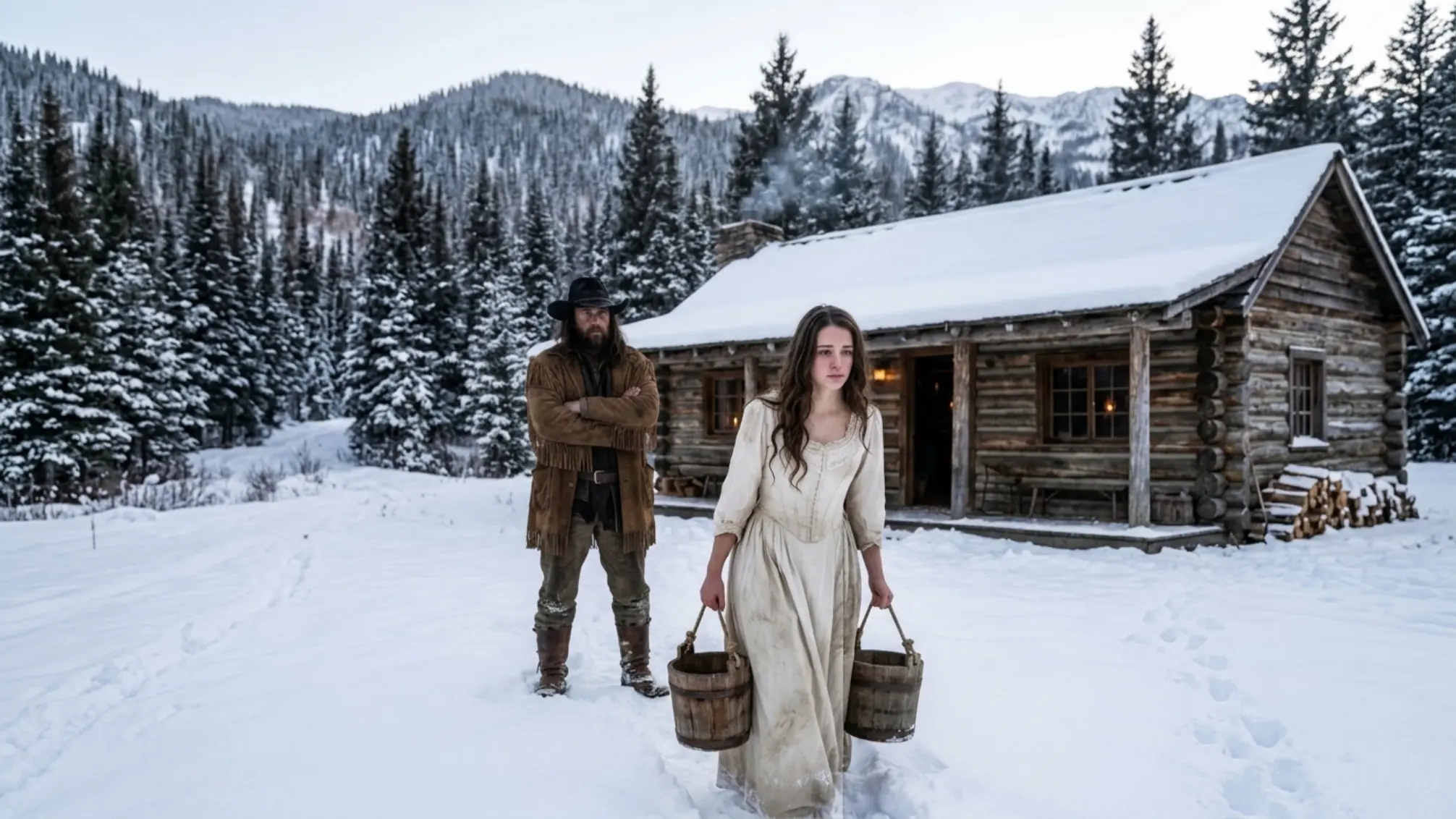
Garrison did not step forward to help. “Good. The mountain won’t carry them for you.”
Every part of Anaya wanted to release the buckets and collapse into the snow. Five months earlier, servants had carried her bathwater, polished her shoes, and buttoned the delicate sleeves of dresses made in Boston. Now her palms were blistered, her skirt was patched, and her breath came in painful white clouds as she forced herself through the frozen yard.
Fifty yards became sixty. Sixty became seventy.
When Anaya finally reached the porch, water spilled over the rims and splashed across her boots. She placed both buckets beside Garrison without dropping them, then straightened despite the fire burning through her arms. “Keep watching,” she said. “I’m not the woman he left behind anymore.”
For the first time that morning, something softened in Garrison’s dark eyes. He gave one small nod, the closest thing he offered to praise. “No,” he said. “You’re not.”
The woman Garrison had first seen in Red Creek would not have survived that walk.
On the day Anaya Mercer was supposed to begin a beautiful new life, she stood alone in the middle of a mining town where dreams vanished almost as quickly as the dust beneath passing wagons. Her white lace wedding dress looked painfully out of place against the muddy street. Three heavy trunks surrounded her, and in one trembling hand she held a train ticket that no longer meant anything.
In the other was a letter from the man she had crossed half a continent to marry.
Anaya, I have made a practical decision. Margaret Bell’s father has offered me a partnership in his bank, and our marriage will provide security neither of us could have achieved together. You have always been kind, but kindness does not build a future. I hope you return east without causing embarrassment.
The letter was signed by Charles Whitmore, the man who had once promised to love her until death. He had not even possessed the courage to meet her train. Instead, a hotel clerk handed her the letter and informed her that Charles had married the banker’s daughter three days earlier.
Anaya had spent nearly everything she owned traveling west. The ticket in her hand would take her only as far as Denver, and she had no money for lodging once she arrived. Her parents were dead, her nearest relative lived somewhere in Massachusetts, and pride prevented her from sending a desperate telegram to people who had warned her not to trust Charles.
The townspeople knew her story within minutes.
Shopkeepers watched from their doors while teamsters whispered beside their wagons. A pair of miners laughed after noticing the veil pinned beneath her dark hair. Even the stationmaster looked at her with the impatient expression of a man waiting for unwanted luggage to be removed.
Then the afternoon wind tore Charles’s letter from her fingers.
The paper rolled across the muddy road and stopped beneath a large, scarred boot. A towering man bent, picked it up, and read only enough to understand what it was before folding it carefully. He wore a weather-darkened buckskin coat, rough trousers, and a black hat pulled low above a face almost hidden by a full beard.
He handed the letter back without offering pity.
“You got nowhere to go?” he asked.
Anaya stared at him. His voice was deep and rough, but there was no amusement in it. She looked past him toward the surrounding strangers, all of whom appeared eager to watch her admit how completely her life had fallen apart.
“No,” she whispered.
The man glanced at her three trunks. “What’s in those?”
“Clothing. Books. Household things.”
“Anything you can’t lose?”
Anaya thought about the silver hairbrush that had belonged to her mother, the small collection of poetry her father had given her, and the linens she had embroidered for a marriage that would never exist. “Yes.”
The stranger lifted the first trunk as though it weighed nothing and carried it toward a pack mule. He returned for the second without explaining himself.
Anaya followed him. “What are you doing?”
“Taking them home.”
“I don’t have a home.”
He secured the trunk to the mule, then looked at her with those calm, unreadable eyes. “Now you do.”
His name was Garrison Black, though few people in Red Creek knew much more about him. He came down from the mountains several times each year to trade furs, purchase flour, salt, coffee, ammunition, and medicine, then disappeared again. Some claimed he had once served as an army scout, while others believed he had fled north after killing a man in Texas.
Anaya knew none of those rumors when she followed him out of town.
She knew only that every person around her had watched her humiliation, and he was the sole man who had lifted her burden without asking what she could give him in return. That simple act felt more trustworthy than all the promises Charles had written during their two-year courtship.
Garrison helped her onto a patient gray mule and led them toward the northern trail. Red Creek disappeared behind a curtain of drifting dust, taking Charles, the mocking miners, and the broken future with it. Anaya did not look back.
The first mile was gentle. After that, the trail narrowed between steep slopes and rocky drops that made her grip the saddle until her fingers hurt. Garrison walked ahead, leading his dark horse and the mule carrying her trunks.
“Keep to the inside,” he called when the path curved above a ravine. “Rocks are loose near the edge.”
“I know how to ride.”
“That mule knows how not to fall. Let her decide where to step.”
Anaya swallowed her offended reply and loosened the reins. The mule immediately moved closer to the mountainside, avoiding a section of shale that broke away beneath her rear hoof. Stones rattled hundreds of feet into the valley below.
Garrison glanced back but said nothing.
Her elegant boots were made for train platforms and drawing rooms, not mountain paths. When the trail became too steep to ride, Anaya dismounted and tried to follow on foot. Within an hour, mud covered the leather and blood stained one heel.
She stumbled while crossing a shallow creek and twisted her ankle. Garrison caught her beneath the arms before she fell into the water. His strength startled her, but he released her as soon as she was steady.
“I can walk,” she insisted.
“Didn’t say you couldn’t.”
Her lace skirt had snagged repeatedly on branches and thorny bushes. When she nearly tripped for the third time, Garrison drew his knife and crouched beside her. Before Anaya understood his intention, he cut away several inches of ruined fabric.
She stepped back indignantly. “That dress was made for my wedding.”
“You kept tripping on it.”
“It was expensive.”
He examined the mud, tears, and blood already covering the ivory cloth. “Still is, if you plan to die protecting it.”
Anaya wanted to slap him. Instead, she looked at the jagged trail behind them and allowed him to cut the other side evenly. When he finished, the dress reached her ankles rather than dragging across the ground.
They continued climbing.
Garrison did not fill the journey with questions. He never asked why Charles abandoned her or what kind of woman crossed the country to marry a man who valued money more than loyalty. His silence felt strange at first, but after hours of public humiliation, Anaya discovered relief in not being forced to explain her pain.
They reached the cabin shortly before darkness.
It stood beneath towering pine trees on a shelf of land high above the valley. Snow remained in shaded places despite the approaching summer, and a narrow stream flowed past the barn before vanishing between rocks. The cabin was small, built from heavy logs darkened by age, with a stone chimney and one glowing window.
Inside, everything was plain but carefully maintained. A large fireplace occupied one wall, while a wooden table, two chairs, and several shelves filled the main room. Traps, snowshoes, ropes, and tools hung from pegs near the door.
There was only one bed.
Anaya stopped when she saw it. Garrison noticed her expression, pulled a rolled blanket from a chest, and placed it near the fireplace.
“You take the bed,” he said. “I sleep here.”
“I did not mean to suggest—”
“You didn’t.”
He carried her trunks inside, then prepared coffee and warmed a pot of venison stew. Anaya sat beside the fire, staring at the wedding veil still pinned in her hair. When she removed it, the lace trembled between her fingers.
Her tears began without warning.
Garrison placed a steaming cup on the floor beside her and draped a thick bearskin around her shoulders. He did not tell her Charles was a fool or promise she would find another man. He did not say that everything happened for a reason.
“Cry if you need to,” he said. “The mountain don’t care.”
Anaya laughed through her tears. It was a broken, exhausted sound, but it was the first honest thing she had felt all day. “That may be the worst comfort anyone has ever offered me.”
“Wasn’t meant as comfort.”
“What was it meant as?”
“Permission.”
She studied him across the fire. Garrison had already turned away, giving her the privacy to fall apart without being watched. Anaya wrapped herself in the bearskin and cried until there were no tears left.
The next morning, she learned that shelter in Garrison’s cabin did not mean a life without work.
He woke before sunrise, fed the animals, checked his traps, repaired a damaged section of roof, and returned carrying enough firewood to last several days. Anaya offered to prepare breakfast, confident that cooking would prove her usefulness.
She burned the biscuits and ruined the coffee.
Garrison ate both without complaint.
“You don’t have to pretend they’re good,” she said.
“A bad biscuit fills the same space as a good one.”
“That is hardly encouraging.”
“Tomorrow, make better ones.”
His bluntness irritated her, but it also freed her from the fear of disappointing him. Garrison did not expect perfection. He expected effort.
Anaya began learning the mountain one task at a time. She gathered eggs, washed clothes in the stream, swept ashes, hauled kindling, and learned which plants could be eaten and which could kill her. Garrison showed her how to set a snare, mend a saddle strap, and recognize the sudden silence that warned of a nearby predator.
He never treated her as fragile.
When she complained that an ax was too heavy, he showed her how to let its weight split the wood. When she failed to start a fire in damp weather, he made her try again until her fingers shook. When she missed every target with his rifle, he reloaded it and handed it back.
“You expect too much,” she said after her tenth failure.
“The mountain won’t lower its expectations because you wore silk once.”
Anaya fired again.
The bullet struck the edge of the tin plate.
Garrison nodded. “Better.”
Weeks passed, and the elegant woman from Boston slowly disappeared beneath sun-browned skin, calloused hands, and practical clothing. Anaya cut the remains of her wedding dress into strips, using the lace to make curtains and the stronger fabric to mend flour sacks. The veil remained folded at the bottom of her trunk.
One evening, she asked why Garrison lived alone.
He continued sharpening his knife. “People are quieter up here.”
“That is not an answer.”
“It’s the one I have.”
She waited, refusing to rescue him from the silence. Eventually, he placed the knife on the table.
Garrison had once lived in Red Creek with his younger brother, Daniel. They worked a small silver claim together and planned to purchase land when they had saved enough money. During a tunnel collapse, Garrison escaped, but Daniel remained trapped beneath the mountain.
For three days, Garrison dug alongside the rescue crew. The mine owner called off the effort after deciding the remaining workers were almost certainly dead. Garrison continued alone until a second collapse nearly killed him.
“They found Daniel two months later,” he said. “He’d lived at least a day after the first cave-in.”
Anaya understood the meaning behind his isolation. Garrison did not fear people. He feared being forced to stand helplessly while someone he loved disappeared.
“You could not have known he survived,” she said.
“I knew he might have.”
“You stayed until the mountain nearly buried you too.”
“Wasn’t enough.”
Anaya reached across the table and placed her hand over his. Garrison’s entire body became still. She expected him to pull away, but after several seconds, his rough fingers turned beneath hers and closed carefully around her hand.
Neither spoke.
Their lives settled into a quiet rhythm as autumn arrived. Garrison left before dawn to hunt or inspect the trap lines, while Anaya worked around the cabin and barn. In the evenings, they shared meals, stories, and the kind of silence that no longer felt empty.
Winter arrived earlier than expected.
Snow buried the trail to Red Creek and gathered against the cabin walls. The stream froze except where fast water moved beneath the ice, forcing Anaya to carry buckets from a narrow opening Garrison cut each morning.
At first, she dropped them before reaching the porch. The handles bruised her fingers, and the weight sent pain through her shoulders. Garrison watched but rarely helped unless she was in danger.
“You enjoy seeing me struggle,” she accused one morning.
“No.”
“Then why do you stand there?”
“Because if I carry them every time, you’ll still be helpless when I’m gone.”
The words angered her because they were true.
Each day, Anaya forced herself farther. Fifty yards became sixty, and eventually she crossed the entire frozen yard. When she told Garrison she was no longer the woman Charles had abandoned, he looked at her as though he had known that long before she did.
The blizzard arrived three days later.
Wind struck the cabin with enough force to shake the shutters. Snow erased the barn, the trees, and the mountains beyond them. Garrison studied the darkening sky and reached for his coat.
“You cannot go out in that,” Anaya said.
“Two traps are set near the eastern ridge. If the animals are caught, they’ll freeze slowly.”
“You may freeze with them.”
“I know the way.”
“So did your brother know the mine.”
The words stopped him.
Anaya immediately regretted them. “Garrison—”
He pulled on his gloves. “Keep the fire high. I’ll return before dark.”
He did not.
Night settled over the mountain, and the storm grew stronger. Anaya placed lamps in the windows and opened the door every few minutes, listening for hoofbeats beneath the screaming wind.
Hours passed.
Fear urged her to saddle the mule and search, but Garrison had taught her enough to understand that leaving the cabin blindly would only create a second person who needed rescue. She gathered blankets, heated water, laid out clean cloth, whiskey, and the medical supplies stored in his trunk.
Near midnight, something struck the door.
Anaya lifted Garrison’s rifle and approached cautiously. When she opened it, he collapsed across the threshold.
Blood covered the side of his coat. His horse was gone, and ice clung to his beard and eyelashes. Anaya dragged him inside, using every ounce of strength she had developed hauling water and chopping wood.
A broken branch had driven through his coat and torn deeply into his side after his horse panicked near the ridge. Garrison had walked several miles through the storm, pressing one hand against the wound. By the time he reached the cabin, he could barely speak.
Anaya cut away the blood-soaked fabric. Her hands trembled as she cleaned the injury with whiskey, but she did not stop. Garrison groaned and gripped the table hard enough to whiten his knuckles.
“I have to stitch it,” she said.
“You ever stitched a man?”
“No.”
“Comforting.”
“I have sewn expensive silk. You cannot possibly be more difficult.”
Despite the pain, something resembling a smile crossed his face.
Anaya closed the wound as carefully as she could, then remained beside him throughout the night. She kept the fire alive, changed the bandages, and forced him to drink water whenever he regained consciousness.
Shortly before dawn, Garrison opened his eyes and found her holding his hand.
“You didn’t faint,” he murmured.
“I don’t have the luxury of fainting.” Tears filled her eyes, but her voice remained steady. “If you don’t make it, neither do I.”
His fingers tightened weakly around hers. “You’d make it.”
“I do not want to.”
That was the closest either of them had come to admitting what had grown between them.
Garrison survived.
For two weeks, Anaya managed the cabin alone while he recovered. She chopped wood, cared for the animals, hunted small game, and walked the shortened trap line. The mountain that had once frightened her now seemed to recognize her steps.
When spring finally softened the snow, Garrison asked what she planned to do.
“Do?”
“The trail will open soon. You can return east.”
Anaya looked toward the window. She had once dreamed of elegant houses, respectable dinners, and a husband whose position would guarantee security. That woman felt like someone she had known in childhood.
“Do you want me to leave?” she asked.
Garrison’s expression closed. “What I want shouldn’t decide your life.”
“Then tell me anyway.”
He looked down at the table. “No.”
The answer wounded her more deeply than she expected. Anaya believed he meant that he did not want her to stay. She packed her trunks, including the folded veil, and said little during their journey back to Red Creek.
Garrison rode beside her in silence.
The town had not changed. Wagons filled the muddy streets, miners shouted outside saloons, and the station platform smelled of coal smoke. But when Anaya stepped down from her mule, no one would have mistaken her for the helpless bride who arrived months earlier.
She purchased a ticket east with money Garrison had paid her for her work. As they waited, a distant whistle echoed through the valley.
“This is where our paths separate,” she said.
Garrison stood beside the horses, his face unreadable beneath his black hat. “You deserve a life you choose.”
Anaya looked at the ticket in her hand. “You never answered me.”
“I did.”
“You said no when I asked whether you wanted me to leave.”
His brow furrowed. “I meant no, I don’t want you to leave.”
Anaya stared at him.
Garrison removed his hat, suddenly appearing less like an unshakable mountain and more like a man terrified of losing the one person who had found a way into his guarded heart. “But wanting you to stay feels selfish,” he said. “I brought you to a hard place. You nearly froze, worked until your hands bled, and saved my life because I was fool enough to ride into a storm.”
“You did not bring me to a hard place,” Anaya replied. “You brought me somewhere I learned I could survive.”
The train entered the station with a roar of iron and steam. Passengers gathered their luggage, and the conductor called for boarding.
Anaya looked at the ticket one final time.
Then she opened her fingers.
The paper drifted into the mud between them.
She stepped toward Garrison. “I crossed half the country searching for a man who promised me an easy life. He abandoned me the moment something richer appeared.”
Garrison remained silent.
“You never promised me anything,” she continued. “You gave me shelter when I had nowhere to go. You told me the truth when comforting lies would have been easier. You taught me how to stand when no one was coming to carry me.”
The conductor called again.
Anaya took Garrison’s rough hand and placed it against her heart. “I am not staying because I need you to save me. I am staying because the life beside you is the first life that has ever felt like mine.”
Garrison looked at her as if he were afraid the moment might vanish. “The mountain is cold.”
“I know.”
“The winters are long.”
“I know.”
“I’m not an easy man to live with.”
Anaya smiled through her tears. “I have noticed.”
His free hand rose to her cheek. The tenderness of the gesture contrasted so sharply with his scarred fingers that her breath caught.
“I love you,” he said. “I think I did before I understood what was happening.”
Anaya leaned into his touch. “Then take me home.”
They left Red Creek while the train carried her empty seat east.
That summer, Garrison built an additional room onto the cabin, though Anaya teased him that repairing the leaking roof would have been more useful. They planted vegetables beside the stream, expanded the barn, and purchased two milk cows.
Anaya never returned to the woman she had been. She kept one piece of the wedding lace, not as a memory of Charles, but as proof that a ruined future could be transformed into something useful and beautiful.
She and Garrison married beside the mountain stream with only a traveling preacher and two neighboring families present. Anaya wore a simple cream dress she had sewn herself. Garrison stood before her without his hat, his dark eyes holding none of their former distance.
Years later, travelers passing through Red Creek often heard stories about the silent mountain man and the abandoned bride he had carried into the wilderness. Most versions claimed Garrison had rescued Anaya from certain ruin.
Anaya always corrected them.
“He lifted my trunks,” she would say. “The rest, we survived together.”
Losing everything had not destroyed her. It had stripped away the future chosen by others and revealed the life she possessed the strength to build.
Garrison had refused to leave her stranded in the mud.
In return, Anaya refused to leave him buried beneath his grief.