“Drop the stolen briefcase, get on your knees, and stop pretending you belong in first class.”
Officer Ryan Keller’s voice carried across Gate B12 at Chicago O’Hare, silencing conversations among the passengers waiting for the afternoon flight to Washington. His gloved hand gripped the lapel of Marcus Holloway’s charcoal overcoat while the other hovered beside the handcuffs on his belt. Marcus remained upright, one hand holding a brown leather briefcase and the other visible beside his body. Above them, the departure sign continued flashing CHICAGO TO WASHINGTON — BOARDING IN TWENTY MINUTES.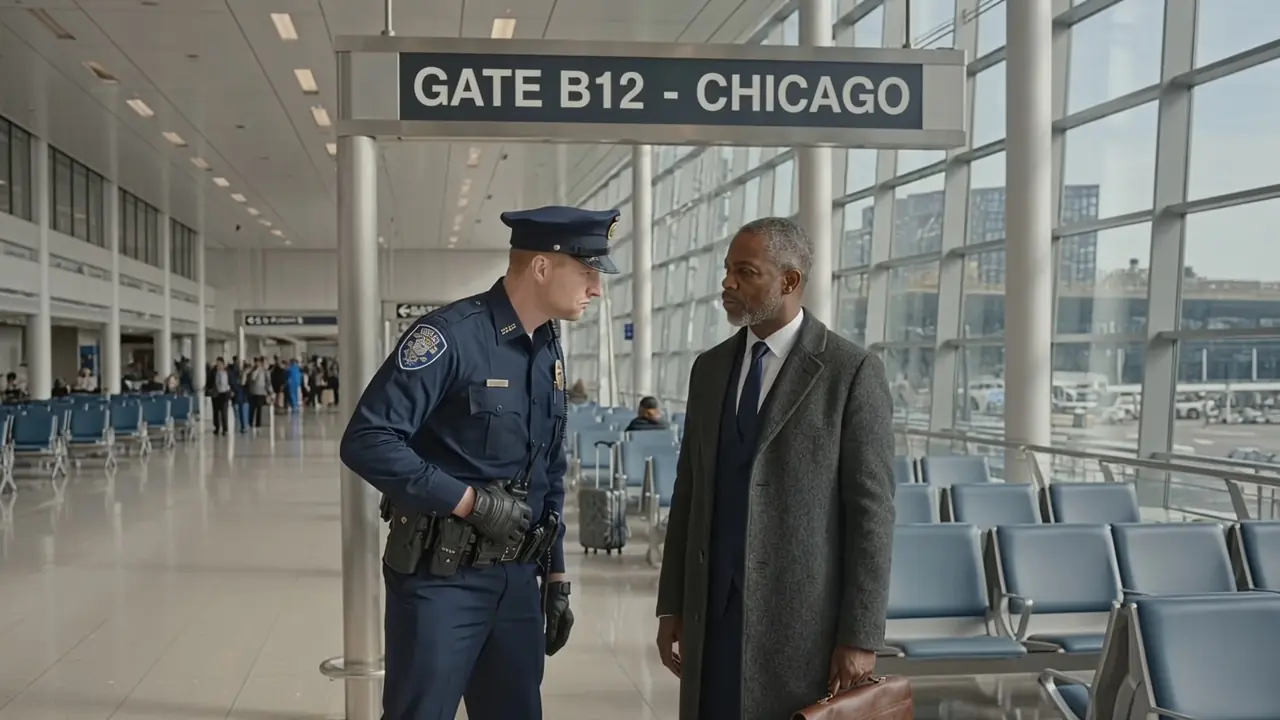
Marcus was fifty-eight, with deep-brown skin, close-cropped salt-and-pepper hair, and a neatly trimmed gray beard. Beneath his overcoat, he wore a dark navy suit, a crisp white shirt, and the blue tie his late wife had given him when he was confirmed to the federal bench. He had spent three decades inside courtrooms where shouting usually signaled weakness rather than authority. Nothing in his expression suggested fear, but the calmness seemed to anger Keller more.
“Take your hand off me,” Marcus said, “before your body camera records the end of your career.”
Several passengers lifted their phones.
Keller tightened his grip. “I’ll break your arm, drag you through this terminal, and write the report however I want.”
Marcus looked directly at the officer’s body camera. “Then write carefully. I am the judge scheduled to review your brutality case this afternoon.”
The color left Keller’s face, but only for an instant.
Then instinct, pride, and panic took control.
“You think flashing some fake title is going to save you?” Keller snapped. “Put the briefcase down.”
Marcus lowered it carefully beside his polished shoes. “My federal identification is inside my coat pocket. You may request it without assaulting me.”
Keller seized Marcus’s wrist and twisted it behind his back.
Marcus felt a sharp pull through his shoulder as the officer drove him against a row of airport seats. The metal frame struck his hip, and nearby passengers shouted for Keller to stop. Marcus did not resist, knowing that one involuntary movement could be rewritten as aggression. He repeated his name, title, and refusal of consent loudly enough for every recording device to capture.
“I am Marcus Holloway, United States district judge,” he said. “I am not resisting, and I have not consented to a search.”
Keller forced him lower.
“You’re under investigation for stealing federal documents.”
“The briefcase contains sealed judicial records.”
“That proves my point.”
“It proves you are opening material protected by federal court order.”
Keller pulled one handcuff from his belt.
Before he could secure it, an airport employee hurried toward them. Her badge identified her as Caroline Shaw, the gate supervisor, and she looked between Marcus and the officer with growing alarm. Caroline had personally checked Marcus’s identification fifteen minutes earlier when assisting with a seating issue. She had also seen the judicial security notation attached to his reservation.
“Officer, release him,” she said. “That passenger is verified.”
Keller did not look at her. “Stay out of police business.”
“I checked his government identification.”
“He could have presented false documents.”
“The airline security system confirmed them.”
Keller forced Marcus’s wrist higher.
The pain reached his shoulder, but Marcus’s voice remained steady. “Ms. Shaw, contact airport command and the United States Marshals Service.”
That order finally made Keller hesitate.
He looked toward Caroline, then toward the growing circle of passengers. A teenage boy was openly filming from three yards away. A woman wearing medical scrubs had begun narrating the time, gate number, and officer’s badge number into her phone.
Keller released Marcus’s arm but kept one hand pressed against his back.
“Turn around slowly,” he ordered.
Marcus straightened, adjusted his coat, and faced him. “You have already been told who I am.”
“I haven’t verified anything.”
“Then verify it.”
Keller reached inside Marcus’s coat without permission and removed a black leather credential wallet. When he opened it, a gold judicial seal appeared beneath Marcus’s photograph. The words UNITED STATES DISTRICT COURT were printed above his name.
Keller stared at the credential.
His mouth opened, but nothing came out.
Marcus bent, retrieved his briefcase, and examined the lock. “Do not touch this again.”
Keller’s eyes moved from the judicial credentials to the phones surrounding them. He seemed to realize that the encounter could no longer be controlled through a report written hours later. Too many strangers had captured the beginning, the threat, and the force.
“You should have identified yourself immediately,” Keller said.
“I did.”
“You were acting suspiciously.”
“I was standing beside my departure gate.”
“You were carrying a sealed case.”
“It is called a briefcase.”
Keller’s jaw tightened.
The confrontation had begun seven minutes earlier when Marcus returned from buying coffee. A woman seated near the gate asked Keller to investigate a “suspicious man” who had left a leather bag beside a first-class seat. Marcus had left the briefcase with his judicial security officer, who stepped away briefly after receiving an emergency call.
When Marcus returned, Keller demanded to know where he had obtained the bag.
Marcus explained that it belonged to him.
Keller did not ask for identification first. He asked why someone “dressed like that” was sitting in the priority boarding area, despite Marcus wearing a tailored suit beneath his overcoat. Then he accused Marcus of taking the briefcase from an attorney who had already boarded another flight.
The accusation grew each time Marcus answered calmly.
When Marcus refused to unlock the sealed case, Keller converted the refusal into evidence. By the time passengers began paying attention, the officer had already convinced himself that Marcus was not a traveler protecting confidential documents. He was a criminal using legal language to delay arrest.
Now the credential in Keller’s hand contradicted everything he had assumed.
A commanding voice sounded behind them. “Officer Keller, step away from Judge Holloway.”
Airport Police Captain Elena Ruiz approached with two supervisors and a pair of federal marshals. Ruiz was a compact woman in her late forties whose expression became colder with every detail she observed. She saw Marcus rubbing his shoulder, the open credential wallet in Keller’s hand, and the crowd recording from several directions.
Keller moved back.
“Captain, I responded to a suspicious-property report.”
Ruiz took the credentials from him and returned them to Marcus. “Was the judge threatening anyone?”
“He refused to surrender the briefcase.”
“That was not my question.”
“He became argumentative.”
Marcus looked at Ruiz. “I requested the legal basis for a warrantless search.”
Keller pointed toward him. “That is exactly what I mean.”
Ruiz turned slowly. “Asking about legal authority is not aggression.”
One federal marshal examined Marcus’s shoulder. His name was Daniel Price, and he had been assigned to accompany the judge after arrival in Washington. He had become separated from Marcus when airport security redirected him through another checkpoint.
“Do you need medical care, Judge?” Daniel asked.
“I need the records inside this case preserved and the officer’s body-camera footage secured.”
Ruiz nodded toward a supervisor. “Take Officer Keller’s camera and department phone.”
Keller stepped back. “You are confiscating my equipment?”
“I am preserving evidence.”
“I made a lawful detention.”
“That conclusion will not be written by you.”
The supervisor removed the camera from Keller’s uniform.
Marcus watched the officer’s confidence collapse into resentment. He had seen the expression inside courtrooms when defendants, attorneys, and officials realized that authority could not erase evidence. Yet this case felt different because Marcus was no longer observing a disputed arrest from behind a bench.
He had felt the officer’s hand on him.
He had heard the threat to fabricate the report.
Most importantly, he knew Ryan Keller’s name before seeing the badge.
The sealed briefcase contained records prepared for a federal oversight hearing scheduled in Washington that afternoon. The hearing concerned repeated allegations of excessive force, unlawful detention, missing body-camera footage, and altered arrest reports within several transportation police units. Keller’s name appeared in three complaints.
One involved a Black airline employee stopped while entering a restricted area where he had worked for eleven years.
Another involved a Latino baggage handler accused of stealing luggage because he carried an untagged suitcase between terminals.
The third involved a homeless veteran who suffered a fractured wrist during an arrest later dismissed for lack of evidence.
Keller had denied wrongdoing in every case.
His reports claimed each person became hostile after receiving lawful instructions. Body-camera footage began after physical contact in two incidents and disappeared entirely in the third. Internal investigations cleared Keller because supervisors said complainants lacked independent witnesses.
Gate B12 had dozens.
Captain Ruiz escorted Keller to a nearby operations room. She did not place him in handcuffs, though several passengers demanded immediate arrest. Marcus remained near the gate while paramedics examined his shoulder and documented bruising along his wrist.
Caroline announced a boarding delay.
No passenger complained.
Instead, witnesses approached one by one and offered their names, videos, and contact information. The woman in medical scrubs had recorded Keller’s threat to break Marcus’s arm. The teenager captured the officer twisting Marcus against the seats after he stated his judicial title.
A retired teacher recorded the beginning.
Her video showed Marcus standing beside his own seat while Keller accused him of stealing the briefcase. It also captured the unidentified passenger who initiated the complaint leaving the gate before officers arrived. Airport cameras later showed that woman watching Marcus for several minutes before speaking to Keller.
She was eventually identified as Lorraine Voss, a wealthy suburban resident traveling to Washington.
When investigators contacted her, Lorraine claimed she reported the briefcase because unattended luggage created danger. Video disproved that explanation. Marcus had been holding the case when she first approached Keller.
Her recorded words were clearer.
“That Black man has been circling the first-class section,” she said. “Someone should check whether that bag is his.”
Keller accepted the assumption without verification.
Marcus’s flight departed without him.
The airline offered another seat, but he declined after federal investigators requested an immediate interview. The Washington hearing was postponed, and Marcus notified the chief judge that he would recuse himself from personally deciding any disciplinary issue involving Keller.
He understood judicial ethics.
Becoming a victim changed his role.
But recusal did not erase what the incident revealed. It transformed the hearing from a review of old complaints into an investigation of an active pattern recorded in public.
The first interview occurred inside an airport conference room.
Captain Ruiz, representatives from the Department of Justice, and an attorney for the airport authority sat across from Marcus. He described every command, response, physical movement, and threat in precise order.
He did not exaggerate.
The truth was damaging enough.
“Did Officer Keller know your title before applying force?” an investigator asked.
“I stated it before he pushed me into the seats.”
“Could he have misunderstood?”
“He responded by accusing me of using a fake title.”
“Did you reach toward your coat?”
“Only after he requested identification. Before I could remove it, he grabbed my wrist.”
“Did you threaten his employment?”
“I warned him that his camera was recording career-ending conduct.”
The airport attorney looked up. “And you knew he was already named in the oversight materials?”
“Yes.”
“Did that influence your reaction?”
“It influenced my decision to speak clearly for the camera. It did not create his behavior.”
Across the building, Keller prepared his own statement.
He claimed Marcus matched the description of a suspected thief and became verbally combative. He wrote that Marcus reached toward his coat without warning and that physical restraint became necessary because the officer feared a weapon.
Then investigators showed him the videos.
Marcus never reached into his coat before Keller touched him.
The description provided by Lorraine included no height, age, facial hair, or clothing beyond “well-dressed Black man.” No theft had been reported, and no passenger claimed a briefcase was missing.
Keller’s report collapsed before he finished writing it.
His police union attorney advised him to stop speaking.
By evening, the airport authority suspended Keller. Captain Ruiz ordered a review of every arrest report he had filed during the previous five years. The Department of Justice expanded its inquiry to include supervisory failures, racial profiling, misuse of force, and possible evidence tampering.
The results reached far beyond Gate B12.
Investigators found that Keller frequently activated his body camera only after gaining physical control of a person. His reports often described movements or threats absent from available footage. Complaints against him were assigned to Sergeant Thomas Blake, a former training partner who closed most cases within forty-eight hours.
Blake’s internal emails showed contempt for complainants.
One message described the injured veteran as “another professional victim.”
Another instructed Keller to add phrases about officer safety before submitting a disputed arrest report.
A third advised him that “nobody believes airport workers over uniforms.”
The oversight hearing resumed two weeks later under another federal judge. Marcus attended only as a witness and watched from the front row while victims described encounters once dismissed as misunderstandings.
Andre Lewis, the airline employee, testified first.
He explained that Keller stopped him outside a secure door despite an identification badge, uniform, and supervisor’s confirmation. Keller ordered him against a wall, searched his lunch bag, and claimed Andre’s frustration created suspicion.
“You said he looked angry,” the attorney questioning him noted.
“I was angry,” Andre replied. “He had one hand on my neck while asking why I was angry.”
The baggage handler, Miguel Santos, testified next.
Keller had emptied a passenger’s damaged suitcase onto the terminal floor after Miguel carried it toward the airline service desk. Even after the airline confirmed the assignment, Keller issued Miguel a citation for creating a disturbance.
The citation was later dismissed.
Miguel never received an apology.
The homeless veteran, Samuel Reed, entered wearing a brace on his wrist. He described sleeping near the train station after missing his connection. Keller ordered him to leave the public area, then twisted his arm when Samuel asked where he was legally permitted to wait.
“I served this country for twenty-two years,” Samuel said. “That officer treated asking a question like declaring war.”
Keller sat beside his attorney and avoided every witness’s eyes.
Then Marcus took the stand.
The hearing room became completely silent.
He described the Gate B12 encounter without revealing confidential judicial material. When asked whether Keller’s knowledge of his title changed the officer’s behavior, Marcus considered the question carefully.
“Yes,” he said. “But not immediately.”
“How did it change?”
“At first, he assumed I was lying. When supervisors confirmed my identity, he did not express concern about harming an innocent person. He expressed concern that the person was a judge.”
The answer settled heavily over the room.
“Why is that distinction important?”
“Because the law did not become more protective when my title appeared. My rights existed before he knew my occupation.”
Marcus looked toward Keller.
“If I had been a teacher, mechanic, airport worker, or unemployed traveler, the assault would have been no less unlawful. The danger is believing that abuse matters only when authority recognizes itself in the victim.”
The hearing produced recommendations, but criminal and civil proceedings continued separately. Keller was dismissed for dishonesty, excessive force, unauthorized search attempts, and repeated failures to activate recording equipment.
Sergeant Blake was demoted and later resigned.
Three previous disciplinary findings were reopened.
The city settled claims with Andre, Miguel, and Samuel. More importantly, their personnel records were corrected, and the false citations used to question their credibility disappeared.
Lorraine Voss faced consequences too.
Prosecutors did not charge her with a major offense, but the airport issued a citation for providing false information during an emergency report. She was also required to complete a civil mediation process after Marcus filed a complaint.
During mediation, Lorraine struggled to explain why she chose him.
“You looked out of place,” she finally admitted.
“In a first-class gate?”
She looked down. “I assumed the bag belonged to someone else.”
“Why?”
“I don’t know.”
Marcus waited.
She eventually whispered, “I thought someone like you would be staff, not a passenger.”
The answer was ugly, but it was honest.
Marcus did not offer forgiveness on demand. He told Lorraine that bias became dangerous when ordinary assumptions recruited armed authority. Her call had not remained a private mistake; it became the justification an officer used to place hands on another person.
Months later, reforms began at the airport.
Officers were required to document objective conduct rather than repeat vague descriptions such as “did not belong” or “appeared suspicious.” Body cameras activated automatically when dispatch assigned an incident. Supervisors could no longer close force complaints without reviewing available terminal footage and interviewing independent witnesses.
Travelers recording police could not be threatened with arrest unless they physically interfered.
Airport workers received direct channels for reporting repeated harassment.
Every reform looked simple after adoption.
Each had required someone to be humiliated, injured, or ignored before officials accepted it was necessary.
One year after the incident, Marcus returned to Gate B12.
He was traveling to Washington again, carrying a different leather briefcase and wearing the same blue tie. Caroline Shaw still supervised the gate and recognized him immediately.
“This time,” she said, “your flight should be less memorable.”
“I would appreciate boring.”
She smiled and handed him an upgraded boarding pass.
Near the transit map, a young officer spoke with a passenger filming a security response. The officer asked him to remain behind a marked line but clearly stated that recording was permitted. The exchange lasted less than thirty seconds.
Nothing dramatic happened.
Marcus watched and felt more satisfaction than he had during Keller’s dismissal.
Real reform often looked like an ordinary moment in which no one was humiliated.
Before boarding, Marcus stood beside the same row of seats where Keller had forced him down. The metal had been replaced during renovation, but he could still remember the pressure against his shoulder and the officer’s promise to write whatever report he wanted.
Keller thought the uniform guaranteed belief.
He thought Marcus was only another Black traveler who could be threatened, searched, and rewritten afterward. He believed the truth began when he activated his camera and ended wherever his report instructed it to end.
He was wrong.
The truth had been present in the passengers who recorded, the employee who spoke, the victims who returned, and the files he tried to seize. It had been waiting inside a sealed briefcase carrying the very complaints he believed would never touch him.
Marcus boarded when his group was called.
As he passed the gate desk, Caroline asked whether he still carried police cases in the bag.
“Sometimes,” he said.
“Anyone dangerous in there today?”
Marcus looked back toward the terminal.
“Only on paper.”
The airport cop who tackled him lost his badge, his authority, and the protection of reports no longer accepted without evidence. But Marcus never considered that the most important reversal.
The real reversal came when Andre, Miguel, Samuel, and every traveler after them no longer needed to become a federal judge before someone believed what had happened.
At Gate B12, Ryan Keller learned Marcus Holloway’s title ten minutes too late.
The rest of the system learned a harder lesson.
Justice should have arrived before it knew his name.