“You’re just an ordinary man wearing a stolen uniform.”
Airport Police Officer Ryan Keller snapped the second steel cuff around the older man’s wrist in the center of Washington International Airport. Passengers slowed beneath the departure screens while phones rose from every direction, recording the decorated Black officer standing motionless before a younger policeman wearing a triumphant smile. Keller tightened the cuffs and laughed at the rows of medals covering the man’s immaculate black Army uniform.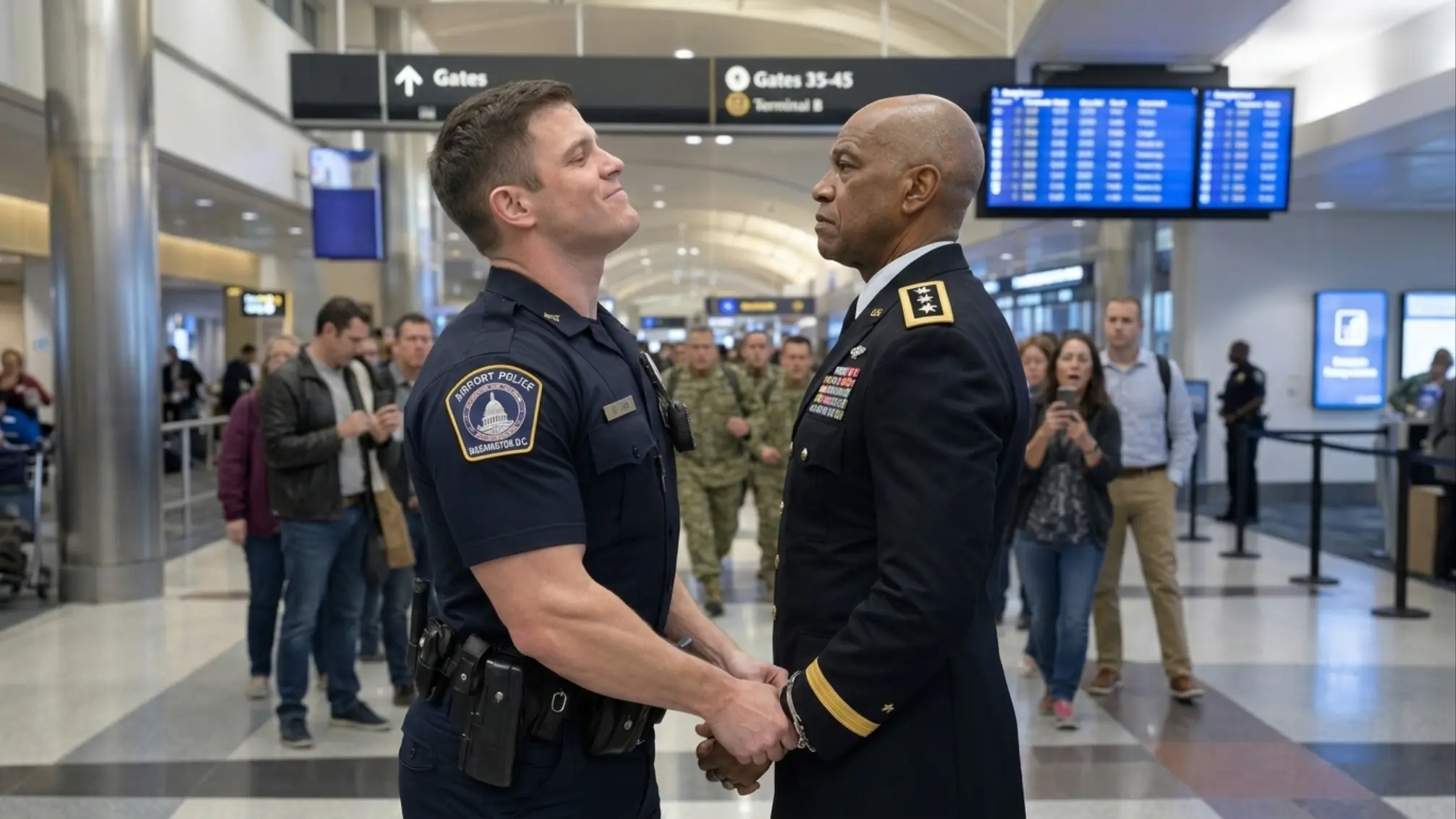
The older man did not struggle.
He was sixty-two, tall and powerfully built, with deep-brown skin, commanding dark eyes, and a closely shaved head. Four silver stars rested on each shoulder, while decades of service ribbons covered the left side of his chest. His nameplate read WALKER, but Keller had dismissed every insignia as counterfeit before allowing him to explain.
“You’re making a serious mistake,” the man said.
Keller leaned closer. “Really? Then prove it.”
“My identification is inside my breast pocket.”
“You expect me to reach inside the costume of a suspected impersonator?”
“It is a United States military uniform.”
“It’s something you bought online.”
Several passengers gasped. Others whispered as Keller guided the man toward a row of metal waiting benches and forced him down. A woman traveling with two children stepped away nervously, while a college student near the charging station began broadcasting the confrontation live.
General Isaiah Walker remained remarkably calm.
He had stood under artillery fire, negotiated cease-fires inside rooms filled with armed men, and notified families that their children would not return from war. An arrogant airport officer could not frighten him. What concerned him was the reason Keller had selected him before asking a single meaningful question.
Walker had arrived through a secure military entrance forty minutes earlier. A delayed government vehicle forced him to walk from the private reception corridor toward Terminal B, where his security detail planned to meet him. He carried no luggage, only a slim black document case secured to his wrist by a short strap.
Keller noticed the case first.
The officer stopped him near a security checkpoint and demanded to know why he was wearing a military uniform inside the civilian terminal. Walker identified himself and explained that he was traveling under official orders. Keller asked for identification, but when Walker reached toward his coat, the officer seized his arm and declared the movement threatening.
Everything escalated from there.
“You have thirty seconds to tell me where you stole that uniform,” Keller said.
Walker looked around the terminal. “Officer, your body camera is recording. Airport surveillance is recording. Do not make this worse.”
Keller tapped the camera mounted on his chest. “Good. Everyone will see how calmly I arrested a fraud.”
“You have not verified my name.”
“I don’t need to. Real generals don’t wander through airports alone.”
“My vehicle was delayed.”
“And your security detail vanished?”
“They are approaching now.”
Keller glanced down the terminal and saw no one close enough to concern him. He smiled again.
“You know what I think?” he said. “You wore those medals because you thought people would be too afraid to question you.”
Walker’s expression hardened. “What you think is becoming increasingly expensive.”
“Is that a threat?”
“It is a prediction.”
Keller called for backup and announced that he had detained a man impersonating a senior military officer while carrying a suspicious secured case. The radio operator asked whether he had checked the passenger’s credentials.
Keller ignored the question.
He had served with the airport police for six years and built a reputation for aggressive stops. Supervisors praised his arrest numbers, though several complaints accused him of escalating minor misunderstandings. Most involved travelers with limited English, elderly passengers, or Black men whom Keller described as “noncompliant” after they questioned his orders.
None of the complaints produced discipline.
The body-camera footage usually began after the confrontation had already escalated.
Today, however, Keller had activated it immediately because he expected the arrest to make him look impressive. He imagined headlines about an alert airport officer stopping a dangerous impersonator before the suspect reached a secure government flight.
He did not imagine losing his badge before lunch.
“Who are you really?” Keller asked.
Walker met his gaze. “General Isaiah Walker, United States Army.”
Keller laughed loudly enough for nearby passengers to hear. “Four-star general?”
“Yes.”
“Commanding what?”
“That answer is classified above your clearance.”
The officer turned toward the crowd. “Did everyone hear that? He picked the oldest excuse in the book.”
Walker lowered his voice. “Unlock the cuffs before your career ends here.”
Keller leaned closer with a confident smile. “Prove you’re important before your fake medals hit the floor.”
Heavy footsteps suddenly echoed from behind them.
A group of uniformed military officers moved rapidly through the terminal, followed by federal protective agents and airport command staff. Keller saw them approaching and straightened with satisfaction. He assumed dispatch had notified military security and that the arriving personnel would congratulate him for identifying the fraud.
He stood.
“Over here,” he called. “I have the impersonator in custody.”
The security team ran straight past him.
A colonel reached General Walker first and stopped sharply at attention. Four other military officers formed beside him, their faces pale with disbelief. The colonel looked at the cuffs, then at Keller.
“General, are you injured?”
The terminal fell silent.
Keller’s smile disappeared.
Walker rose slowly from the bench. The chains between his wrists made a faint metallic sound that carried farther than it should have.
“I am unharmed,” he answered. “Officer Keller appears to have concerns regarding my identity.”
The colonel turned toward the airport policeman. “You handcuffed General Walker?”
Keller stared at the four stars on Walker’s shoulders as though they had appeared only seconds earlier.
“He wouldn’t provide identification.”
“I attempted to,” Walker said.
Keller swallowed. “He reached toward his coat without permission.”
“After you requested his credentials,” said a woman from the crowd. She continued filming with her phone. “We all heard it.”
Another passenger spoke. “The officer grabbed him before he could take anything out.”
Keller looked around and finally noticed how many cameras faced him.
The arriving colonel introduced himself as Colonel David Mercer, director of the general’s protective coordination staff. Behind him stood military police, a Defense Department security officer, and Airport Police Chief Laura Chen.
Chief Chen did not ask what happened first.
She looked directly at Walker’s cuffed wrists.
“Officer Keller,” she said, “remove those immediately.”
Keller reached for the key but hesitated. “Chief, we still need to confirm—”
“Unlock him.”
The authority in her voice ended the argument.
Keller fumbled with the key. His hands, steady moments earlier, began trembling. One cuff opened, then the other. Walker rubbed the red mark around his wrist while Colonel Mercer handed him a secure identification folder.
General Walker opened it himself and showed the credentials to Chief Chen.
She examined the photograph, encrypted seal, and Department of Defense authentication strip.
Her face tightened.
“General Walker, on behalf of this department and the airport authority, I apologize.”
Walker closed the folder. “An apology should follow an investigation, not replace one.”
“Yes, sir.”
Keller tried to recover. “I acted on suspicious behavior.”
Walker looked at him. “Describe it.”
“You were alone, wearing a high-ranking uniform, and carrying a secured case.”
“Military officers travel through this airport every day.”
“Not generals without escorts.”
“My escort was delayed by your terminal’s restricted-access malfunction.”
Keller pointed toward the case. “And you refused to open that.”
“It contains classified briefing material.”
“That proves why I had to detain you.”
“No,” Walker said. “It proves why an officer should verify credentials before demanding access.”
Chief Chen removed Keller’s radio and instructed another officer to collect his duty weapon. His face changed immediately.
“Chief, you’re disarming me in public?”
“You detained a verified four-star general, ignored multiple opportunities to confirm his identity, and described his uniform as a costume.”
“I made a judgment call.”
“You made several. We will determine why.”
Keller looked toward General Walker. “He threatened my career.”
Walker’s expression remained calm. “Your conduct threatened it. I merely informed you.”
Colonel Mercer retrieved Walker’s document case from beside the bench. The short security strap had been scratched during the arrest, but its electronic seal remained intact.
“Sir, the joint briefing begins in fifty-three minutes,” Mercer said.
Walker glanced toward Chief Chen. “I will attend after providing a formal statement.”
“That may delay the operation,” Mercer warned.
“The operation concerns national security,” Walker replied. “So does allowing armed officers to act without accountability.”
They moved into a private airport conference room while the terminal slowly returned to motion. Passengers continued discussing what they had witnessed, and videos spread online before Keller reached the internal-affairs office.
Within twenty minutes, the phrase Airport Cop Handcuffs Four-Star General appeared across social media.
The incident looked terrible in short clips.
The full footage looked worse.
Keller stopped Walker without receiving a complaint, observing a violation, or responding to a security alert. He later claimed the uniform appeared suspicious, yet his body camera recorded him admitting he knew little about military insignia. He refused to contact the airport’s Defense Department liaison, even after Walker requested verification five times.
The recording also captured comments Keller had forgotten making.
“Men like you always think expensive clothes make the story believable.”
“You probably learned those military words from television.”
“Real authority doesn’t need to announce itself.”
Each remark revealed that Keller had decided Walker was fraudulent before examining anything.
Internal Affairs Director Samuel Price reviewed the footage beside Chief Chen. He paused when Keller accused the general of using medals to intimidate people.
“This is not uncertainty,” Price said. “He enjoyed it.”
Chen nodded. “Pull every complaint.”
“All six years?”
“Everything.”
The investigation uncovered fourteen formal complaints and twenty-three informal supervisor notes. Five travelers alleged that Keller mocked accents or questioned citizenship without cause. Four Black passengers described being accused of using stolen premium tickets or false identification.
One complaint involved a decorated Marine veteran.
Keller had detained the man after refusing to believe his disability placard was legitimate. The case disappeared after a supervisor categorized the event as a customer-service misunderstanding.
That supervisor was Lieutenant Mark Dunning.
Dunning entered the internal-affairs interview room shortly after noon. He defended Keller as proactive, energetic, and willing to make difficult decisions.
“How many complaints did you personally review?” Price asked.
“Several.”
“How many resulted in corrective action?”
“I don’t remember.”
“None.”
Dunning shifted in his chair. “That doesn’t mean they were valid.”
“It means fourteen people described similar behavior and the department changed nothing.”
“Keller’s job involves pressure.”
“So does everyone else’s.”
Chief Chen placed the general’s body-camera transcript on the table. “Why did Officer Keller believe he could ignore credential verification?”
Dunning looked at the page. “You would have to ask him.”
“We did. He said aggressive initiative was encouraged by his chain of command.”
The lieutenant’s face tightened.
Keller sat in another room with a union representative. He continued insisting that national-security concerns justified his actions.
“The man carried a locked case,” he said.
“Inside an airport where thousands of passengers carry locked cases,” Price replied.
“He claimed classified status.”
“And provided a direct verification route.”
“He could have been lying.”
“That is why verification systems exist.”
Keller leaned back. “This became a scandal because he’s powerful.”
“No,” Price said. “It became visible because he’s powerful.”
The distinction silenced the room.
General Walker delivered his statement without anger. He described each command, physical movement, and request for confirmation. When asked whether Keller used racial language, Walker answered carefully.
“He used assumptions that have followed Black men in uniforms for generations,” he said. “He did not need to speak a slur to communicate disbelief.”
“Do you believe he would have treated another general differently?” Chief Chen asked.
“I cannot prove what exists inside his mind.”
“What can you prove?”
“He saw a Black man wearing authority and decided the authority had to be stolen.”
Walker requested access to the department’s complaint history. Chen explained that privacy restrictions prevented immediate disclosure but promised an independent review.
He nodded. “Then my concern is larger than what happened to me.”
“You were unlawfully detained.”
“I was also protected by rank, witnesses, cameras, and a security detail. Someone without those things could have been charged before anyone listened.”
Colonel Mercer glanced at his watch again. “General, the convoy is waiting.”
Walker stood.
Before leaving, he turned toward Chief Chen. “Do not discipline him because he embarrassed the airport. Determine whether he harmed people who never made the news.”
The joint-defense briefing began twenty-seven minutes late.
Walker entered an underground command facility beneath a federal complex outside Washington, where senior military officials, intelligence directors, and civilian defense leaders waited around a secured table. He had been selected to lead a new joint operation coordinating national response to cyberattacks against transportation, power, and communications infrastructure.
His delayed arrival had forced hundreds of officials to wait.
No one complained.
News of the airport incident had already reached the Pentagon.
The Secretary of Defense met him near the briefing room entrance. “Do you want federal investigators involved?”
“Yes.”
“At what level?”
“Civil-rights and pattern-of-practice review. Not because of my stars.”
“Because of everyone before you.”
Walker nodded.
The federal review began three days later.
Investigators examined arrest records, passenger complaints, body-camera activation patterns, supervisor decisions, and demographic data. Keller’s stops disproportionately involved Black travelers, immigrants, and lower-income passengers moving through premium or restricted areas.
He often described ordinary confusion as deception.
A traveler entering the wrong line became a trespasser.
A passenger questioning a command became disorderly.
A man reaching for requested identification became threatening.
More troubling, supervisors repeatedly altered complaint classifications to protect department statistics. Force complaints became customer disputes. Bias allegations became communication failures. Unlawful detentions became voluntary interviews.
Lieutenant Dunning had approved most changes.
Chief Chen suspended him during the investigation.
Keller’s disciplinary hearing occurred six weeks after the airport confrontation. He entered wearing a dark suit instead of his police uniform. Across the room sat former complainants whom investigators had finally contacted.
The Marine veteran was there.
So was a Nigerian physician Keller once accused of carrying a stolen diplomatic passport. A Black college professor attended after being detained for sitting inside an airline lounge with a valid membership card.
General Walker did not appear in person.
He submitted a written statement.
The hearing officer read part of it aloud:
Officer Keller’s greatest failure was not mistaking my identity. Human beings make mistakes. His failure was refusing every method that could have corrected him because humiliation had become more satisfying than truth.
Keller looked down.
Video from Gate B39 played across a large screen. The hearing room watched him laugh, tighten the cuffs, and describe Walker’s medals as fake before checking a single credential.
His attorney argued that Keller faced a difficult security environment and acted under incomplete information.
The hearing officer answered, “The information remained incomplete because he refused to gather it.”
Keller was dismissed for unlawful detention, dishonesty, discriminatory conduct, misuse of authority, and repeated failure to follow identification procedures. State investigators also reviewed whether criminal charges were appropriate.
He avoided jail after accepting a plea involving official misconduct. He lost his law-enforcement certification, completed supervised community service, and agreed never to seek another armed security position.
Lieutenant Dunning resigned before his own hearing.
The airport police department reopened thirty-seven cases connected to Keller. Charges were withdrawn in eleven. Several travelers received formal apologies and compensation after evidence showed their detentions lacked lawful justification.
Chief Chen introduced mandatory real-time credential verification for military, diplomatic, and federal travelers. More importantly, she created an external complaint portal that supervisors could not quietly reclassify or delete.
Every bias allegation now received independent review.
Six months later, Walker returned to the same airport.
This time, Colonel Mercer and the security detail accompanied him from the secured entrance. He stopped them before entering the public terminal.
“I can walk.”
“Sir, after last time—”
“I am aware.”
Walker continued alone toward Gate B39.
Passengers recognized him from the widely shared videos, though most respected his privacy. Near the security checkpoint, a young airport officer approached.
“General Walker?”
“Yes.”
“I’m Officer Daniel Ruiz. The Defense Department liaison asked me to confirm your route.”
“Thank you.”
Ruiz scanned the credential Walker provided, checked the secure system, and returned it respectfully.
“You’re cleared, sir. Your gate is straight ahead.”
The entire process took twelve seconds.
No shouting.
No force.
No humiliation.
Walker looked at the officer’s nameplate. “How long have you been here?”
“Four months.”
“What did they teach you about uncertainty?”
Ruiz considered the question. “Verify before escalating.”
“And authority?”
“That it doesn’t make my assumptions true.”
Walker nodded. “Remember that.”
At the gate, Colonel Mercer caught up with him.
“You tested the new procedure.”
“I used it.”
“And?”
“It worked because he allowed it to.”
Walker looked through the terminal windows at aircraft moving beneath the gray Washington sky. His four-star uniform had once placed him in command of hundreds of thousands of soldiers, yet none of those stars made his dignity more valuable than anyone else’s.
They only made Keller’s mistake impossible to hide.
The young officer had looked at a Black man wearing power and assumed the power was counterfeit. He wanted a confession more than confirmation and an audience more than truth.
Then the security detail arrived.
They did not run toward Keller.
They ran past him.
They stood before the man he had mocked and offered the respect Keller refused to recognize.
But General Isaiah Walker never believed the salute was the real lesson.
The real lesson was simpler.
No one should need four stars before an officer listens.