The broken bell above Harland’s Crossing tried to strike noon, but its cracked iron throat produced only a hollow groan. Dust hung over the square beneath the New Mexico sun, clinging to boots, teeth, and the sweating faces of the townspeople who had gathered for entertainment. Elden Graves stood on the auction platform with a rope wrapped around his fist, grinning as though he were selling a stubborn mule rather than a living woman. Beside him, Naya Tall Pine kept her bound hands low and her back straight, refusing to give the crowd the fear they had come to see.
“Not worth the feed!” a man shouted.
“Sell her for the rope!” another answered.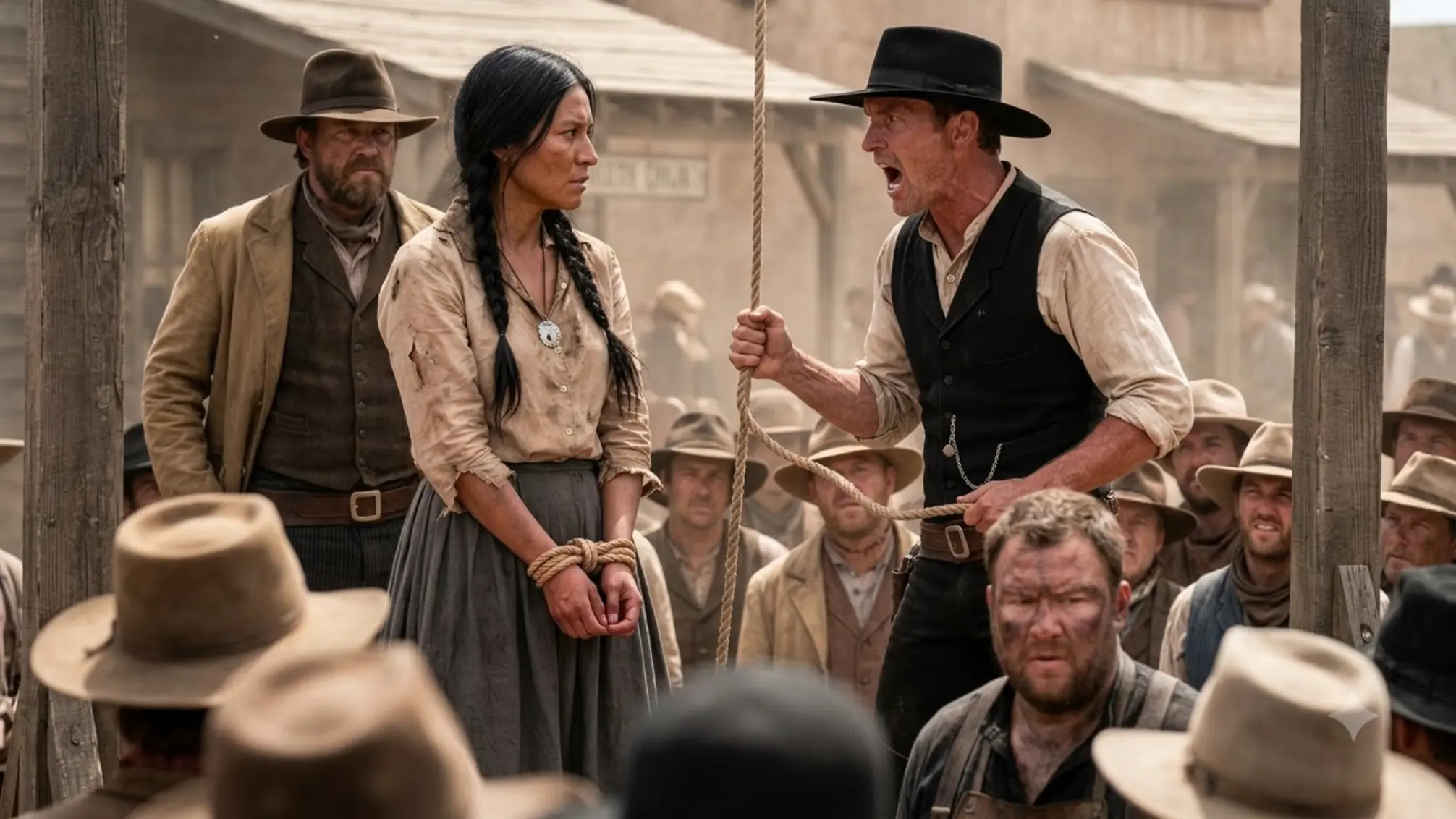
Laughter moved through the square in dry, ugly bursts. Women watched from shaded porches, some disturbed, others relieved that cruelty had selected someone else for the day. Boys squeezed between adults to get closer, learning without instruction what kind of behavior their town rewarded.
Naya looked at each face slowly.
She was twenty-nine, with copper-brown skin darkened by months beneath the open sky, fierce brown eyes, and two long braids hanging over a torn beige blouse. Dirt streaked one cheek, and bruises marked the skin beneath the rope around her wrists. A silver medallion rested against her chest, etched with a mountain, three stars, and a bird with its wings extended.
Graves had tried twice to take it.
Both times, Naya had moved so quickly that he withdrew his hand before she could bite through his fingers.
At the edge of the square, Silas Lark stood outside his forge with his leather apron still tied around his waist. Soot blackened his hands and forearms, and sweat ran beneath the collar of his cream work shirt. He had stepped outside only because the noise had drowned out the rhythm of his hammer.
Then he saw the rope.
Silas was thirty-seven, tall, broad across the chest, and quieter than most men in Harland’s Crossing. He had arrived seven years earlier with one horse, a box of tools, and no interest in explaining where he came from. The town knew him as a reliable blacksmith who repaired wagon axles, forged hinges, and charged poor families less than wealthy ranchers.
No one knew he had once worn a cavalry coat.
No one knew why he had burned it.
Graves pulled the rope tighter. Naya’s bound hands rose slightly, but she did not bend.
“You hear them?” he whispered near her ear. “Nobody wants you.”
Her gaze remained fixed on the crowd.
Graves raised his voice. “Last chance, gentlemen! Who wants the final Apache woman wandering these hills? Strong back, hard hands, and enough temper to keep a man entertained.”
A rancher near the platform laughed. “She looks like she’d cut your throat while you slept.”
“Then don’t sleep,” Graves answered.
More laughter followed.
Silas stepped away from the forge.
He crossed the square slowly, his heavy boots grinding dust beneath them. People moved aside when they recognized him, not because he was feared, but because there was something in his expression they had never seen while he was shoeing horses.
“Two dollars,” he said.
The laughter stopped.
Graves turned. “What?”
Silas reached into his apron pocket and removed two silver dollars. “You heard me.”
Graves stared at the soot on his face. “You buying trouble, blacksmith?”
“I am ending a public embarrassment.”
“For two dollars?”
“That is more than your character is worth.”
Several men murmured. Graves’s smile disappeared.
Naya’s eyes moved to Silas for the first time.
She did not look grateful. She looked suspicious.
Silas preferred that.
Graves stepped toward the front of the platform. “Careful, Lark. I hold lawful papers.”
“You hold a rope.”
“Signed transfer papers from territorial authorities.”
Silas looked toward the courthouse. Sheriff Warren Pike stood beneath the awning, chewing tobacco and avoiding his gaze. That told Silas everything he needed to know about the law involved.
He threw the coins onto the platform.
They struck the boards with two clean metallic notes, louder than the broken bell had sounded.
Graves bent to collect them, but he kept the rope tight. “She is yours.”
Naya’s jaw hardened at the word.
Silas climbed the steps. He drew a short forging knife from his belt and approached her wrists. Naya shifted her weight, watching the blade.
“I am cutting the rope,” he said.
“I know what knives do.”
“Then hold still.”
“One wrong movement and I use it on you.”
Silas’s eyes met hers. “Fair.”
He sliced through the rope.
Naya pulled her hands apart and rubbed the raw skin around her wrists. She could have run immediately. The crowd had opened behind Silas, and no one seemed willing to stop her.
But she stayed.
“You will never own me,” she said.
Her voice was low, calm, and final.
“Good,” Silas replied. “I never wanted to.”
A revolver cocked behind him.
“Too late for that, Lark.”
Silas recognized Sheriff Pike’s voice before turning.
The sheriff stood ten feet away with his weapon aimed toward Silas’s chest. He was a heavy man with a red face, silver mustache, and a badge polished more often than his conscience. Graves remained behind Naya, one hand drifting toward his own gun.
Pike spat into the dust. “That woman is federal property until the transfer is registered.”
“People are not property,” Silas said.
“Territorial paperwork says otherwise.”
“The paperwork is false.”
Pike smiled without humor. “You always were too interested in matters that did not concern you.”
Silas shifted slightly, placing his body between the gun and Naya. “This concerns me now.”
Graves reached for Naya’s shoulder.
She turned and drove her elbow into his throat.
He stumbled backward, choking.
The crowd erupted in shouts.
Pike’s revolver swung toward her. Silas moved before the sheriff could fire, striking the weapon aside with his forearm. The shot exploded into the platform roof, sending splinters across the boards.
Naya seized the loose rope and looped it around Graves’s wrist as he drew his revolver. She twisted hard, dragging his arm across his chest. His gun fell, and she kicked it beneath the platform.
Silas drove his shoulder into Pike and slammed him against a hitching post.
For several seconds, the town square became chaos.
Men scattered. Women pulled children behind barrels. Horses reared against their reins while dust rose around the platform.
Silas pinned Pike’s gun hand against the wooden post.
“Drop it.”
“You strike a sheriff, you hang.”
“You point that weapon at her again, you will not live long enough to write the charge.”
Pike looked into Silas’s face and saw no bluff there.
The revolver fell.
Behind them, Naya had pulled Graves to his knees using the same rope he had wrapped around her wrists. One end was around his arm, the other across his throat. His face had turned red.
“Untie him,” Pike ordered.
Naya tightened the rope.
“He likes ropes,” she said. “I am teaching him the other end.”
Silas almost smiled.
A new voice came from the courthouse steps.
“Enough.”
Judge Elias Crowe descended into the square carrying a leather document case. He was seventy years old, thin, white-haired, and one of the few officials in the territory who treated silence as a tool rather than cowardice. Unlike Pike, he had not watched the auction from the shade.
He had been inside searching records.
Crowe approached the platform and opened the case. “Sheriff, the transfer papers bear the seal of Fort Stanton.”
Pike straightened. “That is correct.”
“The seal is three years out of date.”
Graves stopped struggling.
Crowe removed another paper. “The commanding officer whose name appears here died last winter.”
The square grew still again.
Silas released Pike but kept one hand close to his knife.
Judge Crowe looked at Graves. “Where did you acquire these documents?”
Graves coughed. “A trader in Mesilla.”
“Name?”
“I do not remember.”
Naya pulled the rope tighter.
Graves gasped. “Lucien Vale!”
The name passed through the crowd in whispers.
Lucien Vale owned cattle routes, mining claims, freight wagons, and enough frightened officials to make his business appear lawful. He had spent the previous two years forcing Apache survivors from valuable land near the northern springs. Families vanished, deeds changed hands, and witnesses learned not to ask questions.
Naya’s medallion carried the same mountain marked on those disputed deeds.
Judge Crowe noticed it.
“Where did you get that?” he asked.
Naya closed one hand over the silver disc. “My father.”
“Who was he?”
“Thomas Tall Pine.”
The judge’s expression changed.
Silas recognized the name too. Thomas had served as an Army scout before being granted a small tract of land near Black Mesa. The deed covered a spring, grazing valley, and a narrow canyon later rumored to contain silver.
Thomas disappeared six months earlier.
The territory declared him dead.
His land passed into temporary federal custody.
Lucien Vale claimed it weeks later.
Judge Crowe looked at Pike. “You knew who she was.”
The sheriff’s face hardened. “I knew what Graves told me.”
“You signed the auction authorization.”
“On valid papers.”
“They were visibly fraudulent.”
Pike looked toward the crowd, calculating how much support remained.
Less than before.
Silas picked up the cut rope and dropped it at the sheriff’s boots. “Arrest Graves.”
Pike’s eyes narrowed. “You do not command me.”
“No,” Judge Crowe said. “But I do.”
The sheriff turned. “Judge—”
“Fraud, unlawful confinement, assault, and attempted trafficking under forged authority. Put him in a cell.”
Graves stared at Pike. “You said this was protected.”
That single sentence destroyed whatever remained of the sheriff’s defense.
The judge’s eyes became cold. “Arrest them both.”
Pike reached for the second gun hidden beneath his coat.
Naya saw it first.
She stepped from the platform and kicked his knee sideways. The sheriff collapsed with a cry. Silas caught his wrist, tore the weapon free, and pressed it against the man’s shoulder.
“You keep choosing the wrong hand,” Silas said.
Two deputies finally moved from the courthouse. They had spent years obeying Pike, but neither wanted to stand against a judge, an armed blacksmith, and an Apache woman who had just taken down two men while her wrists were bleeding.
They placed Pike and Graves in irons.
The crowd began dispersing without being told.
People who had laughed now moved quickly, afraid Naya might remember their faces. She did remember. Her eyes followed each of them, but she spoke no names.
Silas retrieved his two silver dollars from Graves’s pocket.
He placed them in Naya’s hand.
“These are yours.”
She looked down at the coins. “Why?”
“They bought nothing.”
“They bought time.”
“Then keep them for the time you lost.”
Her fingers closed around the silver.
Judge Crowe invited them into the courthouse. Naya refused until Silas promised the door would remain open. Inside, she sat near the exit while Crowe examined the medallion.
The back carried a tiny engraving: Black Mesa Grant 1417.
Crowe retrieved an old territorial map. Grant 1417 belonged to Thomas Tall Pine and his legal heirs. The file listed one surviving daughter.
Naya.
“You own the valley Vale has been claiming,” Crowe said.
“My people live there.”
“How many?”
“Twenty-three when I was taken. Maybe fewer now.”
“Vale knows your death would clear the inheritance.”
Naya looked toward the jail window where Graves sat behind iron bars. “He did not want me dead at first.”
“What did he want?”
“The medallion. My father hid the original deed. The numbers lead to it.”
Silas leaned against the wall, listening.
Naya explained that Vale’s riders attacked Black Mesa during the spring. They burned shelters, poisoned one water hole, and demanded the community leave. Thomas refused. Days later, he vanished while traveling to Santa Fe to register evidence of Vale’s fraud.
Naya followed his trail and found his blood near a canyon crossing.
She never found his body.
Vale’s men captured her before she could reach the territorial court. They transferred her between camps, using forged military orders whenever anyone questioned the prisoner.
Graves intended to sell her far from New Mexico.
Judge Crowe folded the map. “The deed must be found.”
Naya looked at Silas. “You have already done more than I asked.”
“You never asked.”
“That is my point.”
He removed his leather apron and placed it on the chair. “Vale will send men before sunset when he learns the auction failed.”
“Then you should stay away from me.”
“I tried staying away from other people’s battles once.”
Her eyes studied him.
“What happened?”
“The people who needed help died.”
Silas rarely spoke about his cavalry years. He had served under Captain Nathan Rourke during a winter campaign that ended with soldiers attacking an Apache camp after receiving false intelligence. Silas refused the order once he saw children among the tents.
Rourke ordered him restrained.
By the time Silas escaped, the camp was burning.
He deserted two days later.
Naya watched the guilt move across his face.
“You were there,” she said.
He did not pretend not to understand.
“Yes.”
“At Willow Creek?”
“Yes.”
Her hand moved toward the knife at his belt.
Silas did not stop her.
“My mother died there,” Naya said.
His throat tightened. “I know.”
“You knew her?”
“I carried a wounded woman from the east side of the camp. She had been shot. She gave me a silver bracelet and asked me to find her daughter.”
Naya stopped breathing.
Silas reached beneath his shirt and drew out a thin chain. Hanging from it was a small silver bracelet marked with the same bird as Naya’s medallion.
Her hand trembled as she took it.
“My mother wore this.”
“She said her daughter’s name was Naya.”
Tears rose in her eyes, but anger came with them. “You had this for seven years.”
“I searched for you.”
“Not hard enough.”
“No,” he admitted. “Not hard enough.”
She struck him.
The slap echoed through the courthouse.
Silas accepted it without moving.
Naya pressed the bracelet against her chest. “Did she die afraid?”
“No. She died believing you lived.”
Her knees weakened.
Silas reached toward her, then stopped before touching her.
Naya noticed the restraint. After a moment, she allowed him to steady her elbow.
Judge Crowe quietly left the room.
By afternoon, the town had changed sides as towns often did when fear moved from one powerful man to another. People who laughed at the auction now claimed they had been uncomfortable all along. Merchants offered food. A woman brought clean clothing.
Naya accepted nothing except water and bandages.
Silas returned to his forge to gather supplies. He gave Naya a clean cream shirt, dark riding skirt, boots, and a short rifle he kept above the workbench.
“You expect me to trust a weapon from you?”
“I expect you to inspect it.”
She did.
The rifle was clean, loaded, and balanced well.
“You know Apache weapons?”
“I know what a person needs when someone is hunting them.”
She strapped it across her back.
At sunset, Vale’s riders entered Harland’s Crossing.
There were twelve of them.
Lucien Vale rode at the front on a black stallion, dressed in a dark coat despite the heat. He was fifty, silver-haired, and handsome in the polished manner of a man whose cruelty was performed through employees and documents.
He stopped before the forge.
“Naya Tall Pine,” he called. “Come outside.”
Silas stepped into the street alone.
Vale smiled. “The blacksmith.”
“The thief.”
“I own Black Mesa.”
“You own paper written by criminals.”
Vale’s men spread across the street.
“Send her out, and your town remains standing.”
Silas rested one hand near his revolver. “She is not mine to send anywhere.”
“Then she has chosen death.”
Naya appeared behind him.
“No,” she said. “I chose witnesses.”
Judge Crowe emerged from the courthouse carrying the forged documents. Behind him stood both deputies, six ranchers, the postmaster, and several townspeople who had found courage after seeing others display it first.
Vale laughed. “This town will fight for an Apache woman?”
A voice from the crowd answered, “We watched enough for one day.”
It belonged to the woman who had brought clothing.
Others lifted rifles.
Vale’s expression cooled.
He drew first.
Silas fired before the revolver cleared leather, striking Vale’s gun from his hand. Naya dropped to one knee and shot the reins from the rider nearest her, sending his horse sideways into two others.
The street erupted.
Bullets shattered windows and punched through water barrels. Silas overturned a trough for cover while Naya moved behind the forge posts, firing with careful precision. She did not waste ammunition.
Vale’s riders expected frightened townspeople.
They found armed men and women defending their homes.
One rider attempted to circle behind Naya. Silas saw him too late to warn her, but she heard the horse. She turned, caught the man’s wrist as he leaned from the saddle, and dragged him into the dust.
He reached for a knife.
She struck him across the throat with the rifle stock.
Silas faced two gunmen near the saloon. His first shot drove one behind a barrel. The second shattered the other man’s shoulder buckle and spun him to the ground.
A bullet grazed Silas’s side.
Naya saw the blood.
Her expression changed from disciplined focus to open fury.
She crossed the street through gunfire, reached Silas, and pulled him behind the forge wall.
“You are hit.”
“Barely.”
“If you die after carrying that bracelet for seven years, I will find you and kill you again.”
He looked at her despite the gunshots. “That sounds almost affectionate.”
She glared at him. “Do not become hopeful.”
Vale shouted for his men to retreat.
Half were wounded, two had surrendered, and the rest no longer believed Black Mesa was worth dying for. They fled toward the southern road, leaving Vale behind after his horse was shot beneath him.
Naya walked toward him.
Vale crawled backward, one hand reaching for the dropped revolver.
She stepped on his wrist.
“Where is my father?”
“I do not know.”
She pressed harder.
He screamed.
“Where?”
“Old mission ruins north of the mesa. He was alive when I left him.”
Naya raised the rifle.
Silas approached, holding one hand against his bleeding side.
“Do not,” he said.
“He killed my mother’s people.”
“Yes.”
“He took my father.”
“Yes.”
“He sold me.”
“Yes.”
“Then why should he breathe?”
“Because death ends his fear. Let the court make him speak every name, reveal every grave, and return every acre.”
Naya looked down at Vale.
For several seconds, Silas believed she would shoot him anyway.
Then she lowered the rifle.
“Put him in the same cage where he kept others.”
The surviving deputies arrested Vale and his men. Judge Crowe sent riders to Santa Fe with copies of the evidence before another sheriff could make it disappear.
Silas stitched his own wound inside the forge until Naya took the needle away.
“You are doing it badly.”
“I have repaired worse.”
“You repair horseshoes.”
“Metal complains less.”
She cleaned the wound and stitched it with steady hands. Silas watched her face as she worked.
“What happens when we find your father?” he asked.
“If he lives, we take him home.”
“And after?”
“You return to your forge.”
He looked away.
Naya tied the bandage. “Unless you wish to help rebuild Black Mesa.”
Silas looked back at her.
“Is that an invitation?”
“It is work.”
“I know work.”
“You also talk too much.”
“No one in this town would agree.”
The corner of her mouth moved.
It was not quite a smile.
At dawn, they rode north together.
They found Thomas Tall Pine in the ruined mission, weak but alive, chained inside an old storage room. Vale had kept him hidden because only Thomas knew where the original land deed was buried.
Father and daughter held each other for a long time without speaking.
Silas waited outside.
Thomas later led Judge Crowe to a stone marker near Black Mesa. Beneath it lay the original deed, military survey maps, and letters proving Vale had bribed officials to manufacture abandonment claims.
Within months, the territorial court restored Black Mesa to the Tall Pine family and the survivors living there. Vale was convicted of fraud, kidnapping, attempted murder, and unlawful trafficking. Pike and Graves received prison sentences after testifying against him.
Harland’s Crossing removed its broken bell.
The town replaced it with one forged by Silas.
On the day the new bell was raised, Naya stood beside him in the square where she had once been bound. The auction platform had been torn down. In its place stood a public water trough and a board displaying notices from the territorial court.
Silas handed her the bell’s first rope.
“You should ring it.”
“Why?”
“Because the old one failed when truth was needed.”
Naya looked around the square. Some of the same people who had laughed now stood silently beneath the awnings.
She pulled the rope.
The bell rang clearly across the town.
Silas watched her release it.
“You are staring,” she said.
“I spent seven years wondering whether you survived.”
“And now?”
“Now I wonder whether you will ever forgive me.”
Naya looked at the bracelet around her wrist, then at the forge behind him.
“Forgiveness is not purchased for two dollars.”
“I know.”
“It is earned slowly.”
“I know that too.”
She stepped closer.
“You may begin by repairing the north gate at Black Mesa. It hangs crooked.”
Silas smiled. “That sounds like an order.”
“It is.”
“And after the gate?”
“There are wagon wheels, roof hinges, plows, and twenty-three people who do not trust you.”
“That could take years.”
Naya finally smiled.
“Then you should start now.”
Silas followed her toward the horses.
The town remembered the day as the afternoon a blacksmith bought an Apache woman for two dollars. That was the version people told because it sounded simple, heroic, and easy to repeat.
The truth was different.
Silas had bought nothing.
He had only placed two coins between a woman and the men trying to erase her.
Naya had freed herself the moment she refused to kneel. She had faced the crowd, survived the rope, defeated the men hunting her, and reclaimed the land carrying her family’s name.
Silas did not become her owner.
He became the man who stood beside her while she proved no one ever would.