The tribunal room fell silent when Brigadier General Conrad Hale pointed toward the floor and ordered Selene Ardan to kneel.
Selene remained standing beside the defense table, her posture straight and her expression unreadable. She was thirty-two, athletic, and dressed in a plain gray T-shirt tucked into dark navy trousers, with her sandy-blonde hair pulled into a high ponytail. Nothing about her clothing suggested rank, authority, or even permanent employment at the coastal installation where she had spent the previous nine days being treated like an unwanted guest.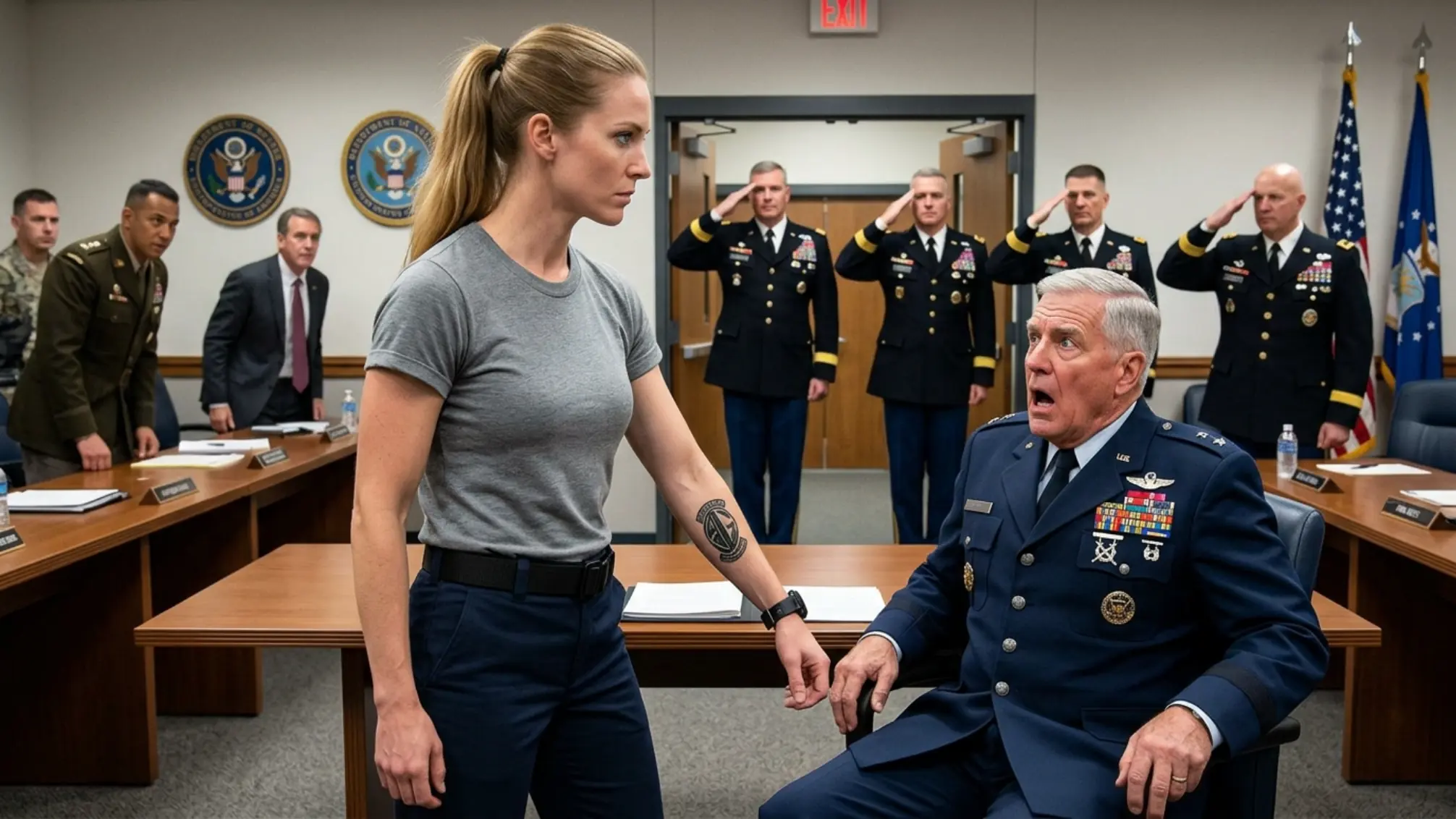
“Cover that fake tattoo,” Hale shouted, glaring at the black emblem exposed along her inner forearm. “Then get on your knees before I have you dragged out.”
Several officers seated behind the long tribunal table exchanged uneasy glances. Two security guards stood near the wall, waiting for a direct order. Gunnery Sergeant Omar Reic sat in the first row with his arms crossed and a satisfied smile spreading across his face.
Selene stepped closer to Hale instead of retreating.
“Reach for me,” she said quietly, “and your face hits that table before your guards take one step.”
Hale surged halfway out of his chair.
“You think one mark makes you untouchable in my tribunal?”
Selene held his furious stare as heavy footsteps sounded beyond the rear doors.
“Turn around, sir,” she said. “Then decide whether you still want to touch me.”
The doors swung open.
Four generals entered together, their decorated uniforms drawing every person in the room to attention. General Wesley Throne came first, followed by General Evelyn Cross, General Harrison Renford, and General Andrew Yates. Each held authority that exceeded Hale’s, and their unexpected arrival immediately transformed the hearing from a disciplinary proceeding into something no one in the room understood.
Hale turned toward them, visibly relieved.
“Generals,” he began, “thank God you’re here. This civilian has disrupted a classified tribunal and—”
He stopped.
The four generals walked past him.
They reached the center aisle, turned toward Selene, and saluted her first.
The room froze.
Selene returned the salute with crisp precision. Then she lowered her arm and looked directly at Hale.
“At ease.”
The generals obeyed.
Reic’s smile vanished.
General Throne faced the tribunal panel. “For the benefit of those who were not cleared to know before this moment, the woman standing before you is Commander Selene Ardan, special director of an interagency counterintelligence task force operating under Red Omega authorization.”
No one moved.
Throne continued. “Her civilian identity was created for an internal security investigation. Her access exceeds the authority of this tribunal, and every charge brought against her was supposed to be preserved as evidence—not used as justification to threaten her.”
Hale’s face lost its color. “That is impossible.”
Selene lowered her sleeve over the tattoo.
“What is impossible, General?” she asked. “That I have authority, or that the woman you ordered to kneel was never beneath you?”
Hale looked toward the four generals as though one of them might correct the situation. None did.
Nine days earlier, Selene had entered the base dining hall carrying a tray and wearing a temporary contractor badge. Her official cover identified her as a strategic psychology consultant assigned to evaluate stress, leadership culture, and personnel readiness. She had no visible rank and no uniform, which made her useful to the investigation—and vulnerable to the people she had been sent to observe.
Reic had noticed her almost immediately.
“This section is for Marines,” he said, blocking the aisle. “Not weak little therapists who think they belong everywhere.”
Selene had asked him to move.
He responded by driving his shoulder into her chest.
The tray flew from her hands. Food scattered across the floor, a drinking glass shattered, and Selene landed hard on both palms. The surrounding tables erupted in laughter as several men shouted for her to leave.
Reic stood over her with the confidence of someone who had humiliated people before and never been challenged for it.
Selene stayed down for three seconds.
Then she rose in one smooth movement, brushed the food from her shirt, and looked at him without fear.
“Are you done?”
The question disturbed him more than anger would have.
Reic stepped closer. “You’re nothing here.”
Selene studied his face for a long moment.
“Understood.”
She walked out while the dining hall celebrated his performance. Only Lieutenant Theo Mercer noticed that she moved differently from an ordinary civilian contractor. Her balance remained centered, her hands relaxed but ready, and her eyes tracked every doorway without appearing to look at any of them.
By the next afternoon, the humiliation had become a campaign.
Whenever Selene entered the dining hall, groups of service members stood and blocked every open seat. Administrative employees delayed the personnel files she needed. Her badge was mysteriously deactivated, and when it was replaced, her clearance had been reduced without explanation.
She documented each incident.
She recorded names, times, access changes, witnesses, and the administrative path behind every obstruction. What looked like workplace harassment was exposing something more valuable: a network of favors and informal authority centered around Reic.
He controlled no department, yet doors closed when he wanted them closed. Reports disappeared after he complained. Junior personnel changed their statements after meeting him privately. People who challenged him received undesirable assignments, disciplinary warnings, or unexplained delays in promotion.
Selene had not come to investigate bullying.
She had come because seven years earlier, a classified operation known as Hollow Mirror had ended in an ambush. Twelve members of a reconnaissance team were killed after their exact location, extraction window, and communication route were delivered to an unidentified hostile buyer.
Selene had survived.
She had spent seven years tracing the leak through encrypted messages, false companies, compromised officials, and personnel records that had been altered after the deaths. One name appeared repeatedly at the edge of the evidence.
Omar Reic.
He had been a communications relay operator during Hollow Mirror. His official file showed a decorated career, but the advancement pattern surrounding him made no sense. Complaints disappeared. Failed evaluations were rewritten. After Hollow Mirror, he received several advantageous assignments despite lacking the recommendations normally required.
Someone had protected him.
Selene’s mission was to discover who.
Reic made the investigation easier by deciding she needed to be destroyed.
On the sixth morning, security officers entered Selene’s temporary quarters and found controlled medication inside a bag beneath her bed. She was questioned for four hours while three witnesses claimed they had previously seen the pills among her belongings.
Selene denied the allegation once.
Then she stopped defending herself and began asking procedural questions.
Who authorized the search? At what time was the room sealed? Which officer collected the evidence? Why did the body-camera footage begin six minutes after the search team entered? Why did one witness describe a blue bag while the evidence photograph showed a black one?
The charge collapsed before sunset.
One witness admitted Reic had told him the pills would “solve the civilian problem.” Another refused to repeat his statement after learning that surveillance footage showed him entering Selene’s building the night before the search.
Major Isaac Vaughn, the intelligence officer assigned to review the incident, called Selene into his office.
“Your background is a wall,” he said. “Not a classified file. A wall.”
Selene sat opposite him with her hands folded.
“Perhaps you should stop trying to climb it.”
Vaughn leaned forward. “Who are you?”
“The person your system says I am.”
“My system says your contractor credentials are valid. It also warns me that attempting to verify them beyond a certain point will trigger an inquiry into me.”
“Then your system is giving you good advice.”
Vaughn should have ordered her detained. Instead, he dismissed her and reopened the investigation into the planted evidence.
For the first time, someone inside the command structure had chosen curiosity over convenience.
Reic reacted badly.
He persuaded administrative officers to reject every evaluation Selene had written. Her database access disappeared. Anonymous complaints accused her of copying classified documents, entering restricted corridors, and manipulating vulnerable personnel during counseling sessions.
Each accusation was false, but together they created the appearance of a pattern.
Brigadier General Hale signed the order convening the tribunal.
Selene could have ended the operation immediately. One encrypted call would have restored her full authority and placed Reic under arrest. Yet she allowed the hearing to proceed because the people supporting him had started exposing themselves.
The false witnesses came from three departments.
The altered access reports originated from a secure administrative account.
The tribunal order was approved unusually fast.
Most importantly, someone had used general-level authorization codes to overwrite portions of Selene’s activity log.
Reic was not capable of that.
He was only the visible hand.
Now, in the tribunal room, that hand trembled.
Selene turned away from Hale and faced Reic.
“You planted the medication in my quarters.”
Reic stood abruptly. “That is a lie.”
“You ordered Corporal Dane to enter the building at 22:14. You told Specialist Warren what to say during questioning. When Warren changed his statement, you threatened his brother’s transfer request.”
Reic looked toward Hale. “Sir, she is trying to intimidate a witness.”
Hale did not answer.
Selene placed a small recorder on the tribunal table.
A man’s voice filled the room.
Three pills. Put them under the bed. Make sure the MPs find them before she comes back.
Reic’s voice.
The recording continued.
If she stays another week, she’ll start looking at things that don’t concern her.
Reic stepped backward. “That was edited.”
Major Vaughn rose from his seat. “The audio was authenticated this morning.”
Reic’s head snapped toward him.
Vaughn opened a folder. “So were messages connecting you to the badge deactivation, the rejected assessments, and the witnesses who accused Commander Ardan of unauthorized access.”
“I was protecting this installation.”
“From a psychologist?” Selene asked.
Reic looked at her tattooed arm.
“From whatever you really are.”
Selene walked slowly toward him.
“You knew I was looking into Hollow Mirror.”
The name struck him like a blow.
Several members of the tribunal appeared confused, but General Yates suddenly became very still.
Selene noticed.
Reic swallowed. “I don’t know what that is.”
“You served as the secondary communications relay.”
“That operation is classified.”
“So you do know what it is.”
Reic’s jaw tightened.
Selene stopped within a few feet of him. “Three unauthorized transmissions left your relay station on the night my team was ambushed. They were routed through a dormant communications node and received by someone outside the approved network.”
“I processed hundreds of messages.”
“You processed those three personally.”
“You cannot prove that.”
Selene opened a folder and slid a copy of the transmission record across the nearest table.
“Your biometric confirmation is attached to every one.”
Reic stared at the page.
“I was following orders.”
No one spoke.
The confession escaped so naturally that even Reic seemed not to understand what he had said until the words were already hanging in the room.
Selene’s voice lowered. “Whose orders?”
Reic looked toward the generals.
That movement told her more than an answer.
Hale stepped forward. “Commander, he should be taken into custody before this continues.”
“You were eager to drag me out two minutes ago,” Selene replied. “Now you want to protect procedure?”
“I was given incomplete information.”
“You were given evidence that the charges were manufactured. Major Vaughn placed his concerns in writing.”
Hale looked at Vaughn.
The intelligence officer nodded. “Three times.”
Selene continued. “You ignored those warnings because removing a civilian was easier than questioning a decorated subordinate.”
Hale’s face tightened with shame.
“General, I—”
“You will have an opportunity to explain your decisions under oath.”
Two security officers approached Reic. He glanced toward the rear exit, calculating whether he could reach it, then seemed to realize every person in the room was watching him.
Selene raised a hand.
“Not yet.”
The officers stopped.
She looked at Reic. “You can leave this room as the man who helped murder twelve people, or as the witness who finally tells us who gave the order.”
“I didn’t know anyone would die.”
“You knew the messages were unauthorized.”
“I was told they were part of a counterintelligence test.”
“By whom?”
Reic’s breathing became shallow.
“I never saw the person’s face.”
“What did you see?”
“Authorization codes. Secure instructions. Money placed into an account I didn’t control. Promotions I didn’t earn.”
His voice cracked.
“They knew where my sister lived. When I tried to stop, they sent me a photograph of her son leaving school.”
Selene’s anger did not disappear, but it changed shape.
Reic had betrayed her team. He had also spent years trapped inside the consequences of that betrayal, protecting himself by becoming crueler to anyone who threatened the fragile power he had been given.
It did not excuse him.
But fear could make him useful.
“Who contacted you before I arrived?” Selene asked.
Reic stared toward the four generals again.
“One of them.”
General Cross stiffened. General Renford slowly turned toward the others. Throne’s expression hardened.
Yates remained calm.
Too calm.
Selene faced him.
“General Andrew Yates, you supervised communication security during Hollow Mirror.”
“I supervised policy,” Yates replied. “Not individual transmissions.”
“You selected Reic for the relay assignment.”
“He was qualified.”
“You approved the dormant node used for the unauthorized messages.”
“That node was part of a discontinued emergency system.”
“And yet you reactivated it forty-eight hours before the ambush.”
Yates’s eyes narrowed. “You are drawing conclusions from fragments.”
Selene removed another document.
“This fragment is a financial transfer into a trust established for your son. The money passed through three shell companies connected to the same foreign intermediary that received the Hollow Mirror coordinates.”
Yates did not look at the document.
That was the final confirmation.
General Throne stepped toward him. “Andrew, tell me she is wrong.”
Yates looked around the tribunal room, assessing loyalties, distances, and exits.
Then he smiled.
“Selene always was the difficult one.”
General Cross stared at him. “You knew her?”
“I knew her father.”
Selene felt the room recede around her.
Her father had died when she was twelve after his car left a mountain road during a storm. Investigators called it an accident, though no mechanical failure was ever identified.
Yates continued watching her.
“He asked the same questions. He found the same patterns. He believed truth protected people.”
“What did you do to him?” Selene asked.
Yates’s smile faded.
“What was necessary.”
The four words carried twenty years of buried meaning.
Selene crossed the distance before anyone else moved and seized the front of his uniform.
General Throne grabbed her shoulder. “Commander.”
She stopped herself.
Yates looked down at her hand.
“There she is,” he whispered. “The survivor beneath the perfect control.”
Selene released him.
“No,” she said. “The investigator above the grief.”
Yates reached inside his jacket.
Three officers drew their weapons, but his hand emerged holding a small black transmitter rather than a firearm.
“If I press this,” he said, “the evidence archive disappears.”
Selene looked at the device.
“You mean the archive copied from your private server at 04:12 this morning?”
His confidence faltered.
Major Vaughn placed a sealed drive on the table.
“We have it,” he said.
Yates pressed the transmitter anyway.
Nothing happened.
Selene stepped closer. “I disabled your external access before entering this room.”
“You planned this.”
“I allowed you to believe you still controlled the hearing.”
Security officers surrounded him.
Yates’s composure finally cracked. “You think arresting me ends anything? The network is larger than this base. Larger than your task force.”
“Then we will need more cells.”
“You don’t know whom you can trust.”
Selene looked at the four generals, then at Vaughn, Mercer, and the officers who had chosen to preserve evidence rather than erase it.
“No,” she said. “But today I learned whom not to trust.”
Yates was placed in restraints and escorted from the room. Reic followed under separate guard, his shoulders collapsed and his earlier arrogance gone. Hale remained beside the tribunal table, staring at the chair from which he had ordered Selene to kneel.
“Commander,” he said, “I owe you an apology.”
“You owe every powerless person who entered this room believing evidence would matter.”
“I made a mistake.”
“A mistake is reading a date incorrectly. You were warned that witnesses had lied, evidence had been planted, and access logs had been manipulated. You proceeded because I looked easier to punish than the men accusing me.”
Hale lowered his eyes.
Selene continued. “You will be suspended while your decisions are reviewed. Whether you retain your position will depend on what investigators find.”
“Yes, Commander.”
It was the first time he addressed her title without resistance.
The inquiry lasted six months.
Yates’s seized files exposed a counterintelligence network that had operated for more than a decade. Classified information had been sold through contractors, false charities, and consulting companies. Several compromised officials were arrested, while others cooperated in exchange for reduced charges.
Evidence connected Yates directly to the Hollow Mirror ambush and the staged accident that killed Selene’s father.
Reic provided routing codes, drop locations, payment records, and the identities of intermediaries. His cooperation did not erase what he had done. He was stripped of rank, convicted of multiple offenses, and sentenced according to his role in the conspiracy.
However, his testimony prevented two planned intelligence transfers and helped dismantle three remaining cells.
Hale was removed from command after investigators discovered a history of dismissing complaints against influential personnel. Although he had not participated in espionage, his unwillingness to challenge powerful subordinates had created the environment in which the conspiracy survived.
Major Vaughn was appointed to lead a new internal security division.
Lieutenant Mercer received a formal commendation for documenting the original dining-hall assault when everyone around him had chosen silence. He initially rejected the praise, arguing that he had not intervened soon enough.
Selene told him remorse was useful only when it changed future behavior.
Ten days after the tribunal, she returned to the dining hall.
The room became quiet as she entered, but this silence was different from the one that followed her first arrival. No one laughed. No one blocked the tables.
A dozen people stood and offered her their seats.
Selene ignored the attention and carried her tray to the narrow ledge beneath the window—the same place where she had once been forced to eat standing alone.
Mercer approached.
“Commander, there are open tables.”
“I can see them.”
“Then why stand here?”
Selene looked across the room.
“Because this is where the problem became visible.”
Mercer followed her gaze. Some of the people who had laughed during the assault now looked down at their meals.
“Are you going to punish them?” he asked.
“No.”
“They helped Reic humiliate you.”
“They followed the strongest voice in the room without asking whether it was right. Punishment might frighten them temporarily. Memory may teach them longer.”
Selene lifted her glass of water.
“Besides, the next person they isolate may not have four generals waiting outside.”
Mercer absorbed that.
“What happens now?”
“I leave.”
“For another investigation?”
Selene gave him a faint smile. “That question is above your clearance.”
He smiled back, then became serious.
“The day Reic shoved you, did you know the entire operation would end in that tribunal?”
“No.”
“You looked like you did.”
“I knew only one thing.”
“What?”
Selene glanced toward the center of the dining hall, where she had once lain among broken glass and spilled food while fifty people laughed.
“People who believe someone is powerless become careless around them.”
The following morning, she walked through the main gate carrying one black case and a small travel bag. She wore the same gray T-shirt and dark trousers she had worn before the tribunal, appearing once again to be an ordinary civilian.
A vehicle waited near the road.
Before she entered, General Cross approached and handed her a sealed folder.
“We found another Hollow Mirror reference in Yates’s archive.”
Selene opened it.
Inside were coordinates, financial records, and the photograph of a government building several states away.
“Another compromised installation?” she asked.
“Possibly.”
“Who knows I’m going?”
“Only the people standing here.”
Selene looked behind Cross.
Throne, Renford, Vaughn, and Mercer waited near the gate. Each understood that Yates’s arrest had not ended the threat. It had only revealed how deep the corruption reached.
Cross extended her hand.
“Be careful.”
Selene closed the folder.
“Careful people rarely make traitors nervous.”
She entered the vehicle, and the door shut behind her.
As it pulled away, Mercer raised his hand in salute. The others followed.
Selene watched them through the rear window but did not return the gesture. Her identity had been exposed once, and the next mission required the illusion of weakness again.
She removed the black insignia from beneath her sleeve and locked it inside the case.
By the time the vehicle reached the highway, Commander Selene Ardan had disappeared.
Only a quiet civilian consultant remained—a woman with no visible rank, no obvious authority, and nothing powerful men believed they needed to fear.
That was precisely how she preferred to enter the next room.