In a quiet neighborhood in Georgia, there lived an elderly woman who had spent most of her life feeding people who had nowhere else to go.
Everyone called her Mama Joe.
Not because she asked them to.
Not because it was written on any sign outside her home.
But because there are some people whose kindness becomes so steady, so natural, and so necessary that the world gives them a name larger than the one they were born with.
Her real name was Josephine Bellamy.
She was seventy-two years old, with silver hair she kept pinned beneath bright headscarves, deep brown skin lined by years of sun and laughter, and hands that had cooked, cleaned, prayed, held, comforted, and carried more than most people would ever know.
She lived alone at the end of Willow Street, in a modest little house with faded yellow paint, a sagging porch, and a screen door that squeaked every time it opened.
The house was not grand.
The porch boards complained under every step. The shutters needed fresh paint. The roof had a patch near the chimney from a storm three summers ago.
But the house had something no real estate agent could list.
A soul.
The walls had soaked in decades of gospel music, laughter, late-night prayers, and the sweet scent of baked cornbread that always seemed to drift around the windows like a welcome mat in the air.
Neighbors knew that if Mama Joe’s porch light was on, there was probably something hot on the stove.
A pot of gumbo.
A pan of beans.
Collard greens simmering low with smoked turkey.
Sweet potato pie cooling near the window.
Cornbread with edges crisp enough to sing when cut.
Mama Joe was known for cooking too much on purpose.
If a neighbor lost a job, she sent over food.
If a child came home from school hungry, she made a plate.
If an old man down the block forgot to eat, she wrapped something in foil and walked it over herself, slow knees and all.
When young mothers were tired, she fed them.
When teenagers acted tough, she fed them too.
When strangers passed by looking lost, she had a way of asking, “You eaten yet?” that sounded less like a question and more like an instruction.
She was seventy-two, but age had not made her small.
It had made her clearer.
She moved slowly now. Her knees ached in cold weather. Her fingers stiffened sometimes before rain. She kept a cane near the back door though she pretended it was only there for reaching high shelves.
But her heart remained fierce.
Her husband had passed decades earlier. Her children were scattered across states and cities, tied up in jobs, families, bills, and lives of their own. They called when they could. They visited when life allowed.
Mama Joe loved them.
But she had learned long ago that loneliness could not be defeated by waiting for the phone to ring.
So she filled her house with purpose.
She planted tomatoes along the fence.
She kept herbs in coffee cans near the kitchen window.
She listened to gospel radio in the mornings and old jazz in the afternoons.
She prayed over every pot of food.
And she never locked her screen door before sunset.
“People need a door they can come to,” she often said.
Some people called her the porch saint.
Others simply called her Mama.
And though she laughed whenever they said it, deep down, she understood.
There are women who become mothers not only by blood, but by how they open their hands.
That day had been like any other.
A warm golden light spilled across her garden, where tomatoes climbed the fence and collard greens reached for the sky. Mama Joe stood in her kitchen, humming an old hymn as she stirred a pot of gumbo thick with okra, sausage, onions, and spices.
The radio crackled in the corner, half playing Louis Armstrong, half static.
She liked it that way.
“Nothing in this world comes through clear all the time,” she would say.
Outside, children rode bikes home from school. Porch lights flickered on one by one. Somewhere down the street, a dog barked once, then quieted.
It was the kind of evening where nothing felt urgent.
The kind of evening that fooled a person into thinking peace had finally decided to stay.
Mama Joe had just pulled a skillet of cornbread from the oven, its crust a perfect golden brown, when she heard it.
A knock.
Soft.
Hesitant.
Barely more than a whisper against the door.
She paused.
Not many people came by that late.
She wiped her hands on her apron.
Her heart did not race, exactly, but it became aware.
That was a different thing.
Women like Mama Joe knew that sometimes trouble did not shout.
Sometimes it barely breathed.
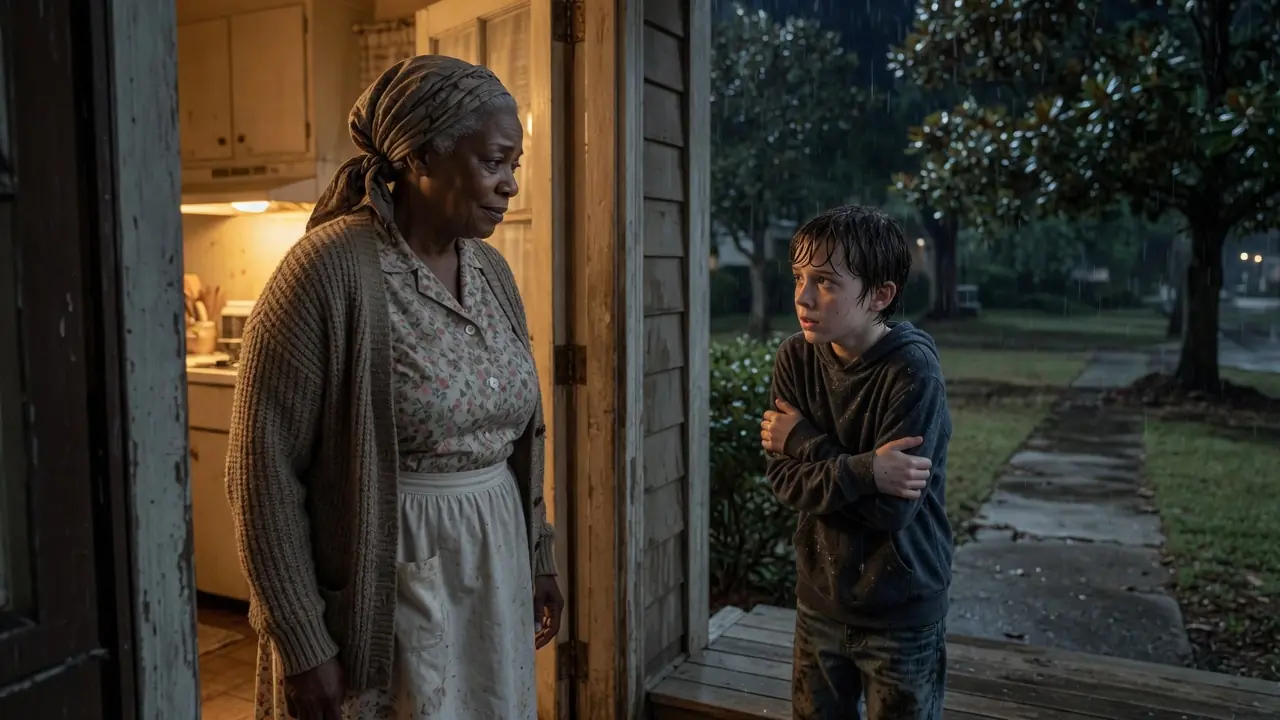
She walked to the front door and opened it.
Standing on her porch was a boy no more than ten years old.
He was soaked from the drizzle that had begun to fall. His arms were folded tightly across his chest. He shivered not just from cold, but from something much deeper.
There were bruises on his arms.
One eye looked swollen.
His lips were cracked, and his face had the pale, exhausted look of a child who had run farther than his body could afford.
But what broke Mama Joe most was not the bruises.
It was the way he looked at her.
Not with simple fear.
With surrender.
Like someone who had run too far, too long, and was no longer sure if he had been running toward hope or away from despair.
He did not explain.
He did not introduce himself.
He said only four words.
“Please don’t make me go.”
Mama Joe did not ask who had hurt him.
She did not ask why he was on her porch.
She did not ask whether he was telling the truth.
At seventy-two, she had lived long enough to know that some truths announce themselves through trembling hands, swollen eyes, and the way a child flinches from kindness before he trusts it.
She simply opened the door wider.
“Come on in, baby.”
The boy hesitated.
Mama Joe held out her hand.
Not quickly.
Not suddenly.
Just steady.
The way you offer trust to something wounded.
He looked at her hand for a long second.
Then he stepped inside.
The door clicked shut behind them with a soft finality, the kind that separates one world from another.
Inside Mama Joe’s kitchen, the warm amber light wrapped itself around the boy like a shawl.
The scent of cornbread and simmering gumbo filled the air. Rain tapped gently against the windows. The old wall clock ticked above the doorway.
The boy stood in the entryway, dripping onto the faded linoleum.
His eyes darted from corner to corner like he expected someone to come out of the shadows.
Mama Joe did not rush him.
She knew the value of silence.
She knew the weight of it too.
She turned toward the stove, pulled a clean dish towel from the drawer, and set it gently on the table.
Then she ladled gumbo into a wide ceramic bowl.
“I made this with okra and smoked sausage,” she said softly, not looking directly at him. “It’s got a little heat, but it’s real kind to the belly.”
She placed the bowl on the table, added a thick slice of cornbread, and stepped back.
The boy did not move at first.
Then, slowly, cautiously, like a stray animal testing whether a hand meant food or harm, he approached the table.
His fingers trembled as he reached for the spoon.
The first bite came slowly.
Almost suspiciously.
The second came faster.
Then the third.
He tried not to eat too quickly, but hunger had its own manners.
Mama Joe watched from the sink, quietly wiping a plate that did not need drying.
Her eyes never left him.
The bruises beneath the sleeve of his wet shirt told more than his mouth could bear.
She had seen enough in her years.
She had seen what people did not want to talk about.
She had seen what the law sometimes missed.
She had seen what children were forced to survive in silence because adults were too busy, too afraid, or too comfortable to notice.
When he finished eating, the boy looked up at her for the first time.
In his eyes, Mama Joe saw the question he was too afraid to ask.
Am I safe here?
She nodded as if answering a prayer instead of a glance.
“You got a name, baby?”
Her voice was velvet, but firm.
The boy hesitated.
Then he whispered, “Nathan.”
It came out hoarse, like he had not used it in a while. Or maybe like he had learned to stop saying it when no one used it kindly.
Mama Joe repeated it back like it was sacred.
“Nathan.”
She smiled gently.
“That’s a strong name. Strong like roots.”
He lowered his eyes.
“Please don’t call nobody,” he whispered. “I’ll be good. I just… I can’t go back.”
There it was.
The plea beneath the silence.
The terror wrapped in obedience.
Mama Joe stepped forward slowly, reached into the drawer by the fridge, and pulled out a faded Afghan blanket.
She laid it over his shoulders with the kind of care that made him flinch.
Not because it hurt.
Because it did not.
“I ain’t sending you back to danger, sugar,” she said calmly. “Not tonight. Not ever if I can help it. But I do have to call someone. Someone who can help you the right way.”
His face crumpled.
“No, please.”
She held up one hand.
“Listen to me, Nathan. You are safe in this house. Nobody is coming in here to drag you anywhere. But a child should not have to run through rain and knock on a stranger’s door to survive. That means grown folks got to do their job now.”
He stared at her.
“I’ll be good,” he said again, as if goodness were rent.
Mama Joe’s chest ached.
“Oh, baby,” she whispered. “You never had to earn safety by being good.”
A tear slipped down his cheek.
It did not fall with a sob.
It simply rolled silently, like it had been waiting for permission.
Mama Joe cupped his cheek gently, her thumb brushing the tear away with all the reverence of a mother tucking in her child.
Then she stepped into the next room and picked up the rotary phone.
The dial clicked with each turn.
Her voice was steady as she gave her name and address to local dispatch.
She did not beg.
She instructed.
“There is a child in my home,” she said. “He is hurt, scared, and needs protection. I need someone trained in child welfare. No sirens. No flashing lights. Do not scare this baby more than he already is.”
The dispatcher tried to ask routine questions.
Mama Joe answered what she could and refused what she would not.
“No, I am not putting him on the phone. No, you are not sending someone here making noise. Yes, I will wait. Yes, he is safe with me.”
When she returned to the kitchen, Nathan had curled into the chair, the blanket wrapped tightly around his shoulders.
His empty bowl sat carefully beside him, as if he did not want to be accused of making a mess.
Mama Joe took the bowl and placed it in the sink.
Then she sat beside him.
“You like books?”
He blinked, surprised by the question.
“A little.”
“Good. I got a shelf full of them. Some are boring as old church announcements, but some are all right.”
His mouth twitched.
Almost a smile.
She pointed toward the living room.
“That couch is soft enough if you don’t fight it. You can rest there while we wait.”
He did not move.
She understood.
“Or you can sit right there. I’ll sit with you.”
So they sat.
The rain softened outside.
The gumbo cooled on the stove.
The house held its breath around them.
After a while, Nathan whispered, “He said nobody would believe me.”
Mama Joe did not ask who.
She knew enough.
She looked at him and said, “He lied.”
Nathan’s eyes filled again.
“He said I was bad.”
“He lied about that too.”
“He said if I told…”
His voice stopped.
Mama Joe waited.
She did not push him into words he was not ready to survive.
After a long silence, he whispered, “My stepdad gets mad.”
Mama Joe’s hands folded tightly in her lap.
She had lived long enough to know anger could become a storm in a house.
And some storms learned how to wear a man’s face.
She kept her voice calm.
“You do not have to tell me everything tonight. You just rest. You made it here. That is enough for now.”
Nathan looked at her.
“Why are you helping me?”
The question was so simple.
So wounded.
Mama Joe leaned back in her chair.
“Because you knocked.”
“That’s it?”
“That’s enough.”
By the time the caseworker arrived near dawn, Nathan had fallen asleep on the couch, wrapped in the Afghan blanket like a cocoon.
Mama Joe had not slept.
She sat in her worn armchair across from him, shawl draped over her shoulders, hands folded in her lap, eyes never leaving the boy.
There was something sacred about watching over someone who did not yet know how to ask for protection.
She had fed many people in her life.
Held many babies.
Helped many mothers.
Prayed through many nights.
But this boy had walked into her house with a silence that shouted.
And Mama Joe had already decided that whatever came next, he would not face it alone.
The knock at dawn was firm, not aggressive.
Mama Joe opened the door.
A woman stood there in a plain coat, mid-forties, hair pulled back, clipboard in hand, eyes calm but alert.
“Mrs. Bellamy?”
“Mama Joe is fine.”
The woman gave a small nod.
“I’m Angela Raymond with the Department of Family and Children Services.”
“You came quiet. I appreciate that.”
“I was told to.”
Mama Joe raised an eyebrow.
Mrs. Raymond almost smiled.
“I was told very clearly.”
“Good.”
They sat at the kitchen table just out of earshot, drinking weak coffee and speaking in low tones.
Mama Joe described the bruises, the fear in Nathan’s eyes, the way he flinched when she laid the blanket on him.
Mrs. Raymond took notes with a mechanical pencil that scratched softly against her clipboard.
“He’s run before,” Mrs. Raymond murmured. “But this time, someone actually opened the door.”
Mama Joe’s face hardened.
“Somebody should have opened it sooner.”
Mrs. Raymond did not defend the system.
That earned her some respect.
“Yes,” she said quietly. “They should have.”
When the time came to wake Nathan, Mama Joe did it herself.
She sat beside him, laid a hand gently on his shoulder, and whispered his name like a lullaby in reverse.
“Nathan, baby. Wake up now.”
He stirred.
His eyes opened with instant panic, the kind of panic that expected punishment before explanation.
Then he saw her.
Just her.
And the fear eased.
Not gone.
But quieter.
“There’s a kind lady here,” Mama Joe said softly. “She wants to help. She ain’t going to hurt you, but we need to talk about what happens next.”
Nathan sat up slowly, arms wrapped tight around his knees.
He did not look at Mrs. Raymond.
Only at Mama Joe.
“Do I have to leave?”
The question was not rebellion.
It was defeat.
Like he already knew the answer and was bracing for it.
Mama Joe took his small hand in hers.
“Not back there. Never back there if I have anything to say about it.”
Mrs. Raymond knelt nearby, her tone professional but warm.
“Nathan, we are going to make sure you are safe. For the next few days, if Miss Josephine agrees, you can stay here while we work through the details.”
Mama Joe lifted her chin.
“He’s got a room.”
Mrs. Raymond looked surprised.
“He does?”
“He does now.”
The room had once belonged to Mama Joe’s nephew, who had stayed with her one summer years ago. It had a narrow bed, soft yellow walls, faded baseball posters, and a quilt that still smelled faintly of lavender soap.
Nathan followed her down the hallway as if afraid the house might change its mind.
Mama Joe opened the door.
“This can be yours for now.”
He stood in the doorway.
His lips parted slightly.
“For me?”
“For you.”
He stepped inside carefully.
There was no luggage to unpack.
No favorite toy.
No clean pajamas.
No toothbrush of his own.
Just a wet, frightened boy standing in a room that did not yet know him but was ready to.
Later that morning, Mama Joe took him shopping.
Not for toys.
She was not one to spoil.
But for socks without holes, underwear still in the package, a toothbrush, toothpaste, a comb, and a secondhand denim jacket he picked out from a thrift store rack.
When he tried it on, it was too big in the sleeves.
He looked at himself in the mirror and smiled so small it barely counted.
But Mama Joe saw it.
She noticed everything.
Over the next few days, Nathan began to thaw.
Not all at once.
Not cleanly.
Healing rarely comes politely.
He had nightmares.
He clenched his fists when someone walked too fast behind him.
He flinched at dropped pots.
Sometimes he forgot to speak.
Sometimes he apologized for things no child should apologize for.
Sorry for eating too much.
Sorry for spilling water.
Sorry for sleeping late.
Sorry for needing soap.
Every time, Mama Joe answered the same way.
“You are allowed to be here.”
The first time he woke screaming, she came into his room with a lamp in one hand and no panic in her face.
He sat upright, gasping.
“I didn’t mean to.”
“I know.”
“I’m sorry.”
“You had a bad dream. That ain’t a crime.”
She sat at the edge of the bed until his breathing slowed.
“Want me to pray?”
He nodded.
She prayed softly, not the loud church kind, but the kitchen kind. The kind that sounded like a woman talking directly to God because they had known each other too long for ceremony.
When she finished, Nathan whispered, “Can you leave the door open?”
“Of course.”
“And the light?”
“Of course.”
She slept in the chair outside his room that night.
Not because he asked.
Because some promises are better made with presence than words.
During the day, she taught him small things.
How to stir roux without burning it.
How to shell peas with patience.
How to fold towels square.
How to tell when cornbread was done by the smell.
How to read weather by the way magnolia leaves turned their undersides toward the wind.
Nathan began to trust her not through speeches, but through repetition.
She was there in the morning.
She was there at lunch.
She was there at night.
She did not disappear when he made mistakes.
She did not withdraw food when he was quiet.
She did not punish tears.
One Sunday afternoon, while gospel music played softly from the radio, Nathan sat beside her on the couch.
At first, there was space between them.
Then less.
Then his head leaned lightly against her shoulder.
Mama Joe did not move.
She did not make a sound.
She only kept breathing steadily, giving him the gift of letting trust arrive without making a spectacle of it.
When Mrs. Raymond returned a week later with news of a foster placement, Nathan did not cry.
But his hands shook as he packed.
A few clothes.
The denim jacket.
A paperback book Mama Joe had given him.
And a small notebook she tucked under his pillow.
On the first page, in her careful looping handwriting, she had written:
You are seen.
You are safe.
You are somebody.
He stood by the door, backpack over one shoulder, eyes on the porch steps.
“Will I see you again?”
Mama Joe cupped his cheek.
“You will, baby. I will be right here. You come back when you are ready. This door does not close on people who need love.”
His lips pressed tight.
Then he nodded and followed Mrs. Raymond down the walkway.
Mama Joe watched until the car disappeared around the corner.
Her hand rested lightly on the frame of the open door.
The house was quiet again.
But something had shifted.
Something alive had taken root.
She did not know it then, not fully, but the seed she had planted in that boy through soup, silence, and the simple act of seeing him had already begun to grow.
The days after Nathan left stretched long and slow, the way time does when something dear has gone but not truly left.
Mama Joe returned to her routines.
Gospel radio in the morning.
Biscuits by seven.
Garden work in the afternoon.
Neighbors at the door.
Food wrapped in foil.
But the quiet inside the house had changed shape.
It was not loneliness exactly.
She had lived alone for years.
But now the silence echoed with memories.
A child’s footsteps padding softly across hardwood.
A spoon clinking against a bowl.
The low murmur of a boy reading aloud.
The denim jacket no longer hanging on the chair.
Meanwhile, Nathan’s path turned down a road lined with uncertainty.
The foster home was safe, at least on the surface.
There were clean clothes, steady meals, a bed of his own.
But nothing tasted like Mama Joe’s gumbo, and no one said his name with the same softness.
His foster guardians were kind but distant, doing their best inside a system that gave them more children than time.
School was worse.
Nathan was quiet, out of step, often alone.
Other kids teased his silence, misunderstood it as arrogance or awkwardness.
He carried Mama Joe’s notebook in his backpack.
Every morning before homeroom, he opened to the first page and read her words.
You are seen.
You are safe.
You are somebody.
The page became his compass.
It did not fix everything.
Not at first.
But it steadied him.
When he felt invisible, he read, You are seen.
When fear returned, he read, You are safe.
When shame whispered that he was nothing, he read, You are somebody.
In middle school, he joined the debate team because a teacher noticed he wrote strong arguments in essays.
At first, Nathan hated speaking in front of people.
His voice shook.
His hands sweated.
But then he discovered that words could become armor.
Logic could become a shield.
Truth could stand upright even when the speaker felt small.
He began to win.
Not because he was loud.
Because he was precise.
He listened carefully, remembered details, and spoke with the controlled fire of someone who had once been silenced and had no intention of wasting his voice now that he had found it.
In high school, he won state debate competitions.
He graduated at the top of his class.
At every milestone, Mama Joe received a letter.
Sometimes a photograph.
Sometimes a program from an awards ceremony.
Sometimes only a note written in his careful hand.
Dear Mama Joe,
I won first place today.
I wore the blue tie you sent.
I was scared before I spoke, but I read your page first.
Your son,
Nathan.
She kept every letter in a shoebox beneath her bed.
Not tucked away from shame.
Kept safe.
When neighbors came by, she sometimes pulled out one or two.
“That boy got fire,” she would say.
“You mean Nathan?” they asked.
“My Nathan,” she corrected.
On scholarship, Nathan went to college.
Then law school.
He worked nights.
Clerked summers.
Volunteered with youth defense programs.
Sat in courtrooms and watched children stand before judges who did not know their stories and lawyers too tired to ask.
He carried within him a sacred duty of protection.
He had no parents of record who could give him inheritance.
No family name that opened doors.
But he carried Mama Joe’s words like blood.
You are seen.
You are safe.
You are somebody.
For Mama Joe, life slowed with grace.
Her hands grew stiffer.
Her steps more deliberate.
Her breath sometimes came in little huffs when she climbed the porch stairs.
But her fire did not dim.
Children still knocked on her door for Sunday treats.
Teenagers still came to sit on her porch when the world spun too fast.
Young mothers still asked how long to cook greens.
Old men still pretended they were not lonely while accepting plates wrapped in foil.
Mama Joe never stopped cooking.
She never stopped listening.
She never stopped believing that one act of mercy could change the whole arc of a person’s life.
And though she did not know it fully, her name was already being spoken in places she had never imagined.
In classrooms.
In courtrooms.
In scholarship essays.
In speeches.
In quiet conversations with frightened children who reminded Nathan of himself.
Whenever someone asked him why he wanted to practice law, Nathan did not begin with ambition.
He began with a rainy night.
A porch.
A bowl of gumbo.
An elderly woman who opened her door.
Years passed like chapters in a well-worn book.
Nathan became an attorney.
Then a respected judge.
Then, after years of service, he was nominated to become a federal judge.
The announcement made newspapers.
People wrote articles about his brilliance, his discipline, his commitment to justice, his rise from hardship.
They called his story inspiring.
But Nathan knew better.
He had not risen alone.
No one rises alone.
It was a spring morning, crisp and clear, the kind of morning where everything felt newly washed by rain and promises hung soft in the air.
Mama Joe sat at her kitchen table, steam rising from her cup of chicory coffee, her hands wrapped gently around the warmth.
She moved slower now.
Her joints ached more often than not.
But she refused to let age make her small.
The world had changed around her.
Neighbors moved.
Children grew.
Stores closed and reopened as something else.
But she remained rooted like the oak tree in her yard, whose branches reached farther even as its trunk weathered.
That morning, she sorted through a stack of mail.
Bills.
Church flyers.
Coupons she would never use.
Then one envelope caught her eye.
Cream-colored.
Thick.
No return address.
Just her name written in handwriting she had not seen in person for years but could recognize blindfolded.
Josephine Bellamy.
Her fingers trembled as she opened it.
Inside was a single sheet folded crisply.
At the top, embossed in deep blue ink, were the words:
United States District Court.
Mama Joe paused.
Her breath caught.
Below that was a letter.
Dearest Mama Joe,
Tomorrow I am being sworn in as a federal judge.
There will be cameras, reporters, speeches, and people asking me to talk about my journey.
I will.
But I wanted you to have these words first because none of this is mine without you.
Not the title.
Not the robe.
Not the law.
Not the man I became.
You saw me when I was invisible.
You fed me when I was starving for more than food.
You gave me a name worth answering to.
You are the reason I stand where I do, not as a survivor, but as a man who belongs.
Tomorrow, when they ask who helped build me, I will say your name out loud so the world will know it too.
I love you, Mama.
Always have.
Always will.
Your son,
Nathan.
The letter trembled in her hand.
She laid it on the table and looked toward the window.
She did not need anything else in that moment.
Not applause.
Not awards.
Not parades.
Her heart was full in a way that left no room for regret.
She had always believed in small things.
Warm meals.
Listening ears.
A place to rest your feet.
A door opened at the right time.
And now one of those small things had grown into something mighty.
The next day, the swearing-in ceremony was broadcast online and carried by local news.
Mama Joe did not own a computer, but her neighbor’s son, Jamal, brought over his laptop and set it up on her coffee table.
“You need to see this, Miss Joe,” he said, smiling like he was holding a secret about to bloom.
She sat upright, hands clasped, as the screen flickered.
A seal appeared.
The seal of the United States District Court.
Then Nathan appeared.
Older now.
Tall.
Elegant in his robe.
Shoulders broad.
Voice deep and steady as gospel.
His speech began with the usual honors, the expected thanks, the formal acknowledgments.
Then he paused.
And he told them about her.
He told them about a rainy night long ago when a broken boy knocked on an elderly woman’s door and was met not with suspicion, but with soup, silence, and love.
He told them her name.
Josephine Bellamy.
Mama Joe to everyone who knew her.
“The woman who did not save my life once,” he said. “She saved it every day after by reminding me that I mattered.”
The courtroom grew still.
Nathan’s voice did not shake.
“We speak of justice as if it only lives in courthouses. But for me, justice began in a small kitchen in Georgia, with a seventy-two-year-old woman’s hands holding mine steady over a bowl of gumbo. She taught me what dignity looked like, what mercy sounded like, and what it meant to belong.”
Mama Joe said nothing.
Not even when her name rang out in that marble courtroom.
She just sat quietly, one hand resting on her chest as if trying to hold in something larger than breath.
Jamal sniffled beside her.
“You famous now, Miss Joe.”
She smiled softly.
“Baby,” she whispered, “I been famous to the only heart that ever mattered.”
But Nathan was not done.
The next morning, while dew still clung to the grass and birds called from the trees, a car pulled into Mama Joe’s driveway.
A sleek sedan.
Quiet as a whisper.
The door opened.
And there he was.
Taller.
Broader.
A little gray at the temples.
But still Nathan.
Still hers.
Mama Joe opened the screen door before he even knocked.
For a moment, neither spoke.
Then Nathan walked up the steps and wrapped his arms around her fragile frame, holding on like he was anchoring himself to the earth.
“I came home,” he whispered.
Mama Joe closed her eyes.
Her arms, thinner now but still strong in the ways that mattered, wrapped around him.
“Took you long enough, baby.”
He laughed through tears.
“I’m not here just to visit.”
She leaned back and looked at him.
“What you mean?”
“I want to take care of you now.”
She raised an eyebrow.
“I been taking care of myself longer than you been alive.”
“I know.”
“Don’t come in here thinking a robe makes you boss of me.”
“I would never.”
“You better not.”
He smiled.
Then his face grew serious.
“I mean it, Mama. I want to be here. Or have you with me. Whatever you want. But I’m not letting you grow old alone.”
She studied him.
There was still the boy in his eyes.
The same boy who had stood on her porch soaked in rain, whispering, Please don’t make me go.
But there was also a man now.
A man who had made something strong from pain.
A man who had returned not out of obligation, but love.
One evening, weeks later, the sky glowing pink with a hush of dusk, Nathan found Mama Joe resting in her rocker, wrapped in a quilt she had sewn years before.
The jasmine outside the window had begun to bloom early, and its scent drifted through the cracked pane like memory returning home.
Nathan sat beside her and took her hand.
Her skin had grown thin, but her grip still held quiet power.
He did not speak right away.
He simply watched her.
The angle of her jaw.
The silver waves of her hair.
The slow rhythm of her breathing.
Then, voice steady but full of ache, he said, “Mama, I’ve been thinking.”
She opened one eye.
“That usually means trouble.”
He laughed softly.
“Maybe.”
She turned her head toward him.
“What is it?”
“It’s not enough for me to visit. Not anymore.”
“I told you, I’m not moving into some fancy judge house with stairs I don’t trust.”
“I know. That’s not what I mean.”
He swallowed.
“I want to make it official.”
She grew still.
“I know I’m grown,” he continued. “I know paperwork can’t create what already exists. But I want you to be my mother. Not just in my heart. In name. In law. In everything.”
Mama Joe looked at him for a long time.
Her eyes shimmered.
Not with shock.
With recognition.
A love so old it did not need to rise.
It had already been there, waiting.
Her thumb traced his knuckles the same way it had when he was a boy too scared to sleep.
“You always were my son,” she whispered. “From the moment you knocked.”
Nathan leaned forward and kissed her forehead.
That night, under the same roof where their story began, Nathan began the paperwork that would make true on paper what had long been true in spirit.
Josephine Bellamy.
His mother by choice.
She did not need the legal title.
But he gave it anyway.
Not to change who she was.
To honor who she had always been.
And from that moment forward, he called her Mama with no hesitation, no explanation, just truth.
Years later, people would remember Judge Nathan Bellamy for his fairness.
For the way he listened before ruling.
For the way he treated children in his courtroom like human beings, not case numbers.
For the programs he helped build for abused and neglected youth.
For the scholarships he funded.
For the speeches that made lawmakers uncomfortable and children feel less alone.
But if anyone asked him where his justice began, he never pointed to law school.
He never pointed to courtrooms.
He never pointed to titles.
He pointed to a little yellow house on Willow Street.
To a seventy-two-year-old elderly woman with silver hair, strong hands, and gumbo on the stove.
He pointed to a rainy night.
A soft knock.
A door opened without hesitation.
Because sometimes the whole future of a child’s life depends on one elderly woman deciding that her home is not just a shelter from rain.
It is a bridge.
And sometimes, years later, the child who crossed that bridge returns as a man, carrying a robe, a title, and a heart still shaped by the first person who told him the truth.
You are seen.
You are safe.
You are somebody.