The bell above Rosie’s Diner had stopped sounding cheerful years ago.
It still rang when the door opened, but the little spring inside had grown weak with age, so instead of a bright welcome, it gave a dull, tired chime. It sounded less like a bell and more like a memory trying not to disappear.
Rosie Hale heard that sound nearly every day.
For forty-six years, she had heard it when farmers came in before sunrise with mud on their boots, when truck drivers stopped for coffee and pie, when teenagers pushed through the door laughing too loudly after football games, and when lonely old men came in just to sit at the counter and complain about the weather.
But lately, the bell rang less and less.
Millford, Kansas, was not the kind of town people passed through much anymore.
The highway had moved years ago, taking most travelers with it. The grain elevator still stood at the edge of town, but half the storefronts on Main Street had dark windows now.
The hardware store had closed after the owner’s son moved to Wichita. The movie theater had been converted into a storage building.
The barber shop was open only three days a week, mostly because old Mr. Quinn said if he stayed home all the time, his wife would start giving him chores.
Rosie’s Diner stayed open.
Not because it made much money.
Not because the building was in good shape.
Not because anyone with sense would keep working at seventy-three years old.
It stayed open because Rosie Hale had never learned how to abandon a place that still fed people.
Inside, the diner was warm in the way old places stay warm. Not because everything worked perfectly, but because something stubborn refused to shut down. The floor tiles were cracked near the counter. One booth leaned slightly to the left. The heater banged in the wall every time it kicked on. The red vinyl seats had been patched with tape so many times that the tape looked like part of the design.
Rosie stood behind the counter with a coffee pot in one hand and a pencil tucked behind her ear.
Her uniform was faded pink, stitched and re-stitched at the sleeves. Her white hair was pinned into a loose bun that never stayed neat past noon. Her hands were knuckled and veined, but they still moved fast when a table needed clearing or a cup needed filling.
Her name tag simply said:
ROSIE
Everyone knew her last name, but the tag did not need it.
Some people in Millford called the place Rosie’s Diner because it had become impossible to imagine the diner without her. The old sign outside still said “Hale’s Lunch Counter” in chipped blue paint because Rosie’s late husband, Frank, had painted it before his hands got too shaky. But to the town, it was Rosie’s.
Rosie never admitted she liked that.
“I just didn’t quit,” she would say whenever someone mentioned it. “That’s not the same as owning something.”
But she did own something there.
Not the building. The bank still had opinions about that.
Not the land. The county tax office had opinions too.
She owned the smell of coffee at six in the morning. She owned the way people relaxed when she put a plate in front of them. She owned the habit of remembering who liked onions, who could not have salt, and who needed conversation more than food.
Outside, winter was punishing the town.
Snow pressed against the windows like it wanted inside more than the people did. The streetlights flickered through the white haze, turning the falling flakes yellow for a second before the darkness swallowed them again. Most shops downtown had already closed early. Even the pharmacy had locked its doors before sunset, which told Rosie the roads must be worse than they looked.
She wiped the counter slowly, watching the empty booths.
“Quiet night,” she muttered.
From the kitchen, Hank Delgado grunted.
Hank was Rosie’s only cook, a broad-shouldered man in his late sixties with a gray ponytail, a bad knee, and a habit of acting irritated by every living person. He had been cooking at the diner for nineteen years and threatening to quit for eighteen of them.
“It’s Tuesday in January,” Hank called from behind the service window. “Even the ghosts are staying home.”
Rosie snorted. “Ghosts tip better than half the regulars.”
Hank appeared in the kitchen doorway holding a spatula.
“Only because you scare them.”
“I do not scare anyone.”
“You once made Pastor Dean apologize to his own wife in front of a plate of meatloaf.”
“He needed guidance.”
“You threatened to put his pie in the trash.”
“That was guidance.”
Hank shook his head and disappeared back into the kitchen.
Rosie smiled faintly, then let the smile fade.
She was tired.
Her legs ached from standing since five-thirty that morning. Her left shoulder hurt when she reached too high. Her doctor kept telling her she needed to cut back, but doctors always said things as if bills would politely wait for healthy choices.
The diner barely broke even in winter.
Sometimes it did not.
Rosie had begun keeping envelopes in a shoebox under the register: electric, water, food supplier, insurance, tax notice, repair estimate for the roof. Each envelope felt heavier than paper should. She paid what she could, delayed what she had to, and prayed in the practical way older women pray when they have already learned that miracles usually arrive wearing work gloves.
The roof still leaked near the back hallway.
The freezer had been making a whining sound for three weeks.
And the county had recently sent a notice reminding her that food service inspections were being updated under new safety rules.
Rosie knew what that meant.
More forms.
More fees.
More people with clipboards standing in old kitchens and writing down everything old places could not afford to become.
She was reaching for the coffee pot again when the bell rang.
Not once.
Twice.
Fast.
Urgent.
Rosie looked up.
The door opened slowly.
Wind pushed snow across the floor.
And two children stepped inside.
At first, they did not seem real. They were small shapes against the storm, half-hidden by blowing snow and the yellow light behind them. Then the door swung shut, and Rosie saw them clearly.
The older one stood in front.
A boy, maybe twelve, though his face carried the exhausted caution of someone older. His hair was dark and wet from melting snow. His coat was too thin for January, the zipper broken halfway up, one sleeve torn near the wrist. His gloves did not match. One was black, one was brown, and both looked too big.
His arms were wrapped protectively around a younger child.
Another boy.
Six, maybe seven at most.
The little one’s cheeks were red from cold, but his lips had gone pale. His shoes were too large, the laces dragging, and his jeans had been folded up at the cuffs. A blue knit hat sat crooked on his head, soaked through and heavy.
Both children were shaking.
Not shivering in the ordinary way people do when they step in from cold.
Shaking.
Deeply.
The kind of shaking that starts when the body has spent too long fighting to stay warm.
Rosie did not move at first.
Not because she was unsure.
Because she was calculating.
Two children.
No adult behind them.
No car outside.
No one calling after them.
No little cloud of family chaos following them into the diner.
Just two boys and the storm.
Hank came to the kitchen doorway, saw them, and froze.
The older boy spoke first.
“Sorry,” he said quickly. “We’re just trying to get warm for a minute.”
His voice cracked on the last word.
Rosie set the coffee pot down carefully.
“Sit,” she said.
The boy hesitated.
“We don’t have money.”
Rosie pointed to the booth nearest the heater.
“I didn’t ask for any.”
The boy stared at her like he did not trust words that simple.
Rosie understood that look.
Some children learned early that kindness often came with a hook hidden inside it.
Still, the boy guided the younger one toward the booth. The little boy collapsed into the seat immediately, too exhausted to resist warmth. He tucked his hands under his arms and leaned toward the heater.
Rosie grabbed two mugs.
Hank stepped closer and lowered his voice.
“Rosie.”
“I see them.”
“They could be runaways.”
“They are freezing.”
“That’s not what I mean.”
Rosie turned slightly.
“I know exactly what you mean.”
Hank’s eyes moved to the boys.
“There’s a hotline now for unaccompanied minors. You know that.”
“Yes,” Rosie said. “I know.”
The state had put up posters in public buildings after a series of incidents in nearby counties. Report minors without guardians. Protect children in crisis. Call immediately. Rosie had one of those posters on the bulletin board near the restroom, right beside an old flyer for a lost cat that had probably died years ago.
She had read it many times.
She knew what the rules said.
She also knew what she was seeing.
Rosie poured hot chocolate instead of coffee. She added milk to cool it slightly so it would not burn their mouths. Then she brought the mugs to the booth.
The younger boy wrapped both hands around his cup like it was the first solid thing he had held in days.
The older one watched him drink first.
Only when the little boy swallowed did the older boy touch his own mug.
Rosie sat across from them slowly.
“What are your names?”
The older boy glanced at the door.
Then back at Rosie.
“Evan.”
“And him?”
“Leo.”
Leo looked up briefly when he heard his name, then went back to the hot chocolate.
Rosie nodded.
“I’m Rosie.”
“We saw the sign,” Evan said.
“That old sign lies. It says Hale’s.”
He blinked, confused.
Rosie pointed to her name tag.
“This is the part that tells the truth.”
Leo looked at the tag.
“Rosie,” he whispered.
“That’s right.”
Evan’s fingers tightened around the mug.
“Are you going to call someone?”
Rosie did not answer immediately.
Hank, still near the counter, grew very still.
“I don’t know yet,” Rosie said.
Evan’s face changed.
He sat straighter, one arm moving instinctively in front of Leo.
“We didn’t steal anything.”
“I didn’t say you did.”
“We’re not bad kids.”
“I didn’t say that either.”
His eyes were too bright.
Not with anger.
With fear trying not to become tears.
Rosie leaned back slightly, giving him room.
“Where did you come from?”
Evan looked down at the table.
“The shelter.”
“Which shelter?”
“County emergency shelter. The one near the old school in Bell Creek.”
Rosie knew it. Twenty miles east. Too far for children to walk in this weather, which meant they had not started there tonight.
“What happened?”
Evan swallowed.
“They said it was full.”
Hank muttered something under his breath.
Rosie shot him a look, and he stopped.
Evan continued quietly.
“They said families with papers had to go first. We had papers before, but Ms. Carla left, and the new lady said she couldn’t find our file. She told us to wait outside while she called somebody. Then Leo started crying because his feet hurt, and a man outside kept looking at us funny.”
Leo stared into his mug.
“I didn’t cry,” he whispered.
Evan touched his shoulder.
“You were cold.”
Leo nodded, accepting that version.
“So we walked,” Evan said.
“From Bell Creek?”
“No. A truck driver gave us a ride part of the way. He said he could drop us at Millford because it had lights.”
Rosie felt anger rise in her throat like heat.
A truck driver had done more than a shelter with state funding.
“Where are your parents?” she asked gently.
Evan’s face closed.
Leo’s chin trembled.
“No one’s coming,” Evan said.
Three words.
Spoken like a fact.
Like weather.
Like something he had said enough times to stop expecting adults to be shocked.
Rosie sat very still.
Hank lowered his eyes.
Rosie had learned something in her life.
When children talk like adults, something already went wrong long before the conversation started.
“Eat first,” she said.
Evan looked at her.
“We already had the hot chocolate.”
“That is not eating.”
“We can’t pay.”
“I already heard that part.”
She stood before he could argue and walked toward the kitchen.
Hank followed her.
The moment they were behind the swinging door, he whispered, “Rosie, this is serious.”
“Yes.”
“They said shelter. Papers. No parents. You have to call.”
“I will make soup.”
“Rosie.”
She turned on him sharply.
“What do you want me to do, Hank? Put them back in the snow while I wait for a recording to tell me my call is important?”
“That’s not what I’m saying.”
“It is close.”
He rubbed a hand over his face.
“I am saying if someone reports this, they’ll come down hard. They’ll ask why you didn’t call immediately. They’ll ask why they were fed before being turned over. They’ll ask if they slept here.”
Rosie stared at the stove.
The pot from lunch still had enough potato soup for two bowls, maybe three if she stretched it. She pulled it forward and turned on the burner.
“They are children.”
“I know.”
“They are cold.”
“I know.”
“They are hungry.”
“I know, Rosie.”
Her voice dropped.
“Then we know enough for the next ten minutes.”
Hank had no answer to that.
The soup was simple.
Potatoes, carrots, broth, a little chicken left from yesterday, bread on the side. Nothing fancy. Nothing that belonged in a magazine. But it was hot, and it smelled like care.
When Rosie brought it out, Evan stared at the bowls.
Leo reached for his spoon, then stopped, waiting for Evan’s permission.
That small pause told Rosie more than she wanted to know.
“Eat,” Evan said softly.
Leo did.
He ate fast at first, then slowed when the heat reached him. Soup dripped onto his chin. Rosie pretended not to notice and quietly placed extra napkins near his hand.
Evan ate more carefully.
Still watching.
Always watching.
Finally, he asked, “Why are you helping us?”
Rosie paused beside the booth.
There were many answers she could have given.
Because you are children.
Because it is cold.
Because I am old and tired and have seen too much to pretend I don’t understand.
Because once, a long time ago, I lost someone small, and ever since then, I have not been able to hear a child cry without feeling the floor drop away beneath me.
Instead, she gave him the cleanest truth.
“Because no one should have to ask permission to be warm.”
Evan looked down quickly.
That answer reached him, and reaching him frightened him.
For a while, the diner was quiet except for spoons against bowls and the heater clicking on and off. Snow collected in the corners of the windows. The wind rattled the front door. Hank moved silently in the kitchen, washing dishes he had already washed once.
Rosie refilled the boys’ hot chocolate.
Leo’s eyelids began to droop.
Evan nudged him gently.
“Stay awake.”
Rosie sat across from them again.
“He can sleep.”
Evan shook his head.
“We shouldn’t.”
“Why?”
“If you sleep, people move you.”
The sentence was soft, but it hit Rosie harder than shouting.
She looked at the little boy trying to remain awake because exhaustion had become dangerous in his world.
“Not here,” she said.
Evan searched her face.
“You promise?”
Rosie did not make promises lightly. Age had taught her that promises should not be decorations. They should be strong enough to stand under weight.
“For tonight,” she said, “I promise.”
That was all she had the right to promise.
But it was enough for Leo.
Within ten minutes, he was curled in the booth, head against his brother’s side, asleep.
Evan stayed awake.
Rosie could see him fighting it.
His eyes moved to the door, to the windows, to Hank, to Rosie, to the old poster near the restroom about reporting minors in crisis. When his gaze landed there, his face tightened.
“You saw that,” Rosie said.
He looked away.
“They separate brothers sometimes.”
Rosie’s chest tightened.
“Has that happened to you?”
He did not answer.
Leo shifted in his sleep and made a small sound.
Evan put one hand on his back.
“They said I was old enough to go one place, and he was young enough to go another. Last time. Before Ms. Carla got us into the shelter together.”
Rosie gripped her pencil so hard it nearly snapped.
“How long ago did you lose your parents?”
Evan looked at the table.
“Mom died first. Cancer. Dad tried after that, but he got sick too. Not like Mom. Different. He just got tired. Stopped talking much. Then one morning he didn’t wake up.”
His voice did not break.
That made it worse.
Rosie whispered, “I’m sorry.”
“People say that.”
“Yes,” she said. “They do.”
“I don’t know what to say back anymore.”
“You don’t have to say anything.”
He looked at her then.
As if no adult had ever told him silence was allowed.
Hank came out from the kitchen holding the phone.
Rosie saw it immediately.
“No.”
Hank lowered his voice.
“Rosie, I am not trying to be cruel. If someone else calls first, this gets worse.”
“I said no.”
“They are minors.”
“They are sleeping.”
“They could be in danger.”
Rosie looked at Evan.
Then at Leo curled into him like he was the last wall left in the world.
“I know danger,” she said softly. “And I know the difference between danger and shelter.”
Hank’s expression folded with worry.
“That’s not how they’ll write it.”
Rosie took a breath.
“I’ve been written about before.”
He lowered the phone.
The words had history behind them.
Hank knew part of it. Not all. Nobody did.
Decades earlier, before the diner was called Rosie’s, before Rosie’s hair turned white, before Frank died and left her with too many memories and not enough money, Rosie had a daughter named Beth.
Beth had been nineteen when she disappeared from a bus station in Wichita.
For three days, people told Rosie not to panic. Young girls ran off. Young girls got dramatic. Young girls came home after teaching everyone a lesson.
Beth never came home alive.
After that, Rosie had learned the terrible weight of waiting while systems moved slowly.
Forms.
Questions.
Departments.
Jurisdictions.
People with polite voices saying they understood, though none of them did.
She did not hate rules.
Rules could protect people.
But she had seen rules become chairs people sat in while urgent things happened outside.
So she looked at Hank and said, “Give them one night.”
“That isn’t legal authority.”
“No,” she said. “It’s soup and blankets.”
He looked at the boys.
Then at the storm.
Then he placed the phone on the counter.
“One night,” he said.
The diner stayed open later than usual.
Rosie turned the sign to CLOSED but left the lights on. Hank cleaned the kitchen twice, muttering the entire time. Rosie brought blankets from the back room, old but clean, the ones she kept for winter emergencies when truckers got stranded or someone’s car would not start.
She set them in the booth.
Leo slept through being wrapped.
Evan did not.
“Where do we sleep?” he asked.
“Right there.”
“In the booth?”
“Best bed in Millford if you’re tired enough.”
He looked skeptical.
Rosie smiled faintly.
“Not good enough for royalty, maybe. But I’ve taken naps there that restored my faith in humanity.”
Evan almost smiled.
Almost.
Hank locked the front door after the last sweep of the parking lot. Rosie left the back hall light on. She made Evan promise he would wake her if Leo felt sick, though Rosie did not go far. She sat at the counter with her coat around her shoulders and pretended to read an old newspaper.
Evan watched her for a long time.
Finally, he asked, “You’re not afraid we’ll cause trouble?”
Rosie looked over the top of the newspaper.
“I’ve run this diner for forty-six years,” she said. “If trouble was going to scare me, it would have done it by now.”
His mouth twitched.
“Are you always like this?”
“Old?”
“No.”
“Tired?”
“No.”
“Bossy?”
He looked down, embarrassed.
Rosie nodded. “Yes.”
That got the smallest laugh out of him.
Small enough to miss.
Big enough to matter.
A little after midnight, Leo woke crying.
Not loudly.
A frightened, muffled crying, like he had learned not to make too much noise even in nightmares. Evan jolted awake instantly and pulled him close.
Rosie was already moving.
“What is it?”
Leo shook his head, half-asleep.
“Dad,” he whimpered.
Evan closed his eyes.
Rosie stopped beside the booth, giving them space.
Leo cried into Evan’s coat.
Evan rocked him the way a parent would.
“He does this sometimes,” Evan whispered. “When he dreams.”
Rosie sat slowly across from them.
“My girl used to have bad dreams after her grandpa died,” she said.
Evan looked up.
“You had kids?”
“One daughter.”
“Where is she now?”
The question was innocent.
Hank, wiping a mug at the counter, went still.
Rosie looked at the tabletop.
“She’s gone.”
Evan understood enough not to ask more.
Leo sniffled.
“Gone like our dad?”
“Yes,” Rosie said softly. “Something like that.”
Leo looked at her with wet eyes.
“Do you still miss her?”
“Every day.”
“Even though you’re old?”
Rosie gave a sad little laugh.
“Especially because I’m old. Missing has more room to spread out.”
Leo seemed to consider that.
Then he whispered, “I miss my mom’s singing.”
Rosie’s eyes burned.
“What did she sing?”
Leo yawned, trying to remember.
“Bus song.”
Evan said quietly, “The wheels on the bus.”
Rosie nodded.
A moment later, in the dim light of the closed diner, a seventy-three-year-old waitress began singing very softly.
“The wheels on the bus go round and round…”
Her voice was rough and not especially pretty, but Leo stopped crying.
Evan stared at her like he did not know what to do with this new kind of pain.
The kind that came from being comforted.
By the second verse, Hank joined from the counter in a low grumble of a voice.
Rosie looked at him.
He shrugged.
“What? I know the song.”
Leo fell asleep before they finished.
Evan stayed awake a while longer.
When he finally slept, his hand was still resting on his brother’s shoulder.
By morning, everything had changed.
Rosie left the diner just after five to walk to her small apartment two blocks away, shower, change uniforms, and feed the orange cat that had moved in with her without permission. Hank stayed behind to start prep. The boys were still asleep in the booth, the blinds half-drawn to keep the morning glare out.
When Rosie returned at six-thirty, there were already two cars outside.
One county vehicle.
One dark sedan she did not recognize.
Her stomach tightened before she reached the door.
Inside, Hank stood near the counter, pale beneath his tan.
“Rosie,” he said quietly.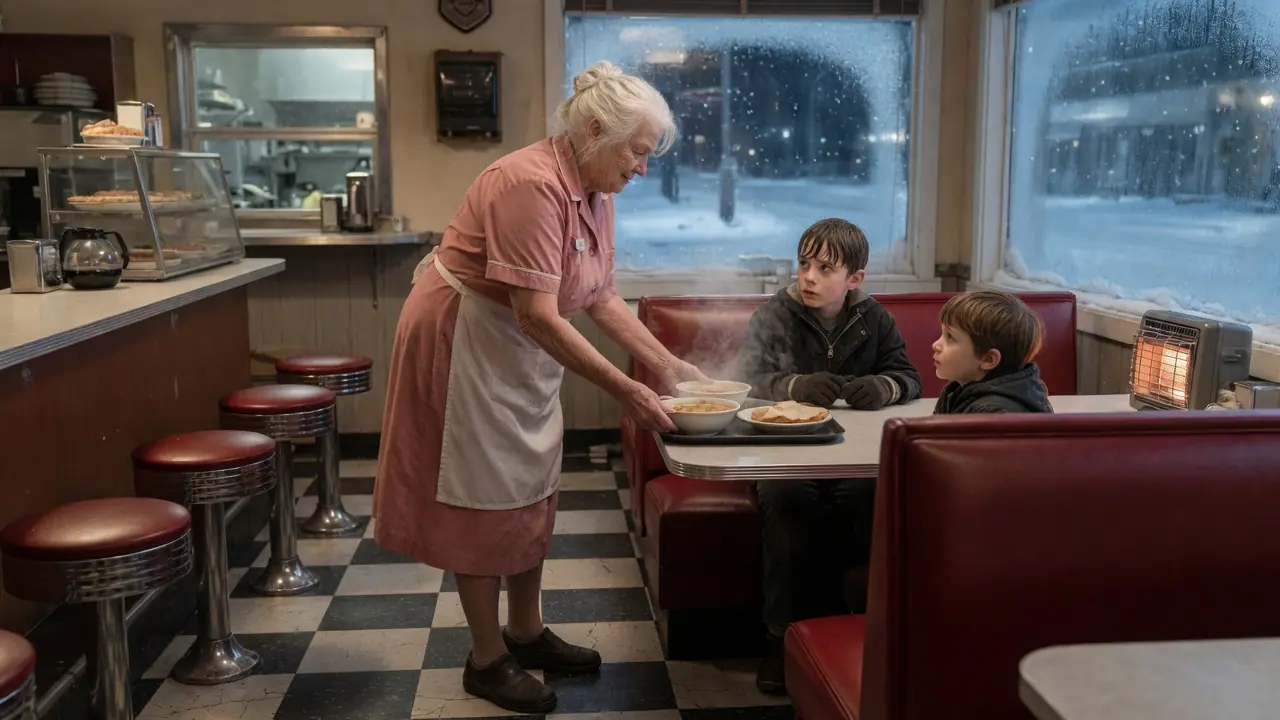
The door opened behind her.
A woman stepped in holding a clipboard.
She was in her forties, with a wool coat, neat hair, and tired eyes that suggested she had seen more sorrow than her paperwork could hold. Beside her came a man in a navy jacket marked CHILD PROTECTIVE SERVICES.
The woman looked around the diner carefully.
“Mrs. Hale?”
Rosie lifted her chin.
“Rosie.”
“My name is Mara Fields. I’m with county family services. This is Daniel Price from Child Protective Services. We received a report that two unaccompanied minors stayed overnight here.”
Hank looked at Rosie with apology in his eyes.
“I didn’t call,” he whispered.
Rosie believed him.
Somebody else had seen.
Maybe through the window.
Maybe someone who passed by and noticed blankets in the booth.
Maybe someone who thought rules were always cleaner than mercy.
Rosie looked toward the booth.
Evan and Leo were still asleep, wrapped in old diner blankets.
Warm.
Breathing.
Alive.
“Yes,” Rosie said.
Mara’s expression did not change.
“They are here now?”
“Yes.”
“We need to assess the situation.”
“They’re not being harmed.”
Daniel Price spoke gently but firmly.
“That is not the only standard.”
“I know.”
Rosie led them to the booth.
Evan woke first.
The moment he saw the clipboard and jacket, he sat up so fast Leo startled awake beside him. His arm went across Leo’s chest.
“No,” Evan said.
Leo grabbed Rosie’s sleeve.
The diner seemed to hold its breath.
Mara crouched beside the booth.
“Good morning. My name is Mara. I’m here to make sure you’re safe.”
Evan’s face closed.
“We are safe.”
Daniel stayed a few steps back, perhaps understanding that too many adults surrounding them would make everything worse.
Mara’s voice remained calm.
“Can you tell me your names?”
Evan hesitated.
Rosie said softly, “It’s all right.”
He looked at her as if betrayed, then looked back at Mara.
“Evan Miller. This is Leo.”
“How old are you?”
“Twelve.”
“And Leo?”
“Six.”
Mara wrote notes.
Leo clung harder to Rosie’s sleeve.
Daniel asked, “Where did you spend the night before this?”
Evan looked down.
“Outside the shelter.”
Mara’s pen stopped.
“Which shelter?”
“Bell Creek.”
Her face changed slightly.
Just enough for Rosie to notice.
“You were turned away?”
“Our file was missing.”
Mara looked at Daniel.
He wrote something.
Rosie saw a flicker of anger cross Mara’s face before professionalism covered it.
Questions continued.
Names.
Ages.
Last known placement.
Parents.
Shelter.
The truck driver.
The walk.
The cold.
The hot chocolate.
The soup.
The blankets.
Rosie stood nearby, silent, hands folded in front of her apron.
Hank looked like he wanted to disappear into the coffee machine.
Then Evan spoke louder.
“She didn’t hurt us,” he said. “She fed us. We were freezing.”
Mara looked up at Rosie.
Rosie did not defend herself.
She had learned that desperate explanations could sound like guilt even when they were truth.
Mara closed her notebook.
“We need to take them for evaluation.”
Evan stiffened.
“No.”
Leo began crying.
“No, no, Evan, no.”
Daniel stepped forward.
“We are not punishing you.”
“You’ll split us up,” Evan said.
Mara’s face softened.
“That is not the goal.”
“That doesn’t mean you won’t.”
The room went quiet.
Rosie closed her eyes for half a second.
Then opened them.
“I’ll take responsibility,” she said.
Everyone looked at her.
Hank whispered, “Rosie.”
She did not look away from Mara.
“I’ll sign whatever says I am responsible for last night.”
Daniel frowned.
“Mrs. Hale, that is not how this works.”
“I know how it works,” Rosie said. “And I know what happens when rooms get too full and names get lost in folders.”
Mara studied her.
Rosie continued.
“I am not a foster home. I am not a facility. I am not pretending this diner is a proper placement. But last night those children were warm, fed, and safe because I did not ask permission before doing the first right thing.”
Daniel looked uncomfortable.
Mara looked thoughtful.
“That does not erase reporting requirements.”
“No,” Rosie said. “But it ought to matter.”
Evan whispered, “Are we going to be separated?”
No one answered immediately.
That silence was answer enough for him.
His face went white.
Rosie stepped closer.
“No,” she said firmly. “Not today.”
Mara looked at her.
Rosie held her gaze.
“Not today,” she repeated.
Something changed then.
Not legally.
Not officially.
Humanly.
Mara closed her folder.
“I need to make calls,” she said. “But first, they need dry clothes, medical checks, and breakfast.”
Rosie nodded.
“Hank.”
Already moving, Hank called from the kitchen, “Pancakes. Eggs. Bacon if we’re pretending the budget isn’t real.”
Rosie did not smile.
But Evan did.
Just a little.
The next days were complicated.
Too many visits.
Too many questions.
Too many forms.
Rosie had to explain everything to county workers, health inspectors, family services, and a woman from the licensing office who treated the diner as if soup were contraband. Hank grumbled through all of it. Mara Fields returned twice, each time looking less like an enemy and more like a tired woman trying to force a rigid system to bend without breaking.
The boys were taken for medical checks first.
Rosie hated watching them leave.
Evan looked back at her from the county car like he was trying not to hope she would still be there later.
She stood on the sidewalk in her faded pink uniform and raised one hand.
“I’ll be here,” she said.
He could not hear her through the closed window.
But he saw her mouth move.
And somehow, he understood.
By evening, Mara returned with news.
Temporary emergency placement had been found in Millford.
A retired teacher named Mrs. Bellamy had been approved years ago as a respite caregiver. She had room for both boys together. Not permanent, not perfect, but safe, warm, and local.
Evan did not trust it.
Leo cried when they left the diner again.
Rosie packed them sandwiches, apple slices, two cookies, and the cleanest blankets she owned.
“Those belong to you,” she told Leo when he tried to give one back.
His eyes widened.
“For real?”
“For real.”
Evan looked at Rosie.
“Can we come back?”
She looked at Mara.
Mara looked at Daniel.
Daniel sighed.
“With supervision and coordination.”
Rosie turned back to Evan.
“That means yes, but adults need to use many words first.”
Leo sniffled.
“I don’t like many words.”
“Neither do I,” Rosie said.
For one week, things seemed manageable.
Then the formal complaint arrived.
Not anonymous this time.
Filed by Councilman Gerald Pritchard.
Rosie knew Gerald. Everyone did. He owned three rental properties, chaired the downtown improvement committee, and believed every problem in Millford could be solved by making poor people less visible. He ate at the diner twice a month and always complained that the coffee was too strong, though he drank three cups.
The complaint accused Rosie of improper housing of minors, failure to report immediately, emotional interference in protective placement, unsafe food handling, and unauthorized shelter operations.
Hank read the notice at the counter and turned red.
“That pompous little weasel.”
“Hank.”
“I will put onions in his pie.”
“You will not.”
“Fine. I will think about it with joy.”
Rosie folded the paper slowly.
Her hands shook.
Not much.
Enough.
Hank noticed.
“I warned you,” he said softly.
Rosie looked up.
“No. You told me it might happen.”
He sighed.
“Rosie.”
She looked toward the back table where Leo had drawn a picture on a napkin during yesterday’s supervised visit. The picture showed two boys, a woman in a pink dress, a man with a spatula, and a diner with smoke coming out of the roof.
“I don’t regret it,” she said.
“I know.”
“That may be foolish.”
“Probably.”
She looked at him.
He shrugged.
“I work here. Foolishness is in the employee handbook.”
The hearing was scheduled for the following Thursday at the county office.
Rosie wore her best dress, the navy one she used for funerals and bank meetings. Hank drove her because her old car had refused to start in the cold. Mara Fields was there. So was Daniel Price. Councilman Pritchard sat near the front with a folder and the expression of a man expecting applause for moral courage.
The room was small and too warm.
Three officials sat behind a long table.
They asked questions.
Rosie answered simply.
“Yes, I gave them food.”
“Yes, I allowed them to sleep in a booth.”
“Yes, I delayed making the call.”
“No, I did not intend to hide them.”
“No, I did not charge them.”
“Yes, I understood there were rules.”
One official, a woman with silver glasses, leaned forward.
“Mrs. Hale, do you understand that reporting procedures exist to protect children?”
“Yes.”
“Then why did you not call immediately?”
Rosie thought about the storm.
Leo’s hands around the mug.
Evan saying, “If you sleep, people move you.”
She thought about Beth.
She thought about the three days after her daughter disappeared, when people with procedures told her to wait.
“I looked at two freezing children,” she said, “and I chose the first protection I could provide.”
Councilman Pritchard cleared his throat.
“With respect, emotional responses cannot replace law.”
Rosie turned to him.
“No. But law without a human pulse can become another locked door.”
His face reddened.
The official with silver glasses asked, “Do you understand that others might have handled it differently?”
Rosie nodded.
“I hope they would.”
The room stilled.
She continued.
“Because then those children would have more than one place in the world where someone didn’t turn them away.”
No one spoke for several seconds.
Then Mara Fields stood.
“If I may.”
The officials allowed it.
Mara opened her folder.
“The children, Evan and Leo Miller, were previously placed in emergency shelter care after the death of their father. Their mother died two years earlier. They were kept together under a temporary arrangement that failed due to staffing changes and documentation mishandling. On the night in question, they were effectively turned away from the Bell Creek shelter despite severe weather conditions.”
Councilman Pritchard shifted in his chair.
Mara continued.
“Mrs. Hale did not follow procedure perfectly. That should be stated. However, the immediate risk to the children at the time she encountered them was exposure, hunger, and further displacement. Her actions prevented harm.”
Daniel Price stood next.
“I have spoken with both minors. They consistently state that Mrs. Hale fed them, warmed them, allowed them to sleep, and did not attempt to conceal them once authorities arrived. They also state they feared separation more than anything else.”
The official with silver glasses looked at Rosie.
“And are you asking for custody?”
Rosie almost laughed.
She was seventy-three.
Her knees hurt.
Her diner leaked.
Her bank account was a sad joke.
“No,” she said. “I am asking that when a child reaches a warm doorway, the person inside not be punished for opening it.”
That sentence became the one people remembered.
The outcome did not come that day.
Government rarely moves at the speed of relief.
For three days, Rosie waited.
The diner felt different. People came in and spoke in lowered voices. Some said they supported her. Some avoided eye contact. One woman told Rosie she had done a beautiful thing. Another told Hank she had heard the diner might be shut down. Hank told her gossip was best served cold and she could take hers outside.
Then, on Monday morning, Mara walked in with Daniel and a man Rosie did not know.
Rosie’s hands tightened on the coffee pot.
“Well,” she said. “Am I ruined before breakfast or after?”
Mara smiled faintly.
“Neither.”
The man introduced himself as Aaron Whitcomb from the county emergency response office. He placed a folder on the counter.
“The county is establishing a pilot program for emergency warming sites during severe weather,” he said. “Primarily for stranded travelers, unhoused individuals, and minors in immediate crisis until proper placement can be arranged.”
Rosie stared at him.
Hank leaned through the service window.
“Say that in diner language.”
Aaron blinked.
Mara translated.
“They want Rosie’s Diner to become an approved emergency safe stop.”
Hank looked at Rosie.
Rosie looked at Mara.
“That is not normal,” Rosie said.
“No,” Mara replied. “But neither was what happened.”
Aaron cleared his throat.
“There will be training, guidelines, inspections, required contact procedures, and limitations. The diner is not a shelter. It will not be used as long-term placement. But in severe weather, it can serve as an immediate warming and coordination site.”
Hank wiped his hands on a towel.
“And the complaint?”
“Closed with corrective guidance,” Daniel said.
Rosie breathed out slowly.
She had not realized how tightly she had been holding herself.
Mara’s eyes softened.
“Evan and Leo are still with Mrs. Bellamy. They asked if they could visit after school.”
Rosie looked away quickly.
Hank pretended to inspect the grill.
“Yes,” Rosie said. “They can visit.”
That afternoon, the bell rang brighter than usual, though Rosie knew that was impossible.
Evan came in first.
Leo ran past him and threw both arms around Rosie’s waist.
She froze for half a second, then placed one hand on his back.
“You’re squeezing an old woman,” she said.
Leo’s voice came muffled against her apron.
“You’re not that old.”
Hank coughed from the kitchen.
Rosie glared at him.
Evan stood near the door, uncertain.
Rosie looked at him.
“You coming in or letting the cold out?”
He stepped forward.
“Are you in trouble?”
“Always.”
“I mean because of us.”
She walked to him and looked him directly in the eye.
“No. Because some grown-ups need a committee meeting before deciding soup is good.”
He smiled then.
A real smile.
Small.
But real.
The pilot program changed the diner.
Not all at once.
At first, it was paperwork and new signs. Rosie had to attend training on mandatory reporting. Hank had to learn where emergency supplies were stored and complained loudly that being seventy years old should exempt a man from labeled plastic bins.
A new sign appeared near the entrance:
COUNTY EMERGENCY SAFE STOP
Warmth, food, phone access, and emergency coordination during severe weather.
People in town had opinions.
Some said it made the diner look charitable in a good way.
Some said it would attract problems.
Rosie had no patience for that.
“Hunger is already a problem,” she told one customer. “At least now it knows where to get soup.”
Evan and Leo visited twice a week with Mrs. Bellamy.
At first, they sat in the same booth near the heater. Leo drew pictures on napkins. Evan helped clear plates without being asked. Rosie pretended not to notice how carefully he watched the register, the door, the kitchen, every movement.
Safety takes time to believe.
Mrs. Bellamy was kind but firm, a retired teacher with white hair, square glasses, and a purse large enough to hold snacks, tissues, and possibly a folding chair. She kept the boys together, which made Rosie respect her immediately.
Over the months, something like routine formed.
Leo began calling Hank “Mr. Pancake.”
Hank claimed to hate it.
He did not.
Evan learned to make coffee, though Rosie refused to let him serve it to customers because, as she said, “Child labor laws and my dignity both object.”
He started doing homework at the corner table after school. At first, he struggled. So much of his life had been survival that multiplication seemed like a luxury. Rosie helped with reading. Hank helped with fractions by using pie slices. Mrs. Bellamy helped with everything else.
Winter softened into spring.
The snow melted.
The safe-stop sign stayed.
Councilman Pritchard lost his next election after a local reporter wrote about the complaint and the failed shelter procedures. He claimed he had been misunderstood. The town understood enough.
By summer, Evan and Leo’s case moved toward permanent placement.
Mrs. Bellamy asked to keep them.
Not as emergency care.
As family.
Evan did not believe it at first.
He came to Rosie the day he found out, standing beside the counter with his hands shoved into his pockets.
“She says we can stay.”
Rosie poured coffee for herself though it was late afternoon.
“She seems like the kind of woman who means what she says.”
“What if she changes her mind?”
Rosie set the pot down.
“Then we will deal with that day if it comes.”
“I don’t like not knowing.”
“No one does.”
“You seem like you do.”
“I’m old. That is different from wise.”
He looked at her.
“Will you still be here?”
The question was quiet.
Rosie heard what he was really asking.
Will another person disappear?
Will another place close?
Will warmth leave too?
She reached across the counter and tapped his hand once.
“I’ll be here tomorrow.”
He frowned.
“That’s all?”
“That’s what people can honestly promise.”
He thought about that.
Then nodded.
“Okay.”
Years moved slowly, then suddenly.
Evan grew taller.
Leo grew louder.
Mrs. Bellamy became their legal guardian, then, after a long process and many emotional meetings, their adoptive grandmother by every measure that mattered. Rosie attended the small courthouse ceremony in her pink uniform because Leo insisted it was “official family clothes.” Hank brought a pie and told everyone he had only come because the pie needed supervision.
The diner survived.
Barely sometimes.
Then better.
The safe-stop program brought grants, donations, repairs, and attention Rosie never asked for but accepted because pride did not patch roofs. The heater was replaced. The roof leak was fixed. The county installed a proper emergency phone line. A local church donated blankets. The high school shop class built storage shelves.
A framed newspaper article appeared near the register.
LOCAL DINER BECOMES SAFE HAVEN AFTER WINTER INCIDENT
Rosie hated the picture of herself.
Hank said it captured her “natural expression of judgment.”
She threatened his pie privileges.
The boys never forgot the first night.
Even when they became teenagers and pretended not to care about sentimental things, they came by every January on the anniversary of the storm. Sometimes they brought flowers. Once they brought a new bell for the door.
Rosie refused to install it.
“There is nothing wrong with that bell.”
“It sounds sick,” Leo said.
“So do I some mornings.”
Evan grinned.
“Please, Rosie.”
“No.”
They installed it anyway while Hank distracted her by pretending the freezer was making a new sound.
For the first time in years, the bell rang bright.
Rosie stood under it with her hands on her hips.
“I hate all of you.”
Leo hugged her.
“No, you don’t.”
“No,” she said. “I don’t.”
When Evan was twenty-two, he returned to Millford after finishing training as a social worker. Not because Millford was glamorous. Not because the pay was good. Because he said systems needed people inside them who remembered what it felt like to be outside in the cold.
Leo became an emergency outreach worker. He had a gift with frightened children because he did not speak to them like problems. He spoke to them like people who had already survived too much.
One winter evening, nearly twelve years after the storm, Rosie stood behind the counter again.
She was eighty-five now.
Thinner.
Slower.
Still stubborn.
Hank had retired two years earlier, then returned three mornings a week because retirement, according to him, was “a scam involving too many daytime television shows.” A younger cook did most of the work now, but Hank still came in to insult the pancake batter.
The bell rang.
Bright.
Clear.
Rosie looked up.
Evan stood in the doorway wearing a dark coat and carrying a folder. He was tall now, serious in a gentle way, with the same watchful eyes he had carried as a boy. Beside him stood Leo, broad-shouldered and smiling, holding a box wrapped in brown paper.
Snow moved behind them.
For one breath, Rosie saw them as they had been.
Two small boys in thin coats.
Wet eyelashes.
Hands shaking around hot chocolate.
Then the present returned.
“Well,” she said. “If it isn’t trouble grown tall.”
Leo laughed and came straight to the counter.
“Still bossy.”
“Still breathing.”
Evan smiled.
“We brought you something.”
“I don’t need anything.”
“You always say that.”
“And yet people keep ignoring me.”
Leo placed the wrapped box on the counter.
Rosie untied the string slowly, partly because her fingers were stiff and partly because she distrusted emotional surprises.
Inside was a brass plaque.
She read the words once.
Then again.
ROSIE HALE SAFE STOP FUND
Because no one should have to ask permission to be warm.
For once, Rosie had no immediate reply.
Evan opened the folder.
“We started it through the county foundation,” he said. “It will help diners, libraries, churches, laundromats, and other small places become emergency warming sites. Training, supplies, insurance support, transportation coordination.”
Leo added, “No one has to guess what to do the way you had to.”
Rosie stared at the plaque.
Her eyes burned.
“That was just something I said.”
“No,” Evan said quietly. “It was something we lived.”
Rosie looked up.
The diner had gone quiet.
Customers were listening. Hank stood in the kitchen doorway, pretending he had dust in his eye.
Evan’s voice softened.
“We never forgot.”
Rosie shook her head.
“I gave you soup.”
Leo smiled.
“That was the beginning.”
Rosie looked at both of them for a long time.
Then she reached for the coffee pot, because some emotions were too large to face without giving people something warm to hold.
“Sit down,” she said. “You’re still allowed to be warm here.”
They sat in the booth near the heater.
Their booth.
The one where Leo had slept and Evan had kept watch.
Rosie brought coffee for Evan, tea for Leo, and pie for both because some traditions deserved sugar.
Outside, snow fell over Millford again.
Inside, the diner glowed.
The bell above the door rang when a truck driver stepped in from the cold, stamping snow from his boots. Behind him came a young mother with a sleeping toddler wrapped in a blanket. Her car had stalled two miles out, she explained, and someone at the gas station told her Rosie’s Diner was a safe stop.
Rosie turned toward Hank.
“Soup.”
Hank grumbled, “I know, I know. Storm policy.”
Evan stood immediately.
“I’ll call the tow service.”
Leo moved toward the storage shelves.
“I’ll get blankets.”
Rosie watched them for a moment.
The boys she had once kept warm now knew exactly how to bring warmth to others.
That was the part no complaint form had known how to measure.
Not the soup.
Not the blankets.
Not the booth.
The continuation.
Rosie turned to the young mother.
“Sit,” she said gently.
The woman looked embarrassed.
“I don’t have much money.”
Rosie pointed to the booth near the heater.
“I didn’t ask for any.”
The young mother stared at her, uncertain, just as Evan had once stared.
Then she sat.
The toddler stirred but did not wake.
Leo placed a blanket around them.
Evan spoke quietly into the phone.
Hank stirred soup in the kitchen.
And Rosie stood behind the counter in her faded pink uniform, older than she had ever meant to become, watching warmth move from person to person like a light that refused to go out.
Years earlier, someone had reported her.
They had meant to stop her.
Instead, the report had forced the town to name what she had done.
Shelter.
That was all it had ever been.
Not rebellion.
Not recklessness.
Not charity for praise.
Just shelter.
A warm place on a cold night.
A bowl of soup.
A booth near the heater.
A tired old waitress who opened a door before the paperwork caught up.
And sometimes, that was enough to change more than one life.
Sometimes, it was enough to change a whole town.