Clara Bennett was seventy-seven years old and still walked to the church bazaar every first Saturday of the month, even when she no longer had anyone waiting at home to ask what she had bought.
She lived in a small yellow house in Millbrook, Ohio, three blocks from St. Andrew’s Church, where she had spent more than fifty years arranging flowers, folding programs, serving coffee, collecting coats, and quietly noticing who needed a little help before they had to ask.
Her husband, Peter, used to call the church hall “Clara’s second kitchen.”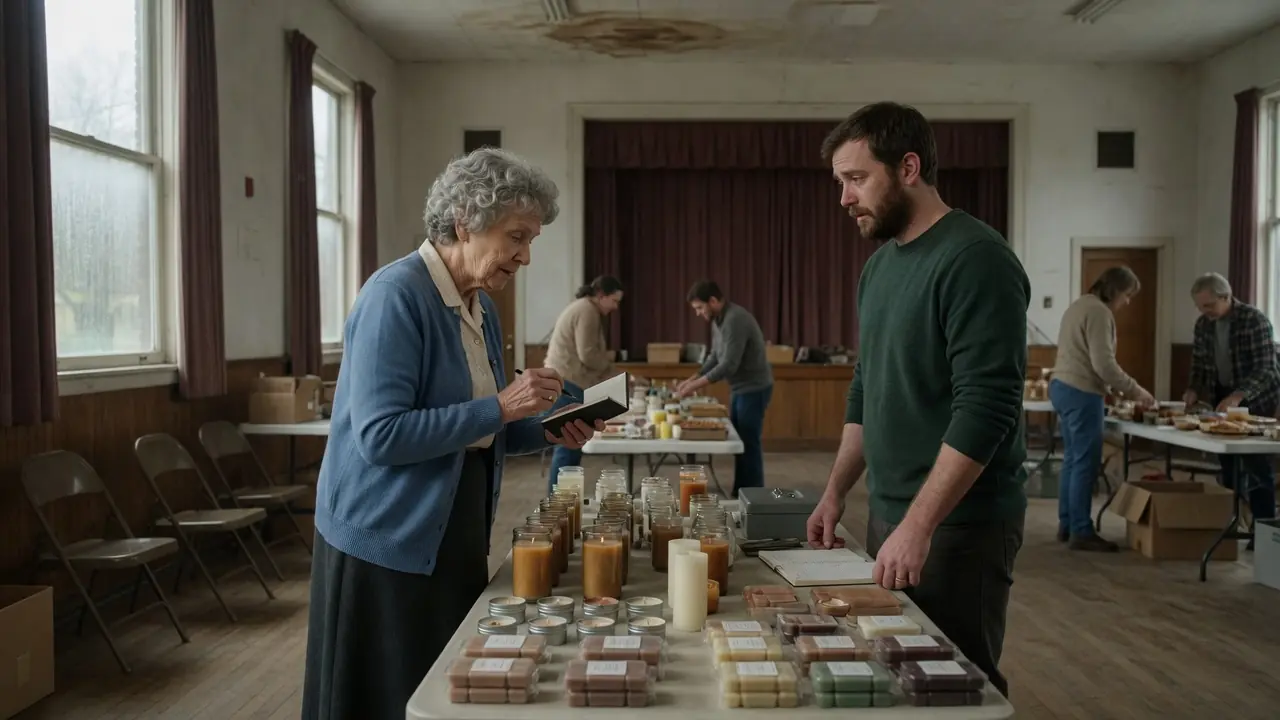
Clara always corrected him.
“It’s everyone’s kitchen,” she would say.
Peter had been gone for eight years.
Still, every time Clara stepped into the church hall, she heard him somewhere in the old wooden floorboards. She remembered him carrying folding chairs after Sunday service, laughing with the children during pancake breakfasts, and sneaking extra cookies from the dessert table when he thought she was not looking.
She always looked.
That was marriage, Clara believed.
Not catching someone in wrongdoing.
Not keeping score.
Simply knowing a person well enough to recognize every small way they were still themselves.
The church hall was old now.
The ceiling had water stains near the back corner. The kitchen stove only worked when it felt cooperative. The stage curtains were faded. The windows rattled in winter. The storage room smelled faintly of dust, hymnals, cardboard boxes, and old coffee.
But to Clara, the hall was beautiful because it had held so many ordinary mercies.
Funeral lunches.
Wedding receptions.
Winter coat drives.
Soup nights.
Birthday parties for people who had no family nearby.
Meetings where tired people came in quiet and left a little less alone.
The world valued large places with shining floors and perfect lighting, but Clara had always trusted the holiness of rooms where people showed up carrying casseroles in both hands.
She had no official title there anymore.
Years earlier, after her knees began complaining during long volunteer days, the church council had gently suggested she “step back.”
Clara had smiled.
Then she continued doing almost everything.
Everyone still asked her where things were.
Extra napkins.
The good coffee urn.
The tablecloth clips.
The old donation envelopes.
The key to the side cabinet.
The blue bin with Christmas garland.
The plug for the ancient electric griddle.
She knew because she had been putting things away for half a century.
Her daughter, Lisa, called from Columbus every Sunday.
“Mom, you’re doing too much at the church,” Lisa said often. “You should rest more.”
Clara always answered, “Rest is what I do between useful things.”
“That’s not how rest works.”
“It is how mine works.”
Lisa would sigh, but she knew better than to argue too hard.
Clara was lonely, yes.
She was aging, yes.
Her hands ached when the weather changed, and her knees complained on the church steps.
But usefulness kept her heart from shrinking.
So she kept going.
She had learned that after Peter died.
The first few months after the funeral, people had brought food until her freezer looked like a casserole museum. They had called every evening, sent cards, stopped by with flowers, and sat with her over tea while saying the same gentle things people say when they do not know how to make death less permanent.
Then, slowly, life continued for everyone else.
People still cared.
They simply had jobs, grandchildren, doctor appointments, leaky roofs, and their own griefs waiting in line.
Clara did not resent them.
But the quiet in her house became enormous.
There were mornings when she brewed two cups of coffee before remembering. There were evenings when she turned toward Peter’s chair to tell him something funny and found only the folded quilt she kept across the back of it.
The first winter after his death, she spent too many hours sitting in that chair, holding his old sweater in her lap.
Then one Saturday, she forced herself to walk to the church hall.
There had been a coat drive that day.
She folded scarves for three hours, sorted mittens by size, and helped a young mother choose a warm jacket for a boy who kept saying he was not cold while his teeth chattered.
When Clara returned home, her grief was still there.
But it had moved over enough for her to breathe.
That was when she understood.
Usefulness would not cure loneliness.
But it could keep loneliness from becoming the only voice in the room.
So every first Saturday, Clara went to the bazaar.
Sometimes she bought things she did not need. Sometimes she bought nothing at all. Sometimes she simply stood in the corner with coffee and watched people, because people, if watched with love, always revealed where the ache was.
One gray Saturday afternoon in November, the church bazaar was nearly over.
It had been a slow day.
Rain had started early and kept people away. The parking lot was full of puddles. The bake sale table still had too many pies left. The craft tables were being packed into boxes. The volunteers were tired, and the fluorescent lights hummed above rows of folding tables.
Clara had bought a small jar of blackberry jam, a knitted dishcloth she did not need, and two slices of banana bread wrapped in plastic.
She was about to help stack chairs when she noticed a young man at the far end of the hall.
His table was still full.
Candles covered it in careful rows.
Small glass jars.
Tin cups.
Tall cream-colored pillars.
Wax melts wrapped in brown paper.
Each had a simple handwritten label.
Evan’s Handmade Candles
Soy Wax. Small Batch. Clean Scents.
There were lavender candles, cedar candles, orange clove, vanilla bean, pine, honey oat, rosemary mint, and one called Porch Light.
Clara slowed when she saw that one.
The young man behind the table looked about twenty-eight. He had broad shoulders, tired hazel eyes, short brown hair, and a neat beard. He wore a dark green sweater with the sleeves pushed to his elbows. His hands were rough but careful, the kind of hands that had poured, trimmed, labeled, boxed, and carried every item himself.
He was pretending not to be discouraged.
Clara recognized that too.
Every time someone walked by, he straightened slightly.
Every time they kept walking, he lowered his eyes and adjusted a candle that did not need adjusting.
A volunteer came by and said gently, “We’re closing in about fifteen minutes.”
The young man nodded.
“Sure. Thank you.”
His voice was polite.
His face was defeated.
Clara walked to his table.
“You made all these yourself?” she asked.
He looked up quickly.
“Yes, ma’am. I did.”
“All of them?”
“Yes.”
“That is a great deal of wax.”
A small laugh escaped him.
“It felt like more at midnight.”
“What’s your name?”
“Evan.”
“Evan what?”
“Evan Miller.”
“I’m Clara Bennett.”
“I know,” he said, then looked embarrassed. “I mean, I’ve seen you helping here. Everyone seems to ask you things.”
Clara smiled.
“That is because I am old enough to know where the tape is.”
Evan laughed again, a little easier this time.
Clara picked up the candle labeled Porch Light.
“What scent is this?”
“Cedar, vanilla, and a little bit of rainwater accord.” He paused. “It’s supposed to smell like coming home at night.”
Clara looked at him.
“That is a brave thing to put in a jar.”
His expression softened.
“My grandmother used to leave the porch light on for me when I worked late. I guess I was trying to make something that felt like that.”
Clara held the candle a moment longer.
Peter had left the porch light on for her too, especially in winter when she stayed late at the church hall. She could still see that warm square of light by their front door, waiting for her through the dark.
When Peter was alive, he used to complain that Clara came home smelling like coffee, floor polish, and church basement.
Then he would kiss her anyway.
“How many did you sell today?” she asked.
Evan’s smile faded.
“Not many.”
“That is not a number.”
He looked down.
“Three candles. Two wax melts.”
Clara looked at the table.
There must have been more than sixty items left.
“First bazaar?” she asked.
“First time selling in person.”
“You sell online?”
“I’m trying. But ads cost money, and photos are harder than I thought. I work at a warehouse during the week. I’ve been making candles at night.” He swallowed. “I hoped today would help me pay for another batch of supplies.”
“And if it doesn’t?”
He gave a small shrug.
A shrug could be louder than a speech.
“I don’t know. Maybe I stop for a while.”
Clara set the candle down carefully.
“Do you want to stop?”
Evan looked up.
The answer came slowly.
“No.”
“Then don’t let a rainy Saturday make a decision for you.”
His mouth trembled, and he looked away quickly.
“I know. It’s just hard when people walk by all day and don’t even smell them.”
Clara understood.
It was hard when the thing you made with care sat in public and nobody reached for it.
She picked up the Porch Light candle again.
“How much for this one?”
“Twelve.”
“And the lavender?”
“Ten.”
“And all of them?”
Evan stared at her.
“I’m sorry?”
“All of them,” Clara repeated. “How much?”
“No. Mrs. Bennett, I couldn’t let you do that.”
“Clara.”
“Clara, that’s too much.”
“For you to sell or for me to carry?”
Despite himself, he gave a broken laugh.
“I mean, it would be a lot of money.”
“That is usually the goal of a bazaar table.”
“But you don’t need this many candles.”
“That is a separate issue.”
He shook his head.
“I don’t want pity.”
Clara’s face grew gentle but firm.
“Evan Miller, pity is when someone looks down on your work and gives you money to feel good about themselves. I am looking straight at your work, and I am buying it because it is good.”
His eyes filled.
He looked down at the table, at the candles he had poured late at night and carried in boxes through the rain.
“I don’t even know what the total would be.”
“Then count.”
He hesitated.
Clara waited.
Slowly, Evan took out a notebook and began adding. He subtracted something from the total, then stopped when Clara cleared her throat.
“Don’t discount yourself while I’m watching,” she said.
He looked almost ashamed.
“Yes, ma’am.”
“Clara.”
“Yes, Clara.”
When he finished, he said quietly, “Four hundred and eighty dollars.”
Clara’s heart gave a small nervous jump.
That was more than she had expected.
She lived carefully. Her pension was modest. Her house needed gutter repair. Winter heating bills were coming. The doctor had mentioned a new prescription her insurance would only partly cover.
But she looked at Evan’s hands.
She looked at the rows of candles.
Then she looked around the hall.
At the bake sale table.
The coat rack.
The old stage.
The kitchen where people had been fed after funerals and before Christmas plays.
Candles could be given.
Light could be shared.
She opened her checkbook.
Evan raised both hands.
“No. Please. I can’t.”
“You can.”
“It’s too much.”
“Not if you use it to make another batch.”
His face changed.
“You mean that?”
“I do.”
He swallowed hard.
“I’ll pay you back.”
“No.”
“I have to.”
“No. You have to keep making candles.”
A tear slipped down his cheek before he could stop it.
He wiped it quickly with the back of his hand.
Clara pretended to examine the lavender candle so he could have a second to recover.
Then she wrote the check and handed it to him.
His fingers shook when he took it.
“Thank you,” he whispered.
“Don’t thank me yet,” Clara said. “You still have to help me decide where all this light is going.”
Together, they packed every candle into boxes.
The volunteers noticed.
Mrs. Talbot from the bake sale table smiled.
Pastor Reed paused near the coffee urn and looked curious.
One of the church ladies came over and bought a banana bread loaf from the bake sale “to go with the candle celebration,” though no one knew what that meant.
Evan loaded the candles into Clara’s old station wagon, then followed her home in his small pickup.
Her house smelled faintly of lemon polish, tea, and old books. In the living room were framed photos of Peter, Lisa, the grandchildren, and old church picnics from years when everyone’s hair had been worse and everyone’s knees had been better.
Near the front window sat a small table where Clara placed mail, church bulletins, and whatever she meant to remember.
Evan carried the boxes inside carefully.
“You have a beautiful house,” he said.
“It is a house with too many memories and not enough closet space.”
He smiled.
Clara began sorting candles on the dining table.
“Lavender for Mrs. Adler. She has trouble sleeping. Cedar for Mr. Jenkins since he misses his cabin. Orange clove for the church kitchen. Honey oat for the nursery workers. Rosemary mint for Pastor Reed because he always says he likes fresh starts and then never cleans his office.”
Evan laughed.
Clara picked up a Porch Light candle and stopped.
Evan noticed.
“For you?” he asked.
Clara touched the lid.
“Yes,” she said softly. “One for me.”
Over the next week, Clara gave candles away.
Not randomly.
Carefully.
She left one with Mr. Greene, a widower who had stopped attending Sunday service but still opened the door when she knocked. His wife had loved lavender, so Clara chose lavender and placed it on the small table by his chair.
“You don’t have to come back to church before you’re ready,” she told him. “But I thought your house might like something gentle.”
He did not say much.
But the following Sunday, he came to service and sat in the back.
She gave two candles to the women who ran the winter coat drive because they always went home smelling like damp wool and kindness.
She brought wax melts to the assisted living home for residents who could not use open flames.
She gave several to church volunteers after a funeral lunch, leaving one beside a woman who had quietly cried while washing casserole dishes.
She placed one on the table at the community soup night, unlit, with a note beside it:
For anyone who needs to remember that warmth can be carried home.
People asked where the candles came from.
Clara gave them Evan’s card.
Orders came slowly at first.
A woman ordered twenty lavender candles for a bridal shower. A church member ordered cedar candles for Christmas gifts. The assisted living home ordered wax melts for a holiday basket program. A local shop owner asked if Evan could supply a small shelf near the register.
Evan came to Clara’s house two weeks later with a new Porch Light candle.
“This one is for you,” he said. “No charge.”
Clara lifted an eyebrow.
“I already bought one.”
“This one is different.”
“How?”
“I made it after that day.”
She opened the lid and smelled it.
Cedar.
Vanilla.
Rain.
And something softer underneath.
“What did you add?” she asked.
“Tea,” he said. “And a little lemon. Your house smelled like that.”
Clara’s eyes filled unexpectedly.
“That is far too sentimental for a young man.”
“I learned from an expert.”
She laughed.
After that, Evan became part of Clara’s life.
At first, he came for business advice, though Clara insisted she knew nothing about business.
“You know people,” he said. “That’s better.”
He was right.
She taught him how to think about customers, not as clicks, not as strangers with wallets, but as people buying feelings they could not always name.
“Someone buying lavender is not buying lavender,” she told him one afternoon as they sat at her kitchen table with a notebook between them. “They may be buying sleep. Or peace. Or a way to tell someone to rest.”
Evan wrote that down.
“Don’t write down everything I say.”
“Too late.”
“She who writes everything down forgets how to listen.”
He paused.
Then wrote that down too.
Clara sighed.
He taught her things as well.
How to take better photos of objects by a window.
How to use her phone calendar without accidentally setting alarms for 3 a.m.
How to order groceries online during icy weather, though Clara considered that “surrendering to machines.”
She taught him to label clearly, package carefully, and never apologize for a fair price.
He helped her with practical things too.
He fixed her sticking back door. He replaced a porch bulb. He carried heavy boxes at the church hall. He drove her home after evening events when the sidewalks were icy.
“You’re not my chauffeur,” Clara told him once.
“No,” he said. “I’m your candle delivery man with expanded duties.”
She laughed so hard she had to sit down.
Lisa noticed the change during a Sunday call.
“You sound brighter, Mom.”
“I sound the same.”
“No, you don’t. What’s going on?”
“I have adopted a candle man.”
There was a pause.
“I’m sorry?”
“Not legally.”
“Mom.”
“His name is Evan. He makes very good candles and listens better than most committee members.”
Lisa came to Millbrook the next month and met him at Clara’s kitchen table. She watched Evan carry in a box of wax melts, fix the loose drawer handle without making a performance of it, and accept Clara’s criticism of his new label design with sincere attention.
When he left, Lisa looked at her mother.
“He’s good.”
“Yes.”
“You helped him?”
“A little.”
Lisa smiled softly.
“And now he helps you.”
Clara folded her hands around her tea.
“People make too much of independence,” she said. “We were not built to be separate cottages.”
Lisa wiped one eye and pretended she had allergies, the way daughters sometimes do when they are trying not to embarrass their mothers with emotion.
Years passed.
Evan’s candle business grew.
He moved from his kitchen table to a rented studio behind a florist shop. Then to a small workshop downtown with wide windows and shelves made from reclaimed wood. He named the business Porch Light Candle Co. because Clara had told him the name mattered.
“You already put the best thing you make on the label,” she said. “Don’t hide it.”
He hired two part-time workers.
Then four.
He supplied gift shops, churches, hospitals, bookstores, and small hotels. His candles became known not for being trendy, but for feeling like memory in a jar.
Every November, he donated candles to St. Andrew’s winter fundraiser.
Every first Saturday, he still stopped by the church bazaar, even after he no longer needed to.
And every year, he brought Clara a new version of Porch Light.
She kept them lined on a shelf near Peter’s photograph.
She burned them slowly.
“Candles are meant to be used,” Evan reminded her.
“So are good dishes,” Clara replied. “And yet I remain in charge.”
As Evan’s business grew, the church hall began to fail.
At first, the failures were small enough to joke about.
A leak in the back corner.
A stove burner that only worked if Pastor Reed tapped it twice with a wooden spoon.
A window that rattled so badly in February that Mrs. Talbot stuffed a dish towel into the frame.
Then the problems stopped being funny.
The roof leak spread.
The kitchen stove stopped working entirely.
The electrical panel was outdated.
The windows needed repair.
The stage curtain was nearly threadbare.
The heating system groaned and clanked through winter like it was reciting its own obituary.
The church had fewer members now, and donations were not enough.
Younger families had moved away.
Older members were on fixed incomes.
The town was changing in ways nobody knew how to stop.
One winter, the furnace failed during a coat drive.
Volunteers finished the event wearing gloves indoors. A little girl chose a purple coat while her mother stood in the corner crying quietly because the church hall was the only place she could still ask for help without feeling ashamed.
Clara saw her.
Of course she did.
That night, Clara went home and sat in Peter’s chair with the Porch Light candle burning on the side table.
“I don’t know how much longer we can keep the hall open,” she whispered.
The room did not answer.
The repair estimate arrived in February.
Then the second estimate.
Then the third.
The church council met in the old hall on a cold Tuesday evening. Clara sat near the coffee urn, hands folded over her cane, listening as they discussed options.
Rent a smaller space.
Sell part of the property.
Close the hall except for Sunday use.
End community dinners.
Pause the bazaar.
Pause the winter shelter partnership.
The words fell like dust.
Clara looked around the room.
At the kitchen where she had served funeral casseroles.
At the stage where children had sung Christmas songs.
At the corner where Peter used to stack chairs.
At the walls that had heard grief, laughter, arguments, hymns, and second chances.
After the meeting, she stayed behind and turned off lights one by one.
When she reached the kitchen, she placed her hand on the old counter.
“Oh, Peter,” she whispered. “I don’t know how to save this.”
She did not tell Evan.
Not at first.
But he noticed.
He came to the bazaar in March and found half the tables missing.
“Where are the craft vendors?” he asked.
Clara was arranging muffins on a tray.
“We reduced the event.”
“Why?”
“Because reducing sounds better than failing.”
He looked at her.
“What happened?”
“Nothing that needs your worry.”
“That means something that needs my attention.”
“You learned to be difficult.”
“From you.”
He walked into the hall and saw the buckets near the back wall, the cracked window, the cold kitchen, the taped sign on the stove that read DO NOT USE.
His face changed.
“Clara.”
She looked away.
“It’s an old building.”
“So is your house. You don’t stop caring because something is old.”
“It needs money we don’t have.”
“How much?”
“Too much.”
“How much?”
She sighed.
The council had the estimates in a folder in the office. Evan read them quietly.
Roof repair.
Kitchen replacement.
Electrical update.
Window sealing.
Floor repair.
Heating system.
The total was large.
Not impossible for a wealthy donor.
Impossible for a shrinking church hall with bake sales and careful envelopes.
“When were you going to tell me?” Evan asked.
“When telling would change something.”
“It does.”
“I don’t want you writing a check.”
“I know.”
“I mean it, Evan.”
“I know.”
“This hall is not your responsibility.”
He looked around.
At the folding tables.
The old stage.
The kitchen.
The hallway where coat racks still stood from winter.
Then he looked at Clara.
“You bought every candle on my table when my dream was not your responsibility.”
“That was different.”
“No,” he said softly. “It was smaller. But it was the same kind of darkness.”
Clara’s eyes filled.
“I don’t want pity.”
“Good,” Evan said. “I don’t sell it.”
He came back one week later with a plan.
Not just a donation.
A project.
Porch Light Candle Co. had grown large enough that Evan needed a community workshop space for seasonal candle classes, fundraising events, and nonprofit partnerships. He did not want a polished retail classroom. He wanted a place with meaning.
The church hall, if repaired, could host monthly Porch Light Workshops, where people paid to make candles, with part of every ticket supporting the hall’s community programs. Evan would fund the initial campaign launch, donate supplies, and bring his customer base.
Local businesses could sponsor tables.
The hall could host craft markets again, soup nights, coat drives, grief gatherings, school fundraisers, and training events.
He had already spoken to a historic preservation group that offered grants for community spaces.
He had already contacted a contractor who attended St. Andrew’s years ago.
He had already made a sample fundraising candle.
Clara stared at the candle he placed in front of her.
The label read:
Hall Light
Cedar. Lemon Tea. Vanilla. Old Wood.
Her hand trembled when she picked it up.
“You made the church hall into a candle?”
“I tried.”
She opened the lid.
The scent rose softly.
Old wood.
Tea.
Rain.
Wax.
Something like Sunday morning after everyone had gone home but the room still held warmth.
Clara closed her eyes.
“That is unfair.”
“I know.”
“You planned all this before asking.”
“Yes.”
“That is manipulative.”
“That is what you taught me to do with packaging.”
Despite herself, she laughed.
The campaign began in April.
Evan called it Keep The Hall Light On.
Clara said it was too sentimental.
Everyone else loved it.
He created a limited candle collection, with profits going to the hall repairs. Porch Light customers ordered online from across the state. Church members bought candles for gifts. Former members heard about the campaign and sent donations. People shared stories with their orders.
My parents had their wedding reception in that hall.
I ate my first hot meal after losing my job there.
Clara gave my mother a candle after my father died.
My daughter sang on that stage.
The local newspaper wrote a small article.
Then a larger one.
Then a television station came, which Clara hated until Evan promised she did not have to “look inspirational.”
“You always look inspirational,” he said.
“Then I will look annoyed to balance it.”
The fundraiser grew beyond candles.
A contractor donated labor.
A restaurant donated soup night proceeds.
A hardware store offered materials at cost.
A local electrician volunteered weekends.
The preservation grant was approved for the windows and floor.
Evan’s company funded the kitchen stove replacement as part of a long-term workshop rental agreement.
The church council voted to keep the hall open.
Clara cried in the empty kitchen after the vote.
Then denied it.
Renovation began in summer.
Clara complained every day.
She complained about contractors.
“They leave dust everywhere.”
Evan replied, “They are removing a ceiling.”
“Dust is still rude.”
She complained about the new stove.
“The old one had personality.”
“The old one had flames where flames should not be.”
“That is a dramatic way to describe character.”
She complained about the windows.
“They look too clean.”
“You can see through them now.”
“That is what concerns me.”
But beneath her complaints, she moved through the hall with new energy.
She labeled cabinets.
She sorted tablecloths.
She found Peter’s old handwritten list of chair counts and had it framed in the storage room.
She chose paint colors, rejected three, accepted one, then pretended she had not cared.
Opening night came in October.
The repaired hall glowed.
The ceiling was clean. The windows sealed. The kitchen stove shone. The floor had been refinished but still held its old character. The stage curtain was replaced with deep blue fabric. Folding tables were set with simple flowers and small unlit candles.
At the entrance, a sign read:
St. Andrew’s Community Hall
The Light Is Still On
Clara stood in the doorway and stared.
Evan stood beside her.
“No,” she whispered.
“Yes,” he said.
“It looks like itself.”
“That was the point.”
People filled the hall before sunset.
Church members.
Neighbors.
Former members.
Customers from Evan’s candle shop.
People who had eaten soup there.
Children who had grown up on the stage.
Widows.
Young families.
Volunteers.
The old contractor who said he had first learned to dance in that room in 1968.
At seven, Evan stood on the stage holding a microphone.
Clara narrowed her eyes from the front table.
“No speeches,” she called.
People laughed.
Evan smiled.
“One.”
“Too many.”
“Necessary.”
The room quieted.
“Years ago,” Evan began, “I stood at a bazaar table in this hall with boxes of candles nobody had bought. I was ready to quit before I had truly begun.”
Clara looked down at her hands.
“Clara Bennett walked to my table and bought every candle I had left. Not because she needed them, but because she saw the work before anyone else did.”
His voice softened.
“She told me not to let a rainy Saturday decide my future. That day became the beginning of Porch Light Candle Co.”
The room grew still.
“This hall has done for this town what Clara did for me. It has kept light ready for people who arrived discouraged, grieving, cold, hungry, lonely, or unsure. Tonight, we are not just reopening a building. We are keeping a promise that no one should have to stand in the dark alone.”
Clara’s eyes filled.
Evan stepped down from the stage and handed her a small box.
She sighed.
“I dislike boxes.”
“I know.”
Inside was a key attached to a small brass tag shaped like a candle flame.
Engraved on it were the words:
Keep The Hall Light On
Clara closed her hand around it.
“Peter would have called this too much.”
Evan smiled.
“And then asked where to stack the chairs.”
A laugh broke through her tears.
“Yes,” she whispered. “He would.”
The hall became alive again.
More than before, in some ways.
Soup nights returned.
The bazaar grew.
The coat drive expanded.
Candle workshops filled the tables once a month, with people pouring wax, choosing scents, telling stories, and laughing when their wicks leaned.
The hall hosted grief groups, birthday dinners, school fundraisers, winter shelter overflow, and quiet afternoons when older neighbors came for tea because home felt too silent.
Evan taught workshops there.
Clara supervised.
Officially, she said she was not in charge.
Everyone knew better.
When someone measured fragrance oil incorrectly, she appeared beside them.
“That candle will smell like a perfume counter exploded.”
When a child placed a label crookedly, she said, “Character is acceptable. Chaos is not.”
When widows came to the grief candle workshop, she sat with them and helped them choose scents that reminded them of someone they missed.
No one did that better than Clara.
On her eighty-third birthday, Evan and Lisa organized a dinner in the hall.
Clara said she did not want a party.
Evan called it “a candle inventory meeting with cake.”
She attended.
The hall was full of warm light, long tables, soup, bread, flowers, and people who loved her more loudly than she preferred. On one table sat candles from every stage of Evan’s business: the first Porch Light, the second version inspired by her house, Hall Light, and a new one made just for her.
The label read:
Clara’s Kitchen
Lemon Tea. Soft Linen. Warm Bread. Steady Hands.
She smelled it and immediately looked away.
“That is unfair too.”
“I’m getting good at unfair,” Evan said.
At the end of the dinner, Lisa stood and said, “Mom, I used to worry that you gave too much of yourself to this place.”
Clara looked alarmed.
Lisa smiled through tears.
“But now I see the truth. You weren’t losing yourself here. You were leaving pieces of light for everyone else to find.”
Clara covered her face with one hand.
“Too many speeches,” she muttered.
Everyone laughed gently.
Later that night, after the hall emptied, Clara and Evan stayed behind to turn off the lights.
The repaired windows reflected the soft glow of the candles on the tables. The kitchen smelled faintly of coffee and cake. The stage curtain hung still. The floorboards creaked beneath them in the familiar way.
“You saved the hall,” Clara said.
Evan shook his head.
“You saved the first light.”
“I bought candles.”
“You bought belief.”
She looked toward the corner where his first bazaar table had stood years earlier.
“I bought all of them because they were good.”
“I know,” he said softly. “That was the part that saved me.”
Clara stood quietly for a moment.
Then she turned off the last overhead light.
Only one candle remained glowing on the table.
Porch Light.
The first scent.
The one that smelled like coming home.
Years earlier, Clara Bennett had seen a young man behind a table of unsold candles, trying not to let one rainy day put out his dream. She bought every candle he had left and gave them away to people who needed warmth.
She thought she was only helping him through one hard afternoon.
But kindness, like light, does not stay where it begins.
It travels.
It catches.
It returns brighter.
Evan built his life from that first proof that his work mattered. And when Clara’s beloved church hall was the thing going dark, he returned with candles, customers, repairs, workers, stories, and gratitude strong enough to keep the doors open.
What Clara received was not only a repaired hall.
She received Peter’s memory alive in the sound of chairs being stacked again.
She received a chosen son in Evan, neighbors gathered around tables, soup simmering in a working kitchen, and proof that no act of kindness is ever truly small if it helps someone keep going.
And every first Saturday after that, when the bazaar neared closing and some nervous new vendor sat behind a table full of unsold work, Clara would walk over, pick up the nearest item, and say,
“Tell me what you made. I’d like to see the light in it.”