Rain had a way of making failure feel louder.
Daniel Mercer learned that on a Thursday night in October, somewhere along a lonely stretch of highway in western Pennsylvania, with his windshield wipers dragging tired half-circles across the glass and his whole life packed into one cardboard box on the passenger seat.
The box held a framed certificate from the first year his company made a profit, a cracked coffee mug with his business logo on it, three folders of unpaid invoices, a tape measure, a small wood sample from a dining table he never got to finish, and a photograph of six employees standing outside a workshop that no longer belonged to him.
His phone sat in the cup holder at three percent battery, buzzing every few minutes with calls he did not have the courage to answer.
The rain thickened as he drove, turning the road into a black ribbon that reflected every passing headlight.
Daniel’s suit jacket was damp from running across the parking lot outside the bank, and his white shirt clung uncomfortably at the collar.
He had loosened his tie an hour ago, but it still felt like something wrapped around his throat.
Every mile he drove took him farther from the building where he had just signed away the last pieces of Mercer Custom Furniture.
It had not always been like that.
Three years earlier, Daniel had believed he was building something that would outlive him.
Mercer Custom Furniture started in a rented warehouse on the edge of Pittsburgh, with secondhand tools, one delivery van, and three men who trusted him because he spoke honestly and paid on time.
He built dining tables, cabinets, bookshelves, benches, and kitchen islands from real wood, with careful joinery and finishes that made people run their hands across the surface before they said anything. Customers loved the work because it felt human.
Daniel loved the work because it made sense.
Wood had rules. Grain had direction. A board could warp, split, cup, or bow, but it never pretended to be something else.
If you forced it, it fought you. If you listened to it, it told you how it wanted to become useful. Daniel had always been better with wood than with people, but running a business meant learning both.
For a while, he succeeded.
He hired more workers. He moved into a bigger workshop. He bought better machines.
He took larger contracts from restaurants, hotels, and developers who wanted custom interiors with a handmade look. He became the kind of man other people called “successful,” and for a while he believed them.
His wife, Lauren, had been proud at first.
She brought lunch to the workshop on Saturdays, took photos of finished pieces, and told customers that Daniel built furniture as if every table might host someone’s best memory.
But success came with longer hours, more pressure, and less of Daniel at home. The more the company grew, the more Daniel disappeared into estimates, orders, payroll, supplier delays, and late-night calls.
Then came the contract that broke everything.
A regional hotel group ordered custom furniture for six locations. It was the largest job Daniel had ever accepted.
The deposit looked strong, the timeline looked tight but possible, and Daniel’s business partner, Mark, convinced him it was the kind of opportunity that turned a small company into a serious one.
Daniel signed, borrowed money for materials, hired temporary help, and expanded faster than his instincts wanted.
The first supplier delay cost him two weeks.
The second cost him a month.
Then Mark disappeared.
Not dramatically. No note on the desk, no confession, no shouting match. He simply stopped answering calls.
By the time Daniel learned that company funds had been moved, invoices had gone unpaid, and several deposits had been mishandled, the hotel deadline was already impossible. The client canceled the remaining contract and demanded penalties.
Daniel fought for six months.
He sold equipment. He took personal loans. He stopped paying himself. He laid off the temporary workers first, then the newest hires, then people who had been with him since the early days. He promised each person he would make things right, though he no longer knew what “right” meant. Every promise cost him sleep.
Lauren left in February.
She did not leave angrily. That almost made it worse. She stood in the kitchen of their rented townhouse, holding a suitcase, and said, “Daniel, I know you’re trying to save the company.
But I don’t think you know you’re losing everything else.” He wanted to argue, but he had been standing there with a phone in one hand and a payroll spreadsheet in the other, and there was nothing convincing about him.
By October, the bank had stopped using gentle language.
That Thursday, he went in wearing his best suit because some part of him still believed looking respectable might help. He asked for an extension, a restructuring, a temporary line of credit, anything that would give him thirty more days.
The loan officer listened with a kind face and folded hands, then told him what Daniel already knew. There would be no extension.
When Daniel left the bank, it was raining.
By nine o’clock, he had emptied his desk.
By ten, he was driving with no destination.
He had thirty-eight dollars in his wallet, half a tank of gas, and a heart so heavy he wondered if it had become a physical object pressing against his ribs. He thought about calling Lauren, then hated himself for wanting comfort from someone he had already exhausted. He thought about calling his foreman, Reggie, to apologize again, but he had apologized so many times the word had lost all shape.
So he drove.
The highway carried him past closed gas stations, dark farmhouses, and fields flattened by rain. He did not know the name of the town he entered near eleven-thirty. He only knew he was hungry in a way that felt shameful, like hunger was another bill he had failed to pay. Then a small yellow sign appeared at the edge of his headlights.
Maggie’s Roadside Diner
Open Late
Coffee, Pie, Supper
Daniel almost passed it.
Then his stomach twisted hard enough to make him slow down.
The diner sat beside an old two-pump gas station that looked long closed, with a gravel lot full of puddles and weeds. A red neon sign buzzed above the door, but the letter G in Maggie’s flickered on and off, so from the road it looked like Ma ie’s if the rain hit at the wrong angle. Warm light glowed behind the windows. There were only two vehicles in the lot: a faded blue sedan and a pickup truck with mud on the tires.
Daniel parked near the side, shut off the engine, and sat without moving.
He looked at himself in the rearview mirror. His face seemed older than it had that morning. His eyes were bloodshot. His hair was damp and flattened. He looked like a man who had walked out of his own life and forgotten to bring a map.
For one moment, he considered starting the car again.
Then his stomach growled.
He stepped into the rain and hurried to the door.
The bell above the diner entrance rang with a small, bright sound that felt too cheerful for the hour. Inside, the diner smelled of coffee, gravy, frying onions, old wood, lemon cleaner, and something sweet cooling somewhere unseen. There were red vinyl booths along the windows, a long counter with round stools, a pie case near the register, and framed photographs on the wall. The floor was worn but clean.
A woman behind the counter looked up from refilling napkin holders.
She was in her early seventies, maybe older, with silver hair pinned into a bun and a blue apron tied over a white blouse. She was small, but nothing about her seemed fragile. Her face had the strong lines of someone who had spent a lifetime waking before sunrise and not asking permission to continue. Her name tag read Maggie.
“Evening,” she said. “You look like the storm dragged you in by the collar.”
Daniel gave a tired laugh because he had no better response.
“It might have.”
“You want a booth or the counter?”
“Counter is fine.”
He sat on a stool near the end, setting his wet cardboard box carefully on the floor by his feet. Maggie looked at the box, then at his suit, then at his face. She did not stare long enough to embarrass him. Just long enough to understand there was more wrong than rain.
“Coffee?” she asked.
“Yes, please.”
“Cream?”
“No, thank you.”
She poured from a glass pot into a thick white mug and set it in front of him. The coffee was hot, strong, and not fancy in the slightest. Daniel wrapped both hands around the mug like he had been cold for years.
Maggie leaned one hip against the counter.
“You passing through?”
He looked down at the coffee.
“Something like that.”
“That means no.”
He looked up, surprised.
She shrugged. “People passing through know where they’re going.”
He almost smiled.
“I suppose that’s true.”
“You hungry?”
“No,” he said automatically.
His stomach growled so loudly that Maggie raised one eyebrow.
“That was a rude interruption from your insides.”
Daniel flushed. “I’m fine.”
“People who are fine don’t usually look at coffee like it’s holding them together.”
He looked away.
“I don’t have much money.”
Maggie did not soften in a way that would make him feel pitied. She simply reached for a menu and slid it toward him.
“Meatloaf special is still warm. Mashed potatoes, green beans, bread. Apple pie if you behave.”
“I can pay for coffee.”
“Coffee is one dollar tonight.”
Daniel glanced at the menu.
“It says two-fifty.”
“Storm discount.”
“That’s not a real discount.”
“It is if I own the coffee pot.”
He looked at her.
“I don’t want charity.”
“Good,” Maggie said immediately. “Charity makes people stiff. I prefer supper.”
That answer confused him enough that he did not know how to argue.
Maggie pointed toward the corner booth near the heater.
“Sit there. Your suit is dripping on my stool.”
Daniel looked down. He was dripping. “Sorry.”
“Don’t apologize to furniture. It gets ideas.”
He picked up his mug and moved to the booth. The red vinyl seat was cracked in the corner, but the heater beneath the window pushed out warm air. Rain streaked the glass beside him, turning the neon sign outside into red rivers. The whole world felt far away, and that frightened him because distance felt too much like relief.
Maggie brought the plate five minutes later.
Meatloaf with brown gravy. Mashed potatoes with butter melting into the top. Green beans cooked with onions. Two slices of bread. A small cup of applesauce. It was not restaurant food. It was the kind of food someone made because they expected hunger to be honest.
Daniel stared at it.
“Maggie, I really can’t pay for all this.”
She set down a fork and napkin.
“You can pay what you can. And before your pride starts performing, listen carefully. I have thrown away more food this week than I like to admit. If you eat this, you are helping me with a waste problem.”
“That sounds like a generous lie.”
“It is a practical arrangement with emotional benefits.”
He laughed once, but his throat tightened.
Maggie stepped back.
“Eat before it cools.”
He picked up the fork.
At first, he ate slowly, as if manners could prove he was not as desperate as he felt. Then hunger took over. The first bite of meatloaf nearly undid him. Not because it was extraordinary, although it was good, but because it was warm and real and given without a lecture. He had spent months being measured by numbers, contracts, balances, deadlines, and failures. A plate of food asked nothing except that he eat.
Halfway through, his eyes blurred.
He put down the fork and covered his face with one hand.
Maggie was wiping the counter. She saw him, but she did not rush over. She did not ask, “Are you okay?” which would have required him to lie. She simply turned slightly, giving him the dignity of privacy in a public room.
That kindness broke him more deeply than questions would have.
After a minute, Daniel lowered his hand.
“I lost everything today,” he said, his voice barely above the rain.
Maggie came over with the coffee pot and refilled his mug.
“Business?”
He nodded.
“What kind?”
“Furniture. Custom furniture.”
“Woodworker?”
“Business owner. I used to build more than I managed. Lately, I mostly failed at managing.”
She sat across from him without asking.
“Did you love it?”
He looked at the plate.
“Yes.”
“Then it hurt worse.”
He let out a breath that almost became a laugh.
“That simple?”
“Most complicated pain has simple bones.”
He looked at her properly for the first time. “My company is gone. My employees lost their jobs because I made bad decisions. My partner stole from the business. My marriage ended because I kept trying to save something that kept sinking. The bank said no today. I don’t even know where I’m sleeping tonight.”
Maggie listened without interrupting.
Daniel had expected shame to rise higher as he spoke, but instead he felt something loosen. Not enough to heal. Just enough to breathe. The words had been trapped inside him for so long that saying them to a stranger felt less dangerous than saying them to someone he loved.
Maggie folded her hands on the table.
“My husband, Frank, lost his repair shop thirty-two years ago.”
Daniel looked up.
“He fixed farm equipment, trucks, anything with wheels and an attitude. Took on too much debt, trusted the wrong man, got caught in a bad season. One day he came home and sat at our kitchen table without taking off his coat. I asked if he wanted coffee, and he said, ‘I don’t think I’m a man anymore.’”
Daniel swallowed.
“What happened?”
“I told him he was being dramatic and made him soup.”
Despite himself, Daniel laughed.
Maggie smiled faintly.
“Then, after he calmed down enough to stop insulting himself, we started smaller. He fixed lawn mowers from our garage. Then snowblowers. Then old trucks again. Never became rich. But he became useful again, and that saved him more than money did.”
Daniel stared at his plate.
“I don’t know how to start smaller. Everything is debt and failure and people I disappointed.”
“You don’t start with everything,” Maggie said. “That will crush you. You start with tomorrow morning.”
“Tomorrow morning I have to tell my remaining employees the company is finished.”
“Then tell them the truth.”
“That I failed them?”
“That you fought, lost, and are sorry. Don’t decorate pain just to protect your pride. People can survive hard truth better than false hope.”
His mouth tightened.
“I don’t know if they’ll forgive me.”
“They might not tomorrow.”
“That’s comforting.”
“Truth isn’t always soft.”
He looked at her.
Maggie leaned forward slightly.
“After that, you ask yourself one question. What skill still belongs to you after the building, the loan, the contracts, and the title are gone?”
Daniel looked at his hands.
They were rough, though less rough than when he built every day. There was a small scar near his thumb from a chisel slip when he was twenty-two. His palms knew weight, grain, sanding, measuring, finishing. He had not thought of them as assets in months.
“I know wood,” he said quietly.
Maggie nodded.
“Then you are not empty-handed.”
“I lost the workshop.”
“Find a smaller table.”
The sentence landed strangely.
He looked at her.
“What?”
“Find a smaller table,” she repeated. “If you can’t build a whole company tomorrow, build one honest thing. Then build the next.”
Daniel stared at her for a long moment.
“That sounds too simple.”
“Simple and easy are not cousins.”
Maggie stood and returned with a slice of apple pie.
He shook his head weakly.
“I didn’t order that.”
“The top cracked.”
“It looks perfect.”
“Emotionally cracked.”
He laughed again, and this time the laugh did not break.
The pie was warm, with cinnamon and butter in the crust. Daniel ate it slowly, feeling ashamed of how much it comforted him and grateful anyway. When he finished, he took twenty dollars from his wallet and placed it on the table.
Maggie picked up the money, removed one ten, and pushed the other ten back.
“No.”
“Maggie.”
“No,” she said. “Gas money.”
“I can’t take that.”
“You are not taking. You are leaving with enough to reach whatever tomorrow morning looks like.”
“I don’t deserve this.”
“That is not how food works.”
He pressed his fingers against the bill.
“Why are you helping me?”
Maggie glanced toward the old photographs near the register. One showed her younger, standing beside a man with dark hair and a wide smile. Frank, Daniel guessed.
“Because someone once fed Frank when he thought shame was the same thing as death. He came home because of that meal. Not because food solved the problem, but because it reminded him he was still alive inside it.”
Daniel lowered his eyes.
Maggie took a receipt pad from her apron pocket and wrote something on the back. She slid it across the table.
He read it.
Find a smaller table. Build one honest thing. Then build the next. - Maggie
He folded the receipt carefully and placed it in his wallet.
“I’ll come back,” he said.
“People say that on hard nights.”
“I mean it.”
“I believe you might.”
When Daniel stepped outside, the rain had softened but not stopped. He sat in the car and watched Maggie move behind the counter, refilling napkins, turning off one light, wiping a surface that was already clean. He looked at the receipt again beneath the dim dome light. Then he started the car and drove toward the cheapest motel he could find.
The next morning hurt.
It hurt worse than the bank.
Daniel stood in the warehouse in front of Reggie, Melissa, Omar, Chris, and two part-time finishers who already knew from his face what had happened. He told them the truth. No extension. No buyer. No miracle. He told them they would receive their final checks from the last available funds and that he would help them find work however he could.
Reggie, his foreman, crossed his arms and looked away.
Melissa cried silently.
Omar asked whether there was any chance of reopening under another name, and Daniel had to say no.
Chris, the youngest, just stared at the floor.
Daniel did not blame Mark out loud, though everyone knew Mark had destroyed them. He did not blame the bank, though he wanted to. He did not make speeches about future opportunities or “family” or resilience. He said, “I am sorry. I made decisions that put too much weight on this company, and all of you paid for it. I will spend the next weeks helping each of you land somewhere stable.”
Nobody applauded honesty.
That was not what honesty was for.
Reggie stayed after everyone else left.
“You should have told us earlier,” he said.
Daniel nodded.
“Yes.”
“I might have helped.”
“I know.”
“That makes it worse.”
Daniel looked down.
“Yes.”
Reggie sighed, then picked up his tool bag.
“You were a good craftsman before you tried to become a big boss.”
Daniel felt that sentence cut deeper than an insult.
Reggie continued, “Don’t lose the part that knew how to build.”
Then he left.
Daniel spent the next month closing the company properly. He called contacts, begged for job openings, wrote reference letters, sold machines, returned materials where possible, and answered creditors with as much honesty as he could. He slept poorly in a rented room above a mechanic’s garage that smelled faintly of motor oil and cold concrete.
When the warehouse was finally empty, he stood alone in the middle of it.
The floor still showed pale rectangles where machines had been. Sawdust remained in corners. The air held the ghost of work. Daniel took the small wood sample from his cardboard box and placed it in his coat pocket.
Then he locked the door.
For three days, he did nothing useful.
He slept badly, ate little, ignored calls that were not urgent, and stared at Maggie’s receipt until the words almost became irritating.
Find a smaller table.
On the fourth day, the mechanic downstairs knocked on his door.
“You still work with wood?”
Daniel almost said no.
Instead, he said, “I used to.”
The mechanic, a man named Vince, held up a broken stool.
“My shop stool finally gave up. Can you fix it?”
Daniel looked at it. Cheap pine, cracked joint, loose leg, ugly finish. It was not worth fixing.
Then he heard Maggie’s voice in his head.
Build one honest thing.
“I can build you a better one,” Daniel said.
“With what shop?”
Daniel looked past him toward the garage below.
“You have clamps?”
Vince did.
They were terrible clamps, but they worked.
Daniel found scrap oak from a salvage yard, borrowed a small saw, bought sandpaper with money he should have saved, and built the stool on two sawhorses behind the garage. It took longer than it should have because he no longer had proper equipment. Every inconvenience humbled him. Every cut reminded him of what he had lost.
But when he finished, the stool was solid.
Simple. Strong. Honest.
Vince paid him forty dollars and sat on it immediately.
“Feels better than the old one.”
“It should,” Daniel said. “The old one was trying to die.”
That night, Daniel wrote $40 in a notebook.
Under it, he wrote:
First smaller table. Not actually a table. Counts anyway.
The next thing he built was a porch bench for Vince’s sister. Then a shelf for a teacher. Then a cutting board set from walnut offcuts. He photographed each piece on a clean sheet near the garage door and posted them online under a name that felt almost like a confession.
Smaller Table Woodworks
His description was simple:
Hand-built furniture and household pieces made carefully, one order at a time. No rush jobs. No fake wood. No shortcuts.
At first, almost no one cared.
That was good for him.
Daniel learned to survive small again. He learned to answer one inquiry without imagining a business empire. He learned to price honestly instead of desperately. He learned to say no when a job was too big or the timeline dishonest. Every time temptation whispered that he could scale quickly if he borrowed just a little money, he took Maggie’s receipt from his wallet and read it.
Build one honest thing.
Then build the next.
Six months passed.
He moved from the rented room into a small apartment behind an old storefront. The front space became his shop. It had uneven floors, poor heat, and a back door that stuck in damp weather, but it was his without debt. He bought tools slowly. One planer. One table saw. Better clamps. A proper workbench.
He called Reggie after eight months.
Not to offer a job. He did not have one. He called to apologize again, this time without asking for absolution.
Reggie listened.
Then said, “You building?”
“Yes.”
“Good.”
A month later, Reggie stopped by the small shop.
He inspected the workbench, ran his hand over a finished shelf, and nodded. “You slowed down.”
Daniel braced for criticism.
Reggie said, “Good. You needed to.”
Eventually, Reggie began helping on weekends. Then part-time. Then full-time, but only after Daniel showed him the books, the contracts, the cash reserves, and the rule written in marker above the office doorway:
No growth that breaks the work.
Reggie read it and pointed.
“Keep that up there.”
“I plan to.”
“No. I mean when you get arrogant again.”
Daniel nodded.
“I deserve that.”
“Yes, you do.”
They laughed for the first time in a long while.
Daniel’s work gained attention slowly, which was the only kind of attention he trusted now. A local café ordered six tables. A young couple ordered a dining table built from reclaimed maple. A school librarian asked for reading benches. A small restaurant group hired him to build counters and booth frames for one location, then another.
He paid his debts as he could.
He sent former employees updates when he found openings for them. Some answered. Some did not. He accepted both. Repair did not always include reunion.
Lauren called once after seeing an article about Smaller Table Woodworks in a local magazine.
“I’m glad you’re building again,” she said.
Daniel sat on the floor of his shop beside a stack of oak boards, phone against his ear.
“Me too.”
“You sound different.”
“I lost the part that wanted to sound impressive.”
She was quiet.
Then she said, “That’s probably good.”
They did not get back together. Life was not that simple. But they spoke with kindness, and Daniel learned that not every broken thing needed to become what it once was to be honored.
Two years after the rainy night, Smaller Table Woodworks had five employees, including Reggie. The shop was still modest, but steady. Daniel had no business partner. No reckless debt. No contract he could not understand with his own eyes. He built less than people wanted and more carefully than they expected.
One afternoon in October, while cleaning out his old wallet, Daniel found Maggie’s receipt tucked behind his driver’s license.
The paper was worn thin at the folds. The ink had faded slightly, but the words remained clear.
Find a smaller table. Build one honest thing. Then build the next. - Maggie
He sat at his desk for several minutes, holding it.
Then he opened a map and searched for the diner.
Maggie’s Roadside Diner still existed.
Barely.
At least online, there was one old review from three months earlier:
Food still good, but place looks like it’s falling apart. Hope Maggie hangs in there.
Daniel felt something cold move through him.
That weekend, he drove back.
Rain began just before sunset.
It felt almost too fitting, like memory had arranged the weather. Daniel drove a work truck this time, clean but not flashy, with Smaller Table Woodworks painted simply on the door. Behind him, Reggie drove another truck loaded with wrapped furniture pieces. A third truck followed with tools, materials, and two employees who had volunteered before Daniel explained fully.
Maggie’s sign appeared through the rain.
It looked worse than Daniel remembered.
The neon barely held. The red awning sagged in the middle. One side of the building had peeling paint. The gravel lot had deep puddles and weeds growing through the cracks. A plywood patch covered the lower corner of one front window. A handwritten sign taped to the door read:
Open. Please pull hard. Door sticks.
Daniel parked in the same place as before.
For a moment, he could not move.
He saw himself from two years earlier, soaked, ashamed, holding his last ten dollars like pride could still buy dinner. He saw Maggie sliding the bill back to him. He heard her say, “You are leaving with enough to reach whatever tomorrow morning looks like.”
Then he stepped out.
The bell above the door rang, though weaker than before.
Inside, the diner smelled the same.
Coffee. Gravy. Toast. Lemon cleaner. Pie.
But the room looked tired in a way that hurt. The booths were torn more deeply. Several tables wobbled on folded cardboard shims. The counter edge was chipped. One stool leaned slightly. The pie case was empty except for one lonely slice under plastic wrap. Only two customers sat inside, both older men at the counter.
Maggie was behind the register, reading an invoice with her glasses low on her nose.
She looked up.
At first, she did not recognize him.
Then her eyes narrowed.
“Well,” she said slowly. “The bank argument came back with better shoes.”
Daniel smiled.
“Hello, Maggie.”
She walked around the counter, studying him with open curiosity now.
“You look alive.”
“I am.”
“That’s good. Alive people order food.”
“I will.”
Her gaze moved past him to the trucks outside.
“You bring friends to eat too?”
“Something like that.”
Maggie’s smile faded slightly.
She knew. Perhaps not the details, but enough. People who had run diners for decades could hear help approaching and become defensive before it opened its mouth.
“Daniel,” she said carefully. “What did you do?”
He looked around the diner.
“What happened?”
She lifted one shoulder.
“Time happened. Rent happened. Roof happened. Equipment happened. People discovered sandwiches can be delivered by children on bicycles and forgot booths exist.”
“That’s not all.”
“No,” she said. “But it’s enough for one sentence.”
He saw the envelope near the register. Thick paper. Formal.
Maggie noticed his eyes move.
“Landlord is selling the property,” she said. “New owner wants to renovate the diner into something with plants hanging from pipes and toast that costs twelve dollars.”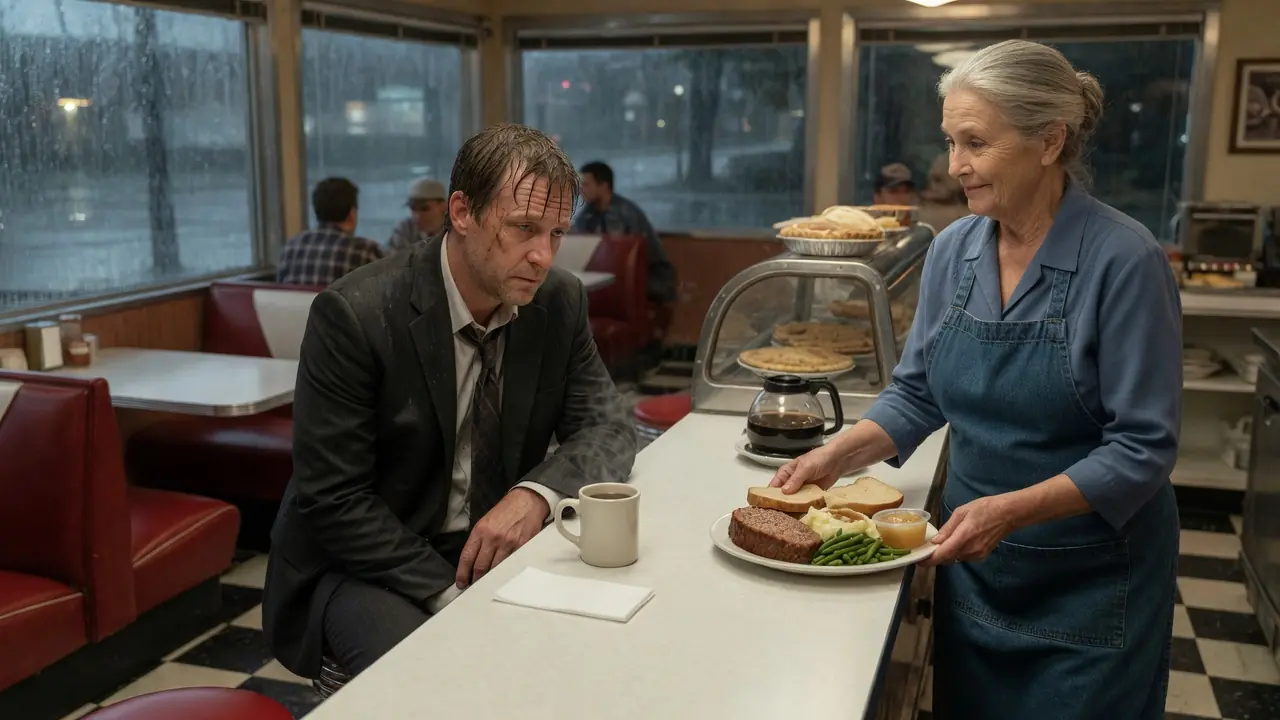
Daniel’s jaw tightened.
“When?”
“My lease ends in sixty days.”
“Do you want to close?”
Maggie laughed once, but it carried no humor.
“Everyone asks if I’m tired. Nobody asks that.”
“I’m asking.”
She looked around.
At the counter.
At the booths.
At the grill window.
At a photograph of Frank near the register, smiling beside a younger Maggie in front of the diner decades ago.
“No,” she said quietly. “I don’t want to close.”
Daniel nodded.
“Then I brought the right trucks.”
Her eyes sharpened.
“No.”
“You haven’t heard the plan.”
“I hear trucks. Trucks are never subtle.”
“Maggie.”
“No, Daniel. I fed you dinner. I didn’t buy shares in your conscience.”
He almost smiled, but her eyes were wet, and he respected the seriousness of her pride.
“This is not charity.”
“That is what people say before charity enters wearing a hat.”
He took a folded proposal from his coat and placed it gently on the counter.
“This is a lease partnership.”
She looked suspicious.
“Those are dangerous words.”
“Smaller Table Woodworks needs a living showroom.”
“A what?”
“A real place where customers can see our diner tables, booth frames, counters, stools, and restoration work being used every day. Not staged in a showroom. Used. Coffee spills, elbows, families, truck drivers, tired people, real life. Maggie’s becomes the first Smaller Table restoration partner.”
Maggie stared at him.
He continued.
“I spoke with your landlord.”
“You did what?”
“He agreed to renew the lease if repairs are completed, rent is secured for twelve months, and the property value improves. My company leases the back storage room and the far corner area as a rotating display space. We pay rent directly into the lease structure. In exchange, we restore the diner furniture, counter, booths, sign frame, and interior woodwork as leasehold improvements and showroom investment.”
Maggie said nothing.
Daniel pushed the folder slightly closer.
“You stay owner of the diner business. Your recipes stay yours. Your name stays on the sign. Your menu stays honest. We do not turn this into a place where toast needs a paragraph.”
One of the old men at the counter muttered, “Thank God.”
Maggie did not laugh.
She opened the folder.
Inside were drawings.
The diner, restored but not erased. New red booth seats built over strong frames. Tables made from warm oak, finished to survive coffee, syrup, and elbows. The counter repaired, polished, and edged with wood that matched the original style. A rebuilt pie case base. New shelves near the entrance displaying small wooden pieces customers could order, each tagged discreetly. The old photographs preserved. The sign repaired but not redesigned.
Maggie turned a page.
There was the corner booth by the heater.
The one where Daniel had eaten.
Above it, a small brass plaque:
The Rainy Night Booth
For Anyone Starting Over
Maggie closed the folder.
“That is too sentimental.”
“Yes.”
“Frank would have made fun of it.”
“Would he have liked it?”
She looked at Frank’s photograph.
After a long moment, she said, “He would have sat there pretending not to cry.”
Daniel smiled softly.
“So will I, probably.”
She shook her head.
“I can’t afford this.”
“You are not paying for the restoration. Smaller Table is investing in its showroom and lease partnership. The numbers are in the folder. Reggie reviewed them. My accountant reviewed them. Your landlord has a draft agreement. Your attorney should review it too.”
“I don’t have an attorney.”
“I found one who works with small businesses. First consultation is covered by us as part of the agreement.”
Her eyes narrowed.
“You thought of everything.”
“No,” Daniel said. “I thought of what I wish I had thought of before losing my first company.”
That quieted her.
He reached into his wallet and took out the old receipt.
Maggie went still when she saw it.
He placed it beside the folder.
“I built Smaller Table from this.”
She touched the edge of the receipt with one finger.
“You kept it.”
“I read it every time I wanted to become foolish again.”
“Did it work?”
“Mostly.”
The two men at the counter listened silently now.
Daniel said, “You told me to build one honest thing. This is the next one.”
Maggie’s mouth trembled, but she looked away quickly.
“I don’t like being helped.”
“I know.”
“I’m the one who feeds people.”
“I know.”
“I don’t know how to sit on the other side of that.”
Daniel’s voice softened.
“Neither did I.”
For a long moment, only the rain spoke.
Then Maggie picked up the folder again.
“You tell your people,” she said, voice firm despite the emotion in it, “that nobody replaces the coffee machine with anything that uses pods.”
Daniel let out the breath he had been holding.
“Agreed.”
“And the meatloaf recipe doesn’t get photographed for marketing.”
“Agreed.”
“And I approve the booth fabric.”
“Already planned.”
“And if anyone calls this place vintage-cute, they leave.”
Daniel smiled.
“I’ll add that to the contract.”
The restoration began the following Monday.
Maggie insisted the diner remain open as much as possible during repairs, because “closed signs teach customers bad habits.” Daniel planned work in phases. Booths were removed two at a time, rebuilt offsite, and returned stronger. Tables were replaced gradually. The counter was refinished overnight. Reggie supervised structural repairs with the seriousness of a man restoring a chapel.
Maggie complained daily.
She complained about sawdust.
“This is a diner, not a lumberyard.”
Daniel replied, “The lumberyard is cleaner.”
She complained about toolboxes in the walkway.
“If someone trips before coffee, I will blame you legally and spiritually.”
Reggie moved the toolbox.
She complained when Daniel removed the wobbliest table.
“That table has been here twenty-seven years.”
“It leans like it has secrets.”
“It does.”
“It’s becoming a display piece.”
“It better display loyalty.”
She complained about the repaired neon sign.
“It’s too bright.”
“It needs to be visible from the road.”
“People who need diners can smell coffee through weather.”
“People who need diners also appreciate functioning letters.”
When the sign returned, fully repaired, Maggie stood outside under a dry sky and stared at it.
Maggie’s Roadside Diner
Every letter glowed.
She crossed her arms.
“Frank would say it looks showy.”
Daniel stood beside her.
“What would you say?”
She waited a long time.
Then said, “I’d say he should hush and enjoy being seen.”
The community noticed before the local paper did.
Truck drivers who had stopped coming returned when they saw the work trucks. Farmers came for breakfast and stayed to ask Daniel about the new tables. Families drove in after someone posted a photo of the restored counter online. Former regulars appeared with stories, opinions, and unsolicited advice.
One woman brought a photograph from 1987 of her parents sitting in booth three.
A man dropped off a box of old matchbooks with Maggie’s logo on them.
A retired sign painter insisted the restored front lettering needed a tiny line of cream paint to match the original. He was right.
The local newspaper eventually sent a reporter.
Daniel tried to avoid the interview.
Maggie made him sit in the Rainy Night Booth while she told the story.
“He came in looking like a soaked apology,” she said.
Daniel put one hand over his eyes.
The reporter laughed.
Maggie continued, “I fed him because he needed feeding. He came back because apparently he has a long memory and too many trucks.”
The headline came out two days later:
A Meal, A Receipt, And A Second Chance: Local Diner Restored By Businessman It Once Helped
Daniel bought five copies because Maggie insisted the photo made him look “less tragic than before.”
The reopening was set for a Thursday night in October.
Exactly two years from the storm, Maggie pointed out.
Daniel had not realized the date.
She had.
Rain started at five o’clock.
By six, the diner glowed against the wet highway like a lantern.
The parking lot filled quickly. Not with fancy cars, not with influencers, not with people pretending to discover authenticity, but with the kind of people Maggie had fed for decades: truck drivers, teachers, farmers, nurses, mechanics, retirees, families, lonely men who ordered coffee and stayed too long, women who brought pies of their own to compare crusts, and children who spun on the counter stools until parents told them to stop.
Inside, the diner looked like itself made whole.
The booths were red again, rich and clean, with sturdy wooden frames built by Daniel’s team. The tables were warm oak, smooth under the hand and heavy enough to last another generation. The counter gleamed but did not look new in a false way. The pie case hummed quietly, no longer angry. Frank’s photograph sat near the register with a small wooden frame Daniel had made from salvaged trim.
The Rainy Night Booth stood near the heater.
The brass plaque caught the light softly.
Maggie pretended to dislike it.
She wiped it twice.
At seven-thirty, she brought Daniel the same meal he had eaten two years earlier.
Meatloaf. Mashed potatoes. Green beans. Bread. Applesauce. Apple pie.
The plate shook slightly in her hands.
Daniel stood to take it, but she waved him down.
“Sit. You’re ruining the symmetry.”
He sat in the booth.
She placed the plate in front of him.
For a moment, neither spoke.
Then Daniel said, “You remembered everything.”
“I remember food,” Maggie said. “It’s my burden.”
He picked up the fork.
The first bite brought the past back so sharply he had to stop.
Two years ago, he had sat in the same corner with failure soaked into his suit and shame pressing his head down. Maggie had not fixed his life. She had fed him, told him the truth, handed him ten dollars, and gave him one sentence simple enough to survive the storm.
Find a smaller table.
He looked around the room at the tables his company had built.
Smaller tables.
Honest ones.
Enough of them to fill a diner.
His eyes burned.
Maggie slid into the seat across from him.
“You’re going to make the meatloaf emotional,” she said.
“Too late.”
She smiled, but her own eyes were wet.
“You saved my diner.”
Daniel shook his head.
“You saved the man who saved it.”
“I gave you supper.”
“You gave me tomorrow morning.”
Maggie looked down at her hands.
“They don’t feel like much, those little things, when you do them.”
“No,” Daniel said. “They don’t.”
She looked up.
“But they come back?”
He smiled.
“If you’re lucky.”
At eight o’clock, Reggie tapped a spoon against a coffee mug.
Maggie immediately said, “No speeches.”
Daniel said, “One.”
“Too many.”
“Necessary.”
The diner quieted.
Daniel stood beside the Rainy Night Booth, holding Maggie’s old receipt in one hand. He had placed it in a small clear sleeve to protect it, though he still carried it in his wallet. The room grew still when people saw the paper.
“Two years ago,” he began, “I walked into this diner after losing my business. I had failed my employees, my family, and myself. I had thirty-eight dollars, no plan, and enough pride left to pretend I wasn’t hungry.”
Maggie looked down.
“This woman fed me anyway.”
The room stayed quiet.
“She didn’t give me false hope. She didn’t tell me everything happened for a reason. She didn’t treat me like a success story in disguise. She gave me meatloaf, coffee, pie, gas money, and a sentence that became the foundation of everything I built after.”
He looked at the receipt.
“Find a smaller table. Build one honest thing. Then build the next.”
Maggie wiped her eye quickly with the corner of her apron.
Daniel continued.
“I thought she had fed a failed businessman. What she really did was hand a craftsman back his hands.”
He looked around the diner.
“Every table in this room was built because of what Maggie taught me. Not about furniture. About beginning again without pretending you are not broken. About doing the next honest thing. About feeding people before asking them what they deserve.”
A few people wiped tears.
One of the old men at the counter blew his nose loudly and said, “Allergies.”
Nobody believed him.
Daniel turned toward Maggie.
“So tonight, this diner remains Maggie’s. The sign stays hers. The recipes stay hers. The coffee remains dangerously strong. Smaller Table Woodworks is only grateful to have a corner in the place where it began.”
Applause filled the diner.
Not polished applause.
Real applause. Hands on tables. Boots on floor. People standing because they could not stay seated.
Maggie stood slowly.
For once, she seemed unsure what to do with everyone looking at her.
Then she pointed toward the kitchen.
“Food’s getting cold,” she said, voice trembling. “If you people cry into the gravy, that’s your own fault.”
Laughter broke through the emotion.
The diner came alive again.
Plates moved. Coffee poured. Pie disappeared. People told stories. Reggie argued with a farmer about wood finish durability. Maggie corrected three people who tried to help clear plates incorrectly. Daniel spent most of the night moving between tables, answering questions, accepting thanks he did not feel he fully deserved, and watching Maggie work the room like a woman returned to her own heartbeat.
Near closing, after the last customers left and the rain slowed to a whisper, Daniel found Maggie sitting in the Rainy Night Booth.
She was not cleaning.
That alone told him the night had meant something.
He brought two mugs of coffee and sat across from her.
She looked around the quiet diner.
“Frank would have liked your tables,” she said.
“That matters.”
“He would have pretended to find flaws.”
“Also fair.”
“He would have said the booth plaque was too much.”
“He’d be right.”
She smiled.
Then she grew quiet.
“I was scared,” she admitted.
Daniel did not interrupt.
“I didn’t tell anyone how scared. People kept saying I deserved rest. Maybe I do. But losing this place felt like losing him again. Like all those years of pancakes and bills and broken freezers and late nights would get painted over by someone selling twelve-dollar toast.”
Daniel nodded.
“I know what it feels like to lose a place that held your whole name.”
She looked at him.
“You came back.”
“So did the work.”
Maggie reached across the table and touched the old receipt, which Daniel had placed between them.
“I thought it was just a line on a receipt.”
“It was.”
“No,” she said softly. “It was a door.”
Daniel’s throat tightened.
For a while, they sat with the sound of rain and the hum of the repaired pie case.
Then Maggie stood, went behind the counter, and returned with a small envelope.
“What’s this?” Daniel asked.
“Don’t argue before opening it.”
He opened it.
Inside was a key.
Old, brass, worn smooth.
Attached to it was a new wooden tag made from one of the diner’s old table legs, sanded and finished beautifully. Daniel recognized the grain because Reggie must have made it secretly. Burned into the wood were the words:
The Next Honest Thing
Daniel closed his hand around it.
“Maggie.”
“That key opens the back storage room. Your showroom corner. Your people will need it.”
He looked at the tag.
“You planned this?”
“I supervise quietly.”
He laughed softly.
She sat back down.
“You gave me a lease agreement, restored furniture, a sign, and a building that feels like Frank might walk out of the kitchen complaining about onions. I am giving you a key. Accept it graciously.”
He nodded.
“Yes, ma’am.”
“And don’t call me ma’am like I’m not going to outlive your knees.”
He laughed again.
The partnership worked.
Not because it was flashy, but because it was true.
Customers who came for meatloaf saw the tables, asked about them, and ordered furniture for their homes, cafés, porches, and shops. People who came to see Daniel’s restoration work stayed for Maggie’s pie. The diner hosted small community suppers once a month, with sponsored meals for people who needed them but no public list of who paid and who didn’t. Maggie insisted dignity was part of the menu.
Smaller Table Woodworks grew, but carefully.
Daniel kept the rule above the office doorway.
No growth that breaks the work.
Whenever a contract looked too large, he drove to Maggie’s and sat in the Rainy Night Booth with coffee until the answer became clear. Sometimes Maggie listened. Sometimes she told him he was being dramatic. Sometimes she fed him without asking first.
A year after the reopening, Daniel bought the old gas station beside the diner and converted it into a small finishing studio and furniture display barn. He kept the outside weathered, repaired the roof, restored the pumps as decoration, and called it The Smaller Table Roadside Shop. Maggie said the name was too long. Customers loved it.
Reggie managed production.
Daniel returned to building with his hands more often.
Maggie kept running the diner, though she finally agreed to shorter hours after Caroline, her niece, came to help three days a week. Maggie claimed this was not retirement, merely “strategic bossing from a seated position.”
The Rainy Night Booth became known.
Travelers left notes under the table edge, tucked into a small wooden box Daniel installed after Maggie pretended not to like the idea. The notes were from people starting over after divorces, lost jobs, family grief, failed businesses, illness, loneliness, and long drives with nowhere else to stop. Maggie read them when the diner was quiet, then placed them in a binder labeled:
Storm Notes
Daniel found her reading one on a snowy evening.
“Sentimental?” he asked.
“Archival,” she said.
Years passed in steady, ordinary ways.
That was the real miracle.
The diner did not become famous in a cheap way. It did not become a backdrop for strangers who wanted a story without understanding one. It remained a place where coffee was poured before questions, where pie could be emotionally cracked, where failed men and tired women and hungry children and lonely travelers found a booth before anyone asked what they could afford.
Daniel changed too.
He stopped being afraid of smallness.
He stopped mistaking speed for success.
He stopped calling himself a failed businessman in his mind. Failure had been part of the story, not the whole title. Maggie had taught him that, though she would deny using the word “title” because she preferred menus.
On the fifth anniversary of the rainy night, Daniel and Reggie built a new front door for the diner.
The old one had stuck for years. Maggie had insisted it had personality. Daniel insisted personality should not require shoulder force. The new door was made from oak, with a glass window and a brass handle shaped simply and comfortably for tired hands.
Above the inside frame, Daniel carved a small line.
The storm can wait outside.
Maggie stood beneath it for a long time.
“Too much,” she said.
“You always say that.”
“I am usually right.”
“Do you want me to remove it?”
She touched the wood.
“No.”
That evening, she made meatloaf.
Daniel sat in the Rainy Night Booth with Reggie, Caroline, and several employees from Smaller Table. Maggie brought plates herself, even though Caroline told her to sit down. Rain tapped softly against the windows, but inside, every table was full.
A young man came in near closing.
He wore a cheap suit and looked soaked through, not only by rain. He sat at the counter and ordered coffee. When Maggie asked if he wanted food, he said no too quickly.
Daniel heard it from the booth.
So did Maggie.
She looked at the young man for one second too long.
Then she poured coffee and said, “Meatloaf special is still warm.”
“I can only pay for coffee,” the young man said quietly.
Maggie leaned both hands on the counter.
“Storm discount.”
Daniel looked down at his plate and smiled.
The story had come back around, but not closed.
It was still moving.
The young man sat in the corner booth near the heater, not the Rainy Night Booth, because that one was occupied. Maggie brought him food. Daniel watched without interfering. Some debts were not repaid by stopping the next act of kindness. They were repaid by letting it continue.
When Maggie returned to the counter, Daniel stood and walked over.
“You need help closing tonight?”
She looked at him suspiciously.
“With dishes or with philosophy?”
“Dishes.”
“Good. Philosophy leaves spots.”
They worked in the kitchen after the diner emptied. Maggie washed. Daniel dried. Rain softened outside. The neon sign glowed red through the wet windows, every letter still holding strong.
“You know,” Maggie said after a while, “Frank used to say diners and workshops were cousins.”
Daniel smiled.
“Why?”
“Both are places where broken things come in hoping someone knows what to do.”
He dried a plate slowly.
“That sounds like Frank was smarter than you let on.”
“He was smart enough to marry me.”
“Strong evidence.”
She gave him a look.
Then she said, quieter, “I’m glad you stopped that night.”
Daniel looked toward the dining room.
“I almost didn’t.”
“I know.”
“How?”
“Men with that much pride usually circle the parking lot in their heads before opening the door.”
He laughed softly.
“I’m glad I opened it.”
Maggie placed another plate in the rack.
“So am I.”
Later, after the lights were off and the door locked, Daniel stood outside beneath the repaired sign. Maggie stood beside him in her coat, arms folded against the cold. The rain had stopped, leaving the highway shining under the lamps.
The diner looked warm from outside.
A small, steady promise on the roadside.
Daniel thought again of the man he had been two years before the restoration, sitting in a failing car with no plan and not enough courage to call anyone. He wished he could tell that man the future would not arrive as a grand rescue. It would arrive as meatloaf, a receipt, a smaller table, a stool built from scrap oak, a phone call to Reggie, one honest piece after another, and a woman stubborn enough to make him eat.
He looked at Maggie.
“You ever think about what would’ve happened if you’d closed early that night?”
She did not answer immediately.
Then she said, “I don’t like that question.”
“Why?”
“Because it makes kindness sound fragile.”
“Isn’t it?”
“No,” Maggie said. “People are fragile. Kindness is stubborn. If I had closed early, maybe someone else would have fed you later. Or maybe you would have remembered something your mother said. Or maybe you would have built a stool anyway. We don’t get to know.”
Daniel considered that.
“Then what did you do?”
Maggie looked at the diner.
“I was there when the road sent you.”
The answer settled between them.
Simple.
Heavy.
True.
Years later, people would tell the story in different ways.
Some said Daniel Mercer was a failed businessman who became successful after an old diner owner gave him free dinner. Some said Maggie saved him. Some said Daniel saved Maggie’s diner. Some said the whole thing was about second chances, small businesses, good furniture, or the importance of roadside places that kept coffee hot during storms.
Daniel never corrected all of it.
Maggie corrected most of it.
“He paid for the coffee,” she would say. “And don’t call the dinner free. He’s been overpaying ever since.”
But if someone asked Daniel what really happened, he gave a quieter answer.
A failed man stopped at a roadside diner on a rainy night.
An old woman saw hunger before pride could hide it.
She gave him food, truth, ten dollars for gas, and a sentence small enough to carry.
Two years later, he walked back in with trucks, tools, tables, and a life rebuilt from that sentence. He did not return as a hero. He returned as proof that kindness, when given with dignity, can become work, and work can become shelter, and shelter can become a place where someone else survives the rain.
And Maggie’s Roadside Diner stayed open.
Not forever, because nothing human does.
But long enough to feed many more people.
Long enough for the sign to guide tired travelers in from the dark.
Long enough for the Rainy Night Booth to hold dozens of strangers starting over.
Long enough for Daniel to understand that the best things he built were not the tables themselves, but the room they made for people to sit down, breathe, and believe in tomorrow morning.
On the final page of the Storm Notes binder, Maggie eventually wrote one sentence in her own hand.
Daniel found it years later, after she had finally agreed to let Caroline handle most late shifts and after her handwriting had grown shaky but still firm.
It said:
A meal is never just a meal when someone has forgotten they are worth feeding.
Daniel stood behind the counter reading it while rain tapped against the diner windows. The young man from years earlier had come back by then too, wearing work boots instead of a cheap suit, bringing his wife and baby for pie. He had overpaid, of course. Everyone who understood Maggie eventually did.
Daniel looked at the dining room.
At the red booths.
At the oak tables.
At the brass plaque.
At Maggie, sitting near the register, correcting Caroline’s coffee pouring from across the room.
Then he folded the binder closed and smiled.
Outside, the storm kept moving.
Inside, the coffee stayed hot.
And when the bell above the door rang again, Maggie looked up, saw another tired traveler standing there with rain on his shoulders and uncertainty in his eyes, and said what she had always said in one way or another.
“Sit down, honey. The road can wait.”