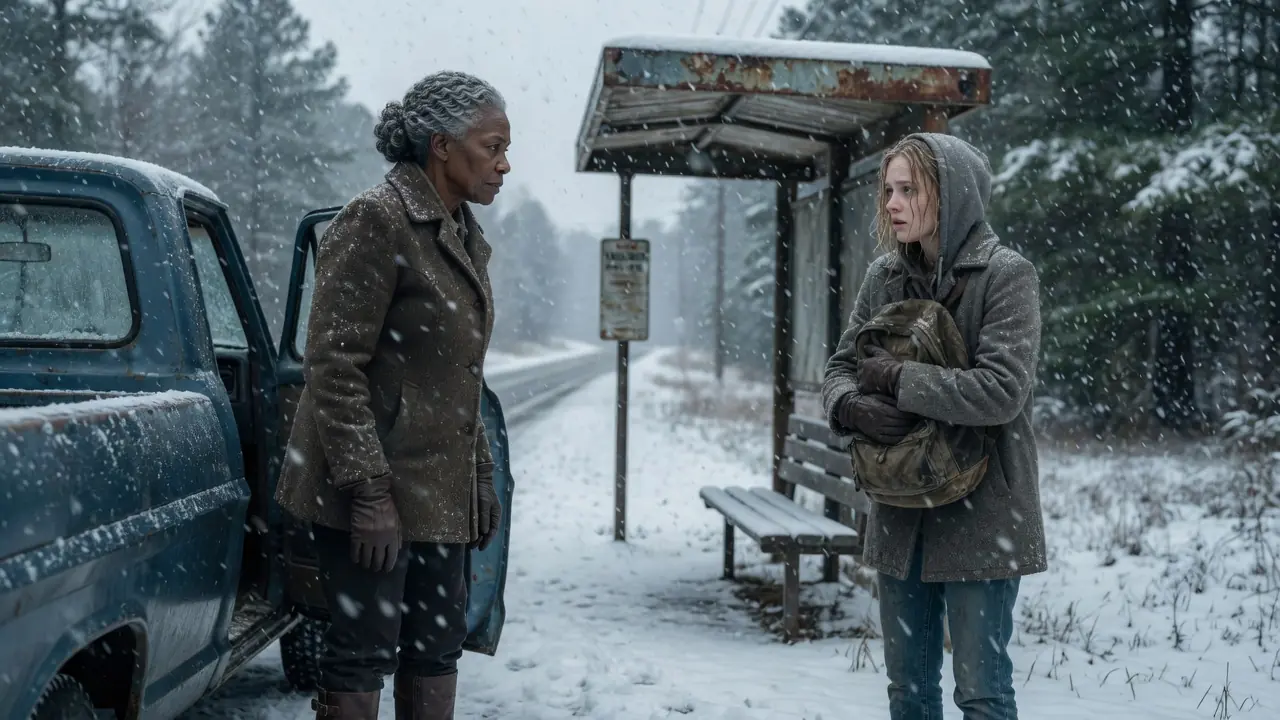
In a snowstorm, a woman found a white teenage girl huddled at a bus stop, barely conscious, clutching a newborn.
She didn’t ask questions.
She just opened her car door.
But what began as a rescue in the cold soon unraveled into something far deeper.
A bond that defied race, silence, and past wounds and changed them both forever.
It was the kind of December morning that felt like time had slowed down, gray skies resting low over the Georgia mountains, and the wind weaving itself through the pine trees like a memory refusing to be forgotten.
Highway 49 curved gently through Monroe County, not far from Forsyth, where the last town lights dimmed behind a curtain of mist.
About 15 miles down a winding, unpaved road, tucked behind a dense line of spruce and oak, stood a small cabin with a chimney still exhaling the remains of the morning fire.
It was quiet there, deliberately quiet, a place for no one, chosen by someone who no longer believed she deserved to be found.
Inside that cabin, Loretta Mayfield folded a heavy wool blanket with methodical care, her fingers rough from years of wood stove work, her nails neatly clipped, but unpolished.
She was a woman of 68, tall with a proud bearing she hadn’t entirely lost, though her posture had surrendered somewhat to grief.
Her silver-threaded curls were pulled into a tight bun at the nape of her neck, and her eyes, dark and knowing, had a weight that made people hold their breath before speaking.
She didn’t get visitors.
She didn’t want them.
The world, with all its noise and betrayal, had been packed into boxes and buried long ago.
But today, Loretta had ventured out into town, into light, into memory.
Her hands gripped the steering wheel of her old Ford pickup with a steadiness she didn’t feel inside.
The radio whispered warnings of a coming snowstorm.
Strongest in the last decade, the announcer said, urging folks to stock up, stay warm, stay in.
Loretta had done just that.
Three boxes of supplies sat in the truck bed.
Cans, rice, baby formula.
Not for herself, of course, just instinct, she’d tell herself.
She had no one to feed but an old photograph and a silence that had learned to sit still.
As she pulled into a gas station near the edge of town, a run-down corner of Jackson, where the wind always carried a hint of frying oil and cigarette smoke, she avoided eye contact with the cashier who knew not to greet her anymore.
She paid cash, didn’t talk, didn’t linger.
A man offered to pump her gas, and she declined with a firm shake of the head.
Her voice hadn’t been used in hours.
It didn’t need to be.
Back behind the wheel, the town in her rearview, Loretta exhaled the way only someone holding too much sorrow learns to.
A soundless, shoulder-lifting sigh.
One more winter.
One more storm.
One more year of doing life without being seen.
But she chose this.
She reminded herself she chose it every morning, like brushing her teeth or stoking the fire.
Yet, as she turned off the main road and drove past the old public bus stop near County Road 22, something made her foot ease off the gas.
She didn’t know why.
She looked up.
Maybe it was the strange stillness.
Maybe it was the color, the stark contrast of ivory skin wrapped around a bundle of brown cloth, like a painting misplaced in the real world.
A young woman, white, sat alone on the bench, clutching something close to her chest, tight, desperate, the way one clings to secrets or infants.
Her coat was thin, her face pale, eyes darting, but too tired to plead.
Loretta slowed the truck, eyes narrowing.
She didn’t like this feeling, this twitch of recognition, of ache, but she pulled over anyway.
She didn’t roll the window down right away.
She sat, studying the girl, watching how her lips trembled, but she didn’t cry.
Strong or stubborn?
Maybe both.
Loretta opened the door and stepped out, her boots crunching against frostbitten gravel.
She approached slowly, arms crossed, voice low and steady.
“You waiting for a bus?”
Her tone was neither warm nor cold, just deliberate, wrapped in the caution of a woman who no longer gave away trust for free.
The girl looked up, startled, and adjusted the bundle in her arms.
“It’s late. I think I missed it.”
Her voice cracked almost like it was trying not to break apart in front of a stranger.
Loretta glanced at the sky.
The wind was picking up.
Snow would fall before nightfall.
She didn’t ask more questions.
She didn’t need to.
She simply tilted her head toward the truck and said, “Storm’s coming. I’m not going to ask where you’re headed, but if you want shelter tonight, I’ve got some.”
The girl hesitated.
Loretta didn’t rush her.
Didn’t comfort her either.
She just turned and walked back to the truck, leaving the door open behind her.
When the girl followed, climbing into the passenger seat with the bundle still cradled to her chest, Loretta didn’t speak.
She just started the engine.
The heater wheezed to life.
The forest swallowed them once more, and in that silence, something small began to shift.
The cabin came into view just as the first snow began to fall.
Soft, tentative flakes brushed the windshield like whispers too shy to speak aloud.
The gravel road, now damp and dark under the dusk sky, wound between the trees like a secret path.
The truck’s headlights cast long beams across the woods, momentarily catching the startled eyes of a deer before it vanished into the thicket.
Loretta said nothing as she guided the vehicle through the final stretch.
The girl beside her didn’t speak either.
She held the bundle close, its weight protective and fragile all at once.
Only the soft coos of the baby beneath the layers of cloth broke the silence.
They arrived in front of the cabin, a modest wooden structure with smoke curling gently from the chimney and a porch light flickering as though unsure if it should welcome anyone anymore.
Loretta turned off the ignition and reached for the bags in the back seat, her movements practiced and unaffected.
She didn’t offer help with the baby, but when she unlocked the door and stepped inside, she left it wide open.
The girl stood for a moment at the threshold, her boots wet, her breath visible.
Then she followed, closing the door behind her with the softest thud.
The warmth inside was immediate, thick with the scent of cedarwood and old books, of iron skillets and dried herbs hanging by the window.
The fire in the hearth was low but steady.
Loretta placed the groceries on the small kitchen table and busied herself with putting things away, moving with a quiet efficiency that made the space feel inhabited but not lived in.
She gestured, not looking back.
“You can sit. Couch over there.”
The girl obeyed, lowering herself carefully onto the worn brown sofa.
She placed the baby on her lap, checking to see if he was still asleep.
He was.
She didn’t say thank you.
Loretta didn’t expect it.
Instead, she poured hot water into two mugs, dropped in chamomile, and handed one over without fanfare.
“No milk, no sugar,” she said plainly, then sipped her own with no further comment.
Hours passed that way.
They didn’t exchange names.
They didn’t ask why.
When the baby whimpered, Loretta handed over a clean towel.
When the girl coughed, Loretta gave her a small bottle of honey from the pantry, but still no questions.
The second night came, and the snow thickened, sealing the cabin in.
The power blinked out twice, but the fireplace stayed loyal.
Loretta laid out clean linens on the cot in the spare room and pointed toward it.
“You’ll sleep better in there,” she murmured, voice flat, but not unkind.
The girl hesitated again, her eyes searching Loretta’s face, but found no hostility, only a weary neutrality that almost felt like mercy.
“I won’t bother you,” Loretta added, then turned back toward her chair by the fire.
By the third day, the rhythm of the storm outside had become familiar.
Howling wind, groaning trees, snow tapping against the windows like it wanted to be let in.
Inside, the silence began to loosen its grip.
The girl wandered into the kitchen in the morning, offered to help chop vegetables.
Loretta didn’t say yes, but she handed her a knife.
They stood side by side for 10 minutes.
The only sounds were the thunk of the blade against the board and the quiet hiss of the kettle.
“You always live alone?” the girl asked suddenly, her voice unsure but honest.
Loretta paused, wiped her hands, then answered without turning.
“For 15 years,” she said.
No elaboration.
The girl nodded, perhaps realizing the answer cost something.
Later that evening, the baby began to cry, inconsolable.
Loretta watched the girl try everything, rocking, humming, bouncing gently, and something flickered in her.
She rose, took the child in her arms with surprising ease, and began to sway.
Her voice, cracked from disuse, began to hum a tune soft and old, a lullaby soaked in memory.
The baby calmed.
The girl stared.
Loretta handed him back wordlessly and sat down without a word.
But something had shifted.
That night, the girl left the bedroom door cracked open, and Loretta noticed.
Outside, the storm continued its tantrum.
But inside, two women sat in the same room for the first time without walls between them.
They didn’t yet know how much they needed each other, but they were beginning to remember what warmth felt like.
By the fourth night, the snow outside had become less an intruder and more a presence, persistent, watchful, muting the world into a hush.
The power had gone out for good this time, but the fireplace glowed faithfully, casting amber light on the wooden walls and revealing dust motes that danced like quiet spirits.
Inside the cabin, it was warm, not just in temperature, but in a way that felt less accidental.
Now, Loretta had begun to notice how the girl moved about the kitchen as if mapping it by memory.
How she folded the same blanket each night before sleep.
The girl, in turn, had stopped flinching at Loretta’s blunt tone, had started reading the older woman’s silences like sentences waiting to be spoken.
That evening, the fire cracked louder than usual.
Loretta sat in her chair with a book on her lap, not reading it, just holding it like a habit she couldn’t let go.
The girl, her name still unspoken, sat cross-legged on the floor, the baby finally asleep in the cot behind the door.
A long pause hovered in the room, like it was waiting to be filled.
Then, almost without warning, the girl spoke.
“I didn’t mean for any of this to happen.”
Her voice was low, like she was telling the fire instead of Loretta.
“I had plans, scholarships, a whole future.”
She paused, swallowed hard.
“Then I got pregnant. One mistake. That’s all it took for everything to disappear.”
Loretta didn’t answer right away.
She didn’t interrupt either.
The girl kept going, words trembling but gathering speed like water breaking through a dam.
“My dad, he told me to get rid of it. Said I’d ruin the family name. My mom just cried. They stopped talking to me. My friends vanished. And then I just stopped trying to explain myself.”
Her chin quivered, her eyes glossy, but not yet shedding tears.
“I didn’t want to give him up. I didn’t want to give up anything. So I left.”
Loretta slowly closed her book.
Her voice, when it came, was dry but not harsh.
“You’re still standing. That’s something.”
The girl looked up at her, surprised.
There was no lecture, no scolding, just that, a small recognition.
And something in the way Loretta’s eyes flickered like the past was knocking on her own door gave the girl the courage to ask, “Why do you live out here alone?”
Another long pause.
Loretta’s hands gripped the arms of her chair like she was grounding herself.
Her jaw tightened, then relaxed.
“I had a daughter once,” she said, her voice barely more than a breath. “Bright as lightning, stubborn like her daddy.”
A bitter smile flickered for a second.
“After he died, I wasn’t right. I couldn’t be soft, not even with her. She got sick. And I…”
She stopped, looked away.
The flames caught the wetness in her eyes.
“I was too late. I didn’t see it until there was nothing left to fix.”
The fire popped.
Loretta blinked, steadying herself.
“So, I left the world before it could leave me again.”
The girl didn’t speak.
She didn’t need to.
Her eyes were wide, not with pity, but with understanding.
She crawled closer to the fire, sitting near Loretta’s chair now.
“I’m sorry,” she said softly.
Loretta nodded once, almost imperceptibly.
“So am I,” she whispered back.
They sat like that for a while, two women bound not by blood, but by the scars no one else could see.
Outside, the storm had begun to slow, the wind softening into silence.
Inside, the air had changed.
Shame had been named.
Regret had been voiced.
And mercy, mercy had finally been offered.
By morning, the world outside had transformed.
The storm had passed, leaving behind a white silence that blanketed every branch, every rooftop, every inch of earth like a soft reset.
The air smelled clean, sharp, alive.
The trees no longer groaned.
Instead, they stood still under the weight of snow, as if listening.
Inside the cabin, the mood was different, too.
There was movement, purpose, a quiet energy neither woman named, but both could feel.
The girl, who finally introduced herself as Emma, was humming faintly as she washed dishes.
The baby was strapped to her chest in a sling fashioned from one of Loretta’s old shawls.
Loretta sat at the kitchen table, sipping coffee, watching with a look that was neither distant nor guarded anymore.
Something had shifted.
“Do you ever think about school?” Loretta asked casually, setting down her mug.
Emma turned, blinking.
“School?”
Loretta tilted her head.
“You speak like someone who used to get straight A’s.”
Emma smiled, embarrassed.
“I did. I mean, I loved it. English mostly. I wanted to teach or write.”
Her voice drifted.
“But that was before.”
Loretta narrowed her eyes.
“Before isn’t dead. It’s just sleeping.”
Emma let the water run for a moment, then turned it off.
“Even if I wanted to, I couldn’t afford it. I’ve got no savings, no support. I’m a single mom with a newborn and no place to go.”
Loretta leaned back, her eyes narrowing in that professor-like way that once made students straighten in their seats.
“I taught at Mercer University for over 20 years. Still know folks there. One of them’s a dean now. Owes me favors, real ones.”
Emma froze, holding a plate midair.
“You’re serious?”
Loretta nodded, slow and deliberate.
“I don’t say things I don’t mean.”
That afternoon, Loretta opened a drawer she hadn’t touched in over a decade.
Inside were old letters, credentials, photographs, reminders of a life she had buried beneath pain.
She retrieved a business card, ran her thumb across the name, then walked to the landline on the wall.
She dialed.
“Carl, it’s Loretta Mayfield,” she said, her voice firmer than it had been in years. “I need a favor. There’s a young woman here, smart, brave. She deserves a second shot, and I want you to help make that happen.”
The pause on the other end was short.
“If you’re asking, I’m listening,” he said.
Loretta looked toward the kitchen, where Emma was rocking the baby and mouthing the words to a lullaby.
“She’s worth it,” Loretta said softly. “She just doesn’t know it yet.”
Over the next few days, the cabin buzzed with unexpected life.
Emma started writing again, just in a notebook at first, while Loretta dug up her old laptop, cleaned it, and powered it back on with a reluctant sigh from the machine.
Loretta began coaching Emma on how to structure essays, how to think critically, how to read between lines.
She corrected her gently but firmly.
Emma didn’t flinch.
She thrived.
In the evenings, they sat by the fire, not as strangers, but as collaborators, as family being formed not by blood, but by choice.
The baby, now more alert, giggled at Loretta’s wrinkled frowns and reached for her glasses.
Loretta pretended to be annoyed, but her heart had long since softened.
One morning, Emma brought her a piece of writing, a short essay about forgiveness and motherhood.
Loretta read it in silence, then handed it back.
“You’ve got something,” she said, her tone clipped but sincere. “Don’t waste it.”
And so the seed was planted.
Small, quiet, but rooted deep.
The storm had passed.
The house no longer felt like a hiding place, but a starting point.
And outside, beneath the melting snow, spring had already begun to whisper.
The seasons turned faster than either of them expected.
Snow gave way to slush, slush to mud, and then quietly, without announcement, flowers began to bloom along the path that led to Loretta’s porch.
Emma, now living in town near the university on a full scholarship arranged quietly but forcefully by Loretta, had fallen into a new rhythm.
Classes.
Part-time work.
Nights of study interrupted by the cries of a growing baby.
Hope, her son, was nearly walking now, fearless and curious, already forming syllables that sounded like laughter.
Still, every Sunday, without fail, they drove back up the winding road to the cabin, where Loretta waited with soup and stories, and that fierce, unspoken love that had become the bedrock of their makeshift family.
It was on one of those visits after dinner when the past finally caught up.
Loretta had just cleared the dishes, and Emma was bouncing Hope on her knee when Loretta’s landline rang.
An old sound, shrill and out of place in the warmth of the kitchen.
She answered on instinct, wiping her hands with a dish towel.
“Hello?”
Her voice, now steadier than it had been in years, faltered at the reply.
“Is this Miss Mayfield?” the voice on the line asked, uncertain. “No, I mean Mrs. Mayfield. You don’t know me. My name is Carol Taylor. I think I think you know my daughter.”
Loretta’s breath caught, eyes darting to Emma without meaning to.
Her voice dropped.
“What is this about?”
Carol’s voice trembled through the static.
“We, my husband and I, we only just found out where she was. A neighbor saw her at the university. We haven’t spoken in nearly two years, but we saw her graduation notice and the baby. His name is Hope.”
The name cracked through the air like lightning.
Carol continued, rushing now.
“We were angry, then ashamed, and then too proud to admit we were wrong. We want to see her. Please, we need to.”
Loretta said nothing for a long moment.
Then, in a voice laced with steel and memory, she replied, “She’s not a child to be summoned. You’ll have to ask her.”
She hung up without another word.
That Sunday, Loretta didn’t bring it up, but Emma could sense something.
The following week, when Loretta returned from checking the mailbox at the bottom of the hill, she held a small envelope in her hand.
Ivory paper, elegant handwriting.
Emma took it, opened it slowly.
Inside, a letter from her parents filled with apologies so raw they read like confessions.
Emma stood frozen for a long time.
Then she folded it carefully, eyes glassy.
“I don’t know if I want to see them,” she said, voice quiet. “I don’t know if I’m ready.”
Loretta nodded, speaking softly.
“You don’t owe them anything, but if you don’t answer, you might spend your life wondering what would have happened if you had.”
Emma turned toward her, the weight of the moment pressing into her spine.
“Did you get that chance?”
Loretta’s voice cracked.
“No, I didn’t.”
Two weeks later, on the day of Emma’s graduation, as she stood in cap and gown, holding Hope in her arms, they came.
Carol and Raymond Taylor stood at the edge of the crowd, awkward in their posture, but desperate in their gaze.
Emma saw them, froze.
The world slowed.
Her hands gripped her child tighter.
Beside her, Loretta placed a steadying hand on her shoulder.
“You don’t forgive them for them,” she said calmly. “You forgive them so they don’t keep living inside your hurt.”
Emma breathed deep, her chest rising slowly.
Then she stepped forward.
Her mother cried first.
Her father, usually so composed, dropped to his knees in front of his grandson.
Emma stood there unmoving for a heartbeat longer, then bent down and whispered, “His name is Hope, because that’s all I had left.”
They wept together.
The crowd around them dissolved into a blur.
Loretta watched from a distance, her hand clutching her cane tightly, her jaw set with emotion.
And yet in her eyes there was peace, a kind she hadn’t known in decades.
The ceremony was over, but its echoes lingered.
Laughter drifted from every corner of the university lawn.
Caps lay scattered across the grass like forgotten dreams, and families posed under the warm Georgia sun, capturing milestones on shaky phones and worn-out cameras.
Yet amid the noise, Emma stood quietly beside Loretta, diploma in one hand, Hope in the other.
Her eyes still watched her parents from a polite distance.
They had asked her to come home.
They had begged, promised, pleaded.
But Emma, despite the forgiveness she had offered, knew something deeper now.
Home wasn’t a place or a bloodline.
It was someone who stayed when you had nothing to give.
So she looked at Loretta, who stood tall despite the cane, her eyes proud but unsentimental, and she smiled with certainty.
“I’m not going back,” she said softly. “I’ll visit. We’ll share holidays, but this, this is where I belong.”
Loretta didn’t reply.
She just reached out, adjusted Hope’s tiny bow tie, and nodded once firmly.
A month later, they moved into a small townhouse near the university’s research center, close enough for Emma to walk to campus with Hope in a stroller, and close enough for Loretta to still keep her cabin, but visit often.
The house was modest, painted a warm cream with deep green shutters, a wraparound porch, and a little garden bed that Loretta insisted on tending herself.
Emma was now enrolled in a graduate fellowship program, one that allowed her to continue her research into single-parent education pathways, a project that had begun as a late-night conversation in front of a cabin fire and had since turned into a grant-backed initiative that drew interest from three national organizations.
It wasn’t just her name on the research proposal.
It was both of theirs.
Emma Taylor and Loretta Mayfield, written side by side like a signature of two hearts that had learned to beat again.
Hope, now a toddling one-year-old with mischief in his eyes and Loretta’s stern frown perfected for play, had grown up never knowing absence.
He had bedtime stories in two voices, lunchboxes packed with handwritten notes, and Saturday mornings split between his mother’s books and Loretta’s gardening gloves.
When he said his first real sentence, it wasn’t mama or grandma.
It was, “We go home now.”
And both women had laughed, not because it was funny, but because it was perfect.
The holidays came with quiet fanfare.
Emma’s parents joined them for Thanksgiving, each visit less awkward than the last.
Raymond brought tools to fix the old porch rail.
Carol baked pies from recipes Emma remembered from childhood.
No one spoke much of the past.
But there was gentleness now where once there had only been walls.
One Christmas, Hope ran toward Carol and called her Nana, and Carol burst into tears that no one mocked.
Emma, standing beside Loretta in the kitchen, whispered, “You were right. I would have regretted it.”
Loretta didn’t smile, but her eyes shimmered.
As the years passed, their story made its way into classrooms and conference halls.
Emma began speaking publicly about education, about resilience, and quietly about the woman who had pulled her out of the cold without asking for anything in return.
In one interview, when asked who had inspired her the most, Emma simply said, “She didn’t just give me shelter. She gave me the permission to dream again.”
When asked who Loretta was to her, Emma answered without pause, “She’s my mother, the kind you choose.”
Three years to the day after that storm, Loretta stood in front of a crowd at Mercer University, invited back for the first time since she left.
Her hair was now fully silver, her posture still regal.
She spoke of second chances, of the courage it takes to open a door when you’ve been hurt, of how saving someone else can sometimes be the very thing that saves you.
And when she finished, the room gave her a standing ovation.
Emma sat in the front row, Hope on her lap, clapping until her palms stung.
That night, the three of them sat on the porch of their home, sipping sweet tea, watching the wind rustle through the spring leaves.
The stars blinked quietly overhead.
Hope had fallen asleep against Loretta’s arm, and Emma leaned into her shoulder.
“You know,” Emma said, her voice barely more than a whisper, “if someone wrote this as a story, no one would believe it.”
Loretta let out a soft hum, resting her hand gently over Emma’s.
“Then I guess we’ll just keep living it,” she murmured, eyes on the stars. “One miracle at a time.”
And in that quiet, beneath the weight of everything they had survived, there was peace.
The kind that doesn’t come quickly, but arrives when it’s earned.
The kind that turns strangers into family.
The kind that makes you believe, just for a moment, that fairy tales might be real after all.