“Excuse me,” the man at the corner table said, lifting his fork as if it were evidence in a trial. “We ordered medium.”
The waitress froze beside his chair, not because the complaint was unusual, but because it was the fourth complaint from the same table in less than twenty minutes.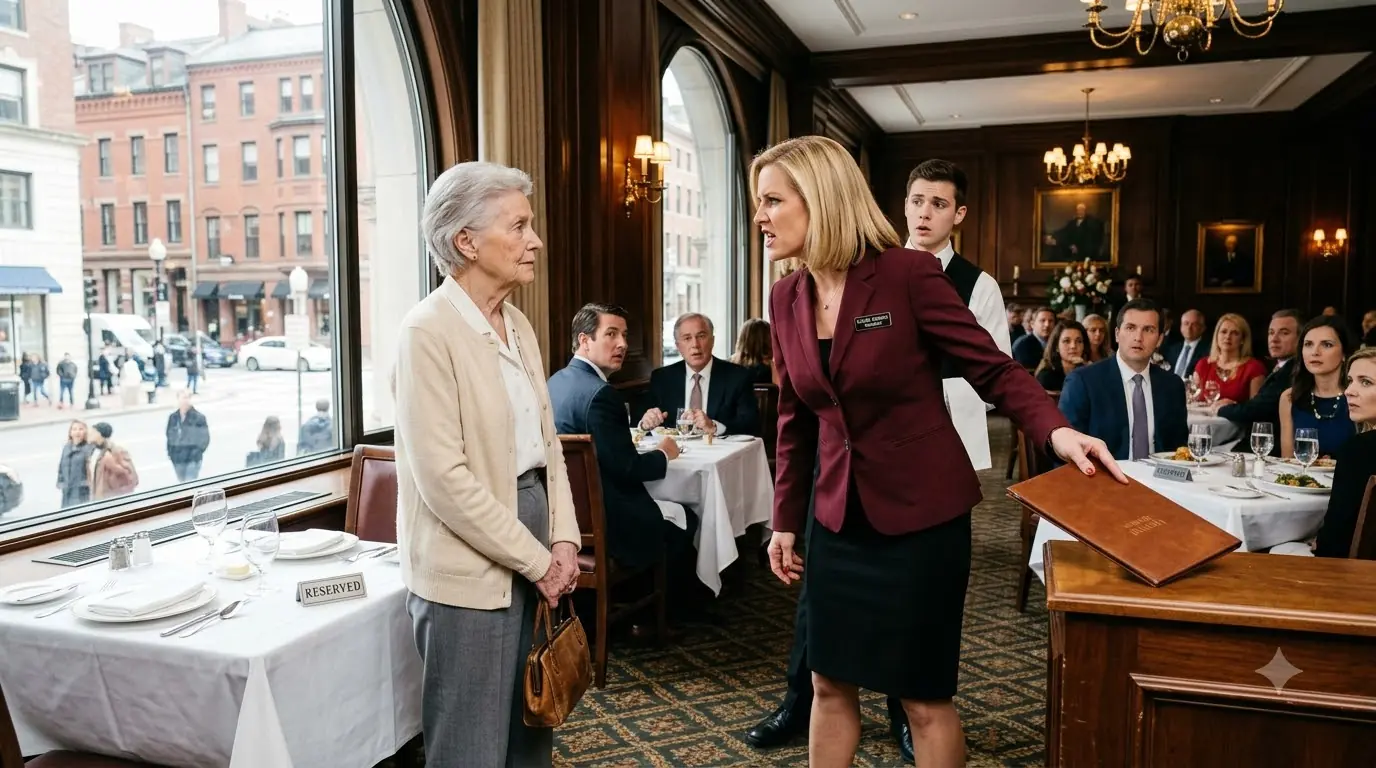
“Yes, sir,” she said carefully. “I’m sorry. Was there something wrong with the steak?”
The man cut into the filet mignon again and tilted the plate toward her.
“Are you sure this is medium? This is medium rare.”
Across from him, a woman in an elegant cream blouse and pearl earrings studied the plate without touching her wine. She was in her late fifties, poised, composed, and dressed with the kind of quiet taste that did not need a logo to announce wealth.
The waitress swallowed.
“This is a medium rare filet mignon, sir. The ticket says medium rare.”
“Yes, exactly,” the man replied. “It should be medium rare, and yet the texture is far from perfect.”
The dining room at Lark & Laurel, one of Whitman Group’s most refined restaurants in downtown Chicago, carried the soft pressure of expensive service. The lights were low but precise. The napkins were folded sharply. The flowers on each table had been selected to match the season without appearing too deliberate. Every employee knew the restaurant served influential guests, investors, visiting executives, politicians, and people who preferred their names whispered rather than announced.
Still, this table was becoming impossible.
The waitress forced a smile.
“I’m very sorry. I’ll have the kitchen prepare a new one for you.”
Before she could move away, the woman lifted a small spoon and tasted the sauce beside her fish.
“Waitress,” the woman said.
“Yes, ma’am?”
“Is this American pepper?”
The waitress blinked.
“I’m sorry?”
“The pepper,” the woman repeated, not raising her voice. “Is it American-grown black pepper, or imported Tellicherry?”
“I would need to check with the kitchen.”
The man let out a sharp laugh.
“You don’t even know the ingredients? Do you actually work here?”
The waitress’s face flushed.
“My apologies. One moment, please. I’ll ask the chef.”
She hurried away, shoulders stiff.
At the next table, a young couple exchanged glances. Two businesswomen near the window lowered their voices. Across the room, a waiter carrying sparkling water slowed just enough to see whether the situation would become a spectacle.
It did.
Five minutes later, the same woman raised her hand again.
“Waiter.”
A young man approached cautiously.
“Yes, ma’am?”
She pointed to the flower vase in the center of the table.
“Is the base of that vase a bit dirty?”
The waiter leaned closer.
The vase was spotless.
“The glaze is uneven,” she continued. “Please remove it.”
The waiter hesitated.
“The vase, ma’am?”
“This one.”
The man across from her nodded with a satisfied air.
“The customer is always right, correct?”
The waiter forced a polite smile.
“Of course, sir.”
“It makes me uncomfortable,” the woman said. “Could you take it away?”
“Yes, ma’am. Please wait a moment.”
The waiter carried the vase to the service station and found the manager near the kitchen entrance.
“Manager,” he whispered. “You should probably see this. That customer again.”
The manager, Victor Langley, closed his eyes for half a second.
“Didn’t I tell the chef to handle him?”
“The steak was replaced. The pepper was verified. The vase was removed. Now he says the lighting is off.”
Victor opened his eyes.
“The lighting.”
“Yes.”
“You know we can’t change the ceiling lights.”
The waiter said nothing.
Victor adjusted his tie, plastered on his professional smile, and headed toward the table.
Before he reached it, the woman seated there lifted her gaze toward a man standing quietly near the bar. He was tall, dignified, and silver-haired, with the calm posture of someone who had spent decades watching rooms reveal themselves.
“Madam Chairwoman,” he murmured, stepping forward. “I’ll handle it.”
The woman lifted one hand.
“No need. I’ll go.”
The waiter’s face nearly collapsed.
Chairwoman.
The word passed through the nearest employees like a spark.
The woman at the table was Margaret Whitman.
Chairwoman of Whitman Group.
Mother of Sean Whitman, the company’s young CEO.
And the owner, through various subsidiaries, of the very restaurant whose staff had been silently panicking for the past half hour.
Victor Langley arrived at the table, unaware that his inspection had already failed in ways he did not yet understand.
“Ma’am,” he said smoothly. “I understand there’s concern about the lighting. I’m afraid we cannot remove or alter the overhead fixtures during service, but we truly want to accommodate you. We can comp your meal today. Is that acceptable, or is there something else you require?”
Margaret looked at him for a long moment.
“I do not want the light removed,” she said. “I wanted to see whether someone in this restaurant would listen before explaining why the answer was no.”
Victor’s smile weakened.
“Do you?”
Her voice remained soft.
That made the question more dangerous.
The man sitting across from her, James Parker, had worked beside Margaret for nearly fifteen years. He knew her methods well. She rarely inspected restaurants by announcing herself. She preferred to sit where staff did not expect power to be sitting, ask difficult questions, watch who became impatient, and learn more in an hour than most executives learned from three months of reports.
Victor began to answer, then stopped as recognition finally arrived.
“Mrs. Whitman,” he said, pale now. “I didn’t realize—”
“That is the problem,” Margaret replied. “You did not realize who I was. But the point of service is not to treat me well because I am Margaret Whitman. It is to treat every guest well before you know whether they matter to you.”
The dining room remained silent.
Margaret stood.
“Send the kitchen my compliments on the second steak. It was properly prepared. Send my concerns to regional training about table-side ingredient knowledge. And replace the vase vendor. The glaze really is uneven.”
James cleared his throat.
“Chairwoman, your coffee.”
He handed her a small white cup.
Margaret took one sip and stopped.
“James.”
“Yes, madam?”
“You’re not working with me anymore?”
His brows lifted.
“Excuse me?”
“You forgot such a small thing.”
“What coffee?” he asked, confused for the first time that evening.
Margaret looked into the cup.
“Maven Blend. Sean’s usual coffee.”
James smiled faintly.
“I thought the chairwoman should have her favorite beans.”
“Never mind,” Margaret said. “It’s for my son. As his mother, I should try it too.”
James’s expression softened.
“You rarely drink what he likes.”
“I rarely understand what he likes,” she said. “I am trying to correct that.”
Outside, Chicago traffic moved under the summer evening. Inside, employees returned slowly to their stations, all of them now aware that their ordinary service had been weighed by someone who owned more than the room.
A young executive approached the table carrying a small insulated case.
“Boss,” he said, “I brought the cheese you requested from Italy.”
Margaret turned.
“Samuel.”
The man smiled.
“While we’re in Chicago, Chairwoman, please call me Sam. It makes everyone less nervous.”
“Fine, Sam,” Margaret said. “Whatever you say.”
He gave a small bow.
“Thank you, Chairwoman.”
James leaned closer.
“How long is your inspection in Chicago?”
Margaret looked through the rain-streaked window toward the lights of the city.
“I plan to live here permanently.”
James blinked.
“Permanently?”
“Why not? Sending Sean here as CEO shows how important the Midwest market is. If necessary, I’ll come back and take charge personally.”
“You’ve said many impossible things before,” James replied.
“Nothing is impossible.”
She took another sip of Sean’s Maven Blend and winced slightly at the bitterness.
“Besides,” she added, “my son has found a partner. The wedding is approaching. As the future mother-in-law, I should be here to help.”
James looked at her carefully.
“I heard you get along well with Miss Natalie Reed.”
“It is acceptable,” Margaret said.
“You haven’t met her properly yet.”
“No. But I know her family background well. She comes from a scholarly family. Her father, Professor William Reed, is an admirable academic. The Reed family is respected, stable, and well-educated.”
James watched her face.
“But?”
Margaret set the cup down.
“The Whitman family is not starving for alliances. Sean does not need to marry for benefits. If he is happy, I will fully support him.”
James smiled.
“As long as he likes her, you will fully support him?”
Margaret looked at him.
“I said I would try.”
That was as much tenderness as Margaret Whitman allowed herself to say aloud.
The following afternoon, Margaret received her first informal introduction to Natalie Reed at a private dining room inside Whitman House, the family’s historic residence on the North Shore.
The house looked less like a home than an institution. Pale stone exterior. Wide steps. Ivy on one side. Rooms full of art, antiques, and the kind of silence money accumulates over generations.
Margaret was seated near a long table when Jenna Whitmore swept into the room first.
“Aunt Margaret!”
Jenna crossed the room with practiced affection and clasped Margaret’s hands.
“I came as soon as I heard you were back from Europe. I missed you so much.”
Margaret smiled politely.
“Jenna, you’re still so well behaved when you’re home.”
“You’re still so beautiful, Aunt Margaret.”
“And you are getting prettier.”
Jenna lowered her eyes, pleased.
Two women entered behind her.
One was Natalie Reed, elegant in a soft ivory dress, dark hair pinned neatly, posture graceful but slightly tense. She had the refined composure of someone raised around books, quiet dinners, and parents who corrected grammar gently but constantly.
Beside her stood Maggie Shaw.
Maggie did not look like she belonged in Whitman House, and she knew it.
She was thirty-two, a single mother with warm brown eyes, shoulder-length chestnut hair tied back hurriedly, and a face that carried more sincerity than polish. Her blouse was clean but inexpensive. Her cardigan had a button sewn slightly crooked near the sleeve. She noticed Margaret noticing it and immediately looked down.
Natalie smiled.
“Aunt Margaret, hello.”
“Hello, Natalie.”
Maggie stepped forward awkwardly.
“Hello, Mrs. Whitman. I’m Maggie Shaw. It’s an honor to meet you.”
Margaret’s eyes moved to the crooked button.
“Did you sew that button on yourself?”
Maggie flushed.
“Yes, ma’am.”
“It’s crooked.”
“I’ll restitch it as soon as I get home.”
Jenna hid a smile.
Natalie quickly said, “Aunt Margaret, Maggie is my good friend.”
“We’re practically family,” Jenna added sweetly, though she had no intention of making Maggie feel included. “No need to be so formal.”
Margaret gestured toward the table.
“Are you hungry? Sit. Let’s eat.”
The first course was lobster bisque, rich and smooth, served in white bowls rimmed with gold.
“This bisque is excellent,” Margaret said. “Try it.”
Maggie picked up her spoon a little too quickly, then set it down when she realized no one else had started. Her discomfort was small, but Jenna caught it immediately.
“Miss Shaw,” Jenna said lightly, “your table manners seem a bit off.”
Maggie’s face warmed.
“I’m sorry.”
Natalie’s hand tightened around her napkin.
“Jenna.”
“What?” Jenna smiled. “I was only trying to help.”
Margaret watched Maggie carefully.
“You went shopping today?”
“Yes,” Natalie answered. “Maggie came with me.”
Margaret turned to Maggie.
“Do you enjoy shopping, Miss Shaw?”
Before Maggie could answer, Natalie said gently, “Maggie isn’t the type to spend recklessly. She came with me because I was buying things for her child.”
Margaret’s eyes sharpened.
“Your child?”
Maggie straightened.
“Yes, ma’am.”
“You look young. How long have you been married?”
Maggie held the question with quiet dignity.
“I’m not married. I’m a single mother.”
Silence touched the table.
Jenna’s eyes brightened slightly, as if a useful weakness had appeared.
Margaret only said, “I see.”
Maggie looked down, preparing herself for pity, judgment, or a graceful change of subject.
Instead, Margaret asked, “How old is your child?”
“Dylan is fourteen.”
“A boy?”
“Yes.”
“That is not an easy age.”
“No, ma’am,” Maggie said softly. “It is not.”
Margaret studied her for a moment longer.
Then she turned to Natalie.
“I heard you met Sean because of Maggie.”
Natalie hesitated.
“Yes. Maggie works at Whitman Group. She knows Mr. Whitman.”
“Just as an employee,” Maggie said quickly. “We’re not close.”
Jenna tilted her head.
“Really? I heard someone got into Whitman Group through connections. Was that you, Maggie?”
Maggie’s fingers tightened in her lap.
Natalie immediately said, “Sean is always strict about work. He only gave Maggie an interview opportunity. She got into the company through her own effort.”
Jenna smiled.
“Is that the truth?”
Natalie’s cheeks colored.
Margaret looked at Maggie.
“Did my son approve your hiring himself?”
Maggie took a breath.
“Yes, ma’am. He allowed me to interview after Natalie recommended me. But I passed the interview on my own. If I had failed, Mr. Whitman would not have hired me.”
Jenna’s smile thinned.
Natalie said quietly, “I hope you don’t blame Sean. It was my idea to ask for the opportunity. Maggie did it because of me.”
Margaret leaned back.
“If Sean was willing to make an exception, that proves someone was special enough for him to consider it.”
Natalie lowered her eyes.
Maggie remained still.
Margaret continued, “But I am curious about one thing, Miss Shaw.”
“Yes, ma’am?”
“When did you realize I was Sean’s mother?”
Maggie blinked.
“Ever since Jenna called you Aunt Margaret, I had a hunch. Then when I arrived, Mrs. Whitman’s housekeeper wasn’t here, and everyone seemed nervous around you. I was certain.”
“Yet you did not announce my identity or flatter me with it.”
“That did not feel appropriate.”
Margaret’s gaze warmed by the smallest degree.
“Not many people would resist using that knowledge like a trophy.”
Maggie looked surprised.
“Thank you for the compliment.”
Margaret picked up her spoon.
“Let’s eat.”
Across the table, Jenna watched the exchange in silence.
She had known Sean Whitman since childhood. She had attended the same holiday dinners, the same charity events, the same summer gatherings at lakeside homes. She had loved him for years while everyone laughed and called it a childhood crush. They told her Sean saw her as a little sister. They told her she would grow out of it.
Jenna had not grown out of it.
She had simply learned patience.
Time, she believed, was a weapon if a person knew how to hold it long enough.
For now, Natalie Reed seemed to be the woman chosen for Sean.
But Jenna’s eyes kept returning to Maggie Shaw.
The single mother.
The employee.
The woman with the crooked button and the strange dignity.
Jenna smiled faintly.
No one else noticed.
Two days later, Maggie stood in her small apartment kitchen with two empty cake boxes on the counter, a mixing bowl under one arm, and powdered sugar on her sleeve.
“Natalie, look here,” she said. “I picked up two cake boxes on my way home. Don’t they look nice?”
Natalie Reed, sitting at the tiny kitchen table, lifted an eyebrow.
“You brought two boxes? Are you worried I’ll ruin the first cake and need a backup?”
“When have I ever doubted you?”
“Yesterday,” Natalie said.
“That was not doubt. That was experience.”
Natalie laughed despite herself.
Maggie opened the refrigerator and began pulling out ingredients.
“Since we’re making a cake today anyway, I thought I’d make one for Sean too.”
Natalie immediately looked up.
“Oh, Maggie, you don’t have to be that thoughtful.”
“It makes sense. You’ve already met your future mother-in-law. It’s about time you show off what a perfect, virtuous wife you are.”
Natalie’s smile faded.
“Let’s not bring up what happened yesterday.”
Maggie turned.
“What? Margaret Whitman liking me?”
“She was testing everyone.”
“She tests people the way hospitals test blood. Quietly and with consequences.”
Natalie rubbed her hands together.
“It’s been twenty-four hours, and my hands are still cold.”
“Oh, come on,” Maggie said. “I always thought you and Sean were a perfect match. One sharp, one gentle. You were always calmer than me.”
Natalie looked down.
“Now I know why. It’s because I hadn’t met someone I truly cared about.”
Maggie froze briefly, then forced brightness into her voice.
“Are you saying Sean makes you nervous?”
“I can barely hold myself together when I first see him,” Natalie admitted. “What if I mess up in front of his mother? What if I say something wrong?”
“If I were with Sean, I’d be a nervous wreck too,” Maggie said, too quickly. “Don’t worry. Even the scariest people can be as harmless as pets.”
“Are you talking about Sean or his mother?”
“Both.”
Natalie laughed.
“What cake are we making today?”
Maggie became instantly serious.
“I want to make a special one.”
“How special?”
Maggie lifted a stalk of celery.
Natalie stared.
“That is celery.”
“Yes.”
Maggie placed a purple sweet potato beside it.
“This is purple sweet potato. We’ll add strawberries and dark chocolate later.”
Natalie stared longer.
“You’re making a cake with celery, purple sweet potato, strawberries, and chocolate.”
“Correct.”
“That sounds like a dare.”
“It should be good.”
“It should be investigated.”
Maggie grinned.
“I really want to know what it tastes like when someone takes a bite.”
Natalie watched her friend move around the kitchen, messy, quick, full of strange confidence.
“I don’t think I’ve ever asked you why you like mixing completely mismatched foods.”
Maggie’s smile softened.
“You once told me that although the things I make are strange, they’re interesting. Maybe that’s why I do it. By putting ordinary things together, the taste might be okay, or it could be awful. But one thing stays the same. You never know until you take a bite.”
Natalie listened.
“There’s always anticipation,” Maggie continued. “Life is already tough. We all need something fun and hopeful to hold on to. Something that doesn’t tie us down to rent, bills, exams, work, and daily struggles.”
Natalie’s face changed.
“Maggie.”
“What?”
“That was beautiful.”
Maggie laughed and waved flour from her fingers.
“It was cake philosophy. Don’t make it dramatic.”
But Natalie did not laugh.
She understood, perhaps more than Maggie realized, that Sean Whitman had spent his whole life around people who spoke polished sentences without ever saying anything alive.
Maggie, somehow, could turn celery cake into a reason to keep hoping.
At Whitman Group headquarters the next morning, hope was not on the agenda.
Innovation was.
The executive conference room overlooked Chicago’s riverfront, all glass, polished oak, and carefully controlled temperature. Sean Whitman sat at the head of the table, expression unreadable, while senior executives debated the future of the company’s beverage division.
Margaret Whitman sat two chairs to his right.
She had been invited as chairwoman.
In reality, everyone knew she was there to see whether her son would challenge the board.
He did.
“Our R&D division has completed early modeling for a new line of seasonal coffee blends,” Sean said. “Not novelty flavors. Curated profiles tied to region, memory, and food pairing. The market is shifting. We cannot pretend heritage alone will protect us.”
One older board member cleared his throat.
“With respect, Sean, Whitman Group should stick to its classic line and keep focusing on high-end products. Why do people love our coffee? Because they care about our classic flavor and cultural heritage.”
Another executive nodded.
“Developing experimental coffee flavors is risky and thankless. Our tea beverage launch last year is proof. We copied popular flavors too quickly and entered the market without discipline. The result was poor.”
Sean’s jaw tightened.
“Every classic was an innovation on the day it was created.”
Margaret looked at him, hiding her approval.
He continued.
“The success of the Harbor Table restaurant project proves that our customers do not reject innovation. They reject shallow imitation. There is a difference.”
The older board member leaned back.
“You’re driven and full of ideas. That is a good thing. But we must follow rules and procedures. Whitman Group is not only yours, and it is not only your mother’s. It belongs to all shareholders.”
Sean glanced toward Sam Anderson, who stood near the wall with a tablet.
“What is the board afraid of?” Sean asked after the meeting ended. “That I’m up to something? Is that why my mother sent you here to spy on me?”
Sam adjusted his glasses.
“No, Mr. Whitman. I’m your assistant. I’m supposed to stay by your side.”
“We both know exactly what role you’re playing beside me. Do you need me to spell it out?”
Sam lowered his eyes.
“No, sir.”
“Tell the chairwoman I fully obey her decision. She may rest assured.”
“Yes, sir.”
Sean picked up his coat.
“Now I’m going on a date. Do you still want to come with me?”
Sam immediately stepped aside.
“No, sir.”
Sean walked out.
He told himself he was going to see Natalie Reed.
But lately, when he thought of Natalie, he did not picture her face first.
He heard a voice through the phone at night, telling him to say what he truly meant.
Those conversations had started by accident.
Natalie was polite in person. Gentle. Appropriate. Sometimes distant, as if carefully holding herself together. But at night, through messages and phone calls, she seemed different. Sharper. Warmer. Less afraid to challenge him.
When Sean mentioned stress, the voice on the phone always pushed him.
“Don’t just say you’re tired. Say what made you tired.”
When he dismissed a problem as nothing, she would reply, “If it were nothing, you wouldn’t still be talking about it.”
When he described the pressure of leading Whitman Group under his mother’s shadow, she had said, “You can’t rely on someone’s love to force them to accept a life they did not choose.”
That sentence had stayed with him.
It had changed something.
What Sean did not know was that Natalie was not always the one typing.
Sometimes she panicked and handed the phone to Maggie.
“Please,” Natalie would whisper. “I don’t know how to answer him.”
Maggie would protest, then help.
At first, she wrote only small suggestions.
Then, slowly, the conversations became hers.
She did not flirt.
She did not pretend.
She simply asked the questions Natalie was too nervous to ask.
And Sean, who had spent years surrounded by people who either feared him or wanted something from him, began opening up to a woman he believed was Natalie Reed.
The mistake would alter all of their lives.
That evening, Natalie met Sean near the lakefront.
The wind moved gently across Lake Michigan, carrying the smell of water and summer grass. Sean had brought coffee from a small shop instead of choosing an expensive restaurant. Natalie took the cup with both hands, nervous.
“How is it?” Sean asked.
“It’s good.”
“Come on. Let’s eat.”
“We should light candles and cut the cake first,” Natalie said quickly, lifting the box Maggie had packed.
Sean looked surprised.
“You made this?”
Natalie hesitated.
Then she smiled.
“Yes. I made it myself.”
The lie was small enough to step into.
Large enough to drown in.
Sean opened the box.
The cake looked unusual but charming, dark chocolate glaze over a faint purple layer, strawberries arranged unevenly across the top, and a thin green fleck near the edge that made him pause.
“This is… unique.”
Natalie’s hands tightened.
“Strawberry, purple sweet potato, celery, and dark chocolate.”
Sean took a bite.
Natalie held her breath.
His brows shifted.
Then he laughed softly.
“It’s not exactly delicious.”
Her face fell.
“But it’s interesting,” he continued. “Complex. Unexpected. There’s something hopeful about it.”
Natalie looked at him.
“Hopeful?”
“How did you even think of using such wild ingredients?”
Natalie heard Maggie’s voice in her memory.
By putting ordinary things together, the taste could be okay, or it could be awful. You never know until you take a bite. There’s always anticipation. Life is tough. We all need little things that are fun and hopeful.
So Natalie repeated it.
Almost word for word.
Sean became very still.
As she spoke, his expression changed in a way Natalie had never seen before. He looked less like a CEO evaluating a person and more like a man who had unexpectedly found a door opening inside himself.
“That,” he said quietly, “is exactly what I’ve been trying to say to the board.”
Natalie’s heart beat faster.
“What?”
“You understand something they don’t. Innovation isn’t about chasing novelty. It’s about giving people a reason to feel anticipation again.”
Natalie lowered her eyes.
She should have told him then.
She should have said, Sean, those are Maggie’s words.
But his gaze was warm.
For the first time, he looked at her as if she were not a suitable match selected by family, not Professor Reed’s daughter, not a graceful woman with proper manners and a respectable background.
He looked at her as if she had reached him.
And Natalie, who had spent weeks fearing she could never truly reach him, could not make herself step back.
Later that night, Maggie received a call from Natalie.
“I got the wrong cake,” Maggie said before Natalie could speak. “I just found out too. Did you open it in front of Sean? Are you all right?”
“He thinks it’s fine.”
“That’s only because of you. If you told him I baked it, he would have thrown it straight in the trash.”
“Maggie,” Natalie said weakly.
“What?”
“It’s awkward for me to talk right now. We can talk later.”
“Okay. Call me when you’re free.”
Maggie hung up, unaware that the lie had already begun building a life of its own.
The next day was Dylan’s birthday.
Maggie stood in the kitchen with a normal cake this time, white frosting, blue candles, no celery, no purple sweet potato, no experimental hope.
Dylan sat at the table, arms folded, face turned away.
“Can I ask for another birthday present?” he asked.
Maggie forced a smile.
“Say it.”
“Can you give me my phone back?”
Her smile vanished.
“Mom can’t agree to that.”
“You don’t want to.”
“I don’t want you messaging Ava during class all day. This year is important.”
“Then take out my phone and turn it on.”
“Dylan.”
“It’s my birthday. I want to see if any classmates sent me messages.”
Maggie hesitated.
She hated how much of motherhood felt like choosing between being kind and being responsible.
“Fine,” she said. “Wait a minute. Don’t get angry.”
“I’m not angry.”
“You look angry.”
“I knew where you hid it anyway,” he muttered. “I wasn’t going to steal it.”
“This kid,” Maggie sighed, though she softened when she handed him the phone.
Dylan turned it on.
One message.
From Ava Young.
Happy birthday.
No one else.
Maggie’s chest tightened.
“Look,” she said too brightly. “A classmate sent you birthday wishes.”
Dylan stared at the screen.
“Do you know why I only have Ava as a friend?”
Maggie did not answer.
“I’m not hungry,” he said, pushing away from the table. “You can eat the cake yourself.”
“No. Dylan, wait. Let’s cut it. I made it specially for today. You’ve never seen me make something this normal.”
He looked back from the hallway.
“I’ve never seen you make something this normal either.”
Then his bedroom door closed.
Maggie stood alone in the kitchen with the birthday cake, the candles unlit.
She pressed both hands against the counter and breathed until the sting behind her eyes passed.
Life did not stop because a heart was bruised.
Bills still waited.
Children still needed dinner.
And somewhere in the city, Sean Whitman was preparing to propose to the wrong woman for the right words.
Natalie could not sleep for days after Sean proposed.
The engagement was arranged almost instantly.
Margaret, delighted and relieved, began planning with terrifying efficiency. The date would be that weekend. The engagement party would be held at Whitman House. Professor William Reed was informed. Invitations were quietly issued. Florists, caterers, musicians, photographers, and family attorneys began moving like soldiers under Margaret’s command.
Natalie should have been happy.
Everyone told her she should be happy.
Jenna called her “the most dazzling bride-to-be.”
Margaret told her she was decent, generous, and gentle.
Sean was kind, respectful, and increasingly open with her.
But Natalie carried the truth like a stone beneath her ribs.
Sean had not proposed because he understood her.
He had proposed because Maggie had accidentally shown him the part of herself Natalie had borrowed.
One afternoon, Natalie asked Maggie to meet at a quiet café near the mall.
Maggie arrived hurriedly, still in her work cardigan.
“What’s wrong? You sounded serious.”
Natalie sat with both hands around a coffee cup she had not touched.
“I need to ask you something.”
“Okay.”
“Do you have feelings for Sean?”
Maggie stared.
“What?”
“I mean… do you feel anything special for him?”
“Natalie.”
“I’m not accusing you,” Natalie said quickly. “I’m not saying you two have feelings for each other. I mean that what moved him may have been you, not me.”
Maggie’s face went pale.
Natalie continued, voice trembling.
“You know the reason Sean proposed was because of that cake. The cake you made. He asked how I could make such a strange combination, and I told him what you said to me. About ordinary things, anticipation, life being tough, needing little things that are fun and hopeful.”
Maggie looked away.
“I wanted to tell him the truth,” Natalie whispered. “But he liked the cake so much. And I don’t know what came over me. I just went along with it.”
“You’re overthinking,” Maggie said.
“Am I?”
“Yes. Sean has long admired your generosity, gentleness, and kindness. He sees you as a marriage partner. You two are familiar with each other now. Engagement was only a matter of time. Whether I talked to him on the phone or gave him a cake has nothing to do with it.”
Natalie searched her face.
“Are you saying that to comfort me?”
“No. Of course not.”
Maggie smiled with an effort that hurt.
“We’re always together, aren’t we? Of course you should listen to me. Marry Sean. Don’t think about anything else.”
Natalie’s eyes filled.
“You’re so kind, Maggie.”
Maggie looked down at her coffee.
Kindness had never felt so much like betrayal.
Neither woman saw Jenna Whitmore seated behind the partition.
Jenna had not planned to hear everything.
But once she did, she stayed very still.
By the time Natalie left the café, Jenna had everything she needed.
The following evening, Jenna found Natalie alone at Whitman House while the engagement decorations were being finalized.
“How are you feeling, Sister Natalie?” Jenna asked sweetly.
“Nervous.”
“That makes sense. Tomorrow is such an important day.”
Natalie tried to smile.
Jenna stepped closer.
“You know, I didn’t understand before. But now I do.”
Natalie looked up.
“Understand what?”
“You’re uneasy because you cheated.”
The color drained from Natalie’s face.
“Jenna, what do you mean?”
“Brother Sean was originally indifferent to you. Nothing special. Then suddenly he got close and proposed. Why? Because Maggie Shaw was standing behind you.”
Natalie stood.
“How did you know that?”
“I heard it with my own ears.”
“You eavesdropped on my conversation with Maggie?”
“What’s so terrible about eavesdropping?” Jenna said lightly. “Some people are deceiving Sean. Isn’t that worse?”
Natalie stared at her.
“You’re not acting like yourself.”
“Really?” Jenna smiled. “Do you truly think you can stay by Sean’s side with your abilities? Even Faye probably noticed and warned Maggie already. But you still chose to believe the lie would hold.”
Natalie’s voice shook.
“What about Sean? Does he know?”
“Not yet.”
Jenna walked toward the window.
“I’ve known Sean since we were teenagers. Since then, I’ve never had eyes for any other man. But knowing him too long became my flaw. He sees me as a sister. He thinks my feelings are childish. He believes if I meet other men, I’ll forget him.”
Her smile disappeared.
“But he doesn’t know me well. What I decide does not change easily.”
Natalie’s eyes filled with horror.
“How could you watch him go on blind dates all these years?”
“I know Sean better than you. It is hard to play tricks under his nose. All I could do was wait. Drive them away one by one.”
“Including me.”
“Yes.”
“Jenna, aren’t you tired of pretending?”
Jenna turned.
“Aren’t you doing the same thing?”
Natalie could not answer.
“If you truly love someone, you don’t feel tired,” Jenna continued. “Now that you know I know about you and Maggie, here is my offer. Give up the engagement yourself. Preserve your image in Sean’s heart. Leave him with a good memory.”
“And if I don’t?”
“Tomorrow morning, Sean will receive the contact records between you and Maggie. The phone calls. The messages. Enough for him to ask questions.”
Natalie’s breathing became shallow.
“I don’t want him to know you are a liar,” Jenna said softly. “And I don’t want Maggie alerted too early. That would make me lose more than I gain.”
She picked up her purse.
“You love Sean, don’t you? Even if you cannot be together, leave him a beautiful memory. Isn’t that better?”
Jenna walked away.
Natalie remained by the window, shaking.
Outside, the engagement flowers were being unloaded from a white van.
Inside, the life everyone had arranged for her had begun collapsing.
That same night, Maggie’s world broke in a different way.
She had tried to help Dylan.
She had used his phone without asking and sent a group message to several classmates, inviting them to a study-and-barbecue party at a lakeside picnic area near Ava Young’s neighborhood. She thought if Dylan’s classmates came, if they studied together, ate together, laughed together, maybe Dylan would feel less alone.
She asked Tyler Bennett to come too.
Tyler had recently returned to Chicago after years away. He was handsome, kind, successful, and still carried the quiet history of a college confession Maggie had rejected years earlier so he would not give up a study-abroad opportunity at Caltech for her.
Maggie thought Dylan’s classmates might admire Tyler.
She thought Dylan might feel proud.
She was wrong.
The classmates came because the message mentioned Tyler’s education and tutoring help, not because they wanted Dylan’s friendship. One boy returned notes Dylan had lent to Ava, explaining they had fallen into a toilet but had been dried and “didn’t smell anymore.”
Dylan stood there, humiliated beyond words.
“Did you see that?” he said to Maggie, voice trembling with fury. “No one came here to be my friend. You finally succeeded in humiliating me, right?”
“Dylan, I only wanted what you wanted.”
“Did you ever ask me what I wanted?”
“Maggie,” Tyler said gently, stepping in, “your mom has been running around all day for this party. Even if the final result isn’t perfect, you shouldn’t misunderstand her intentions.”
Dylan turned on him.
“What intentions? She’s afraid I’ll get too close to Ava and it’ll affect my exams. It has everything to do with school.”
“No,” Maggie said, tears in her eyes. “I wanted you to have more friends. I wanted you to be happier.”
“Who says all kids have to be cheerful?” Dylan shouted. “I’m just like this. If people don’t like me, they can abandon me like my father did.”
Maggie flinched.
Dylan’s face crumpled.
“I’m just a burden, aren’t I? Without me, you could find a boyfriend and get married. Maybe even this rich and handsome Tyler. I ruined your life.”
Maggie crossed the space and grabbed his shoulders.
“I will never let you say that again.”
But Dylan pulled away.
By the time Maggie turned to speak to Tyler, Dylan was gone.
At first, she thought he had walked to the bathrooms.
Then to the parking lot.
Then to Ava’s house.
He was nowhere.
Ava was missing too.
The night became a frantic pattern of phone calls.
Maggie called Ava’s mother, Karen Young.
Karen said Ava was not home.
Tyler searched the playground.
Faye Miller checked the tutoring center.
Ben Parker drove toward the bus station.
Maggie ran through the neighborhood calling Dylan’s name until her throat hurt.
She did not call Natalie at first.
Natalie was getting engaged the next day.
But when Faye asked, “Wasn’t Dylan close to Natalie too?” Maggie called.
Natalie answered immediately.
“Is Dylan with you?” Maggie asked.
“No. Why? Did something happen?”
“It’s nothing. I’ll call you back.”
“Maggie.”
“He ran off. Ava too. We’re looking.”
“I’m coming.”
“No. Natalie, your engagement—”
“I’m coming.”
The sky darkened.
Rain began to fall.
Natalie arrived near Ava’s neighborhood twenty minutes later, still wearing the pale dress Margaret had chosen for a pre-engagement family dinner. She had thrown a coat over it and forgotten proper shoes. She ran through wet streets calling Dylan and Ava’s names.
Near the small garden behind the Youngs’ apartment community, Natalie found them.
Dylan and Ava were sitting beneath a half-covered pavilion, cold, angry, and frightened enough not to admit either one.
“Aunt Natalie?” Dylan whispered.
Natalie rushed toward them.
“Thank God.”
She called Maggie.
“We found them. They’re in the back garden behind Ava’s building. It’s going to rain harder. There’s a supermarket nearby. I’ll take them there for shelter.”
Maggie nearly collapsed with relief.
“I’m close. I’ll come get you.”
But before Natalie could guide the children across the wet street, a dark SUV came too fast around the corner.
Ava stepped forward too early.
Dylan grabbed her.
Natalie saw the headlights.
She pushed both children back with everything she had.
The SUV swerved.
Tires screamed against wet pavement.
There was a sound Dylan would remember for the rest of his life.
Then Natalie was on the ground.
The engagement party never happened.
For a full day and night, everyone waited at the hospital.
Maggie sat in a plastic chair with wet hair, blood on one sleeve that was not hers, and both hands clasped so tightly her knuckles turned white.
Sean stood near the window, silent.
Margaret sat rigidly in a chair, her face stripped of all its usual authority.
Professor William Reed looked twenty years older.
Faye brought coffee no one drank.
Tyler stayed with Dylan and Ava in a separate room until their parents arrived.
When the doctor came out, no one needed to hear the words.
They could see the answer in his face.
Natalie Reed died before morning.
Sean handled the formalities with a precision that looked like strength to anyone who did not know him.
Maggie knew better.
He helped Professor Reed. He arranged the transport. He called the funeral home. He answered questions Margaret could not answer. He stood beside Natalie’s father like a wall holding back weather.
Maggie did not move.
At some point, Faye crouched before her.
“Maggie, you need to sleep.”
“Maybe when I wake up, this won’t be real.”
“Maggie.”
“I killed her.”
“No.”
“If I hadn’t hosted that barbecue, Dylan wouldn’t have run. If I hadn’t called Natalie, she wouldn’t have come. If she hadn’t come—”
“There are no ifs,” Faye said, gripping her hands. “This world is full of awful accidents and broken people and terrible timing. Natalie was not killed by you. Do you hear me? Even her spirit would not want you thinking that way.”
Maggie shook her head.
“It’s because I have dreams. Because I wanted Dylan to be happy. Because I called her.”
“Maggie, pull yourself together. You are not alone. You still have Dylan. You still have your dreams. You still have us. And Natalie would want you to live.”
Maggie cried then.
Not beautifully.
Not quietly.
She cried like something inside her had been torn open and could not be closed.
Days later, after the funeral, Margaret Whitman asked to speak with Maggie alone.
They met outside the cemetery beneath a gray sky.
Sean had walked away to speak with Professor Reed. Faye and Tyler waited near the cars.
Maggie stood before Margaret, thinner than before, hollow-eyed, wearing the same black dress she had borrowed from Faye because she did not own one appropriate for a funeral.
Margaret studied her.
“Miss Shaw,” she said quietly, “you have lost a lot of weight. You still need to grieve.”
Maggie lowered her eyes.
“I understand how you feel,” Margaret continued. “It happened so suddenly. No one could have imagined that such a wonderful girl, so young, would be gone.”
Maggie’s throat tightened.
“I think,” Margaret said, “it will be difficult in the future to find a daughter-in-law like Natalie.”
Maggie said nothing.
“I heard that before Natalie passed, she was most worried about who would take care of you.”
Maggie looked up sharply.
Margaret’s eyes were unreadable.
“This friendship moved me deeply. At the moment she left this world, Natalie entrusted the person she cared about most to the person she trusted most.”
Maggie’s voice was rough.
“The person she trusted most was Sean.”
“Yes,” Margaret said. “At that moment, perhaps she did not have time to consider whether it was right for Sean to look after you.”
Maggie understood then.
Every word was wrapped in sympathy.
Every word was a blade.
Margaret continued gently, “You must understand that Sean is the CEO of Whitman Group. He is very busy. Before all this, your only connection to him was through Natalie. Without Natalie, you might not be friends at all. If you did not work at Whitman Group, your worlds would likely never have crossed.”
Maggie’s face went white.
“Mrs. Whitman,” she said, “I understand what you mean.”
Margaret’s expression softened, but she did not take the words back.
“I only hope you do not confuse grief, guilt, and gratitude with something else.”
Maggie nodded.
“Please don’t worry.”
She turned away before Margaret could see her cry.
That evening, Sean returned to Whitman Group headquarters for the first time since the funeral.
The office looked exactly the same.
Glass walls.
Polished floors.
Silent assistants.
Calendar reminders.
The world had the cruelty to remain functional after death.
Sam Anderson met him near the elevator.
“Mr. Whitman,” he said carefully, “I think you should see this.”
Sean stopped.
“What is it?”
“HR just sent Maggie Shaw’s resignation letter.”
The hallway seemed to lose sound.
Sean took the paper.
It was brief.
Formal.
Effective immediately.
No severance.
No salary collection.
No explanation beyond one line.
Thank you for the opportunity.
Sean read it twice.
“Where is she?”
“They said she submitted the resignation, packed her things, and left. She didn’t even collect this month’s pay.”
Sean folded the paper slowly.
“All right,” he said.
But nothing was all right.
Not Natalie’s death.
Not Maggie’s guilt.
Not the phone conversations he now suspected had never belonged fully to the woman he was supposed to marry.
Not the cake.
Not the words about ordinary things and hope.
Not the strange ache in his chest when he realized Maggie Shaw had left without saying goodbye.
Sean stood in the glass hallway of Whitman Group, surrounded by everything his family had built.
For the first time in his life, none of it felt large enough to hold what he had lost.
He looked toward the elevators.
Then down at the resignation letter.
Somewhere beyond the building, Maggie Shaw was walking away with her grief, her son, her crooked button, her impossible cake, and the part of Sean’s heart she had reached before either of them knew what was happening.
And for the first time, Sean Whitman understood that the most important person in his life might not be the woman chosen for him by family, background, or suitability.
It might be the woman who had never tried to impress him at all.
The woman who mixed celery, purple sweet potato, strawberries, and chocolate because life was difficult, and people still needed something hopeful to taste.
The woman who had left.
The woman he now had to find.