Eleanor Williams sat by the window of her small, sunlit kitchen, carefully clipping coupons from a stack of Sunday newspapers.
Her hands were weathered by decades of work, prayer, cooking, teaching, mending, gardening, holding children, and burying a husband she still reached for in her sleep.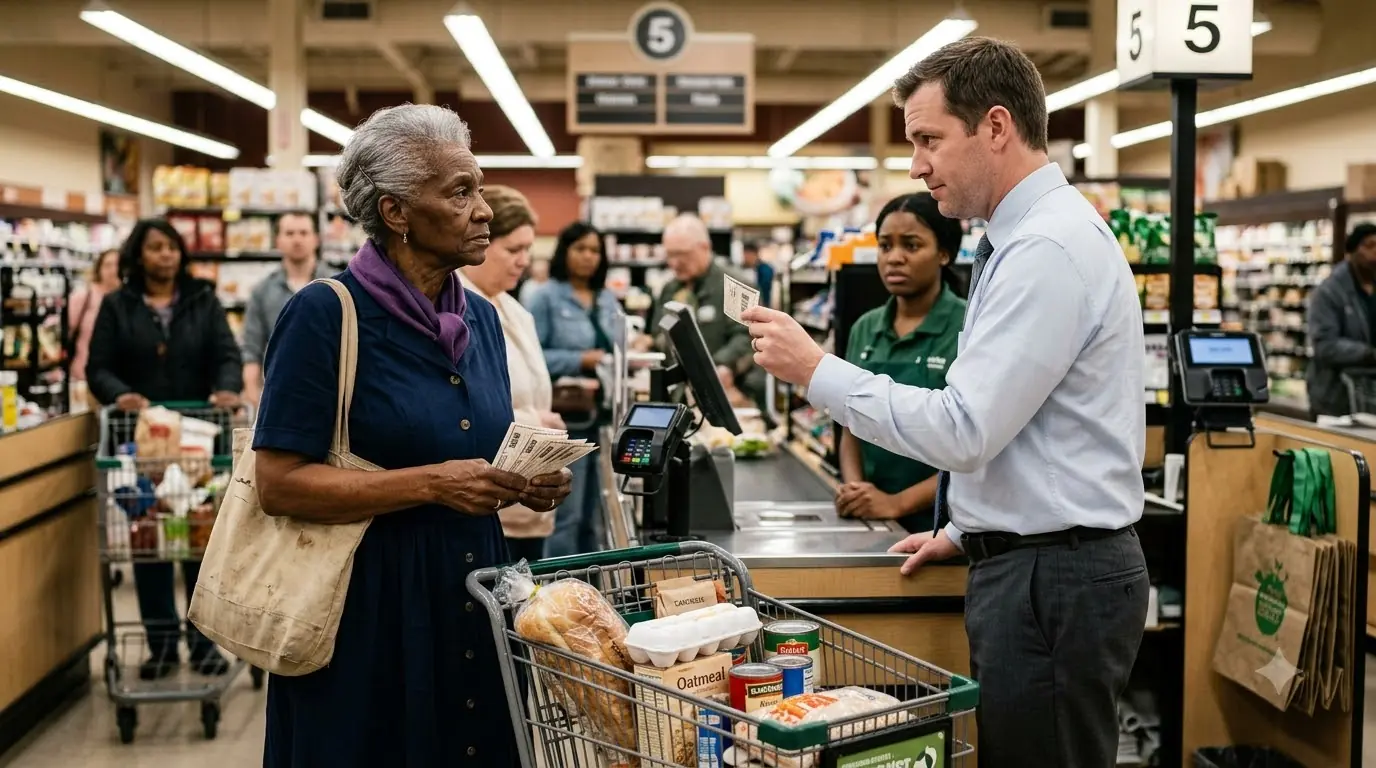
They moved with the steady precision of someone who had done this for most of her life, not because it amused her, but because it mattered.
The scissors opened and closed with a soft rhythmic sound, snip after snip, each coupon falling into neat little piles on the table in front of her.
One stack was for canned goods. One was for bread and cereal. One was for cleaning supplies. One was for medicine and vitamins.
The last stack was marked “maybe,” which meant Eleanor would only use those coupons if the item was already marked down and if the final price made better sense than the store brand.
The kitchen was modest, but warm in a way expensive rooms often failed to be. The curtains were white with tiny yellow flowers stitched along the edges, faded slightly from years of washing and sunlight.
A kettle rested on the stove, still giving off a little steam from the tea she had brewed half an hour earlier. The scent of black tea lingered in the air, mingling with the faint lavender fragrance from a small candle burning on the windowsill.
Shelves lined with jars of homemade peach preserves, blackberry jam, pickled okra, and neatly folded dish towels told the story of a woman who found dignity in order and joy in simplicity.
The table had scratches near one corner from when her youngest son, David, had carved his initials into the wood at age eight and then cried harder than Eleanor did when Clarence made him sand it down.
Eleanor had never replaced the table. She had always said a good table should remember a family.
Her eyes drifted to a picture frame perched on the counter near the sugar bowl.
It held a black-and-white photograph of a young couple on their wedding day. Clarence Williams stood tall and proud in a dark suit that was slightly too large in the shoulders.
Eleanor stood beside him in a lace dress her mother had altered by hand, her smile bright enough to make the whole photograph feel warmer than black and white should have allowed.
They had been twenty-two and twenty-one, too young to understand how hard marriage could become, but old enough to know they wanted to face that hardness together.
Eleanor smiled softly and traced the edge of the frame with one finger.
Her late husband had always teased her about her coupons.
“You could find a deal on air if they sold it,” Clarence used to say, his deep laugh filling the kitchen while he leaned against the counter with a cup of coffee in one hand.
“And you would breathe it for free because of me,” Eleanor would reply.
Those were good times, she thought.
Not easy times.
Good times.
There was a difference.
Raising three children on Clarence’s factory wages and her teaching salary had meant making every penny count. They had lived by careful lists, hand-me-down clothes, garden vegetables, church rummage sales, and the kind of quiet sacrifice children rarely understand until they are grown and buying groceries themselves. Clarence worked at the manufacturing plant for thirty-two years, coming home with sore shoulders, machine oil on his cuffs, and a grin whenever Eleanor managed to turn leftover roast into three different dinners. Eleanor taught fourth grade at Carver Elementary, where she spent her days helping other people’s children believe they could become more than their circumstances.
Coupons were not just a habit.
They were a lifeline.
They had paid for lunchbox snacks when the children were small. They had stretched Sunday dinners when Clarence’s overtime disappeared without warning. They had helped Eleanor keep cereal in the pantry, laundry soap in the cabinet, and dignity on the table during years when there was more month than money. Every clipped coupon represented a small rebellion against scarcity, a little proof that carefulness could be its own kind of courage.
The rhythmic snip of her scissors paused as Eleanor’s gaze shifted to her old coupon organizer. It sat beside her tea cup, the edges frayed from years of use, the plastic pockets softened and cracked at the corners. Inside were neatly arranged slips of paper, each one representing a small victory against rising prices and fixed income. Clarence used to joke that if there were ever a fire, Eleanor would grab the children first, his photograph second, and the coupon organizer third.
She sighed.
Everything cost more now.
Milk.
Bread.
Eggs.
Medicine.
Bus fare.
Even the Sunday paper she bought for the coupons cost more than it used to.
But Eleanor had never believed in complaining without planning. If the world grew more expensive, then she would grow more careful. That was how she had survived widowhood, retirement, and the long quiet years after her children moved into lives of their own. She did not mistake frugality for fear. To her, frugality was wisdom wearing an apron.
Every dollar saved meant a little more room for the unexpected.
A little more room to help her neighbor’s daughter buy school supplies.
A little more room to add canned goods to the church food pantry.
A little more room to send five dollars tucked into a birthday card when one of her grandchildren turned another year older.
Eleanor had always believed in stretching what little she had so she could still have enough to give.
Outside, the neighborhood was beginning to stir. Children’s laughter echoed faintly down the street. Somewhere a lawn mower coughed to life, though autumn had already begun thinning the grass. Cars rumbled past in the morning light, their tires whispering against fallen leaves.
Eleanor folded the last coupon into her pouch and stood, her movements deliberate and unhurried.
At seventy-five, she was still steady, though she moved more carefully than she used to. Her knees complained on rainy days. Her fingers stiffened in the cold. Some mornings, she had to sit on the edge of the bed for a moment before trusting her body with the day.
But she was not fragile.
She refused that word.
She picked up her canvas shopping bag, its handles worn but sturdy, and draped it over her arm. Today was grocery day, and she had planned the trip with the care of a seasoned strategist. The store circular was marked with pencil. Her list was arranged by aisle. Her coupons were stacked in order of use.
Before leaving, she glanced at her reflection in the hallway mirror.
Her silver hair was neatly pinned back. Her warm brown skin carried the fine lines of age, grief, laughter, and long summers spent watching children play outside. Her dress was simple, navy blue with tiny white buttons down the front, pressed carefully the night before. Around her neck, she adjusted a deep purple scarf Clarence had bought her years ago from a street vendor during a trip to Chicago.
“Ready as ever,” she murmured to herself.
Her voice was steady, though tinged with a trace of melancholy.
Grocery shopping had once been something she and Clarence did together. He pushed the cart. She held the list. He tried to sneak cookies into the basket. She pretended not to notice until checkout, then scolded him lightly while he smiled like a boy caught stealing pie.
Now it was one of many routines she tackled alone.
As Eleanor stepped onto the porch, the crisp autumn air greeted her gently. The sun hung low in the sky, casting a soft glow over the rows of modest houses lining the street. The maple tree in her front yard had turned half red and half orange, as if it could not decide which version of beauty to become. A small pile of leaves had gathered by the porch steps, and Eleanor made a mental note to sweep them when she returned.
A young woman walking by with a stroller waved cheerfully.
“Good morning, Mrs. Williams. Heading to Harper’s?”
Eleanor nodded, a kind smile softening her features.
“Morning, Tina. Yes, just a quick trip today.”
Tina laughed.
“Bet you’ll find better deals than anyone else in town.”
Eleanor’s smile widened.
“Well, dear, a dollar saved is a dollar that can do another job.”
“That sounds like something my grandmother would say.”
“Then your grandmother was a wise woman.”
Tina grinned and continued down the sidewalk, pushing the stroller while her toddler kicked happily beneath a blanket.
Eleanor watched them for a moment, her heart swelling with quiet concern. Tina was young, single, and always tired in the way mothers become when every bill feels personal. Eleanor had seen her counting coins at the laundromat. She had seen her put back cereal at the store after checking the price. She had slipped extra canned peaches into Tina’s church donation box twice without saying a word.
She clutched her bag a little tighter.
She might not have much, but what she had, she knew how to make last.
As she walked toward the bus stop, her mind wandered to a conversation she had overheard at church the previous Sunday. A friend named Ruth had mentioned how the manager at Harper’s Groceries had been treating customers poorly lately, especially those who used coupons, asked about discounts, or bought only the essentials.
“Greg Harper acts like every poor person in the neighborhood is personally ruining his day,” Ruth had said, stirring sugar into her coffee after service.
Eleanor had brushed it off at the time.
She had been shopping at Harper’s for years. The old owner, Walter Harper, had known every family on the block. He used to carry bags for elderly customers himself and give children a free apple if their parents said yes. He had not been perfect, but he had understood that a neighborhood grocery store was not just a place where money changed hands.
It was where people crossed paths.
Where news traveled.
Where small kindnesses could keep someone going for another day.
But Walter had retired, and his son Greg had taken over the daily management.
Times changed.
People changed.
Stores changed too.
“Times change,” Eleanor mused aloud as she reached the bus stop.
The words drifted into the morning air.
She did not yet know this trip to Harper’s Groceries would be unlike any she had taken before.
What awaited her inside would not only test her resilience, but ignite a chain of events she never could have imagined.
The bus ride was uneventful, filled with the low hum of conversation, the squeak of brakes, and the occasional burst of laughter from teenagers in the back. Eleanor found a seat near the window and rested her shopping bag on her lap. She liked this route. It took her past the library where she had once read stories to first graders, past the bakery that still sold sweet potato pies in November, and past the old movie theater that had been converted into offices.
The city moved by in small scenes.
A man unlocking a barbershop door.
A delivery driver stacking crates outside a café.
A woman in scrubs hurrying across the street with coffee in one hand.
Eleanor liked watching people begin their days. It made her feel connected to the world, even if her own life had become smaller with age. She had once moved through the morning with purpose because children were waiting in a classroom. Now her errands gave shape to her week, and she treated them with the same respect she had once given lesson plans.
When the bus slowed to a stop near Harper’s Groceries, Eleanor rose, steadying herself against the rail before descending the steps.
The store stood across the street, its bright red sign beckoning customers inside. It was not the fanciest grocery store, but it was close, well stocked, and familiar enough that Eleanor still thought of it as part of the neighborhood’s bones. The parking lot had cracks near the entrance, and the planters by the door held more weeds than flowers, but Eleanor still remembered when Clarence used to buy peaches there every July.
She adjusted her scarf against the light chill and crossed carefully at the crosswalk.
The automatic doors slid open with a soft hiss, and Eleanor stepped into the familiar environment of the store. The scent of freshly baked bread mingled with the crisp aroma of produce, and the faint hum of refrigeration units filled the air.
For a moment, she paused.
She had been here countless times before, but today she noticed things she had once overlooked. The fruit display looked tired, apples bruised on one side turned carefully away from view. The floor near the entrance needed polishing. A stack of sale flyers sat crooked near the carts. One of the overhead lights flickered faintly.
A young woman in a sharp suit stood near the customer service desk, speaking animatedly with Greg Harper.
Eleanor’s gaze lingered on Greg.
He was a man in his mid-thirties with a sharp jawline, neatly styled hair, and a demeanor that seemed perpetually rushed. He wore a pale blue dress shirt with the sleeves rolled up and a tie loosened just enough to suggest he considered himself too busy for formalities. She had seen him before, always darting around the store, giving curt instructions to employees, checking his phone while customers waited.
He did not often interact with customers unless there was a problem.
And even then, his tone usually suggested the customer was the problem.
Eleanor dismissed the interaction and made her way toward the carts.
Her focus shifted to her list.
She moved through the store methodically, choosing each item with care. She compared unit prices, checked expiration dates, and paused whenever she needed to calculate whether a coupon made the name brand cheaper than the store brand. She chose oatmeal, tea, rice, beans, canned tomatoes, eggs, and a small pack of chicken thighs with a yellow markdown sticker.
“Eighty-nine cents for the generic,” she murmured under her breath, slipping a can of green beans into her cart. “But the coupon makes this one seventy-nine.”
She smiled slightly.
A small victory.
Her cart was not full. Eleanor never bought more than she needed. But every item had purpose. The apples from the discount bag were not pretty enough for the front display, but they were perfectly fine for stewing with cinnamon. The day-old bread would toast well. The chicken thighs could make soup, then sandwiches, then stock if she treated the bones right.
In the next aisle, she saw Tina standing with her stroller, holding two boxes of cereal and frowning at the shelf tag. Eleanor slowed her cart.
“Need a second pair of eyes, dear?”
Tina looked embarrassed.
“I’m trying to figure out which one is cheaper, but the bigger box is on sale, and I have one coupon, and now my brain is giving up.”
Eleanor chuckled and took the boxes gently.
“Let’s see.”
She checked the ounces, the sale price, and the coupon value. Then she pointed to the larger box.
“This one. It gives you more for the money, but only with the coupon. Without it, the store brand wins.”
Tina exhaled.
“I don’t know how you do that so fast.”
“Years of practice and three children who treated cereal like oxygen.”
Tina laughed, and the tension left her shoulders.
Eleanor pulled a coupon from her organizer.
“Here. I have an extra.”
“No, Mrs. Williams, I can’t take your coupon.”
“You can, and you will. Your little one needs breakfast more than I need two boxes of oatmeal.”
Tina’s eyes softened.
“Thank you.”
Eleanor waved it off.
“Just pass the kindness along when you can.”
She continued shopping, not knowing that Greg had seen the exchange from the end of the aisle. His eyes narrowed slightly, not because Eleanor had done anything wrong, but because kindness irritated him when it did not pass through a register first.
The atmosphere in the store was calm at first, punctuated by the occasional squeak of a cart or the chatter of children pleading for snacks. Eleanor did not rush. Shopping was her time to think, to plan, and to savor small victories.
When she reached the checkout counter, she placed her items on the conveyor belt with care.
Jasmine, the cashier, greeted her with a warm but tired smile.
“Good morning, Mrs. Williams.”
“Good morning, Jasmine. How’s your little boy?”
Jasmine’s smile grew real for a second.
“Still climbing everything. Yesterday he tried to climb the bookcase.”
“Oh, Lord. That child is part squirrel.”
Jasmine laughed.
“He might be.”
Eleanor handed her the coupons, neatly stacked and clipped.
“These should match the order,” Eleanor said. “I tried to make it easy.”
“You always do.”
Jasmine began scanning.
But just as the transaction moved smoothly forward, Greg Harper appeared behind the counter.
His presence was abrupt.
He looked from Jasmine’s hand to the stack of coupons, and his mouth tightened.
“What’s going on here?” he asked sharply.
Jasmine hesitated.
“Just processing these, Mr. Harper. They’re valid.”
Greg leaned over the counter, inspecting the coupons with exaggerated scrutiny. He picked one up between two fingers as though it were contaminated.
“These things,” he said, “are more trouble than they’re worth. They slow the line down and confuse the system.”
The woman behind Eleanor shifted uncomfortably. A man two lanes over turned his head. Someone else stopped unloading a cart.
Eleanor felt the air change around her.
Greg turned his gaze to her, his voice taking on a condescending sweetness worse than open rudeness.
“Ma’am, maybe next time stick to regular purchases. These discounts aren’t really meant to cover everything, you know.”
Eleanor’s face remained calm, though a flicker of indignation crossed her eyes.
“These discounts are printed by the manufacturers and accepted by this store,” she said evenly. “They are meant to be used.”
Greg gave a little shrug.
“I suppose. But don’t hold up the line again. We’ve got paying customers waiting.”
The words struck harder than Eleanor expected.
Paying customers.
As if she were not one.
As if careful spending made her less legitimate.
As if the money she had earned through decades of teaching children to read was somehow worth less because she stretched it with scissors and patience.
Jasmine flushed.
“She is paying, Mr. Harper.”
Greg’s eyes snapped toward her.
“I’m handling it, Jasmine.”
The young cashier looked down, her hands trembling slightly as she continued scanning.
Eleanor felt the weight of eyes on her. Other customers had turned to watch, their expressions ranging from curiosity to discomfort. Some looked away quickly. Others pretended to check their phones. No one spoke.
Her hands tightened on the edge of her shopping bag.
She thought of Clarence.
His voice.
Stand tall, Ellie.
Dignity was something no one could take unless she allowed it.
So Eleanor lifted her chin.
“Finish the transaction, please,” she said gently to Jasmine.
Greg made a soft sound of annoyance, but he stepped back.
The coupons scanned.
Every one of them valid.
The total dropped by twelve dollars and forty-three cents.
Twelve dollars and forty-three cents was not nothing.
It was bus fare.
It was eggs, bread, and tea.
It was a contribution to the food pantry.
It was proof that Eleanor had planned well.
She paid, gathered her items, and turned toward the exit.
As she left, she heard Greg mutter under his breath, just loud enough to be cruel.
“Some people take more time than they’re worth.”
Eleanor did not stop.
Not in the store.
Not in front of him.
But as the automatic doors opened and the crisp morning air met her face, something inside her settled into place.
It was not the first time someone had treated her like she did not belong.
But as she stepped onto the sidewalk, she promised herself it would be the last time she accepted it quietly.
Eleanor walked down the street with slow, deliberate steps, her shopping bag swaying lightly against her side. The weight of Greg Harper’s words lingered in her mind.
Not because she had never faced such treatment before.
She had.
A Black woman born in a time when people measured dignity by the doors you were allowed to enter did not reach seventy-five without collecting a history of insults. Some had been loud. Some subtle. Some wrapped in smiles so polite they cut deeper than shouting.
But this one stirred something old.
Something tired.
Something that had swallowed enough.
She had spent a lifetime brushing off indignities for the sake of peace. In grocery stores. In banks. In school offices when parents assumed a white teacher must be in charge. In hospitals when doctors spoke over her as if age had made her invisible. In restaurants where servers called her “sweetie” while ignoring what she asked for.
This time felt different.
Maybe it was Greg’s tone.
Maybe it was the way Jasmine had looked ashamed but frightened.
Maybe it was the way the other customers had averted their eyes, unwilling to acknowledge what had happened.
Maybe it was Tina’s tired face from that morning, and the knowledge that if Greg spoke that way to Eleanor, he likely spoke worse to people with fewer years and less confidence.
Either way, Eleanor knew this feeling would not fade easily.
She turned into the small park she often passed on her way home. A bench under a large oak tree beckoned, and she sat down, setting her bag beside her.
The sunlight filtered through the branches, casting shifting patterns on the ground. Children played near the swings. A dog barked in the distance. A city bus sighed at the curb.
Eleanor took a deep breath, letting the cool air fill her lungs.
Memories of Clarence surfaced unbidden.
His deep voice.
His rough hand closing around hers during hard seasons.
His laughter that could lighten even the heaviest day.
She could almost hear him now, gently teasing her.
“Eleanor, you’ve never let anyone tell you what you’re worth. Don’t start now.”
A smile tugged at her lips, but it quickly faded.
She opened her eyes and stared ahead, her gaze fixed on the children playing near the swings.
Her thoughts turned to Tina. To Ruth from church. To Mr. Alvarez from the bus, who counted coins before buying bananas. To Mrs. Greene, who once asked Eleanor whether canned tuna could be frozen because she had bought too many during a sale and could not afford to waste even one.
How many people in this community relied on the same coupons Eleanor used?
How many felt embarrassed every time they handed one across the counter?
How many had been made to feel small for doing what they had to do to survive?
A small bird hopped near her feet.
Eleanor reached into her bag and tore a corner from the loaf of bread she had bought, scattering crumbs on the ground. The bird pecked eagerly, fearless for a few seconds.
She watched it with quiet intensity.
She was not angry.
Not exactly.
Anger was sharp and hot. It came and went.
This was something else.
Purpose.
And purpose was something she could hold.
Eleanor straightened her shoulders.
For years, she had lived frugally, setting aside what little she could for emergencies. Clarence’s pension helped. Her teacher’s retirement was modest but steady. The house was paid off. She had never dipped into the inheritance Clarence left her from his union settlement and a small investment he had made decades earlier with money he won in a company raffle.
“It’s for when life gets bigger than your plans,” Clarence had told her.
She had always thought that meant illness.
A roof repair.
A grandchild in trouble.
A final emergency.
But now, sitting beneath the oak tree with groceries at her feet and humiliation cooling into resolve, Eleanor wondered if life had finally become bigger than her plans in a different way.
What if she could do something more than defend herself?
What if she could make sure no one else in her community had to stand at a checkout counter and be treated like a burden for saving money?
What if the store itself could change?
The thought seemed bold.
Almost absurd.
Eleanor Williams, seventy-five years old, retired schoolteacher, coupon clipper, widow, owner of one creaky knee and a coupon organizer older than some cashiers, buying a grocery store.
She almost laughed.
Then she did laugh, softly.
Because the more impossible it sounded, the more awake she felt.
Clarence would have leaned back, rubbed his chin, and said, “Ellie, if you’re going to do something wild, at least make sure the math works.”
So that was where she would start.
With the math.
Eleanor rose from the bench, her steps lighter and her mind sharper.
The faint hum of traffic and children’s laughter faded into the background as one unwavering thought took hold.
It was time to stop letting others decide her worth.
It was time to change the narrative.
Not just for herself, but for everyone who had ever been made to feel invisible.
She did not yet know how.
But she knew where to begin.
And it all began with a grocery store.
The next few days passed in a blur of phone calls, research, and quiet determination.
Eleanor did not speak much to anyone about what she was planning. It was not the type of thing you mentioned casually over tea or after church service. People meant well, but doubt dressed as concern could smother an idea before it had legs.
No, this was something that needed to be done in silence.
Eleanor had always preferred to act first and explain later.
She began at the local library, where the same librarian who had once been one of her students helped her access public business records.
Bernard Lewis had been a quiet boy in her fourth-grade class, the kind who finished every book early and then asked if he could help shelve the classroom library. Now he was forty-two, balding slightly, with patient eyes and a cardigan collection that made Eleanor smile. When he saw her staring intensely at the computer screen, he walked over with gentle curiosity.
“Mrs. Williams,” he said, peering over his glasses, “are you researching grocery store ownership?”
“I am.”
“Should I ask why?”
“No, Bernard.”
“Yes, ma’am.”
He walked away smiling.
Eleanor spent hours poring over business guides, real estate listings, tax documents, ownership records, and local filings. She learned that Harper’s Groceries was still owned by Walter Harper on paper, though Greg ran it day to day. She learned that the store had been losing customers slowly for years. She learned that there were liens from unpaid vendor invoices, a property lease due for renewal within the year, and a business loan that had been restructured twice.
In other words, Harper’s Groceries was struggling.
That did not surprise her.
The shelves had told the story.
So had the tired staff.
So had Greg’s attitude.
Carelessness usually showed up in a business long before it appeared on paper.
The more Eleanor researched, the clearer the picture became. The small neighborhood store had been in business for decades, but it was showing signs of neglect. Customers complained about high prices and poor service. Employees left quickly. The community still used the store because it was convenient, not because it was loved.
That was not the way Walter Harper had run it.
But Walter was older now, living with his daughter in Ohio after a stroke. Greg had inherited the daily operations without inheriting the heart. He seemed content with the store’s slow decline, unconcerned about the people who relied on it.
Eleanor’s plan was simple in theory.
She would use a portion of Clarence’s inheritance, the money that had sat untouched for years, to purchase the business. She would not try to buy the building immediately, since the property itself was leased, but she could buy the operating company, the inventory, the name, the customer lists, and the right to manage the store.
Simple in theory did not mean simple in practice.
She was not naive.
Buying a store was not like buying a good winter coat at half price. There would be contracts, debt review, vendor agreements, employment records, insurance, permits, taxes, inspections, and a dozen other things she did not yet understand.
But Eleanor was a teacher.
Teachers learn before they teach.
So she learned.
She spoke with a local attorney, Vanessa Rowe, a sharp woman in her forties who had helped Eleanor update her will after Clarence passed. Vanessa had short natural curls, silver-rimmed glasses, and a way of listening that made people careful with their own words. Her office smelled faintly of coffee and printer paper, and every document on her desk sat in a pile that probably made sense only to her.
Vanessa was surprised when Eleanor explained her intentions.
“You want to buy Harper’s Groceries?” Vanessa asked, removing her glasses slowly. “The store?”
“Yes.”
“The whole store?”
“That is generally what buying a store means.”
Vanessa blinked, then laughed despite herself.
“Mrs. Williams, I’m not trying to discourage you. But this is serious. It’s not just a purchase. It’s operations, payroll, compliance, contracts. You would be taking on a lot.”
Eleanor folded her hands in her lap.
“I raised three children on two modest incomes, taught public school for thirty-eight years, cared for my husband through cancer, managed a household through recessions, strikes, inflation, and teenage boys eating everything not nailed down. I understand work.”
Vanessa smiled.
“I believe you do.”
“I also understand what it means when people depend on something that is being poorly cared for.”
That quiet sentence changed the room.
Vanessa leaned back.
“What happened?”
Eleanor told her.
Not dramatically.
Not with bitterness.
She described the checkout counter, the coupons, Greg’s words, Jasmine’s embarrassment, the silence of other customers.
Vanessa’s expression hardened by the time Eleanor finished.
“I see.”
“No,” Eleanor said softly. “That is the problem. Too many people see, and nothing changes.”
Vanessa was quiet for a moment.
Then she opened a legal pad.
“All right. Let’s see what we can find out.”
Eleanor also met with a financial adviser, Mr. Iqbal, who had managed Clarence’s small investment account for years. He pulled up numbers, asked difficult questions, and spoke honestly.
“It can be done,” he said finally. “But it will not be comfortable. You would be putting a significant portion of your savings into an asset that needs repair.”
“I know.”
“You may not see profit for a while.”
“I understand.”
“You will have to manage people, negotiate vendors, and face losses.”
“I have managed seventh graders after recess,” Eleanor said. “I am not easily frightened.”
Mr. Iqbal smiled.
Still, he made her run the numbers three times.
Eleanor appreciated that.
Faith was good.
Math was necessary.
Weeks passed.
There were calls to Walter Harper’s daughter. There were tense conversations with Greg, who did not yet know Eleanor was the interested buyer because Vanessa had wisely kept the process anonymous until the offer was serious. There were inspections, financial reviews, and one long afternoon when Eleanor nearly walked away after discovering just how badly Greg had allowed vendor relationships to deteriorate.
He had been paying some suppliers late and blaming accounting. He had ignored maintenance on refrigeration units until they ran inefficiently. He had cut staff hours during peak customer periods, then complained that lines moved too slowly. He had raised prices on basic goods while letting specialty items sit untouched.
It was not only poor management.
It was contempt disguised as business judgment.
But then Eleanor thought of Tina.
Of Jasmine.
Of the words “paying customers.”
And she kept going.
At last, after a series of tense meetings, revised offers, and a final phone call with Walter Harper himself, the deal was done.
Walter’s voice had been frail over the phone, but kind.
“Eleanor Williams,” he said slowly. “I remember you. Clarence used to buy peaches from me every July.”
“He said yours were the only ones worth canning.”
Walter chuckled weakly.
“He was right.”
There was a pause.
Then Walter sighed.
“My boy lost the way of the place. I know that. I didn’t want to see it, but I know it. If you mean to bring the neighborhood back into that store, then I’d rather sell it to you than some chain that’ll tear it up and call it progress.”
“I’ll take care of it,” Eleanor said.
“I believe you will.”
The day the papers were signed, Eleanor sat at her kitchen table, looking over the documents. Her fingers brushed over the official signatures, her own and Walter Harper’s.
The kitchen was quiet.
Clarence’s photograph watched from the counter.
Eleanor held the pen a moment longer than necessary.
“This is bigger than I planned, Clarence,” she whispered.
Then, almost as if she could hear him answer, she smiled.
That never stopped you before, Ellie.
She signed her name.
Eleanor Williams, at the age of seventy-five, was now the proud owner of Harper’s Groceries.
Not because she wanted power.
Not because she wanted revenge.
Because she believed a neighborhood store should not make people feel ashamed to eat.
The following week, Eleanor visited the store for the first time as its owner.
She stood outside Harper’s Groceries, fingers wrapped around the keys, feeling the weight of them like a promise. The fading red-and-white sign looked the same. The automatic doors slid open the same way. The carts still rattled at the entrance.
But Eleanor knew something had changed.
She had changed it.
Inside, the store was just as she remembered.
Crowded aisles.
Cluttered shelves.
Dim corners.
Tired signs.
A produce section that needed attention.
A checkout area that felt more like a checkpoint than a welcome.
Greg Harper stood at the counter with his back turned, speaking sharply to a stock boy named Mike about a misplaced case of soup.
Eleanor cleared her throat.
Greg turned.
His eyes widened when he saw her.
At first, he looked annoyed.
Then he saw the folder under her arm.
Then he saw Vanessa step in behind her.
Realization arrived slowly.
“What are you doing here?” Greg asked.
Eleanor did not flinch.
“I’m the new owner.”
There was a long pause.
The fluorescent lights hummed overhead.
Mike froze with a box in his hands.
Jasmine, at register two, looked up sharply.
Greg blinked, then let out a short incredulous laugh.
“You? The new owner? You’re not serious.”
“Very serious.”
His face reddened.
“You can’t just waltz in here and take over a business you know nothing about.”
“I didn’t waltz,” Eleanor said. “I took the bus.”
Mike coughed into his sleeve to hide a laugh.
Greg shot him a look.
Eleanor stepped closer, calm and steady.
“I have spent weeks with lawyers, accountants, vendor records, debt statements, inspection reports, and payroll files. I know more than enough to begin. I also know this store has been losing customers because people no longer feel respected here.”
Greg’s jaw tightened.
“This isn’t a charity. You think you can cut prices, smile at everybody, and magically keep the lights on?”
“No,” Eleanor said. “I think people return to places where they are treated with dignity. I think value matters. I think fair prices matter. I think good service matters. And I think a store that depends on a community should not insult that community at the register.”
His eyes narrowed.
“So this is about the coupons.”
“It started there.”
“That was one misunderstanding.”
“No,” Eleanor said. “It was a symptom.”
Jasmine looked down quickly, but Eleanor saw tears shine in her eyes.
Greg folded his arms.
“So what now? You fire me?”
The question hung in the air.
Eleanor had thought about it.
More than once.
She could have fired him that minute. Part of her wanted to. He had humiliated her. He had made employees fearful. He had treated customers like interruptions.
But Eleanor had taught children for decades. She knew the difference between someone unwilling to learn and someone who had never been required to.
“I could,” she said.
Greg swallowed.
“But I won’t. Not today.”
He looked surprised despite himself.
Eleanor continued.
“You know the store’s systems. You know the vendors. You know the staff. Whether you have used that knowledge well is another matter. If you want to keep your job, you will help me repair what has been neglected.”
Greg scoffed.
“Repair?”
“Yes. Prices. Service. Layout. Training. Community trust. All of it.”
“And if I don’t?”
“Then you will leave.”
Her voice was not loud.
It did not need to be.
For the first time since Eleanor had known him, Greg Harper had nothing quick to say.
She turned toward the staff.
“I’ll be speaking with each of you today. Not to frighten you. To listen. I want to know what works, what doesn’t, what customers complain about, what you need, and what you’ve been afraid to say.”
The store remained still.
Then Jasmine slowly raised her hand, as if she were in school.
“Mrs. Williams?”
“Yes, dear?”
“Are we still accepting coupons?”
Eleanor smiled.
“We are not only accepting them. We are going to make sure customers know how to use them properly.”
Jasmine smiled back.
A small thing.
A beginning.
The following days were filled with activity.
Eleanor spent hours in the store getting to know her staff, organizing shelves, reviewing invoices, and making small but meaningful changes.
Her first order of business was pricing.
She could not change everything overnight, but she began with basic necessities.
Milk.
Bread.
Eggs.
Rice.
Beans.
Cereal.
Diapers.
Toilet paper.
The things people needed before they needed anything else.
She worked closely with suppliers, renegotiating contracts Greg had ignored for too long. Some vendors dismissed her at first, hearing an elderly woman’s voice and assuming she could be pushed into whatever terms they preferred.
They learned quickly.
Eleanor was polite, but not soft.
“I taught middle school for thirty-eight years,” she told one supplier who tried to confuse her with fees. “You will need a better trick than talking fast.”
By the end of the call, she had better terms.
When new price tags appeared, the changes were subtle but powerful.
Milk that had been $3.79 became $2.99.
Bread dropped from $2.49 to $1.99.
Eggs were marked down every Wednesday.
Canned vegetables had a rotating sale.
Eleanor placed a new sign near the front:
Coupons welcome. Ask us if you need help matching weekly deals.
Some customers stopped in front of it and stared.
One elderly man took off his glasses, cleaned them, and read it again.
At register two, Jasmine began helping shoppers match coupons to sale items. At first she moved nervously, glancing toward Greg whenever a line formed. Eleanor noticed and adjusted the staffing schedule so checkout lanes had backup during peak hours.
“People using coupons are not slowing the store,” Eleanor told the staff at their first meeting. “Poor planning slows the store.”
Greg looked away.
Eleanor let him.
The staff was not easily won over.
Jasmine worried lower prices meant lower wages. Mike worried new systems meant more work with no appreciation. Carrie, an older cashier who had worked for Walter Harper, had seen enough new ideas fail to distrust optimism on principle.
So Eleanor sat with them.
One at a time.
She listened.
Jasmine told her Greg often changed schedules without warning. Mike explained the stockroom was disorganized because old inventory never got rotated properly. Carrie admitted customers had been complaining for years, but nobody wanted to tell Greg because he made people feel like a bother. A young part-time worker named Luis confessed that he sometimes threw away produce that could still have been used because no one had trained him on markdown procedures.
Eleanor wrote everything down.
Then she acted.
Schedules became predictable.
The stockroom was reorganized.
Employees received training on customer service, coupon use, and inventory management.
The break room, once a dingy space with a broken chair and stained microwave, was cleaned, painted soft yellow, and given a small table with fresh coffee. Eleanor brought in a vase of flowers from her garden.
Greg walked in, saw the flowers, and muttered, “Employees need hours, not daisies.”
Eleanor replied, “They need both respect and wages. We can manage more than one thing at a time.”
The first month was difficult.
Sales dipped before they rose.
Some customers came only to check whether the rumors were true.
Some used the lower prices and still complained.
A few people accused Eleanor of making the store “too soft.”
She ignored what needed ignoring and corrected what needed correcting.
The next major change was the Community Corner.
Eleanor cleared a neglected space near the entrance where old promotional displays had gathered dust. She placed shelves there, painted them herself with Mike’s help, and added a handwritten sign:
Take what you need. Give what you can.
At first, donations came slowly.
A can of soup.
A box of pasta.
A jar of peanut butter.
Then Ruth from church brought three bags of groceries.
Tina brought baby food her youngest had outgrown.
Jared from the community center dropped off flyers about job training and utility assistance.
Within weeks, the corner became more than shelves.
It became a quiet place of exchange.
People left things there without needing credit.
Others took what they needed without having to ask.
Eleanor insisted the area remain near the entrance, not hidden in the back.
“Need is not shameful,” she told Greg when he suggested moving it somewhere less visible.
He opened his mouth, then closed it.
He was learning, slowly, when not to argue.
Eleanor also began hosting workshops.
The first was a couponing class on a Thursday evening.
She expected six people.
Thirty-two showed up.
They gathered between the produce section and the bakery, sitting on folding chairs borrowed from the church. Eleanor stood in front with her old coupon organizer and a stack of sale flyers. Jasmine sat in the front with a notebook. Tina arrived with both children and apologized three times for bringing snacks, even though Eleanor had told her children belonged wherever their mothers needed to learn.
Eleanor explained unit pricing.
Store brands.
Rain checks.
Meal planning.
How to avoid buying something unnecessary just because it was discounted.
“Saving money is not about being cheap,” she told them. “It is about making your money obey your priorities.”
Tina wrote that sentence down.
So did Greg, though he did it on the back of a receipt and hid it when Eleanor looked his way.
The second workshop was about cooking affordable meals.
A local chef named Samantha demonstrated how to make vegetable soup, baked chicken, and rice stretch into three dinners.
The third workshop brought in a nutritionist.
The fourth invited a financial counselor.
Soon the store’s bulletin board became a community resource, filled with job postings, tutoring flyers, babysitting offers, church events, lost pet notices, and handwritten recipes.
The store changed.
Slowly.
Then noticeably.
The aisles felt less tense.
Customers talked to one another.
Staff smiled more easily.
People lingered by the Community Corner and swapped tips.
Children were given free apples on Saturdays, with parental permission, just as Walter Harper had once done.
Eleanor had not planned that last part.
Carrie suggested it.
“I miss seeing kids get excited over something simple,” she said.
Eleanor approved it immediately.
Greg objected to the cost.
Eleanor handed him a calculator and made him compare the cost of a bag of apples against the value of parents choosing their store every week because their children felt welcome.
He stared at the numbers.
Then he said, “Fine. Apples.”
It was not enthusiasm.
But it was not resistance either.
Progress came in strange clothing sometimes.
By the end of the third month, sales were up eighteen percent.
Not because prices were higher.
Because customers came back.
And brought others with them.
One chilly afternoon, Eleanor saw Ruth standing in front of the canned vegetables, studying the new price tags.
“How’s the new pricing working out for you?” Eleanor asked.
Ruth smiled.
“I didn’t think much of it at first. But I’ve saved a few dollars every week on things I already buy. That matters.”
“Every little bit helps.”
Ruth leaned closer.
“You know people are talking about you.”
“I assumed.”
“Good things,” Ruth said. “Mostly.”
Eleanor laughed.
“Mostly is more than enough.”
Ruth’s expression softened.
“You gave people permission not to feel embarrassed. That is no small thing.”
Eleanor looked around the store.
Tina was at register two, laughing with Jasmine. Mike was helping an elderly customer reach soup on a high shelf. Greg was near the front, watching a customer use a coupon without making a face.
It was not perfect.
But there was possibility now.
Hope.
The tired grocery store was becoming something more.
Then came the rent notice.
It arrived on a rainy Tuesday morning in a white envelope from Davis Property Group, the landlord that owned the building.
Eleanor opened it in the back office while sipping tea from a thermos.
By the second paragraph, the tea had gone cold in her hand.
The rent would nearly double in six weeks.
She read the letter once.
Then again.
Then she set it down on the desk and pressed her palm flat over it, as though she could physically hold the threat in place.
The store’s finances had improved, but not enough for this.
Not yet.
Higher rent would force higher prices.
Higher prices would push away the very people she had fought to serve.
And if she refused to raise prices, the store could collapse under overhead costs.
For the first time since signing the purchase papers, Eleanor felt fear rise fast enough to steal her breath.
She called Vanessa.
Her attorney’s voice tightened as she reviewed the lease.
“They’re within their rights to increase it at renewal,” Vanessa said. “But doubling it is aggressive. It looks like they’re trying to push you out or force renegotiation from a position of fear.”
“Can we fight it legally?”
“Maybe delay it. Not stop it easily. You need leverage.”
Eleanor looked through the office window at the store outside.
Customers moved through the aisles. Jasmine laughed at something Carrie said. Tina stood by the Community Corner reading a flyer about childcare assistance. An elderly man selected apples one by one with the care of someone making each purchase count.
Leverage.
Eleanor knew what her leverage was.
People.
Not in the cold business sense.
In the truest sense.
The store mattered to people now.
And people, when given a reason, could stand together.
That evening, Eleanor called a staff meeting.
Everyone gathered near the bakery after closing. Greg stood by the bread rack, arms crossed. Jasmine looked worried. Mike leaned against a stack of flour bags. Carrie folded and unfolded a receipt in her hands.
Eleanor held up the letter.
“The landlord is raising our rent,” she said. “A lot.”
“How much?” Greg asked.
“Nearly double.”
The room went quiet.
Jasmine whispered, “Can we survive that?”
“Not without changing who we are,” Eleanor said.
Greg’s face darkened.
“I knew something like this would happen.”
Eleanor looked at him.
“Then help me stop it.”
He blinked.
“What?”
“I don’t need blame. I need help. This store belongs to the community now, whether the property papers say so or not. We’re going to show Mr. Davis exactly what he is threatening.”
Greg looked uncertain.
Then, for the first time, he did not argue.
“What do you need?”
The question was small.
But Eleanor heard the shift in it.
She gave him a stack of blank petition sheets.
“Start here.”
The next weeks were intense.
Eleanor organized petitions, customer letters, neighborhood meetings, and calls to local leaders. Jared helped coordinate volunteers. Tina spoke to other young parents. Ruth took petitions to church. Jasmine talked to customers at checkout. Mike created flyers and taped them in windows with permission from nearby businesses.
Even Greg surprised everyone.
He worked late.
Made calls.
Explained the situation to longtime customers.
When one man said, “Why should we care? It’s just a store,” Greg replied, “Because you’ll care when the only places left charge you twice as much and know you have nowhere else to go.”
Eleanor overheard and smiled quietly from the next aisle.
The petition grew fast.
Hundreds of signatures became thousands.
People wrote letters.
Not polished letters.
Real ones.
A grandmother wrote that Harper’s new prices helped her buy fresh fruit for her grandchildren.
A young father wrote that the budgeting workshop helped him avoid payday loans.
A retired veteran wrote that the store made him feel seen after years of feeling invisible.
Tina wrote three pages in careful handwriting about how the Community Corner helped her through a week when her childcare bill and electric bill came due at the same time.
Eleanor read every letter.
Some made her cry.
She kept going.
On the morning of the meeting with Mr. Davis, Eleanor dressed with care.
She wore the navy dress again, the purple scarf, and the pearl earrings Clarence had given her on their twenty-fifth anniversary. Her silver hair was pinned neatly. Her shoes were polished. In one hand, she carried a folder full of numbers. In the other, a box full of letters.
Greg insisted on driving her.
“I can take the bus,” she said.
“I know,” he replied. “But you shouldn’t have to carry all that.”
She looked at him for a moment.
Then nodded.
“All right.”
Mr. Davis’s office was downtown, in a glass building with polished floors and a receptionist who looked surprised when Eleanor entered carrying a cardboard box.
Mr. Davis was waiting in a conference room.
He was in his sixties, with cold eyes, a sharp suit, and the impatience of a man who had decided most conversations were interruptions to profit.
“Mrs. Williams,” he said without standing. “Let’s get this over with. I understand you have concerns about the rent increase.”
Eleanor sat across from him and placed the folder neatly on the table.
“Yes, Mr. Davis. I do.”
Greg sat beside her, unusually quiet.
Mr. Davis glanced at him.
“Mr. Harper. I didn’t expect you.”
Greg’s jaw tightened.
“I work for Mrs. Williams now.”
Eleanor did not look at him, but the words warmed her more than she expected.
Mr. Davis leaned back.
“This is business. Costs have gone up. Property values have gone up. I need to adjust accordingly.”
“I understand business,” Eleanor said. “So I brought numbers first.”
She opened the folder and laid out sales reports, customer growth, neighborhood foot traffic, vendor improvements, and revenue trends. She showed him the store was not failing. It was recovering. She showed how a sharp rent increase would destabilize that recovery and likely lead to vacancy if the business collapsed.
Mr. Davis listened, expression unchanged.
Then Eleanor lifted the box.
“And I brought something numbers cannot show.”
She placed the petitions on the table.
Three thousand signatures.
Then the letters.
Dozens of them.
“This store is not just a tenant in your building,” she said. “It is a cornerstone of the neighborhood. The people who signed these are not asking for charity. Neither am I. I am asking for a fair rent that allows a valuable business to continue serving the community and paying you reliably for years to come.”
Mr. Davis flipped through a few pages.
“I’m not interested in sentimentality.”
Eleanor’s eyes remained steady.
“Then read the numbers again. Empty buildings do not pay rent. Angry communities do not support landlords. A stable tenant with growing community support is worth more than a short-term increase.”
Greg looked at her with open surprise.
Mr. Davis paused.
For the first time, he seemed to actually consider her.
Eleanor continued.
“We are willing to negotiate. We understand an increase may be necessary. But nearly doubling the rent is not adjustment. It is extraction. And this community has already decided it will not stay silent about that.”
Mr. Davis looked toward the petition box.
“Is that a threat?”
“No,” Eleanor said. “It is information. You are free to make your decision. The community is free to respond to it.”
The room went quiet.
Mr. Davis closed the folder slowly.
“I’ll review the materials.”
Eleanor stood.
“Thank you.”
As she and Greg walked out, he waited until they reached the elevator before speaking.
“I didn’t know you had that in you.”
Eleanor pressed the elevator button.
“Greg, I taught children whose parents thought homework was optional and principals who thought budgets mattered more than books. Mr. Davis was not my first difficult man in a suit.”
Greg laughed.
It startled both of them.
Three days later, the call came.
Mr. Davis agreed to reduce the increase by half and lock the lease for five years, with smaller predictable increases after that.
It was not perfect.
But it was survivable.
Eleanor thanked him calmly, hung up the phone, walked into the store, and announced the news.
For one second, everyone was silent.
Then Jasmine screamed.
Carrie cried.
Mike lifted both arms like his team had won a championship.
Tina, who happened to be shopping with her children, hugged Eleanor so tightly Eleanor nearly dropped her glasses.
Greg stood near the register, looking down.
Eleanor walked over.
“You helped,” she said.
He shrugged, but his eyes were damp.
“I should have helped sooner.”
“Yes,” Eleanor said.
He flinched.
Then she added, “But sooner is gone. Now is still useful.”
Greg nodded slowly.
“I’m sorry,” he said.
It was quiet.
Not dramatic.
Not polished.
But it was the first real apology he had given her.
Eleanor studied him.
“For the coupons?” she asked.
His face reddened.
“For that. For more than that. For thinking people spending less were worth less. For treating this place like it was mine to run down.”
Eleanor was silent for a moment.
Then she said, “Apology accepted. Now go help Mike restock the apples.”
Greg blinked.
Then he laughed under his breath.
“Yes, ma’am.”
By the end of the first year, Harper’s Groceries had become almost unrecognizable from the store Eleanor had walked into that humiliating morning.
The shelves were bright and organized.
The produce section was fresh.
The bakery had a new local supplier.
The Community Corner had expanded to include a small refrigerator for donated fresh food, managed carefully according to safety guidelines Vanessa helped review.
Workshops became weekly events.
Budget cooking.
Couponing.
Nutrition.
Diabetes-friendly meals.
Job readiness.
Basic financial planning.
A local nurse offered blood pressure checks once a month.
The bulletin board became so crowded that Mike built a second one.
Customers no longer rushed in and out with heads down.
They lingered.
They talked.
They asked questions.
They helped one another.
Harper’s Groceries became the place where people found out who needed a babysitter, whose mother was in the hospital, whose son got accepted into college, whose rent was late, whose church was collecting coats.
Eleanor did not turn the store into a charity.
She turned it into what a neighborhood business should have been all along.
A place with fair prices.
Good service.
Sound operations.
And a heart.
Profit returned, slowly but steadily.
Enough to raise wages modestly.
Enough to repair the old freezer units.
Enough to create a small emergency fund for employees.
Enough to prove that dignity and sustainability were not enemies.
The first time Greg handed a customer an extra coupon without being asked, Jasmine saw it happen.
The customer was an elderly man named Mr. Alvarez, who stood at the register counting coins for a small bag of groceries. He had set aside a carton of eggs with visible disappointment, trying to decide whether bread or protein mattered more that week. Greg glanced at the total, stepped quietly to the coupon drawer Eleanor had placed by the register, and scanned a store discount code.
The total dropped by four dollars and six cents.
Mr. Alvarez blinked.
“Did something come off?”
Greg nodded.
“Weekly savings. You qualified.”
“I did?”
“Yes, sir.”
Jasmine looked at Greg.
Greg did not look at her.
But his ears turned red.
Eleanor heard about it later and said nothing to him, though she left a fresh cup of coffee on his desk the next morning.
Some lessons, she knew, should be allowed to take root without applause.
The store’s second year brought new challenges.
A regional chain announced plans to open a larger supermarket three blocks away. Their ads promised lower prices, wider aisles, digital coupons, and “a modern shopping experience for hardworking families.” Several people in the neighborhood worried Harper’s would not survive the competition.
Greg panicked first.
“We can’t beat a chain,” he told Eleanor one morning, pacing in the office. “They have buying power. They can undercut us for six months just to wipe us out.”
Eleanor continued reviewing invoices.
“Maybe.”
“Maybe? That’s all you have?”
She looked up.
“Greg, if we try to become them, we lose before we begin. We do not win by being bigger. We win by being better at what they cannot copy.”
“What can’t they copy?”
She looked through the office window at Jasmine helping Tina’s toddler choose an apple from the free basket.
“That.”
The chain opened in March.
For two weeks, Harper’s sales dropped.
People were curious. Some liked the shiny new space. Some liked the opening discounts. Some wanted to compare prices.
Eleanor did not panic.
She improved.
Harper’s launched a neighborhood loyalty program that did not require smartphones, because Eleanor knew not every senior had one. Customers could track points on a simple card. Low-income families could sign up privately for monthly staple boxes at reduced cost. Local farmers were invited to sell seasonal produce on Saturdays outside the entrance.
The chain had digital kiosks.
Harper’s had people who remembered your child’s name.
The chain had polished aisles.
Harper’s had a Community Corner where no one made you feel poor.
The chain had self-checkout lanes.
Harper’s had Jasmine saying, “Mrs. Greene, don’t forget the coupon for that tuna.”
By summer, sales stabilized.
By fall, Harper’s had gained back almost all its lost customers.
By winter, the chain manager quietly visited Harper’s to see what Eleanor was doing right.
Eleanor greeted him politely.
Then she handed him an apple.
Three years after she bought the store, Eleanor stood outside beneath the newly restored sign.
It no longer said only Harper’s Groceries.
The sign now read:
Harper’s Community Market
Founded by Walter Harper
Renewed by Eleanor Williams
She had resisted having her name added.
The staff had insisted.
Greg had been the loudest.
“It belongs there,” he said. “You saved this place.”
“No,” Eleanor replied. “We saved it.”
“Fine,” Greg said. “Then we’ll put all our names on the sign and make it ridiculous.”
She had allowed the smaller line beneath the name after that.
The unveiling happened on a Saturday morning in October, under a sky clear enough to make the leaves look painted. The parking lot was full. Children ran between folding chairs. Ruth brought a cake from the church kitchen. Tina helped organize the refreshment table. Bernard from the library set up a children’s reading booth near the entrance.
Walter Harper came too.
He arrived in a wheelchair pushed by his daughter, his face thinner than Eleanor remembered but his eyes still bright. When he saw the restored store, he cried openly.
“I thought it was gone,” he told Eleanor.
“What was gone?”
“The feeling,” he said. “The place used to feel like people belonged here. I thought that was gone.”
Eleanor placed a hand over his.
“Not gone. Just neglected.”
Walter looked toward Greg, who stood nearby adjusting a display of apples for no reason other than nerves.
“My boy doing all right?”
Eleanor smiled gently.
“He is learning.”
Walter nodded, tears still in his eyes.
“That might be better than doing all right.”
The ceremony was small, informal, and perfect.
Greg spoke briefly, surprising everyone.
He stood in front of the crowd holding a folded piece of paper, then gave up on reading it after the first sentence.
“When Mrs. Williams bought this store, I thought she was here to punish me,” he said. “Honestly, I deserved some of that. I had forgotten that a grocery store is not just inventory and margins. It is people. I forgot that because I was scared of failing, and I turned that fear into arrogance.”
The crowd was quiet.
Greg swallowed.
“I treated customers like problems. I treated staff like costs. I treated coupons like insults. Mrs. Williams showed me that if you are ashamed of the people who keep your business alive, you do not deserve their business.”
He turned toward Eleanor.
“I am sorry. And thank you.”
Eleanor nodded once.
That was enough.
Then Tina spoke.
She stood with her toddler on her hip and a trembling piece of paper in her hand.
“I don’t like speaking in front of people,” she began, “but Mrs. Williams said courage is not the same thing as comfort, so here I am.”
People laughed softly.
“When I first came here after she bought the store, I was embarrassed all the time. Embarrassed that I needed coupons. Embarrassed that I counted every dollar. Embarrassed when my card declined once and Jasmine quietly held my groceries aside so no one else would notice.”
Jasmine wiped her eyes.
Tina continued.
“This store did not make me rich. It did something better. It made me feel like struggling did not make me less worthy. That changed how I walked into every other room in my life.”
Eleanor lowered her gaze.
Some praise was harder to receive than insult.
At last, Eleanor stepped forward.
She had not planned a speech.
But she had taught long enough to know that sometimes the right words only arrived when people were ready to hear them.
“I started clipping coupons when my children were small,” she said. “Not because it was fun, though sometimes it was. Not because I was cheap, though Clarence liked to tease me about that. I did it because every penny had a job, and I was responsible for making sure those pennies got where they needed to go.”
She looked at the crowd.
“Years later, someone tried to make me feel ashamed for that. For planning. For saving. For taking time. For being careful with what I had.”
Her voice remained calm.
“I could have gone home and complained. I could have told myself that was just the way things were. But I looked around and realized it was not only about me. It was about every person who has ever been treated like their need made them inconvenient.”
The crowd stayed silent.
“That is why this store changed. Not because of me alone. Because all of you decided dignity was worth protecting.”
She looked toward the entrance.
“This place sells bread, milk, apples, soap, rice, and all the ordinary things people need. But I hope it also gives something else. I hope it gives people the feeling that they are seen before they are measured. That they are welcome before they are judged. That their money, whether much or little, is still the result of someone’s labor and deserves respect.”
Her voice softened.
“A grocery store cannot fix every problem. But it can stop adding shame to the burden people already carry.”
Ruth began clapping first.
Then Jasmine.
Then Tina.
Then everyone.
Eleanor stood beneath the restored sign with tears in her eyes, feeling Clarence near her in the way grief sometimes becomes comfort after enough years. She imagined him leaning against a cart, smiling, slipping cookies into the basket when she was not looking.
That evening, after the celebration ended and the last folding chair was stacked away, Eleanor sat alone in the small back office with a cup of tea.
The day’s receipts were balanced.
The lights in the store were dimmed.
The hum of refrigeration units filled the quiet.
She opened her old coupon organizer and placed it on the desk.
Its edges were still frayed.
Its pockets still cracked.
But now, beside it, lay a stack of flyers for next week’s workshop:
Stretching Meals Without Stretching Yourself Thin
Eleanor smiled.
Clarence’s photograph sat on a small shelf she had installed above the desk.
She looked at it for a long time.
“You were right,” she whispered. “A good deal on air might be possible after all.”
In her mind, she heard his laugh.
Warm.
Deep.
Home.
Eleanor’s journey with Harper’s Community Market had never been just about running a business.
It was about building a community.
Creating a space where people felt valued.
Proving that a store could thrive while prioritizing people over profit.
From the initial humiliation at the checkout counter to the fight against the rent increase, Eleanor showed what could be accomplished when determination, compassion, and a deep sense of purpose drove the mission.
She did not set out to become a business owner.
She did not set out to challenge a landlord, change a store, or build a movement.
She simply refused to accept that dignity should depend on how much money someone spent at a register.
She refused to accept that people struggling to make ends meet should be treated like burdens.
She refused to accept that a place built to serve a neighborhood should forget the people who kept it alive.
And because she refused, a tired grocery store became a home.
A coupon became a statement.
A rent fight became a community stand.
A cashier found courage.
A manager learned humility.
A young mother found support.
An old woman found a new purpose.
And one small store on a familiar street became proof that meaningful change does not always begin loudly.
Sometimes it begins quietly.
At a kitchen table.
With scissors.
With a stack of newspapers.
With a woman who has been underestimated one time too many.
With a decision.
With a plan.
With the courage to say, “Enough.”
And with the belief that when people are treated with dignity, they do more than come back.
They rise together.