Karen Pinebrook arrived at the lake house wearing enough gold to catch the morning sun from across the water. At sixty-seven, she carried herself with the polished confidence of a woman who had spent years confusing attention with authority: a flawless silver bob, oversized black sunglasses, sculpted features, large gold hoop earrings, a thick chain necklace, stacked bracelets, and an ivory sleeveless top tucked into elegant beige trousers. She stood on the tiled terrace of Rachel Merritt’s lakefront home, waved an unauthorized occupancy notice, and ordered Rachel to pack before the police arrived. Karen had no idea the woman she was trying to remove commanded the entire state police force.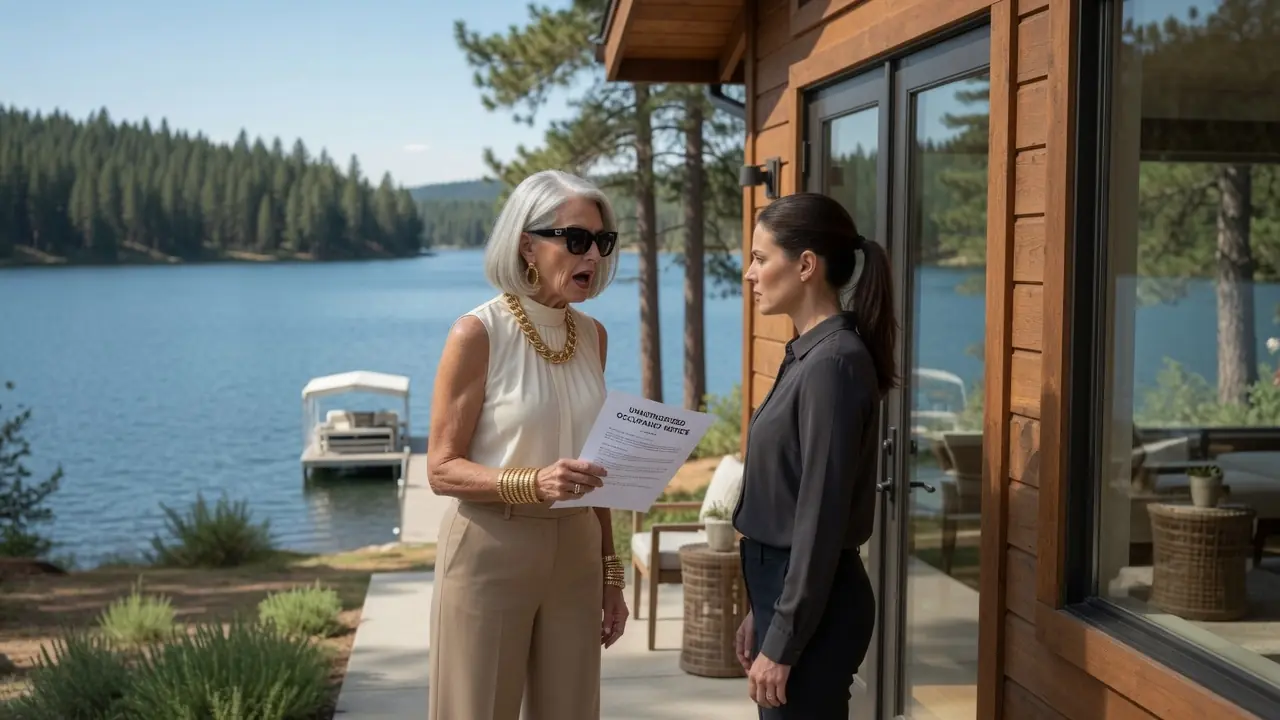
Rachel did not raise her voice.
At forty-two, she had spent most of her adult life in rooms where calm mattered more than intimidation. Her dark brown hair was pulled into a neat ponytail, and she wore a fitted charcoal blouse, dark trousers, and simple leather boots. Nothing about her appearance advertised the rank she held, and she preferred it that way.
The lake house belonged to Rachel and her husband, Daniel Merritt, though the property deed had been registered through an LLC created under Daniel’s name. The arrangement simplified taxes and inheritance planning, but Karen saw only an opportunity. Because Rachel’s full name did not appear on the first page of the public property record, Karen decided she was an unauthorized occupant.
“You have ten minutes,” Karen said, lifting the notice. “After that, I’m calling emergency services.”
Rachel stood between Karen and the glass doors leading into the house. “You’re trying to evict a wife from her own home with a document you invented.”
“I run this HOA.”
“You administer community rules. You do not decide who is married to whom or who may enter privately owned property.”
Karen’s lips tightened. “One call will prove you’re nobody here.”
Rachel met her eyes. “Make it. The officers answering that call report directly to me.”
Karen laughed.
It was not a nervous laugh or a confused one. It was the sharp, dismissive laugh of someone who had already decided Rachel was lying. She raised her phone, dialed 911, and turned slightly so Rachel could hear every word.
“There is a trespasser refusing to leave a private residence in Lake Pine Estates,” Karen announced. “She has become hostile, and I believe the lawful owner may be in danger.”
Daniel stood inside the kitchen, listening from behind the half-open door. He had wanted to intervene the moment Karen entered the terrace without permission, but Rachel asked him to remain inside and let the situation unfold. Karen had been threatening neighbors for years, and this time she had placed her own misconduct on an emergency recording.
The dispatcher asked whether Karen knew the alleged trespasser.
“She claims her name is Rachel Merritt,” Karen replied. “She says she lives here, but there is no Rachel Merritt listed on the deed.”
Rachel folded her arms.
Karen exaggerated further, claiming Rachel had blocked an HOA inspection and threatened community leadership. By the time she ended the call, her story had transformed a quiet disagreement into an active home invasion.
“Now we wait,” Karen said.
Rachel looked toward the road. “Yes.”
The trouble had begun three days earlier when Rachel and Daniel arrived for a long weekend at the lake. They had purchased the property the previous spring after Rachel’s promotion to commander of the state police. The house was meant to be an escape from twelve-hour meetings, statewide emergencies, and the constant pressure attached to overseeing thousands of officers.
Lake Pine Estates appeared perfect from a distance.
The community sat between tall pines and a clear blue lake, with private docks, stone paths, and large homes separated by quiet stretches of forest. The HOA’s responsibilities were simple: maintain the common road, manage the boat launch, and protect the shoreline. Karen had expanded those duties until she behaved like the mayor of a private country.
She first approached Rachel while Daniel was unloading groceries.
Karen drove into the private driveway in a white luxury SUV and stepped out carrying a clipboard. Without introducing herself, she walked around the property, photographed the porch, measured the firewood stack, and wrote several notes. Rachel had watched for nearly a minute before asking whether she needed help.
“I’m inspecting unauthorized activity,” Karen replied.
“This is our house.”
“I don’t recognize you.”
“That doesn’t change ownership.”
Karen demanded identification and an occupancy notice filed through the HOA’s online portal. Rachel explained that owners were not required to seek permission before staying in their own homes. Karen responded by placing a warning beneath the windshield wiper of Daniel’s truck.
The following morning brought a citation for excessive natural debris.
Three pinecones lay beside the front steps.
The second notice accused Rachel of “extended porch occupation” because she drank coffee outside for forty minutes. The third declared her an unauthorized cohabitant and ordered her to leave within forty-eight hours.
Daniel laughed when he read it.
Rachel did not.
“This isn’t confusion,” she said. “She knows the property is occupied legally.”
“Then why keep going?”
“Because she expects pressure to work faster than truth.”
Rachel began documenting each visit. Security cameras recorded Karen measuring windows, photographing vehicles, and entering the porch without permission. Emails showed that Karen repeatedly described Rachel as unstable despite never having a private conversation with her.
The other neighbors noticed.
A retired accountant named Vince stopped Daniel near the mailbox and quietly warned him not to challenge Karen. An elderly widow named Mrs. Landon admitted she had paid nearly four thousand dollars in questionable fines because she feared losing her home. Several residents described the same pattern: Karen invented small violations, increased penalties when challenged, and controlled every appeal meeting.
“She doesn’t enforce rules,” Rachel told Daniel. “She tests how much fear people will tolerate.”
The 911 call was the first time Karen’s intimidation crossed directly into criminal territory.
Two patrol vehicles appeared at the end of the road twelve minutes after the call. Blue lights reflected across the lake as four officers stepped onto the gravel. Karen moved toward them before they reached the terrace, waving the false notice like an official warrant.
“Thank goodness,” she said. “The trespasser is still here.”
The lead officer, Sergeant Luis Martinez, looked toward Rachel and stopped.
He recognized her immediately.
Every officer in the state knew Commander Rachel Merritt by reputation, though many had never met her personally. She had taken charge after exposing corruption inside the previous administration and became known for demanding professionalism without humiliating subordinates. Martinez had attended one of her command briefings only two months earlier.
“Commander Merritt?” he said.
The younger officers straightened.
Karen turned slowly. “Commander?”
Rachel stepped forward. “Good morning, Sergeant.”
Martinez removed his sunglasses. “Ma’am, dispatch sent us on a reported trespass in progress.”
“I know. Mrs. Pinebrook made the call while standing on my terrace.”
One officer glanced toward Karen.
Her confidence had not fully disappeared, but cracks had begun to form.
“She is not the owner,” Karen insisted. “The deed lists a company.”
Daniel stepped through the door carrying a folder. “The company is mine.”
He presented the deed, LLC registration, marriage certificate, insurance documents, and a signed declaration identifying Rachel as co-executive and authorized resident. Martinez reviewed each page carefully.
Karen interrupted twice.
“This is an HOA matter.”
“No,” Rachel said. “It became a law-enforcement matter when you knowingly reported a false home invasion.”
“I believed the call was legitimate.”
“You identified me by name, ignored the documents we sent you, entered private property, and told emergency dispatch that Daniel might be in danger.”
Karen looked toward Daniel. “I had no proof he consented to her presence.”
Daniel stared at her. “You watched us arrive together.”
“That proves nothing.”
“It proves more than your homemade eviction notice.”
One of the younger officers tried not to smile.
Rachel asked Martinez to confirm whether the incident recording would be preserved. He assured her the call, dispatch notes, and body-camera footage would be logged automatically. She then requested an independent investigator because she did not want her position influencing the process.
Karen seized on that statement.
“So you admit this is a conflict of interest.”
“I am preventing one.”
“You’re using your title to frighten me.”
Rachel’s voice became colder. “My title is the only reason you are suddenly questioning your conduct. You were comfortable when you thought I had no authority.”
The officers asked Karen to leave the property.
She refused at first, insisting the HOA granted her inspection rights. Martinez pointed toward a private-property sign beside the terrace gate and explained that community bylaws could not override trespass laws. Karen finally stepped backward, her bracelets clinking as her hands began to shake.
“This is not over,” she told Rachel.
“No,” Rachel replied. “It’s finally documented.”
Karen drove away while the patrol officers completed their report.
Daniel watched the white SUV disappear between the pines. “Do you think she’ll stop?”
Rachel looked at the false notice still lying on the table. “No. She believes embarrassment is an attack that must be avenged.”
Karen escalated before sunset.
She emailed the entire HOA board claiming Rachel had impersonated a law-enforcement official to intimidate community leadership. The accusation made little sense because Rachel’s position could be verified in seconds, but Karen’s supporters repeated it anyway. By evening, an emergency board session had been scheduled for the following afternoon.
Rachel attended alone.
The clubhouse was a beige building near the boat launch, decorated with framed photographs of past fishing contests and community picnics. Karen sat at the head of a long table in another carefully coordinated ivory outfit. Four board members occupied the remaining seats, each avoiding eye contact.
Karen opened with a speech about safety.
She claimed residents had become afraid of Rachel because patrol cars arrived at her home. She omitted the fact that Karen summoned them. She then proposed suspending the household’s lake access and imposing a ten-thousand-dollar penalty for obstructing an HOA inspection.
Treasurer Greg Nolan cleared his throat. “Karen, I don’t see authorization for that fine.”
“I am authorizing it.”
“The board has to vote.”
“You always vote with me.”
The room became quiet.
Rachel placed the property records on the table. “Before anyone votes, I would like Mrs. Pinebrook to identify the bylaw permitting the HOA president to remove a legal spouse from a privately owned home.”
Karen opened a thick binder and flipped through several pages.
She found nothing.
“The circumstances are unusual,” she said.
“Because you invented them.”
“You refused verification.”
“We sent verification twice.”
“You were disrespectful.”
“Disrespect is not a property violation.”
Greg looked toward Karen. “Did you receive the LLC documents?”
Karen did not answer.
One board member, a retired teacher named Linda Shaw, leaned forward. “Karen?”
“They were incomplete.”
Rachel opened her phone and displayed the email receipt showing Karen had downloaded every attachment. She also produced the written response Karen sent hours later, threatening forced removal despite acknowledging Daniel’s ownership.
The board members shifted uncomfortably.
Rachel did not reveal her full investigation. She wanted to know whether they would correct the abuse voluntarily. Instead, they postponed the vote and asked for more documentation, a decision that protected Karen by pretending the truth remained uncertain.
When Rachel returned to the lake house, Daniel saw the answer on her face.
“They’re afraid of her,” she said.
“So what happens?”
“She gets more rope.”
The next day, someone reported the house as an illegal vacation rental to the insurance company. A few hours later, county zoning received an anonymous complaint about septic contamination and excessive occupancy. Both reports contained phrases copied directly from Karen’s HOA emails.
Rachel answered each complaint with documentation.
She also requested preservation of the filing records.
Karen’s largest mistake came two nights later.
Rachel and Daniel returned from dinner to find the front door slightly open. Nothing valuable had been stolen, but drawers had been disturbed, family photographs moved, and the cabinet holding Rachel’s off-duty credentials left ajar.
The security footage showed a figure entering with an HOA emergency master key.
The silver bob, ivory clothing, and heavy gold jewelry were unmistakable.
Karen had entered the home.
Rachel contacted an independent state investigator instead of local officers under her command. The entry logs showed Karen signed out the master key by claiming a gas leak had been reported at the property. No such report existed.
The next morning, a drone appeared outside the bedroom window.
Daniel pulled the curtain closed while Rachel watched the small aircraft hover. She traced its registration through the serial number visible on the security camera.
The drone belonged to Mitchell Community Compliance, a private company controlled by Karen.
“She thinks surveillance becomes legal when she labels it an inspection,” Daniel said.
Rachel saved the footage. “People like her rename misconduct because the real words frighten them.”
By noon, Karen arrived with a young attorney named Steven Price. He wore a cheap navy suit and carried a large briefcase, but his confidence faded the moment Rachel opened the door.
Steven presented a cease-and-desist letter accusing her of obstructing HOA operations.
Rachel read the first page.
“This cites a commercial tenancy statute.”
Steven blinked. “The language is applicable.”
“This is a private residence.”
Karen stepped forward. “The point is that you cannot continue threatening us.”
“I have not threatened you.”
“You had police sent to my house.”
“The investigators contacted you after reviewing evidence of unlawful entry.”
“That key belongs to the HOA.”
“The house does not.”
Rachel then played the security video.
Steven watched Karen enter the lake house, open drawers, and photograph documents. His face drained of color.
“You said this was an emergency inspection,” he whispered.
“It was.”
“Where is the emergency?”
Karen ignored him.
Rachel held out one hand. “The drone controller.”
“I don’t have it.”
Daniel looked toward Karen’s large leather handbag.
A faint electronic beep sounded from inside.
Steven closed his eyes.
Karen eventually removed the controller and placed it in Rachel’s palm. Rachel powered it down, sealed it in an evidence bag, and handed both the device and the surveillance report to the independent investigator waiting inside the house.
Karen realized too late that the porch conversation had also been recorded.
“You set me up,” she said.
“No,” Rachel replied. “I let you bring the evidence to my door.”
Steven withdrew from representing the HOA that afternoon.
Karen filed an emergency petition in county court seeking Rachel’s removal as a dangerous unauthorized resident. The petition contained altered property maps, fabricated witness statements, and accusations that Rachel used armed officers to terrorize elderly community volunteers.
The judge rejected it within hours.
He also forwarded the documents to state investigators because several signatures appeared falsified.
That referral triggered a wider audit.
Investigators examined HOA finances, emergency-key records, resident complaints, and vendor contracts. They discovered that Karen had redirected more than seventy thousand dollars through Mitchell Community Compliance. She charged residents inspection fees never approved by the board, created false invoices, and placed penalties into accounts she controlled.
The investigation also exposed years of personal retaliation.
Mrs. Landon had been fined after refusing to support Karen’s reelection. Vince received accounting complaints after questioning missing HOA funds. A young family was threatened with a lien after their teenage daughter criticized Karen’s nephew online.
Rachel invited the residents to speak at a public meeting near the lake.
She did not wear her uniform.
She stood on the wooden dock in ordinary clothes while more than forty homeowners gathered in folding chairs. Behind them, evening light moved across the pine trees and calm water.
“This is not about replacing one powerful person with another,” Rachel said. “It is about building rules that cannot be controlled by fear.”
Mrs. Landon spoke first.
She described skipping medication to pay fraudulent fines. Vince shared emails threatening his business. Greg admitted he had approved reports without reviewing them because Karen threatened to accuse him of financial misconduct.
One by one, the silence that protected Karen disappeared.
The board suspended her unanimously.
Karen arrived before the vote ended.
She wore the same oversized sunglasses and gold jewelry she had worn on Rachel’s terrace, but the polished confidence was gone. Her face looked tight and exhausted as she walked through the crowd.
“You cannot remove me,” she said. “I built this community.”
“You controlled it,” Greg replied. “That is not the same.”
Karen pointed toward Rachel. “She manipulated all of you.”
Rachel remained beside the dock railing. “I presented documents.”
“You used your office.”
“I assigned every investigation outside my command.”
“You destroyed my reputation.”
“Your actions revealed it.”
Karen stepped closer. “You think you’re better than me because officers salute you?”
Rachel shook her head. “They salute the office. What matters is whether the person holding it deserves their trust.”
Karen looked around for support.
No one moved.
The state investigators approached her with a warrant for financial records and electronic devices. Karen attempted to leave, but officers blocked the path without touching her. For the first time in years, she faced authority that did not depend on her permission.
She was later charged with fraud, unlawful entry, misuse of emergency services, falsifying documents, and obstruction. The court released her pending trial but prohibited her from using HOA records, contacting witnesses, or entering community properties without invitation.
Her luxury SUV disappeared from Lake Pine Estates two weeks later.
The new board canceled hundreds of invalid penalties and returned recovered money to residents. They replaced the emergency-master-key system, required two signatures for inspections, and made every financial report publicly accessible.
Rachel declined every leadership position offered to her.
“I already have a job,” she told Greg. “This community needs residents who serve one another, not another commander.”
Months passed before the lake house felt peaceful again.
Rachel still checked the security cameras more often than she admitted. Daniel still paused whenever a white SUV appeared on the road. Yet slowly, ordinary routines returned: coffee on the terrace, evenings on the dock, and weekends that passed without citations taped to the door.
One summer afternoon, Mrs. Landon visited wearing a wide sun hat.
She placed a small box on the outdoor table.
Inside was a gold bracelet.
“I bought this with part of the money the HOA returned,” she said.
Rachel smiled. “You didn’t need to bring me anything.”
“It isn’t for you.”
Mrs. Landon fastened the bracelet around her own wrist. “I wanted you to see that this time, I spent my money on something I chose.”
Rachel understood.
The victory had never been the arrest, the audit, or Karen’s removal. It was the moment frightened people realized their homes still belonged to them.
A year later, Lake Pine Estates held its first open summer gathering on the community dock. Children swam near the shore, neighbors shared food, and Greg displayed the HOA budget on a public board where anyone could examine it.
Rachel and Daniel sat together beneath the pines.
Martinez, the sergeant who answered Karen’s 911 call, stopped by while off duty. He laughed when he remembered arriving to remove a supposed trespasser and finding his statewide commander standing at the door.
“I thought my career was over,” he admitted.
“You responded professionally,” Rachel said.
“I still wish dispatch had warned me.”
Daniel smiled. “Karen wanted the surprise.”
Across the lake, sunlight reflected against the glass walls of their home.
The terrace remained exactly as it had been the morning Karen arrived: ivory furniture, terracotta tiles, flowering bushes, and the olive tree moving gently in the wind. Only the false notice was gone.
Karen had believed power came from a title she printed beneath her own name.
She believed a clipboard could replace law, an altered map could replace ownership, and an emergency call could turn a legal resident into an intruder. She walked onto Rachel’s terrace dressed like a queen and ordered another woman to leave her own home.
Rachel never shouted.
She simply told Karen to make the call.
Minutes later, the officers arrived.
They did not remove Rachel.
They stood at her door, recognized their commander, and saluted.