“Get off this lot—the HOA voted to take control of it.”
Linda Mercer stood behind a heavy steel chain stretched across the entrance of Ethan Cole’s parking lot, clutching a laminated neighborhood map as though colored ink could replace a legal deed. Ethan had inherited the commercial property from his grandfather, who once operated a small repair shop there long before the surrounding houses and their homeowners association existed. For two years, Ethan had allowed the residents to use the sixty parking spaces without charging them a single dollar.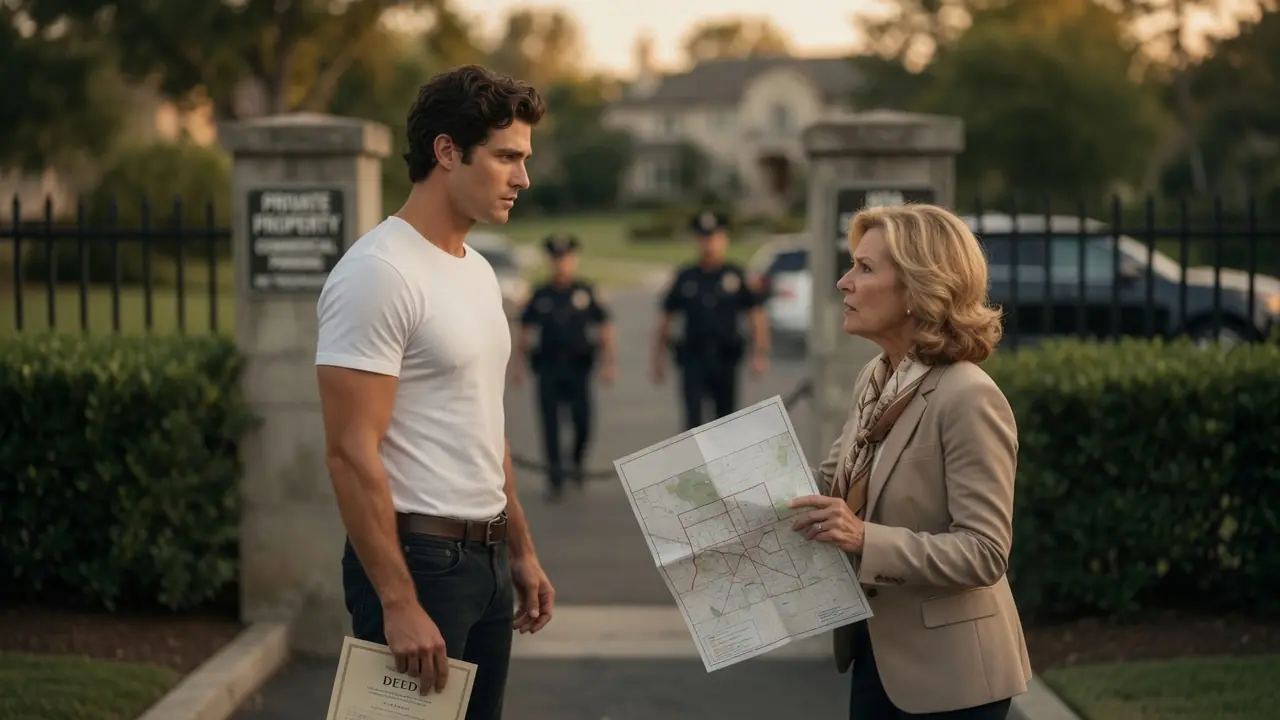
Ethan was thirty, athletic and strikingly handsome, with thick wavy dark-brown hair, piercing blue-gray eyes, and a strong clean-shaven face. He wore a fitted white T-shirt, dark jeans, and worn leather boots, having arrived that Saturday morning to patch potholes and collect trash. Instead, he found two steel posts cemented into his asphalt and an official-looking sign declaring the lot closed by order of the Briar Glen HOA. Linda stood between him and the land his grandfather had left him, wearing the satisfied smile of someone convinced authority mattered more than ownership.
“Your little vote doesn’t rewrite my grandfather’s deed,” Ethan said.
Linda raised her phone. “I’ll have you arrested and chain this entrance permanently.”
Ethan rested one hand against his truck and glanced toward the approaching police cruiser. “Call them—then watch me charge your entire neighborhood for the parking I gave them free.”
Linda’s expression flickered, but she quickly recovered. For the past eight months, she had treated Ethan’s patience as weakness and his generosity as proof that the lot belonged to the community. She could not imagine the quiet man before her would ever make good on such a threat. Ethan had spent most of his life avoiding conflict, especially when that conflict involved the people his grandfather had once called neighbors.
The property sat at the entrance of Briar Glen, an expensive residential development built around the old Cole Automotive lot. Ethan’s grandfather, Samuel Cole, had opened the repair shop in 1978 when the area consisted of farmland, one gas station, and a two-lane road. Samuel repaired trucks, tractors, school buses, and nearly anything with an engine, often allowing struggling customers to pay after harvest or over several months. He was not wealthy, but half the older residents of Briar Glen remembered a time when Samuel had helped them without asking what he would receive in return.
When developers arrived in the early 2000s, they offered Samuel enough money to retire comfortably. He refused because the shop contained forty years of memories, including the workbench where he had taught Ethan to rebuild his first engine. The developers purchased every surrounding parcel and constructed the neighborhood around him, leaving the commercial lot outside the association’s legal boundaries. Samuel continued working until age seventy-four, when poor health forced him to close the business.
The building became unsafe several years later and had to be demolished. What remained was a broad paved lot with faded parking lines, two old light poles, and the foundation outline of Samuel’s garage. When Samuel died in 2019, he left the property to Ethan along with a handwritten note. It said, “Land remembers how people treat one another, even when people forget.”
Ethan did not know what to do with the lot at first. He worked as a project supervisor for a construction company and lived twenty minutes away in a modest apartment. Selling the property would have provided a comfortable down payment on a house, but every time he considered it, he remembered sitting beside Samuel while the old man greeted customers by name. Ethan decided to keep the land until he found a purpose worthy of the person who had protected it.
Briar Glen had a serious parking problem. Most houses had two-car garages, short driveways, and strict association rules banning overnight street parking. Families with teenage drivers, work vehicles, boats, or visiting relatives had nowhere to put them. Within months of Samuel’s shop being demolished, residents began leaving cars on the empty commercial lot.
Ethan could have stopped them, but he did not. Many of the people parking there had once brought food to Samuel when he became sick or helped Ethan clean the shop after the funeral. Ethan spent several weekends filling potholes, repainting parking spaces, installing two trash cans, and replacing a damaged light fixture. He eventually posted a simple sign near the entrance: Neighbors May Park Here Free—Please Keep It Clean.
For nearly two years, the arrangement worked perfectly. Residents parked respectfully, Ethan maintained the property, and nobody questioned who owned it. Some people left thank-you notes beneath the windshield wipers of his truck when they saw him working. Others brought bottled water or helped sweep leaves from the pavement.
Then Linda Mercer became HOA president.
Linda had lived in Briar Glen for five years and campaigned for the unpaid position as though she were running for national office. She promised stronger enforcement, cleaner common areas, and protection of community property values. Most residents supported her because nobody else wanted the exhausting responsibility of managing disputes over fences, mailboxes, and lawn decorations. Within weeks, Linda began searching for visible problems she could claim to have solved.
The parking lot attracted her attention immediately.
It sat directly beside the neighborhood entrance, filled with vehicles she could not regulate. Ethan’s handwritten sign did not carry the HOA logo, and the asphalt had several repaired patches that did not match the decorative stone used throughout Briar Glen. More importantly, Linda disliked that residents depended on land outside her authority.
Ethan received the first violation letter in early spring. It accused him of maintaining unauthorized signage, using unapproved asphalt materials, and making exterior property modifications without architectural review. The letter demanded that he attend the next HOA board meeting and submit a plan for bringing the lot into compliance. Ethan initially assumed the notice had been mailed by mistake.
He called the association management company and explained that his property was a separate commercial parcel. The employee apologized, recorded the parcel number, and promised to notify the board. Ethan believed the matter had ended until another envelope arrived one week later.
This letter carried Linda’s signature.
She claimed that every property within the “visual community boundary” fell under HOA oversight, regardless of the recorded parcel list. Attached was a map showing the neighborhood shaded green, with Ethan’s lot colored the same way. The original development map clearly excluded his land, but Linda had redrawn the boundary line around it.
Ethan responded with patience. He mailed copies of the deed, the commercial zoning certificate, the county parcel map, and the HOA’s own governing documents. He highlighted the section listing every property legally subject to association rules. His parcel number appeared nowhere.
Linda sent a final warning.
The HOA would fine him fifty dollars per day unless he removed the sign and requested architectural approval. Ethan’s attorney, an old college friend named Marcus Bell, reviewed the letters and laughed. Marcus explained that the association had no legal power over the property and could not collect fines from a nonmember.
“Send them one clear response,” Marcus advised. “After that, document everything and stop arguing.”
Ethan followed the advice. He informed Linda that further notices would be retained as evidence of harassment. He expected her to become embarrassed and retreat quietly. Instead, she escalated.
Someone reported Ethan to city code enforcement for operating an “unlicensed commercial parking facility.” A city officer visited the lot, inspected the property, and asked how much Ethan charged drivers. When Ethan explained that parking was free, the officer closed the complaint immediately.
“This isn’t commercial activity,” the officer said. “Someone is wasting your time.”
Ethan requested a copy of the complaint through public records. The handwriting on the form matched Linda’s signature on previous HOA letters. The phrase unlicensed commercial parking facility appeared three times. Ethan placed the document inside a growing folder on his kitchen table.
Flyers began appearing on parked vehicles the following month. They warned residents that the HOA could not guarantee the safety, legality, or insurance status of anyone using a “noncompliant property.” Several older residents contacted Ethan in panic, believing their cars might be towed. He reassured them that the lot remained private and available.
Linda then hired an attorney using association funds. The certified letter from the law firm offered Ethan two choices: submit the property to HOA rules or stop allowing Briar Glen residents to park there. Marcus replied with the deed and warned that filing a baseless claim could leave the association responsible for Ethan’s legal expenses.
No lawsuit followed.
However, Ethan learned from a friendly board member that Linda had authorized five thousand dollars in legal spending related to the lot. Most residents had no idea their dues were financing the dispute. Linda described the expense as necessary to secure “community access rights” to property she publicly insisted the HOA already controlled.
Ethan remained calm because Samuel had taught him never to mistake loudness for strength. He continued maintaining the lot and allowed everyone to park. He even replaced a broken light after Linda’s letters became more threatening. Part of him hoped his refusal to retaliate would make her lose interest.
Eight months after the first notice, Ethan arrived to find the chain.
Linda had hired a contractor to drill into his asphalt, install steel posts, and close the entrance. The laminated sign declared the property an HOA common area under temporary safety restriction. Several residents’ vehicles remained trapped inside.
Linda came out of her house as soon as Ethan parked. Her home stood near the entrance, giving her a clear view of the lot. She informed him that the board had formally designated the land as community property and that he could no longer enter without written permission.
“You’re telling me I need your approval to walk onto land I own?” Ethan asked.
“The board’s decision is final.”
“You installed permanent structures on my property.”
“For community safety.”
“Remove them today.”
Linda called the police instead.
Officer James Nolan arrived twelve minutes later. He examined Ethan’s deed, photographed the steel posts, and listened while Linda described a board vote that supposedly transferred control of the parcel. When he asked for a court order, easement, purchase contract, or recorded ownership document, she produced only her redesigned map.
“A board vote cannot take somebody’s land,” Nolan said.
Linda insisted Ethan was trespassing on HOA property.
Officer Nolan turned toward her. “The county record identifies Mr. Cole as the owner. Installing these posts without permission may constitute vandalism or criminal damage.”
Linda’s confidence vanished.
She lowered her phone and began explaining that the association attorney had supported her position. Nolan suggested she call that attorney before touching the property again. Ethan filed an official damage report, photographed everything, and returned that afternoon with bolt cutters.
He cut the chain while Linda watched from her window.
Removing the cemented posts required professional equipment and cost Ethan nearly twelve hundred dollars. The asphalt around both locations had to be repaired. Marcus sent the HOA a demand letter seeking reimbursement, preservation of meeting records, and identification of everyone who approved the installation.
That night, Ethan sat at his kitchen table surrounded by eight months of documents.
He had violation notices claiming the lot must follow HOA rules. He had Linda’s complaint calling the free arrangement a commercial parking operation. He also had the attorney’s letter ordering him to stop allowing residents to park unless he submitted to association control.
For the first time, Ethan stopped asking how to preserve the free arrangement.
He asked what Linda’s own words allowed him to build.
The parcel was already commercially zoned because of Samuel’s repair shop. City regulations permitted a paid surface-parking operation with a business license, insurance, updated signage, and a simple inspection. Linda had repeatedly accused him of running such an operation without a license.
Ethan decided to make her accusation true.
He submitted the application the next morning.
The process required six weeks, several fees, fresh parking lines, accessible spaces, liability coverage, and improved entrance lighting. Ethan completed every requirement exactly. He installed security cameras and hired a local towing company to enforce registration.
The final sign stood where Linda’s chain had once blocked the entrance.
PRIVATE COMMERCIAL PARKING FACILITY
BRIAR GLEN RESIDENTS: $10 PER DAY
NON-HOA COMMUNITY VISITORS: FREE WITH REGISTRATION
UNREGISTERED VEHICLES WILL BE TOWED
Ethan designed the pricing deliberately. Linda had ordered him to stop giving HOA residents free parking, so he stopped. People outside Briar Glen could register and use the lot without charge, preserving part of Samuel’s community tradition while ensuring the association felt the cost of its president’s decisions.
The reaction began within hours.
Residents arrived expecting their usual spaces and discovered the payment system. Some became angry with Ethan before hearing the story. Others read copies of Linda’s complaint and attorney letter that Ethan posted inside a weatherproof display beside the entrance.
He did not insult Linda or accuse the entire neighborhood. He simply presented the documents in chronological order. At the bottom, he added one sentence: Free parking ended because your HOA demanded that it end.
A woman named Carol Jennings approached him while he was checking the payment kiosk. She had parked there for eighteen months because her adult son used the family driveway. “I’m paying three hundred dollars a month now,” she said.
“I know.”
“Can’t you make an exception?”
“I made an exception for the entire neighborhood for two years.”
Carol looked toward Linda’s house. “We didn’t know she was doing this.”
“That is something your board needs to explain.”
Within two weeks, the lot averaged twenty-five paying HOA vehicles per day. Weekends brought more because residents hosted guests but could not legally use the streets overnight. Ethan’s free act of goodwill became a profitable business almost immediately.
He felt conflicted about the income.
Samuel had never helped neighbors to profit from their difficulty. Yet Ethan also understood generosity required consent and respect. Linda had not merely failed to appreciate the arrangement; she attempted to seize the land, damage it, and criminalize its owner.
The residents scheduled an emergency association meeting.
More than a hundred people filled the clubhouse. Linda sat at the front beside two board allies, insisting she had acted to protect property values. She argued that Ethan’s lot should naturally belong to Briar Glen because residents had used it for years.
A retired accountant stood and held up the code-enforcement complaint.
“You told the city he was operating a commercial parking business,” the man said. “Now it is a commercial parking business.”
Linda attempted to interrupt.
He continued, “You called it unlicensed, so he obtained a license. Your lawyer ordered him to stop giving us free parking, so he stopped. You spent our money writing the instructions for the business now charging us.”
Carol raised her phone and displayed her parking payments. “I’ve spent one hundred and fifty dollars in fifteen days.”
Other residents began calling out amounts.
Parents with teenage drivers described the added monthly expense. Families explained that visiting relatives now cost them money because the HOA’s own street-parking rules left no alternative. Several residents demanded to know why five thousand dollars in dues had been spent pursuing a property clearly excluded from the association.
Then Marcus entered carrying photographs of the chain and damaged asphalt.
He had been invited by residents who wanted an independent explanation of the association’s legal exposure. Marcus described possible claims for property damage, harassment, interference with business use, and reimbursement of legal expenses. He also confirmed that Linda’s board vote had no ability to transfer ownership.
The room turned against her completely.
Linda refused to apologize. She insisted Ethan had exploited the situation and argued that the HOA should sue to claim permanent access through years of community use. Marcus explained that the parking had been an expressly revocable favor, not an adverse claim, and Ethan’s sign had always identified it as private property.
A resident near the back asked the most important question.
“Why didn’t you leave him alone?”
Linda had no convincing answer.
The membership held a vote of no confidence. Eighty-seven percent supported her removal. Her two closest board allies resigned before residents could begin examining their role in approving the chain.
Linda left through a side door without looking toward Ethan, who had remained quietly near the back wall. He did not feel victorious watching her go. He felt relieved that the conflict had finally become visible to the people paying for it.
The new board president was a middle-aged teacher named Michael Grant. One week after the vote, Michael visited the lot alone. He shook Ethan’s hand and apologized without excuses.
“What happened was wrong,” Michael said. “The property is yours, and the association had no right to interfere.”
Ethan appreciated the directness.
Michael asked whether they could create a fair arrangement for residents who still needed parking. He did not demand free access or suggest the HOA deserved control. He acknowledged that any agreement would exist only because Ethan chose to offer one.
They negotiated for several weeks.
The final contract gave Briar Glen residents access to designated spaces through a monthly lease paid by the association. The guaranteed payment was lower than Ethan’s peak daily revenue but eliminated the need to monitor individual accounts. The HOA accepted responsibility for distributing permits, and Ethan handled maintenance and insurance.
The lease also required the association to reimburse the cost of repairing the damaged asphalt. It prohibited any future claim of ownership or control and stated clearly that the lot remained a separate commercial property. Every board member signed after independent legal review.
Residents regained parking without daily charges.
Ethan gained reliable monthly income.
The association gained something even more important: written boundaries that no ambitious president could redraw with a marker.
Ethan used part of the money to restore Samuel’s original repair-shop sign. The weathered blue letters now stood near the parking entrance beneath a smaller plaque.
SAMUEL COLE COMMUNITY LOT
PRIVATE LAND—SHARED THROUGH RESPECT
Older residents stopped to read it.
Some told Ethan stories about his grandfather repairing cars after midnight or allowing families to pay slowly when money was scarce. Others apologized for failing to question Linda earlier. Ethan accepted the apologies but reminded them that unchecked authority grew because reasonable people assumed someone else would challenge it.
Linda eventually sold her home.
Before leaving, she drove past the lot while Ethan was replacing a light. She stopped her car near the entrance and lowered the window.
“You made money from humiliating me,” she said.
Ethan set down his tools. “I made money from property you tried to steal.”
“I was protecting the neighborhood.”
“You protected your authority.”
Linda’s face tightened. “Everyone turned against me because of you.”
“No. They turned against you when they saw what you did in their name.”
She glanced toward Samuel’s sign. “Your grandfather gave people free parking.”
“My grandfather gave kindness freely. He never taught me to surrender ownership to someone who mistook kindness for weakness.”
Linda drove away without answering.
Two years later, the lot remained one of the most orderly parts of Briar Glen. The HOA lease paid for maintenance, taxes, and enough additional income that Ethan could leave the weekend side job he had worked since his grandfather’s death. He used his recovered time to begin planning a small workshop on the rear section of the property.
It would not be another full repair garage.
Instead, Ethan created a community skills center where teenagers could learn basic vehicle maintenance, carpentry, and electrical safety. The HOA rented spaces in the program for local students, while Ethan offered several free places each semester in Samuel’s memory.
At the opening ceremony, Michael asked Ethan whether he regretted ever allowing free parking.
Ethan looked across the lot at families arriving together. “No.”
“Even after everything?”
“The kindness wasn’t the mistake. Failing to protect its boundaries was.”
Michael nodded toward the restored sign. “Your grandfather would be proud.”
Ethan smiled. “He’d probably complain that I overpaid for the paint.”
As evening settled over Briar Glen, the parking-lot lights came on one by one. Cars filled the spaces neatly, residents entered through the neighborhood gates, and teenagers worked inside the new shop beneath Samuel’s old tools.
The land had never belonged to the HOA.
But it still served the community, not through force, fabricated maps, or a board president’s command. It served because its owner freely chose an arrangement built on consent, fairness, and respect.
Linda had believed authority meant taking control of whatever people depended upon.
Ethan proved that real authority began with knowing what was yours, protecting it without cruelty, and refusing to let generosity become an invitation for exploitation.
For two years, the neighborhood had parked there free.
Then one woman chained the owner outside his own property.
Her power disappeared, the chain was cut, and the land she tried to seize became more valuable than it had ever been.
Not because Ethan sought revenge.
Because he finally stopped allowing kindness to cost him his dignity.