At exactly 4:17 in the morning, Marcus Hale woke to the sound of wood splitting beside the front lock. The noise tore through the silence of his suburban home, followed by the shrill warning from the hallway security system and the frightened cry of one of his daughters. Marcus was out of bed before his wife could fully sit up, moving on instinct through the dark bedroom in a black T-shirt and gray sweatpants. By the time his bare feet reached the upstairs landing, his two German shepherds were already waiting below.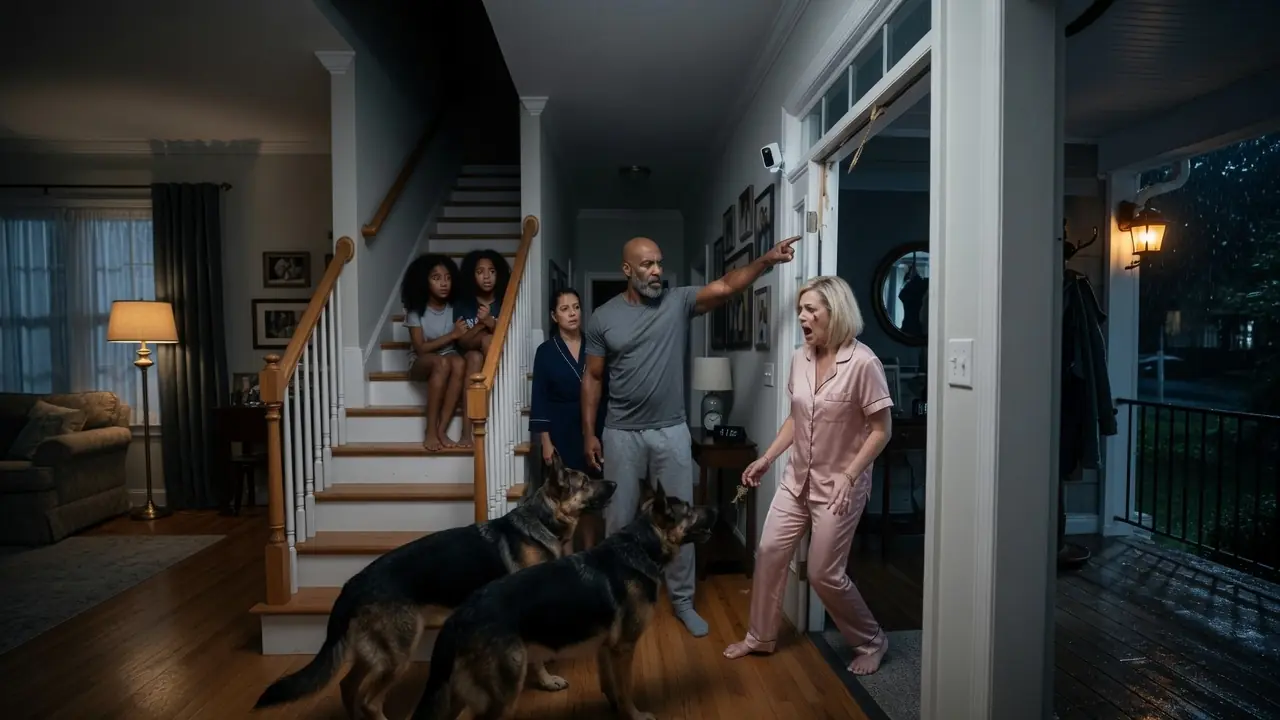
Rex stood at the base of the staircase with his ears raised and his body rigid. Beside him, Nova remained half a step behind, watching the front door while quietly awaiting Marcus’s command. Neither dog barked wildly or charged forward, because they had been trained to identify a threat without becoming one themselves. Their discipline was the only reason the woman forcing her way through the shattered doorway did not immediately lose control of the situation.
Bethany Crowe stepped into the entryway wearing pale-pink satin pajamas, soft house slippers, and a silk robe that probably cost more than most residents paid in monthly HOA dues. Her blonde bob was uneven from sleep, and her face was twisted with the fury of someone who had convinced herself that irritation was the same as legal authority. One hand clutched a silver key, while the other still gripped the brass knob she had partially broken from the door. She looked less like a burglar only because she carried herself as though the house already belonged to her.
“I have master key authority,” Bethany shouted. “Your filthy dogs woke the entire neighborhood, and I’m done with you military types acting like you’re above the rules, soldier boy.”
Marcus came down three steps and stopped. He was forty-four, tall and powerfully built, with deep-brown skin, a bald head, and a short gray-black beard. Twelve years in the Army had taught him that the first few seconds of a crisis mattered most, especially when children were nearby. He raised one hand toward the dogs and gave a low command.
“Hold.”
Rex and Nova remained in position.
Behind Marcus, his wife Elena appeared in a navy robe and pulled their daughters toward the upper hallway. Maya, who was twelve, gripped the banister with both hands while nine-year-old Zoe pressed against her mother’s side. Neither child screamed, but their faces showed the kind of fear that could stay with them long after the broken door was repaired. Marcus felt anger rise in his chest, but he refused to let Bethany control what happened next.
“Drop that key and back away from my family,” he said.
Bethany stared at him as if he had challenged the natural order of the neighborhood. “You do not give me commands in Briar Crest. I am the HOA president.”
“You broke into my home.”
“I entered under emergency authority.”
“You kicked down the door.”
“You refused to answer.”
“At four in the morning.”
“Because your dogs were disturbing the community.”
Marcus glanced at Rex and Nova. Both animals had been asleep in the laundry room before the alarm sounded. The neighborhood had been silent, and the only barking anyone might have heard came after Bethany struck the door. He also knew the HOA rules contained no master-key provision for privately owned homes.
Bethany raised the silver key. “This opens every property managed by the association.”
“No, it does not.”
“It opened yours.”
Marcus looked at the broken lock. “You used the key to turn the deadbolt, then kicked the door when the security chain stopped you.”
Bethany’s expression changed for half a second. She had not expected him to understand exactly how she entered. The chain still hung from the wall, while fresh damage marked the doorframe where her shoulder or foot had forced it loose. Above her head, the hallway camera displayed a steady blue recording light.
Marcus pointed toward it. “Everything you did is on video.”
Bethany looked up.
For the first time, she appeared uncertain.
Then she recovered and gave a sharp laugh. “Perfect. The footage will prove I had to enter because of dangerous animals.”
Rex shifted his weight but remained silent.
Bethany pointed at him. “Look at that thing. It is preparing to attack me.”
“He is holding position.”
“You expect me to trust military dogs inside a family neighborhood?”
“They are retired working K9s.”
“That only makes them more dangerous.”
Marcus lowered his voice. “You entered the home they are trained to protect.”
Bethany stepped farther inside, apparently believing that retreat would look like weakness. She moved past the broken pieces of the door and lifted her chin toward the dogs. “I have already contacted animal control. By sunrise, both of them will be removed, and I will fine you for every day they remain registered at this address.”
Elena spoke from the stairs. “You woke our children and broke into our home. Get out.”
Bethany glanced at her. “This does not concern you.”
“It is my house.”
“The deed is in his name.”
Marcus noticed the confidence behind that answer. Bethany had searched their property records closely enough to know which spouse appeared on the title. That meant the break-in was not the product of a sudden noise complaint. She had planned it.
“You have been investigating my family,” Marcus said.
“I oversee compliance.”
“You have been watching us.”
“I document violations.”
“What violation?”
Bethany opened the leather folder tucked beneath her arm and removed several pages. “Unapproved commercial animals, excessive security equipment, exterior surveillance facing shared property, unauthorized modifications to the garage, military equipment stored in a residential dwelling, and intimidating conduct toward an HOA officer.”
Marcus almost laughed. “The dogs are registered pets. The cameras face my property. The garage modification was approved before we moved in. My military equipment is a locked medical training kit.”
“You also refused inspection.”
“I refused to let you enter without notice or legal cause.”
Bethany smiled. “Which is why I secured a master key.”
Elena looked toward Marcus. He could see the question in her eyes: where had Bethany obtained it? Their home had been built only three years earlier, and the original developer retained no keys after closing. Marcus had replaced the exterior locks within forty-eight hours of moving in.
That meant Bethany had copied one.
The silver key in her hand was not an old association key. It was a newly cut duplicate of Marcus’s own deadbolt key.
He remembered the maintenance inspection two months earlier. A plumbing contractor hired by the HOA had entered the home to check a shared water-pressure issue. Bethany arrived unexpectedly during that visit, claiming she needed to observe, and spent several minutes alone near the front entrance while Marcus accompanied the plumber upstairs.
He now understood what she had done.
“You photographed my key during the plumbing inspection,” Marcus said.
Bethany did not answer.
“You ordered a copy.”
“I have access rights.”
“You duplicated a private residential key without consent.”
“I told you I have master authority.”
“No such authority exists.”
Bethany’s face reddened. “You think your military history lets you challenge every rule I enforce.”
“My military history has nothing to do with this.”
“It explains the aggression.”
“I have not moved toward you.”
“Your dogs are threatening me.”
“They have not moved either.”
Bethany looked at the staircase, then at Rex and Nova. She seemed to realize that every person and animal in the house was calmer than she was. That realization only made her angrier.
She stepped closer to Marcus and raised the key near his face. “I run this HOA, soldier boy. I will seize those mutts, fine you until this house belongs to me, and make your family regret moving into my neighborhood.”
Marcus heard a vehicle stop outside.
A second followed.
He looked toward the open doorway, where light from the street washed across the damaged frame.
“Deputies, come in,” he called. “My K9s just detained the woman who broke into a federal handler’s home.”
Bethany froze.
Four sheriff’s deputies appeared in the driveway, two approaching the door while the others remained near their vehicles. At the front was Lieutenant David Collins, a broad-shouldered Black man in his early fifties who had worked with Marcus during a county emergency-response program. Beside him walked Deputy Laura Nguyen, one hand resting near her radio as she assessed the broken entrance.
Bethany spun toward them. “Thank God you are here. These dogs trapped me inside.”
Collins looked at the destroyed door. “Why are you inside?”
“I have master-key authority through the homeowners association.”
“Is this your residence?”
“No, but—”
“Did the homeowner invite you inside?”
“I do not need an invitation during a compliance emergency.”
Collins looked at Marcus. “Any injuries?”
“No.”
“Are the dogs under control?”
“Yes.”
“Call them back.”
Marcus gave one quiet command. Rex and Nova turned together, walked to the bottom stair, and sat beside Elena. Their immediate response shifted the atmosphere in the hallway. The animals Bethany had described as uncontrollable were clearly the most obedient beings in the room.
Collins stepped over the broken wood and looked up at the camera. “Is the system recording?”
“Audio and video,” Marcus said.
Bethany shook her head. “He is manipulating the situation. I called your office first.”
Laura checked the dispatch screen on her phone. “You called at 4:09 and reported aggressive dogs loose in the street.”
“They were loose.”
Marcus looked at her. “They were asleep inside my laundry room.”
“You cannot prove that.”
“The interior camera can.”
Bethany’s mouth tightened.
Collins asked her to place the key on the entry table.
She refused.
“It is association property.”
“It is evidence in a possible unlawful-entry investigation.”
“I am the elected president of Briar Crest.”
“That does not exempt you from an investigation.”
Bethany looked toward Marcus again. “Tell them I was performing my duty.”
Marcus folded his arms. “You kicked down my door while my daughters were asleep.”
“I knocked repeatedly.”
“You struck the door once, entered the copied key, and kicked it three times.”
Bethany’s eyes moved toward the camera again.
Laura approached slowly. “Place the key on the table.”
After a long pause, Bethany released it.
The small piece of metal struck the wood with a quiet click that somehow sounded louder than the shattered door had. Laura placed it into an evidence envelope, then photographed the damaged lock, the broken chain, and the debris across the floor. Collins asked Marcus to play the security footage from the beginning.
The video showed Bethany arriving alone at 4:12 in her pajamas, carrying the key and folder. She stood on the porch for less than ten seconds before inserting the copy into the lock. When the chain prevented the door from opening, she stepped backward and kicked it repeatedly while shouting that the HOA had the right to enter.
At no point before the alarm sounded had any dog barked.
After the third kick, the frame broke and Bethany forced herself inside. Rex and Nova approached but stopped six feet away when Marcus spoke from upstairs. Bethany then shouted the statement about filthy mutts and military types.
Collins stopped the recording.
Bethany crossed her arms. “I heard barking earlier.”
“From where?” Laura asked.
“My house.”
“Your house is three streets away.”
“Noise travels.”
“At four in the morning?”
“It was constant.”
Marcus opened another camera feed. It showed the dogs sleeping in the laundry room from midnight until the front-door alarm activated. Rex lifted his head only after the first kick.
Collins turned toward Bethany. “You filed a false emergency report.”
“I reported what I believed.”
“You then entered a residence using a copied key.”
“I had authority.”
“Show me the written provision granting it.”
Bethany opened her folder and flipped through several pages. She produced the association bylaws, a maintenance policy, and an emergency-access rule that applied only to the clubhouse, pool equipment room, and irrigation systems.
Nothing mentioned private homes.
Collins handed the pages back. “Turn around.”
Bethany stared at him. “Excuse me?”
“You are being detained while we investigate unlawful entry, property damage, possession of an unauthorized key, and filing a false report.”
“You cannot handcuff me in front of these people.”
“It is four in the morning. The only people here are the family whose home you entered.”
“You know what I mean.”
Marcus did know. Bethany did not fear the arrest itself as much as she feared losing the image of authority she had built. She had spent seven years walking through Briar Crest with a clipboard, issuing violations, photographing homes, and reminding residents that the association could place liens on their property.
Now she stood barefoot in satin pajamas while deputies asked her to place her hands behind her back.
She turned toward Marcus. “Call them off.”
“They are not my deputies.”
“You work with the county.”
“I trained search teams. I do not control law enforcement.”
“You made this happen.”
“You broke my door.”
Bethany stepped toward him, but Laura moved between them. “Turn around now.”
Bethany finally complied.
The handcuffs closed around her wrists, and the certainty drained from her face. Elena guided the girls upstairs before the deputies escorted Bethany outside. Marcus remained in the hallway, watching through the broken doorway as several neighbors appeared beneath porch lights.
Some recorded.
Others simply stared.
Bethany noticed them and began shouting.
“This is retaliation! Marcus Hale brought trained attack dogs into our community, installed illegal cameras, and threatened the HOA president!”
Rex and Nova sat quietly inside.
Collins placed Bethany in the rear of a patrol SUV. Before closing the door, he told her that anything further she said could become part of the official record.
She kept talking anyway.
The deputies remained at the house until nearly six, collecting footage and statements. A temporary board covered the damaged entrance while Marcus contacted a locksmith. The girls did not return to sleep, so Elena made cocoa and sat with them in the kitchen while Marcus answered questions.
Maya finally asked the question he had been avoiding.
“Could she come back?”
“No,” Marcus said.
“She had our key.”
“The deputies took it.”
“What if she made another one?”
Marcus glanced toward Elena. “Then we replace every lock today.”
Zoe looked at the dogs. “Rex scared her.”
“Rex protected the house by listening.”
“He could have bitten her.”
“But he did not.”
Marcus wanted his daughters to understand the distinction. Strength was not proved by using every ability one possessed. It was proved by maintaining control when fear and anger made losing control easy.
By noon, the story had spread across Briar Crest. Bethany’s supporters claimed she had responded to an animal emergency and been humiliated by an aggressive veteran with police connections. Other residents shared years of complaints about unauthorized inspections, selective fines, and intimidation.
One neighbor, seventy-year-old Walter Bell, said Bethany once entered his backyard while he was at a medical appointment. She photographed an unfinished wheelchair ramp and fined him for unapproved construction, even though the ramp was necessary for his wife. When he challenged the penalty, Bethany threatened to place a lien on the house.
Another resident, Priya Shah, reported that Bethany used a copied garage code to enter her property during a vacation. The HOA president claimed she smelled leaking gasoline, but footage showed her searching cabinets and taking pictures of storage boxes.
A third homeowner discovered Bethany had kept a handwritten list of residents categorized as “cooperative,” “difficult,” “military,” “renters,” or “likely foreclosure.”
Marcus’s name appeared under military—watch closely.
Two days after the break-in, the HOA board held an emergency meeting at the clubhouse. Bethany had been released pending charges and arrived with an attorney, wearing a gray suit and attempting to reclaim the chair at the front. The remaining directors informed her that she had been suspended until an independent review could determine whether she abused her position.
Bethany refused to sit in the audience.
“I am still president,” she said.
Board treasurer Samuel Ortiz opened the bylaws. “Section twelve permits temporary suspension after an alleged felony involving association authority.”
“This was not a felony.”
“You entered a private home with an unauthorized key.”
“I was preventing danger.”
“Your own report falsely claimed the dogs were outside.”
Bethany pointed toward Marcus, who sat beside Elena near the back. “He intimidated me into making an imperfect statement.”
Marcus did not respond.
Samuel asked the association’s attorney whether any policy granted a master key to private houses. The attorney answered clearly.
“No.”
Bethany’s supporters began whispering.
The board then displayed records showing that she had ordered duplicate keys, garage remotes, and gate codes through a private locksmith. The invoices were hidden under a budget category called emergency-preparedness materials. Over four years, the HOA spent more than eighteen thousand dollars creating unauthorized access tools.
The locksmith had retained customer records.
Bethany personally ordered every copy.
The investigation widened immediately.
Deputies searched a locked cabinet in the HOA office and found thirty-seven labeled keys, fourteen remote transmitters, and printed property maps. Bethany had written resident names beside several keys, along with notes describing work schedules and travel patterns.
Marcus found his own key inside a plastic envelope labeled:
Hale—dogs, cameras, resistant.
Elena read the label twice before placing the evidence photograph face down.
“She planned to come back,” she said.
Marcus nodded.
The financial review uncovered more. Bethany had issued fines to residents, then offered to reduce them in exchange for allowing access to garages, backyards, and interior utility rooms. She directed repair work to a company owned by her brother and added administrative fees when homeowners refused.
In three cases, the HOA initiated lien proceedings over balances created almost entirely through penalties Bethany approved herself.
One family nearly lost its home over an original landscaping fine of three hundred dollars.
The board froze all enforcement actions.
Bethany was eventually charged with burglary-related unlawful entry, criminal property damage, possession and use of unlawfully duplicated keys, filing a false police report, and several counts involving misuse of HOA records. Prosecutors also charged her brother after evidence showed his company helped obtain access codes and bill residents for unnecessary inspections.
Her attorney argued that Bethany acted in good faith.
The security footage made that argument difficult.
At trial, the prosecutor played the entire entry sequence. Jurors watched Bethany arrive without knocking properly, insert the copied key, kick the door, and enter before any dog approached. They heard her claim master authority, insult Marcus’s military background, and threaten to seize the animals and take the house through fines.
Then they watched Rex and Nova hold position without barking.
Marcus testified for less than an hour. He described the alarm, his family’s location, his commands to the dogs, and Bethany’s actions. When the defense attorney suggested that two German shepherds created a legitimate emergency, Marcus remained calm.
“Were the dogs attacking your client?” he asked.
“I am asking the questions.”
“Then the answer is no.”
The attorney changed direction. “You were trained by the military to intimidate people.”
“I was trained to protect people and control force.”
“Would those animals have attacked if you ordered them?”
“They were capable of responding to a real threat.”
“So Bethany Crowe was in danger.”
“She was in a home she entered illegally, but the dogs obeyed me and did not touch her.”
“Because she did not move?”
“Because they were trained better than she was behaving.”
The courtroom became silent.
Bethany was convicted on the major charges.
At sentencing, she described herself as a dedicated volunteer who made one mistake while protecting neighborhood standards. Several residents then gave statements explaining that the break-in was not one isolated mistake. It was the most visible example of a system she had built around fear.
Walter Bell spoke about his wife’s ramp.
Priya described finding Bethany inside her garage.
Elena described her daughters sitting on the staircase while a stranger stood inside their home claiming ownership over the family’s safety.
Marcus spoke last.
“My dogs did exactly what they were trained to do,” he said. “They recognized an intrusion, held their position, and waited for lawful direction. Bethany had every opportunity to do the same. She chose force because she believed her title placed her above consent.”
The judge sentenced Bethany to prison, restitution, probation after release, and a permanent ban from serving as an HOA officer, property manager, or licensed community-association representative. She was also ordered to surrender every copied key and pay for the damaged door, security upgrades, and counseling for Marcus’s daughters.
The Briar Crest HOA changed almost immediately.
Residents elected a new board, imposed term limits, opened all meetings, and required two directors to approve any inspection. No employee or officer could possess keys to private homes, and emergency access now required law enforcement, the fire department, or written owner consent.
Fines could not become liens without independent review.
Contracts involving relatives had to be publicly disclosed.
Marcus declined every invitation to join the board.
“I did not retire from one chain of command to create another,” he told Samuel.
Instead, he helped establish a neighborhood safety committee focused on emergency preparedness, home-security education, and responsible pet ownership. Rex and Nova became familiar sights at community demonstrations, where Marcus showed children how trained dogs responded to commands.
Maya eventually stopped checking the front door three times before bed.
Zoe stopped asking whether Bethany had another key.
The family replaced the damaged entrance with a reinforced door, but Marcus insisted it remain welcoming rather than fortress-like. The new camera was smaller, the glass panels were stronger, and a wooden sign near the frame carried four simple words:
Knock. Wait. Be Invited.
One year after the break-in, Marcus woke at 4:17 in the morning without knowing why.
The house was silent.
Elena slept beside him, the girls were safe upstairs, and Rex and Nova rested near the bedroom door. Marcus walked downstairs, checked the new lock, and stood for a moment in the entryway where Bethany once waved the copied key.
The repaired wall showed no trace of damage.
He opened the door and looked across the quiet street. Porch lights glowed beneath trees, sprinklers clicked in distant yards, and no one claimed authority over the homes they did not own.
Rex joined him and sat at his left side.
Nova settled at his right.
Bethany Crowe had believed a copied key gave her the right to enter. She believed an HOA title gave her permission to frighten children, seize animals, and turn fines into weapons. She believed Marcus’s military discipline would make him dangerous enough to blame or obedient enough to control.
She had misunderstood all three.
The key opened a lock, but it did not create consent.
The title created responsibilities, not ownership.
And Marcus’s training did not make him lose control when she invaded his home.
It taught him, his family, and his K9s exactly how to hold their ground until lawful authority arrived.