“Hand them over—Mom says your fines belong to us.”
The sixteen-year-old American boy stood behind the single father’s open trunk with both arms crossed, blocking the narrow path to the front door. Four grocery bags rested on the pavement between them, one containing vegetables, another holding milk and bread, and a warm rotisserie chicken filling the cold Tennessee air with the smell of pepper and roasted skin. The boy stared at the food with the arrogant certainty of someone who had never been forced to question whether his mother had the right to take what she wanted.
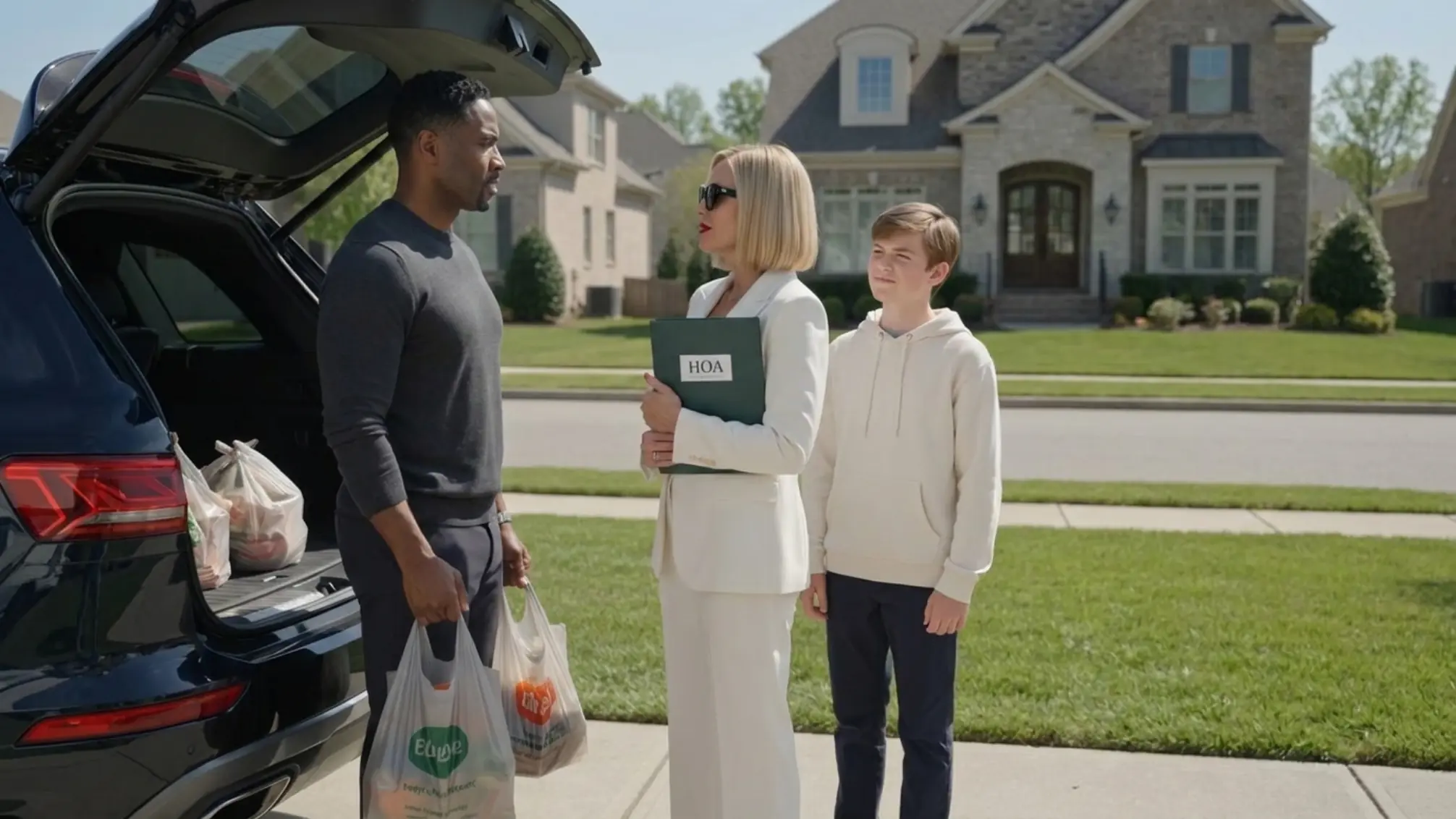
The single father slowly closed the trunk.
He was a handsome forty-seven-year-old Black American man with deep-brown skin, steady dark eyes, short black hair, and a strong athletic build. He wore a charcoal sweater, dark trousers, and clean leather shoes after returning from the market with food for himself and his twelve-year-old daughter. Nothing about him looked aggressive, but the silence in his face made the teenager shift his weight.
“Touch my groceries,” the single father said, “and your next lesson comes from a police report.”
The boy laughed.
“You going to call the cops over chicken?”
“No.”
The answer made him laugh harder.
“That’s what I thought.”
The single father picked up two bags and looked directly into the boy’s eyes.
“I won’t have to call them.”
The teenager did not understand the warning. He stepped forward and reached toward one of the remaining bags, but the single father moved his hand away with calm precision.
“You want to think carefully about what you’re doing.”
“My mom runs this neighborhood.”
“She runs an association.”
“Same thing.”
“No,” the single father said. “That mistake is about to cost your family more than groceries.”
The boy pulled out his phone.
“I’m telling her you threatened me.”
“Tell her exactly what happened.”
He backed away toward the golf cart parked beside the curb, still pretending confidence. The small electric vehicle rolled across the cul-de-sac toward a large two-story house decorated with matching white shutters, sculpted hedges, and an American flag displayed at a perfect forty-five-degree angle.
Four minutes later, the HOA president crossed the street.
She matched the picture of authority she had carefully built for herself. The fifty-three-year-old white American woman had a sleek chin-length blonde bob, red lipstick, large black sunglasses, and an elegant fitted white pantsuit. Nude heels clicked against the driveway while she pressed a dark-green folder marked HOA against her chest.
Her son walked behind her.
The single father was still unloading groceries when she entered his property without permission.
“I run this neighborhood,” she announced, raising her phone. “One call, and officers drag you off your own driveway.”
The single father placed the final bag beside the others.
“Make it.”
The certainty in his answer briefly interrupted her performance.
“What?”
“Call them.”
Her lips tightened.
“You think I’m bluffing?”
“I think you’ve spent years threatening neighbors who were too exhausted or frightened to challenge you.”
Her son moved beside her.
“Mom, he threatened me.”
The single father looked at him.
“I warned you not to steal.”
“They aren’t stealing,” the HOA president snapped. “Your unpaid obligations belong to the association.”
“My groceries do not.”
“You owe fines.”
“Fines issued under rules your board never legally adopted.”
Her jaw moved slightly.
The single father noticed.
Over the previous fourteen months, the HOA president had issued him eleven violation notices. The first claimed his mailbox post was painted white instead of the approved shade called antique linen. The difference was invisible to any reasonable person, but the notice included a forty-dollar penalty and a warning that repeated violations could trigger a property inspection.
He paid the first fine.
Not because it was valid.
Because he was tired.
At the time, he had seven active investigations on his desk, a city-budget hearing scheduled for Thursday, and a daughter who needed help preparing for a science presentation. Arguing over two nearly identical shades of paint seemed like a waste of energy.
The HOA president interpreted his payment as surrender.
After that came notices about recycling bins, gutter cleanliness, decorative stones around a tree, the placement of a garden hose, and an alleged storm-water problem beneath his driveway. Each notice arrived in a red-marked envelope as though the association were issuing criminal summonses.
The single father documented every one.
His neighbors believed he was a quiet city employee. That was how he introduced himself when he moved into Meadowlark Estates. He wanted privacy after more than two decades in law enforcement, and he did not want strangers treating him like a personal security service.
What no one knew was that he had recently been appointed chief of the Ridgecroft Police Department.
He spent his professional life handling conflict.
At home, he wanted to mow the lawn, cook dinner for his daughter, and sit on the back deck without hearing a police radio. For months, he allowed the HOA president to believe his quietness meant weakness.
Then her son demanded his groceries.
The HOA president unlocked her phone.
“I’m reporting a hostile resident obstructing an official HOA collection.”
“There is no official grocery collection.”
“You don’t decide that.”
“Neither do you.”
She turned toward her son.
“Start recording.”
The teenager lifted his phone.
The single father’s expression remained calm.
“That recording will be useful.”
The HOA president began the call.
She identified herself as the board president and described a combative homeowner who had threatened her child. She claimed she feared the situation might become violent, even though the single father had not raised his voice or moved toward either of them.
The dispatcher asked for the address.
The moment the HOA president gave it, the call changed.
She did not hear what happened inside the dispatch center. The address had been flagged two days earlier after the police chief notified his duty sergeant that an HOA dispute might produce a false or exaggerated emergency call.
“Officers are coming,” she said after hanging up.
The single father picked up one grocery bag.
“Good.”
“You won’t be smiling when they place you in handcuffs.”
“I’m not smiling now.”
Her son stepped closer.
“Maybe they’ll search his house.”
The single father looked at him with disappointment rather than anger.
“You are sixteen years old. That is old enough to understand that lying to the police can hurt innocent people.”
“My mother doesn’t lie.”
The HOA president lifted her chin.
“Stop trying to frighten him.”
“I’m trying to keep him from becoming you.”
The insult finally broke her composure.
She stepped into the single father’s face.
“You have been a problem since the day you moved here. You refuse instructions, challenge notices, encourage residents to disrespect the board, and now you’re intimidating my son.”
“I asked for written evidence.”
“You question everything.”
“Authority that hates questions usually has something to hide.”
Her fingers tightened around the green folder.
The single father had already discovered what she was hiding.
Three weeks earlier, his attorney reviewed Meadowlark Estates’ original governing documents. The HOA president had been issuing fines under a schedule approved only by the board, even though the recorded community rules required a full resident vote.
That vote had never happened.
Every fine issued under the schedule was potentially invalid.
The attorney found something worse in the annual financial disclosure. More than nine thousand dollars had been paid for administrative services to a company owned by the HOA president herself. Residents were never told about the relationship, and the board never approved the conflict.
The single father also visited the county recorder’s office and obtained the original version of the neighborhood rules.
Buried in the document was a clause stating that if the HOA pursued an enforcement action without documented evidence of a real violation, the association could be required to reimburse the affected resident’s costs and pay damages tied to the improper fine.
The president had sent him eleven notices.
He possessed evidence disproving every one.
He was not standing helplessly on his driveway.
He was standing at the end of a case he had been quietly building for months.
A police cruiser turned into the cul-de-sac.
The HOA president smiled.
“Now we’ll see who actually has authority.”
The cruiser stopped at the curb. A forty-five-year-old Black American female sergeant stepped out, adjusted her uniform, and approached with the calm posture of an officer who already knew more than the caller expected.
The HOA president moved toward her.
“Thank you for coming. This man threatened my son and is refusing to comply with an official association collection.”
The sergeant looked at the teenager.
“What collection?”
The boy pointed at the grocery bags.
“He owes us.”
The sergeant’s expression remained neutral.
“You attempted to take his food?”
“My mom told me to.”
The HOA president immediately interrupted.
“That is an oversimplification. The groceries were offered as partial compensation for outstanding penalties.”
The single father looked at her.
“I never offered anything.”
The sergeant took out a notebook.
“Do you have a written agreement authorizing the association to seize personal property?”
“I am the board president.”
“That wasn’t my question.”
The HOA president’s smile weakened.
“The homeowner is delinquent.”
The sergeant turned to the single father.
“Sir, can I have your name?”
He gave it.
The sergeant nodded once.
It was a small professional acknowledgment, but the HOA president saw it.
“You know him?”
“Yes.”
“From where?”
The sergeant closed her notebook.
“He’s my police chief.”
The words struck the driveway harder than any shout could have.
The teenager slowly lowered his phone.
The HOA president stared at the single father, then at the uniformed sergeant.
“Your chief?”
“The chief of the Ridgecroft Police Department.”
The president’s sunglasses concealed her eyes, but not the sudden loss of color in her face.
The single father picked up his grocery bag.
“I told you to make the call.”
She looked toward her son.
For the first time, neither of them had a rehearsed response.
The sergeant asked to see the video the teenager had been recording. It showed the HOA president claiming she could have officers drag the single father from his driveway. It also captured her son admitting that his mother had ordered him to collect the groceries.
“This appears to be a civil dispute,” the sergeant said. “But attempting to take property without consent may become a criminal matter.”
The teenager swallowed.
“I didn’t take anything.”
“Because he stopped you.”
His mother stepped forward.
“He misunderstood.”
“No,” the single father said. “He repeated your exact instruction.”
“You’re using your position to intimidate us.”
“I kept my position private for fourteen months.”
He pointed toward the green folder.
“You threatened me before you knew it.”
A woman carrying a notebook approached from a parked car two houses away. She was a white American municipal reporter who had covered the police department for several years. The single father had invited her after receiving a handwritten threat from the HOA president the previous day.
The president saw the notebook and stiffened.
“Why is the press here?”
The reporter raised a recorder.
“I’m covering the resident petition requesting your removal and the payments from HOA funds to your private company.”
Her mouth opened.
The reporter continued.
“Do you have a comment regarding the alleged conflict of interest?”
The green folder slipped slightly against her white jacket.
Her son looked between the adults, finally understanding that this was not a confrontation his mother controlled.
“What payments?” he asked.
She ignored him.
The single father’s attorney stepped out of the house holding a thick file.
The HOA president stared at her.
“You brought a lawyer?”
“You announced an illegal inspection and threatened police involvement,” the attorney replied. “We prepared appropriately.”
The attorney handed the sergeant copies of the relevant notices. She also provided the certificate of property compliance issued by the county, proving that the supposed driveway, gutter, and landscaping violations did not exist.
The HOA president’s authority collapsed document by document.
The mandatory property-audit rule lacked the required appeal process.
The fine schedule had never been ratified.
The private payments had not been disclosed.
The special meeting petition carried signatures from twenty-three households, more than enough to force a full resident vote.
The president stepped backward.
“This is harassment.”
The reporter wrote down the statement.
The attorney answered calmly.
“Requesting financial records is not harassment. Challenging invalid fines is not harassment. Calling the police after directing your child to take a resident’s groceries may, however, create serious questions.”
The president turned toward the sergeant.
“Are you going to allow them to threaten me?”
“No one here has threatened you.”
“My reputation is being destroyed.”
The single father looked toward the neighbors emerging onto their porches.
“No. It is being documented.”
The sentence left her silent.
She crossed the street without another word. Her heels clicked unevenly now, and the green folder no longer looked like a symbol of authority. Her son pushed the golf cart from the driveway rather than turning it on, keeping his eyes lowered as he followed her home.
The reporter called after them.
“Would you like to comment on the grocery demand?”
Neither answered.
The special membership meeting occurred three weeks later inside the neighborhood clubhouse.
More than one hundred residents attended.
People who had been silent for years carried folders of their own. An elderly American widow presented a warning she received for hanging wind chimes. A young family revealed they had paid fines on a storage shed built before the HOA existed.
Another homeowner described being threatened with legal action after allowing his disabled brother to park a work van overnight.
The HOA president did not attend.
Her attorney submitted a statement claiming she had acted in good faith to protect property values. The words drew no sympathy from residents who had experienced years of selective enforcement.
The vote removing her as president passed overwhelmingly.
Only eight households opposed it.
Most were relatives or close friends.
The two remaining board members resigned within days. The management company terminated its agreement after its insurance carrier reviewed the undisclosed payments.
The financial dispute took several months to resolve.
The former president eventually agreed to repay most of the money paid to her private company. The new HOA board canceled the invalid fines and reimbursed residents whose payments had been improperly collected.
The single father recovered his forty dollars.
He framed the returned check and placed it above his home-office desk.
His daughter laughed when she saw it.
“You framed forty dollars?”
“I framed what it taught me.”
“That the HOA lady was mean?”
“That small abuses grow when everyone decides fighting them is too inconvenient.”
His daughter looked toward the window.
“What happened to her son?”
“He’s still a kid.”
“He tried to steal our groceries.”
“He followed a bad example.”
“That doesn’t make it okay.”
“No,” the single father agreed. “But people should have a chance to stop becoming the person they were taught to be.”
A month later, he encountered the teenager outside the neighborhood market.
The boy was loading groceries into a car alone. There was no golf cart, no green HOA folder, and no mother standing behind him.
He saw the police chief and froze.
The single father walked toward his own truck.
“Sir,” the teenager said.
He stopped.
“I’m sorry.”
The apology sounded uncomfortable and unprepared.
“For what?”
The boy looked at the bags in his hands.
“For coming onto your driveway. For thinking we could just take things because my mom said so.”
The single father studied him.
“Did you understand it was wrong before the police arrived?”
The boy hesitated.
“I knew it felt wrong.”
“But you did it anyway.”
“Yes.”
“That’s the part you need to remember.”
The teenager nodded.
“Am I going to be charged?”
“No groceries were taken. I chose not to pursue it.”
“Why?”
“Because punishment isn’t the only way people learn.”
The boy looked relieved.
The single father raised one hand.
“That doesn’t mean there were no consequences. Your neighbors saw what happened. Your mother lost her position. You will carry that memory.”
“I know.”
“Good. Carry it somewhere useful.”
The single father continued toward his truck.
Behind him, the teenager finished loading the groceries without asking anyone else to do the work.
Spring returned to Meadowlark Estates.
The dogwood tree in the single father’s front yard bloomed with white flowers. His neighbors gathered on the restored deck for coffee, food, and the first community meeting held without threats or laminated color charts.
The new HOA board published every expense online.
Fines required evidence, written explanations, and an independent appeal. No officer could receive association money without full disclosure and resident approval.
The community became quieter.
Not because rules disappeared.
Because rules stopped being weapons.
One afternoon, the single father came home carrying grocery bags again. His daughter met him at the trunk and took the lightest one.
“Any HOA collections today?” she asked.
“Not yet.”
She smiled.
Across the street, the former HOA president closed her curtains after seeing them.
The single father did not celebrate her isolation.
Her removal had been necessary, but revenge had never been the purpose. He wanted his home protected, his neighbors treated honestly, and his daughter to see that patience could be stronger than intimidation.
He carried the bags toward the house.
At the bottom of the driveway, he noticed a new mailbox post installed by the board. It was painted a pale cream shade that looked almost exactly like white.
A small label identified the approved color.
ANTIQUE LINEN.
His daughter compared it to their old white post.
“They look the same.”
“They always did.”
“Then why did she fine you?”
“Because she believed having the power to punish meant she was right.”
His daughter considered that.
“Was she?”
The single father opened the front door.
“No.”
He looked back once at the peaceful street, the dogwood blossoms, and the ordinary homes whose owners finally felt safe speaking.
“She was simply the loudest person in a quiet neighborhood.”
The first time the HOA president demanded his compliance, he paid forty dollars because he had more important battles to fight.
The final time she came to his driveway, she brought her entitled son, a folder full of false authority, and a phone she believed could summon the police as her private weapon.
She made the call with complete confidence.
Then the officer arrived, faced the quiet Black single father, and acknowledged him as the chief.
But his badge was never the real reason she lost.
She lost because he had already gathered the records, found the hidden payments, organized the neighbors, secured legal counsel, and waited until her own arrogance placed every final piece of evidence in public view.
The police title revealed who he was.
The case he built revealed who she was.
And from that day forward, no one in Meadowlark Estates ever again confused an HOA position with ownership of another person’s home, property, groceries, or dignity.