Daniel Mercer heard the first strike from inside his garage.
The sound was too sharp to be a dropped tool and too violent to be an accident. He stepped around a workbench and saw a woman standing in his driveway with a claw hammer raised above the dark-blue Lamborghini parked near the curb. A white fracture spread across the windshield like frozen lightning, while glass fragments glittered across the hood. Beside the vehicle stood a young police officer who looked as stunned as Daniel felt.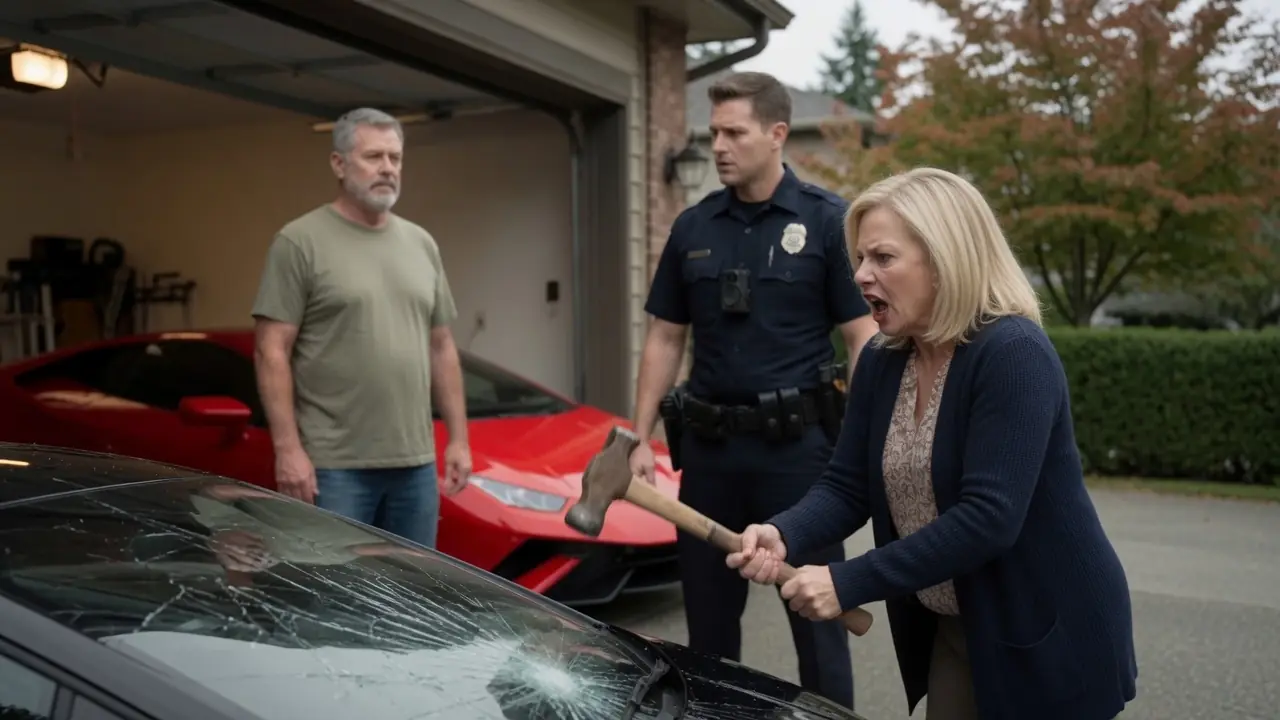
Karen Whitmore turned toward him without lowering the hammer. At sixty-one, she wore her platinum-blonde curls arranged carefully around a flushed face, a dusty-pink cardigan, a floral blouse, and dark slacks. She had served as president of the Briarwood Heights Homeowners Association for nearly nine years and carried herself as though every driveway, mailbox, and blade of grass existed by her permission. Her eyes traveled over Daniel’s faded olive T-shirt, worn jeans, brown work boots, gray beard, and grease-stained hands.
“You think people like you deserve a car like this?” she demanded.
Daniel stopped several feet away. “Karen, drop the hammer.”
Instead, she struck the windshield again.
The second impact crushed the passenger side and sent a web of cracks toward the roof. The officer stepped forward, but Karen swung the hammer down beside her leg and pointed at Daniel with her free hand. She announced that the Lamborghini violated community standards, that Daniel had ignored repeated warnings, and that she was exercising the HOA’s authority to remove a dangerous nuisance. Daniel listened without interrupting, even as the vehicle alarm began screaming through the quiet suburban street.
Officer Lucas Grant lifted one palm. “Ma’am, damaging a vehicle is not an HOA enforcement procedure.”
Karen looked at his name tag as though memorizing it for punishment. “Young man, I called your department because this individual became aggressive when I ordered him to remove an unauthorized automobile.”
“I just arrived,” Lucas replied. “He was inside the garage when I pulled up.”
Karen’s mouth tightened. She had expected the uniform to support her automatically, just as several previous officers had accepted her description of neighborhood disputes without asking many questions. Lucas was new to the district and did not know that Karen chaired charity lunches with the police captain’s wife. He also did not know that she had spent years telling residents she could make citations, permits, and parking complaints disappear.
Daniel took his phone from his pocket and ended the recording he had started through the garage security application. “Officer, the driveway cameras captured both strikes and everything she said before you arrived.”
Karen’s expression shifted. “You recorded me without consent.”
“The cameras are mounted on my property and clearly visible.”
“You do not own this property,” she snapped. “You are occupying it while the association reviews your violation history.”
Daniel glanced toward the two-story brick house behind him. He had purchased it through a holding company six weeks earlier and moved in with little furniture, no staff, and none of the professional clothing associated with his public identity. The plain appearance was deliberate. He wanted to experience Briarwood Heights as an ordinary homeowner before deciding whether the complaints reaching his office were exaggerated.
They were not.
“Who told you I do not own the house?” Daniel asked.
Karen pulled a folded notice from her handbag. “The title is registered to Mercer Community Holdings. You are not listed as an authorized resident, and your application identifies you only as a maintenance consultant.”
Daniel accepted the paper without touching her. The notice threatened daily fines for an “unverified occupant,” demanded removal of the Lamborghini, and scheduled a forced inspection of the garage. None of those actions had been approved by the full HOA board. Karen had signed the document herself and printed the association’s attorney’s name beneath it without his signature.
Lucas looked at the shattered windshield. “Is the vehicle registered to you, sir?”
Daniel handed him his license and digital registration. Both carried his full name, Daniel Alexander Mercer, and the same Briarwood address. Lucas verified the information through his patrol tablet while Karen watched with growing impatience.
“The registration is valid,” Lucas said. “The vehicle belongs to Mr. Mercer.”
Karen dismissed the result with a wave of the hammer. “That proves nothing. Men like him borrow luxury vehicles for photographs or use them to attract criminal activity.”
Daniel’s face became still. “Men like me?”
“Contractors, laborers, temporary occupants—people who do not understand how a refined community operates.”
Lucas switched on his body camera. “Place the hammer on the ground, ma’am.”
Karen stepped toward him. “You should be questioning him, not me.”
“You damaged his car while I was standing here.”
“I was protecting property values.”
“You are being instructed to put down the hammer.”
Karen looked toward the neighboring houses. Curtains moved behind several windows, and two residents had already stepped onto their porches with phones raised. She realized the confrontation had attracted an audience, but instead of becoming cautious, she lifted her chin. Public attention had strengthened her authority for years because people were afraid of becoming her next target.
“I run this neighborhood,” she said. “I decide what belongs here.”
Daniel raised his phone and selected a contact. “That is the mistake that just ended your control of it.”
Karen laughed. “You cannot even attend an HOA meeting until your residency is approved.”
Daniel placed the call on speaker. “Rebecca, initiate the emergency suspension of Whitmore Residential Management’s contract and notify the independent directors that the Briarwood audit is now active.”
A woman answered immediately. “Understood. Do you want the developer voting rights exercised today?”
“Yes. Freeze Karen Whitmore’s access to association accounts, preserve every digital record, and send counsel to the clubhouse.”
Karen’s confidence faltered. “Who are you calling?”
Daniel looked directly at her. “The general counsel for Mercer Urban Development.”
The name traveled across the driveway like a sudden change in temperature. Briarwood Heights had been built twenty-two years earlier by a regional company that later collapsed under debt. Four months before Daniel moved into the neighborhood, Mercer Urban Development had quietly purchased the remaining undeveloped land, the community clubhouse, the HOA management contract, and the original developer’s controlling voting rights during the transition period.
Karen knew the company name.
She simply had never seen its chairman wearing work boots.
“That does not mean you own this neighborhood,” she said, though her voice had weakened.
“I do not own the residents’ homes,” Daniel replied. “I control the development company, the management contract you work under, the common facilities, and enough voting rights to suspend your authority pending an investigation.”
Karen tightened her grip on the hammer. “You are lying.”
Daniel turned his phone toward her. The screen displayed his corporate identification, a photograph of him in a suit, and his title as founder and executive chairman of Mercer Urban Development. Beneath it appeared the completed acquisition notice for Briarwood Development Partners.
Lucas read the screen and then looked at Karen. “Put the hammer down now.”
For several seconds, she did nothing. Daniel could see her searching for a version of events in which status might still rescue her. Finally, she released the hammer. It struck the driveway with a heavy metallic sound.
Lucas moved it beyond her reach and instructed her to place her hands behind her back.
Karen stared at him. “You are arresting the president of the HOA?”
“I am detaining a person I witnessed deliberately damaging a vehicle.”
“Daniel, tell him to stop.”
The sudden use of his first name almost made him laugh. Minutes earlier, she had refused to accept that he belonged in the house. Now she spoke as though they were business partners resolving an unfortunate misunderstanding.
Daniel shook his head. “The officer will make his own decision based on the evidence.”
Karen’s face twisted. “You planned this.”
“I planned an audit. You brought the hammer.”
Lucas secured her wrists and read her rights. Karen protested that the Lamborghini had been parked too close to the sidewalk, that its engine noise frightened residents, and that the HOA documents permitted corrective action. None of the covenants authorized property destruction, and the car had not moved since Daniel washed it the previous afternoon.
As Lucas guided her toward the patrol vehicle, Karen looked back at Daniel. “You will regret humiliating me.”
Daniel glanced at the broken windshield. “You confused accountability with humiliation for too long.”
The Lamborghini was more than an expensive machine. Daniel’s younger brother, Michael, had helped restore it after Daniel purchased it from a bankrupt collector seven years earlier. Michael died from an undiagnosed heart condition before they could take the planned road trip along the Pacific Coast, and Daniel kept the vehicle because the final voice message from his brother was still saved in its audio system.
The damage could be repaired.
The cruelty behind it concerned him more.
Within an hour, attorneys, forensic accountants, and representatives from Mercer Urban Development arrived at the Briarwood clubhouse. Daniel changed into a charcoal shirt but kept his jeans and work boots. He wanted Karen’s board members to confront the same man they had dismissed as an unapproved laborer.
Four of the seven directors attended the emergency session. Vice President Martin Cole entered first, pale and defensive, followed by Treasurer Susan Bell, Secretary Elaine Porter, and board member Richard Hale. All four insisted they had not authorized Karen to confront Daniel or damage the Lamborghini.
Daniel placed copies of the violation notice on the conference table. “Who approved the claim that I was an unauthorized occupant?”
No one answered.
“Who authorized forced entry into my garage?”
Susan stared at the document. “I have never seen this.”
“Your digital signature appears on the second page.”
She examined it more closely. “That is not my signature.”
Rebecca Lane, Mercer’s general counsel, opened a laptop and displayed the document’s metadata. The notice had been created from Karen’s personal account at 11:43 the previous night. Susan’s signature had been copied from a landscaping contract approved six months earlier.
Martin removed his glasses. “Karen told us the owner was operating an illegal repair business.”
Daniel looked toward the windows overlooking the community pool. “I was replacing a fuel pump on my own truck.”
“She showed us photographs of equipment in the garage.”
“She photographed my property through a side window.”
Elaine’s face tightened. “That violates the board’s inspection policy.”
“It also may violate state law,” Rebecca said.
The accountants began reviewing the HOA’s financial records. Karen had resisted electronic transparency for years, claiming that public account summaries created security risks. Residents received annual budgets, but invoices, vendor contracts, and reserve statements were available only by written request. Most requests disappeared into what Karen called administrative review.
The first irregularity appeared before sunset.
Briarwood Heights had paid $186,000 over three years to Whitmore Exterior Solutions for pressure washing, roof inspections, and storm-drain cleaning. The company’s listed address belonged to Karen’s nephew. Several services had never been performed, while others were completed by ordinary maintenance employees already receiving salaries from the HOA.
A second vendor, Heritage Compliance Consulting, collected almost $94,000 for architectural reviews. It was registered to Karen’s longtime friend, who possessed no architectural license. Residents had paid the firm mandatory fees before installing fences, repainting doors, replacing windows, or adding accessibility ramps.
Daniel asked how many homeowners had been fined during Karen’s presidency.
The answer was 312.
The pattern was not random. Elderly residents, young families, renters, immigrants, and homeowners who questioned association spending received the most violations. Karen’s close friends were rarely fined, even when their properties clearly breached the same rules.
One resident, retired teacher Linda Alvarez, had accumulated $14,800 in penalties for installing a wheelchair ramp for her husband without approval. The board denied her first application, claimed to have lost the second, and added legal fees when she refused to remove the ramp. Karen later offered to waive half the debt if Linda signed an agreement promising never to attend another HOA meeting.
Another family was fined because their children’s bicycles remained visible for forty minutes after sunset.
A widower received weekly penalties for a brown patch of grass during a municipal watering ban.
Daniel reviewed every complaint until nearly midnight. He had expected harsh enforcement and possible financial mismanagement. He had not expected a system built to turn personal grudges into debt.
At nine the following morning, Briarwood residents received notice of an emergency community meeting. Karen’s access to association systems had been disabled, the board’s enforcement authority was temporarily suspended, and all outstanding fines were frozen pending independent review. The announcement did not mention Daniel’s Lamborghini.
By six that evening, nearly three hundred residents had crowded into the clubhouse and overflowed onto the patio. Some arrived angry at Karen, while others feared Daniel planned to dissolve the HOA, seize homes, or replace modest houses with luxury towers. Rumors had spread faster than facts.
Daniel stood at the front without a security detail. The damaged Lamborghini remained in his driveway beneath a protective cover, and photographs of the shattered windshield had already circulated online. Yet he began the meeting by discussing the audit, not the car.
“I purchased the remaining developer interests in Briarwood because residents submitted forty-seven complaints about selective enforcement and hidden financial records,” he said. “I moved here quietly because I wanted to understand how the association treated people who had no influence.”
A man near the back called out, “So this was a test?”
“No,” Daniel replied. “Your lives are not an experiment. It was an inspection, and the association failed before Karen ever touched my vehicle.”
He explained the financial irregularities, forged signatures, conflicted vendors, and frozen accounts. Rebecca then outlined the legal protections preventing Mercer Urban Development from taking individual homes or altering private deeds. The company controlled only the remaining development rights, shared facilities, and temporary voting power granted by the original covenants.
Linda Alvarez raised her hand. “What happens to the lien on my house?”
“It is suspended,” Daniel answered. “If the review confirms that your wheelchair ramp complied with safety requirements, every related fine and legal fee will be canceled.”
Her husband lowered his face into his hands.
Other residents began speaking. One described Karen entering her backyard without notice. Another said the HOA threatened foreclosure over a mailbox color that had been approved three years earlier. A Black homeowner named Marcus Reed explained that Karen repeatedly questioned whether his luxury SUV belonged to him, while never challenging white neighbors with more expensive vehicles.
Daniel listened for nearly two hours.
When anger spread through the room, he refused to turn the meeting into a public trial of Karen. “We will document what happened, preserve evidence, and let investigators determine responsibility,” he said. “Accountability is stronger when it does not depend on a crowd’s rage.”
Three weeks later, the forensic audit revealed that $417,000 had been misused or diverted. Karen had approved inflated contracts, received indirect payments through relatives, and charged personal travel expenses to a neighborhood conference budget. She also maintained a private file labeling certain residents as “troublemakers,” “outsiders,” “low-class owners,” or “likely renters.”
Daniel’s name appeared beneath a new entry.
Garage man. Possibly using owner’s identity. Luxury car suspicious. Remove before he influences others.
Investigators also recovered text messages between Karen and Martin Cole. Martin warned her not to touch the Lamborghini until they confirmed who owned the house. Karen responded that allowing “someone like that” to display such a car would destroy the authority she had built.
Martin resigned from the board and cooperated with prosecutors. Susan and Elaine were cleared of financial wrongdoing but admitted they had ignored warning signs because opposing Karen made meetings unbearable. Richard Hale had approved several vendor payments without reviewing them and was removed by resident vote.
Karen was charged with felony vandalism because the Lamborghini’s damage exceeded the state threshold, along with fraud, forgery, theft from the association, and unlawful use of personal information. Her attorney initially argued that she believed the HOA possessed emergency authority over the vehicle. The recorded statements, forged notice, and financial evidence made that defense impossible to sustain.
At her preliminary hearing, Karen arrived in a gray suit without the pink cardigan that had become recognizable from neighborhood videos. She looked smaller than she had in Daniel’s driveway, but she still refused to acknowledge the residents sitting behind the prosecution table. When the judge asked whether she understood the charges, she answered with the offended tone of someone being inconvenienced.
Daniel testified only about the vandalism and the ownership documents. He did not exaggerate her words or describe himself as a victim of extraordinary persecution. He repeated the opening sentence exactly as the security recording captured it.
“You think people like you deserve a car like this?”
Karen stared at the table.
The prosecutor asked what Daniel believed she meant.
“I do not need to interpret it,” he answered. “Her decisions afterward explained it. She assumed clothing, occupation, and appearance determined who deserved respect. That assumption shaped how she treated many residents long before she met me.”
Karen eventually accepted a plea agreement after her nephew agreed to testify about the false vendors. She received prison time, financial restitution requirements, and a permanent ban from serving as an officer or manager of any homeowners association. The court also ordered the sale of two investment properties purchased during the period when HOA funds disappeared.
The restitution did not immediately repair everything.
Some residents had borrowed money to pay illegitimate fines. Others sold possessions, delayed medical care, or lived under foreclosure threats that had never been lawful. Daniel created a recovery fund using returned HOA money, insurance proceeds, and a voluntary contribution from Mercer Urban Development.
He refused to use the fund as advertising.
No banners carried his company’s name, and no press release praised his generosity. Residents submitted documented losses to an independent administrator, and payments were approved publicly at monthly meetings. Linda Alvarez received reimbursement for legal fees and repairs to the wheelchair ramp Karen’s contractors had damaged during an unauthorized inspection.
Briarwood’s governing documents were rewritten through resident votes. Fines could no longer be issued by one person, inspections required notice and documented cause, and all vendor contracts became searchable online. Any board member with a family relationship to a contractor had to disclose it and abstain from voting.
The most important reform involved foreclosure.
No home could face a lien based solely on administrative fines without independent mediation and approval from a resident review panel. Daniel believed community associations needed tools to maintain shared property, but no disagreement over grass height or paint color should become a machine for taking someone’s home.
Six months after the hammer strike, the Lamborghini returned from restoration. The new windshield was flawless, the hood had been repainted, and the security system had been upgraded. Daniel drove it into Briarwood on a Saturday morning while children rode bicycles along the sidewalk and residents prepared tables for the neighborhood’s first open community festival.
He parked beside the clubhouse.
Marcus Reed walked over and admired the vehicle. “You know half the neighborhood expects you to keep it locked in a museum now.”
Daniel smiled. “Michael would hate that.”
He opened the passenger door and played his brother’s final saved message. Michael’s voice filled the quiet interior, joking about Daniel driving too carefully and promising that their coastal road trip would begin as soon as he finished one last project.
For years, Daniel had avoided listening to the recording because it ended with a future that never arrived. The repaired windshield changed something. The car no longer felt like a monument to the trip they lost; it felt like permission to keep moving.
Linda approached with her husband, who used the restored ramp daily. She handed Daniel a small wooden keychain carved in the shape of a hammer.
He raised an eyebrow.
“For emergencies,” she said.
Daniel laughed for the first time whenever he thought about the attack.
That afternoon, residents elected a new HOA board. Emily Reed, an accountant with two children, became president after promising she would never make a decision she could not explain in an open meeting. Linda joined the accessibility committee, while Lucas Grant attended as a community liaison from the police department.
Daniel did not run for any position.
His company’s temporary voting control ended after the reforms were adopted, and authority returned fully to the homeowners. Mercer Urban Development retained the remaining land but agreed that future construction would require resident consultation and public environmental review.
Some board members asked Daniel to install a plaque recognizing his role in exposing Karen.
He declined.
Instead, the clubhouse lobby received a simple framed statement drafted by the residents:
No title, income, occupation, age, or appearance determines who belongs here. Rules must protect the community, never the power of the person enforcing them.
A year after the confrontation, Daniel stood in his garage replacing the brakes on an old pickup truck. He wore the same olive T-shirt, worn jeans, and work boots. The Lamborghini sat nearby with its doors open while a group of neighborhood teenagers listened as he explained how its carbon-ceramic braking system differed from the truck’s ordinary steel rotors.
No one questioned whether either vehicle belonged to him.
Across the street, residents held an open budget meeting beneath the clubhouse awning. Contracts, reserve totals, proposed repairs, and every dollar collected in fines were displayed on a large screen. The process was slower than Karen’s private decisions, but it belonged to the people affected by it.
Karen Whitmore had believed the hammer proved she controlled Briarwood Heights. She assumed Daniel’s clothes revealed his worth, his silence revealed weakness, and his expensive car represented an insult to the social order she protected. She did not know that the man she called a garage worker had purchased the company controlling her contract.
Yet Daniel’s identity was never the most important truth she failed to understand.
Destroying the Lamborghini would still have been wrong if it belonged to a mechanic, a renter, a visitor, or someone who had saved for twenty years to purchase it. Karen did not lose her power because she attacked a wealthy developer. She lost it because evidence finally exposed what she had been doing to people without power.
The repaired Lamborghini became famous throughout Briarwood, but Daniel rarely discussed its price.
Whenever someone asked what the shattered windshield had cost, he gave the same answer.
“Less than letting her keep the hammer.”