The white Lexus struck Daniel Hayes’s ranch gate with enough force to rip one hinge from the cedar post and throw the twisted metal frame across the gravel road. Brenda Caldwell did not slow until the broken gate disappeared beneath her rear tires. She had expected another open stretch of private road leading through Daniel’s pasture and toward the exclusive neighborhood beyond it. Instead, two thick steel bollards stood upright ten feet ahead of her, blocking the Lexus before it could reach the wildflower garden beside Daniel’s house.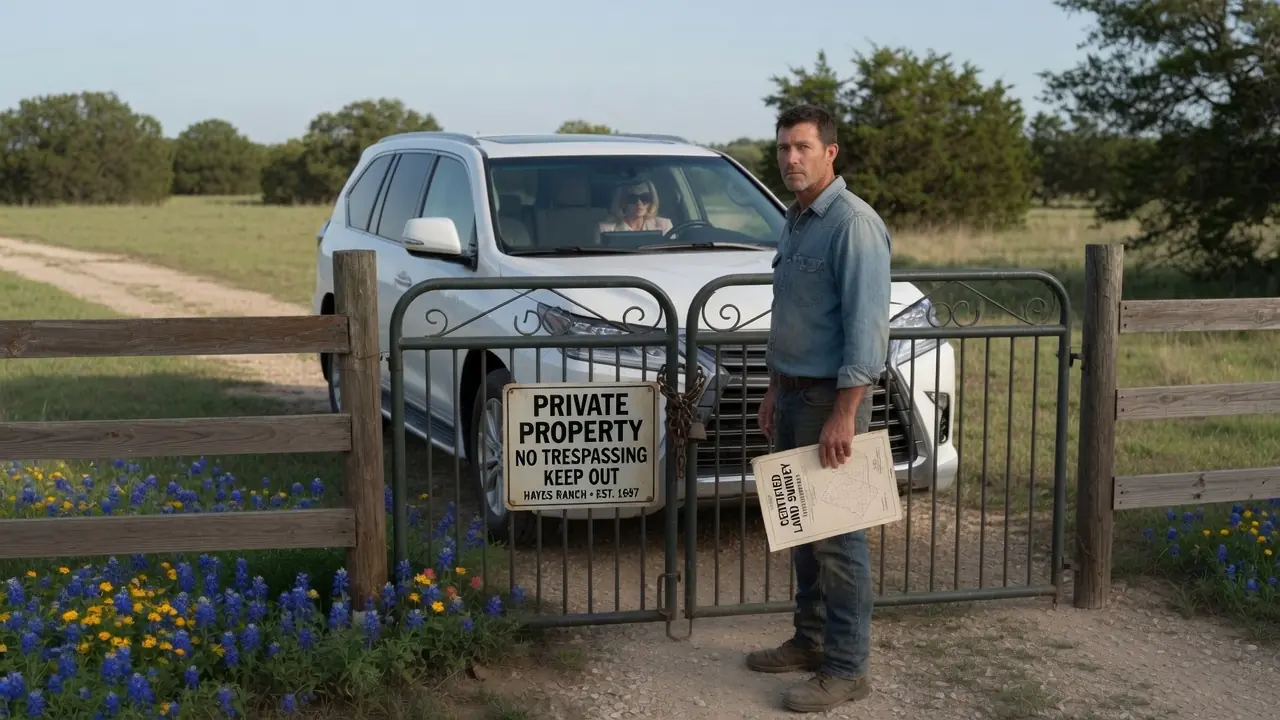
Brenda slammed on the brakes so hard that the SUV stopped sideways between the demolished gate and the steel posts. Dust mixed with the pale morning mist, coating the hood and windshield. She gripped the steering wheel in both hands, her pale pink blazer bright against the cream leather seat, while her oversized sunglasses concealed the first flash of panic in her eyes. Daniel remained beside the reinforced fence line, holding the certified warning notice she had signed two days earlier.
Nine-year-old Lily Hayes stood safely on the front porch almost a hundred yards away. She had been watering the yellow coreopsis and blue sage she had planted with her father when the sound of the impact echoed across the ranch. Daniel had ordered her inside the moment he heard Brenda’s engine accelerating beyond the property boundary. Now Lily watched through the porch window as the woman who had repeatedly crushed her flowers shouted at her father through the open driver’s window.
“You trapped me!” Brenda yelled.
Daniel glanced at the wide space between the Lexus and the bollards. “You drove through a locked gate.”
“This road belongs to Meadow Glen Estates.”
“No. It belongs to my daughter and me.”
Brenda reached for her phone. She told Daniel she was calling the county, the HOA attorney, and every homeowner whose access he had illegally blocked. Daniel did not argue. He had learned during the previous three months that Brenda treated every conversation as a performance, especially when she believed someone was watching.
He simply pointed toward the new security camera mounted above the gatepost.
Its red indicator light blinked steadily.
Brenda’s expression tightened. She raised the window and began speaking rapidly into her phone while Daniel walked toward the mangled gate. He did not touch the Lexus, threaten her, or approach the driver’s door. He photographed the torn hinges, broken chain, tire marks, damaged property sign, and the position of her SUV. Then he sent the images to the county sheriff’s office along with the live camera feed.
This was the fourth time Brenda had driven onto Hayes Ranch without permission.
The first incident had happened on a quiet Monday morning in April. Daniel had been repairing a water trough when a white Lexus appeared on the gravel road behind his barn. He assumed the driver was lost until the SUV crossed a shallow pasture, frightened two horses, and exited through the north service path toward Meadow Glen Estates.
Daniel followed the vehicle in his pickup and found Brenda inspecting the neighborhood’s decorative stone entrance. She introduced herself as the president of the Meadow Glen Homeowners Association and told him his ranch road was a historic community route. Daniel explained that the subdivision had its own paved entrance from the county road. Brenda replied that the ranch was a faster route to the eastern side of the development.
“That doesn’t make it public,” Daniel said.
“It makes it necessary.”
Daniel had remained polite because Lily was sitting beside him in the pickup. He asked Brenda not to enter the ranch again, then drove home and locked the gate. The following morning, someone had cut the chain.
Brenda returned twice that week.
On the second visit, she drove over the edge of Lily’s wildflower patch while leading a landscaping contractor toward the HOA’s rear fence. On the third, she brought two board members and claimed they were assessing potential locations for an emergency access lane. Daniel confronted them near the barn and demanded that they leave.
Brenda responded by presenting a photocopied map with a yellow line drawn across his land.
“This proves the HOA has an easement,” she said.
The map carried no county seal, filing number, surveyor’s signature, or legal description. It looked official only from a distance. Daniel photographed it before Brenda returned it to her folder.
That evening, he searched every property document his parents had left him. Hayes Ranch had belonged to his family for seventy-three years. His grandfather had raised cattle there, his father had repaired farm equipment in the old barn, and Daniel had returned with Lily after his wife, Rachel, died in a highway accident four years earlier.
The ranch was not merely land. It was the place where Lily had finally begun sleeping through the night again.
Rachel had loved native flowers. During their first spring on the ranch, she had planted a narrow garden beside the driveway to attract butterflies and bees. After her death, Daniel could not bring himself to maintain it, but Lily began restoring it when she turned eight.
Every crushed flower felt personal to both of them.
Daniel took Brenda’s map to the county recorder’s office. A clerk named Margaret Hill searched deeds, plats, utility records, and easement filings going back to the subdivision’s construction seventeen years earlier. She found a temporary construction license allowing equipment to cross one corner of the ranch while Meadow Glen’s drainage system was installed.
The license had expired after eight months.
It covered a fifteen-foot corridor near the northern fence, not the gravel road through Daniel’s property. It did not authorize HOA members, private vehicles, inspections, tours, or permanent access. More importantly, the document stated that all temporary rights ended automatically once construction was completed.
Brenda’s yellow line followed none of the recorded coordinates.
Margaret printed certified copies for Daniel and suggested that he hire a licensed surveyor. Daniel contacted Olivia Warren, a property surveyor known for handling rural boundary disputes. She spent two days marking the legal lines and comparing them with the old construction route.
Her findings were clear.
The HOA had no active right to cross Hayes Ranch.
Daniel mailed Brenda a certified notice containing the survey, deed, expired construction license, and demand that the HOA stop entering his property. Brenda signed for the envelope herself. The next morning, she drove through the gate again.
This time, her Lexus crushed six young sage plants Lily had grown from seed.
Daniel found his daughter kneeling beside the broken stems after school. She tried to straighten one plant with both hands, as if enough care could reverse what the tires had done.
“Why does she keep doing it?” Lily asked.
“Because she thinks being important means no one can tell her no.”
“Is she more important than us?”
Daniel crouched beside her. “Not on our land.”
He promised that Brenda would never drive through the garden again. That evening, he called a contractor and ordered two legally permitted steel bollards for the inner ranch road. They were fixed barriers, not hidden traps, installed well inside the property boundary with bright reflective markings and warning signs visible from the gate.
Daniel also replaced the chain, reinforced the hinges, and added security cameras.
The contractor asked why he needed both a gate and bollards. Daniel showed him the recordings of Brenda forcing the gate open with her SUV bumper.
“She doesn’t believe the gate applies to her,” Daniel said.
“Steel usually communicates more clearly.”
Before the installation, Daniel notified the sheriff’s office and county planning department. He obtained permits, photographed the work, and mailed Brenda a second certified notice describing the reinforced entrance. The letter warned that any vehicle crossing the locked gate without permission would encounter permanent barriers beyond it.
Brenda signed for that notice too.
She later claimed she had never read it.
The sheriff’s deputy arrived nine minutes after the Lexus smashed through the gate. Deputy Marcus Reed parked near the county road and approached on foot, body camera active. Brenda immediately climbed out of the SUV, still holding her phone, and pointed at Daniel as though he were the intruder.
“This man installed dangerous barriers on a community road,” she announced. “He intentionally trapped me.”
Marcus looked at the shattered gate behind her vehicle. “How did the gate come down?”
“It was blocking lawful HOA access.”
“That wasn’t my question.”
Brenda said the gate had been weak and collapsed when her Lexus touched it. Daniel said nothing. He handed Marcus the survey, deed, certified notices, delivery receipts, permits, and camera tablet.
The video showed Brenda stopping outside the locked gate.
It showed her reading the PRIVATE PROPERTY sign.
It showed her reversing twenty feet, accelerating, and striking the center of the gate.
Marcus watched the recording twice.
“Mrs. Caldwell, you deliberately drove through this entrance.”
“I was exercising an easement right.”
“Do you have the easement?”
Brenda lifted her HOA folder. Inside were copies of the same unofficial map Daniel had seen before, a letter signed by the HOA board, and a document titled PERMANENT COMMUNITY ACCESS AGREEMENT.
The agreement appeared to grant Meadow Glen unrestricted access across Hayes Ranch. It carried what looked like Daniel’s late father’s signature.
Daniel felt his stomach tighten when he saw the name.
His father, Thomas Hayes, had died six years earlier. The document was dated only three years ago.
Brenda noticed Daniel’s reaction and smiled as if she had finally produced the weapon she had been saving.
“Your family agreed to this,” she said. “The HOA has been generous by not billing you for obstructing us.”
Daniel pointed at the date. “My father was dead when that was signed.”
The smile disappeared.
Marcus examined the paper without touching it. He asked Brenda where she obtained the original. She said it was stored in the HOA archive and accused Daniel of inventing his father’s death to avoid compliance.
Daniel opened the county obituary record on his phone.
Marcus called his supervisor.
Brenda was not immediately arrested. The deputy explained that the suspected forged document required investigation and that the vehicle could not be removed until the damaged gate and bollards were documented. Brenda remained beside the Lexus, calling board members and demanding legal representation.
Daniel returned to the porch.
Lily was standing behind the screen door.
“Is she going to jail?” she asked.
“I don’t know.”
“But she broke the gate.”
“Yes.”
“And lied about Grandpa.”
“Yes.”
Lily looked toward the garden. “Then what happens if important people lie better than us?”
Daniel rested a hand on her shoulder. “We make sure the truth has better records.”
By noon, two more deputies, a county investigator, and Olivia Warren had arrived. Olivia measured the bollards, the vehicle position, and the destroyed gate. She confirmed that every barrier stood more than thirty feet inside Daniel’s legal boundary and that the HOA’s claimed route crossed the ranch without following any registered corridor.
The investigator photographed Brenda’s agreement and requested access to the HOA’s original records.
Brenda refused.
She said the archive contained confidential homeowner information and could be reviewed only by the association’s attorney. That refusal changed the direction of the case. The investigator obtained a preservation order preventing the HOA from destroying or modifying any documents connected to Hayes Ranch.
The Lexus was eventually towed backward through the ruined entrance. Its front bumper had been scraped by the gate, but it had never touched the bollards. Brenda nonetheless told neighbors that Daniel had installed a violent mechanical trap designed to destroy her vehicle.
She posted photographs online showing the Lexus surrounded by deputies.
She did not post the video of herself smashing through the gate.
Within hours, Meadow Glen residents began calling Daniel. Some were angry, accusing him of threatening their emergency access. Others were confused because they had never known the HOA claimed a road through his ranch.
One resident, Paul Ellis, asked to meet privately.
Paul had served as HOA treasurer for six years. He arrived at Daniel’s kitchen after sunset carrying a laptop and three bank statements. He looked frightened enough that Daniel kept the porch light off and parked Paul’s vehicle inside the barn.
“Brenda told us your family granted the easement,” Paul said. “She said the HOA paid for it.”
“How much?”
“Two hundred and eighty thousand dollars.”
Daniel stared at him. “My family never received anything.”
Paul opened a spreadsheet showing payments from the HOA reserve fund to a company called Rural Access Consulting. The descriptions included easement acquisition, landowner compensation, legal surveys, and emergency-road construction.
The payments had been approved over four years.
Rural Access Consulting was registered to a post-office box. Paul had begun asking questions after Brenda demanded another ninety thousand dollars to expand the supposed ranch road. She removed him from the finance committee and told the board he was confused.
Paul searched the payment records before losing access.
The account receiving the money belonged to a company managed by Brenda’s brother.
Daniel understood then that the trespassing was not simply entitlement. Brenda needed the road to appear legitimate because she had been billing homeowners for acquiring rights that did not exist.
The forged agreement was part of a larger fraud.
The following morning, investigators searched the HOA office under a court order. They found the original document Brenda had shown Marcus, several versions of Daniel’s father’s signature, and a scanned copy of Thomas Hayes’s old equipment lease.
The signature on the false easement had been copied from that lease.
They also recovered invoices from Rural Access Consulting, unsigned survey maps, and emails between Brenda and her brother. One message instructed him to create “something that looks county-ready” before the annual audit.
Another discussed the ranch road’s real purpose.
Brenda was negotiating with a development company that wanted to build forty luxury homes on the eastern side of Meadow Glen. The existing public road could not support the construction traffic. A route through Hayes Ranch would reduce development costs by almost two million dollars.
The developer had promised Brenda a private consulting payment if she secured access.
She had spent years manufacturing the appearance of an easement, using HOA funds to pay her brother, leading board members across the ranch, and repeatedly driving the route to create a history of use.
Daniel’s locked gate threatened the entire scheme.
Her decision to smash through it had placed the fraud directly in front of a security camera.
Brenda’s attorney tried to negotiate. He offered to pay for the gate, repair the garden, and withdraw every access claim if Daniel agreed not to cooperate with investigators.
Daniel refused.
“This stopped being about my gate when she forged my father’s name.”
Meadow Glen’s board called an emergency meeting. More than one hundred homeowners attended, many carrying copies of special assessments they had paid for the nonexistent access project.
Brenda entered wearing another pale pink blazer and insisted the investigation was a misunderstanding. She claimed her brother’s company performed legitimate consulting work and said the forged document had been created by an unknown former employee.
Paul displayed the bank transfers.
The county investigator displayed the emails.
Daniel displayed the gate video.
The room remained silent as Brenda’s Lexus reversed, accelerated, and tore through the entrance on the large projection screen. Her own voice filled the meeting hall.
“Your cheap little gate can’t stop me from using my road!”
No one applauded when the recording ended.
The HOA board removed Brenda as president that night. The county charged her with criminal trespass, property destruction, document forgery, financial fraud, and obstruction related to attempts to alter the association’s digital archive.
Her brother was charged for creating false invoices and laundering HOA payments through Rural Access Consulting. The developer canceled its agreement after investigators discovered that one of its executives had approved an undisclosed payment to Brenda.
The consequences spread far beyond Hayes Ranch.
A forensic audit found that Brenda had taken more than four hundred thousand dollars from HOA reserves. Some money funded her brother’s company. Other payments covered personal travel, vehicle expenses, and legal fees used to threaten residents who questioned her.
Meadow Glen had delayed roof repairs, drainage maintenance, and emergency reserves while homeowners were told their fees financed the ranch access project.
The new board created an independent restitution fund.
Brenda’s assets, insurance coverage, and recovered company accounts were used to repay homeowners. Daniel received compensation for the gate, damaged landscaping, legal expenses, and the cost of the security system.
He accepted reimbursement for the property damage but refused a private settlement requiring silence.
At the criminal hearing, Brenda’s attorney described the gate collision as an emotional mistake during a heated property disagreement. The prosecutor played the footage showing her reading the warning sign, reversing, and accelerating.
Then he presented both certified notices carrying her signature.
Brenda had known the gate was private.
She had known the bollards were installed.
She had known the easement was false because she helped create it.
The court prohibited her from holding a financial or leadership position in any homeowners association during her probation after a custodial sentence. She was ordered to pay restitution and surrender the Lexus because company money had covered several of its payments.
The vehicle was sold at auction.
Daniel never attended the sale.
He was home repairing the gate with Lily.
They replaced the twisted metal frame with a heavy steel entrance painted dark green. Lily chose the color because it matched the sage leaves in the restored garden. They planted new coreopsis, milkweed, and bluebonnets along the fence, leaving enough distance that no vehicle could reach them without crossing the bollards first.
Daniel mounted the old broken hinge inside the barn.
Lily asked why he wanted to keep it.
“Because it reminds me that something can break without giving someone the right to take what’s behind it.”
The new HOA board negotiated legitimate utility access with neighboring landowners where necessary. It stopped claiming any route through Hayes Ranch and installed signs directing residents and contractors toward the public entrance.
Paul became interim treasurer.
He created a system requiring two independent approvals for large payments and published the association’s financial records every quarter. Meadow Glen residents began inviting Daniel to meetings, but he attended only when ranch boundaries or drainage issues were involved.
He did not want power over the neighborhood.
He wanted the neighborhood to respect where its power ended.
Six months after the collision, the wildflower garden bloomed more densely than before. Monarch butterflies gathered around the milkweed while Lily sat beside Daniel on the porch, sketching the new gate for a school art project.
The steel bollards remained visible beyond the entrance.
They had never stopped a moving vehicle.
They had not needed to.
Their purpose was not to destroy Brenda’s Lexus or punish anyone who approached the ranch. They existed because a clearly marked gate had failed to stop a woman who believed written rules applied only to people with less influence than she had.
The cameras provided the evidence.
The survey protected the boundary.
The documents exposed the fraud.
But Daniel knew the most important moment had happened before the investigators, court hearings, and restitution. It happened when Lily asked whether Brenda was more important than they were, and Daniel promised that she was not more important on their land.
The ranch was quiet again.
Cattle grazed beyond the fence. The rebuilt gate stood straight across the gravel road, and Rachel’s garden moved gently in the afternoon breeze.
Lily leaned against her father’s arm.
“Do you think she finally understands the gate?” she asked.
Daniel watched a butterfly settle on one of the flowers they had replanted.
“No,” he said. “But now she understands what was standing behind it.”