“Get the hell off this property.”
Cynthia Whitmore thrust her clipboard toward Brandon Hall as though the polished brown board carried the authority of a judge’s gavel. She stood on the sidewalk in front of the gray two-story house he had purchased three weeks earlier, dressed in an emerald-green blazer, white trousers, pearls, and an expression sharpened by absolute certainty. Behind her, a moving truck occupied half the driveway while an unfamiliar family carried boxes through Brandon’s open front door.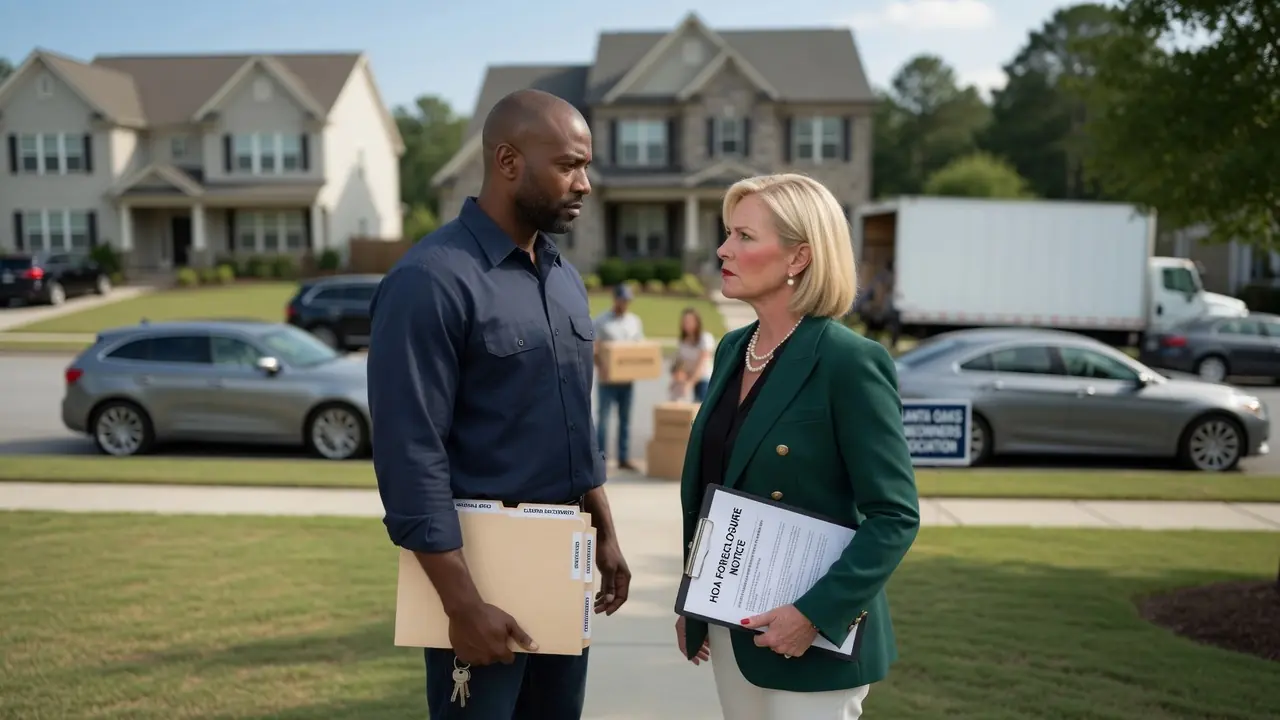
Brandon did not move.
“Funny,” he said, lifting the original brass key between two fingers. “I bought this house.”
The woman’s bright red mouth curved into a contemptuous smile. “The HOA sold it after you ignored our foreclosure notices.”
Brandon looked past her toward the front porch. A little boy he had never seen sat on the top step holding a stuffed dinosaur, while a woman inside arranged framed photographs on Brandon’s living-room mantel. Someone had already changed the curtains, placed shoes beside the entrance, and removed the temporary security notice Brandon left inside the window.
For one disorienting second, the home no longer looked like his.
He had bought the property after twelve years of moving from one apartment to another. The closing represented nearly every dollar he had saved, countless weekends spent working overtime, and the promise he made his late mother that he would someday own a place no landlord could take from him. He had signed the deed, collected the keys, activated utilities, and left town for a three-week assignment before moving in completely.
Now strangers were living inside.
Brandon opened the thick manila folder beneath his arm. “My deed was recorded on May third.”
Cynthia tapped the clipboard. “And the association recorded a superior lien on May seventeenth. You failed to pay mandatory assessments, ignored certified notices, and abandoned the property.”
“I owned the house for fourteen days.”
“You should have read the covenants.”
“The first quarterly assessment isn’t due until July.”
Her smile disappeared.
Brandon removed a certified copy of the deed and held it where she could see the county seal. “Your lien was filed after my purchase, claims six years of unpaid dues, and names an owner who died before I bought the property.”
Cynthia’s chin lifted. “Nobody will believe you over the president who controls every record in this neighborhood.”
Brandon pulled out his phone.
“Keep talking,” he said. “The state investigators arrive in ten minutes, and every forged sale leads straight to you.”
The moving family stopped carrying boxes.
Cynthia stared at him for several seconds before laughing too loudly. “State investigators?”
“Property-fraud division.”
“You called them over an HOA dispute?”
“I work for them.”
The color began draining from her face.
Brandon Hall was not an ordinary buyer who happened to recognize suspicious paperwork. He was a senior investigator assigned to the Georgia Attorney General’s real-estate fraud unit, where he spent his days examining forged deeds, fraudulent liens, stolen identities, predatory closings, and shell companies created to hide illegal property transfers.
He had prosecuted versions of Cynthia’s scheme before.
None had ever involved his own house.
A tall man stepped out through the front door. He looked about forty, wore a faded work shirt, and carried confusion rather than aggression in his face. He glanced between Brandon and Cynthia before speaking.
“My name is Eric Lawson,” he said. “My wife and I purchased this house.”
“From whom?” Brandon asked.
Eric pointed toward Cynthia. “Her brokerage company.”
Cynthia turned sharply. “Do not answer him.”
Eric’s wife appeared behind him. Her name was Grace, and fear had already replaced the excitement visible in the family photographs she had been unpacking. She carried a folder containing closing papers marked with the logo of Whitmore Community Realty.
“We paid a down payment,” Grace said. “We signed everything last Friday.”
Brandon’s anger shifted.
The Lawsons were not trespassers trying to steal his home. They were victims standing inside someone else’s crime, surrounded by furniture they had moved believing the transaction was legal. The little boy on the steps watched the adults with the silent worry children developed when they sensed their parents were losing control.
Brandon lowered his voice. “How much did you pay?”
“Forty-two thousand dollars,” Eric answered.
Cynthia stepped between them. “This conversation is over. The association’s attorneys approved the transaction.”
“Name the attorney,” Brandon said.
“That information is confidential.”
“Then name the title company.”
Cynthia clutched the clipboard tighter. “You’re harassing me.”
Brandon studied the papers in Grace’s hands. The settlement agent listed on the first page was Meridian Residential Title, a company he recognized from an investigation six months earlier. Meridian had supposedly closed after regulators suspended its license for failing to maintain escrow funds.
Someone had revived its name.
The document contained a printed notary seal, but the commission number belonged to a woman who had died the previous year. The warranty deed described an association foreclosure but lacked the required public-auction information. Even the parcel number ended with two transposed digits.
The fraud was not sophisticated enough to survive scrutiny.
It had survived because Cynthia selected victims who never expected an HOA president to invent an entire sale.
A black government sedan turned onto the street.
Cynthia saw it and immediately began walking toward her silver Mercedes. Brandon moved sideways, blocking her path without touching her.
“Don’t leave.”
“You cannot detain me.”
“You’re right,” he said. “They can.”
Two investigators stepped from the sedan. Special Agent Lena Ortiz carried a leather case, while forensic accountant Marcus Bell followed with a tablet already connected to the county property database. A second vehicle arrived behind them carrying an attorney from the consumer-protection division and a uniformed sheriff’s deputy.
Cynthia’s confident posture collapsed by inches.
Lena approached Brandon first. “You said the property was transferred after your recorded purchase?”
He handed her the deed, the fraudulent lien, and the Lawsons’ contract.
Lena examined the first pages. “Who provided these documents?”
Eric pointed toward Cynthia.
Cynthia’s voice sharpened. “I’m the elected president of Magnolia Ridge. I have authority to enforce association debts.”
Lena looked at her. “Do you also own Whitmore Community Realty?”
“It is a separate business.”
“And Meridian Residential Title?”
“No.”
Marcus turned his tablet toward the group. “Meridian’s corporate registration was reinstated eleven days ago by a manager named Caroline W. Mercer.”
Lena glanced at Cynthia. “Your maiden name is Mercer, correct?”
Cynthia said nothing.
The first ten minutes ended with the sheriff’s deputy asking her to step away from the Mercedes. He did not arrest her immediately, but he collected her keys and instructed her to remain present while investigators secured documents. The authority she had used against homeowners vanished the moment someone demanded proof.
Brandon entered the house with Eric and Grace.
Most of his belongings remained in storage, but several boxes he left inside had been opened and moved into the garage. His mother’s wooden rocking chair stood beneath a plastic sheet near the wall. The Lawsons apologized repeatedly, though Brandon assured them they had done nothing knowingly wrong.
Cynthia had shown them forged foreclosure records, an apparently valid deed, and a clean title report.
“She said the previous owner disappeared after refusing to follow community rules,” Grace explained.
Brandon’s jaw tightened. “I was working in Savannah.”
“She called you an absentee investor.”
“I bought this as my home.”
Eric looked toward the front window where Cynthia stood under the deputy’s supervision. “She said the association was protecting the neighborhood from abandoned properties.”
“How did you find the listing?”
“It never appeared online. A coworker’s mother lives here and told us Cynthia had an off-market foreclosure.”
That detail mattered.
Public listings created records, witnesses, and outside scrutiny. Cynthia sold the house privately because secrecy allowed her to control every person involved. She acted as HOA president, real-estate broker, foreclosure representative, and referral source for the fake title company.
Brandon asked to see proof of payment.
Grace produced wire instructions directing their money to an account called Magnolia Community Recovery Fund. The account was held at a small regional bank under a nonprofit classification, though no such nonprofit appeared in state records.
Marcus examined the transfer number and requested an emergency freeze.
Within minutes, the bank confirmed the forty-two thousand dollars remained in the account alongside more than six hundred thousand from similar transactions. Investigators locked the funds before Cynthia could move them.
That was when the case expanded beyond Brandon’s house.
Marcus searched recent property filings connected to Magnolia Ridge. Over eighteen months, the HOA had recorded twelve liens against homes whose owners were traveling, hospitalized, deceased, or involved in probate. Five properties had been transferred through suspicious private sales.
Three were currently occupied by buyers who believed they had legitimate deeds.
Cynthia had created a system.
She targeted properties appearing temporarily vacant, manufactured years of unpaid HOA fees, and mailed notices to outdated addresses she knew the owners would never receive. Then she scheduled fake foreclosure auctions attended only by companies she controlled.
Her shell company purchased the homes for the amount of the fabricated debt.
Whitmore Community Realty resold them privately at discounted prices. The fake title operation produced documents convincing enough for buyers eager to secure affordable homes in an expensive neighborhood.
Cynthia collected down payments, association fees, commissions, and supposed legal costs at every stage.
The original owners usually discovered the theft months later.
One elderly man lived in assisted care after surgery and believed his nephew was maintaining the property. A military family returned from deployment to find renters occupying their house. A widow lost the home she inherited while probate paperwork was still pending.
Each victim contacted Cynthia first.
She frightened them with legal language, demanded immediate payments, and warned that challenging the HOA would cost more than surrendering the property. Some hired lawyers, but Cynthia delayed proceedings through altered records and shell companies.
Brandon was different because he discovered the scheme within days.
He also knew where to look.
Investigators searched Cynthia’s clipboard and found more than violation notices. Beneath the top pages were blank lien templates, copied signatures, prepaid certified-mail labels, and handwritten notes about several homeowners’ travel schedules.
One entry beside Brandon’s name read: Single purchaser. No local family. Away until June. Fast resale possible.
Brandon read it twice.
She had watched him from the beginning.
Cynthia approached while the deputy remained close. “That note proves nothing.”
“It proves you knew I was away.”
“I monitor properties as HOA president.”
“You monitored me as a target.”
“You failed to move in.”
“There is no deadline requiring an owner to sleep inside his house.”
Cynthia’s composure began cracking. “Vacant properties create risks.”
“So you stole mine?”
“The association acted to protect community value.”
“You sold it to an innocent family and took their savings.”
“They received a house.”
“A house you did not own.”
Her eyes flashed. “You people always believe paperwork makes you untouchable.”
The street became silent.
Brandon looked at her. “What people?”
Cynthia realized too late what she had said.
Neighbors had begun gathering along the sidewalks, drawn by the government vehicles and moving truck. Several were recording. Cynthia adjusted the pearls around her neck and attempted to retreat into bureaucratic language.
“I meant outsiders who do not respect established communities.”
“I purchased a home here.”
“You arrived making demands.”
“I asked for the mailbox key.”
“You questioned association procedures.”
“I asked why you wanted a copy of my travel schedule.”
Cynthia looked away.
Brandon remembered that conversation now. Two days after closing, she arrived with a welcome packet and asked whether the house would remain empty. She claimed the HOA needed emergency contact information and wanted the exact dates of his work trip.
He gave her only the month.
It had still been enough.
Lena instructed the deputy to preserve Cynthia’s phone and laptop. Cynthia refused, saying they contained confidential association business. The investigator produced an emergency warrant approved using evidence already found in the fraudulent closing file.
The deputy removed the phone from Cynthia’s hand.
Messages immediately began appearing on the locked screen.
One came from the branch manager of a private bank: The Hall buyer is back early. Move the funds now.
Another came from someone saved as Judge R: Destroy the auction attendance sheets.
The conspiracy reached beyond one HOA president.
By evening, agents searched Cynthia’s home office and the association clubhouse. They recovered homeowner files organized by financial vulnerability: elderly, divorced, inherited, deployed, medical absence, and investment owner.
The categories were not administrative.
They were hunting lists.
A locked cabinet held forged notary stamps, blank deeds, counterfeit title insurance forms, and copies of driver’s licenses belonging to residents. Another drawer contained prepaid debit cards used to transfer money between shell companies.
The entire operation depended on private information Cynthia collected through HOA forms.
Emergency contacts revealed who had no nearby relatives. Vehicle registrations showed which homes might be empty during work hours. Requests for medical accommodations identified residents struggling with illness.
Cynthia turned community records into tools for selecting victims.
She was arrested shortly after sunset.
The charges initially included deed fraud, forgery, theft, identity fraud, financial exploitation, and conspiracy. More counts followed as investigators contacted property owners and discovered additional illegal transfers.
Cynthia kept her head high as the deputy escorted her toward the vehicle.
She stopped near Brandon.
“You think you won?”
“This isn’t about winning.”
“You destroyed this neighborhood.”
“No,” he replied. “I stopped you from selling it one house at a time.”
The Lawsons spent that night in a hotel paid for through an emergency victim-assistance fund. Brandon refused to force them from the house immediately, but the property legally remained his and investigators needed access to preserve evidence. Their furniture was placed in secure storage while consumer-protection attorneys worked to recover their money.
The frozen bank account returned most of the down payment within three weeks.
The remaining amount came from a state compensation program.
Brandon helped the Lawsons find another legitimate home nearby. He reviewed every page of their new closing documents personally, though Eric joked that no ordinary buyer should need a state fraud investigator beside the signing table.
“This time,” Brandon said, “you get a title company that exists.”
The larger investigation lasted eleven months.
Cynthia’s fake title operation involved a suspended closing attorney, a bank manager receiving secret payments, and a county clerk who allowed questionable filings to pass without required verification. The supposed judge in her phone was actually a retired magistrate using his old title to intimidate residents and draft fraudulent legal notices.
The private bank manager admitted he helped establish shell accounts in exchange for part of every sale.
The clerk altered timestamps and removed scanned objections from county records.
Cynthia coordinated everything.
Her defense attorney argued that HOA law was complicated and that she made administrative mistakes while attempting to collect legitimate debts. The prosecution responded with messages where she described homes as “inventory” and vulnerable residents as “easy acquisitions.”
One message about a hospitalized owner read: Move before the daughter understands probate.
Another about Brandon said: Professional Black buyer, but absent. Association authority should scare him into settlement.
That sentence ended any claim that the transfer was accidental.
At trial, Brandon described returning from Savannah and seeing another family inside his home. He did not dramatize the moment. He explained the dates, documents, account transfers, and statutory violations with the precision that defined his work.
Cynthia’s attorney tried to suggest he used government influence to turn a civil disagreement into a criminal prosecution.
“You summoned investigators within minutes,” the attorney said.
“I reported evidence of an active fraudulent transfer.”
“Because the property belonged to you.”
“Because the crime was continuing.”
“Would you have acted so quickly for another homeowner?”
Brandon looked toward the gallery, where several previous victims sat together.
“That is my job.”
The prosecution called Grace Lawson next.
She described saving for nine years, trusting Cynthia’s position, and telling her son they had finally found a permanent home. Her voice broke when she explained that the little boy slept with his shoes on during the hotel stay because he feared they would be moved again.
Cynthia looked down for the first time.
The jury convicted her on every major count.
The judge sentenced her to prison, ordered restitution, and permanently barred her from real-estate, title, banking, and association-management work. The closing attorney lost his license, the bank manager received a separate sentence, and the county clerk resigned before pleading guilty.
Five stolen properties were returned to their rightful owners.
Two had already been resold again, requiring complicated settlements funded by seized assets and title insurance. Nobody emerged untouched, but the victims recovered far more than they expected when the investigation began.
Magnolia Ridge dissolved its old HOA board.
Residents elected new leadership and adopted rules requiring independent audits, public financial records, and outside legal review before any property lien could be filed. No board officer could own a company receiving association business.
Travel schedules and medical details were removed from routine forms.
Brandon refused requests to become president.
“I bought a house,” he said at the community meeting. “I did not volunteer for another investigation.”
The room laughed, but everyone understood the exhaustion beneath the joke.
One year after returning to find strangers inside, Brandon finally hosted a housewarming party. The delay had become a neighborhood story of its own. Friends filled the backyard, music played from the patio, and Eric Lawson stood beside the grill arguing about barbecue sauce.
Grace brought a framed copy of Brandon’s restored deed.
Beneath it, she had attached a small brass plate reading:
THE HOUSE THAT COULD NOT BE SOLD TWICE
Brandon hung it in his home office.
The rocking chair that belonged to his mother stood beside the window. She had died before seeing him purchase the house, but he imagined what she would say about the year-long fight.
She would not focus on Cynthia.
She would remind him that ownership meant more than paper. It meant security, memory, and the right to close a door without wondering whether someone else could erase your name while you were gone.
Late that evening, after the final guest left, Brandon stood outside beneath the porch light.
The neighborhood was quiet.
No moving truck blocked the driveway. No forged document rested in Cynthia’s clipboard. The keys in Brandon’s pocket opened a home whose ownership was no longer in question.
Cynthia had believed her title gave her power over every resident.
She controlled association records, knew when homeowners traveled, and surrounded her thefts with official-looking paperwork. She assumed frightened people would surrender before learning how thoroughly she had deceived them.
Then Brandon returned early.
Ten minutes after she ordered him off his own property, investigators froze her money, uncovered the false sale, and connected the first documents in a scheme built across years.
The house never belonged to her.
The authority never belonged to her.
All she truly owned was the trail of evidence that brought her entire operation down.