“Hand over the Lamborghini keys—trash like you doesn’t belong in my neighborhood.”
Karen Peterson lunged toward Michael Harrison’s wrist as though the silver car behind him already belonged to her. Her vivid-red blazer flashed beneath the afternoon sun, and an oversized black binder marked HOA PRESIDENT remained crushed against her chest. Behind her sunglasses, her expression carried the certainty of someone who had spent years confusing a title with ownership.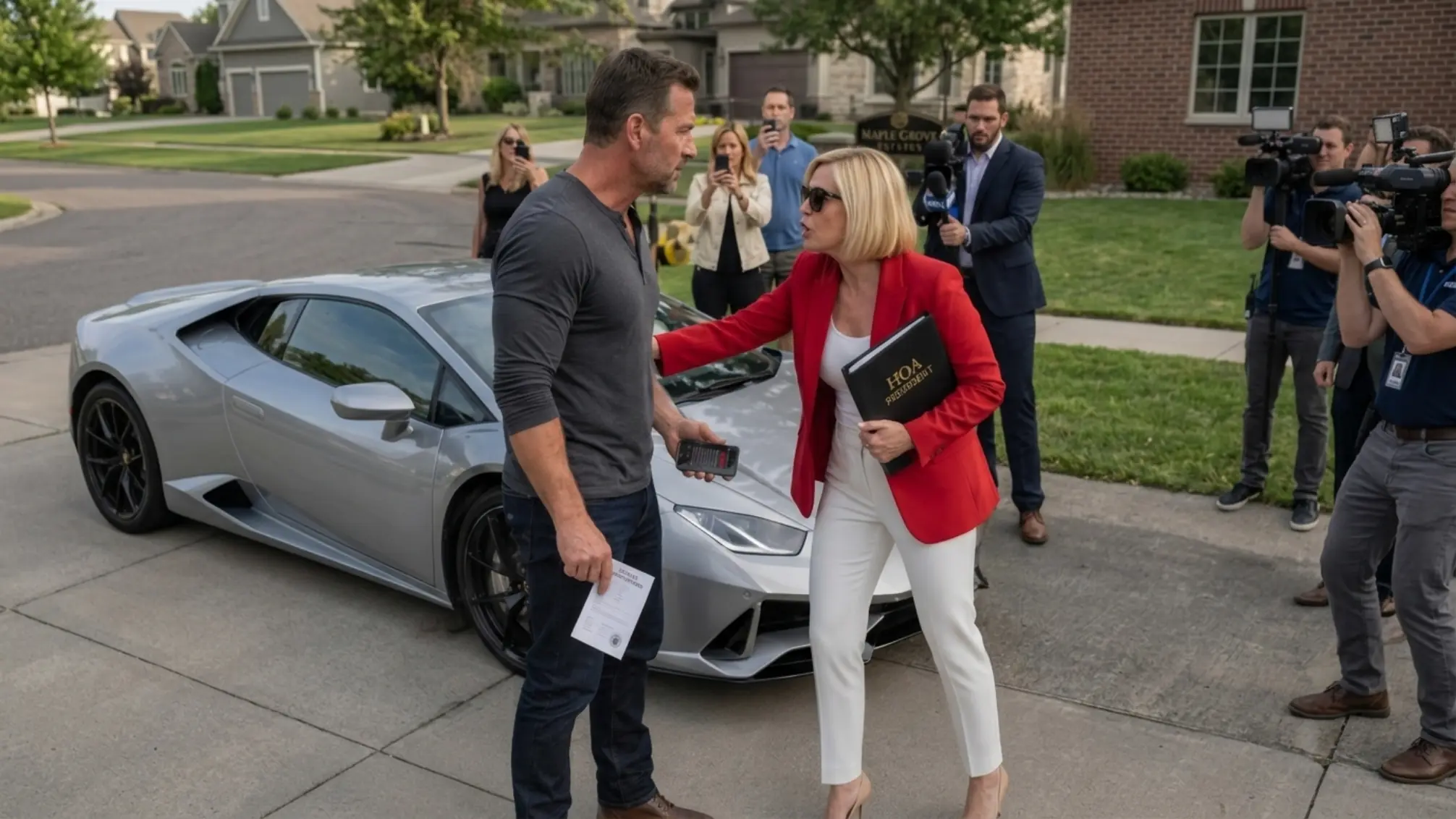
Michael pulled his hand away before she could touch the keys.
“Your fake title doesn’t outrank my deed or registration.”
Karen’s mouth tightened. “I’ll tow it, bankrupt you with fines, and make everyone watch.”
Michael glanced over her shoulder toward the woman approaching with a camera crew.
“Perfect,” he said. “Say it louder so the reporter records your confession.”
The driveway fell silent.
Several neighbors stood near the sidewalk holding phones. A local journalist raised her microphone, while the silver Lamborghini remained parked legally on Michael’s private property. Karen slowly turned toward the cameras and realized the confrontation she expected to control had already become public.
Six weeks earlier, Michael had been enjoying the quiet life he believed twenty-five years in the United States Army had earned him. At fifty-two, he had no interest in community politics, arguments over landscaping, or neighbors who treated every unfamiliar vehicle as a personal threat. He wanted slow mornings, a garden behind his house, and enough peace to finish the photography projects he had postponed during years of deployments.
Maple Grove initially appeared perfect.
The upscale neighborhood had wide sidewalks, trimmed lawns, mature trees, and homes spaced far enough apart to preserve privacy. Michael purchased his house in 2019 after carefully reviewing the deed, neighborhood rules, and HOA restrictions. Nothing prohibited luxury vehicles from being parked in private driveways, and nothing gave the association authority to seize legally registered property.
His silver Lamborghini was not a recent purchase.
Michael had bought it after retiring, using money saved through investments and military benefits. To him, the car represented neither wealth nor social status. It was something he had promised himself during a freezing night overseas when survival until morning felt uncertain.
He kept it polished, insured, and properly maintained.
The first warning arrived on a Monday morning while Michael drank coffee beside his kitchen window. The email claimed his vehicle had remained outdoors for more than seventy-two hours, violating Section 4.7 of Maple Grove’s community standards. A $250 penalty had already been added to his account.
Michael opened the bylaws.
Section 4.7 concerned abandoned commercial trailers.
He replied politely, explaining that his Lamborghini was a registered passenger vehicle parked on his own driveway. He attached the relevant pages from the association rules and requested that the incorrect fine be removed.
Karen answered within an hour.
Fine increased to $500 due to argumentative conduct toward HOA leadership.
Michael read the sentence twice.
Then he created a folder on his computer labeled HOA Correspondence and saved both messages. In the Army, he had learned that anger encouraged mistakes, while documentation created leverage.
Two days later, another violation arrived.
The Lamborghini was now classified as an “excessive display of personal wealth inconsistent with community character.” The notice demanded that Michael place the vehicle inside his garage or relocate it outside Maple Grove.
There was no rule supporting that demand either.
Michael photographed the car from every angle, recorded its distance from the sidewalk, and saved footage showing that it blocked neither traffic nor pedestrian access. Then he sent Karen another factual response.
She did not remove the fine.
Instead, she scheduled an emergency HOA meeting.
The notice described a growing crisis threatening Maple Grove’s safety and modest identity. When Michael entered the community center Sunday evening, only four homeowners had attended. Karen stood beside a projector screen displaying an enlarged photograph of his Lamborghini.
“We cannot permit Maple Grove to become a showroom for excess,” she announced.
A man in the back row raised his hand. “Is the car breaking any actual rule?”
Karen ignored the question.
“Luxury vehicles attract criminal attention,” she continued. “They raise insurance concerns and undermine the family-oriented values this neighborhood was built to protect.”
Michael activated the recorder on his phone.
Karen proposed an immediate amendment banning vehicles worth more than $100,000 from outdoor parking. The four tired residents barely understood what they were approving before she rushed the motion through.
Michael stood. “Was proper notice given for a bylaw amendment?”
Karen struck her gavel. “You are not recognized.”
“This meeting was announced forty-eight hours ago. Your governing documents require thirty days.”
“You are out of order.”
“The amendment is invalid.”
Karen leaned toward the microphone. “Your military background does not give you authority here.”
“No. My deed does.”
The meeting ended with no valid vote, but Karen emailed the next morning claiming the restriction had passed unanimously. Michael saved the message beside the audio recording proving otherwise.
The harassment escalated during the following week.
Flyers appeared beneath windshield wipers and inside neighborhood mailboxes. Each featured a blurred photograph of Michael’s Lamborghini beneath the words:
PRIVILEGE OR PROBLEM?
The text warned that “noncompliant residents” were exposing Maple Grove to theft, jealousy, and declining community values. No author’s name appeared, but the bottom corner carried the phrase Concerned HOA Leadership.
One flyer had been taped directly to Michael’s mailbox.
Another was pushed beneath his front door.
The third appeared inside his grocery bag after Karen’s son happened to be working near the community market.
Tyler Peterson was seventeen and had inherited his mother’s confidence without developing her ability to disguise it. He began riding his bicycle past Michael’s house with a GoPro strapped to his chest. Sometimes he circled twice. Other times he stopped near the hedge and photographed the Lamborghini’s license plate.
One evening, Michael’s security camera captured Tyler crouching beside the driveway with a measuring tape.
Michael stepped outside.
“What are you doing?”
Tyler froze. “Community inspection.”
“Who authorized you?”
“My mom.”
“Your mother cannot authorize you to trespass.”
“I’m on the youth compliance committee.”
“There is no youth compliance committee.”
Tyler stood quickly. “You don’t know how the HOA works.”
Michael looked directly at the camera strapped to the teenager’s chest.
“I know you recorded yourself entering private property.”
Tyler climbed onto his bicycle and disappeared around the corner.
Michael downloaded his own footage and added it to the folder.
He submitted a formal complaint against Karen and Tyler, requesting independent board review. Karen controlled the next meeting agenda and refused to include it. When Michael tried to speak during public comments, she repeatedly struck her gavel.
“You are not recognized.”
“My written complaint has been ignored for twelve days.”
“It lacked proper formatting.”
“I used the form your office provided.”
“The current form has been updated.”
“When?”
“This week.”
“After I submitted mine?”
Karen’s face reddened. “Security.”
No security guards existed inside the building. Tyler sat in the corner looking embarrassed while several residents laughed quietly.
Karen ended the meeting early.
The following morning, she circulated a neighborhood survey asking whether luxury vehicles increased crime and whether “excessive personal wealth displays” should be restricted. None of the questions provided neutral options. Every answer was designed to support the policy she had already decided to enforce.
Michael did not participate.
He continued collecting evidence.
His nephew David visited that weekend. At twenty-seven, David had recently become a sheriff’s deputy and arrived wearing his uniform after finishing a shift. They grilled steaks behind the house and discussed the escalating conflict.
“Uncle Mike, this is harassment,” David said. “She’s inventing authority.”
“I know.”
“Want me to speak with her?”
“No badges unless necessary.”
David studied him. “Then why did you ask me to come in uniform?”
“To let her understand that I’m not isolated.”
Karen drove past four times during dinner.
On the final pass, Michael waved.
David turned toward the road.
Karen saw the deputy’s uniform and accelerated away.
For two days, no flyers appeared.
Then Michael found a final violation notice taped to his door. It imposed a $5,000 “community disruption” penalty and authorized the HOA to tow his Lamborghini if he failed to surrender the keys by Friday morning.
The document cited the Maple Grove Community Integrity Enforcement Unit.
No such department existed.
Michael called the towing company listed at the bottom. Its manager explained that Karen had requested removal of an abandoned exotic vehicle but had not provided proof that the HOA owned or controlled Michael’s driveway.
“We weren’t going to touch it without police confirmation,” the manager said.
“Did she give you a scheduled time?”
“Friday at ten.”
Michael thanked him and saved the call recording with permission.
Then he contacted Rachel Morgan, a journalist known for investigating HOA misconduct and local-government abuse. They met at a downtown coffee shop, where Michael placed his folder on the table.
Rachel reviewed emails, recorded meetings, false regulations, trespassing footage, flyers, and the invented $5,000 fine. Her expression shifted from curiosity to disbelief.
“She increased your penalty because you disagreed with her?”
“In writing.”
“She used her son to conduct surveillance?”
“He recorded himself doing it.”
“And now she intends to take your car?”
“She intends to create a public spectacle.”
Rachel closed the folder. “Then we should let her.”
Friday arrived bright and clear.
Michael washed the Lamborghini before sunrise and parked it precisely where it had always been. He placed the registration, insurance documents, title, property survey, and HOA rules inside a clear binder.
At 9:42, Karen’s white SUV stopped at the curb.
She emerged wearing a vivid-red blazer, fitted white top, white ankle-length pants, nude heels, and oversized black sunglasses. Her blunt platinum-blonde bob moved sharply as she marched toward the driveway.
Tyler followed several steps behind, holding his phone.
A tow truck waited at the end of the street.
Karen stopped before Michael and raised the black HOA binder.
“You have ignored every opportunity to comply.”
“I disputed rules that do not exist.”
“The board approved them.”
“Your recording says otherwise.”
“You made an unauthorized recording.”
“State law allows recording in that meeting.”
Her lips tightened. “Hand over the keys.”
“No.”
Karen stepped closer. “This vehicle is now subject to immediate HOA seizure.”
“HOAs do not seize cars.”
“We can tow noncompliant property.”
“Not from a private driveway without legal authority.”
She reached toward his hand.
“Give me the keys.”
Michael moved them beyond her grasp.
Several neighbors emerged from their houses.
Karen raised her voice. “Everyone should witness this. Mr. Harrison believes his money and military history place him above community standards.”
Michael glanced toward the sidewalk, where Rachel and her camera operator had just arrived.
“Continue,” he said.
Karen mistook his calmness for weakness.
“I will tow this car, place a lien against your property, and bankrupt you with fines until you learn your place.”
Rachel lifted the microphone.
“Mrs. Peterson, which bylaw authorizes seizure of a resident’s legally registered vehicle?”
Karen turned sharply.
“Who are you?”
“Rachel Morgan, North County Investigations.”
“I did not authorize media access.”
“We’re standing on a public sidewalk.”
Karen lowered her voice. “This is an internal HOA matter.”
Rachel gestured toward the Lamborghini. “You threatened to take private property in front of witnesses.”
“The owner is violating community rules.”
“Which rule?”
Karen opened the binder and flipped through several pages. Her fingers moved more quickly as she searched for a provision that did not exist.
Michael handed Rachel the genuine bylaws.
“The document she’s using was created three weeks ago without notice, quorum, or homeowner approval.”
“That is a lie,” Karen snapped.
Michael played the meeting recording from his phone.
Her own voice filled the driveway, declaring the amendment approved while residents were still asking what they were voting on. Another section captured her ending the meeting without completing a formal count.
Neighbors began murmuring.
Karen pointed toward Michael. “He has been manipulating the board from the beginning.”
Rachel asked, “Did you issue this $5,000 fine?”
Karen stared at the printed notice inside Rachel’s hand.
“Community disruption allows enhanced penalties.”
“That phrase appears nowhere in the recorded bylaws.”
“It exists under executive enforcement authority.”
Michael opened another document. “The HOA president has no unilateral enforcement authority.”
Tyler lowered his phone.
The tow-truck driver stepped from his cab but did not approach the Lamborghini.
Karen turned toward him. “Remove the vehicle.”
“I need written proof that you control the property.”
“I already sent it.”
“You sent an HOA notice. The driveway belongs to him.”
“I am ordering you as association president.”
“That doesn’t protect my company from a theft charge.”
Karen’s face flushed.
Michael raised his phone and displayed footage of Tyler trespassing beside the Lamborghini.
“Your son entered my property eleven times.”
Tyler stepped backward. “Mom said I was allowed.”
Michael played another clip showing Tyler measuring the driveway while discussing ways to classify the car as abandoned.
Rachel turned toward Karen. “Were you directing a minor to enter Mr. Harrison’s property?”
“It was an inspection.”
“Performed by an unlicensed teenager?”
“He is an HOA volunteer.”
“He said you instructed him.”
Karen grabbed for Michael’s phone.
He pulled it away.
“Do not touch my evidence.”
At that moment, a sheriff’s cruiser entered the street.
David was not driving it. Michael had deliberately requested officers with no family connection to him. Two deputies parked near the tow truck and approached after receiving a complaint about attempted unauthorized vehicle removal.
Karen immediately pointed at Michael.
“Officers, this resident is threatening me and obstructing lawful HOA enforcement.”
One deputy activated his body camera. “Who called us?”
“The towing company,” the driver answered.
He showed them Karen’s paperwork and explained why he refused the removal.
The deputy examined Michael’s deed, vehicle documents, and association rules.
“This car is legally parked on private property,” he said.
Karen lifted her chin. “The HOA approved a special restriction.”
“Do you have evidence the amendment was legally adopted?”
She handed him the new page.
The deputy compared it with the certified bylaws Michael had obtained from the county.
“These documents don’t match.”
“Our copy is updated.”
“Was the update filed?”
“It didn’t require county filing.”
“Did homeowners vote?”
“Yes.”
Michael played the recording again.
The officer listened carefully.
Karen’s confidence began collapsing.
Rachel continued filming.
The deputy handed back the invented regulation. “You cannot remove this vehicle.”
Karen pointed toward the Lamborghini. “Then I’ll fine him every day until he moves it.”
“You also cannot use fraudulent penalties to coerce someone into surrendering property.”
“Are you accusing me of fraud?”
“I’m telling you this document has no legal enforcement power.”
Tyler whispered, “Mom, let’s go.”
Karen ignored him.
“This neighborhood needs discipline. People like him arrive with expensive toys and think they can change our character.”
Michael’s voice became colder.
“I served twenty-five years so people like you could speak freely. I did not serve so you could convert resentment into law.”
Karen removed her sunglasses.
For the first time, neighbors saw the panic in her eyes.
“You think your uniform history makes you special?”
“No. I think my property belongs to me.”
Rachel stepped closer. “Mrs. Peterson, did you increase his fine because he challenged you?”
“That email was taken out of context.”
“It says, ‘Fine increased due to argumentative posture toward HOA.’ What context changes that?”
Karen had no answer.
One neighbor raised her voice from the sidewalk.
“She fined me for asking why board expenses weren’t public.”
Another man spoke. “She threatened a lien because my son parked his work truck overnight.”
A retired teacher held up her phone. “I have emails too.”
The accusations spread quickly.
Michael had expected the confrontation to expose his case. He had not expected nearly half the street to begin describing their own experiences.
Rachel turned toward the gathering residents.
“How many of you received fines after disputing Mrs. Peterson?”
Nine hands rose.
Karen looked around in disbelief.
“You people approved those standards.”
“We were afraid of you,” one woman said.
“That is not approval.”
The deputies instructed Karen to leave Michael’s property. She stepped toward her SUV but stopped beside the Lamborghini.
“This car will destroy your standing here.”
Michael looked at the cameras surrounding her.
“I believe you already handled that.”
Rachel’s investigation was published that afternoon.
The headline read:
HOA PRESIDENT INVENTED $5,000 FINE TO SEIZE VETERAN’S LAMBORGHINI
The article included Karen’s emails, meeting audio, invalid rules, surveillance instructions, and footage of her attempting to grab Michael’s keys. It also documented complaints from residents who had faced retaliatory fines.
By evening, regional television stations repeated the story.
The HOA board received more than seventy requests for an emergency recall vote.
Karen called the article defamatory, but every major claim came from documents carrying her own signature or recordings containing her voice. Her attorney advised her to stop speaking publicly.
She ignored him.
Karen posted a twelve-paragraph statement accusing Michael of weaponizing veteran status, wealth, male privilege, law enforcement connections, and media manipulation. The post included no explanation for the fabricated bylaw or invented enforcement unit.
Comments were disabled within an hour.
The emergency board meeting took place Sunday evening.
More residents attended than had appeared at any Maple Grove gathering in years. Karen entered carrying the black binder but found someone else sitting in the president’s chair.
The board treasurer had temporarily suspended her authority pending investigation.
“You cannot do this,” Karen said.
“We voted before the meeting.”
“I control the agenda.”
“Not anymore.”
Karen turned toward Michael. “This was your plan.”
Michael remained seated near the back.
“My plan was to keep my car.”
Rachel’s article had prompted an independent audit. Preliminary findings showed Karen had approved legal fees, printing expenses, and consulting payments without proper board authorization. Several vendors were connected to friends or relatives.
The board voted to remove her as president.
The result was eleven to one.
The only opposing vote came from Karen herself.
Tyler waited near the exit with his hands inside his pockets. The swagger he once displayed around Michael’s driveway had disappeared.
Three weeks later, Karen placed her house on the market.
Before leaving Maple Grove, Tyler visited Michael alone.
He stopped near the Lamborghini but did not step onto the driveway until invited.
“I’m sorry,” he said.
“For which part?”
“Filming your house. Measuring the car. Acting like my mom owned everything.”
“Did you believe she did?”
Tyler looked down. “I believed being president made her right.”
“Titles don’t make people right. They make their mistakes more dangerous.”
The teenager nodded.
“My mom says you ruined her life.”
“Your mother wrote the emails, invented the rules, and tried to take my car. I preserved the record.”
Tyler extended his hand.
Michael shook it.
“Learn something from this,” he said. “Do not spend your life defending someone’s behavior merely because you love them.”
After Karen left, Maple Grove rewrote its governance policies. Board meetings were recorded, financial statements became available online, and no president could issue fines without independent review.
The invalid luxury-vehicle restriction disappeared immediately.
Residents began organizing community events without turning them into displays of control. The Johnson family hosted a barbecue near the park. Michael brought coleslaw, expected to stay thirty minutes, and remained for three hours.
People asked about his deployments, his photography, and eventually the Lamborghini.
One child wanted to know how fast it could travel.
“Faster than this neighborhood permits,” Michael answered.
Laughter moved through the group.
The car stayed in his driveway.
Still polished.
Still registered.
Still his.
Months later, Michael sat on his porch with coffee as sunlight moved across the silver hood. The entire conflict had begun with one woman deciding that another person’s property threatened her control.
She called the Lamborghini excessive because she could not regulate it.
She called Michael argumentative because he required evidence.
She called harassment leadership, resentment safety, and invented penalties community standards.
But Karen’s greatest mistake was not targeting a wealthy veteran or choosing a man prepared to document every word.
Her mistake was believing authority could replace truth.
Michael never needed to shout louder than she did.
He only needed to let her speak while the cameras were running.