The first time Marissa Vale demanded that Ethan Walker unlock the gate across his gravel road, she arrived in a white luxury SUV wearing a pale-pink pantsuit and carrying a folder thick enough to suggest authority. She laid on the horn until Ethan walked down from his house, then stepped from the vehicle as though she were inspecting property that already belonged to her. Behind them, the fifteen-foot-wide gravel path ran across the southern edge of Ethan’s rural land toward a county road that connected directly to the highway.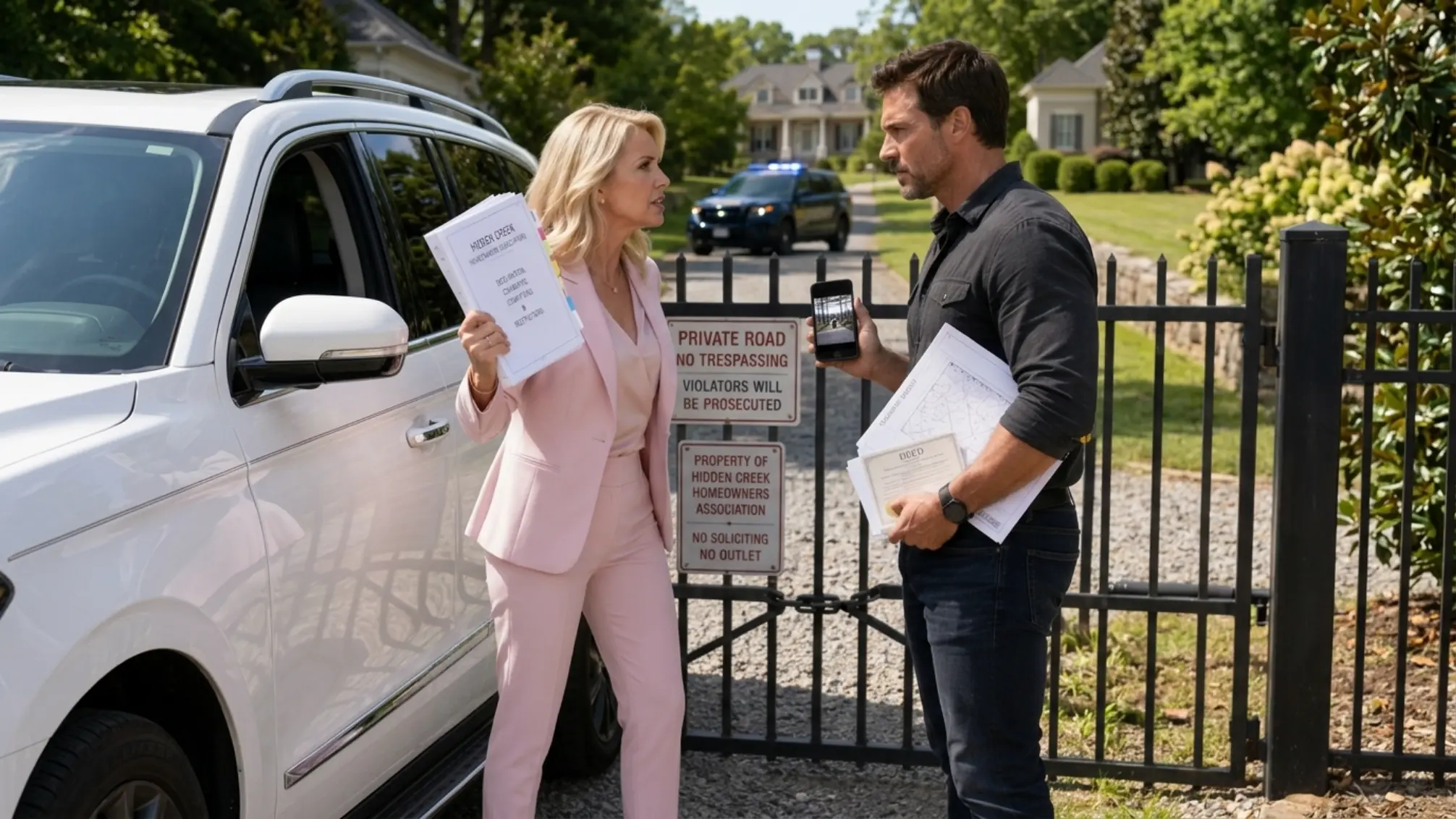
“Open this gate,” Marissa said. “One hundred families use this access road.”
“It isn’t an access road.”
“It has served this community for ten years.”
“It has crossed private property for ten years.”
Marissa lifted the HOA folder and stepped closer. She was forty-six, polished and beautiful, with shoulder-length blonde hair arranged in soft waves and the practiced expression of someone accustomed to winning arguments before anyone examined the facts. “You bought land beside our neighborhood,” she said. “That does not give you the right to disrupt everyone’s commute.”
Ethan stood on the opposite side of the locked steel gate, holding his deed and property survey. At forty-two, he had spent most of his adult life building homes, repairing equipment, and saving for the quiet property where he now lived with his wife. His dark work shirt was rolled at the sleeves, and his boots were dusty from replacing another lock someone from the neighborhood had cut.
“My deed gives me exactly that right,” he said. “This path is inside my property line.”
Marissa struck the folder against the gate. “Open it, or the HOA will take the road in court and bankrupt you first.”
Ethan held up his phone.
The screen displayed security footage of Marissa standing beside a man with bolt cutters three days earlier. The video showed them cutting Ethan’s chain, entering his land, walking around his garage, looking through the windows of his house, and photographing everything.
“Perfect,” Ethan said as a sheriff’s cruiser appeared behind her SUV. “Tell the deputy why your bolt cutters, copied key, and trespassing are all recorded.”
Three years earlier, Ethan had purchased the rectangular rural lot on the eastern edge of Hidden Creek Estates. The previous owner had been an elderly hunter who used a small cabin on weekends and rarely visited during the workweek. After his death, his children sold the property, and Ethan replaced the cabin with a modest house, workshop, and fenced garden.
The neighborhood beside him was newer and far more expensive. Hidden Creek contained nearly one hundred twenty homes built around landscaped ponds, stone entrances, and identical mailboxes approved by a homeowners association. The development had one official entrance on the western side, forcing residents to drive two miles south before reaching the highway.
The gravel path across Ethan’s property provided a faster route.
Someone leaving Hidden Creek could use it to reach the eastern county road and save five or six minutes. The path had existed for decades as an agricultural lane, never as a public street. The previous owner either tolerated the traffic or remained unaware because residents usually crossed during weekday mornings when he was absent.
Ethan discovered the problem three weeks after moving in.
He was drinking coffee on the rear porch when four cars passed through his land within ten minutes. None slowed near the house. Drivers behaved as though the path belonged to the neighborhood and Ethan’s property merely surrounded it.
The following morning, he waited beside the lane.
The first driver was a man in a pickup truck who lowered his window with visible irritation. Ethan explained that the road crossed private land and asked him to use the neighborhood’s official entrance.
“I’ve been driving through here for six years,” the man answered.
“I understand.”
“So you’re blocking the shortcut?”
“It isn’t a shortcut. It’s my property.”
The man shook his head and drove away.
Ethan had similar conversations with several residents that week. No one threatened him directly, but nearly everyone treated his request as unreasonable. Their argument remained the same: they had used the road before Ethan arrived, therefore his ownership should not inconvenience them.
Ethan contacted the HOA management company.
The employee who answered explained that his property was not part of Hidden Creek and therefore remained outside the association’s authority. She suggested installing signs if he wanted residents to stop crossing.
Ethan purchased four large PRIVATE PROPERTY—NO TRESPASSING signs and installed two at each end of the road. He placed a chain across the entrance nearest Hidden Creek with another warning sign hanging from the center.
Someone removed it the next day.
Ethan replaced the chain.
It was removed again.
After the fourth incident, someone cut through one of the links and left the broken chain in the mud.
Ethan drove to a farm-supply store and purchased two heavy steel gates. He secured one at the Hidden Creek entrance and another where the road reached the county lane. Concrete-set posts supported both, and commercial padlocks prevented anyone from opening them without a key.
For four days, no vehicles crossed.
Then Ethan returned from work and found a letter nailed to his front door.
The unsigned notice accused him of blocking a community access route used for more than a decade. It claimed the closure affected over one hundred families and demanded immediate removal of the gates. The writer identified herself only as an HOA board member and threatened legal action if Ethan refused.
He photographed the letter and placed it in a file.
Two mornings later, Marissa arrived for the first time.
She sat in her SUV and pressed the horn repeatedly until Ethan walked down the path. When she learned he was the owner, she demanded that he open the gate and described the gravel lane as “community infrastructure.”
Ethan showed her the survey.
She barely looked at it.
“This road has been used openly for years,” she said. “You cannot suddenly erase that.”
“The road was never theirs.”
“Usage creates rights.”
“Not automatically.”
Marissa lifted her phone. “I’m calling the police.”
“Go ahead.”
A sheriff’s deputy arrived twenty minutes later. Ethan returned to the house, collected the recorded deed and certified survey, then met the deputy beside the gate. The young officer studied both documents and compared the property markers to the county map on his computer.
“This is clear,” he said. “The road is inside your boundary.”
Marissa folded her arms. “But the community has used it for ten years.”
“That does not make it public.”
“There must be an easement.”
“There isn’t one in the county record.”
She pointed at Ethan. “He is deliberately trapping residents inside the neighborhood.”
The deputy glanced toward Hidden Creek’s open western entrance. “The subdivision has a public road leading out.”
“It adds six minutes.”
“That is not a law-enforcement emergency.”
Before leaving, the deputy warned Marissa not to damage the gate, locks, or signs. Unauthorized entry could result in charges for criminal trespassing and destruction of property.
Marissa drove away without answering.
The deputy advised Ethan to install cameras.
Within one week, Ethan mounted six security cameras around the property. Two covered each gate, another watched the main driveway, and the final camera overlooked the house and workshop. Every recording uploaded immediately to a cloud account, ensuring that destroying a camera would not erase the footage.
The cameras revealed that the warnings had changed nothing.
Twice, unidentified people attempted to pry open a padlock with a metal bar. During another incident, a person wearing a baseball cap arrived with bolt cutters and removed the lock completely. Ethan filed reports, supplied recordings, and replaced the damaged hardware with stronger locks and secondary chains.
The deputy admitted that identifying the intruders remained difficult because they covered their faces.
Ethan consulted an attorney.
The lawyer confirmed that he could take reasonable measures to protect private land after repeated trespassing and documented property destruction. State law permitted commercial tire-deflation devices on private roads if the property owner installed adequate warnings and did not create an indiscriminate hidden hazard.
Ethan purchased two one-way strips similar to those used at secured parking exits. The metal teeth remained flat when vehicles traveled outward from inside the property but punctured tires if someone drove inward from outside. He installed each strip ten feet beyond the gates, entirely within his boundary.
Then he added bright yellow signs:
WARNING: PRIVATE PROPERTY
TIRE-DEFLATION DEVICES IN USE
TRESPASSERS WILL BE PROSECUTED
Two signs hung on every gate.
For fourteen days, the property remained quiet.
Ethan hoped the dispute had ended.
Then he and his wife left town for a weekend.
On Saturday morning, his phone received a motion alert from the Hidden Creek gate. Ethan opened the live feed and saw Marissa standing beside a man carrying bolt cutters.
Both examined the warning signs.
The man cut the chain anyway.
They entered on foot and followed the gravel lane toward Ethan’s house. Because they were walking, the tire-deflation strips posed no danger. For nearly fifteen minutes, they explored the property without permission.
The man photographed Ethan’s workshop, gates, cameras, drainage ditch, and rear porch. Marissa stepped close to the living-room window and looked inside. Near one camera, the microphone recorded part of their conversation.
“This entire section could be reclassified,” she said. “The board needs to know what we can take.”
The sentence transformed Ethan’s anger into something colder.
They were not confused residents searching for directions. Marissa was gathering information for an organized attempt to seize permanent access across his land.
Ethan saved every recording.
On Monday morning, he filed another police report, providing a USB drive containing the trespassing, damaged chain, and audio. Later that week, he received a formal notice from the HOA management company stating that Hidden Creek intended to explore a prescriptive easement claim based on historical use.
The letter requested that Ethan remove the gates and tire strips during legal review.
His attorney almost laughed when he read it.
A prescriptive easement required open, hostile, continuous use for at least twenty years under state law. Hidden Creek had existed for only ten. More damaging to the HOA’s position, Ethan had immediately revoked any implied permission after discovering the traffic.
County archives revealed something even worse for Marissa’s case.
When Hidden Creek was originally planned, the developer approached the previous landowner and offered to purchase a strip for a second entrance. The owner refused. The rejection was documented in planning records and acknowledged by the developer.
The HOA had always known the road was private.
Its residents crossed not because anyone believed it was public, but because years of convenience made them behave as though permission no longer mattered.
Three weeks later, Ethan was served with a lawsuit.
Hidden Creek sought a court order forcing him to remove the gates and grant the neighborhood a permanent easement. The complaint also accused him of creating a dangerous trap through the tire-deflation strips.
Ethan’s attorney filed a response supported by the deed, survey, police reports, warning-sign photographs, damaged locks, videos, and original planning documents. They also requested internal HOA communications related to the road.
The records contained repeated references to an “eastern private access path.”
One board meeting discussed maintaining informal neighborhood use without contacting the owner because a formal agreement would likely require payment. Another set of minutes acknowledged that no easement existed but suggested continued use might create one eventually.
Marissa had signed both documents.
The case was already weakening.
Then she gave Ethan the strongest evidence he could have requested.
Three weeks before the hearing, Ethan traveled out of town for work. While reviewing camera footage after returning, he saw Marissa’s SUV pull up to the Hidden Creek gate at two o’clock in the afternoon.
She exited alone.
This time, she carried no bolt cutters.
She had a key.
Marissa inserted it into Ethan’s padlock, opened the gate, and returned to her SUV. No one had permission to duplicate the key, and Ethan could not determine how she obtained one.
The camera captured both warning signs directly beside her face as she entered.
Marissa drove forward.
Ten feet beyond the gate, the front tires struck the deflation strip. The SUV dipped abruptly. Instead of braking, she accelerated in panic and swerved from the gravel road.
The right front tire began collapsing as the SUV slid sideways into the shallow drainage ditch. It did not roll, but the nose settled into soft soil while the driver’s side remained tilted upward.
Marissa climbed out visibly shaken.
She stared at the signs, the strip, and the disabled vehicle before calling for help. A tow truck arrived thirty minutes later, followed by another car carrying two HOA representatives. They stood beside the gate discussing the scene before the tow operator removed the SUV.
Both front tires were flat.
No one closed the gate.
Ethan called his attorney immediately.
The lawyer watched the footage twice.
“They are suing you because these strips supposedly threaten innocent drivers,” he said. “Now their board president has unlocked your private gate with a copied key, ignored four warning signs, trespassed again, and driven directly into the device.”
“What do we do?”
“Preserve everything.”
Ethan made multiple copies and filed another police report. This time, deputies identified Marissa clearly and issued a formal citation for criminal trespassing. She also faced a property-damage allegation because forcing the gate open bent part of the mounting hardware.
The courtroom hearing drew more attention than either side expected.
Hidden Creek’s attorney argued that residents had openly used the road for a decade and had come to rely on it. He described the tire strips as a reckless escalation that could injure visitors or delay emergency responders.
Ethan’s attorney dismantled the argument piece by piece.
He presented the statutory twenty-year requirement. Hidden Creek had existed for half that period. The developer’s rejected purchase offer proved that everyone involved knew the path belonged to someone else.
Then he displayed internal HOA minutes.
The documents referred to private property repeatedly and showed that the board understood it lacked legal access. Continued trespassing had not resulted from an honest mistake.
It had been a strategy.
Next came the timeline.
Ethan first asked residents politely to stop. When they ignored him, he installed signs. When they removed the chain, he replaced it. When someone cut the chain, he installed gates. After repeated attempts to damage the gates, he added cameras and filed reports.
Only after further destruction did he install legal tire-deflation devices with multiple visible warnings.
Finally, the attorney played the recordings.
The courtroom watched Marissa and the unidentified man cut Ethan’s chain. They saw them enter his land, inspect his workshop, look through his windows, and discuss reclassifying the property.
Marissa shifted uncomfortably beside her lawyer.
Then the second video began.
Her white SUV approached the gate.
She unlocked Ethan’s padlock with a key.
She looked directly at the bright warnings.
She drove through anyway.
The vehicle struck the tire strips and slid into the ditch.
“Your Honor,” Ethan’s attorney said, freezing the image with both signs visible, “this was not an innocent driver making a wrong turn. The gate was locked. The defendant possessed an unauthorized key. She had been warned by a deputy and cited after previous trespassing.”
The HOA attorney argued that emergency vehicles might still be endangered.
Ethan’s attorney produced an aerial map. Ethan’s residence had a separate legal driveway from another road, the route local fire and ambulance services already used. No emergency responder needed to break through a locked gate on an unrelated private farm lane.
The judge recessed for one hour.
When he returned, his ruling was direct.
The prescriptive-easement claim failed because the statutory period had not been satisfied. The HOA’s documents demonstrated knowledge that the path remained private, and Ethan had taken immediate action to stop unauthorized use once he became aware of it.
The judge also found the tire-deflation devices lawful under the circumstances.
They were inside a locked, signed gate following repeated property damage. He compared them to properly marked electric fencing used to protect agricultural land.
Then he addressed the HOA representatives.
“The conduct of your board president is troubling,” he said. “She repeatedly entered property after explicit notice, damaged security measures, and used an unauthorized key while this litigation remained pending.”
Marissa looked down.
“The plaintiff should consider itself fortunate that the defendant has not yet pursued damages.”
Ethan’s lawyer leaned toward him.
“That sounds like an invitation.”
They filed a countersuit the following week.
The claim sought reimbursement for cut chains, destroyed locks, bent gate hardware, cameras, security improvements, attorney fees, harassment, and repeated trespassing. The total exceeded $14,000.
Hidden Creek settled before a second trial.
The final agreement required payment of nearly $15,000. Marissa personally paid approximately $3,800 related to her individual trespassing and property damage. The remainder came from the HOA budget, meaning every homeowner helped pay for the conflict their board allowed her to create.
The HOA also agreed to send an official notice to all residents.
It stated that the eastern gravel path was private property, contained lawful security measures, and could not be used without written permission. Residents caught trespassing would face HOA fines in addition to possible criminal charges.
Most homeowners reacted not with anger toward Ethan, but toward Marissa.
Their dues had funded a lawsuit built on documents proving the board already knew it would lose. Several residents had warned her to abandon the fight after the deputy confirmed Ethan’s ownership.
She refused.
One month after the settlement, Marissa resigned.
According to a neighbor who later spoke with Ethan, she attempted to rally support during a final board meeting. Residents shut her down before she finished speaking. No one wanted another lawsuit, increased dues, or another public recording of their HOA president climbing through someone else’s property.
Ethan kept both gates.
He maintained the cameras, signs, and tire strips. The shortcut remained closed, while Hidden Creek residents used the same official entrance their development had possessed from the beginning.
Their commutes became six minutes longer.
Ethan’s land became quiet.
One evening, the original deputy stopped beside the gate while Ethan was checking the lock.
“Everything settled?” he asked.
“Almost fifteen thousand dollars later.”
The deputy looked toward Hidden Creek. “All this for six minutes.”
“No,” Ethan said. “For believing convenience creates ownership.”
The deputy nodded.
Marissa had threatened to take Ethan’s road and bankrupt him first. She arrived carrying an HOA folder, confident that one hundred families outweighed one man’s deed.
In court, the number of families never mattered.
The survey mattered.
The warnings mattered.
The cut chains mattered.
And most of all, the recordings mattered.
Marissa believed the cameras would capture a frightened property owner surrendering to pressure. Instead, they preserved every choice she made after learning the land was not hers.
She ignored the signs.
She cut the chain.
She copied the key.
She entered the gate.
Then she drove straight into the evidence that ended her authority.