At 5:32 on a cool Tennessee morning, the first heavy-duty tow truck rolled onto Hollow Creek Road with its amber lights flashing through the fog. A second truck followed less than a minute later, and a third stopped beside the eastern fence of Travis Mercer’s family farm. Travis stood near the gate holding a mug of black coffee in one hand and a thick binder of evidence beneath his other arm. After eight months of warnings, surveys, lies, and trespassing, Karen Holloway’s luxury motor home was finally leaving his property.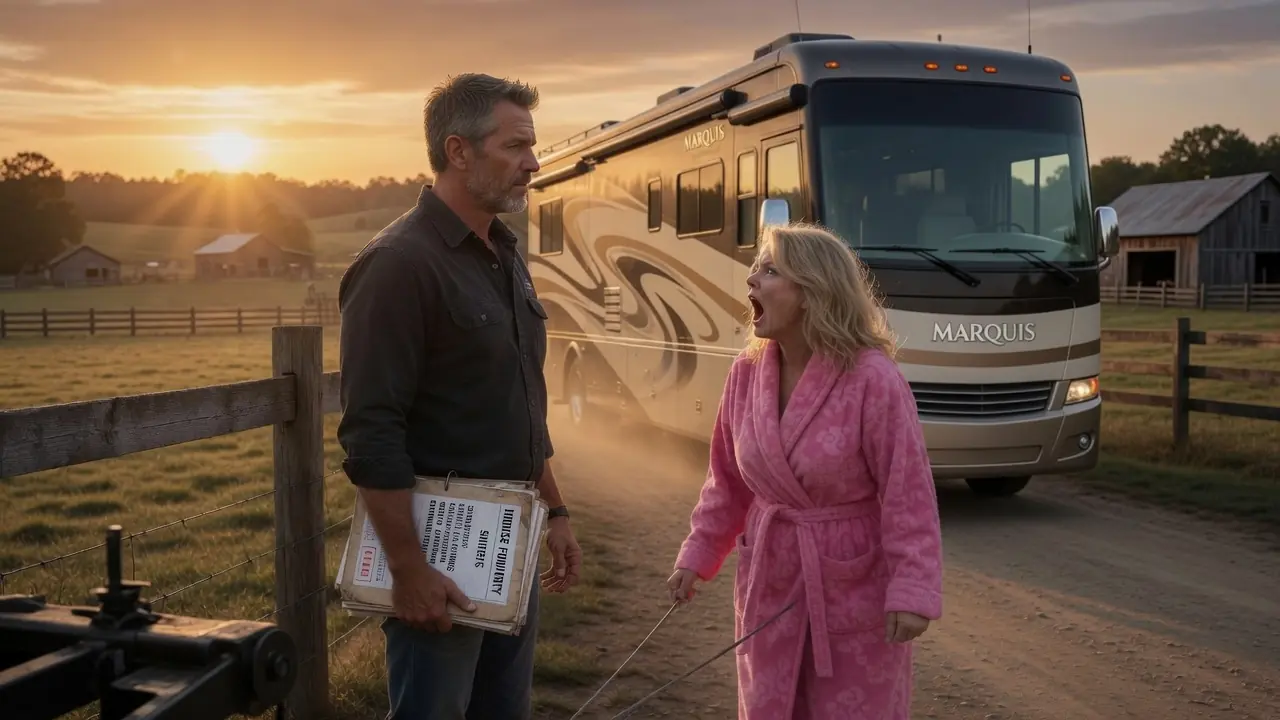
At fifty-seven, Travis was a ruggedly handsome widower with a strong build, short salt-and-pepper hair, a neatly trimmed beard, and steady blue eyes that rarely revealed anger. He wore a fitted charcoal work shirt, faded jeans, and worn brown boots, the same practical clothes he had favored during thirty years in the towing business. His wife, Susan, had died five years earlier, and since then he had preferred quiet mornings, time with his daughter Emily, and peaceful evenings on the porch they once shared. The farm had become both his home and the last place where his memories still felt untouched.
Sheriff Ben Harrison arrived carrying a folder and a paper cup of coffee. He inspected the posted towing signs, compared the survey markers with the map, and reviewed the authorization documents one last time. Then he gave Travis a small nod.
“Everything is in order.”
The lead tow operator moved toward the forty-foot motor home parked beneath Travis’s oak trees. The machine looked less like a vehicle and more like a luxury apartment, with four extended slide-outs, an outdoor television, decorative lights, a wooden platform, and a satellite dish. It had remained in that exact position for nearly nine months. Karen had behaved as if it were permanent.
Steel cables tightened beneath the RV.
That was when the front door of Karen’s house flew open across the road.
She charged down the driveway wearing a bright pink bathrobe and slippers, her blonde hair only half brushed. Even at that distance, Travis could hear her shouting. She crossed the road without checking for traffic and pointed directly at the tow operator.
“What do you think you’re doing?”
No one stopped.
Her gaze moved from the cables to the sheriff and finally to Travis.
“You can’t take my RV!”
Travis raised the signed authorization papers. “Actually, Karen, I can.”
She believed the RV was the worst thing she was about to lose. She had no idea that Travis’s binder contained proof of every dollar she had earned by renting out land she did not own. The tow was only the beginning.
The conflict had started eight months earlier on a quiet Tuesday morning.
Travis stepped onto his wraparound porch with his coffee and immediately noticed that something had changed along the eastern edge of the farm. A massive champagne-colored motor home sat beneath the oldest oak trees, more than twenty feet inside his property line. Its slide-outs were already extended, and Karen’s expensive SUV was parked beside it.
For several seconds, Travis assumed a driver had made a mistake.
Then he saw the folding chairs and welcome mat.
He crossed the field and knocked on the RV door. Karen emerged wearing oversized sunglasses and holding a travel mug. She smiled as if finding her vehicle on his land were entirely normal.
“Morning, Travis.”
“Karen, you know this is my property.”
“Yes.”
“Then why is your motor home parked here?”
“It’s temporary.”
Travis asked how long temporary meant. Karen shrugged and said perhaps several days, maybe a week, until she found a better storage solution. He told her plainly that the RV had to be moved onto her side of the road.
Karen thanked him for being understanding.
One week passed.
Then two.
By the end of the month, an electrical cable stretched from Karen’s house to the motor home. A water hose crossed the roadside ditch, and outdoor furniture had appeared beneath the trees. When Travis confronted her again, Karen acted annoyed by the interruption.
“It still needs electricity,” she said.
“It also needs to leave.”
“You’re not using this section of the farm.”
“That doesn’t make it yours.”
Karen smiled tightly. “You have seventy acres, Travis. I’m borrowing a narrow strip.”
“No. You’re trespassing on it.”
He mailed her a polite letter with a copy of the property survey. She ignored it. Thirty days later, he sent a certified notice demanding removal of the RV. Karen signed for the envelope but never responded.
Instead, she added string lights.
Then came a wooden sign:
WELCOME TO MAGNOLIA CREEK RV LOUNGE
Magnolia Creek was the new subdivision across the road from Travis’s farm. Its brick entrance, identical houses, and rigid homeowners association had arrived less than five years earlier. Most residents were decent people, but Karen had become HOA president almost immediately and treated the title like personal authority over everyone living nearby.
She had introduced herself to Travis by announcing her office before giving her name.
Within weeks of moving in, she suggested that his grassy roadside strip would make an excellent community recreation space. Travis told her the land was not for sale. Karen responded that perhaps they could “work something out.”
Apparently, parking a luxury RV there without permission was her version of working something out.
The situation became more serious when Travis’s daughter Emily called him one afternoon.
Emily was thirty-two and worked as a property attorney in Nashville. She had inherited her father’s patience, but not his willingness to tolerate obvious nonsense. Her voice sounded unusually controlled when she asked a strange question.
“Dad, why is your home address listed on a vacation-rental website?”
Travis stopped repairing his mower. “What?”
She sent him a link.
The listing showed Karen’s motor home beneath Travis’s oak trees. It advertised a “luxury private farm retreat with peaceful country views,” using his address and photographs of his land. Reviews praised the sunsets over his fields, the privacy of his property, and the shade beneath his century-old trees.
Karen had completed twelve bookings.
She was not merely trespassing.
She was selling access to Travis’s land.
Emily instructed him to save everything. Within hours, they downloaded the full listing, photographs, reviews, pricing, booking calendar, and host profile. Travis printed each page and placed it inside a new three-inch binder.
He labeled the first section RENTAL RECORDS.
A former guest named Carol Jenkins arrived at his farmhouse several days later. She had rented the RV with her husband and genuinely believed Karen owned the surrounding property. Karen had personally collected additional cleaning and recreation fees while describing the land as an HOA-managed country retreat.
“I’m sorry,” Carol told Travis. “We had no idea.”
“You didn’t do anything wrong.”
“She told us the trees, the field, and even the walking path belonged to the community.”
Travis looked toward the RV. “None of it does.”
Carol provided a written statement and copies of her receipts.
The binder grew thicker.
Then Travis learned Karen had convinced Magnolia Creek residents to pay an annual recreation assessment to maintain the so-called RV lounge. HOA newsletters described planned improvements to the “community grounds,” including additional parking and a picnic shelter. The grounds were still entirely on Travis’s farm.
Karen was collecting money from both renters and homeowners.
For months, Travis had tried to solve the issue like a neighbor. He now began approaching it like the former owner of a towing company.
He ordered a new professional survey even though the boundary had never been disputed. A licensed surveyor spent six hours checking GPS coordinates, deed descriptions, and original markers. His conclusion was clear: the RV sat more than twenty feet inside Travis’s property.
Travis added the signed report to the binder.
He photographed the electrical cable, water hose, furniture, signs, platform, outdoor fire pit, and every new guest vehicle. Each image received a date and time. When the Airbnb booking calendar changed, he saved another copy.
He was not seeking revenge.
He was building a record no one could dismiss as a misunderstanding.
Karen continued expanding.
One evening, Travis returned from town and found six HOA residents drinking wine beneath his trees. A man thanked him for allowing the community to use the space. Karen stood near the motor home smiling as if she had negotiated his permission personally.
Later, she approached him near the fence.
“You should let this go.”
“The RV is still on my property.”
“Look how many people enjoy it.”
“That doesn’t change ownership.”
Karen took a slow sip from her wine. “At some point, you need to accept that this land is more useful to the community than it is to you.”
That sentence ended Travis’s attempts at friendly persuasion.
He called Bo Lawson, an old friend who had once worked as a driver for Mercer Recovery Services. Bo now owned the largest heavy-towing company in three counties.
After hearing the story, Bo laughed for several seconds.
“She has been there eight months?”
“Almost.”
“You gave written notice?”
“Twice.”
“Current survey?”
“Completed last week.”
“Commercial use?”
“Rental income and HOA fees.”
Bo whistled. “Karen has built one impressive case against herself.”
They spent the next week reviewing Tennessee towing requirements. Travis completed every necessary form, registered the property as a legal private tow zone, and posted six reflective signs along the boundary.
PRIVATE PROPERTY
AUTHORIZED VEHICLES ONLY
UNAUTHORIZED VEHICLES SUBJECT TO TOWING
Each sign included the required company information and telephone numbers. Travis photographed the placement and documented the installation date.
Karen drove past them daily without reacting.
Then one morning, she walked onto his land, grabbed one of the signs, tore it from the ground, and threw it into the ditch.
She did not know Travis had installed security cameras.
The footage showed her face, the sign, the date, and the deliberate removal in perfect detail. Travis saved three copies and added them to the binder.
By late summer, several Magnolia Creek residents had begun asking Karen whether the RV site truly belonged to the HOA. She gave long speeches about community benefit, historical access, and shared resources but never provided a deed or survey.
Questions spread.
Karen responded by planning something bigger.
A bright flyer appeared in Travis’s mailbox announcing the Magnolia Founders Day Festival. It promised live music, a beer garden, food trucks, children’s activities, and nearly two hundred guests.
The attached map placed the entire festival on Travis’s property.
The stage stood beneath his oak trees. Vendor parking covered his field. Portable restrooms, storage trailers, and the beer garden were arranged across the strip Karen had claimed as an HOA recreation area.
Travis created another binder section.
FOUNDERS DAY
Karen promoted the event online every day. Each post provided more evidence that she intended to use land she had repeatedly been told she did not own. Food-truck companies posted arrival times, vendors published maps, and the HOA announced that 173 people had confirmed attendance.
Two days before the festival, trailers began arriving.
Travis photographed every one.
The evening before the event, he called Bo.
“We’re ready.”
“We have been ready for months,” Bo replied.
The towing operation began before dawn to prevent a confrontation involving hundreds of guests. Three trucks arrived at 5:32, followed by Sheriff Harrison and two deputies. The sheriff had already reviewed the surveys, notices, camera footage, and towing authorization.
Once he declared everything lawful, Bo’s operators began preparing the RV.
Karen arrived screaming minutes later.
“This is theft!”
Sheriff Harrison remained calm. “No, ma’am. This is a lawful private-property tow.”
“I’m calling my attorney.”
“You are free to do so.”
“I’m the HOA president!”
“That does not give you authority over Mr. Mercer’s farm.”
Karen turned toward Travis. “Stop them now.”
He held up the binder. “You ignored two certified notices, six posted signs, and a legal survey.”
“This land belongs to the community.”
“No, Karen. It belongs to me.”
The hydraulic system lifted the front of the motor home. For the first time in nearly nine months, its enormous wheels began moving.
Karen ran beside the operator, demanding that he stop. The deputies ordered her to remain clear of the equipment. She called HOA board members, attorneys, and anyone she believed might overrule the sheriff.
No one could.
By 6:30, residents began arriving for festival setup. They expected tents and food vendors but found tow trucks, deputies, and Karen standing in her bathrobe beside an empty patch of grass.
A food truck arrived, saw the scene, and immediately left.
Two more vendors followed.
The band canceled.
The portable-restroom company refused delivery when informed the landowner had never approved the event. Within an hour, the largest festival in Magnolia Creek history collapsed before it began.
The RV was the final vehicle removed.
As it disappeared down Hollow Creek Road, Karen stood motionless. Her face had gone pale, and her voice was quieter when she turned toward Travis.
“This isn’t over.”
Travis glanced at the evidence binder.
“You’re right. The towing part is over. The rest hasn’t started.”
Three days later, Emily returned to the farmhouse and spent four hours reviewing the complete record. She opened the rental documents, guest statements, HOA assessments, festival deposits, surveys, notices, and security footage.
Then she closed the binder.
“Dad, you’ve been thinking about this as trespassing.”
“It is trespassing.”
“It is also a business.”
Karen had earned money by advertising, renting, and collecting fees from property belonging to Travis. Under the law, he could seek compensation for unauthorized commercial use and unjust enrichment.
Emily filed suit the following week.
Karen responded by calling an emergency HOA meeting. She claimed Travis was attacking the community, destroying property values, and trying to bankrupt a volunteer organization. Several board members finally challenged her.
They asked why she had never shown them a survey proving ownership.
Karen had no answer.
During legal discovery, the rental platform produced booking records and payment information. HOA financial statements confirmed special recreation assessments. Emails showed Karen directing vendors to use Travis’s address. Meeting minutes revealed she had repeatedly described the land as an HOA asset despite knowing Travis disputed the claim.
The most damaging evidence came from Karen herself.
During her deposition, Emily asked why she believed she could use the property.
Karen answered, “I assumed the land wasn’t being used.”
Emily allowed several seconds of silence before continuing.
“Do you believe ownership disappears when land appears unused?”
Karen became angry. “He had more space than he needed.”
“That was not my question.”
“The community benefited from it.”
“Did my father consent?”
“He should have.”
“Did he?”
“No.”
The case reached court nearly one year after the motor home first appeared.
There was no shouting or dramatic surprise. Emily presented the evidence chronologically. She showed the deed, professional survey, certified notices, rental listing, guest reviews, HOA assessments, camera footage, festival map, and towing compliance records.
Karen’s attorney argued misunderstanding and community benefit.
The judge rejected both.
A misunderstanding might explain one day or one misplaced vehicle. It could not explain nine months of ignored warnings, profitable rentals, removed signs, collected fees, and an entire festival planned on another person’s land.
The judge studied a photograph of the wooden sign reading MAGNOLIA RV COMMONS beneath Travis’s oak trees.
“Who authorized this name?” he asked.
Karen lifted her chin. “The HOA board.”
“Did the HOA own the property?”
“We believed—”
“That is a yes-or-no question.”
“No.”
The written judgment arrived one week later.
Travis opened it on the porch where he and Susan had once watched summer storms. The court found Karen liable for continuing trespass, private nuisance, and unjust enrichment. The ruling emphasized that she had knowingly treated private land as both a commercial rental asset and an HOA-controlled recreation area.
The award totaled $20,417.
The figure included rental profits, collected fees, documented land-use value, property restoration costs, and legal expenses allowed by the court. It was not a fortune, and Travis did not need it to survive.
What mattered was the judgment’s message.
Karen did not have the right to take something because she believed another person was not using it properly.
The HOA removed her as president during an emergency vote. The decision was nearly unanimous. A new board formally recognized Travis’s property line, refunded improper recreation assessments, and deleted every reference to the Magnolia RV Commons.
Karen eventually recovered the motor home from the towing yard after paying substantial transport and storage fees. Several months later, she sold it.
Some memories were too expensive to keep.
Travis used part of the judgment to create a local vehicle-repair fund for veterans and struggling families. Bo’s towing company donated labor, while several independent garages offered discounted parts. The remaining money helped fund trade-school scholarships in honor of Travis’s grandfather and father, both men who had built their lives with their hands.
He spent the final portion taking his grandson Luke fishing.
They caught almost nothing.
Neither cared.
By the following spring, the grass beneath the oak trees had recovered. Travis installed a strong iron fence along the eastern boundary and mounted a brass plaque near the gate.
MERCER FAMILY FARM
ESTABLISHED 1951
Karen still lived across the road. Whenever she saw Travis, she avoided eye contact. He never mocked her, never mentioned the lawsuit, and never pointed toward the place where her luxury RV had once stood.
He did not need to.
The open field spoke for itself.
Karen Holloway had looked at a quiet strip of grass and assumed no one valued it. She mistook patience for permission, unused land for abandoned land, and HOA authority for ownership.
Then three tow trucks arrived at sunrise.
The RV disappeared first.
Her rental income, community reputation, HOA title, and twenty thousand dollars followed soon after.
Karen believed she had discovered a free place to park her luxury motor home.
What she actually found was the most expensive parking space in Tennessee.