Daniel Bronson bought the old Mallister farm because he wanted silence. After twenty years in law enforcement, silence felt more valuable than money, status, or anything else people chased once they had enough of it. The ninety-acre property in northern Georgia had a sagging farmhouse, a tired barn, a muddy pond, and fences that leaned like old men resting after hard work. To Daniel, every broken board and rusted hinge looked less like damage and more like something honest enough to repair.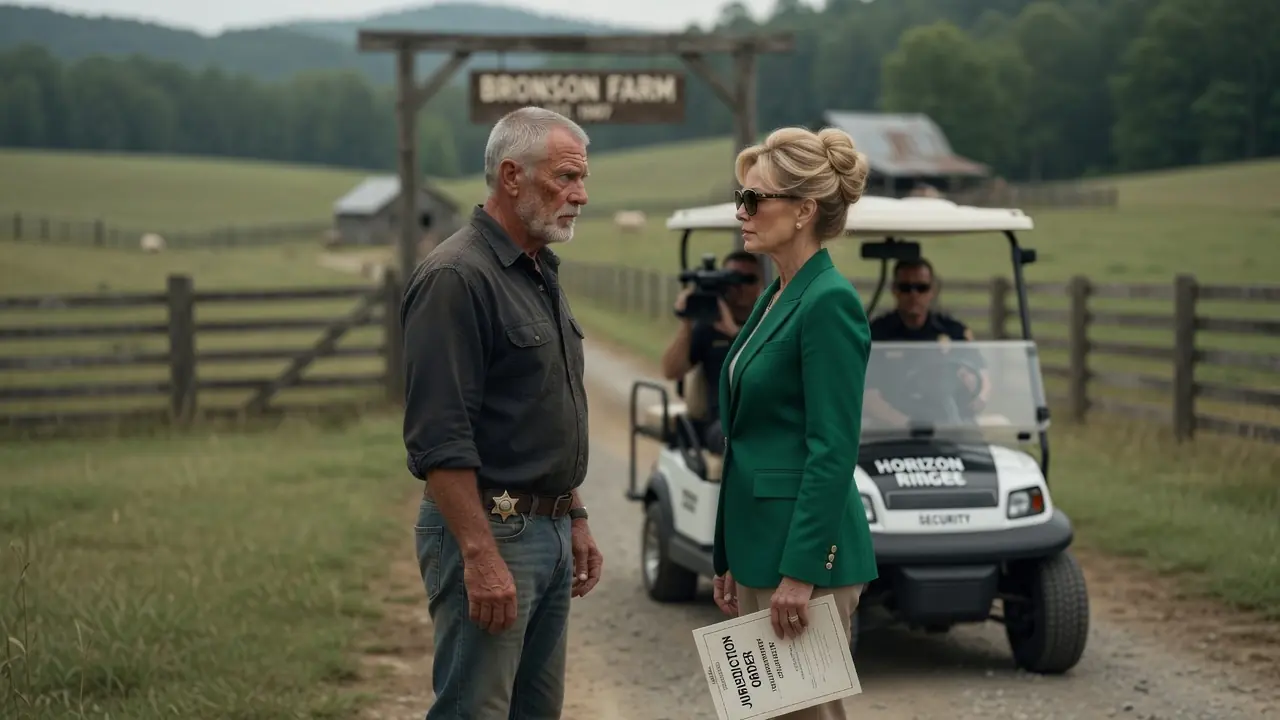
At sixty, Daniel remained broad-shouldered and physically strong, though gray had overtaken most of his short hair and neatly trimmed beard. His weathered face carried the calm, watchful expression of a man who had spent decades entering rooms where everyone else was already shouting. He wore dark work shirts, faded jeans, leather boots, and an old sheriff’s badge clipped discreetly inside his belt, though he rarely showed it. He had retired because he was tired of living around other people’s violence, excuses, and fear.
The first year on the farm gave him exactly what he needed. He rebuilt the barn roof, cleared weeds from the pond, repaired the porch, and restored the old tractor his father had taught him to drive as a teenager. Each morning began before sunrise with coffee, eggs cooked in a cast-iron skillet, and the sound of goats complaining from the lower pasture. At night, Daniel sat beneath the porch light and listened to cicadas instead of police radios.
Then Horizon Ridge Estates appeared along the eastern ridge.
The development rose quickly, replacing pine trees and wild grass with identical houses, concrete driveways, decorative fountains, and a stone entrance sign large enough to resemble a government building. Daniel did not object to new neighbors. The subdivision stood outside his property line, and his deed predated every house in it by more than half a century. Their rules had no authority over his farm.
For several months, the relationship remained distant but peaceful. Residents occasionally waved from passing cars, and a few families asked whether their children could see the goats from the fence. Daniel usually agreed, provided they stayed outside the pasture and did not feed the animals. He had no quarrel with people who respected a boundary.
The trouble began with a golf cart.
One Tuesday morning, Daniel noticed a white cart moving slowly along his northern fence. Two people in matching polo shirts sat inside, one driving while the other pointed toward the barn and wrote notes on a clipboard. They did not wave or introduce themselves. When Daniel walked toward them, the cart accelerated and disappeared behind the development’s decorative gate.
Two days later, a drone hovered above his driveway.
At first, Daniel assumed it belonged to a teenager testing a new toy. Then it lowered to within twelve feet of the ground, drifted over his equipment shed, and tilted its camera toward the windows. Daniel stepped into the open and stared directly at it. The drone immediately climbed and flew toward Horizon Ridge.
By the end of the week, three more golf carts had traced the fence line.
Daniel had learned long ago that one strange incident could be coincidence. Two might be poor judgment. Repetition created intent.
The first trespasser entered the farm on a cool Thursday afternoon.
Daniel was sharpening a brush-cutter blade inside the workshop when he heard boots grinding across the gravel behind the barn. He stepped outside and found a man wearing dark green tactical clothing, a body camera, and a vest printed with the words HOA SECURITY. The man held a large camera aimed at Daniel’s tractor.
“Your patrol trespassed into my barnyard and started recording my property,” Daniel said.
The man turned sharply. “We’re performing a perimeter integrity assessment.”
“This is private land.”
“Horizon Ridge civilian patrol has authority to monitor adjacent parcels for potential hazards.”
Daniel stared at him. “No, it doesn’t.”
The security officer lifted a radio and began reporting that the property owner was becoming confrontational. Daniel took one slow step closer. The man stopped speaking, backed toward the tree line, and then hurried to a waiting golf cart.
Daniel called Sheriff Lawrence Wells.
Wells had served under Daniel years earlier and later replaced him as county sheriff. A deputy arrived, photographed the boot prints, and filed a report, but the trespasser had already vanished. Daniel did not expect the HOA to admit anything.
The next morning, another patrol officer entered the barn itself.
This one wore tactical boots, utility pants, a body camera, and enough equipment to imitate a law-enforcement officer without actually being one. He filmed fuel containers, tools, the welding rig, and serial numbers on farm machinery. Daniel appeared behind him before the man realized he was no longer alone.
“You’re conducting a felony trespass,” Daniel said.
The officer raised his camera toward Daniel’s face. “You are interfering with an official safety inspection.”
“I spent twenty years wearing a real badge. Your costume has no authority here.”
The man’s confidence disappeared.
Daniel ordered him out. The officer retreated until he reached the barn door, then turned and ran toward another golf cart waiting beyond the pasture. Daniel photographed the vehicle as it sped away.
The following morning, Karen Whitlow arrived.
She stepped from a white luxury SUV wearing a cream blazer, tailored trousers, oversized sunglasses, and polished boots that had never crossed muddy ground willingly. Her blonde hair was arranged perfectly, and she carried a clipboard against her chest like a symbol of office. Behind her stood another private security officer beside a golf cart with flashing amber lights.
“You must be Daniel Bronson,” she said.
“That’s what the deed says.”
“I’m Karen Whitlow, president of the Horizon Ridge Homeowners Association.”
Daniel waited.
She continued as though her title should explain her presence. “Your behavior toward our security personnel has created concern.”
“Your personnel trespassed twice.”
“They were performing inspections authorized under our community safety charter.”
“Your charter ends at your fence.”
Karen smiled without warmth. “Not according to this.”
She handed him a document claiming Horizon Ridge possessed temporary jurisdiction over adjacent undeveloped parcels. The paper carried what appeared to be a sheriff’s-office seal and an official signature. Daniel recognized both immediately.
The seal had been discontinued six years earlier.
The signature belonged to a sheriff who had retired nearly a decade ago.
“That order is fake,” Daniel said.
Karen’s expression barely moved. “It is perfectly valid.”
“The seal is obsolete, and the man who signed it hasn’t held office in ten years.”
She lifted her chin. “Keep resisting, and I’ll have this entire farm condemned.”
Daniel pulled out his phone. “Try it. The current sheriff is already coming for whoever forged his office.”
Karen’s face changed for the first time.
Sheriff Wells arrived ten minutes later. He examined the document, looked at Karen, and asked where she obtained it. Karen insisted it came through official channels.
“This office never issued it,” Wells said. “Your organization has no jurisdiction over Mr. Bronson’s land.”
“We have community standards to protect.”
“You’re leaving.”
Karen glanced at Daniel. “This is not over.”
“No,” Daniel said. “Now it’s documented.”
After she drove away, Wells remained near the fence.
“You’re wondering why I didn’t arrest her,” he said.
Daniel nodded.
“That forgery is too polished for her to have created alone. Someone supplied templates, old signatures, and seals. If I take only Karen, everyone behind her disappears.”
“You think the developer is involved?”
“I think Karen is a loud piece of a quiet machine.”
Wells told Daniel to keep cameras running and record every contact. Daniel installed additional trail cameras near the pond, barn, and woods. He also upgraded the security system around the farmhouse.
For six days, nothing happened.
Then the drone returned.
It approached from the eastern ridge just before noon, passed low over the barn, and moved toward the house. Daniel watched it hover directly outside his bedroom window before turning toward the pond. A sudden gust forced it into an oak branch.
The drone spun violently and crashed into the water.
Daniel pulled it from the pond with a rake. It was expensive, fitted with multiple cameras, GPS hardware, and a large memory card protected inside a waterproof compartment. He dried the card, inserted it into an old laptop, and opened the first video file.
The footage was not casual.
It showed detailed passes over the barn, fuel tanks, livestock pens, equipment sheds, windows, gates, and blind spots around the house. Some recordings had been made at night. One showed Daniel inside his kitchen. Another hovered close to visiting children playing near the pond.
The surveillance had continued for weeks.
Daniel copied every file to three separate drives.
Then he found a document stored inside the drone’s memory.
PHASE TWO EXPANSION — PRELIMINARY DEVELOPMENT PLAN
The map showed new streets, twenty-one luxury homes, sewer connections, and private lake-access lots. Every line was drawn directly across Daniel’s farm. His house, barn, pasture, and pond had been erased and replaced with a planned expansion of Horizon Ridge.
One note stood out.
Current landowner likely resistant. Contingency options required.
The drone’s flight logs revealed nearly every mission began and ended behind one Horizon Ridge home. Property records identified the owner as Justin Marlow, the twenty-six-year-old son of Judge Gerald Marlow.
Daniel called Wells immediately.
The sheriff arrived, examined the drone, and requested copies of everything. He warned Daniel not to confront Justin or Karen yet.
“If we move too soon, they’ll claim this was one kid flying where he shouldn’t.”
“This map didn’t come from a kid.”
“No. It came from the people paying him.”
Two nights later, Daniel received a call from an unknown number.
The caller identified himself as Tobias Manning, a former Horizon Ridge security employee. His voice shook as he requested a meeting away from both the subdivision and the farm. Daniel agreed to meet near an old riverside picnic area.
Tobias arrived in a battered Honda and kept looking over his shoulder.
“I didn’t sign up for any of this,” he said.
“What did you sign up for?”
“Neighborhood patrol. Pool checks. Traffic. Stupid HOA stuff.”
“What changed?”
“Karen started ordering us to build a case against you.”
Tobias explained that officers had been told to photograph fuel containers, equipment, livestock waste, smoke, and anything that could be described as a code violation. When they found nothing serious, Karen ordered them to create pressure through constant patrols, surveillance, complaints, and trespassing.
Daniel remained silent until Tobias described the next phase.
“She wanted two men to bury contaminated soil near your pond,” Tobias said. “Enough to trigger an environmental investigation.”
Daniel’s eyes hardened. “They planned to poison my land.”
“She said it wasn’t dangerous. Just enough to force cleanup costs.”
“Who paid for it?”
“Candler Horizons, the developer.”
Tobias admitted Karen received bonuses for each property brought into the expansion plan. The HOA was not protecting residents. It was helping the developer force surrounding owners into selling.
Daniel told Tobias to preserve every text, email, order, and payment record.
“You are not in danger because you spoke to me,” Daniel said. “You were in danger the moment you knew too much.”
The attack came the following night.
At 1:42 a.m., Daniel heard metal strike stone beyond the pond. He took his shotgun, released his two hounds, and moved through the woods without using a flashlight. Voices carried from a clearing ahead.
Two men were digging a hole.
Beside them sat a black container marked with a yellow hazard symbol.
A trail camera above the clearing recorded the entire scene.
Daniel stepped into view and switched on a powerful flashlight. Both intruders froze. One dropped the shovel.
Daniel racked the shotgun once.
The sound cut through the woods.
“Your only warning,” he said. “Get off my land.”
The taller man raised both hands. “We’re leaving.”
“You’re leaving the container.”
“We were told it was only treated soil.”
“Karen Whitlow told you?”
Neither answered.
Daniel pointed toward the blinking trail camera. “Your faces, voices, tools, and that drum are already recorded.”
The shorter man whispered a curse.
Daniel told them to run.
They fled toward Horizon Ridge, crashing through branches while the hounds barked behind them. Daniel did not pursue. He photographed the drum, the hole, the shovel, and the path they had taken.
Sheriff Wells arrived shortly after sunrise.
He watched the trail-camera footage twice. Evidence technicians collected the container and sealed the area. Laboratory testing later confirmed it contained industrial chemicals capable of contaminating the pond and surrounding soil.
“This is felony sabotage,” Wells said.
“Then arrest Karen.”
“Soon. I still need the full chain.”
Daniel hired Roberta Dean, a land-use attorney known for dismantling fraudulent developments. She reviewed the drone data, forged order, expansion map, and chemical attack. Her conclusion was direct.
“This is not an HOA dispute. It’s attempted real-estate seizure.”
Roberta arranged an independent environmental inspection before Karen could weaponize anonymous complaints. A certified consultant tested Daniel’s pond, soil, waste systems, fuel storage, and livestock areas. Every result confirmed the farm complied with county and state regulations.
The Georgia Environmental Protection Division arrived three days later in response to multiple anonymous complaints from Horizon Ridge.
Daniel handed the inspectors the independent report before they began.
Senior Inspector Margaret Mills reviewed the documentation, toured the farm, and then watched the trail-camera footage of the men attempting to bury chemicals near the pond.
Her professional neutrality vanished.
“This was deliberate contamination intent,” she said.
She checked the complaint logs and discovered all reports had been submitted within minutes of one another from addresses inside Horizon Ridge. The agency opened an investigation into the complainants instead of Daniel.
The machine had finally started turning against Karen.
Justin Marlow broke first.
After learning Daniel recovered the drone and investigators had obtained flight records, Justin entered the district attorney’s office with an attorney. He surrendered emails, payment records, voice messages, development files, and recordings of Karen ordering surveillance.
One message captured her clearly.
“Keep him angry. Make Bronson crack. Once he becomes unstable, the land becomes pliable.”
Justin admitted the developer paid him to operate the drone and report Daniel’s daily schedule. He also confirmed Karen authorized the forged jurisdiction order and coordinated the environmental complaints.
Tobias provided written statements and text messages.
The two men from the woods were identified through camera footage. Faced with chemical-tampering charges, both agreed to cooperate. They admitted Karen gave them the container and promised payment after inspectors declared Daniel’s farm contaminated.
Sheriff Wells finally had the full chain.
The arrest occurred outside the Horizon Ridge clubhouse.
Karen stood on the steps wearing another cream suit and shouting at a resident over a minor landscaping violation. Sheriff Wells approached from behind with two deputies.
“You don’t run anything anymore,” he said.
Karen turned and forced a smile. “Sheriff, there must be a misunderstanding.”
“Karen Whitlow, you are under arrest.”
Her smile vanished.
The deputies read the charges: felony forgery, conspiracy, criminal trespass, unlawful surveillance, environmental sabotage, and attempted real-estate fraud.
“You have no evidence,” she snapped.
Wells held up a folder. “Your drone pilot gave us everything.”
“Justin would never betray me.”
“He already did.”
Karen’s face went pale.
“He gave us your emails, payment records, and voice messages,” Wells continued. “He also told us who supplied the old sheriff’s seal.”
Karen glanced toward the clubhouse, where residents had begun gathering. “I built this community.”
“You controlled it,” Wells said. “That isn’t the same thing.”
The handcuffs closed around her wrists.
Candler Horizons attempted to distance itself from Karen, but financial records connected company executives directly to her bonuses and the Phase Two plan. Investigators found secret acquisition budgets, forged complaint templates, and payments to the private patrol company.
The developer had targeted three other rural properties before Daniel’s.
Two owners had already sold after facing code complaints, anonymous threats, and sudden legal costs. Roberta reopened those cases and added their evidence to Daniel’s.
Judge Gerald Marlow recused himself from every related proceeding once his son’s involvement became public. Justin received probation, a large fine, and five hundred hours of community service in exchange for cooperation. Tobias was not charged because he had refused the chemical operation and voluntarily provided evidence.
Karen refused every reasonable plea offer.
At trial, she portrayed herself as a community leader who had relied on bad information. The prosecution answered with recordings of her own voice, the forged order, surveillance footage, payment records, and the chemical container.
The courtroom listened as one recording played.
“I don’t care if the violation is real,” Karen said. “We only need enough pressure to make him sell.”
Another showed her discussing Daniel’s pond.
“Once the state sees contamination, he’ll never afford the cleanup.”
Karen’s attorney asked that the recordings be excluded.
The judge refused.
Daniel testified calmly. He described the golf carts, barn trespasses, drone surveillance, forged document, expansion map, and attempted poisoning. Karen stared at him throughout his testimony, but he never looked away.
Her attorney suggested Daniel had escalated the conflict because of his law-enforcement background.
Daniel answered evenly.
“I retired to stop dealing with criminals. She brought them to my farm.”
The jury returned guilty verdicts on the primary charges.
Karen received a lengthy state-prison sentence, while several Candler Horizons executives faced separate fraud and conspiracy cases. Horizon Ridge HOA entered state receivership, its private patrol was dissolved, and every contract Karen authorized underwent audit.
The developer settled Daniel’s civil claims before discovery exposed additional internal records.
The settlement totaled $740,000, including property damage, privacy violations, legal costs, and compensation for the attempted contamination. Daniel used part of it to replace damaged equipment, strengthen the gates, and restore the woods near the pond. Most of the money remained untouched.
He had not fought for a payout.
He had fought because people who crossed one boundary without consequence rarely stopped at one.
Six months later, spring returned to the farm.
New grass covered the disturbed clearing, and fresh leaves appeared on the oak that had damaged Justin’s drone. Daniel repaired the final section of fence and installed a reinforced steel gate at the entrance. In the center, he bolted a simple sign.
PRIVATE LAND
NO HOA AUTHORITY
TRESPASSERS WILL BE PROSECUTED
Horizon Ridge changed as well.
The new board eliminated the fake patrol, refunded improper security assessments, and adopted rules preventing future officers from acting outside the development. Residents began visiting Daniel to apologize, though he assured them most had done nothing wrong.
“Just remember where your authority ends,” he told them.
Sheriff Wells still stopped by occasionally with terrible coffee.
One afternoon, they stood beside the truck watching the sun settle behind the barn. Wells mentioned seeing Justin Marlow wearing an orange roadside-cleanup vest along Highway 9.
“Five hundred hours,” Wells said. “He’ll have plenty of time to think.”
“And Tobias?”
“Working at the county feed store. Doing well.”
Daniel nodded.
The farm had returned to the quiet he originally purchased, but it no longer felt fragile. The silence was not the absence of danger. It was the result of having faced danger and refused to surrender.
Karen had believed a clipboard created authority.
Her patrol officers believed tactical clothing turned trespassing into an inspection. The developer believed forged documents and anonymous complaints could erase a deed older than its subdivision.
They had all mistaken Daniel’s isolation for weakness.
What they found instead was a retired sheriff who understood evidence, patience, and the difference between loud power and lawful authority.
One evening, Daniel walked to the pond as mist settled across the water. The goats moved quietly through the pasture, the restored barn stood firm beneath the fading sky, and no drone hovered above the trees.
He listened carefully.
No engines.
No radios.
No golf carts.
Only wind moving through pine branches and water touching the bank.
The silence had finally returned.
This time, it stayed.