The water struck Naomi Carter hard enough to push her backward into the flower bed.
Her heel sank into damp soil. One of the young plants she had spent the afternoon straightening folded beneath her shoe.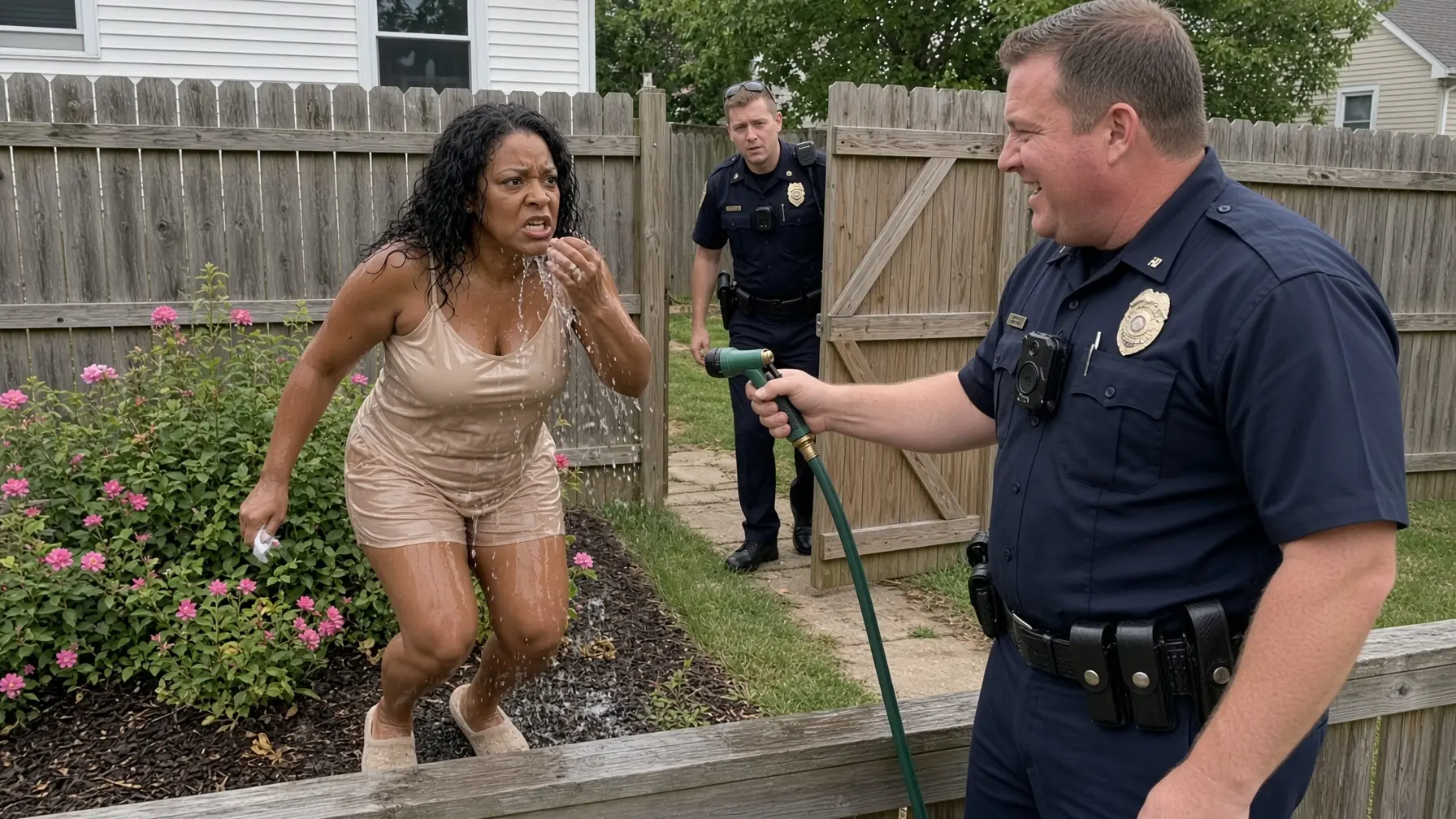
Officer Brett Mercer laughed.
Naomi looked at the nozzle in his hand, then at the darkening fabric across her chest. For a moment, the shock was so complete that she could not decide which part to react to first.
He was standing in her backyard.
He was holding her hose.
And he had just aimed it at her.
Behind him, Officer Ethan Cole leaned near the open gate, smiling.
Mercer squeezed the nozzle again.
Naomi turned her face, but the stream caught her shoulder and swept across her curls. Water ran into her eyes and down the sleeves of her pale-blue gardening shirt.
“Still feel important?” Mercer asked.
She wiped her eyes with the back of her hand.
“This is where people like you belong,” he continued. “Holding the hose.”
Naomi looked at his badge.
Then at the camera below it.
She did not tell him what she did for a living. She did not reach for him, threaten him, or try to pull the hose away.
“You entered the wrong backyard,” she said.
Mercer lowered the nozzle.
His smile widened.
“Lady, nobody here cares who you are.”
Then his radio came alive.
Naomi had chosen the house seven years earlier because its backyard was ordinary and its location made her life easier.
Bellweather Ridge sat outside Richmond, Virginia, in a neighborhood of stone façades, similar mailboxes, and lawns maintained with a consistency that sometimes made her feel she lived inside somebody else’s drawing.
She did not particularly love subdivisions.
She loved that her daughter could walk to school.
She loved that her mother lived twelve minutes away.
And after her divorce, she loved having a piece of ground she could arrange without negotiating every decision.
The garden had grown gradually.
Tomatoes along the south fence.
Lavender near the patio.
Hydrangeas beneath the kitchen windows.
Two raised beds and a narrow strip of wildflowers that had generated almost a year of emails from the homeowners association.
Someone had decided the native plants looked insufficiently maintained.
Naomi had read the rules, photographed the planting, and answered the complaints one by one.
The wildflowers stayed.
It was not the confrontation she enjoyed.
It was the point at which a person stopped insisting that preference and authority were the same thing.
By forty-four, Naomi had spent enough of her life reading documents to recognize that confusion quickly. Contracts, policies, procedures, and records often told a different story from the confident people explaining them.
She paid attention to both.
On Saturday afternoon, however, the only document she wanted to consult was the folded irrigation guide she had left on the kitchen counter.
Maya, her sixteen-year-old daughter, was at a friend’s house. Naomi’s mother had taken the dog to the veterinarian.
For a few hours, the house was quiet.
Naomi wore old beige trousers, white sneakers, and a gardening shirt already marked by soil at the cuffs. She had no reason to look polished for anyone.
At about three-thirty, she noticed that the irrigation beside the hydrangeas had stopped working.
She turned on the garden hose, disconnected a clogged section, and crouched beside the bed.
A voice came from the walking path beyond her fence.
“Excuse me.”
Naomi continued working.
People passed along the greenway all day. She assumed the voice belonged to someone speaking to a companion.
“Hey. You.”
She looked up.
A woman in a visor and white tennis skirt stood on the other side of the fence, holding a phone.
Naomi recognized her vaguely.
Linda Haskell lived two streets over and had developed a reputation for noticing things she believed required reporting.
Garbage cans.
Teenagers at the pool.
Dogs whose owners had not made the leash sufficiently visible.
Linda pointed toward Naomi.
“Do you live here?”
“Yes.”
“Which house?”
Naomi looked behind her.
“This one.”
Linda did not smile.
“I haven’t seen you before.”
“I’ve lived here seven years.”
“I walk this path every day.”
“Congratulations.”
The answer escaped before Naomi decided whether it was useful.
Linda’s expression hardened.
“What are you doing with that hose?”
Naomi glanced down.
“Gardening.”
“You’re messing with the irrigation.”
“My irrigation.”
Linda raised the phone.
“I’m calling security.”
“There isn’t neighborhood security.”
“The police, then.”
Naomi stood.
“For gardening?”
Linda looked toward the house as though it might contradict her.
Then she turned and walked away.
Naomi watched for a moment.
She was irritated, but she had other work to finish. A neighbor’s inability to recognize her did not seem capable of becoming much more than another unpleasant exchange beside the fence.