“That orphan owns eleven dollars,” the tractor dealer said, thrusting the $3,200 purchase offer toward the elderly farmer. “Give him this machine, and he’ll destroy it before winter.”
Seventeen-year-old Silas Bontrager stood barefoot in uncertainty despite the oversized work boots covering his feet. His faded plaid shirt had been washed so often that its original colors were almost impossible to recognize, and the duffel bag resting in the gravel contained every possession he owned. Yet his blue-gray eyes did not leave the dealer’s face.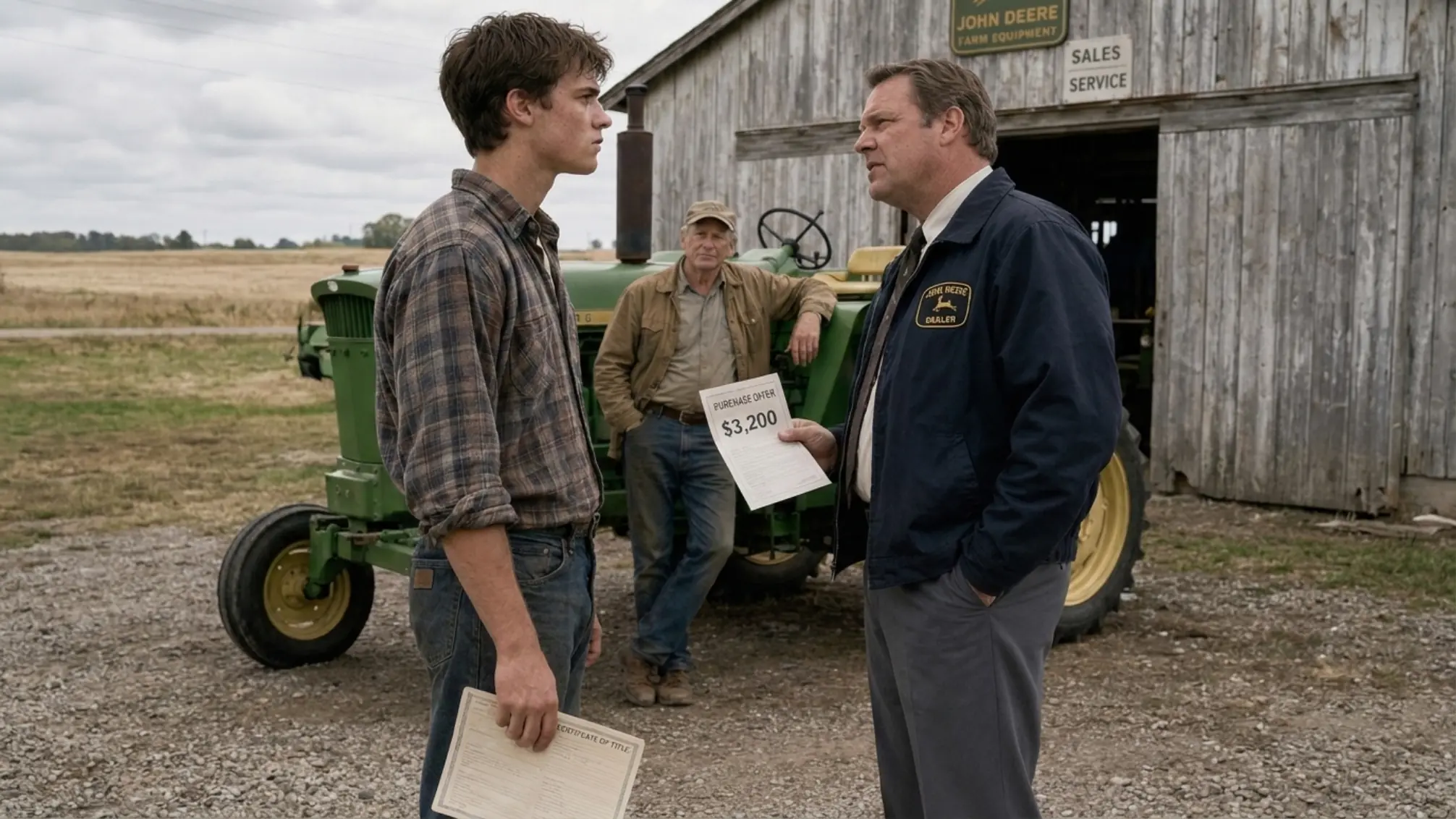
“Then stop counting my money,” Silas replied, gripping the freshly signed tractor title, “and watch what these hands can do.”
The dealer laughed. “Before harvest, you’ll beg me to haul that tractor away as scrap.”
Emmett Hassell rested one weathered hand against the green body of his 1962 John Deere 4010. At sixty-one, he had spent thirty-eight years farming the same Iowa soil and had never made a careless decision about machinery, money, or land. He looked from the dealer to the frightened boy and spoke with quiet certainty.
“Come back after harvest,” Emmett said. “You’ll see what eleven dollars and one honest chance can build.”
The dealer folded his offer and walked away shaking his head.
Silas remained in the gravel driveway holding the title as though it were written in a language he could not read. The tractor behind him was worth more money than he had ever seen. Its green paint was faded, its tires carried years of field dust, and its metal hood bore small scars from seventeen planting seasons.
Silas looked at Emmett. “Why?”
“Because you’re going to need it.”
“I can’t pay you.”
“I know.”
“I don’t understand.”
Emmett turned toward the farmhouse. “You will.”
That was the entire explanation.
Three months earlier, Silas had arrived in Eldora, Iowa, on a Greyhound bus. His ticket had taken him as far as eleven dollars could carry him, and when the driver announced the final stop, Silas stepped onto the sidewalk with no plan beyond avoiding another institution.
He had spent most of his childhood moving through foster homes in Des Moines. Some families were kind but temporary. Others made it clear that food, space, and patience were expenses he had not earned.
At seventeen, Silas aged out of the system with four shirts, one pair of jeans, oversized boots, and no relatives anyone had located. He entered a diner on Eldora’s main street and asked whether they needed a dishwasher.
Lorraine Webb, the woman behind the counter, looked at the thin boy for several seconds.
“You ever washed dishes before?”
“Yes, ma’am.”
“You ever washed two hundred plates before seven in the morning?”
“No, ma’am.”
“Then you haven’t washed dishes.”
Silas expected her to dismiss him.
Instead, Lorraine tied an apron around his waist and pointed toward the kitchen.
“Start learning.”
Emmett ate breakfast at Lorraine’s every Tuesday and Thursday. He first noticed Silas because the boy moved like someone trying to take up as little space as possible. He never leaned against the counter, never ate without permission, and never complained when the morning cook stacked another tray beside the sink.
For three weeks, Emmett said nothing.
On the fourth Thursday, he asked Lorraine where the boy came from.
She told him everything she knew.
Emmett finished his eggs, left his usual tip, walked to his truck, and then returned.
“Can you spare him Saturday morning?”
Lorraine glanced toward the kitchen. “Depends what you’re planning to do with him.”
“Teach him something useful.”
“That would be a first for most men who come through here.”
Saturday morning, Emmett picked Silas up outside the rented room above the hardware store. During the drive to the farm, neither spoke. Silas assumed the old farmer needed cheap labor and had already decided he would accept almost any work.
Emmett showed him the machine shed, grain bins, shop, and 480 acres of dark Iowa soil. Then he led Silas toward the John Deere 4010.
“You know anything about tractors?”
“Not much.”
“That’s better than thinking you know everything.”
Emmett showed him how to check the engine oil, hydraulic fluid, belts, and grease fittings. He explained that machinery rarely failed without warning. It made different sounds, changed temperature, vibrated, leaked, or resisted before breaking.
“The trouble,” Emmett said, “is that most people don’t listen until the machine starts screaming.”
Silas listened.
He returned the next Saturday and the Saturday after that. By August, he was spending evenings at the farm whenever the diner did not need him.
Emmett taught him to operate the 4010 without rushing the clutch or fighting the hydraulic controls. The old tractor responded differently from newer machines. It rewarded patience and punished force.
Silas developed an instinctive feel for it. He could hear a bearing changing long before the sound became obvious. He noticed small leaks and loose connections without being told where to look.
Emmett rarely praised anyone, but one evening he watched the boy adjust the tractor’s throttle by sound alone and quietly made a decision.
The dealer had offered $3,200 for the 4010. It was a fair price, and Emmett had a newer tractor capable of handling the heavy work. Selling the older machine would reduce insurance and maintenance expenses.
Yet every time he considered accepting the offer, he imagined Silas returning to the diner through winter with nothing but a rented room and hourly wages.
Emmett had no son waiting to inherit the farm. His wife had died eight years earlier, and his daughter lived in Cedar Rapids with no interest in agriculture. He understood that land and machinery did not automatically become a legacy simply because they remained inside a family.
Sometimes a person had to choose where the legacy went.
So Emmett rejected the dealer’s offer, contacted the courthouse, and transferred the tractor title to a seventeen-year-old orphan.
The morning after receiving it, Silas entered the machine shed before sunrise. He checked the oil even though Emmett had checked it the previous evening.
Emmett watched from the doorway.
“You expecting it to disappear?”
Silas wiped the dipstick. “Maybe.”
“It won’t.”
“People usually take things back.”
“I’m not people.”
Silas looked at him carefully, trying to determine whether the statement was a joke.
Emmett pointed toward the tractor. “If you want to keep something, maintain it. Fear doesn’t preserve machinery.”
Silas never forgot those words.
He worked at the diner throughout the winter and saved nearly every dollar. Lorraine sometimes found him sleeping in a booth between closing and the breakfast shift because his room above the hardware store had almost no heat.
In March 1980, Silas rented forty acres from a retired farmer named Clarence Peterson. The ground was not exceptional, but it was available, and Clarence agreed to take part of the rent after harvest.
Silas bought a two-row planter at auction for $220. It had rusted chains, worn bearings, and one damaged seed box. He rebuilt it inside Emmett’s shop using borrowed tools and parts salvaged from another machine.
When planting season began, Silas drove the 4010 into his first field.
He was eighteen years old and completely alone behind the wheel.
The straight black rows forming behind the planter looked like evidence that his life might finally be moving somewhere instead of merely ending wherever the next ticket or temporary room placed him.
The crop did not make him rich.
After rent, fuel, seed, repairs, and loan payments, almost nothing remained. Yet Silas had produced enough to plant again.
Emmett offered no empty congratulations.
“You planted too deep on the south end.”
Silas nodded. “I know.”
“You turned before the planter cleared twice.”
“I know.”
“You waited when the western ground was too wet.”
“Yes.”
“That was right.”
From Emmett, those three words felt like a medal.
By 1982, Silas farmed eighty acres. He paid off the planter and purchased a used 1968 John Deere combine for $1,400.
The combine arrived with a damaged feeder house and an engine that smoked under load. Silas spent the winter rebuilding it with a repair manual and tools purchased one at a time.
When the machine started cleanly in spring, he drove it past Lorraine’s diner.
She stepped outside, folded her arms, and stared.
“That thing looks older than you.”
“It is.”
“Does it work?”
“It does now.”
Lorraine smiled. “Then I suppose you do too.”
By 1984, Silas farmed 160 acres and employed two seasonal workers during planting and harvest. He purchased a small house at the edge of town, though it took him nearly six months to stop sleeping as if someone might order him to leave.
The people of Hardin County began speaking about him differently.
At first, he had been the foster boy Emmett allowed around his equipment. Then he became the boy with the old tractor. Finally, he became Silas Bontrager, the young farmer who maintained his machinery, paid his debts, and did not plant until the soil was ready.
The distinction mattered.
Emmett watched from a respectful distance. He answered questions when Silas asked them and resisted solving problems the younger man needed to understand himself.
In 1987, Silas married Helen Donnelly.
Emmett attended the wedding in the same canvas jacket he wore nearly everywhere. He offered no speech and left before the dancing became loud, but the following morning, Silas found a new set of mechanic’s tools inside the machine shed.
The card contained one sentence:
A family makes breakdowns more expensive.
Helen laughed for several minutes when Silas showed her.
Their first son, Aaron, was born the following year. Jonah followed in 1991, and Micah arrived in 1994.
Emmett visited the hospital after each birth. He stood awkwardly beside the bed, held each child as though newborns required the same careful balance as delicate machinery, and returned the baby before anyone could take a photograph.
The farm crisis of the 1980s destroyed operations much larger than Silas’s. Farmers who borrowed against inflated land values discovered that banks could turn decades of work into auction listings.
Silas survived because Emmett taught him never to borrow more than he could repay within two good seasons. He lost rented acres and postponed equipment purchases, but he never lost the tractor or his core ground.
The 4010 continued working.
Its engine was rebuilt once, its hydraulic system once, and nearly every hose, bearing, belt, and seal was replaced over the years. Silas used original parts whenever possible and refused shortcuts that would save money today by creating failure tomorrow.
Aaron learned to drive on the tractor at nine years old.
“Why this one?” the boy asked when newer machines sat nearby.
“Because this one tells the truth.”
“Tractors can’t talk.”
“This one can. You just don’t understand it yet.”
In 1997, Emmett suffered a stroke.
The weakness in his left side made operating machinery dangerous, and his daughter moved him into an assisted-living facility in Eldora. The farm equipment was sold, while the land was rented to a neighbor.
Silas visited every week.
Sometimes they spoke for an hour about crop prices, soil moisture, and repairs. Other times, Emmett sat near the window without saying much while Silas described what had happened on the farm.
One afternoon, Emmett asked about the 4010.
“Still running.”
“Oil pressure?”
“Good.”
“Hydraulics?”
“Rebuilt last winter.”
“Cost?”
“More than the tractor’s supposed to be worth.”
Emmett looked toward him. “Supposed by whom?”
Silas smiled. “A dealer.”
“That explains it.”
Emmett died in February 2001 at eighty-two.
After the funeral, Silas returned to his farm and entered the machine shed alone. The 4010 stood in the corner beneath a thin layer of dust.
He rested one hand on its hood and remained there for several minutes.
Then he checked the oil.
By 2015, Silas farmed more than eight hundred acres with Aaron as his partner. They owned modern tractors guided by satellites, an enormous combine, precision planters, grain carts, and equipment worth more than Emmett’s entire farm had once been.
The 4010 remained in the shed.
Aaron once asked whether they would ever sell it.
“No.”
“What if someone offers more than it’s worth?”
“They can’t.”
In April 2018, another young man arrived in Hardin County carrying nearly everything he owned.
His name was Tobias Marquez. He was nineteen, had recently left a group home in Waterloo, and reached Eldora after hearing there might be agricultural work available.
The manager at the cooperative called Silas.
“There’s a young man here who needs work.”
“Does he know farming?”
“No.”
Silas remembered an old farmer asking him the same question thirty-nine years earlier.
“Send him out.”
Tobias arrived at the farm wary, quiet, and careful about needing anything. He accepted every assignment without complaint, but Silas noticed something beyond obedience.
The young man watched machinery.
He did not merely see moving parts. He followed the logic connecting them. After operating the grain cart twice, Tobias began anticipating the combine’s movements without instructions.
Aaron noticed too.
“He has a feel for it,” Aaron said one evening.
“I know.”
“What are you going to do?”
“I’m thinking.”
Helen looked across the kitchen table. “You’ve already decided.”
Silas did not deny it.
Throughout the 2018 harvest, Tobias ran the grain cart without a serious mistake. He arrived before anyone else, checked equipment without being told, and asked questions only after attempting to reason through the problem himself.
On the last day of harvest, Silas asked him to come to the shop.
Three tractors stood in a row.
The first was the 1962 John Deere 4010.
Beside it stood a restored 1958 Farmall 560 and a 1971 John Deere 4020. Both were older working machines Silas had purchased and rebuilt over the years.
Tobias stopped in the doorway.
Silas let the silence remain.
Finally, Tobias asked, “What are they doing here?”
“I want to tell you about them.”
Silas walked toward the 4010 and placed his hand against its hood.
“This tractor was given to me when I was seventeen by a farmer named Emmett Hassell. I owned eleven dollars, four shirts, bad boots, and nothing else.”
Tobias looked at him.
“Why would he give it to you?”
“Because he believed I was going to need it.”
Silas pointed toward the other machines. “I bought and restored those because Emmett taught me that old machinery maintained correctly has more value than people assume. I also kept them because I wanted something worth giving.”
Tobias’s expression changed.
“Giving to whom?”
“To someone who was going to need it.”
Silas removed three folded titles from his canvas jacket and held them out.
Tobias did not take them immediately.
“What is this?”
“I’ve watched you since April. You have something Emmett saw in me. I don’t know exactly what to call it, but it doesn’t appear often.”
Tobias finally accepted the papers.
“The 4010 will teach you patience,” Silas continued. “The Farmall will teach you how to use power without wasting it. The 4020 will teach you balance.”
Tobias stared at the titles.
“Why?”
Silas heard his seventeen-year-old voice returning across thirty-nine years.
“Because you’re going to need them.”
“I can’t pay you.”
“I know.”
“I don’t understand.”
Silas looked at the 4010.
“You will.”
Aaron stood near the toolbox, no longer pretending to organize anything.
Tobias farmed his first forty acres in 2019. The spring was cold and wet, and neighbors pressured him to plant before the ideal window closed.
He waited.
The soil, Silas had taught him, carried more authority than the calendar.
His crop yielded better than many nearby fields planted too early. He did not become wealthy, but he earned enough to continue.
By 2021, Tobias farmed eighty acres and owned a rebuilt planter. By 2023, he managed 120 acres and hired a sixteen-year-old seasonal worker named Marcus Webb.
Tobias placed Marcus on the 4010 first.
The teenager struggled with the slower hydraulic response and complained that the tractor was difficult.
“It isn’t being difficult,” Tobias told him. “It’s being honest.”
“What does that mean?”
“It shows you what you’re doing wrong. New machines correct you before you notice.”
“How do you know that?”
Tobias looked toward Silas standing beside the field.
“Someone showed me.”
In the autumn of 2023, Silas turned sixty-one—the same age Emmett had been when he gave away the tractor. The John Deere was also sixty-one years old.
Helen pointed out the symmetry one evening.
Silas sat quietly before answering.
“I think Emmett knew what he was doing.”
“So do I.”
The tractor had survived three stewards because each treated maintenance as a responsibility rather than an expense. It was not preserved behind museum ropes. It still pulled wagons, powered augers, taught young operators, and carried the marks of honest work.
Emmett’s daughter had sold the original family land years earlier. By the conventional definition, his agricultural legacy should have ended.
It did not.
Legacy had traveled through attention rather than blood.
Emmett saw possibility in an orphan who could not yet see it in himself. He gave Silas the machine that made that possibility real and asked for nothing in return.
Thirty-nine years later, Silas saw the same quality in Tobias and placed three titles into his hands.
Tobias was now teaching Marcus patience on the tractor Emmett purchased in 1962.
The chain had never broken.
A dealer once looked at Silas’s worn clothes, empty pockets, and lack of family and concluded the old tractor would be wasted on him. He calculated value using the machine’s sale price and the boy’s eleven dollars.
Emmett calculated differently.
He understood that the most valuable thing he could give was not green metal, an engine, or a signed title.
It was proof that someone believed Silas possessed a future worth equipping.
The tractor dealer never returned after harvest.
He did not see the first forty acres, the rebuilt combine, the growing family farm, or the three boys learning to work Iowa soil. He never watched Silas preserve the 4010 for thirty-nine years before giving it and two more machines to another abandoned young man.
He missed the entire return on Emmett’s gift.
But on quiet mornings in Hardin County, the old John Deere still crossed the fields. Its engine carried the work of three generations, and its hydraulic controls continued teaching young hands not to fight what they had not yet learned to understand.
Some machines become obsolete.
Some gifts are spent and forgotten.
But an honest chance, placed in the right hands, keeps moving long after the person who gave it is gone.