The laughter began before the auctioneer had even finished announcing the price. Fifteen dollars was all Alan Perry paid for the enormous cracked engine block lying half buried in weeds at the edge of the Dry Creek estate auction, yet from the reaction around him, anyone would have thought the sixty-eight-year-old farmer had just traded his house for a pile of rust. Men stood beside pickup trucks with coffee in their hands, pointing and grinning while an old forklift struggled to lift the half-ton piece of iron toward Alan’s faded green truck. Alan never answered them.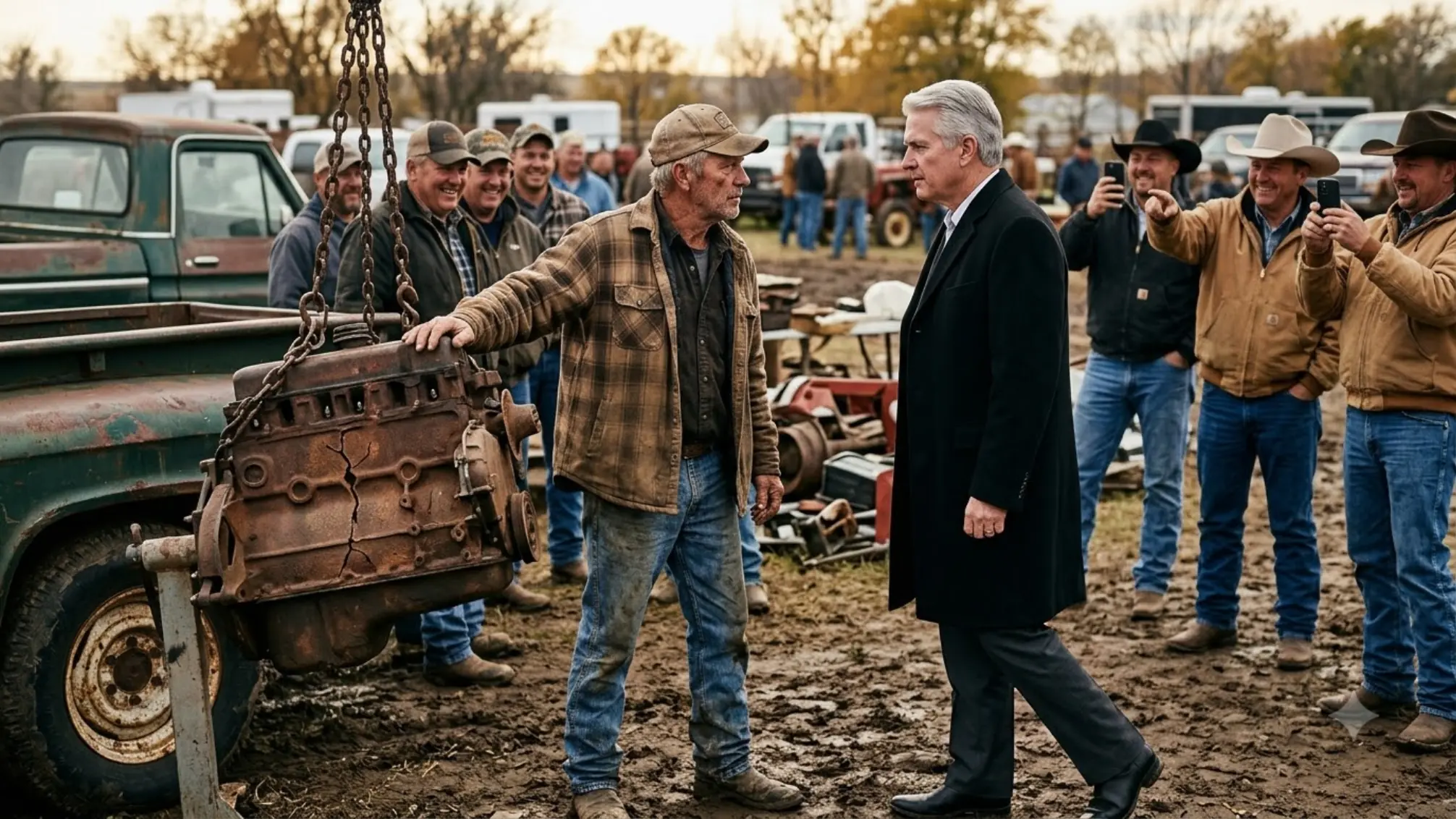
He stood in his mud-stained brown plaid work shirt, faded jeans, old tan cap, and boots worn almost smooth at the heels, watching the engine block swing from rusty chains. The steel was badly corroded, one side cracked nearly from top to bottom, and several cylinder openings were filled with years of dirt and old grease. To everyone else, it was scrap. To Alan, the narrow curved weld beneath the rust looked exactly like something he had not seen since childhood.
Elias Perry’s welding.
Alan’s father had possessed a strange habit when repairing cast iron. Instead of finishing a weld in a perfectly straight line, Elias angled the last pass slightly upward and curved it at the end like a crooked crescent. Alan had watched those hands work beneath the yellow lamp inside the family machine shop hundreds of times. Forty years could not erase the shape from his memory.
The forklift operator lowered the block toward Alan’s truck.
The chains slipped.
The iron dropped several inches and slammed against the truck bed with a deafening metallic crack.
Alan lunged forward instinctively.
“Easy!”
The crowd exploded with laughter.
A younger mechanic named Travis Cole raised his phone and recorded everything.
“Careful, Perry!” somebody shouted. “You’ll damage your treasure!”
More laughter followed.
Alan barely heard it.
The impact had broken away another layer of corrosion near the old weld.
Underneath, the crescent was clearer.
Definitely Elias.
Alan rested one weathered hand against the cold iron.
Behind him came another voice.
“Old man just bought half a ton of scrap.”
Alan turned.
Wade Holloway stood near the cattle fence in an expensive black overcoat, polished shoes carefully avoiding the mud. At sixty-one, Wade was president of Prairie State Bank and carried himself with the calm confidence of someone accustomed to deciding whether families kept land or lost it. Silver hair was combed neatly away from his face, and nothing about his appearance belonged in a muddy estate auction except the calculation in his eyes.
Alan stared at him.
Wade smiled.
“Fifteen dollars for junk, Alan. You really are as finished as this town says.”
Several nearby men laughed again.
Alan kept one hand on the block.
“Then quit staring at it like you’re afraid I might open it.”
For the first time, Wade’s expression changed.
Only slightly.
But Alan noticed.
Wade stepped closer.
“Sell it to me.”
Alan’s eyes narrowed.
“What?”
“I’ll give you thirty.”
The laughter behind them grew louder.
Wade smiled as though he had made a joke.
“Double your investment.”
Alan studied him.
A banker worth millions was standing in freezing Kansas mud offering to buy a worthless engine block five minutes after insulting him for purchasing it.
Alan looked back at the curved weld.
Then at Wade.
“No.”
Wade’s smile thinned.
“Think about it.”
“I did.”
Alan turned toward the truck.
Wade’s voice followed him.
“Old machines carry old problems, Alan.”
Alan stopped.
That sentence did not sound like a joke.
He turned again.
Wade stepped closer until only the hanging engine block separated them.
“Your father filled your head with enough nonsense while he was alive. Don’t let his old junk cost you the farm too.”
Alan held his stare.
“You just told me exactly why I’m cutting this thing open tonight.”
Wade’s face became completely still.
For several seconds, neither man moved.
Then Alan climbed into the truck and drove away.
Dry Creek, Kansas, had been calling Alan Perry finished for nearly two years. His farm sat three miles outside town beyond a line of cedar trees permanently bent east by decades of prairie wind. The farmhouse paint had peeled from the porch. The north irrigation pivot had not moved since the previous summer. His barn roof leaked whenever rain came from the west.
Everyone could see the decline.
What almost nobody understood was why Alan refused to sell.
His wife Linda’s final illness had consumed most of their savings. Long drives to Wichita for treatment, prescriptions, insurance gaps, and hospital bills arrived faster than wheat checks could cover them. Then his main tractor transmission failed during harvest. Drought followed.
Prairie State Bank had been patient at first.
Then Wade Holloway began sending notices.
First polite reminders.
Then restructuring offers.
Then invitations to discuss selling part of the acreage.
Finally came foreclosure warnings.
The most suspicious detail was that the offers increased every time Alan refused.
Connor Holloway, Wade’s thirty-five-year-old son, handled most of the negotiations. Connor wore expensive pearl-button shirts, a gold watch, and boots too clean for farming. He spoke about the Perry property not as soil that had fed a family for generations, but as an “underutilized agricultural asset.”
Alan knew what that meant.
Somebody wanted the land.
He simply did not know why.
The Perry farm did not contain oil.
It did not sit beside a highway.
Most of the soil was average by Kansas standards.
Yet within eighteen months, three companies had quietly approached him through brokers.
Each wanted the same narrow strip running east to west across the center of his property.
His father had once warned him about that ground.
Alan remembered being fourteen years old inside Elias Perry’s machine shop while a winter storm rattled the windows. County maps covered the workbench. His father traced one finger across blue lines representing water routes beneath the county.
“Men steal land slowly now,” Elias had said.
Alan, barely interested, continued cleaning sockets.
“With paper instead of guns.”
At fourteen, the sentence sounded like another one of his father’s strange warnings.
Forty years later, it sounded different.
Elias Perry had been one of the finest mechanics in western Kansas during the 1970s. Farmers hauled broken tractors from three counties because Elias could diagnose machines other shops had already given up on. He often stood beside an engine with one hand against the block, eyes closed, listening.
“Machines always tell the truth eventually,” he told Alan.
Alan believed he meant machinery.
Later he understood Elias meant people too.
During the late 1970s, Elias began repairing pumps and county equipment connected to irrigation and pipeline surveys. He noticed inconsistencies between physical markers and maps. Easement stakes appeared where official property descriptions said they should not. Access roads crossed farmland without clear permission.
Most people ignored such details.
Elias did not.
He collected documents.
Copied surveys.
Saved irrigation permits.
Marked county maps.
Then farmers began losing narrow strips of property during refinancing disputes.
Prairie State Bank appeared repeatedly in the paperwork.
So did Wade Holloway’s father, Vernon.
Elias confronted county officials publicly.
People laughed.
Vernon Holloway told him during one meeting to stick to fixing tractors.
That sentence became famous in Dry Creek.
Not because Vernon was proven right.
Because Elias was eventually treated like a man who had lost his mind.
Eight months later, the Perry machine shop burned.
Investigators blamed faulty wiring.
Elias insisted cabinets had been opened before the fire.
Important papers disappeared.
People called him paranoid.
Within a year, Elias died from a heart attack.
Alan spent the next four decades trying not to become his father.
He farmed.
Raised a family.
Fixed machinery.
Stayed away from county politics.
Whenever old men at Miller’s Diner joked about Elias hiding secrets in equipment, Alan stared into his coffee.
Then the engine block appeared at the estate auction.
That night, Alan backed the pickup inside the old barn.
Rain tapped against the metal roof.
He shut the doors and stood alone beside the engine block.
The crescent weld was unmistakable under shop light.
He ran his fingers across it.
The weld line did not follow the crack properly.
That bothered him.
A legitimate repair should have strengthened the damaged section.
This seam crossed solid metal for no obvious mechanical reason.
Alan grabbed a small hammer.
He tapped one area.
Solid.
Another.
Solid.
Then the center.
The sound changed.
Hollow.
Alan stepped back.
Headlights moved across the barn windows.
A dark truck slowed beside the county road.
It remained there several seconds.
Then drove away.
Alan watched through a crack in the door.
His heartbeat accelerated.
Someone else was interested.
The next morning, Dry Creek had already turned his purchase into entertainment.
Travis Cole’s phone video had spread through local social media pages. At Miller’s Diner, men replayed the moment the block dropped while making jokes about Alan guarding scrap like treasure. Jolene, the longtime waitress, quietly filled Alan’s cup.
“You okay?”
Alan stirred his coffee.
“Yes.”
“Lie.”
He looked toward the laughing men.
“Town gets cruel when it gets bored,” Jolene said.
Alan shook his head.
“No.”
“What?”
“Town gets scared.”
She stared at him.
He left without explaining.
Alan drove to Holloway Farm Supply because he needed cutting gas and replacement welding equipment. The moment he entered, conversations stopped.
Connor Holloway leaned against the counter.
Travis stood nearby.
“Well,” Connor said. “The scrapyard millionaire.”
Alan continued walking.
Travis called after him.
“You crack open your treasure yet?”
Alan ignored him.
Connor followed.
“I’ll give you fifty dollars for it.”
Alan stopped.
He turned slowly.
“Yesterday your father offered thirty.”
Connor’s grin faded.
“Did he?”
“You offering against him?”
A few nearby workers became quiet.
Connor laughed awkwardly.
“It’s junk, Alan.”
“Then neither of you should want it.”
Connor’s eyes hardened.
Alan picked up the welding cylinder.
Outside the store, someone called his name.
Hank Mercer stood beside an old white service truck.
Hank was seventy, a retired welder who had worked beside Elias occasionally decades earlier. His face was lined from years of heat and prairie wind.
“You planning to open it alone?”
Alan studied him.
“Maybe.”
Hank smoked silently.
“That crack line isn’t natural.”
Alan said nothing.
“The forklift dropped it yesterday.”
“So?”
“Sounded hollow.”
Alan looked toward the store window.
Connor was watching them.
Hank followed his gaze.
Then lowered his voice.
“Your father didn’t repair that block.”
Alan’s stomach tightened.
“What did he do?”
Hank crushed the cigarette beneath his boot.
“Sealed it.”
They met at Alan’s barn at eight that evening.
Hank brought a plasma cutter.
Alan prepared chains and a hoist.
Neither man spoke much.
The block stood upright beneath the old yellow shop light that had once belonged to Elias.
Hank traced the crescent weld.
“Definitely your father.”
“You sure?”
“I welded beside that stubborn bastard twenty years.”
Hank lowered his mask.
“I’m sure.”
The cutter screamed.
Blue sparks scattered across the concrete floor.
Alan held the chains steady while Hank cut through the outer layer.
Slowly, the seam opened.
Behind it sat another steel plate.
Hand fabricated.
Welded inside.
Hank shut off the cutter.
Steam rose.
He removed his mask.
“Alan.”
“I see it.”
“Your father built a vault.”
They opened the second plate carefully.
Inside the engine block was a narrow cylindrical container wrapped in hardened black oil cloth.
Alan’s hands began shaking.
Hank helped remove it.
The container had brass caps sealed with old grease.
They carried it to Elias’s workbench.
Alan stared at it.
“What if he hid it because nobody was supposed to open it?”
Hank leaned against the bench.
“Truth usually hurts somebody.”
Alan picked up a wrench.
The cap resisted.
Then broke loose.
Old air escaped with a dry hiss.
Inside were rolled maps.
Photographs.
A small ledger.
Oil-wrapped papers.
A brass key.
And an envelope.
Alan froze when he saw the writing.
FOR ALAN — IF THEY FINALLY COME FOR THE LAND.
He sat down.
For a long time, he simply stared at his name.
Then he opened it.
The first sentence read:
Alan, if you are reading this, then either I was right or the wrong men finally got desperate enough to return.
Alan stopped breathing for a moment.
He continued.
Elias described disputed water easements.
Survey boundaries changed without proper authorization.
Families pressured during drought years.
Land transferred after refinancing.
Names appeared repeatedly.
Vernon Holloway.
Prairie State Bank.
County officials.
One line was underlined twice.
They moved the boundary on paper only. Ground never moved.
Alan spread the maps across the bench.
The Perry farm sat directly across a subsurface corridor linked to industrial water access.
The same corridor companies were currently trying to secure.
The farm everyone called worthless was not worthless.
It was strategically critical.
Alan picked up the brass key.
A small word had been engraved on it.
Wichita.
The following morning, he drove four hours to Security Plains Trust.
The bank manager examined the key and immediately became serious.
“Mr. Perry, this safe-deposit box has been inactive since 1983.”
Alan swallowed.
“The year after my father died.”
“Yes.”
The manager checked documents.
“Instructions transfer access directly to you.”
Inside the vault, Alan opened a metal box that had waited more than forty years.
What he found removed the last doubt.
Certified copies of survey maps.
Affidavits.
Bank records.
Photographs.
Audio cassette tapes.
Correspondence.
A notarized statement from former county clerk Miriam Vance describing pressure from Vernon Holloway to alter property corridor descriptions.
Attached was a handwritten note from Elias.
If anything happens to me, this is why.
Alan sat alone inside the viewing room.
For years he had wondered whether his father’s final years had really been consumed by paranoia.
Now he knew.
Elias had not imagined the pattern.
He had documented it.
He had hidden duplicates outside Dry Creek because he expected local records might disappear.
When Alan walked outside the bank, the dark blue Ford from his county road sat half a block away.
Tinted windows.
Engine running.
He stopped.
The vehicle pulled away.
Someone knew.
Alan returned to Dry Creek after dark and went directly to Hank.
He placed the archive box on the workbench.
“You got followed?” Hank asked.
“Yes.”
“That’s bad.”
Alan shook his head.
“No.”
Hank looked confused.
“That means they’re nervous.”
Over the following week, Alan and Hank organized everything.
The records revealed decades of irregularities.
Not every case proved outright theft.
That was what made the system effective.
A boundary shifted.
An easement description changed.
A refinancing deadline appeared.
A desperate farmer accepted a sale.
One piece at a time.
Never dramatic enough to make a newspaper headline.
But together, the pattern was enormous.
Alan needed a lawyer.
He went to Martha Bennett, nearly seventy and one of the last independent attorneys practicing in Dry Creek County.
She knew Elias.
More importantly, she remembered the county meeting where people laughed at him.
Alan entered her office carrying the archive box.
Martha looked at him.
“You look like a man carrying dynamite.”
Alan closed the door.
“Close enough.”
Three hours later, Martha removed her glasses and stared at him.
“My God.”
“You believe him?”
“Alan.”
She spread the maps across the desk.
“These records could invalidate sections of existing industrial water agreements.”
Alan said nothing.
“If these affidavits authenticate, Prairie State Bank could face enormous civil exposure.”
She looked toward Elias’s letter.
“Why didn’t your father go public?”
Alan’s expression hardened.
“He did.”
Martha became quiet.
Of course he had.
People simply chose not to listen.
Pressure intensified almost immediately.
Alan received tax notices.
A county inspection targeted his fuel tanks.
Prairie State Bank requested another meeting about foreclosure.
Then Connor Holloway arrived at the farm.
He stepped from a polished black truck wearing a clean coat and expensive boots.
“Thought we should talk neighbor to neighbor.”
Alan wiped grease from his hands.
“About?”
Connor glanced toward the barn.
“That engine block.”
Alan’s eyes narrowed.
“What about it?”
“Earl Dory mentioned your father used to hide things inside machinery.”
Alan became still.
Earl Dory was the old forklift operator from the auction.
The man had disappeared immediately afterward.
“When did Earl tell you that?”
Connor hesitated.
Tiny.
Almost invisible.
But Alan saw it.
“Recently.”
Lie.
Alan stepped closer.
“You nervous, Connor?”
“What?”
“You sound nervous.”
Connor’s smile disappeared.
“If there’s paperwork connected to the property, I’d hate for you to misunderstand old documents and create unnecessary trouble.”
Alan stared at him.
“My father knew.”
Connor stopped.
Alan did not finish the sentence.
He did not need to.
Connor’s face changed.
Alan turned toward the barn.
“Tell Wade something for me.”
Connor remained frozen.
“Tell him I finally opened the engine block.”
Connor drove away without another word.
The county hearing was scheduled for the following Tuesday.
Officially, it concerned foreclosure and easement questions.
Unofficially, half of Dry Creek treated it like the final chapter of the Perry farm.
Pickup trucks filled the courthouse square before nine.
Wade Holloway arrived in a perfect suit.
Connor carried a leather portfolio behind him.
Alan arrived carrying Elias Perry’s old metal toolbox.
Martha walked beside him.
Inside were copies of every important document.
And one broken section of the engine block showing the welded hidden compartment.
Wade spoke first.
He explained debt.
Missed payments.
Foreclosure procedures.
Development opportunities.
He described Prairie State Bank as having acted in “good faith.”
Martha almost smiled.
Those two words would become important.
Connor spoke next.
He described the Perry property as economically distressed.
Then he made the mistake that changed the mood.
“It’s unfortunate Mr. Perry inherited certain misunderstandings from his father.”
Several people laughed softly.
Alan looked up.
Commissioner Dale Rener asked whether he wanted to respond.
Alan stood.
He carried the toolbox forward.
Placed it on the evidence table.
Clank.
The sound filled the room.
“My father spent the last years of his life being called crazy in this county.”
The room quieted.
“Turns out he was keeping records.”
Alan opened the box.
He removed the cut engine-block section.
Confusion crossed several faces.
“What is that?” Rener asked.
“Evidence.”
A few people laughed.
Alan did not react.
Martha stepped forward.
“Mr. Perry recently recovered historical materials sealed inside this engine block by his father, Elias Perry, approximately forty years ago.”
The laughter stopped.
She placed the first map down.
Then another.
A notarized affidavit.
Copies from Wichita.
County survey overlays.
Wade’s smile gradually vanished.
Martha presented Miriam Vance’s affidavit describing pressure to alter agricultural corridor records.
Commissioners leaned forward.
Then came the photograph.
Vernon Holloway standing beside county survey stakes.
Beside him was Earl Dory.
Wade spoke sharply.
“That proves absolutely nothing.”
Too quick.
Too angry.
Alan looked toward him.
“My father said that forty years ago.”
Silence.
Martha displayed the original and altered survey descriptions.
“The ground never moved,” she said. “Only the paperwork did.”
Connor whispered urgently toward Wade.
Then Martha explained the modern significance.
“The Perry property appears to control critical subsurface positioning connected to current industrial water expansion.”
Connor’s face lost color.
The room finally understood.
The Holloways had not been trying to take Alan’s farm because he was weak.
They had been trying to take it before he understood what he owned.
Commissioner Rener looked toward Wade.
“Was Prairie State Bank aware of these historical claims?”
Wade hesitated.
That pause mattered more than a speech.
Before he could answer, the courthouse door opened.
Every head turned.
Earl Dory entered.
The old forklift operator removed his cap.
He looked exhausted.
He looked afraid.
And he looked directly at Alan.
“I think I need to tell the truth before I die.”
Nobody laughed.
Not one person.
Earl was sworn in.
He explained that in 1979 he had worked with county survey support crews.
Vernon Holloway paid extra money off the books.
Boundary stakes were moved.
Not miles.
Sometimes only yards.
Enough to change where easements appeared on paper.
Commissioner Rener stared at him.
“You are saying agricultural boundaries were intentionally manipulated?”
“Yes.”
Wade stood.
“This is nonsense from an old man protecting himself.”
Earl looked directly at him.
“No.”
His voice remained quiet.
“I already spent forty years protecting your family.”
The room changed.
Completely.
Earl described distressed farmers.
Refinancing pressure.
Survey adjustments.
Vernon Holloway’s involvement.
Then he talked about Elias.
“He figured it out early.”
Martha asked, “Did Mr. Perry confront you?”
Earl nodded.
“He told me we kept pretending we were only moving paper while families were losing land.”
Alan closed his eyes.
For a moment he could see his father again beneath the yellow shop light.
Not paranoid.
Not broken.
Alone.
There was a difference.
Martha placed the audio tapes on the table.
Recorded conversations.
Dates.
Names.
Wade’s confidence disappeared.
The commissioners recessed.
Outside, Dry Creek gathered in small groups.
Nobody joked now.
Travis Cole stood near the steps with his phone in his pocket.
Eventually he approached Alan.
“I didn’t know.”
Alan looked at him.
Travis lowered his eyes.
“About your dad.”
“I know.”
No lecture.
No anger.
That almost hurt Travis more.
Inside, the commissioners reconvened that afternoon.
Rener announced that foreclosure proceedings against the Perry property were suspended pending independent review.
Gasps moved through the room.
Then came the second announcement.
Historical easement alterations connected to Prairie State Bank and county officials would be referred for state investigation.
Connor closed his eyes.
Wade remained expressionless.
But everyone knew.
The story had changed.
Outside the courthouse, Wade approached Alan.
“You could destroy this town with those records.”
Alan stared at him.
“No.”
Wade waited.
“Your family already did the damage.”
Wade looked away.
Alan continued.
“My father tried warning everybody.”
The banker had no answer.
That mattered more than any apology.
The investigation lasted more than a year.
Prairie State Bank lost business.
Industrial water negotiations froze.
Old easement cases reopened.
Former county employees were interviewed.
Some records were missing permanently.
Others matched Elias’s copies almost perfectly.
Because decades had passed, criminal consequences were limited.
Civil consequences were not.
The Perry farm was removed from foreclosure.
Its disputed boundaries were restored.
Several neighboring families received settlements connected to historical easement irregularities.
Alan received money too.
Enough to clear his debt.
Enough to repair the farm.
Enough to stop wondering whether the next envelope in the mailbox would end four generations of Perry ownership.
But he did not sell.
He did something else.
He rebuilt Elias Perry’s machine shop.
Not as a monument.
As a working garage.
Hank helped.
They replaced the burned wiring.
Repaired the roof.
Restored the old benches.
Hung Elias’s tools where they had originally been.
The yellow lamp remained over the center workbench.
Especially the lamp.
People began stopping by.
At first they came to see the engine block.
Then they brought broken machinery.
One afternoon, Travis Cole arrived carrying a hydraulic pump.
He looked embarrassed.
“Heard you might rebuild these cheaper than the dealership.”
Alan stared at him.
Travis shifted awkwardly.
Alan pointed toward the bench.
“Set it down.”
That was all.
No revenge.
No reminder about the auction video.
Travis began returning.
Eventually Alan taught him.
Other young mechanics followed.
Farmers with broken tractors arrived because they could not afford new equipment.
Widowers brought machinery they had been afraid to touch since their sons moved away.
Teenagers learned welding.
Old men traded knowledge for coffee.
The building gradually became the Perry Repair Cooperative.
The cracked engine block sat near the center of the shop beneath mounted lights.
Alan left the hidden compartment exposed.
Visitors constantly asked why he had not sold the piece to a museum.
One teenage apprentice asked directly.
“Why keep that ugly thing here?”
Alan rested one hand on the rusted steel.
“Because people need reminders.”
“Of what?”
Alan smiled faintly.
“That valuable things sometimes get mistaken for junk.”
The boy nodded.
Alan looked beyond him toward Elias’s old tools.
The sentence had never really been about the engine.
Six years after the courthouse hearing, harvest light poured through the shop doors one evening.
Alan sat at his father’s workbench.
He was older now.
Slower.
His hands shook occasionally when holding small bolts.
But young mechanics filled the garage around him.
Travis had become one of the best repairmen in the county.
One wall displayed photographs of tractors the cooperative had kept running for families who could not afford replacement equipment.
Another held Elias’s tools.
Beside the engine block was a framed copy of Elias’s final letter.
Underneath, Alan had written only four words.
He told the truth.
That was enough.
A teenage apprentice sweeping near the door looked toward Alan.
“Can I ask something?”
“Probably.”
“Did you ever get angry at your father?”
The garage became quieter.
Alan leaned back.
“Yes.”
The answer surprised them.
“For what?”
Alan looked toward the engine block.
“When you’re young, you think strong people should protect themselves better.”
Nobody spoke.
Alan continued.
“I used to wonder why he let everybody call him crazy.”
He looked toward the old yellow lamp.
“Why he didn’t fight harder.”
“What changed?”
Alan smiled sadly.
“I got old enough to understand he was fighting the whole time.”
Wind moved through Kansas wheat beyond the open doors.
“He just wasn’t fighting for himself.”
The young mechanic lowered his broom.
Alan turned toward Elias’s framed letter.
His father had died carrying truth nobody wanted.
Alan spent forty years carrying the shame people attached to that truth.
In the end, neither money nor revenge repaired what had been broken.
Evidence did.
Persistence did.
And one cracked engine block did.
The piece of iron everyone laughed at survived a fire.
It survived four decades of weather, storage, auctions, rust, and neglect.
Inside it, Elias Perry had placed the one thing powerful men could never completely control.
A second copy.
A record.
A memory they did not know existed.
Machines always tell the truth eventually.
Alan finally understood.
His father had not been talking about engines at all.
Outside, the evening sun dropped toward the western Kansas horizon.
The Perry farm remained exactly where it had always been.
Same prairie wind.
Same wheat.
Same dry roads.
But the people driving past looked toward the property differently now.
They no longer saw the old farmer who refused to accept defeat.
They saw the man whose father had been right before anybody was willing to listen.
Alan never cared much about that recognition.
He had already received the only thing he truly wanted.
Elias Perry’s name belonged to the truth again.
And whenever visitors entered the cooperative and stopped before the enormous cracked engine block beneath the lights, Alan allowed them to stare.
Eventually someone always asked the same question.
“How much did you pay for that?”
Alan would look toward the rusted steel.
Then toward his father’s tools.
And smile.
“Fifteen dollars.”
They usually laughed in disbelief.
Alan never minded that laughter.
It sounded completely different now.