The first engine reached Walter Hayes before the first truck appeared. It rolled across the Missouri hills like distant thunder, growing steadily louder while the eighty-three-year-old farmer stood beneath the porch roof with a cup of black coffee cooling between his weathered hands. He wore a wide tan cowboy hat, a brown work jacket over an orange-and-gray plaid shirt, faded jeans, and boots marked by more than sixty harvests. His clear blue eyes narrowed as a line of heavy service vehicles emerged along the gravel road leading toward the farm his family had owned for generations.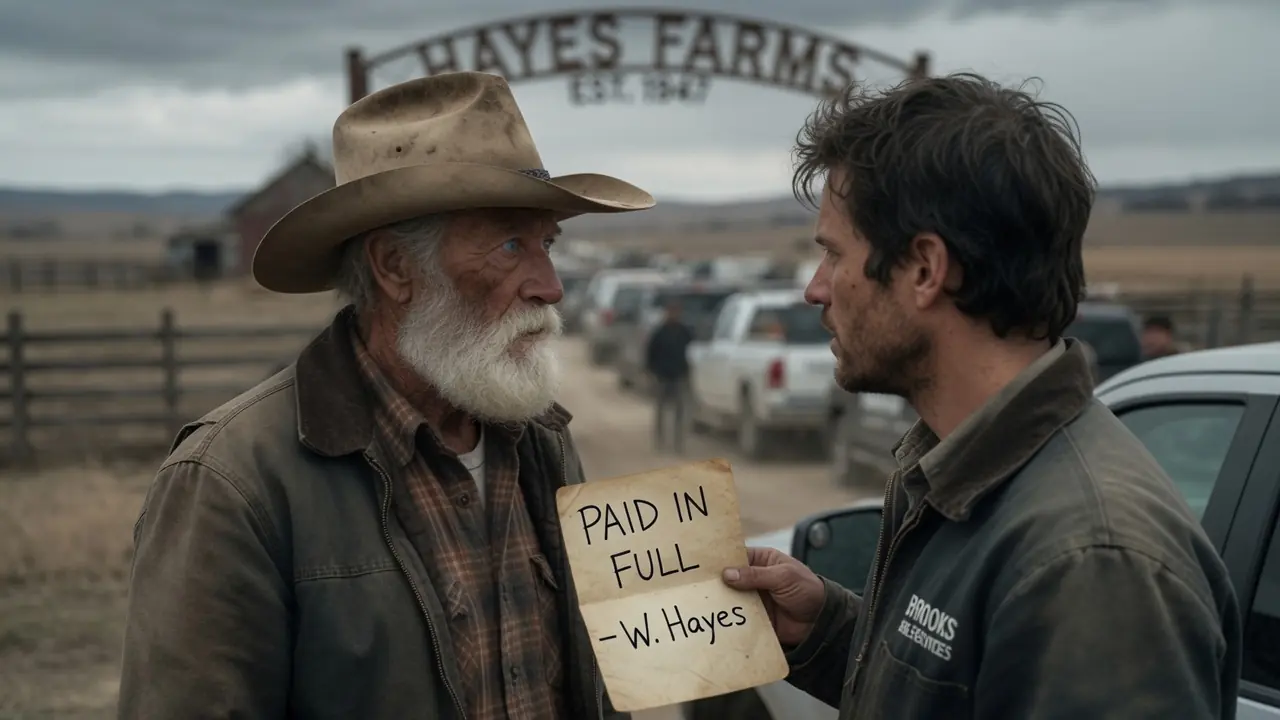
There were more than forty trucks in the convoy. Some carried hydraulic equipment, while others pulled trailers stacked with parts, welding machines, tires, and portable generators. Walter saw company logos he did not recognize and men in work uniforms talking through radios as they passed through the open gate. His first thought was not rescue, kindness, or reunion.
It was foreclosure.
The bank had warned him that someone would eventually come to inventory the equipment. Walter had ignored the latest letters, hiding them in the bottom drawer of his desk beneath seed invoices and veterinary receipts. He had imagined two men arriving with clipboards, not an army of mechanics large enough to dismantle the entire farm before supper. Behind him, his seventy-nine-year-old wife, Evelyn, stepped onto the porch and followed his stare.
“Walter,” she whispered, “who are they?”
He lowered the coffee cup. “I reckon the bank finally got tired of waiting.”
Evelyn reached for his arm, but Walter pulled away gently and descended the porch steps. If strangers intended to take his machinery, he would face them standing rather than watch from behind a curtain. His back hurt, arthritis stiffened his fingers, and every step reminded him that the land had outlived stronger men than he had become. Still, he crossed the yard with his shoulders squared.
The convoy stopped near the machinery barn. Doors opened, boots struck gravel, and technicians began unloading toolboxes without waiting for instructions from Walter. One team walked toward the combine, while another inspected the oldest tractor beside the workshop. A third group raised a portable shelter near the equipment shed.
Walter’s fear changed into anger.
“Hold it right there!” he shouted.
The workers stopped.
“If the bank sent you, take the machinery,” Walter said, his voice rough but steady. “But leave me my family’s land.”
Nobody answered immediately. Then a silver pickup moved through the center of the convoy and stopped near the barn. The driver’s door opened, and a broad-shouldered man in his early fifties climbed out wearing dark work pants, a clean denim shirt, and boots polished only by use.
Silver touched the man’s dark hair near his temples. A neatly trimmed beard covered his jaw, and old scars marked the backs of his hands. He carried himself with the calm confidence of someone accustomed to being followed, yet nothing about him appeared arrogant. When his eyes found Walter, his expression softened.
“I’m not the bank,” he said.
Walter studied him.
The man took several slow steps forward. “I’m the homeless boy you saved with your best bull.”
The gravel seemed to shift beneath Walter’s boots.
“Ethan?”
The man smiled, and the years fell away from his face. Walter saw the hungry eighteen-year-old who had once appeared on the road carrying a torn backpack, too proud to beg and too exhausted to hide how desperate he was. His coffee cup slipped from his hand and shattered beside his boot.
“Ethan Brooks,” Walter whispered.
“After thirty-one years.”
Walter crossed the remaining distance, and Ethan caught him in a fierce embrace. The old farmer held the successful businessman as though he feared the young man might disappear again if he loosened his arms. Evelyn came down from the porch crying openly, and Ethan pulled her into the embrace as well.
Around them, the technicians looked away respectfully.
Walter finally stepped back and gripped Ethan’s shoulders. “We thought you were dead.”
“I wrote for years.”
“The letters stopped.”
“My business moved. Then your address changed after the county renamed the road.” Ethan’s eyes filled with regret. “I should have tried harder.”
Walter shook his head. “You came back.”
Ethan reached inside the pickup and removed a wooden frame. Behind the glass was an old photograph taken in 1993 inside Walter’s workshop. A younger Walter stood beside a thin teenager with long dark hair, both of them smiling beside a tractor engine spread across a workbench.
Mounted beside the photograph was a faded fifty-dollar bill and a yellowed note.
Don’t quit when you’re halfway there.
Walter touched the glass with one trembling finger.
“You kept that?”
“I carried the original note in my wallet for thirty-one years.”
Walter’s eyes lowered. “I barely remember writing it.”
“I remembered every word.”
Ethan turned toward the convoy. “These people are here because of that note.”
The summer Walter met Ethan had been one of the hardest the Hayes farm had endured. Corn prices were falling, the combine required repairs Walter could not afford, and every month brought a bill large enough to threaten the next. Walter was fifty-two then, broad-shouldered and strong, though worry already cut lines across his face.
One afternoon, he saw a teenager walking along the gravel road beneath brutal July heat. Ethan’s clothes were dusty, his boots were separating at the soles, and a frayed backpack hung from one thin shoulder. He stopped near the farm gate but seemed uncertain whether to continue.
Walter stepped from the machinery shed. “You looking for someone?”
“Work,” Ethan replied. “Anything.”
Walter noticed the boy’s dry lips and hollow cheeks. “When did you last eat?”
Ethan hesitated, and the silence answered.
Evelyn fed him roast beef, potatoes, bread, and three slices of pie that evening. Ethan ate slowly at first, as though afraid someone might take the plate away, then faster when he realized nobody would. He explained that his mother had remarried, his stepfather had forced him out, and the forty dollars in his pocket had disappeared during weeks on the road.
Walter had no money for another worker.
He gave Ethan a place in the old cabin anyway.
The teenager rose before sunrise every morning and worked until Walter ordered him to stop. He repaired fences, hauled hay, cleaned stalls, and never complained about heat or exhaustion. Yet what captured Walter’s attention was the way Ethan watched whenever a machine failed.
He understood engines instinctively.
Within days, Ethan could identify loose belts and blocked fuel lines by sound. Within weeks, he helped Walter rebuild a hydraulic pump that two experienced mechanics had declared useless. The boy did not merely enjoy fixing machines; he came alive around them.
“You should study this properly,” Walter told him one evening.
Ethan laughed bitterly. “School costs money.”
“There’s a vocational program in Springfield.”
“There are also mansions in California. I can’t afford either.”
Walter said nothing, but the answer stayed with him.
His finest Black Angus bull was named King. The animal represented years of careful breeding and would have produced calves capable of stabilizing the farm’s struggling cattle operation. Every neighboring rancher knew what King was worth and understood how badly Walter needed him.
Walter sold the bull anyway.
He used the money to pay Ethan’s first tuition installment, purchase tools, and secure a small room near the vocational school. The decision spread through Rolla before Ethan’s bus left town. Men at the feed store called Walter sentimental, irresponsible, and foolish.
“You’re risking your farm for a runaway,” one neighbor said.
Walter looked through the bus-station window at Ethan gripping his new tool case. “No. I’m investing in a mechanic.”
Ethan promised to repay every dollar.
Walter refused.
“Then what do I owe you?” the boy asked.
“A finished education.”
The bus pulled away, and Walter stood beside Evelyn until it disappeared.
Ethan’s path was not easy. He worked nights in a repair garage, slept in a small room above an auto-parts store, and often survived on bread, noodles, and coffee. During his first year, a tuition notice arrived that threatened to end everything he had begun.
Then Walter’s envelope came.
Inside was fifty dollars and the note Ethan would carry for the rest of his life. Walter did not know that Ethan had packed his belongings the night before, intending to quit school and return to manual labor. Those eight handwritten words changed his decision.
Ethan graduated near the top of his class. He found work repairing agricultural equipment in Nebraska and developed a reputation for solving failures other technicians abandoned. When a highway collision left him with multiple fractures and doctors warned that he might never return to fieldwork, he taped Walter’s note above the hospital bed.
He walked again.
Years later, Ethan opened a small repair shop with two employees and a rented building. The first winter nearly destroyed it, but he continued. One shop became three, then seven, and eventually Brooks Agricultural Services operated across several Midwestern states.
Ethan never forgot the farm that started everything.
Life, however, carried him farther from Missouri. Addresses changed, letters returned unopened, and business emergencies became months and years. Ethan always intended to search properly once things became calmer.
Things never became calmer.
Thirty-one years passed.
Walter’s farm survived, though never comfortably. Evelyn managed the house and accounts while Walter continued planting, repairing, borrowing, and hoping. Good harvests paid for bad ones, but age and failing machinery gradually reduced the margin between survival and ruin.
Then three terrible seasons came almost together.
A spring flood destroyed part of the corn crop. The following summer brought drought, and the year after that, fertilizer and fuel prices rose beyond anything Walter had budgeted. To keep operating, he refinanced equipment and borrowed against the land.
The debt grew quietly.
Walter hid the worst letters from Evelyn because he believed protecting her meant carrying fear alone. He sat on the porch after midnight, staring across fields that had belonged to his grandfather, wondering whether he would become the generation that lost them.
Ethan learned the truth from a customer.
Nathan Mercer, an older Nebraska rancher, mentioned during a service visit that Walter Hayes was facing foreclosure. Ethan stopped working in the middle of a sentence and asked Nathan to repeat the name.
Within two days, Ethan’s financial team had assembled the full picture.
The Hayes farm owed the bank more than Walter could ever repay. The combine was barely functional, two tractors required major repairs, and the workshop roof was failing. The bank had begun preparing foreclosure action.
Ethan did not call.
He assembled forty service crews.
Now those crews stood across the Hayes farm, waiting for his signal.
Walter looked from Ethan to the equipment trailers. “What exactly did you bring?”
“Enough people to give your machines another twenty years.”
“I can’t pay for this.”
“You already did.”
“No.” Walter shook his head. “Selling that bull didn’t buy all this.”
Ethan stepped closer. “It bought the first class. The first tools. The first chance. Everything after that grew from what you gave me.”
Walter’s pride fought against the relief rising inside him. “I helped you because it was right. Not so you’d owe me.”
“This isn’t debt.” Ethan’s voice softened. “It’s a man choosing what kind of person he wants to be because someone once chose him.”
Evelyn placed her hand over Walter’s. “Let him do this.”
Walter looked at the woman who had shared every difficult season with him. She was crying, but her smile carried a peace he had not seen in years.
He nodded.
The farm transformed over the following three weeks.
Technicians removed the combine’s damaged transmission, rebuilt the hydraulic system, modernized its electrical components, and replaced worn safety equipment. Diesel specialists restored two tractors, while welders repaired the grain wagon and reinforced the machinery shed.
A roofing crew replaced the workshop’s leaking metal panels.
Another team installed efficient lighting, repaired barn doors, and rebuilt the cattle-water system. Ethan’s company did not deliver shiny new machines designed to make Walter dependent on expensive financing. They restored what he owned and trained local mechanics to maintain it.
Walter spent every day among them.
Though his hands were slower, he still recognized a badly seated bearing and could hear an improper engine rhythm before diagnostic tools detected it. Younger technicians began gathering near him during breaks, asking questions about equipment built before many of their parents were born.
Ethan watched from a distance.
The old farmer who once taught a homeless teenager now taught forty professionals.
Neighbors gathered along the road during the repairs. Some were the same men who had mocked Walter for selling King. They watched the convoy return old machines to life and spoke more quietly than they had thirty-one years earlier.
One afternoon, Carl Jensen approached Walter beside the rebuilt tractor.
“I said you were a fool,” Carl admitted.
Walter wiped grease from his fingers. “You weren’t alone.”
“I was wrong.”
Walter looked toward Ethan, who was helping a young technician measure a hydraulic fitting. “At the time, none of us knew whether it would work.”
“You knew enough.”
“No.” Walter smiled faintly. “I only knew the boy deserved one chance.”
When the equipment restoration was almost complete, Ethan asked Walter to ride into Rolla. He refused to explain where they were going, only saying that one final matter remained unfinished.
They stopped outside the office of Rebecca Collins, a real-estate attorney known for defending family farms. Several thick folders waited on her conference table.
Rebecca invited Walter to sit and placed a document before him.
He adjusted his glasses.
The first page released the equipment liens.
The second satisfied the operating loans.
The final page carried the words Walter had stopped allowing himself to imagine.
PAID IN FULL.
He read them again.
“The bank debt?” Walter asked.
“Cleared,” Rebecca said. “Every mortgage and agricultural lien has been released.”
Walter turned toward Ethan. “You paid it?”
“I purchased the debt and satisfied it.”
“Why?”
Ethan removed the old note from his wallet. The paper was worn nearly transparent along the folds.
“You gave me this when you had almost nothing.”
Walter looked down. “That fifty dollars probably cost me less than your breakfast this morning.”
“It cost you something you needed. That is why it mattered.”
Walter’s mouth trembled.
Ethan continued. “When I was injured, I read it. When my first shop lost money, I read it. When banks refused my loans, employees left, and customers told me I’d fail, I read it.”
Walter covered his eyes with one hand.
“You didn’t give me money,” Ethan said. “You gave me permission to believe my life wasn’t finished.”
The old farmer rose and embraced him again.
This time, Ethan was the one who cried first.
After leaving the law office, they returned to the Hayes property by a route leading behind the horse barn. The abandoned cabin where Ethan had once slept was no longer abandoned. Fresh paint covered the walls, new windows reflected the fields, and flowers bordered a rebuilt porch.
Above the entrance hung a wooden sign.
THE WALTER HAYES SKILLED TRADES FUND
Walter stood without speaking.
Ethan explained that the foundation would provide vocational scholarships to homeless teenagers, young adults leaving foster care, and students from struggling rural families. Tuition, tools, housing assistance, and job placement would be covered for fifty students during the first year.
“Why my name?” Walter asked.
“Because the program isn’t built on my success. It’s built on your decision.”
“I sold one bull.”
“You showed one boy he was worth more than the most valuable animal on your farm.”
Walter entered the cabin slowly.
The original iron bed remained against one wall, restored but unchanged. Ethan’s old tool case sat beneath a framed photograph, and beside it was a plaque containing the words from Walter’s note.
Don’t quit when you’re halfway there.
The first students arrived three months later.
Some carried new suitcases, while others came with belongings packed inside plastic bags. They studied diesel technology, welding, electrical systems, plumbing, and equipment repair. Every student received support without being required to express permanent gratitude.
Walter insisted on that rule.
“A chance isn’t a chain,” he told Ethan. “They don’t owe us their lives because we opened a door.”
Ethan nodded. “Then what do they owe?”
“The work.”
Walter became a regular visitor at the training center. He taught basic machinery maintenance and told students about mistakes he had made, rather than presenting himself as a hero. They respected him because he never spoke down to them.
One year later, the first class graduated.
Walter stood before fifty young men and women inside a new workshop built beside the cabin. He wore his tan cowboy hat and brown jacket, his white beard neatly trimmed, while Evelyn sat in the front row beside Ethan.
Walter’s hands shook around the microphone.
“People keep saying I changed Ethan’s life,” he began. “That makes me sound wiser than I was.”
The students listened.
“I was scared when I sold that bull. I needed the money. I didn’t know whether Ethan would finish school, disappear, fail, or decide I had made a mistake.”
Walter glanced toward Ethan.
“I helped because a young man stood at my gate hungry and willing to work. That was enough.”
He paused.
“You may never know what becomes of the person you help. Do it anyway when you can. But remember that kindness without respect becomes control, and opportunity without work becomes waste.”
The room remained silent.
Walter’s voice grew softer. “Someone gave each of you a door. Walking through it is your responsibility.”
Applause rose slowly, then filled the building.
After the ceremony, Walter and Ethan walked toward the pasture where King once grazed. The field was green after spring rain, and the repaired fence stretched toward the horizon.
“Did you ever regret selling him?” Ethan asked.
Walter considered the question.
“During the first winter, yes.”
Ethan laughed.
“I missed that bull every time money got tight,” Walter admitted. “But regret isn’t the same as believing the choice was wrong.”
They stopped beside the fence.
“You saved my farm,” Walter said.
“You saved me first.”
Walter shook his head. “No. I gave you a beginning. You saved yourself every day after that.”
Ethan rested both hands on the top rail. “Maybe that’s how chances work.”
“How?”
“One person opens the gate. The other has to keep walking.”
Walter smiled.
The farm no longer faced foreclosure. Its machines worked, its mortgage was gone, and the land would remain with the Hayes family under an estate plan Ethan’s attorneys helped create. Walter and Evelyn finally slept without unopened bank letters hidden beneath the desk.
Yet the greatest return did not appear in the paid deed.
It appeared each year when another class arrived at the training center. Students who had slept in cars became technicians. Young adults who believed they had no future became welders, electricians, and mechanics.
Some returned as instructors.
Others created scholarships of their own.
Walter lived long enough to watch the program expand into three states. Whenever newspapers called him a hero, he changed the subject and asked whether they wanted to see the repaired combine.
To him, the story had never been about heroism.
It was about noticing one tired teenager on a hot road and refusing to let him continue hungry.
Thirty-one years earlier, the county believed Walter had thrown away the most valuable thing on his farm.
They were wrong.
The bull had value because it could produce more cattle.
The chance Walter gave Ethan produced futures.
And as forty service trucks stood across the land that kindness had returned to him, Walter finally understood that some harvests require decades before the field reveals what was planted.