The breakfast truck hissed softly in the freezing New York morning while the city hurried around it without looking down.
Steam curled into the gray air above the small silver cart, rising from eggs, sausages, buttered rolls, and bitter black coffee as traffic growled along the curb.
Yellow taxis crawled through dirty slush. 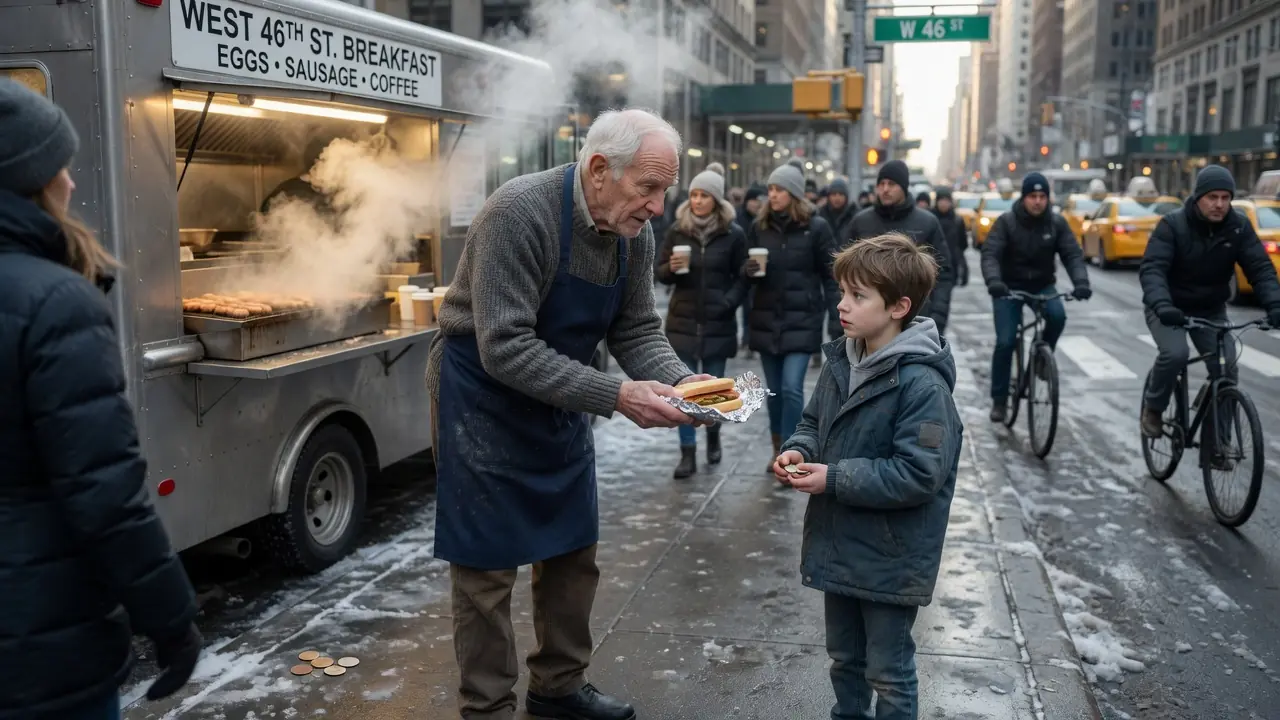
Delivery bikes weaved between cars with silver bags strapped to their backs. Somewhere down the block, a bus sighed at the curb, letting out a tired line of commuters who immediately folded themselves into the rushing crowd.
It was the kind of morning when everyone seemed late for something. Office workers pushed through the cold with paper cups clutched against their chests, scarves pulled high, eyes fixed straight ahead. A woman in heels stepped over a patch of ice without slowing. A man in a wool coat bumped shoulders with a cyclist and never turned back. The whole city seemed to have made the same silent agreement.
Do not stop.
Do not look too closely.
Do not notice anyone who looks like trouble, grief, hunger, or need.
Walter Bennett noticed.
He always had.
At seventy-one years old, Walter had been feeding people from the same corner near West 46th Street for almost three decades. His food truck was not fancy. It was a dented white trailer with one stubborn back tire, a stubborn coffee machine, and a faded blue sign that read BENNETT’S BREAKFAST in letters Ruth had painted by hand back when her knees were good and her laugh could still fill a room.
The blue paint had started peeling years ago. Walter kept saying he would repaint it in the spring, then spring would come, and he would be too busy serving construction workers, nurses, cab drivers, office clerks, students, and lonely old men who bought coffee just to have someone say good morning to them.
Regulars knew him by name.
He knew them by order.
He knew Mr. Alvarez took two eggs on a roll with pepper but no salt because his doctor had scared him straight. He knew Miss Carol from the law office bought a blueberry muffin every Monday and swore she was quitting sugar every Tuesday. He knew the sanitation crew wanted coffee hot enough to punish them after snowstorms. He knew which delivery drivers were short on cash before they said a word.
Walter had a memory for hunger.
Not just the kind that came from an empty stomach, but the kind that lived in the eyes. The kind people tried to hide behind jokes, pride, silence, or a hand pressed too casually over the middle of their coat.
His late wife, Ruth, used to say he could not feed everyone in New York.
Walter always answered the same way.
“No,” he would say. “But I can feed the person standing in front of me.”
Ruth had been gone six years now, but her voice stayed with him every morning. It lived in the way he folded napkins neatly. It lived in the way he wiped the counter between customers even when the line was long. It lived in the way he poured a little extra coffee into cups that belonged to men who looked like they had slept badly.
It lived in the small jar he kept under the counter, labeled SHORT TODAY? PAY NEXT TIME.
And it lived in the way he saw the little boy standing beside his truck before anyone else did.
At first, the child was only a small shape near the edge of the line.
Maybe seven years old.
Maybe eight.
He wore a navy-blue coat too thin for the weather, the zipper pulled up crooked and one sleeve torn at the wrist. His jeans were stiff with dried mud near the knees. His sneakers had gone dark from the slush, and one shoelace dragged behind him, soaking up gray water from the sidewalk.
His hair was brown, damp, and flattened against his forehead. His cheeks were red from the cold, but underneath the redness, his skin had that pale, hollow look Walter had seen too many times. The boy held himself very still beside the metal wall of the truck, as if he already knew that loud children got noticed and noticed children got sent away.
His little fingers gripped the edge of the cart.
They were shaking.
Walter saw his lips move before he heard him.
“I’m so hungry…”
The words barely survived the traffic noise.
Nobody stopped.
A man in a black wool coat brushed past the boy so hard his shoulder hit the truck. The child’s hand opened, and three small coins fell from his palm, clattering across the sidewalk.
He dropped to his knees instantly.
Not slowly.
Not like a child picking up something he had dropped.
Like a person trying to save the last thing he owned.
One quarter spun in a shining circle beside a taxi tire before stopping near someone’s polished boot. Another rolled toward the curb, wobbling dangerously close to the gutter where brown slush rushed along the street. The last coin slid beneath the metal step of Walter’s truck.
The polished boot did not move.
Walter watched the man above that boot glance down, then look away.
The city kept rushing.
The boy scrambled for the coins, his red fingers clumsy from cold. His breath came too fast, white and shallow in the morning air. He reached for the quarter near the boot, hesitated as if afraid the man might step on his hand, then snatched it quickly and pressed it to his chest.
Walter turned off the grill with one quick motion.
The eggs on the flat top hissed in protest.
“Hold up,” said the businessman waiting for his bacon sandwich. “I’m late.”
Walter looked at him.
“You’ll still be late with a sandwich.”
The man opened his mouth, then closed it.
Walter came around the side of the truck slowly, because his right knee did not appreciate sudden heroics anymore. He had once been able to step off curbs, lift heavy flour sacks, and stand twelve hours without thinking about it. These days, every motion had a price. The cold made his knuckles ache, and his knee gave him a sharp reminder each time he bent.
Still, he bent.
He braced one hand against the truck and picked up the quarter near the curb before the slush could take it.
Then he crouched beside the boy as much as his old body allowed and held the coin out to him.
“You dropped this, son.”
The child looked up.
His eyes were enormous.
Not just hungry.
Frightened.
He took the coin carefully, like it was treasure.
“Thank you,” he whispered.
Walter noticed everything then.
The way the boy kept glancing over his shoulder.
The way his hands trembled even after the coins were safely back in his palm.
The way his cheeks were too pale beneath the cold.
The way his coat had no school name, no bright backpack, no adult hand nearby.
The way he stood close to the truck, but not too close, as if warmth itself might come with consequences.
Walter’s heart tightened.
He had raised two daughters. He had carried sleepy grandchildren from car seats into warm beds. He had bandaged scraped knees, cut grapes in half for toddlers, sat through school plays, and rocked crying babies at three in the morning while Ruth slept with one ear open. He knew the difference between a child who had wandered and a child who had been running.
This boy looked like he had been running.
Walter did not ask another question yet.
Questions could come after warmth.
He eased himself upright, ignoring the protest in his knee.
“What’s your name?”
The boy looked down at the coins in his palm.
“Noah.”
“Noah,” Walter repeated gently. “That’s a strong name.”
“Where are your parents, Noah?”
The child lowered his eyes immediately.
“I don’t know.”
The city suddenly felt quieter.
Not silent.
New York never became silent.
But heavier.
The rushing feet, the horns, the hiss of steam from Walter’s truck, the clatter of cups, all of it seemed to move around the boy instead of through him.
Walter’s throat tightened.
He had heard all kinds of answers from lost people over the years. “I’m waiting for someone.” “I missed the bus.” “I forgot my wallet.” “I’m fine.” “I don’t need anything.” But this one came without decoration, without excuse, without even enough energy to make it sound less terrible.
I don’t know.
Walter looked at the crowd behind him. Some customers had grown impatient. Some had softened. Most were trying not to get involved.
He turned back to Noah.
“Come here,” he said softly. “Stand by the side panel, out of the wind.”
The boy hesitated.
Walter pointed to the narrow space beside the truck where the metal wall blocked most of the cold air.
“You’ll still be right here where everyone can see you,” Walter said. “No tricks. Just less wind.”
That seemed to matter.
Noah moved closer, still clutching his three coins.
Walter stepped back into the truck and washed his hands in the tiny sink. He did it slowly enough for Noah to see every motion. Then he took the freshest roll he had, cracked two eggs onto the grill, added a small sausage patty, and placed a slice of cheese on top as it melted into the heat.
The smell filled the air almost immediately.
Noah’s eyes followed every movement.
Walter pretended not to notice how the boy swallowed. Pretended not to notice how his body leaned forward despite his fear. Hunger had a way of pulling people toward food before pride could stop them.
The businessman in line frowned.
“I was next.”
Walter did not look at him.
“He was colder.”
A construction worker behind the businessman muttered, “Let the kid eat.”
That ended the argument.
Walter wrapped the sandwich in foil, tucked a napkin around it, and poured warm apple cider into a small paper cup because coffee was no drink for a hungry child. He added a lid, then thought better of it and left it open so the heat could rise into the boy’s hands.
He stepped down from the truck and knelt carefully in front of Noah.
“This one is for you.”
The little boy froze.
Actually froze.
Like his mind could not understand the sentence.
“Really?”
Walter nodded once.
“Really.”
Noah looked at the sandwich, then at the coins in his hand.
“But I can’t pay.”
Walter smiled softly.
“You already did.”
The boy’s brow furrowed.
“With what?”
“With telling me the truth.”
Noah’s eyes filled instantly.
He took the warm sandwich with both hands and held it against his chest as if someone had handed him life itself.
Walter held out the cider.
“Careful. It’s warm.”
Noah took it.
For a moment, he only stared at the food.
Then hunger won.
He unwrapped the foil with shaking fingers and took a bite.
His eyes closed.
Not in joy exactly.
In relief.
That was what broke Walter’s heart.
Not the hunger itself, but the relief of a child who had expected nothing and received breakfast.
The nearby pedestrians had started slowing now. Some pretended to check their phones. Some watched openly. A woman in a red scarf stopped at the edge of the sidewalk, concern pulling at her face. The construction worker removed one glove and dug into his pocket. A young delivery driver lowered his bike stand and looked around as if searching for the adult who should have been beside Noah.
Walter kept his voice calm.
“Noah, did you sleep outside last night?”
The boy’s hands tightened around the sandwich.
He did not answer.
“That’s okay,” Walter said quickly. “You don’t have to tell me yet.”
Noah swallowed another bite.
A tear slipped down his cheek.
Walter reached for the clean towel he kept tucked into his apron and offered it to him.
The boy wiped his face with the corner.
“One day,” Noah whispered, “I’ll pay you back.”
Walter gave a quiet laugh, though his own voice nearly broke.
“You don’t owe me anything.”
“My mom says we pay people back when people are kind.”
“Your mom sounds smart.”
“She is.”
Walter’s chest tightened again.
“Do you know where she is?”
Noah opened his mouth.
Then stopped.
His eyes drifted past Walter’s shoulder.
Toward the street.
Toward a black luxury SUV slowly pulling to the curb.
Walter noticed the change before he turned.
Noah’s entire body stiffened.
The warm cider trembled in his hands. The half-eaten sandwich lowered slowly. His breathing changed from hungry and cold to panicked and shallow.
The window of the SUV slid halfway down.
Walter turned just enough to see the man inside.
Middle-aged.
Clean-shaven.
Expensive coat.
Leather gloves.
A face too calm for the situation.
He had the look of a man who expected doors to open, lines to part, and explanations to be accepted because he spoke them with confidence. The kind of man who did not rush because he believed the world would wait for him.
All the color drained from Noah’s face.
His voice became so small Walter nearly missed it.
“That’s him.”
Walter’s body went still.
The SUV door began to open.
Noah grabbed Walter’s sleeve tightly.
His fingers were tiny, but fear made them strong.
“He’s the one who took me from my mom.”
Walter’s breathing stopped for half a second.
Then everything inside him became quiet.
Not calm.
Focused.
He was an old man with a bad knee, stiff hands, and a food truck that barely passed inspection some winters. He was not strong the way he had been at thirty. He could not chase anyone down a street, and he had no interest in pretending otherwise.
But he knew something most frightened people forgot.
A city could look away one person at a time.
It could also turn around one person at a time.
Walter placed one hand gently over Noah’s.
“Listen to me,” he said softly. “You stay right beside me.”
The man from the SUV stepped onto the curb.
He smiled immediately.
That bothered Walter more than anger would have.
“Noah,” the man called, voice smooth and pleasant. “There you are. You gave us quite a scare.”
Noah pressed himself closer to Walter’s side.
The businessman in the black coat took one step back.
The woman in the red scarf stopped pretending not to watch.
Walter straightened slowly.
His knee protested.
He ignored it.
“Sir,” Walter said, keeping his voice even. “You know this child?”
The man’s eyes flicked over Walter, the truck, the gathering pedestrians.
“My nephew,” he said. “He wandered off.”
Noah made a tiny sound.
Walter felt it through the child’s grip on his sleeve.
“Your nephew,” Walter repeated.
“Yes.” The man’s smile tightened. “He has emotional issues. We’ve been looking everywhere.”
Walter had heard that kind of sentence before.
People used soft words when they wanted to make fear sound like inconvenience.
Emotional issues.
Confused.
Difficult.
Dramatic.
A problem child.
A troubled child.
A child whose fear could be dismissed if the adult sounded calm enough.
Walter had lived long enough to know that labels could become locked doors.
Noah whispered, “No.”
The man’s eyes sharpened.
Walter shifted slightly, placing his body between Noah and the man.
“What’s his full name?”
The man did not hesitate.
“Noah Martin.”
“What’s his mother’s name?”
The man’s jaw tightened almost invisibly.
“His mother is not well.”
The woman in the red scarf spoke from behind Walter.
“That wasn’t the question.”
The man turned his smile toward her.
“This is a family matter.”
The construction worker stepped closer.
“Kid looks scared.”
The man’s pleasant mask thinned.
“He’s had a stressful morning. If everyone could stop making a scene, I’ll take him home.”
Walter looked down at Noah.
The boy’s eyes were fixed on the man.
Not confused.
Not embarrassed.
Terrified.
Walter’s choice became simple.
“Noah,” he said softly, “do you want to go with him?”
The man’s face hardened.
“That is not appropriate.”
Walter did not look away from the child.
Noah shook his head.
“No.”
His voice was barely audible.
Walter nodded.
“Then you’re not going.”
The man stepped forward.
The construction worker moved at the same time, not touching him, just filling the sidewalk with his broad shoulders and orange safety vest.
The delivery driver pulled out his phone.
The woman in the red scarf was already recording, but her other hand was dialing.
Walter turned his head slightly.
“Call 911,” he said.
The man’s eyes flashed.
“Do you have any idea who I am?”
Walter gave him a tired look.
“Not yet. But I imagine the police can help us learn.”
The man glanced toward the SUV.
The driver inside shifted.
Walter saw the calculation happen.
Crowd.
Phones.
Witnesses.
Morning traffic.
No quiet way to force the child into the vehicle now.
The man lowered his voice.
“You’re making a mistake, old man.”
Walter smiled faintly.
“I’ve made plenty. This won’t be one of them.”
Noah leaned against his side.
Walter felt how badly the boy was shaking again.
He wanted to pick him up, carry him into the truck, lock every door, and block the whole city from reaching him. But he knew sudden movements might frighten him more. So Walter stayed still and became the safest wall he could manage.
The man looked at Noah.
“Tell them you know me.”
Noah’s chin trembled.
“I know you.”
His smile returned.
Then Noah continued.
“You said my mom didn’t want me anymore.”
The crowd went silent.
Walter felt anger rise in him slowly.
Not hot.
Deep.
The man’s eyes narrowed.
“Noah.”
“You said if I cried, nobody would believe me.”
The woman in the red scarf whispered, “Oh my God.”
Walter lowered his voice.
“Noah, what’s your mom’s name?”
The boy looked up at him.
“Sarah Martin.”
The delivery driver, phone pressed to his ear, repeated it to the dispatcher.
“Sarah Martin. Little boy named Noah Martin. Black SUV. West 46th and Ninth.”
The man backed one step toward the vehicle.
Walter saw it.
So did the construction worker.
“Don’t leave,” the worker said.
The man glared at him.
“I have an appointment.”
“You have a problem,” Walter said.
Sirens sounded in the distance.
Faint at first.
Then closer.
The driver of the SUV started the engine.
Walter’s heart kicked hard.
The man turned quickly.
In that moment, Noah panicked.
“He’s going!”
He lunged forward, not toward the man but away, as if fear had told him to run again before anyone could decide what to do with him.
Walter caught him gently by the shoulders.
“Stay with me. Stay with me.”
Noah sobbed once.
“He’ll find me.”
“No,” Walter said, voice firm. “Not through all of us.”
And somehow, the words became true.
People stepped closer.
Not dramatically.
Not like a movie.
Just one by one.
The woman in the red scarf.
The construction worker.
The delivery driver.
A bus driver on break.
A nurse still wearing scrubs beneath her winter coat.
Two teenagers who had been filming at first and now looked ashamed enough to do something useful.
A coffee vendor from the next corner.
They formed no perfect wall.
But they formed enough.
The man from the SUV looked around and understood the morning had turned against him.
The SUV lurched forward.
The driver tried to pull away from the curb.
But a garbage truck had stopped behind it, blocking the lane.
The sanitation worker leaned out the window.
“Problem?” he called.
Walter looked at him and pointed.
“Don’t let that vehicle leave.”
The sanitation worker took one look at Noah, one look at the man, and turned off his engine.
The SUV was trapped.
Police arrived three minutes later.
To Noah, it felt like three years.
Walter kept one hand lightly on his shoulder the entire time.
He did not force him to talk.
He did not tell him to be brave.
He only repeated, whenever the boy’s breathing grew too fast, “You’re right here. I’m right here. Breakfast truck. Steam. Red scarf lady. Big orange garbage truck. Tell me what you see.”
“Steam,” Noah whispered.
“That’s right.”
“Red scarf lady.”
“Good.”
“Orange truck.”
“Good boy.”
The first officer approached carefully, hands visible, eyes moving over the crowd.
“What’s going on?”
The man from the SUV spoke first.
“Officer, thank God. This child is my nephew. He ran away, and these people are interfering with a family matter.”
Noah hid behind Walter.
Walter looked at the officer.
“This child says he was taken from his mother.”
The man scoffed.
“He is confused.”
Noah’s small voice came from behind Walter.
“I’m not confused.”
The officer’s expression changed.
He crouched, not too close.
“What’s your name?”
“Noah Martin.”
“How old are you, Noah?”
“Eight.”
“Do you know this man?”
Noah nodded.
“He worked near my mom. He said she was hurt and I had to come with him. But then he wouldn’t take me to her. He took my coat with my school name on it. He said if I ran, nobody would help me.”
Walter closed his eyes briefly.
When he opened them, the officer was looking at the man very differently.
A second officer moved toward the SUV.
The man raised his hands.
“This is absurd. He misunderstood. I was helping.”
The woman in the red scarf stepped forward.
“I have video from the moment he arrived.”
The delivery driver said, “Dispatcher has the call. I gave the plate.”
The sanitation worker added, “SUV tried to leave.”
The man’s face changed.
Not completely.
Men like that rarely collapsed all at once.
But the confidence cracked.
The officer asked for his identification.
He refused at first.
Then more sirens arrived.
That helped his memory.
His name was Victor Lang.
He was not Noah’s uncle.
He had once worked in the same office building as Noah’s mother. He had watched Sarah Martin’s schedule for weeks. He had known when she dropped her son at an after-school program in Queens, and he had known how to speak with enough authority to make a child hesitate.
An alert had gone out the previous evening for a missing eight-year-old boy last seen outside the program.
The alert had not yet reached every corner of the city.
But it had reached enough.
When the officer confirmed it over the radio, Noah began to cry in earnest.
Not quiet tears this time.
Full, shaking sobs that bent his small body forward.
Walter turned and knelt with difficulty.
His bad knee screamed.
He did not care.
“You did it,” he said softly. “You told the truth.”
Noah clutched the foil-wrapped remains of the breakfast sandwich in one hand and Walter’s sleeve in the other.
“Will I see Mommy?”
“Yes,” the officer said gently. “We’re going to make that happen.”
Noah looked at Walter as if he needed him to confirm it.
Walter nodded.
“You’re going to see your mommy.”
Victor Lang was placed in the back of a police car.
He did not look at Noah again.
Maybe because he could not.
Maybe because he had lost the power that came from being the only adult in the story.
Now there were many adults.
And one old man who had given a hungry boy breakfast before he knew his full name.
An ambulance arrived to check Noah because he was cold, exhausted, and had been outside too long. Walter stood nearby while the paramedic wrapped a blanket around the boy’s shoulders.
Noah refused to let go of the sandwich.
The paramedic smiled gently.
“You can keep it.”
Noah looked at Walter.
“It’s cold now.”
“I can make another,” Walter said.
The officer looked surprised.
“Sir, we’ll take him to the precinct first. His mother is on the way.”
“Then I’ll bring it there.”
The officer blinked.
“You don’t have to do that.”
Walter looked at Noah, who was staring at him with the raw trust of a child who had been given one safe person and did not want to lose him too quickly.
“Yes,” Walter said. “I do.”
The precinct was six blocks away.
Walter closed his truck for the first time during morning rush in twenty-three years.
The businessman who had complained earlier returned just as Walter pulled down the service window.
“Hey, I still need breakfast.”
The construction worker turned toward him.
“Read the room, man.”
Walter handed the businessman a wrapped sandwich anyway.
“On the house,” he said. “Try kindness today. It fills better.”
Then he packed a fresh egg sandwich, a cup of warm cider, and two oatmeal cookies Ruth used to make him keep for children, though now they came from a bakery supplier and were not nearly as good.
He wrapped everything carefully and placed it in a paper bag.
Before leaving, he looked once at the sidewalk where the coins had fallen.
The city had already swallowed the evidence.
Footprints crossed over the slush.
Taxis splashed the curb.
People moved again.
But Walter knew that corner would never look the same to him.
At the precinct, Noah sat in a small interview room with a blanket around his shoulders. A female detective sat nearby, speaking softly. The woman in the red scarf had come too, giving her statement. The delivery driver waited near the hall. The construction worker had left for work but not before giving Walter his phone number in case anyone needed another witness.
The city that had ignored Noah for those first terrible minutes had begun repairing itself around him.
Walter knocked gently on the open door.
Noah looked up.
His face changed.
“You came.”
“Breakfast delivery,” Walter said.
The detective smiled and moved aside.
Noah took the new sandwich with both hands.
This time, he did not hold it like a lifeline.
He held it like food.
That difference mattered.
Walter sat across from him.
“Did they call your mommy?”
Noah nodded, chewing carefully.
“She’s coming.”
“Good.”
“She’s going to be scared.”
“Yes.”
“Will she be mad I ate a sandwich from a truck?”
Walter’s eyebrows rose.
“First, that is not just a sandwich from a truck. That is a Bennett’s Breakfast special. Second, if your mother is mad about anything, it will not be breakfast.”
Noah looked relieved.
“I was really hungry.”
“I know.”
He looked down.
“I had coins.”
“You did.”
“But not enough.”
Walter folded his hands on the table.
“Noah, when I was a boy, my father lost work for a while. We were not living on the street, but we were close enough to see it from the window. I remember standing outside a bakery once with twelve cents in my hand, staring at the rolls until the woman inside came out and gave me one for free.”
Noah looked at him.
“She did?”
“She did. She told me, ‘Grow up and feed someone else one day.’”
“Did you?”
Walter smiled.
“I’ve been trying.”
Noah’s fingers moved across the edge of the paper bag.
“Was she your friend?”
“No,” Walter said. “She was just someone who noticed.”
Before Noah could answer, a sound came from the hallway.
Footsteps running.
A woman’s voice breaking.
“Noah?”
The boy dropped the sandwich.
“Mommy!”
Sarah Martin appeared in the doorway like someone who had been pulled apart by fear and stitched back together by hope only seconds before.
She was in her early thirties, hair undone, coat half-buttoned, eyes swollen from crying. One shoe was untied. Her hands shook as she reached for the doorframe, as if her own body could not quite believe she had made it to this room.
A detective barely had time to step aside before Noah ran into her arms.
Sarah fell to her knees and caught her son.
The sound she made was not a word.
It was the sound of a mother getting her child back.
Walter turned his head and looked at the wall because some moments deserved privacy, even in a police station.
But he still heard them.
“I’m sorry,” Noah cried.
“No, baby. No. You did nothing wrong.”
“I ran.”
“You survived.”
“He said you didn’t want me.”
Sarah held him tighter.
“I will always want you. Always. Every day. Every breath.”
Walter wiped his eyes with the heel of his hand and pretended it was the cold.
After a few minutes, Sarah looked up.
The detective pointed gently toward Walter.
“This is Mr. Bennett. He helped him.”
Noah turned quickly.
“He gave me breakfast.”
Sarah stared at Walter.
Then she rose slowly, still holding Noah against her side.
“You fed my son?”
Walter stood.
“My truck was on the corner.”
“You stopped him?”
“People helped.”
“But you started it.”
Walter did not know how to answer that.
Sarah crossed the room and hugged him.
It startled him.
He was old enough that surprises usually irritated him, but this one only made his chest ache.
“Thank you,” she whispered.
Walter patted her shoulder awkwardly.
“He was hungry.”
Sarah pulled back, tears streaming down her face.
“You saw that before anything else.”
Walter looked at Noah.
“He was standing in front of me.”
For a few days, the story traveled through New York.
Not because Walter wanted it to.
He hated attention.
But the woman in the red scarf posted part of the video after police cleared it, blurring Noah’s face and focusing on the crowd that slowly formed around him. The clip did not show the worst of the fear, and Walter was grateful for that. It showed only enough for people to understand what had almost happened and what had stopped it.
News outlets called Walter a hero.
He disliked that word.
Heroes, in his opinion, belonged in books or on memorial plaques. What he had done was cook breakfast, ask a question, and refuse to step aside when a frightened child grabbed his sleeve.
That did not feel like heroism.
It felt like the minimum.
Customers lined up at his truck, some genuinely hungry, some wanting to take pictures, some wanting to say they had met him. A reporter asked him how it felt to save a missing boy. Walter told her the eggs were getting cold. Another asked what message he wanted to send to the city. Walter told him to tip delivery workers in bad weather.
The attention lasted longer than he liked.
The work lasted longer than the attention.
Eggs did not flip themselves.
Coffee did not pour itself.
And kindness, Walter believed, was best proven by repetition, not applause.
Sarah came back with Noah one week later.
This time, Noah wore a warm green coat, clean boots, and a backpack with a little rocket ship keychain. He looked healthier, but he still held his mother’s hand tightly. His eyes moved over the sidewalk with caution, pausing on the curb, the truck, the line of customers, and finally Walter.
Walter saw them from the grill and immediately turned down the flame.
“Well,” he said, stepping out of the truck. “There’s my breakfast critic.”
Noah smiled shyly.
“I brought money.”
Walter looked at Sarah.
Sarah shrugged helplessly.
“He insisted.”
Noah held out a small envelope.
Inside was a drawing.
Walter standing beside his food truck, steam curling into the air, while a little boy held a sandwich almost as big as his face. There was a black SUV in the corner of the page, but Noah had drawn it very small, almost disappearing behind a big orange garbage truck.
Across the top, in careful letters, Noah had written:
THANK YOU FOR FEEDING ME WHEN I WAS LOST.
Walter stared at it.
For a long moment, he could not speak.
Then he cleared his throat.
“This is too much payment.”
Noah frowned.
“It is?”
“Yes. Drawings are expensive.”
The boy smiled.
Sarah stepped forward.
“There’s something else.”
Walter groaned softly.
“Please don’t say award.”
“No award.”
“Good.”
“A fund.”
He eyed her suspiciously.
Sarah continued, “People kept asking how to thank you. I told them to buy breakfast for someone who needed it. Then a few local parents, delivery workers, and your regulars helped set up a prepaid meal board.”
Walter looked at the side of his truck.
Sarah pulled out a small laminated sign.
NEED BREAKFAST? TAKE A TICKET.
WANT TO HELP? BUY A TICKET.
Walter read it twice.
His throat tightened.
“I used to have something like that.”
“The jar?” Sarah asked.
He nodded.
“Short Today? Pay Next Time.”
Noah looked up.
“My mom said this means kids can eat even if they don’t have coins.”
Walter looked down at him.
“That is exactly what it means.”
The next morning, the first tickets appeared on the board.
One from the construction worker.
One from the woman in the red scarf.
Three from the sanitation worker who had blocked the SUV.
Five from the delivery driver’s whole team.
One from a nurse who said she had been coming off a twelve-hour shift and had almost kept walking.
One from a bus driver who wrote, For the kid who needs to get warm before school.
One from a businessman in a black coat who did not make eye contact when he placed it there and quietly said, “I was rude that day.”
Walter accepted the ticket without shaming him.
People could learn.
That mattered too.
By the end of the month, the board was full.
Children ate.
Old men ate.
Women coming off night shifts ate.
Delivery workers short on cash ate.
A runaway teenager who refused to give his name ate two egg sandwiches and cried behind the truck where he thought Walter could not see him.
Walter saw.
He always saw.
Spring came slowly to New York.
The cold loosened.
Snow turned to gray slush, then rain, then puddles reflecting sunlight between buildings. The morning air softened. People unwrapped their scarves. The same corner that had once felt sharp and unforgiving began to smell faintly of wet concrete, coffee, and the first hesitant bloom of something green in the planters outside the office building.
Walter kept the drawing taped inside his truck beside Ruth’s old photograph.
Sometimes customers asked about it.
He would say, “A child paid me back.”
That was all.
He never told the story like it was his.
It belonged to Noah.
To Sarah.
To the woman in the red scarf.
To the delivery driver.
To the construction worker.
To the sanitation worker who turned off his engine and trapped an SUV without asking for an explanation.
To everyone who had remembered, even briefly, that a city is made not only of buildings and traffic, but of people deciding whether to turn away.
One afternoon, months later, Noah came by after school with Sarah.
He was laughing at something before he reached the truck.
That sound alone was worth more to Walter than every news headline.
“Mr. Bennett!” he called.
“Mr. Noah,” Walter answered. “Hungry?”
“Always.”
Sarah laughed.
“He wants the usual.”
Walter raised an eyebrow.
“Already has a usual?”
Noah nodded proudly.
“Egg sandwich. No mustard.”
Walter placed a hand over his heart.
“Good. Mustard on eggs is a crime.”
Noah giggled.
As Walter cooked, the boy stood near the side of the truck, no longer gripping it in fear, just waiting in the way children wait when they trust the adult preparing food will hand it to them.
Walter wrapped the sandwich and gave it to him.
Noah handed him two dollars.
This time, Walter accepted.
Not because he needed it.
Because Noah’s face said paying mattered.
“Thank you,” Walter said.
Noah beamed.
Sarah watched them with quiet eyes.
After Noah moved a few steps away to inspect the ticket board, Sarah spoke softly.
“He still talks about that morning.”
Walter nodded.
“So do I.”
“He says you looked like someone’s grandpa.”
“I am someone’s grandpa.”
“He says you sounded like you already knew him.”
Walter looked toward Noah.
“I knew he was hungry.”
Sarah’s eyes filled.
“That was enough?”
Walter thought about Ruth.
About the bakery woman from his childhood.
About every person who had ever been saved first by something simple.
A roll.
A coat.
A cup of tea.
A hot breakfast handed over without asking for proof of deserving it.
“Yes,” he said. “That was enough to start.”
Sarah looked at him for a long moment.
Then she said, “I hope one day he remembers the kindness more than the fear.”
Walter watched Noah carefully pin a prepaid meal ticket to the board.
“He will,” he said.
And he believed it.
Years passed, as they do even when people wish they would slow down.
Noah grew taller. His cheeks filled out. The fear did not vanish all at once, but it loosened its grip year by year. He stopped flinching whenever a black SUV passed. He learned to ride the subway again without pressing too close to his mother. He began school counseling, made friends slowly, joined a science club, and developed a habit of carrying granola bars in his backpack because knowing he had food made the world feel steadier.
Every few weeks, he and Sarah still came to Bennett’s Breakfast.
At first, Noah came for the sandwich.
Then for the routine.
Then for Walter.
He would stand by the side panel and talk while Walter worked. Sometimes he talked about school. Sometimes about the book he was reading. Sometimes about nothing important at all, which Walter privately believed was one of the finest kinds of conversation.
When Noah turned twelve, he started helping tape new tickets to the board.
When he turned thirteen, he asked if he could help hand out sandwiches on school holidays.
When he turned fourteen, he learned how Walter folded the foil so the heat stayed in longer.
By fifteen, Noah could work the morning rush almost as well as any adult, though Sarah insisted he only help on weekends and school breaks.
Walter pretended to grumble about child labor.
Noah pretended not to like being useful.
Neither of them fooled anybody.
The breakfast wall grew beyond Walter’s little truck. A nearby coffee shop started its own version. Then a deli. Then a bakery. A teacher from Queens asked Sarah for help setting up a prepaid breakfast program near her school. A church group donated winter gloves. A group of delivery drivers started leaving extra tickets every Friday.
Noah watched all of it with quiet wonder.
One morning, when he was sixteen, he found Walter sitting inside the truck before opening time, rubbing his knee with both hands.
“You okay?” Noah asked.
Walter looked up.
“I’m old.”
“You’ve been old.”
“That’s rude.”
“That’s accurate.”
Walter laughed, then winced.
Noah’s expression changed.
“You should rest today.”
“I have customers.”
“You have me.”
Walter studied him.
Noah stood straighter, wearing a Bennett’s Breakfast apron Sarah had altered to fit him. He was still young, still thin in the wrists, still carrying shadows from a morning that had changed his life. But he was no longer the trembling boy with three coins in his palm.
He was steady.
Walter felt Ruth’s voice somewhere in the back of his memory.
Feed the person standing in front of you.
He had done that.
And now the person standing in front of him was ready to feed someone else.
Walter pointed to the grill.
“Eggs first. Low heat. Don’t rush them.”
Noah smiled.
“I know.”
“Foil tight, but don’t crush the roll.”
“I know.”
“Cider for kids. Coffee for adults. Unless the adult looks like they need cider.”
“I know, Walter.”
“And no mustard on eggs.”
“That’s a crime,” Noah said.
Walter leaned back on the little stool and let the boy take over.
For the first time in decades, Bennett’s Breakfast opened that morning with Walter sitting instead of standing. He corrected Noah too much. Noah rolled his eyes exactly as a teenager should. Customers smiled, tipped extra, and pretended not to notice the way Walter’s eyes kept shining.
Later that afternoon, after the rush ended, Noah pulled something from his backpack.
It was another drawing.
Not in crayon this time.
This one was careful, detailed, shaded in pencil and ink. It showed the breakfast truck under a winter sky, steam rising into the city air. It showed a small boy standing beside an old man, both of them facing the crowd.
But the crowd was not walking past.
The crowd was turning around.
At the bottom, Noah had written:
THE DAY THE CITY STOPPED.
Walter stared at it for a long time.
“You trying to make an old man cry?”
“No,” Noah said. Then he grinned. “Maybe.”
Walter looked at the drawing, then at the boy who had made it.
“I didn’t stop the city.”
Noah’s smile softened.
“You stopped first. That was enough.”
Walter had no answer for that.
Years later, people still came to Bennett’s Breakfast.
The truck grew older.
So did Walter.
His knee worsened, and his hands stiffened, but he kept coming to the corner as long as he could stand behind the grill. When standing became harder, Noah came more often. By then, he was tall enough to reach every shelf, responsible enough to open the truck, and stubborn enough to argue with Walter about taking breaks.
The prepaid board became part of the neighborhood.
Children called it the breakfast wall.
Workers called it Walter’s wall.
Walter called it Ruth’s kind of trouble.
Every winter, when the air sharpened and steam rose high above the truck, Walter remembered that morning.
A little boy with cracked lips.
Coins rattling across concrete.
A black SUV at the curb.
A sleeve grabbed in terror.
He remembered the fear, yes.
But more than that, he remembered the moment before everything dangerous arrived.
The moment when a child said, “I’m so hungry,” and the world kept walking.
He remembered choosing not to.
That was the part he carried.
Because sometimes saving someone does not begin with a grand act.
Sometimes it begins with breakfast.
With an old man bending down despite a bad knee to pick up a quarter.
With a warm sandwich wrapped in foil.
With cider in a paper cup.
With one person deciding that hunger matters before paperwork, fear, explanations, or danger.
Walter Bennett did not think he changed the world that morning.
He fed a child.
But to Noah Martin, standing frozen beside a food truck in a city too busy to see him, that breakfast was the first proof that the whole world had not turned away.
And sometimes one warm meal is enough to help a lost child hold on until help arrives.
Sometimes one old man’s kindness becomes a wall strong enough to stop fear at the curb.
Sometimes a child grows up, returns to the same corner, ties on an apron, and learns how to pass the warmth forward.
Not because he owes a debt.
But because someone once saw him when he was invisible.
And once a person has been saved by being seen, they never forget how to look.