The breakfast truck hissed softly in the freezing New York morning while the city hurried around it without looking down.
Steam curled into the gray air above the small silver cart, rising from eggs, sausages, and coffee as traffic growled along the curb. Yellow taxis crawled through slush. Delivery bikes weaved between cars.
Office workers rushed past with paper cups, scarves pulled high, and tired eyes fixed straight ahead as if the whole city had agreed not to notice anyone who moved too slowly.
Walter Bennett noticed.
He always had.
At seventy-one years old, Walter had been feeding people from the same corner near West 46th Street for almost three decades. His food truck was not fancy, just a dented white trailer with a faded blue sign that read BENNETT’S BREAKFAST, but regulars knew him by name. He knew who wanted black coffee, who needed extra hot sauce, who was watching their blood pressure, and who pretended not to need kindness when they were quietly falling apart.
Walter’s hands were stiff with age that morning. The cold made his knuckles ache, and his right knee complained every time he shifted his weight. Still, he moved with steady patience, flipping eggs, wrapping sandwiches, pouring coffee, and calling people “son,” “miss,” or “neighbor” whether he had known them for ten years or ten seconds.
His late wife, Ruth, used to say he could not feed everyone in New York.
Walter always answered the same way.
“No,” he would say. “But I can feed the person standing in front of me.”
Ruth had been gone six years now, but her voice stayed with him every morning.
It lived in the way he folded napkins neatly.
In the way he gave free coffee to the sanitation workers after snowstorms.
In the way he kept a small jar under the counter labeled SHORT TODAY? PAY NEXT TIME.
And in the way he noticed the little girl standing beside his truck before anyone else did.
At first, she was just a small shape near the edge of the line.
Maybe seven years old.
Maybe eight.
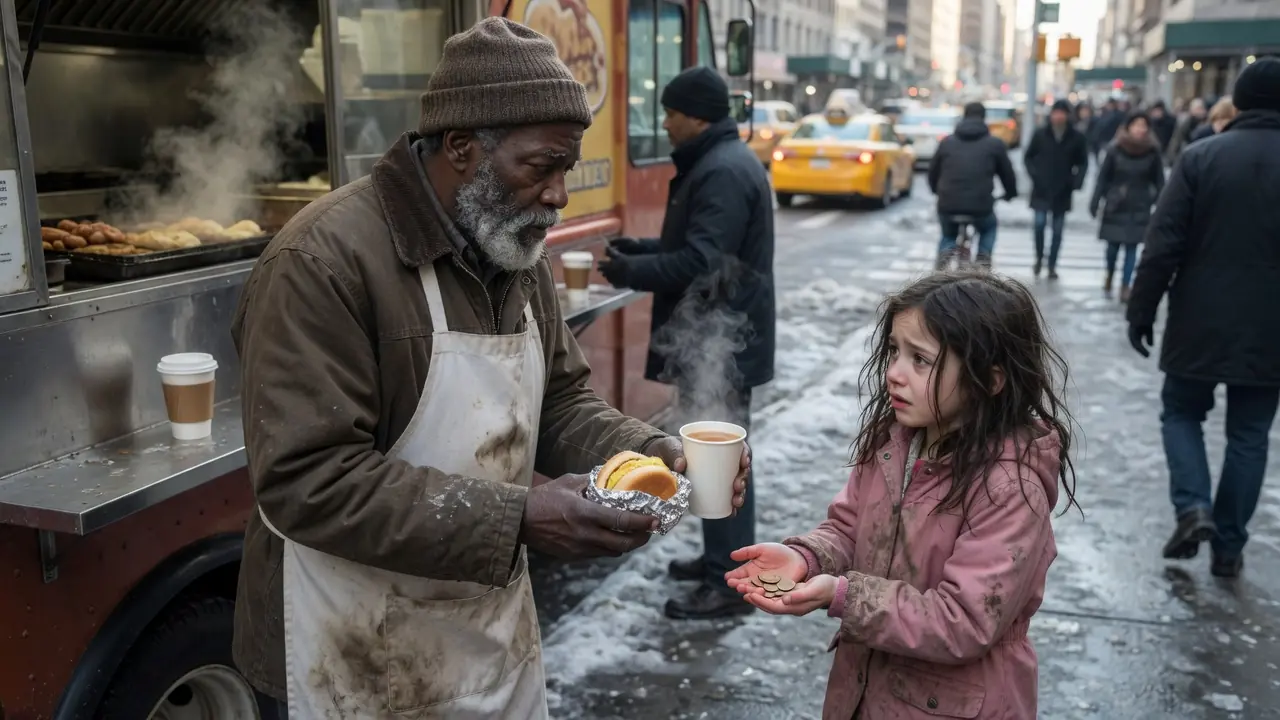
She wore a pink coat too thin for the weather, gray leggings, and sneakers that were wet from the slush. Her hair was dark and tangled around her face, and her sleeves stopped short of her wrists. She stood near the metal side of the truck, gripping the edge with tiny shaking fingers, trying not to cry loudly enough to bother the city.
Walter saw her lips move before he heard her.
“I’m so hungry…”
The words barely survived the traffic noise.
Nobody stopped.
A man in a black wool coat brushed past her so hard her shoulder bumped against the cart. The little girl’s hand opened, and three small coins fell from her palm, clattering across the sidewalk.
She dropped to her knees instantly.
Not slowly.
Not like a child picking up something she had dropped.
Like a person trying to save the last thing she had.
One quarter spun in a shining circle beside a taxi tire before stopping near someone’s polished boot.
The boot did not move.
Walter watched the man above that boot glance down, then look away.
The city kept rushing.
The girl scrambled for the coins, her fingers red and clumsy from cold.
Walter turned off the grill with one quick motion.
“Hold up,” said the businessman waiting for his bacon sandwich. “I’m late.”
Walter looked at him.
“You’ll still be late with a sandwich.”
The man opened his mouth, then closed it.
Walter came around the side of the truck slowly, because his knee did not appreciate sudden heroics. He bent with effort and picked up the quarter near the boot.
Then he held it out to the little girl.
“You dropped this, sweetheart.”
The child looked up.
Her eyes were enormous.
Not just hungry.
Frightened.
She took the coin carefully, like it was treasure.
“Thank you,” she whispered.
Walter noticed everything then.
The way her hands trembled.
The way she kept glancing over her shoulder.
The way her cheeks were too pale beneath the redness from the cold.
The way her coat had no school name, no bright backpack, no adult hand nearby.
He crouched as much as his knee allowed, one hand braced on the side of the truck.
“What’s your name?”
The girl looked at the coins in her palm.
“Lucy.”
“Lucy,” Walter repeated gently. “That’s a good name.”
She gave no answer.
“Where are your parents, Lucy?”
The little girl lowered her eyes immediately.
“I don’t know.”
The city suddenly felt quieter.
Not silent.
New York never became silent.
But heavier.
The rushing feet, the horns, the hiss of steam from Walter’s truck, the clatter of cups, all of it seemed to move around the little girl instead of through her.
Walter’s heart tightened.
Lucy looked like she had been running.
He did not ask another question yet.
Questions could come after warmth.
“Come here,” he said softly. “Stand by the side panel, out of the wind.”
She hesitated.
Walter pointed to the narrow space beside the truck where the metal wall blocked most of the cold air.
“You’ll still be right here where everyone can see you,” he said. “No tricks.”
That seemed to matter.
Lucy moved closer, still clutching her coins.
Walter stepped back into the truck and washed his hands. Then he took the freshest roll he had, cracked two eggs onto the grill, added a small sausage patty, and placed a slice of cheese on top as it melted into the heat. He wrapped the sandwich in foil, tucked a napkin around it, and poured warm apple cider into a small paper cup because coffee was no drink for a hungry child.
The businessman in line frowned.
“I was next.”
Walter did not look at him.
“She was colder.”
A construction worker behind the businessman muttered, “Let the kid eat.”
That ended the argument.
Walter stepped down from the truck and knelt carefully in front of Lucy.
“This one is for you.”
The little girl froze.
Actually froze.
Like her mind could not understand the sentence.
“Really?”
Walter nodded once.
“Really.”
She looked at the sandwich, then at the coins in her hand.
“But I can’t pay.”
Walter smiled softly.
“You already did.”
Her brow furrowed.
“With what?”
“With telling me the truth.”
Lucy’s eyes filled instantly.
She took the warm sandwich with both hands and held it against her chest as if someone had handed her life itself.
Walter held out the cider.
“Careful. It’s warm.”
She took it.
For a moment, she only stared at the food.
Then hunger won.
She unwrapped the foil with shaking fingers and took a bite.
Her eyes closed.
Not in joy exactly.
In relief.
That was what broke Walter’s heart.
Not the hunger itself, but the relief of a child who had expected nothing and received breakfast.
The nearby pedestrians had started slowing now.
Watching quietly.
Some pretending not to stare.
A woman in a red scarf stopped at the edge of the sidewalk, phone in hand, concern pulling at her face. The construction worker removed one glove and dug into his pocket. A young delivery driver lowered his bike stand and looked around as if searching for the adult who should have been beside Lucy.
Walter kept his voice calm.
“Lucy, did you sleep outside last night?”
The girl’s hands tightened around the sandwich.
She did not answer.
“That’s okay,” Walter said quickly. “You don’t have to tell me yet.”
She swallowed another bite.
A tear slipped down her cheek.
Walter reached for the clean towel he kept tucked into his apron and offered it to her.
She wiped her face.
“One day,” Lucy whispered, “I’ll pay you back.”
Walter gave a quiet laugh, though his own voice nearly broke.
“You don’t owe me anything.”
“My mommy says we pay people back when they’re kind.”
“Your mommy sounds smart.”
“She is.”
Walter’s chest tightened again.
“Do you know where she is?”
Lucy opened her mouth.
Then stopped.
Her eyes drifted past Walter’s shoulder.
Toward the street.
Toward a black luxury SUV slowly pulling to the curb.
Walter noticed the change before he turned.
Lucy’s entire body stiffened.
The warm cider trembled in her hands.
The half-eaten sandwich lowered slowly.
The window of the SUV slid halfway down.
Walter turned just enough to see the man inside.
Middle-aged.
Clean-shaven.
Expensive coat.
Leather gloves.
A face too calm for the situation.
The kind of man who expected doors to open, lines to part, and explanations to be accepted because he spoke them with confidence.
All the color drained from Lucy’s face.
Her voice became so small Walter nearly missed it.
“That’s him.”
Walter’s body went still.
The SUV door began to open.
Lucy grabbed Walter’s sleeve tightly.
Her fingers were tiny, but fear made them strong.
“He’s the one who took me from my mommy.”
Walter’s breathing stopped for half a second.
Then everything inside him became quiet.
Not calm.
Focused.
He was an old man with a bad knee, stiff hands, and a food truck that barely passed inspection some winters. He was not strong the way he had been at thirty. He could not chase anyone down a street, and he had no interest in pretending otherwise.
But he knew something most frightened people forgot.
A city could look away one person at a time.
It could also turn around one person at a time.
Walter placed one hand gently over Lucy’s.
“Listen to me,” he said softly. “You stay right beside me.”
The man from the SUV stepped onto the curb.
He smiled immediately.
That bothered Walter more than anger would have.
“Lucy,” the man called, voice smooth and pleasant. “There you are. You gave us quite a scare.”
Lucy pressed herself closer to Walter’s side.
The businessman in the black coat took one step back.
The woman in the red scarf stopped pretending not to watch.
Walter straightened slowly.
His knee protested.
He ignored it.
“Sir,” Walter said, keeping his voice even. “You know this child?”
The man’s eyes flicked over Walter, the truck, the gathering pedestrians.
“My niece,” he said. “She wandered off.”
Lucy made a tiny sound.
Walter felt it through her hand on his sleeve.
“Your niece,” Walter repeated.
“Yes.” The man’s smile tightened. “She has emotional issues. We’ve been looking everywhere.”
Walter had heard that kind of sentence before.
People used soft words when they wanted to make fear sound like inconvenience.
Emotional issues.
Confused.
Difficult.
Dramatic.
He had lived long enough to know that labels could be doors closing.
Lucy whispered, “No.”
The man’s eyes sharpened.
Walter shifted slightly, placing his body between Lucy and the man.
“What’s her full name?”
The man did not hesitate.
“Lucy Martin.”
Lucy’s grip changed.
Walter noticed.
“What’s her mother’s name?”
The man’s jaw tightened almost invisibly.
“Her mother is not well.”
The woman in the red scarf spoke from behind Walter.
“That wasn’t the question.”
The man turned his smile toward her.
“This is a family matter.”
The construction worker stepped closer.
“Kid looks scared.”
The man’s pleasant mask thinned.
“She’s been through a stressful morning. If everyone could stop making a scene, I’ll take her home.”
Walter looked down at Lucy.
Her eyes were fixed on the man.
Not confused.
Not embarrassed.
Terrified.
Walter’s choice became simple.
“Lucy,” he said softly, “do you want to go with him?”
The man’s face hardened.
“That is not appropriate.”
Walter did not look away from the child.
Lucy shook her head.
“No.”
Her voice was barely audible.
Walter nodded.
“Then you’re not going.”
The man stepped forward.
The construction worker moved at the same time, not touching him, just filling the sidewalk.
The delivery driver pulled out his phone.
The woman in the red scarf was already recording, but her other hand was dialing.
Walter turned his head slightly.
“Call 911,” he said.
The man’s eyes flashed.
“Do you have any idea who I am?”
Walter gave him a tired look.
“Not yet. But I imagine the police can help us learn.”
The man glanced toward the SUV.
The driver inside shifted.
Walter saw the calculation happen.
Crowd.
Phones.
Witnesses.
Morning traffic.
No quiet way to force the child into the vehicle now.
The man lowered his voice.
“You’re making a mistake, old man.”
Walter smiled faintly.
“I’ve made plenty. This won’t be one of them.”
Lucy leaned against his side.
He felt how badly she was shaking again.
He wanted to pick her up, carry her into the truck, lock every door, and block the whole city from reaching her. But he knew sudden movements might frighten her more. So he stayed still and became the safest wall he could manage.
The man looked at Lucy.
“Tell them you know me.”
Lucy’s chin trembled.
“I know you.”
His smile returned.
Then she continued.
“You said my mommy didn’t want me anymore.”
The crowd went silent.
Walter felt anger rise in him slowly.
Not hot.
Deep.
The man’s eyes narrowed.
“Lucy.”
“You said if I cried, nobody would believe me.”
The woman in the red scarf whispered, “Oh my God.”
Walter lowered his voice.
“Lucy, what’s your mommy’s name?”
The girl looked up at him.
“Sarah Martin.”
The delivery driver, phone pressed to his ear, repeated it to the dispatcher.
“Sarah Martin,” he said. “Little girl named Lucy Martin. Black SUV. West 46th and Ninth.”
The man backed one step toward the vehicle.
Walter saw it.
So did the construction worker.
“Don’t leave,” the worker said.
The man glared at him.
“I have an appointment.”
“You have a problem,” Walter said.
Sirens sounded in the distance.
Faint at first.
Then closer.
The driver of the SUV started the engine.
Walter’s heart kicked hard.
The man turned quickly.
In that moment, Lucy panicked.
“He’s going!”
She lunged forward, not toward him but away, as if fear had told her to run again.
Walter caught her gently by the shoulders.
“Stay with me. Stay with me.”
She sobbed once.
“He’ll find me.”
“No,” Walter said, voice firm. “Not through all of us.”
And somehow, the words became true.
People stepped closer.
Not dramatically.
Not like a movie.
Just one by one.
The woman in the red scarf.
The construction worker.
The delivery driver.
A bus driver on break.
A nurse still wearing scrubs beneath her winter coat.
Two teenagers who had been filming at first and now looked ashamed enough to do something useful.
A coffee vendor from the next corner.
They formed no perfect wall.
But they formed enough.
The man from the SUV looked around and understood the morning had turned against him.
The SUV lurched forward.
The driver tried to pull away from the curb.
But a garbage truck had stopped behind it, blocking the lane.
The sanitation worker leaned out the window.
“Problem?” he called.
Walter looked at him and pointed.
“Don’t let that vehicle leave.”
The sanitation worker took one look at Lucy, one look at the man, and turned off his engine.
The SUV was trapped.
Police arrived three minutes later.
To Lucy, it felt like three years.
Walter kept one hand lightly on her shoulder the entire time.
He did not force her to talk.
He did not tell her to be brave.
He only repeated, whenever her breathing grew too fast, “You’re right here. I’m right here. Breakfast truck. Steam. Red scarf lady. Big orange garbage truck. Tell me what you see.”
“Steam,” Lucy whispered.
“That’s right.”
“Red scarf lady.”
“Good.”
“Orange truck.”
“Good girl.”
The first officer approached carefully, hands visible, eyes moving over the crowd.
“What’s going on?”
The man from the SUV spoke first.
“Officer, thank God. This child is my niece. She ran away, and these people are interfering with a family matter.”
Lucy hid behind Walter.
Walter looked at the officer.
“This child says he took her from her mother.”
The man scoffed.
“She is confused.”
Lucy’s small voice came from behind Walter.
“I’m not confused.”
The officer’s expression changed.
He crouched, not too close.
“What’s your name?”
“Lucy Martin.”
“How old are you, Lucy?”
“Seven.”
“Do you know this man?”
She nodded.
“He worked with my mom. He said she was hurt and I had to come with him. But then he wouldn’t take me to her. He took my coat with my school name. He said if I ran, nobody would help me.”
Walter closed his eyes briefly.
When he opened them, the officer was looking at the man very differently.
A second officer moved toward the SUV.
The man raised his hands.
“This is absurd. She misunderstood. I was helping—”
The woman in the red scarf stepped forward.
“I have video from the moment he arrived.”
The delivery driver said, “Dispatcher has the call. I gave the plate.”
The sanitation worker added, “SUV tried to leave.”
The man’s face changed.
Not completely.
Men like that rarely collapsed all at once.
But the confidence cracked.
The officer asked for his identification.
He refused at first.
Then more sirens arrived.
That helped his memory.
His name was Victor Lang.
He was not Lucy’s uncle.
He had once worked in the same office building as Lucy’s mother.
An alert had gone out the previous evening for a missing seven-year-old girl last seen outside an after-school program in Queens.
The alert had not yet reached every corner of the city.
But it had reached enough.
When the officer confirmed it over the radio, Lucy began to cry in earnest.
Not quiet tears this time.
Full, shaking sobs that bent her small body forward.
Walter turned and knelt with difficulty.
His bad knee screamed.
He did not care.
“You did it,” he said softly. “You told the truth.”
Lucy clutched the foil-wrapped remains of the breakfast sandwich in one hand and Walter’s sleeve in the other.
“Will I see Mommy?”
“Yes,” the officer said gently. “We’re going to make that happen.”
Lucy looked at Walter as if she needed him to confirm it.
Walter nodded.
“You’re going to see your mommy.”
Victor Lang was placed in the back of a police car.
He did not look at Lucy again.
Maybe because he could not.
Maybe because he had lost the power that came from being the only adult in the story.
Now there were many adults.
And one old man who had given a hungry child breakfast before he knew her name.
An ambulance arrived to check Lucy because she was cold, exhausted, and had been outside too long. Walter stood nearby while the paramedic wrapped a blanket around her shoulders.
Lucy refused to let go of the sandwich.
The paramedic smiled gently.
“You can keep it.”
Lucy looked at Walter.
“It’s cold now.”
“I can make another,” Walter said.
The officer looked surprised.
“Sir, we’ll take her to the precinct first. Her mother is on the way.”
“Then I’ll bring it there.”
The officer blinked.
“You don’t have to do that.”
Walter looked at Lucy, who was staring at him with the raw trust of a child who had been given one safe person and did not want to lose him too quickly.
“Yes,” he said. “I do.”
The precinct was six blocks away.
Walter closed his truck for the first time during morning rush in twenty-three years.
The businessman who had complained earlier returned just as Walter pulled down the service window.
“Hey, I still need breakfast.”
The construction worker turned toward him.
“Read the room, man.”
Walter handed the businessman a wrapped sandwich anyway.
“On the house,” he said. “Try kindness today. It fills better.”
Then he packed a fresh egg sandwich, a cup of warm cider, and two oatmeal cookies Ruth used to make him keep for children, though now they came from a bakery supplier and were not nearly as good.
At the precinct, Lucy sat in a small interview room with a blanket around her shoulders. A female detective sat nearby, speaking softly. The woman in the red scarf had come too, giving her statement. The delivery driver waited near the hall. The construction worker had left for work but not before giving Walter his phone number in case anyone needed another witness.
The city that had ignored Lucy for those first terrible minutes had begun repairing itself around her.
Walter knocked gently on the open door.
Lucy looked up.
Her face changed.
“You came.”
“Breakfast delivery,” Walter said.
The detective smiled and moved aside.
Lucy took the new sandwich with both hands.
This time, she did not hold it like a lifeline.
She held it like food.
That difference mattered.
Walter sat across from her.
“Did they call your mommy?”
Lucy nodded, chewing carefully.
“She’s coming.”
“Good.”
“She’s going to be scared.”
“Yes.”
“Will she be mad I ate a hotdog?”
Walter’s eyebrows rose.
“First, that was an egg sandwich. Second, if your mother is mad about anything, it won’t be breakfast.”
Lucy looked relieved.
“I was really hungry.”
“I know.”
She looked down.
“I had coins.”
“You did.”
“But not enough.”
Walter folded his hands.
“Lucy, when I was a boy, my father lost work for a while. I remember standing outside a bakery once with twelve cents. A woman gave me a roll for free and told me to grow up and feed someone else one day.”
Lucy looked at him.
“Did you?”
Walter smiled.
“I’ve been trying.”
Before Lucy could answer, a sound came from the hallway.
Footsteps running.
A woman’s voice breaking.
“Lucy?”
Lucy dropped the sandwich.
“Mommy!”
Sarah Martin appeared in the doorway like someone who had been pulled apart by fear and stitched back together by hope only seconds before.
She was in her early thirties, hair undone, coat half-buttoned, eyes swollen from crying. A detective barely had time to step aside before Lucy ran into her arms.
Sarah fell to her knees and caught her daughter.
The sound she made was not a word.
It was the sound of a mother getting her child back.
Walter turned his head and looked at the wall because some moments deserved privacy, even in a police station.
But he still heard them.
“I’m sorry,” Lucy cried.
“No, baby. No. You did nothing wrong.”
“I ran.”
“You survived.”
“He said you didn’t want me.”
Sarah held her tighter.
“I will always want you. Always. Every day. Every breath.”
Walter wiped his eyes with the heel of his hand and pretended it was the cold.
After a few minutes, Sarah looked up.
The detective pointed gently toward Walter.
“This is Mr. Bennett. He helped her.”
Lucy turned quickly.
“He gave me breakfast.”
Sarah stared at him.
Then she rose slowly, still holding Lucy against her side.
“You fed my daughter?”
Walter stood.
“My truck was on the corner.”
“You stopped him?”
“People helped.”
“But you started it.”
Walter did not know how to answer that.
Sarah crossed the room and hugged him.
It startled him.
He was old enough that surprises usually irritated him, but this one only made his chest ache.
“Thank you,” she whispered.
Walter patted her shoulder awkwardly.
“She was hungry.”
Sarah pulled back, tears streaming down her face.
“You saw that before anything else.”
Walter looked at Lucy.
“She was standing in front of me.”
For a few days, the story traveled through New York.
Not because Walter wanted it to.
He hated attention.
But the woman in the red scarf posted part of the video after police cleared it, blurring Lucy’s face and focusing on the crowd that slowly formed around her.
News outlets called Walter a hero.
He disliked that word.
Customers lined up at his truck, some genuinely hungry, some wanting to take pictures, some wanting to say they had met him.
Walter kept cooking.
Eggs did not flip themselves.
Coffee did not pour itself.
And kindness, he believed, was best proven by repetition, not applause.
Sarah came back with Lucy one week later.
This time, Lucy wore a warm purple coat, clean boots, and a backpack with a unicorn keychain. She looked healthier, but still held her mother’s hand tightly.
Walter saw them from the grill and immediately turned down the flame.
“Well,” he said, stepping out of the truck. “There’s my breakfast critic.”
Lucy smiled shyly.
“I brought money.”
Walter looked at Sarah.
Sarah shrugged helplessly.
“She insisted.”
Lucy held out a small envelope.
Inside was a drawing.
Walter standing beside his food truck, steam curling into the air, while a little girl held a sandwich almost as big as her face.
Across the top, in careful letters, Lucy had written:
THANK YOU FOR FEEDING ME WHEN I WAS LOST.
Walter stared at it.
For a long moment, he could not speak.
Then he cleared his throat.
“This is too much payment.”
Lucy frowned.
“It is?”
“Yes. Drawings are expensive.”
She smiled.
Sarah stepped forward.
“There’s something else.”
Walter groaned softly.
“Please don’t say award.”
“No award.”
“Good.”
“A fund.”
He eyed her suspiciously.
Sarah continued, “People kept asking how to thank you. I told them to buy breakfast for someone who needed it. Then a few local parents, delivery workers, and your regulars helped set up a prepaid meal board.”
Walter looked at the side of his truck.
Sarah pulled out a small laminated sign.
NEED BREAKFAST? TAKE A TICKET.
WANT TO HELP? BUY A TICKET.
Walter read it twice.
His throat tightened.
“I used to have something like that.”
“The jar?” Sarah asked.
He nodded.
“Short Today? Pay Next Time.”
Lucy looked up.
“My mommy said this means kids can eat even if they don’t have coins.”
Walter looked down at her.
“That’s exactly what it means.”
The next morning, the first tickets appeared on the board.
One from the construction worker.
One from the woman in the red scarf.
Three from the sanitation worker who blocked the SUV.
Five from the delivery driver’s whole team.
One from a businessman in a black coat who did not make eye contact when he placed it there and quietly said, “I was rude that day.”
Walter accepted the ticket without shaming him.
People could learn.
That mattered too.
By the end of the month, the board was full.
Children ate.
Old men ate.
Women coming off night shifts ate.
Delivery workers short on cash ate.
A runaway teen who refused to give his name ate two egg sandwiches and cried behind the truck where he thought Walter could not see him.
Walter saw.
He always saw.
Spring came slowly to New York.
The cold loosened.
Snow turned to gray slush, then rain, then puddles reflecting sunlight between buildings.
Walter kept the drawing taped inside his truck beside Ruth’s old photograph.
Sometimes customers asked about it.
He would say, “A child paid me back.”
That was all.
He never told the story like it was his.
It belonged to Lucy.
To Sarah.
To the woman in the red scarf.
To the crowd that remembered how to stop.
To the little coins that fell across the sidewalk and changed everything.
One afternoon, months later, Lucy came by after school with Sarah.
She was laughing at something before she reached the truck.
That sound alone was worth more to Walter than every news headline.
“Mr. Bennett!” she called.
“Miss Lucy,” he answered. “Hungry?”
“Always.”
Sarah laughed.
“She wants the usual.”
Walter raised an eyebrow.
“Already has a usual?”
Lucy nodded proudly.
“Egg sandwich. No mustard.”
Walter placed a hand over his heart.
“Good. Mustard on eggs is a crime.”
Lucy giggled.
As he cooked, she stood near the side of the truck, no longer gripping it in fear, just waiting in the way children wait when they trust the adult preparing food will hand it to them.
Walter wrapped the sandwich and gave it to her.
She handed him two dollars.
This time, he accepted.
Not because he needed it.
Because her face said paying mattered.
“Thank you,” he said.
Lucy beamed.
Sarah watched them with quiet eyes.
After Lucy moved a few steps away to inspect the ticket board, Sarah spoke softly.
“She still talks about that morning.”
Walter nodded.
“So do I.”
“She says you looked like someone’s grandpa.”
“I am someone’s grandpa.”
“She says you sounded like you already knew her.”
Walter looked toward Lucy.
“I knew she was hungry.”
Sarah’s eyes filled.
“That was enough?”
Walter thought about Ruth.
About the bakery woman from his childhood.
About every person who had ever been saved first by something simple.
A roll.
A coat.
A cup of tea.
A hot breakfast handed over without asking for proof of deserving it.
“Yes,” he said. “That was enough to start.”
Sarah looked at him for a long moment.
Then she said, “I hope one day she remembers the fear less than the kindness.”
Walter watched Lucy carefully pin a prepaid meal ticket to the board.
“She will,” he said.
And he believed it.
Years later, people still came to Bennett’s Breakfast.
The truck grew older.
So did Walter.
His knee worsened, and his hands stiffened, but he kept coming to the corner as long as he could stand behind the grill.
The prepaid board became part of the neighborhood.
Children called it the breakfast wall.
Workers called it Walter’s wall.
Walter called it Ruth’s kind of trouble.
Every winter, when the air sharpened and steam rose high above the truck, he remembered that morning.
A little girl with cracked lips.
Coins rattling across concrete.
A black SUV at the curb.
A sleeve grabbed in terror.
He remembered the fear, yes.
But more than that, he remembered the moment before everything dangerous arrived.
The moment when a child said, “I’m so hungry,” and the world kept walking.
He remembered choosing not to.
That was the part he carried.
Because sometimes saving someone does not begin with a grand act.
Sometimes it begins with breakfast.
With an old man bending down despite a bad knee to pick up a quarter.
With a warm sandwich wrapped in foil.
With cider in a paper cup.
With one person deciding that hunger matters before paperwork, fear, explanations, or danger.
Walter Bennett did not think he changed the world that morning.
He fed a child.
But to Lucy Martin, standing frozen beside a food truck in a city too busy to see her, that breakfast was the first proof that the whole world had not turned away.
And sometimes one warm meal is enough to help a lost child hold on until help arrives.